MM 433
Bicycle Manufacturing
(Fixed Gear)
Presented By
Rahul Kumar 140110068
Devendra Malav 140110069
Aditya Kumawat 140110070
IMPORTANT PARTS
❖ MAIN FRAME
❖ WHEELS
❖ GEAR SYSTEM
Main Frame TOP TUBE
STEERER
(TOP OF FORK)
HEAD TUBE
FORK
DOWN TUBE
SEAT STAYS
SEAT TUBE
CHAIN STAYS
MAIN FRAME
Structure Importance :-
● The most important part of the bicycle is the diamond-shaped frame, which
links the components together in the proper geometric configuration
● The frame provides strength and rigidity to the bicycle and largely
determines the handling of the bicycle
● The frame consists of the front and rear triangles, the front really forming
more of a quadrilateral of four tubes: the top, seat, down, and head tubes
● The rear triangle consists of the chainstays, seatstays, and rear wheel
dropouts
● Attached to the head tube at the front of the frame are the fork and steering
MAIN FRAME
Material Importance :-
● For much of the bicycle's history the frame was constructed of heavy, but
strong, steel and alloy steel
● Frame material was continually improved to increase strength, rigidity,
lightness, and durability.
● In the recent decade lightweight aluminum frames became the popular
choice.
● The strongest metals, however, are steel and titanium with life-expectancy
spanning decades, while aluminum may fatigue within three to five years.
MAIN FRAME
Advanced Materials :-
● Advances in technology led to the use of even lighter and stronger frames
made of composites of structural fibers such as carbon.
● Composite materials, unlike metals, are anisotropic; that is, they are
strongest along the axis of the fibers.
● Composites can be shaped into single-piece frames, providing strength
where needed
MAIN FRAME
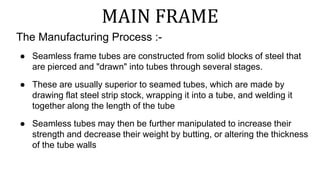
The Manufacturing Process :-
● Seamless frame tubes are constructed from solid blocks of steel that
are pierced and "drawn" into tubes through several stages.
● These are usually superior to seamed tubes, which are made by
drawing flat steel strip stock, wrapping it into a tube, and welding it
together along the length of the tube
● Seamless tubes may then be further manipulated to increase their
strength and decrease their weight by butting, or altering the thickness
of the tube walls
MAIN FRAME
The Manufacturing Process :-
● The metal is annealed, or softened by heating, and hollowed out to form
"hollows," or "blooms." These are heated again, pickled in acid to remove
scale, and lubricated
● The hollows are measured, cut, and precision mitered to the appropriate
dimensions. Frame sizes for adult bicycles generally run from 19-25 inches
(48-63 cm) from the top of the seat post tube to the middle of the crank
hanger
● Next, the hollows are fitted over a mandrel, or rod, attached to a draw
bench. To achieve the right gauge, the hollows pass through dies which
stretch them into thinner and longer tubes, a process called cold drawing
MAIN FRAME
The Manufacturing Process :-
● The tubes may be shaped and tapered into a variety of designs and
lengths. The taper-gauge fork blades may have to pass through more than
a dozen operations to achieve the correct strength, weight, and resilience
● Frames may be brazed, welded, or glued, with or without lugs, which are
the metal sleeves joining two or more tubes at a joint
● Brazing is essentially welding at a temperature of about 1600°F (871°C) or
lower. Gas burners are arranged evenly around the lugs which are heated,
forming a white flux that melts and cleans the surface, preparing it for
brazing
MAIN FRAME
The Manufacturing Process :-
● The brazing filler is generally brass (copper-zinc alloy) or silver, which melt
at lower temperatures than the tubes being joined. The filler is applied and
as it melts, it flows around the joint, sealing it.
● The assembled frames are placed into jigs and checked for proper
alignment. Adjustments are made while the frame is still hot and malleable
● The frames are painted, not only to create a more finished appearance, but
also to protect the frame. The frame is first primed with an undercoat and
then painted with a colored enamel
WHEELS
RIM TUBE AND TYRES
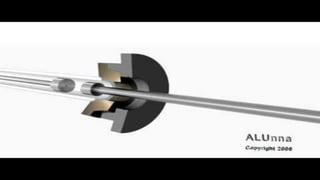
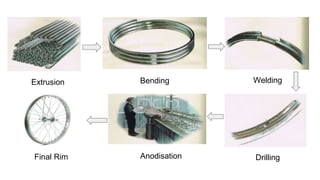
Manufacturing Process Rim
Source- youtube
Let’s have a look on the video
for basic understanding
Extrusion Bending Welding
DrillingAnodisationFinal Rim
Manufacturing of Tyres
The two wheels spinning under our bicycle frame disperse our weight from the hubs, through
the spokes under tension, into the rim, and then into the tire on the surface of the road.
Materials Used
● Synthetic Rubber
● Carbon Black
● Natural rubber
● Sulphur
SPROCKET AND CHAIN
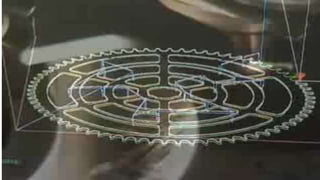
SPROCKETS
Sprockets is a wheel that has a row of teeth around its edge which fit into the
holes of bicycle chain and cause it to turn when the wheel turns
1. Metal forming (traditional process) : the process involves forming the
circumferential teeth using a die, the center hole may be created using die-
punches.
2. Powder processing (traditional process) : in this method, the sprockets
are produced from metal powders and involves three basic steps: powder
blending(pulverisation), die compaction, and sintering. Further powder
compaction may be done using Hot isostatic pressing and die pressing.
SPROCKETS
3. Rapid prototyping (non-traditional process): additive
manufacturing(material is added unlike other process where the material
gets removed) the process involves layer by layer formation of objects
using a 3D printer. The raw material is generally polymer but advanced
laser sintering of metals is also possible nowadays.
4. Electric discharge machining (non-traditional process) : it is spark
erosion process in which intense heat generation between the electrode
tool and workpiece vaporizes metal particles. The shape of the electrode
gets imprinted on the workpiece.
CHAIN
● A bicycle chain is essentially a roller chain, It’s designed specifically to
transfer pedal power to the bicycle’s rear drive wheel.
● The manufacturing process starts with a punch press, It cuts and presses
steel into the shape of a chain’s inner link.
● Incredibly, the punch press generates 10,000 links per hour! Each of the
links have been made to interconnect, their contours formed to travel easily
across the bike’s gear sprockets
● Samples of these inner links are sent to a measuring station to confirm the
space between the holes is precisely 12.7 millimeters.
● The tester also gauges the diameter of the holes which must be accurate to
Thank You !!

Bicycle Manufacturing Process

  • 2.
    MM 433 Bicycle Manufacturing (FixedGear) Presented By Rahul Kumar 140110068 Devendra Malav 140110069 Aditya Kumawat 140110070
  • 3.
    IMPORTANT PARTS ❖ MAINFRAME ❖ WHEELS ❖ GEAR SYSTEM
  • 4.
    Main Frame TOPTUBE STEERER (TOP OF FORK) HEAD TUBE FORK DOWN TUBE SEAT STAYS SEAT TUBE CHAIN STAYS
  • 5.
    MAIN FRAME Structure Importance:- ● The most important part of the bicycle is the diamond-shaped frame, which links the components together in the proper geometric configuration ● The frame provides strength and rigidity to the bicycle and largely determines the handling of the bicycle ● The frame consists of the front and rear triangles, the front really forming more of a quadrilateral of four tubes: the top, seat, down, and head tubes ● The rear triangle consists of the chainstays, seatstays, and rear wheel dropouts ● Attached to the head tube at the front of the frame are the fork and steering
  • 6.
    MAIN FRAME Material Importance:- ● For much of the bicycle's history the frame was constructed of heavy, but strong, steel and alloy steel ● Frame material was continually improved to increase strength, rigidity, lightness, and durability. ● In the recent decade lightweight aluminum frames became the popular choice. ● The strongest metals, however, are steel and titanium with life-expectancy spanning decades, while aluminum may fatigue within three to five years.
  • 7.
    MAIN FRAME Advanced Materials:- ● Advances in technology led to the use of even lighter and stronger frames made of composites of structural fibers such as carbon. ● Composite materials, unlike metals, are anisotropic; that is, they are strongest along the axis of the fibers. ● Composites can be shaped into single-piece frames, providing strength where needed
  • 8.
    MAIN FRAME The ManufacturingProcess :- ● Seamless frame tubes are constructed from solid blocks of steel that are pierced and "drawn" into tubes through several stages. ● These are usually superior to seamed tubes, which are made by drawing flat steel strip stock, wrapping it into a tube, and welding it together along the length of the tube ● Seamless tubes may then be further manipulated to increase their strength and decrease their weight by butting, or altering the thickness of the tube walls
  • 9.
    MAIN FRAME The ManufacturingProcess :- ● The metal is annealed, or softened by heating, and hollowed out to form "hollows," or "blooms." These are heated again, pickled in acid to remove scale, and lubricated ● The hollows are measured, cut, and precision mitered to the appropriate dimensions. Frame sizes for adult bicycles generally run from 19-25 inches (48-63 cm) from the top of the seat post tube to the middle of the crank hanger ● Next, the hollows are fitted over a mandrel, or rod, attached to a draw bench. To achieve the right gauge, the hollows pass through dies which stretch them into thinner and longer tubes, a process called cold drawing
  • 11.
    MAIN FRAME The ManufacturingProcess :- ● The tubes may be shaped and tapered into a variety of designs and lengths. The taper-gauge fork blades may have to pass through more than a dozen operations to achieve the correct strength, weight, and resilience ● Frames may be brazed, welded, or glued, with or without lugs, which are the metal sleeves joining two or more tubes at a joint ● Brazing is essentially welding at a temperature of about 1600°F (871°C) or lower. Gas burners are arranged evenly around the lugs which are heated, forming a white flux that melts and cleans the surface, preparing it for brazing
  • 12.
    MAIN FRAME The ManufacturingProcess :- ● The brazing filler is generally brass (copper-zinc alloy) or silver, which melt at lower temperatures than the tubes being joined. The filler is applied and as it melts, it flows around the joint, sealing it. ● The assembled frames are placed into jigs and checked for proper alignment. Adjustments are made while the frame is still hot and malleable ● The frames are painted, not only to create a more finished appearance, but also to protect the frame. The frame is first primed with an undercoat and then painted with a colored enamel
  • 13.
  • 14.
    Manufacturing Process Rim Source-youtube Let’s have a look on the video for basic understanding
  • 15.
  • 16.
    Manufacturing of Tyres Thetwo wheels spinning under our bicycle frame disperse our weight from the hubs, through the spokes under tension, into the rim, and then into the tire on the surface of the road. Materials Used ● Synthetic Rubber ● Carbon Black ● Natural rubber ● Sulphur
  • 18.
  • 19.
    SPROCKETS Sprockets is awheel that has a row of teeth around its edge which fit into the holes of bicycle chain and cause it to turn when the wheel turns 1. Metal forming (traditional process) : the process involves forming the circumferential teeth using a die, the center hole may be created using die- punches. 2. Powder processing (traditional process) : in this method, the sprockets are produced from metal powders and involves three basic steps: powder blending(pulverisation), die compaction, and sintering. Further powder compaction may be done using Hot isostatic pressing and die pressing.
  • 20.
    SPROCKETS 3. Rapid prototyping(non-traditional process): additive manufacturing(material is added unlike other process where the material gets removed) the process involves layer by layer formation of objects using a 3D printer. The raw material is generally polymer but advanced laser sintering of metals is also possible nowadays. 4. Electric discharge machining (non-traditional process) : it is spark erosion process in which intense heat generation between the electrode tool and workpiece vaporizes metal particles. The shape of the electrode gets imprinted on the workpiece.
  • 22.
    CHAIN ● A bicyclechain is essentially a roller chain, It’s designed specifically to transfer pedal power to the bicycle’s rear drive wheel. ● The manufacturing process starts with a punch press, It cuts and presses steel into the shape of a chain’s inner link. ● Incredibly, the punch press generates 10,000 links per hour! Each of the links have been made to interconnect, their contours formed to travel easily across the bike’s gear sprockets ● Samples of these inner links are sent to a measuring station to confirm the space between the holes is precisely 12.7 millimeters. ● The tester also gauges the diameter of the holes which must be accurate to
  • 24.

Editor's Notes

  • #17 SBR- Styrene Butadiene
  • #18 Process Blend- Materials are mixed in giant blenders to produce black gummy compound Mill- Cold rubber is cut into strips Build- Steel, belts and other components are placed to form tyre In the mixing stage, the raw materials are mixed together and heated at a temperature of approximately 120 degrees Celsius.