Er Saurav Kumar Thakur 1
Unit 3: Foundry
Er Saurav Kumar Thakur 2
3.1 Introduction to foundry:
3.1.1 Describe introduction to foundry practice
A foundry is a workshop or factory where metal is melted and poured
into molds to create solid metal parts. This process is called casting.
Foundries produce a wide range of metal components used in
industries like automotive, construction, and manufacturing.
Er Saurav Kumar Thakur 3
3.1 Introduction to foundry:
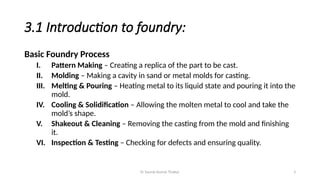
Basic Foundry Process
I. Pattern Making – Creating a replica of the part to be cast.
II. Molding – Making a cavity in sand or metal molds for casting.
III. Melting & Pouring – Heating metal to its liquid state and pouring it into the
mold.
IV. Cooling & Solidification – Allowing the molten metal to cool and take the
mold’s shape.
V. Shakeout & Cleaning – Removing the casting from the mold and finishing
it.
VI. Inspection & Testing – Checking for defects and ensuring quality.
Er Saurav Kumar Thakur 4
3.1 Introduction to foundry:
2.1.2 Development, Advantages, and Uses of Casting
Development of Casting
• Ancient Times: The casting process dates back to 3000 BC (Bronze
Age), where people used molds to shape metal.
• Industrial Revolution: Improved foundry techniques led to mass
production of cast parts.
• Modern Era: Advanced casting methods like investment casting, die
casting, and centrifugal casting have improved precision and quality.
Er Saurav Kumar Thakur 5
3.1 Introduction to foundry:
Advantages of Casting
Complex Shapes – Can produce intricate and large components.
 Cost-Effective – Less machining required, reducing material waste.
Versatile – Suitable for different metals (iron, aluminum, steel, bronze, etc.).
 High Strength & Durability – Can produce parts with excellent mechanical
properties.
Mass Production – Ideal for large-scale manufacturing.
Er Saurav Kumar Thakur 6
3.1 Introduction to foundry:
Uses of Casting
a) Automotive Industry: Engine blocks, pistons, brake drums.
b) Aerospace Industry: Turbine blades, structural components.
c) Construction: Manhole covers, pipes, architectural structures.
d) Machine Tools: Gear wheels, housings, machine frames.
e) Consumer Goods: Cookware, decorative items.
Er Saurav Kumar Thakur 7
3.1 Introduction to foundry:
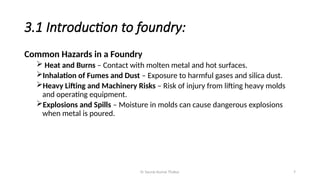
Common Hazards in a Foundry
 Heat and Burns – Contact with molten metal and hot surfaces.
Inhalation of Fumes and Dust – Exposure to harmful gases and silica dust.
Heavy Lifting and Machinery Risks – Risk of injury from lifting heavy molds
and operating equipment.
Explosions and Spills – Moisture in molds can cause dangerous explosions
when metal is poured.
Er Saurav Kumar Thakur 8
Safety Measures
 Wear Protective Equipment – Use heat-resistant gloves, safety goggles,
and fire-resistant clothing.
Proper Ventilation – Ensure good airflow to remove harmful fumes and
dust.
Training and Awareness – Workers should be trained in safety protocols.
Safe Handling of Molten Metal – Use proper tools and follow standard
procedures.
 Emergency Preparedness – Fire extinguishers and first-aid stations should
be accessible.
Er Saurav Kumar Thakur 9
3.2 Casting
Casting is a manufacturing process where molten metal is poured into a
mold to solidify into a desired shape. Various casting techniques are used
depending on the material, complexity, and application.
1. Permanent Mold Casting
• Process: Uses reusable metal molds. Molten metal is poured into the
mold, cooled, and removed.
• Advantages: High dimensional accuracy, better surface finish, reusable
molds.
• Applications: Automotive parts (pistons, wheels), cookware.
Er Saurav Kumar Thakur 10
3.2 Casting
Permanent Mold Casting
Er Saurav Kumar Thakur 11
3.2 Casting
2. Centrifugal Casting
• Process: Molten metal is poured into a rotating mold, forcing metal
against the mold walls due to centrifugal force.
• Advantages: Produces hollow cylindrical parts, removes impurities,
stronger castings.
• Applications: Pipes, tubes, bearings, gears.
Er Saurav Kumar Thakur 12
3.2 Casting
3. Die Casting
• Process: Molten metal is injected under high pressure into a steel
mold (die).
• Advantages: High-speed production, excellent surface finish, precise
shapes.
• Applications: Automotive components, electronic housings, appliance
parts.
Er Saurav Kumar Thakur 13
3.2 Casting
Shell Moulding
Er Saurav Kumar Thakur 14
3.2 Casting
4. Shell Molding
• Process: A thin resin-coated sand shell is used as a mold, created by
heating a metal pattern and applying sand layers.
• Advantages: High-quality surface finish, good dimensional accuracy.
• Applications: Small to medium-sized parts in automotive and
machine industries.
Er Saurav Kumar Thakur 15
3.2 Casting
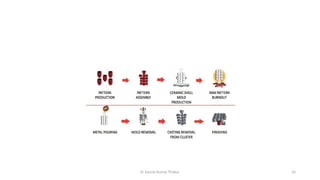
5. Investment Casting (Lost Wax Process)
• Process: A wax pattern is coated with ceramic, then melted out,
leaving a mold cavity for metal casting.
• Advantages: Highly detailed and complex shapes, excellent surface
finish.
• Applications: Aerospace, medical implants, turbine blades.
Er Saurav Kumar Thakur 16
Er Saurav Kumar Thakur 17
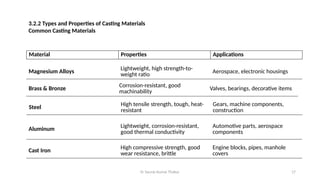
Material Properties Applications
Cast Iron
High compressive strength, good
wear resistance, brittle
Engine blocks, pipes, manhole
covers
Steel
High tensile strength, tough, heat-
resistant
Gears, machine components,
construction
Aluminum Lightweight, corrosion-resistant,
good thermal conductivity
Automotive parts, aerospace
components
Brass & Bronze
Corrosion-resistant, good
machinability Valves, bearings, decorative items
Magnesium Alloys Lightweight, high strength-to-
weight ratio
Aerospace, electronic housings
3.2.2 Types and Properties of Casting Materials
Common Casting Materials
Er Saurav Kumar Thakur 18
3.2 Casting
3.2.4 Construction and Uses of Melting Furnaces
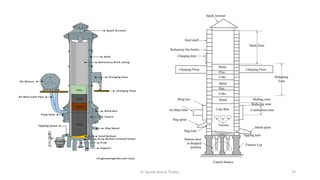
1. Cupola Furnace
• Construction: A tall, cylindrical furnace made of
refractory bricks, with coke as the fuel.
• Working: Layers of metal, coke, and limestone
are added from the top, air is blown from below
to maintain combustion, and molten metal is
collected at the bottom.
• Uses: Primarily used for melting cast iron, then
Some bronzes, Pig iron
Er Saurav Kumar Thakur 19
Er Saurav Kumar Thakur 20
3.2 Casting
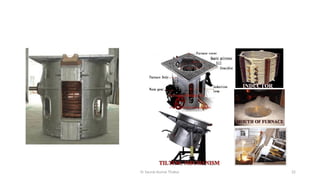
2. Induction Furnace
• Construction: A steel shell lined with refractory material, uses
electromagnetic induction for heating.
• Working: An alternating current creates an electromagnetic field,
generating heat in the metal charge.
• Uses: Used for steel, aluminum, and precious metals due to precise
temperature control.
Er Saurav Kumar Thakur 21
Er Saurav Kumar Thakur 22
Er Saurav Kumar Thakur 23
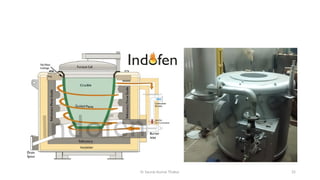
3. Crucible Furnace
• Construction: A refractory-lined pot (crucible) heated by gas, oil, or
electricity.
• Working: The metal is melted inside the crucible, which is then lifted
and poured into molds.
• Uses: Small-scale production of non-ferrous metals (aluminum, brass,
bronze)
Er Saurav Kumar Thakur 24
Er Saurav Kumar Thakur 25
Er Saurav Kumar Thakur 26
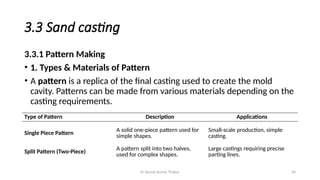
3.3 Sand casting
3.3.1 Pattern Making
• 1. Types & Materials of Pattern
• A pattern is a replica of the final casting used to create the mold
cavity. Patterns can be made from various materials depending on the
casting requirements.
Type of Pattern Description Applications
Single Piece Pattern
A solid one-piece pattern used for
simple shapes.
Small-scale production, simple
casting.
Split Pattern (Two-Piece)
A pattern split into two halves,
used for complex shapes.
Large castings requiring precise
parting lines.
Er Saurav Kumar Thakur 27
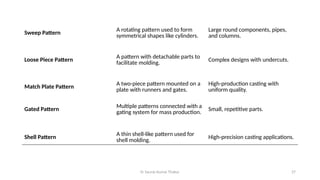
Match Plate Pattern
A two-piece pattern mounted on a
plate with runners and gates.
High-production casting with
uniform quality.
Loose Piece Pattern
A pattern with detachable parts to
facilitate molding.
Complex designs with undercuts.
Sweep Pattern
A rotating pattern used to form
symmetrical shapes like cylinders.
Large round components, pipes,
and columns.
Gated Pattern
Multiple patterns connected with a
gating system for mass production.
Small, repetitive parts.
Shell Pattern
A thin shell-like pattern used for
shell molding.
High-precision casting applications.
Er Saurav Kumar Thakur 28
Er Saurav Kumar Thakur 29
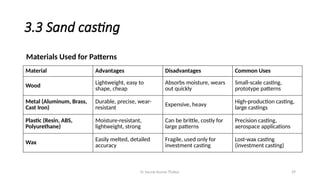
3.3 Sand casting
Material Advantages Disadvantages Common Uses
Wood
Lightweight, easy to
shape, cheap
Absorbs moisture, wears
out quickly
Small-scale casting,
prototype patterns
Metal (Aluminum, Brass,
Cast Iron)
Durable, precise, wear-
resistant
Expensive, heavy
High-production casting,
large castings
Plastic (Resin, ABS,
Polyurethane)
Moisture-resistant,
lightweight, strong
Can be brittle, costly for
large patterns
Precision casting,
aerospace applications
Wax
Easily melted, detailed
accuracy
Fragile, used only for
investment casting
Lost-wax casting
(investment casting)
Materials Used for Patterns
Er Saurav Kumar Thakur 30
3.3 Sand casting
3.3.2 Sand Moulding
Sand moulding is a process in which a sand-based mold is used to shape molten metal into a
desired casting form. The sand mold is created using a pattern, and molten metal is poured into
the cavity to form the casting.
• Key Components of a Sand Mold
• Cope – The upper part of the mold.
• Drag – The lower part of the mold.
• Flask – The frame that holds the sand mold together.
• Molding Sand – A special mixture of sand and binders that holds the mold shape.
• Gating System – Channels (sprue, runners, and gates) through which molten metal flows into
the mold cavity.
• Vents – Small openings that allow gases to escape.
Er Saurav Kumar Thakur 31
Er Saurav Kumar Thakur 32
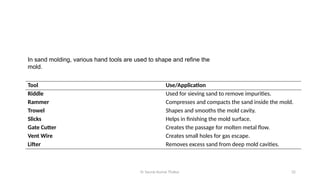
Tool Use/Application
Riddle Used for sieving sand to remove impurities.
Rammer Compresses and compacts the sand inside the mold.
Trowel Shapes and smooths the mold cavity.
Slicks Helps in finishing the mold surface.
Gate Cutter Creates the passage for molten metal flow.
Vent Wire Creates small holes for gas escape.
Lifter Removes excess sand from deep mold cavities.
In sand molding, various hand tools are used to shape and refine the
mold.
Er Saurav Kumar Thakur 33
Type of Sand Properties Applications
Green Sand Moist, easily shaped, reusable General sand casting
Dry Sand Dried in an oven, stronger than
green sand
Large castings, heavy-duty
applications
Loam Sand
Clay-rich, sticky, high bonding
strength
Large-scale castings like boilers
Facing Sand
Fine-grain, provides smooth
surface finish
Outer layer of mold cavity
Backing Sand Coarse, supports facing sand Fills flask behind the facing sand
Core Sand Special sand for making cores Hollow castings
Types of Moulding Sand
Er Saurav Kumar Thakur 34
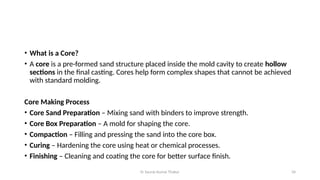
• What is a Core?
• A core is a pre-formed sand structure placed inside the mold cavity to create hollow
sections in the final casting. Cores help form complex shapes that cannot be achieved
with standard molding.
Core Making Process
• Core Sand Preparation – Mixing sand with binders to improve strength.
• Core Box Preparation – A mold for shaping the core.
• Compaction – Filling and pressing the sand into the core box.
• Curing – Hardening the core using heat or chemical processes.
• Finishing – Cleaning and coating the core for better surface finish.
Er Saurav Kumar Thakur 35
Applications of Cores
• Cylinder blocks and pipes – Hollow interiors.
• Turbine casings – Complex internal shapes.
• Valve bodies and engine manifolds – Precise internal cavities.
Er Saurav Kumar Thakur 36
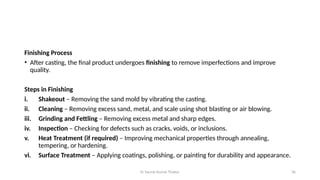
Finishing Process
• After casting, the final product undergoes finishing to remove imperfections and improve
quality.
Steps in Finishing
i. Shakeout – Removing the sand mold by vibrating the casting.
ii. Cleaning – Removing excess sand, metal, and scale using shot blasting or air blowing.
iii. Grinding and Fettling – Removing excess metal and sharp edges.
iv. Inspection – Checking for defects such as cracks, voids, or inclusions.
v. Heat Treatment (if required) – Improving mechanical properties through annealing,
tempering, or hardening.
vi. Surface Treatment – Applying coatings, polishing, or painting for durability and appearance.
Unit 3 foundry workshop technology ppt.pptx

  • 1.
    Er Saurav KumarThakur 1 Unit 3: Foundry
  • 2.
    Er Saurav KumarThakur 2 3.1 Introduction to foundry: 3.1.1 Describe introduction to foundry practice A foundry is a workshop or factory where metal is melted and poured into molds to create solid metal parts. This process is called casting. Foundries produce a wide range of metal components used in industries like automotive, construction, and manufacturing.
  • 3.
    Er Saurav KumarThakur 3 3.1 Introduction to foundry: Basic Foundry Process I. Pattern Making – Creating a replica of the part to be cast. II. Molding – Making a cavity in sand or metal molds for casting. III. Melting & Pouring – Heating metal to its liquid state and pouring it into the mold. IV. Cooling & Solidification – Allowing the molten metal to cool and take the mold’s shape. V. Shakeout & Cleaning – Removing the casting from the mold and finishing it. VI. Inspection & Testing – Checking for defects and ensuring quality.
  • 4.
    Er Saurav KumarThakur 4 3.1 Introduction to foundry: 2.1.2 Development, Advantages, and Uses of Casting Development of Casting • Ancient Times: The casting process dates back to 3000 BC (Bronze Age), where people used molds to shape metal. • Industrial Revolution: Improved foundry techniques led to mass production of cast parts. • Modern Era: Advanced casting methods like investment casting, die casting, and centrifugal casting have improved precision and quality.
  • 5.
    Er Saurav KumarThakur 5 3.1 Introduction to foundry: Advantages of Casting Complex Shapes – Can produce intricate and large components.  Cost-Effective – Less machining required, reducing material waste. Versatile – Suitable for different metals (iron, aluminum, steel, bronze, etc.).  High Strength & Durability – Can produce parts with excellent mechanical properties. Mass Production – Ideal for large-scale manufacturing.
  • 6.
    Er Saurav KumarThakur 6 3.1 Introduction to foundry: Uses of Casting a) Automotive Industry: Engine blocks, pistons, brake drums. b) Aerospace Industry: Turbine blades, structural components. c) Construction: Manhole covers, pipes, architectural structures. d) Machine Tools: Gear wheels, housings, machine frames. e) Consumer Goods: Cookware, decorative items.
  • 7.
    Er Saurav KumarThakur 7 3.1 Introduction to foundry: Common Hazards in a Foundry  Heat and Burns – Contact with molten metal and hot surfaces. Inhalation of Fumes and Dust – Exposure to harmful gases and silica dust. Heavy Lifting and Machinery Risks – Risk of injury from lifting heavy molds and operating equipment. Explosions and Spills – Moisture in molds can cause dangerous explosions when metal is poured.
  • 8.
    Er Saurav KumarThakur 8 Safety Measures  Wear Protective Equipment – Use heat-resistant gloves, safety goggles, and fire-resistant clothing. Proper Ventilation – Ensure good airflow to remove harmful fumes and dust. Training and Awareness – Workers should be trained in safety protocols. Safe Handling of Molten Metal – Use proper tools and follow standard procedures.  Emergency Preparedness – Fire extinguishers and first-aid stations should be accessible.
  • 9.
    Er Saurav KumarThakur 9 3.2 Casting Casting is a manufacturing process where molten metal is poured into a mold to solidify into a desired shape. Various casting techniques are used depending on the material, complexity, and application. 1. Permanent Mold Casting • Process: Uses reusable metal molds. Molten metal is poured into the mold, cooled, and removed. • Advantages: High dimensional accuracy, better surface finish, reusable molds. • Applications: Automotive parts (pistons, wheels), cookware.
  • 10.
    Er Saurav KumarThakur 10 3.2 Casting Permanent Mold Casting
  • 11.
    Er Saurav KumarThakur 11 3.2 Casting 2. Centrifugal Casting • Process: Molten metal is poured into a rotating mold, forcing metal against the mold walls due to centrifugal force. • Advantages: Produces hollow cylindrical parts, removes impurities, stronger castings. • Applications: Pipes, tubes, bearings, gears.
  • 12.
    Er Saurav KumarThakur 12 3.2 Casting 3. Die Casting • Process: Molten metal is injected under high pressure into a steel mold (die). • Advantages: High-speed production, excellent surface finish, precise shapes. • Applications: Automotive components, electronic housings, appliance parts.
  • 13.
    Er Saurav KumarThakur 13 3.2 Casting Shell Moulding
  • 14.
    Er Saurav KumarThakur 14 3.2 Casting 4. Shell Molding • Process: A thin resin-coated sand shell is used as a mold, created by heating a metal pattern and applying sand layers. • Advantages: High-quality surface finish, good dimensional accuracy. • Applications: Small to medium-sized parts in automotive and machine industries.
  • 15.
    Er Saurav KumarThakur 15 3.2 Casting 5. Investment Casting (Lost Wax Process) • Process: A wax pattern is coated with ceramic, then melted out, leaving a mold cavity for metal casting. • Advantages: Highly detailed and complex shapes, excellent surface finish. • Applications: Aerospace, medical implants, turbine blades.
  • 16.
    Er Saurav KumarThakur 16
  • 17.
    Er Saurav KumarThakur 17 Material Properties Applications Cast Iron High compressive strength, good wear resistance, brittle Engine blocks, pipes, manhole covers Steel High tensile strength, tough, heat- resistant Gears, machine components, construction Aluminum Lightweight, corrosion-resistant, good thermal conductivity Automotive parts, aerospace components Brass & Bronze Corrosion-resistant, good machinability Valves, bearings, decorative items Magnesium Alloys Lightweight, high strength-to- weight ratio Aerospace, electronic housings 3.2.2 Types and Properties of Casting Materials Common Casting Materials
  • 18.
    Er Saurav KumarThakur 18 3.2 Casting 3.2.4 Construction and Uses of Melting Furnaces 1. Cupola Furnace • Construction: A tall, cylindrical furnace made of refractory bricks, with coke as the fuel. • Working: Layers of metal, coke, and limestone are added from the top, air is blown from below to maintain combustion, and molten metal is collected at the bottom. • Uses: Primarily used for melting cast iron, then Some bronzes, Pig iron
  • 19.
    Er Saurav KumarThakur 19
  • 20.
    Er Saurav KumarThakur 20 3.2 Casting 2. Induction Furnace • Construction: A steel shell lined with refractory material, uses electromagnetic induction for heating. • Working: An alternating current creates an electromagnetic field, generating heat in the metal charge. • Uses: Used for steel, aluminum, and precious metals due to precise temperature control.
  • 21.
    Er Saurav KumarThakur 21
  • 22.
    Er Saurav KumarThakur 22
  • 23.
    Er Saurav KumarThakur 23 3. Crucible Furnace • Construction: A refractory-lined pot (crucible) heated by gas, oil, or electricity. • Working: The metal is melted inside the crucible, which is then lifted and poured into molds. • Uses: Small-scale production of non-ferrous metals (aluminum, brass, bronze)
  • 24.
    Er Saurav KumarThakur 24
  • 25.
    Er Saurav KumarThakur 25
  • 26.
    Er Saurav KumarThakur 26 3.3 Sand casting 3.3.1 Pattern Making • 1. Types & Materials of Pattern • A pattern is a replica of the final casting used to create the mold cavity. Patterns can be made from various materials depending on the casting requirements. Type of Pattern Description Applications Single Piece Pattern A solid one-piece pattern used for simple shapes. Small-scale production, simple casting. Split Pattern (Two-Piece) A pattern split into two halves, used for complex shapes. Large castings requiring precise parting lines.
  • 27.
    Er Saurav KumarThakur 27 Match Plate Pattern A two-piece pattern mounted on a plate with runners and gates. High-production casting with uniform quality. Loose Piece Pattern A pattern with detachable parts to facilitate molding. Complex designs with undercuts. Sweep Pattern A rotating pattern used to form symmetrical shapes like cylinders. Large round components, pipes, and columns. Gated Pattern Multiple patterns connected with a gating system for mass production. Small, repetitive parts. Shell Pattern A thin shell-like pattern used for shell molding. High-precision casting applications.
  • 28.
    Er Saurav KumarThakur 28
  • 29.
    Er Saurav KumarThakur 29 3.3 Sand casting Material Advantages Disadvantages Common Uses Wood Lightweight, easy to shape, cheap Absorbs moisture, wears out quickly Small-scale casting, prototype patterns Metal (Aluminum, Brass, Cast Iron) Durable, precise, wear- resistant Expensive, heavy High-production casting, large castings Plastic (Resin, ABS, Polyurethane) Moisture-resistant, lightweight, strong Can be brittle, costly for large patterns Precision casting, aerospace applications Wax Easily melted, detailed accuracy Fragile, used only for investment casting Lost-wax casting (investment casting) Materials Used for Patterns
  • 30.
    Er Saurav KumarThakur 30 3.3 Sand casting 3.3.2 Sand Moulding Sand moulding is a process in which a sand-based mold is used to shape molten metal into a desired casting form. The sand mold is created using a pattern, and molten metal is poured into the cavity to form the casting. • Key Components of a Sand Mold • Cope – The upper part of the mold. • Drag – The lower part of the mold. • Flask – The frame that holds the sand mold together. • Molding Sand – A special mixture of sand and binders that holds the mold shape. • Gating System – Channels (sprue, runners, and gates) through which molten metal flows into the mold cavity. • Vents – Small openings that allow gases to escape.
  • 31.
    Er Saurav KumarThakur 31
  • 32.
    Er Saurav KumarThakur 32 Tool Use/Application Riddle Used for sieving sand to remove impurities. Rammer Compresses and compacts the sand inside the mold. Trowel Shapes and smooths the mold cavity. Slicks Helps in finishing the mold surface. Gate Cutter Creates the passage for molten metal flow. Vent Wire Creates small holes for gas escape. Lifter Removes excess sand from deep mold cavities. In sand molding, various hand tools are used to shape and refine the mold.
  • 33.
    Er Saurav KumarThakur 33 Type of Sand Properties Applications Green Sand Moist, easily shaped, reusable General sand casting Dry Sand Dried in an oven, stronger than green sand Large castings, heavy-duty applications Loam Sand Clay-rich, sticky, high bonding strength Large-scale castings like boilers Facing Sand Fine-grain, provides smooth surface finish Outer layer of mold cavity Backing Sand Coarse, supports facing sand Fills flask behind the facing sand Core Sand Special sand for making cores Hollow castings Types of Moulding Sand
  • 34.
    Er Saurav KumarThakur 34 • What is a Core? • A core is a pre-formed sand structure placed inside the mold cavity to create hollow sections in the final casting. Cores help form complex shapes that cannot be achieved with standard molding. Core Making Process • Core Sand Preparation – Mixing sand with binders to improve strength. • Core Box Preparation – A mold for shaping the core. • Compaction – Filling and pressing the sand into the core box. • Curing – Hardening the core using heat or chemical processes. • Finishing – Cleaning and coating the core for better surface finish.
  • 35.
    Er Saurav KumarThakur 35 Applications of Cores • Cylinder blocks and pipes – Hollow interiors. • Turbine casings – Complex internal shapes. • Valve bodies and engine manifolds – Precise internal cavities.
  • 36.
    Er Saurav KumarThakur 36 Finishing Process • After casting, the final product undergoes finishing to remove imperfections and improve quality. Steps in Finishing i. Shakeout – Removing the sand mold by vibrating the casting. ii. Cleaning – Removing excess sand, metal, and scale using shot blasting or air blowing. iii. Grinding and Fettling – Removing excess metal and sharp edges. iv. Inspection – Checking for defects such as cracks, voids, or inclusions. v. Heat Treatment (if required) – Improving mechanical properties through annealing, tempering, or hardening. vi. Surface Treatment – Applying coatings, polishing, or painting for durability and appearance.