Natural Purification in streams and Rivers 
Natural forms of pollutants always present in surface water. In the early civilization, many of the impurities 
were washed from the air, eroded from land surface, or leached from the soil ultimately reached to surface 
water. The self purification processes were able to remove or render these materials harmless. As civilized 
evolved, human activity increased the amount and changed the nature of pollutants entering water bodies. 
As settlements grew into villages, villages into towns, cities and megacities, the quantity of waste products 
increased until the self purification capacity of water bodies was exceeded. Smaller streams were affected 
first, with larger streams and lakes ultimately becoming polluted. 
When decomposable organic waste is discharge into a water body. A series of physical, chemical and 
biological reactions are initiated. The stream relieved of its pollution burden. This process is known as Self 
purification or natural purification process. This process continuously changing water quality characteristics 
through out the reach of the stream. The speed and completeness with which these processes occur depend 
on many variable like volume, flow rate, turbulence of flow, variation in sunlight and temperature. In natural 
waters, these systems variables are set by nature and can seldom be altered. DO concentration in water is 
the most important factor that effect the decomposable organic matter in a stream. It is also necessary to 
maintained mandated DO in the stream. Therefore the type and nature of wastewater treatment depends 
on the condition and best usage of the receiving stream. The same processes that serve to purify natural 
water system also work in engineered systems. In water and wastewater treatment plants, the rate and 
extent of these processes are managed and controlling the system variable.
Natural Purification in streams and Rivers 
Flowing water bodies like streams, canals and rivers can recover rapidly from degradable, Oxygen 
demanding wastes and excess heat through a combination of dilution and bacterial decay. This natural 
recovery process works as long as pollutants do not overload the stream and drought, or water diversion 
for agriculture or industry do not reduce their flows. However, these natural dilution and biodegradation 
processes do not eliminate slowly degradable and non degradable pollutants. 
In a flowing stream, the breakdown of degradable wastes by bacteria depletes dissolved oxygen. This 
reduces or eliminates populations of organisms with high oxygen requirements until the stream is cleansed 
of wastes. The depth and width of the resulting oxygen sag curve and thus the time and distance needed 
for a stream to recover, depend on the volume of incoming degradable wastes and the stream’s volume, 
flow rate, temperature and pH level. Similar oxygen sag curve can be plotted for heated water from 
industrial and power plants is discharged into streams. 
Despite progress in improving stream quality in most of the developed world, large fish kills and drinking 
water contamination still occurs. One main reason of these disasters is accidental or deliberate releases of 
toxic inorganic and organic chemicals by industries or mines. Similarly, non point runoff of pesticides and 
excess plant nutrients from crop land and animal feedlots. 
In case of lakes and reservoirs, dilution of pollutants often are less effective than streams. In lakes and 
reservoirs flow is usually vertical, and have slow movements. That is the reason they are more vulnerable 
to contamination by runoff or discharge of plant nutrients, pesticides and toxic substances.
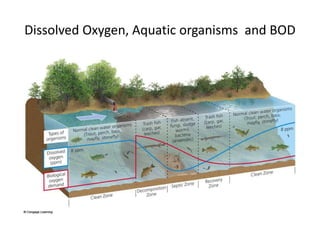
Dissolved Oxygen, Aquatic organisms and BOD
Water Quality Management in Rivers 
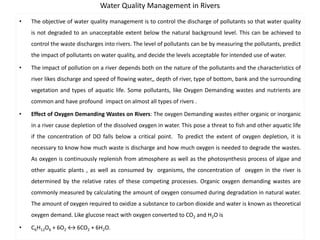
• The objective of water quality management is to control the discharge of pollutants so that water quality 
is not degraded to an unacceptable extent below the natural background level. This can be achieved to 
control the waste discharges into rivers. The level of pollutants can be by measuring the pollutants, predict 
the impact of pollutants on water quality, and decide the levels acceptable for intended use of water. 
• The impact of pollution on a river depends both on the nature of the pollutants and the characteristics of 
river likes discharge and speed of flowing water,, depth of river, type of bottom, bank and the surrounding 
vegetation and types of aquatic life. Some pollutants, like Oxygen Demanding wastes and nutrients are 
common and have profound impact on almost all types of rivers . 
• Effect of Oxygen Demanding Wastes on Rivers: The oxygen Demanding wastes either organic or inorganic 
in a river cause depletion of the dissolved oxygen in water. This pose a threat to fish and other aquatic life 
if the concentration of DO falls below a critical point. To predict the extent of oxygen depletion, it is 
necessary to know how much waste is discharge and how much oxygen is needed to degrade the wastes. 
As oxygen is continuously replenish from atmosphere as well as the photosynthesis process of algae and 
other aquatic plants , as well as consumed by organisms, the concentration of oxygen in the river is 
determined by the relative rates of these competing processes. Organic oxygen demanding wastes are 
commonly measured by calculating the amount of oxygen consumed during degradation in natural water. 
The amount of oxygen required to oxidize a substance to carbon dioxide and water is known as theoretical 
oxygen demand. Like glucose react with oxygen converted to CO2 and H2O is 
• C6H12O6 + 6O2 ↔ 6CO2 + 6H2O.
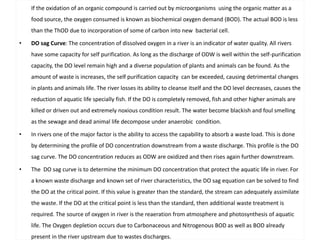
If the oxidation of an organic compound is carried out by microorganisms using the organic matter as a 
food source, the oxygen consumed is known as biochemical oxygen demand (BOD). The actual BOD is less 
than the ThOD due to incorporation of some of carbon into new bacterial cell. 
• DO sag Curve: The concentration of dissolved oxygen in a river is an indicator of water quality. All rivers 
have some capacity for self purification. As long as the discharge of ODW is well within the self-purification 
capacity, the DO level remain high and a diverse population of plants and animals can be found. As the 
amount of waste is increases, the self purification capacity can be exceeded, causing detrimental changes 
in plants and animals life. The river losses its ability to cleanse itself and the DO level decreases, causes the 
reduction of aquatic life specially fish. If the DO is completely removed, fish and other higher animals are 
killed or driven out and extremely noxious condition result. The water become blackish and foul smelling 
as the sewage and dead animal life decompose under anaerobic condition. 
• In rivers one of the major factor is the ability to access the capability to absorb a waste load. This is done 
by determining the profile of DO concentration downstream from a waste discharge. This profile is the DO 
sag curve. The DO concentration reduces as ODW are oxidized and then rises again further downstream. 
• The DO sag curve is to determine the minimum DO concentration that protect the aquatic life in river. For 
a known waste discharge and known set of river characteristics, the DO sag equation can be solved to find 
the DO at the critical point. If this value is greater than the standard, the stream can adequately assimilate 
the waste. If the DO at the critical point is less than the standard, then additional waste treatment is 
required. The source of oxygen in river is the reaeration from atmosphere and photosynthesis of aquatic 
life. The Oxygen depletion occurs due to Carbonaceous and Nitrogenous BOD as well as BOD already 
present in the river upstream due to wastes discharges.
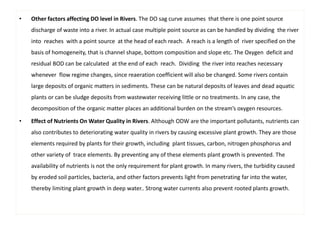
• Other factors affecting DO level in Rivers. The DO sag curve assumes that there is one point source 
discharge of waste into a river. In actual case multiple point source as can be handled by dividing the river 
into reaches with a point source at the head of each reach. A reach is a length of river specified on the 
basis of homogeneity, that is channel shape, bottom composition and slope etc. The Oxygen deficit and 
residual BOD can be calculated at the end of each reach. Dividing the river into reaches necessary 
whenever flow regime changes, since reaeration coefficient will also be changed. Some rivers contain 
large deposits of organic matters in sediments. These can be natural deposits of leaves and dead aquatic 
plants or can be sludge deposits from wastewater receiving little or no treatments. In any case, the 
decomposition of the organic matter places an additional burden on the stream’s oxygen resources. 
• Effect of Nutrients On Water Quality in Rivers. Although ODW are the important pollutants, nutrients can 
also contributes to deteriorating water quality in rivers by causing excessive plant growth. They are those 
elements required by plants for their growth, including plant tissues, carbon, nitrogen phosphorus and 
other variety of trace elements. By preventing any of these elements plant growth is prevented. The 
availability of nutrients is not the only requirement for plant growth. In many rivers, the turbidity caused 
by eroded soil particles, bacteria, and other factors prevents light from penetrating far into the water, 
thereby limiting plant growth in deep water.. Strong water currents also prevent rooted plants growth.

Natural purification in streams and rivers

  • 1.
    Natural Purification instreams and Rivers Natural forms of pollutants always present in surface water. In the early civilization, many of the impurities were washed from the air, eroded from land surface, or leached from the soil ultimately reached to surface water. The self purification processes were able to remove or render these materials harmless. As civilized evolved, human activity increased the amount and changed the nature of pollutants entering water bodies. As settlements grew into villages, villages into towns, cities and megacities, the quantity of waste products increased until the self purification capacity of water bodies was exceeded. Smaller streams were affected first, with larger streams and lakes ultimately becoming polluted. When decomposable organic waste is discharge into a water body. A series of physical, chemical and biological reactions are initiated. The stream relieved of its pollution burden. This process is known as Self purification or natural purification process. This process continuously changing water quality characteristics through out the reach of the stream. The speed and completeness with which these processes occur depend on many variable like volume, flow rate, turbulence of flow, variation in sunlight and temperature. In natural waters, these systems variables are set by nature and can seldom be altered. DO concentration in water is the most important factor that effect the decomposable organic matter in a stream. It is also necessary to maintained mandated DO in the stream. Therefore the type and nature of wastewater treatment depends on the condition and best usage of the receiving stream. The same processes that serve to purify natural water system also work in engineered systems. In water and wastewater treatment plants, the rate and extent of these processes are managed and controlling the system variable.
  • 2.
    Natural Purification instreams and Rivers Flowing water bodies like streams, canals and rivers can recover rapidly from degradable, Oxygen demanding wastes and excess heat through a combination of dilution and bacterial decay. This natural recovery process works as long as pollutants do not overload the stream and drought, or water diversion for agriculture or industry do not reduce their flows. However, these natural dilution and biodegradation processes do not eliminate slowly degradable and non degradable pollutants. In a flowing stream, the breakdown of degradable wastes by bacteria depletes dissolved oxygen. This reduces or eliminates populations of organisms with high oxygen requirements until the stream is cleansed of wastes. The depth and width of the resulting oxygen sag curve and thus the time and distance needed for a stream to recover, depend on the volume of incoming degradable wastes and the stream’s volume, flow rate, temperature and pH level. Similar oxygen sag curve can be plotted for heated water from industrial and power plants is discharged into streams. Despite progress in improving stream quality in most of the developed world, large fish kills and drinking water contamination still occurs. One main reason of these disasters is accidental or deliberate releases of toxic inorganic and organic chemicals by industries or mines. Similarly, non point runoff of pesticides and excess plant nutrients from crop land and animal feedlots. In case of lakes and reservoirs, dilution of pollutants often are less effective than streams. In lakes and reservoirs flow is usually vertical, and have slow movements. That is the reason they are more vulnerable to contamination by runoff or discharge of plant nutrients, pesticides and toxic substances.
  • 3.
    Dissolved Oxygen, Aquaticorganisms and BOD
  • 4.
    Water Quality Managementin Rivers • The objective of water quality management is to control the discharge of pollutants so that water quality is not degraded to an unacceptable extent below the natural background level. This can be achieved to control the waste discharges into rivers. The level of pollutants can be by measuring the pollutants, predict the impact of pollutants on water quality, and decide the levels acceptable for intended use of water. • The impact of pollution on a river depends both on the nature of the pollutants and the characteristics of river likes discharge and speed of flowing water,, depth of river, type of bottom, bank and the surrounding vegetation and types of aquatic life. Some pollutants, like Oxygen Demanding wastes and nutrients are common and have profound impact on almost all types of rivers . • Effect of Oxygen Demanding Wastes on Rivers: The oxygen Demanding wastes either organic or inorganic in a river cause depletion of the dissolved oxygen in water. This pose a threat to fish and other aquatic life if the concentration of DO falls below a critical point. To predict the extent of oxygen depletion, it is necessary to know how much waste is discharge and how much oxygen is needed to degrade the wastes. As oxygen is continuously replenish from atmosphere as well as the photosynthesis process of algae and other aquatic plants , as well as consumed by organisms, the concentration of oxygen in the river is determined by the relative rates of these competing processes. Organic oxygen demanding wastes are commonly measured by calculating the amount of oxygen consumed during degradation in natural water. The amount of oxygen required to oxidize a substance to carbon dioxide and water is known as theoretical oxygen demand. Like glucose react with oxygen converted to CO2 and H2O is • C6H12O6 + 6O2 ↔ 6CO2 + 6H2O.
  • 5.
    If the oxidationof an organic compound is carried out by microorganisms using the organic matter as a food source, the oxygen consumed is known as biochemical oxygen demand (BOD). The actual BOD is less than the ThOD due to incorporation of some of carbon into new bacterial cell. • DO sag Curve: The concentration of dissolved oxygen in a river is an indicator of water quality. All rivers have some capacity for self purification. As long as the discharge of ODW is well within the self-purification capacity, the DO level remain high and a diverse population of plants and animals can be found. As the amount of waste is increases, the self purification capacity can be exceeded, causing detrimental changes in plants and animals life. The river losses its ability to cleanse itself and the DO level decreases, causes the reduction of aquatic life specially fish. If the DO is completely removed, fish and other higher animals are killed or driven out and extremely noxious condition result. The water become blackish and foul smelling as the sewage and dead animal life decompose under anaerobic condition. • In rivers one of the major factor is the ability to access the capability to absorb a waste load. This is done by determining the profile of DO concentration downstream from a waste discharge. This profile is the DO sag curve. The DO concentration reduces as ODW are oxidized and then rises again further downstream. • The DO sag curve is to determine the minimum DO concentration that protect the aquatic life in river. For a known waste discharge and known set of river characteristics, the DO sag equation can be solved to find the DO at the critical point. If this value is greater than the standard, the stream can adequately assimilate the waste. If the DO at the critical point is less than the standard, then additional waste treatment is required. The source of oxygen in river is the reaeration from atmosphere and photosynthesis of aquatic life. The Oxygen depletion occurs due to Carbonaceous and Nitrogenous BOD as well as BOD already present in the river upstream due to wastes discharges.
  • 6.
    • Other factorsaffecting DO level in Rivers. The DO sag curve assumes that there is one point source discharge of waste into a river. In actual case multiple point source as can be handled by dividing the river into reaches with a point source at the head of each reach. A reach is a length of river specified on the basis of homogeneity, that is channel shape, bottom composition and slope etc. The Oxygen deficit and residual BOD can be calculated at the end of each reach. Dividing the river into reaches necessary whenever flow regime changes, since reaeration coefficient will also be changed. Some rivers contain large deposits of organic matters in sediments. These can be natural deposits of leaves and dead aquatic plants or can be sludge deposits from wastewater receiving little or no treatments. In any case, the decomposition of the organic matter places an additional burden on the stream’s oxygen resources. • Effect of Nutrients On Water Quality in Rivers. Although ODW are the important pollutants, nutrients can also contributes to deteriorating water quality in rivers by causing excessive plant growth. They are those elements required by plants for their growth, including plant tissues, carbon, nitrogen phosphorus and other variety of trace elements. By preventing any of these elements plant growth is prevented. The availability of nutrients is not the only requirement for plant growth. In many rivers, the turbidity caused by eroded soil particles, bacteria, and other factors prevents light from penetrating far into the water, thereby limiting plant growth in deep water.. Strong water currents also prevent rooted plants growth.