DEPARTMENT OF
CIVIL ENGINEERING
Harbours Engineering
Ports and Docks
Modern trends in water transportation
Er. RAMPRASAD KUMAWAT
(M.Tech)
Contents
• Harbours: History of Water Transportation
• Components of harbour,
• Classification of harbours.
• Ports and docks .
• Modern trends in water transportation
Ports
• The term port is used to indicate a harbour
where terminal facilities, such a stores, landing
of passengers and cargo, etc. are added to it.
• Thus, a harbour consists of the waterways and
channels as far as the pier head lines and a port
includes everything on the landward side of
those lines i.e. piers, slips, wharves, sheds,
tracks, handling equipment, etc.
Classification of ports
Depending upon the location, the ports can be
classified as;
• Canal ports
• River ports and
• Sea ports
• The term free port is used to indicate an
isolated, enclosed and policed area for
handling of cargo; etc. for the purpose of
reshipping without the intervention of customs.
• It is furnished with the facilities for loading
and unloading; for storing goods and
reshipping them by land or water; and for
supplying fuel.
• Free port thus indicates an area within which
goods can be landed, stored, mixed, blended,
repacked, manufactured and reshipped without
payment of duties and without the intervention
of custom department.
• Depending upon the commodities dealt with or
their use, the ports can also be classified as
grain ports, coaling ports, transhipment ports,
ports of call, etc.
• Depending upon the size and location, the
ports can also be grouped as major ports,
intermediate ports and minor ports .
• A major port is able to attract trade and it
commands a really pivoted position for the
extension of communications.
Port Design
The design of a port should be made while
keeping in mind the following requirements:
The entrance channel should be such that the
ships can come in and go out easily.
The ships should be able to turn in the basin
itself.
The alignment of quays should be such that the
ships can come along side easily even when
there is an on-shore wind.
The width behind the quay should be sufficient
to deal with the goods.
There should be enough provision for railway
tracks to take care for loading and unloading of
cargo.
Requirements of a Good Port
• It should be centrally situated for the hinterland.
For a port, the hinterland is that part of the
country behind it which can be served with
economy and efficiency by the port.
• It should get good tonnage i .e. charge per tonne
of cargo handled by it.
• It should have good communication with the rest
of country.
• It should be populous It should be advance in
culture, trade and industry.
• It should be a place of defence and for resisting
the sea-borne invasion.
• It should command valuable and extensive trade.
• It should be capable of easy, smooth and
economic development.
• It should afford shelter to all ships and at all
seasons of the years .
• It should provide the maximum facilities to all the
visiting ships including the servicing of ships.
DOCKS
• Docks arc enclosed areas for berthing ships, to
keep them afloat at a uniform level, to
facilitate loading and unloading cargo.
• Harbours are prone to be affected by tides,
which may cause changes in the water level.
• If at low tides the level is sufficient as not to
ground the ships, the ships could be berthed in
these areas.
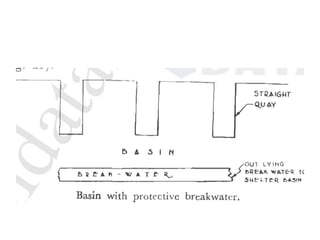
• Thus, in ports on the open sea coast protected
by an outlying breakwater, basins are formed
within its shelter fig. 1.
• In these basins, quay walls are projected at
right angles to the shore alongside which
vessels can lie and discharge their cargoes.
FIG
• Open berths : Where tidal ranges are very
marked and large, docks are formed by
enclosures. The water level in these enclosures
should be maintained at constant level by
providing locks and gates.
• Docks or WET docks are enclosed and are
shut off by entrances or locks to maintain a
fairly uniform level of water, and basins are
partially enclosed areas of water, which are
apprmrched by open entrances and are subject
to fluctuations of levels, due to tidal variations.
• These are also known as tidal basins (e.g.
Mediterranean sea) . The permissible tidal
range is about 15'-0".
Advantages of tidal basins
• (1) Vessels can come in and berth or leave at
all times.
(2) Costly arrangements like lock gates are not
required.
Advantages of wet docks
(1) Uniform level of water is maintained which
is very convenient ' for handling cargo.
(2) Prevents the rubbing of the ships' sides
against the quay walls.
(3) Effect of storms in the outer sea and harbour
do not obstruct the dock enclosure.
River ports
River ports are formed with quays alongside the
river banks, where the tidal effect is small. '
The river in this case serves as the basin
(fig. 2).
• When tide ranges are large in such rivers, wet
docks are constructed, with locks and
entrances, 'which retain the water level during
the fall of level in the river.
Shape of decks and basins
• Should be of shapes formed by straight lines,
as curved lines arc not suitable for ships to
stand alongside.
• (i) Rectangular shape: The length and breadth
could be adjusted to give the maximum
quayage (fig. 3).
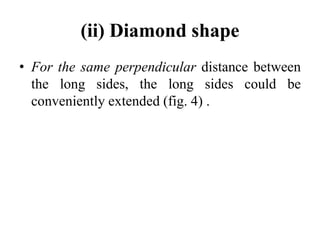
(ii) Diamond shape
• For the same perpendicular distance between
the long sides, the long sides could be
conveniently extended (fig. 4) .
(iii) Inclined quays type
• It consists of a number of projecting quays
into the basin or dock (fig. 5).
Location
• Docks could be located, on inland ports of
rivers, at estuaries or on open sea coast.
• A site on the sea coast is preferable to one up a
river as at Calcutta, where navigation of the
Hugli river is difficult especially as the river is
congested with local traffic.
• A proper piloting service is necessary for this
purpose. The river approaches to the dock have
to be maintained.
Internal Arrangetnent
• Separate docks are usually required for
different kinds of cargo, as for example, coal
and oil should be dealt with separately, away
from general or food cargo.
• Flour acquires the smell of its surroundings
and should not be discharged near cargo, with
strong odor like salted fish.
Modern Trends in Water
Transportation
• Modern water transport is classified like
• (1) Foreign going oceanic
• (2) National inland water ways
• (3) costal shipping.
• Foreign going traffic had enjoyed the largest
expansion in modern times.
• Inland waterways have inherent advantages
such as being less expensive, energy saving
and no need for more investment.
• Inland waterways extend to 14,500 Kms.
comprising of a variety of river system canals
and backwaters. India has a vast coastline of
about 5500Kms.
• THANKS!
• Gmail: ramkumawat001@gmail.com

Harbours Engineering

  • 1.
    DEPARTMENT OF CIVIL ENGINEERING HarboursEngineering Ports and Docks Modern trends in water transportation Er. RAMPRASAD KUMAWAT (M.Tech)
  • 2.
    Contents • Harbours: Historyof Water Transportation • Components of harbour, • Classification of harbours. • Ports and docks . • Modern trends in water transportation
  • 3.
    Ports • The termport is used to indicate a harbour where terminal facilities, such a stores, landing of passengers and cargo, etc. are added to it. • Thus, a harbour consists of the waterways and channels as far as the pier head lines and a port includes everything on the landward side of those lines i.e. piers, slips, wharves, sheds, tracks, handling equipment, etc.
  • 4.
    Classification of ports Dependingupon the location, the ports can be classified as; • Canal ports • River ports and • Sea ports
  • 5.
    • The termfree port is used to indicate an isolated, enclosed and policed area for handling of cargo; etc. for the purpose of reshipping without the intervention of customs. • It is furnished with the facilities for loading and unloading; for storing goods and reshipping them by land or water; and for supplying fuel.
  • 6.
    • Free portthus indicates an area within which goods can be landed, stored, mixed, blended, repacked, manufactured and reshipped without payment of duties and without the intervention of custom department. • Depending upon the commodities dealt with or their use, the ports can also be classified as grain ports, coaling ports, transhipment ports, ports of call, etc.
  • 7.
    • Depending uponthe size and location, the ports can also be grouped as major ports, intermediate ports and minor ports . • A major port is able to attract trade and it commands a really pivoted position for the extension of communications.
  • 8.
    Port Design The designof a port should be made while keeping in mind the following requirements: The entrance channel should be such that the ships can come in and go out easily. The ships should be able to turn in the basin itself. The alignment of quays should be such that the ships can come along side easily even when there is an on-shore wind.
  • 9.
    The width behindthe quay should be sufficient to deal with the goods. There should be enough provision for railway tracks to take care for loading and unloading of cargo.
  • 10.
    Requirements of aGood Port • It should be centrally situated for the hinterland. For a port, the hinterland is that part of the country behind it which can be served with economy and efficiency by the port. • It should get good tonnage i .e. charge per tonne of cargo handled by it. • It should have good communication with the rest of country. • It should be populous It should be advance in culture, trade and industry.
  • 11.
    • It shouldbe a place of defence and for resisting the sea-borne invasion. • It should command valuable and extensive trade. • It should be capable of easy, smooth and economic development. • It should afford shelter to all ships and at all seasons of the years . • It should provide the maximum facilities to all the visiting ships including the servicing of ships.
  • 12.
    DOCKS • Docks arcenclosed areas for berthing ships, to keep them afloat at a uniform level, to facilitate loading and unloading cargo. • Harbours are prone to be affected by tides, which may cause changes in the water level. • If at low tides the level is sufficient as not to ground the ships, the ships could be berthed in these areas.
  • 13.
    • Thus, inports on the open sea coast protected by an outlying breakwater, basins are formed within its shelter fig. 1. • In these basins, quay walls are projected at right angles to the shore alongside which vessels can lie and discharge their cargoes.
  • 14.
  • 15.
    • Open berths: Where tidal ranges are very marked and large, docks are formed by enclosures. The water level in these enclosures should be maintained at constant level by providing locks and gates.
  • 16.
    • Docks orWET docks are enclosed and are shut off by entrances or locks to maintain a fairly uniform level of water, and basins are partially enclosed areas of water, which are apprmrched by open entrances and are subject to fluctuations of levels, due to tidal variations. • These are also known as tidal basins (e.g. Mediterranean sea) . The permissible tidal range is about 15'-0".
  • 17.
    Advantages of tidalbasins • (1) Vessels can come in and berth or leave at all times. (2) Costly arrangements like lock gates are not required.
  • 18.
    Advantages of wetdocks (1) Uniform level of water is maintained which is very convenient ' for handling cargo. (2) Prevents the rubbing of the ships' sides against the quay walls. (3) Effect of storms in the outer sea and harbour do not obstruct the dock enclosure.
  • 19.
    River ports River portsare formed with quays alongside the river banks, where the tidal effect is small. ' The river in this case serves as the basin (fig. 2). • When tide ranges are large in such rivers, wet docks are constructed, with locks and entrances, 'which retain the water level during the fall of level in the river.
  • 21.
    Shape of decksand basins • Should be of shapes formed by straight lines, as curved lines arc not suitable for ships to stand alongside. • (i) Rectangular shape: The length and breadth could be adjusted to give the maximum quayage (fig. 3).
  • 23.
    (ii) Diamond shape •For the same perpendicular distance between the long sides, the long sides could be conveniently extended (fig. 4) .
  • 25.
    (iii) Inclined quaystype • It consists of a number of projecting quays into the basin or dock (fig. 5).
  • 27.
    Location • Docks couldbe located, on inland ports of rivers, at estuaries or on open sea coast. • A site on the sea coast is preferable to one up a river as at Calcutta, where navigation of the Hugli river is difficult especially as the river is congested with local traffic. • A proper piloting service is necessary for this purpose. The river approaches to the dock have to be maintained.
  • 28.
    Internal Arrangetnent • Separatedocks are usually required for different kinds of cargo, as for example, coal and oil should be dealt with separately, away from general or food cargo. • Flour acquires the smell of its surroundings and should not be discharged near cargo, with strong odor like salted fish.
  • 29.
    Modern Trends inWater Transportation • Modern water transport is classified like • (1) Foreign going oceanic • (2) National inland water ways • (3) costal shipping.
  • 30.
    • Foreign goingtraffic had enjoyed the largest expansion in modern times. • Inland waterways have inherent advantages such as being less expensive, energy saving and no need for more investment. • Inland waterways extend to 14,500 Kms. comprising of a variety of river system canals and backwaters. India has a vast coastline of about 5500Kms.
  • 31.
    • THANKS! • Gmail:ramkumawat001@gmail.com