1 | P a g e
Harbor?
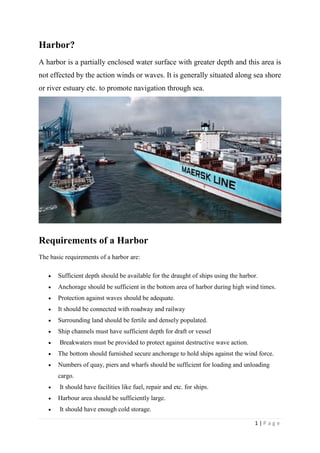
A harbor is a partially enclosed water surface with greater depth and this area is
not effected by the action winds or waves. It is generally situated along sea shore
or river estuary etc. to promote navigation through sea.
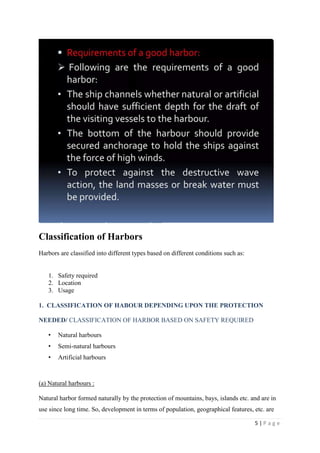
Requirements of a Harbor
The basic requirements of a harbor are:
 Sufficient depth should be available for the draught of ships using the harbor.
 Anchorage should be sufficient in the bottom area of harbor during high wind times.
 Protection against waves should be adequate.
 It should be connected with roadway and railway
 Surrounding land should be fertile and densely populated.
 Ship channels must have sufficient depth for draft or vessel
 Breakwaters must be provided to protect against destructive wave action.
 The bottom should furnished secure anchorage to hold ships against the wind force.
 Numbers of quay, piers and wharfs should be sufficient for loading and unloading
cargo.
 It should have facilities like fuel, repair and etc. for ships.
 Harbour area should be sufficiently large.
 It should have enough cold storage.
2 | P a g e
Site Selection for a Harbor
If natural formations of harbor are not available then it is essential to build artificial harbor.
But the site selected for a harbor should be based on some important factors such as:
 Marine conditions should be mostly favorable without any disturbances.
 The foundation soil or sea bed is properly checked whether it is capable to bear
breakwaters against wave and other forces.
 If there are Natural formations like mountains or island, then it is better to select a site
nearer to that area.
 Site should be economical and construction material should be easily available.
 Water should be fresh without any pollution.
 Surrounding area should be developed with factories and industries, then exports and
imports of goods will takes place highly.
 The harbor should be easily reachable.
 The area of harbor should be large. Generally, it is decided on the basis of
accommodation for number of ships.
Harbour Planning:-
 It is necessary to carry out a topography survey of the neighborhood including the
foreshore and the depths of water in the vicinity.
 The borings and soundings should be taken to ascertain the character of the ground.
3 | P a g e
4 | P a g e
5 | P a g e
Classification of Harbors
Harbors are classified into different types based on different conditions such as:
1. Safety required
2. Location
3. Usage
1. CLASSIFICATION OF HABOUR DEPENDING UPON THE PROTECTION
NEEDED/ CLASSIFICATION OF HARBOR BASED ON SAFETY REQUIRED
• Natural harbours
• Semi-natural harbours
• Artificial harbours
(a) Natural harbours :
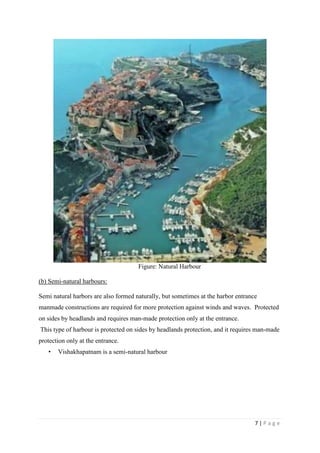
Natural harbor formed naturally by the protection of mountains, bays, islands etc. and are in
use since long time. So, development in terms of population, geographical features, etc. are
6 | P a g e
rapid in natural harbor regions. Inlet protected from storms and waves by natural
configuration of the land. A deep navigable channel with a protective natural bank or shoal to
seaward is a good example of a natural roadstead.
• Natural formations affording safe discharge facilities for ships on sea coasts, in the form
of creeks and basins, are called natural harbours.
• With the rapid development of navies engaged either in commerce or war, improved
accommodation and facilities for repairs, storage of cargo and connected amenities had
to be provided in natural harbours.
• The size and draft of present day vessels have necessitated the works improvement for
natural harbours.
• The factors such as local geographical features, growth of population, development of
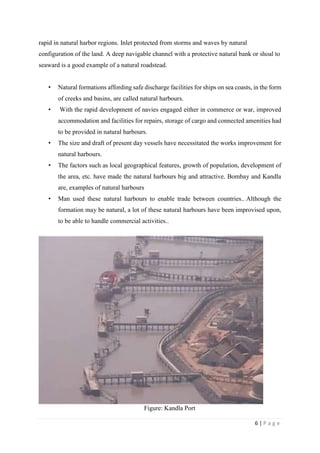
the area, etc. have made the natural harbours big and attractive. Bombay and Kandla
are, examples of natural harbours
• Man used these natural harbours to enable trade between countries.. Although the
formation may be natural, a lot of these natural harbours have been improvised upon,
to be able to handle commercial activities..
Figure: Kandla Port
7 | P a g e
Figure: Natural Harbour
(b) Semi-natural harbours:
Semi natural harbors are also formed naturally, but sometimes at the harbor entrance
manmade constructions are required for more protection against winds and waves. Protected
on sides by headlands and requires man-made protection only at the entrance.
This type of harbour is protected on sides by headlands protection, and it requires man-made
protection only at the entrance.
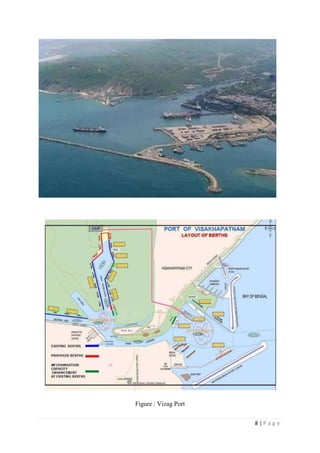
• Vishakhapatnam is a semi-natural harbour
8 | P a g e
Figure : Vizag Port
9 | P a g e
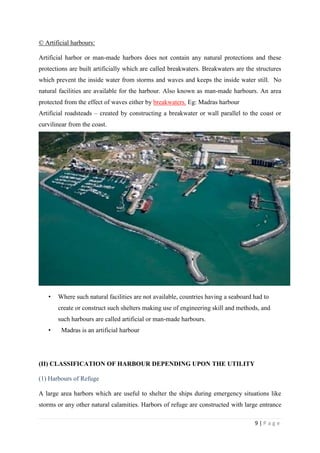
© Artificial harbours:
Artificial harbor or man-made harbors does not contain any natural protections and these
protections are built artificially which are called breakwaters. Breakwaters are the structures
which prevent the inside water from storms and waves and keeps the inside water still. No
natural facilities are available for the harbour. Also known as man-made harbours. An area
protected from the effect of waves either by breakwaters. Eg: Madras harbour
Artificial roadsteads – created by constructing a breakwater or wall parallel to the coast or
curvilinear from the coast.
• Where such natural facilities are not available, countries having a seaboard had to
create or construct such shelters making use of engineering skill and methods, and
such harbours are called artificial or man-made harbours.
• Madras is an artificial harbour
(II) CLASSIFICATION OF HARBOUR DEPENDING UPON THE UTILITY
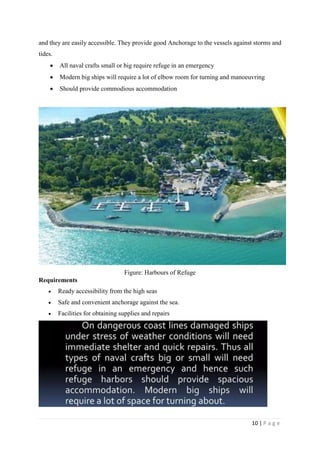
(1) Harbours of Refuge
A large area harbors which are useful to shelter the ships during emergency situations like
storms or any other natural calamities. Harbors of refuge are constructed with large entrance
10 | P a g e
and they are easily accessible. They provide good Anchorage to the vessels against storms and
tides.
 All naval crafts small or big require refuge in an emergency
 Modern big ships will require a lot of elbow room for turning and manoeuvring
 Should provide commodious accommodation
Figure: Harbours of Refuge
Requirements
 Ready accessibility from the high seas
 Safe and convenient anchorage against the sea.
 Facilities for obtaining supplies and repairs
11 | P a g e
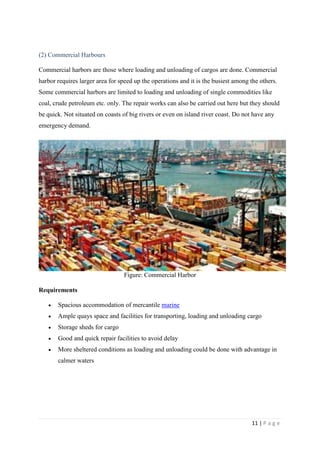
(2) Commercial Harbours
Commercial harbors are those where loading and unloading of cargos are done. Commercial
harbor requires larger area for speed up the operations and it is the busiest among the others.
Some commercial harbors are limited to loading and unloading of single commodities like
coal, crude petroleum etc. only. The repair works can also be carried out here but they should
be quick. Not situated on coasts of big rivers or even on island river coast. Do not have any
emergency demand.
Figure: Commercial Harbor
Requirements
 Spacious accommodation of mercantile marine
 Ample quays space and facilities for transporting, loading and unloading cargo
 Storage sheds for cargo
 Good and quick repair facilities to avoid delay
 More sheltered conditions as loading and unloading could be done with advantage in
calmer waters
12 | P a g e
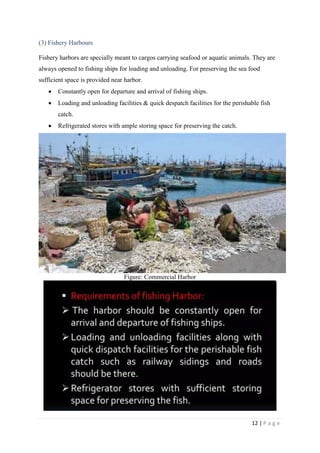
(3) Fishery Harbours
Fishery harbors are specially meant to cargos carrying seafood or aquatic animals. They are
always opened to fishing ships for loading and unloading. For preserving the sea food
sufficient space is provided near harbor.
 Constantly open for departure and arrival of fishing ships.
 Loading and unloading facilities & quick despatch facilities for the perishable fish
catch.
 Refrigerated stores with ample storing space for preserving the catch.
Figure: Commercial Harbor
13 | P a g e
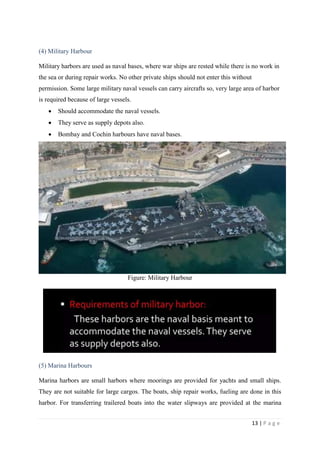
(4) Military Harbour
Military harbors are used as naval bases, where war ships are rested while there is no work in
the sea or during repair works. No other private ships should not enter this without
permission. Some large military naval vessels can carry aircrafts so, very large area of harbor
is required because of large vessels.
 Should accommodate the naval vessels.
 They serve as supply depots also.
 Bombay and Cochin harbours have naval bases.
Figure: Military Harbour
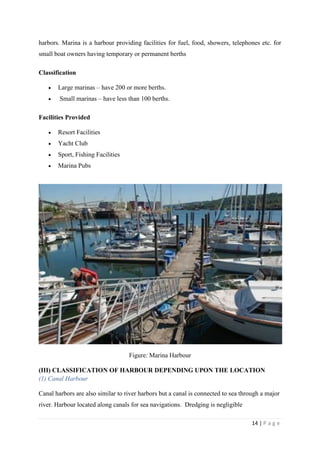
(5) Marina Harbours
Marina harbors are small harbors where moorings are provided for yachts and small ships.
They are not suitable for large cargos. The boats, ship repair works, fueling are done in this
harbor. For transferring trailered boats into the water slipways are provided at the marina
14 | P a g e
harbors. Marina is a harbour providing facilities for fuel, food, showers, telephones etc. for
small boat owners having temporary or permanent berths
Classification
 Large marinas – have 200 or more berths.
 Small marinas – have less than 100 berths.
Facilities Provided
 Resort Facilities
 Yacht Club
 Sport, Fishing Facilities
 Marina Pubs
Figure: Marina Harbour
(III) CLASSIFICATION OF HARBOUR DEPENDING UPON THE LOCATION
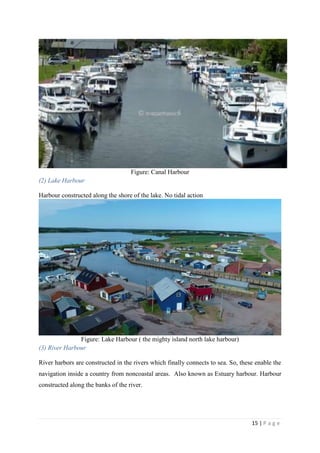
(1) Canal Harbour
Canal harbors are also similar to river harbors but a canal is connected to sea through a major
river. Harbour located along canals for sea navigations. Dredging is negligible
15 | P a g e
Figure: Canal Harbour
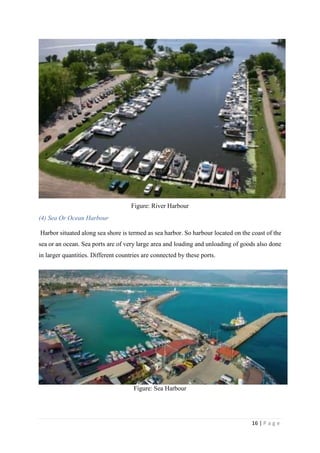
(2) Lake Harbour
Harbour constructed along the shore of the lake. No tidal action
Figure: Lake Harbour ( the mighty island north lake harbour)
(3) River Harbour
River harbors are constructed in the rivers which finally connects to sea. So, these enable the
navigation inside a country from noncoastal areas. Also known as Estuary harbour. Harbour
constructed along the banks of the river.
16 | P a g e
Figure: River Harbour
(4) Sea Or Ocean Harbour
Harbor situated along sea shore is termed as sea harbor. So harbour located on the coast of the
sea or an ocean. Sea ports are of very large area and loading and unloading of goods also done
in larger quantities. Different countries are connected by these ports.
Figure: Sea Harbour
17 | P a g e
18 | P a g e
19 | P a g e
20 | P a g e
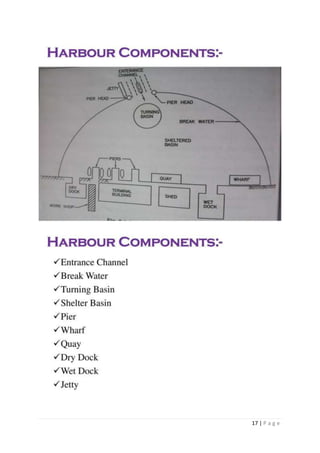
Components of Artificial Harbor: -
1. Approach channel
2. Entrance channel
3. Berthing basin
4. Turning basin
5. Quays and wharves
6. Breakwaters
7. Dry docks and slipways
8. Jetties & piers
9. Lock and locked basin
10. Other components like sheds, buoys, godown, fire protection towers, lights, anchors,
warehouses, moorings etc. are also included in the layout of harbor
Approach channel: -
 Depth of water in the entire harbor area should be adequate or sufficient for the
purpose of navigation of design vessel or ship. When the depth of water is the net
sufficient, then a channel with sufficient depth & width should be made by dredging
which further provide a passage of ship between the harbor entrance & the docks
 There are two types of approach channel namely (i) Outer channel and (ii) Inner
channel
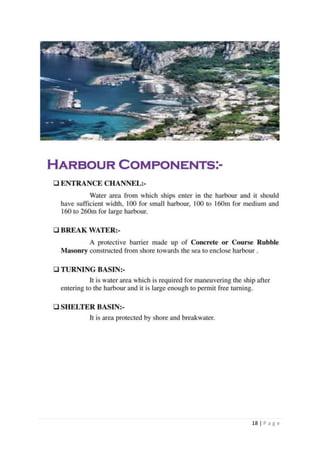
Entrance channel: -
 Water area from which ships enter in the harbour and it should have sufficient width,
100 for small harbour, 100 to 160m for medium and 160 to 260m for large harbour.
 The portion entrance to a harbor is called as entrance channel & entrance to a harbor
is generally more exposed to sea waves, hence depth & width of entrance channel are
more.
 The entrance channel should be sufficiently wide for navigational purposes & to
prevent dangerous tidal currents.
Berthing basin: -
 A basin in which the vessels or ships rests or parks is called as berthing basin. Area of
berthing basin is protected by shore & breakwaters.
 In such basin, other elements of harbor including area for anchorage of vessels
Turning basin: -
 It is water area which is required for maneuvering the ship after entering to the
harbour and it is large enough to permit free turning
 The area required for manoeuvring the ship while going or leaving the berth so that a
ship can leave head on is called as turning basin
 The size & area of turning basin should be preferably designed large enough so as to
allow a free turning
Quays and wharves: -
21 | P a g e
 Quays & wharves are the structures generally constructed parallel to shore or
breakwater within harbor itself so as to permit berthing of vessel alongside for cargo
working. It has wide platform at top.
Breakwaters:-
 A protective barrier made up of Concrete or Course Rubble Masonry constructed
from shore towards the sea to enclose harbour
 Breakwater is a structure constructed so as to protect the enclosed area of water from
strong storm waves of sea. Breakwater helps to keep the water steady or calm in the
harbor and provide safety to the vessel and easy working
 The monolithic structure generally built at the tip of the breakwater which is termed
as pier head.
Dry docks slipways: -
 Dry docks and slipways are used for repairs, maintenance and construction of ships.
Building dock is essentially provided for construction of ship.
 These are kept dry for easy working.
Jetties and piers: -
 Jetties and piers are open or solid tape of structure having a wide platform on the top
so as to permit cargo working of vessels or ships berthed alongside.
Lock and locked basin: -
 Locked basin is an enclosed basin in which a number of ships or vessels are berthed.
Locked basin has an entrance gate which is controlled by lock gates.
Other components: -
 Components like moorings, sheds, buoys, godowns, fire protection towers, anchors,
warehouses, lights and other essential service unit are essential at different location in
the harbor.
22 | P a g e
23 | P a g e

Harbor_Classification 27.11.2022.docx

  • 1.
    1 | Pa g e Harbor? A harbor is a partially enclosed water surface with greater depth and this area is not effected by the action winds or waves. It is generally situated along sea shore or river estuary etc. to promote navigation through sea. Requirements of a Harbor The basic requirements of a harbor are:  Sufficient depth should be available for the draught of ships using the harbor.  Anchorage should be sufficient in the bottom area of harbor during high wind times.  Protection against waves should be adequate.  It should be connected with roadway and railway  Surrounding land should be fertile and densely populated.  Ship channels must have sufficient depth for draft or vessel  Breakwaters must be provided to protect against destructive wave action.  The bottom should furnished secure anchorage to hold ships against the wind force.  Numbers of quay, piers and wharfs should be sufficient for loading and unloading cargo.  It should have facilities like fuel, repair and etc. for ships.  Harbour area should be sufficiently large.  It should have enough cold storage.
  • 2.
    2 | Pa g e Site Selection for a Harbor If natural formations of harbor are not available then it is essential to build artificial harbor. But the site selected for a harbor should be based on some important factors such as:  Marine conditions should be mostly favorable without any disturbances.  The foundation soil or sea bed is properly checked whether it is capable to bear breakwaters against wave and other forces.  If there are Natural formations like mountains or island, then it is better to select a site nearer to that area.  Site should be economical and construction material should be easily available.  Water should be fresh without any pollution.  Surrounding area should be developed with factories and industries, then exports and imports of goods will takes place highly.  The harbor should be easily reachable.  The area of harbor should be large. Generally, it is decided on the basis of accommodation for number of ships. Harbour Planning:-  It is necessary to carry out a topography survey of the neighborhood including the foreshore and the depths of water in the vicinity.  The borings and soundings should be taken to ascertain the character of the ground.
  • 3.
    3 | Pa g e
  • 4.
    4 | Pa g e
  • 5.
    5 | Pa g e Classification of Harbors Harbors are classified into different types based on different conditions such as: 1. Safety required 2. Location 3. Usage 1. CLASSIFICATION OF HABOUR DEPENDING UPON THE PROTECTION NEEDED/ CLASSIFICATION OF HARBOR BASED ON SAFETY REQUIRED • Natural harbours • Semi-natural harbours • Artificial harbours (a) Natural harbours : Natural harbor formed naturally by the protection of mountains, bays, islands etc. and are in use since long time. So, development in terms of population, geographical features, etc. are
  • 6.
    6 | Pa g e rapid in natural harbor regions. Inlet protected from storms and waves by natural configuration of the land. A deep navigable channel with a protective natural bank or shoal to seaward is a good example of a natural roadstead. • Natural formations affording safe discharge facilities for ships on sea coasts, in the form of creeks and basins, are called natural harbours. • With the rapid development of navies engaged either in commerce or war, improved accommodation and facilities for repairs, storage of cargo and connected amenities had to be provided in natural harbours. • The size and draft of present day vessels have necessitated the works improvement for natural harbours. • The factors such as local geographical features, growth of population, development of the area, etc. have made the natural harbours big and attractive. Bombay and Kandla are, examples of natural harbours • Man used these natural harbours to enable trade between countries.. Although the formation may be natural, a lot of these natural harbours have been improvised upon, to be able to handle commercial activities.. Figure: Kandla Port
  • 7.
    7 | Pa g e Figure: Natural Harbour (b) Semi-natural harbours: Semi natural harbors are also formed naturally, but sometimes at the harbor entrance manmade constructions are required for more protection against winds and waves. Protected on sides by headlands and requires man-made protection only at the entrance. This type of harbour is protected on sides by headlands protection, and it requires man-made protection only at the entrance. • Vishakhapatnam is a semi-natural harbour
  • 8.
    8 | Pa g e Figure : Vizag Port
  • 9.
    9 | Pa g e © Artificial harbours: Artificial harbor or man-made harbors does not contain any natural protections and these protections are built artificially which are called breakwaters. Breakwaters are the structures which prevent the inside water from storms and waves and keeps the inside water still. No natural facilities are available for the harbour. Also known as man-made harbours. An area protected from the effect of waves either by breakwaters. Eg: Madras harbour Artificial roadsteads – created by constructing a breakwater or wall parallel to the coast or curvilinear from the coast. • Where such natural facilities are not available, countries having a seaboard had to create or construct such shelters making use of engineering skill and methods, and such harbours are called artificial or man-made harbours. • Madras is an artificial harbour (II) CLASSIFICATION OF HARBOUR DEPENDING UPON THE UTILITY (1) Harbours of Refuge A large area harbors which are useful to shelter the ships during emergency situations like storms or any other natural calamities. Harbors of refuge are constructed with large entrance
  • 10.
    10 | Pa g e and they are easily accessible. They provide good Anchorage to the vessels against storms and tides.  All naval crafts small or big require refuge in an emergency  Modern big ships will require a lot of elbow room for turning and manoeuvring  Should provide commodious accommodation Figure: Harbours of Refuge Requirements  Ready accessibility from the high seas  Safe and convenient anchorage against the sea.  Facilities for obtaining supplies and repairs
  • 11.
    11 | Pa g e (2) Commercial Harbours Commercial harbors are those where loading and unloading of cargos are done. Commercial harbor requires larger area for speed up the operations and it is the busiest among the others. Some commercial harbors are limited to loading and unloading of single commodities like coal, crude petroleum etc. only. The repair works can also be carried out here but they should be quick. Not situated on coasts of big rivers or even on island river coast. Do not have any emergency demand. Figure: Commercial Harbor Requirements  Spacious accommodation of mercantile marine  Ample quays space and facilities for transporting, loading and unloading cargo  Storage sheds for cargo  Good and quick repair facilities to avoid delay  More sheltered conditions as loading and unloading could be done with advantage in calmer waters
  • 12.
    12 | Pa g e (3) Fishery Harbours Fishery harbors are specially meant to cargos carrying seafood or aquatic animals. They are always opened to fishing ships for loading and unloading. For preserving the sea food sufficient space is provided near harbor.  Constantly open for departure and arrival of fishing ships.  Loading and unloading facilities & quick despatch facilities for the perishable fish catch.  Refrigerated stores with ample storing space for preserving the catch. Figure: Commercial Harbor
  • 13.
    13 | Pa g e (4) Military Harbour Military harbors are used as naval bases, where war ships are rested while there is no work in the sea or during repair works. No other private ships should not enter this without permission. Some large military naval vessels can carry aircrafts so, very large area of harbor is required because of large vessels.  Should accommodate the naval vessels.  They serve as supply depots also.  Bombay and Cochin harbours have naval bases. Figure: Military Harbour (5) Marina Harbours Marina harbors are small harbors where moorings are provided for yachts and small ships. They are not suitable for large cargos. The boats, ship repair works, fueling are done in this harbor. For transferring trailered boats into the water slipways are provided at the marina
  • 14.
    14 | Pa g e harbors. Marina is a harbour providing facilities for fuel, food, showers, telephones etc. for small boat owners having temporary or permanent berths Classification  Large marinas – have 200 or more berths.  Small marinas – have less than 100 berths. Facilities Provided  Resort Facilities  Yacht Club  Sport, Fishing Facilities  Marina Pubs Figure: Marina Harbour (III) CLASSIFICATION OF HARBOUR DEPENDING UPON THE LOCATION (1) Canal Harbour Canal harbors are also similar to river harbors but a canal is connected to sea through a major river. Harbour located along canals for sea navigations. Dredging is negligible
  • 15.
    15 | Pa g e Figure: Canal Harbour (2) Lake Harbour Harbour constructed along the shore of the lake. No tidal action Figure: Lake Harbour ( the mighty island north lake harbour) (3) River Harbour River harbors are constructed in the rivers which finally connects to sea. So, these enable the navigation inside a country from noncoastal areas. Also known as Estuary harbour. Harbour constructed along the banks of the river.
  • 16.
    16 | Pa g e Figure: River Harbour (4) Sea Or Ocean Harbour Harbor situated along sea shore is termed as sea harbor. So harbour located on the coast of the sea or an ocean. Sea ports are of very large area and loading and unloading of goods also done in larger quantities. Different countries are connected by these ports. Figure: Sea Harbour
  • 17.
    17 | Pa g e
  • 18.
    18 | Pa g e
  • 19.
    19 | Pa g e
  • 20.
    20 | Pa g e Components of Artificial Harbor: - 1. Approach channel 2. Entrance channel 3. Berthing basin 4. Turning basin 5. Quays and wharves 6. Breakwaters 7. Dry docks and slipways 8. Jetties & piers 9. Lock and locked basin 10. Other components like sheds, buoys, godown, fire protection towers, lights, anchors, warehouses, moorings etc. are also included in the layout of harbor Approach channel: -  Depth of water in the entire harbor area should be adequate or sufficient for the purpose of navigation of design vessel or ship. When the depth of water is the net sufficient, then a channel with sufficient depth & width should be made by dredging which further provide a passage of ship between the harbor entrance & the docks  There are two types of approach channel namely (i) Outer channel and (ii) Inner channel Entrance channel: -  Water area from which ships enter in the harbour and it should have sufficient width, 100 for small harbour, 100 to 160m for medium and 160 to 260m for large harbour.  The portion entrance to a harbor is called as entrance channel & entrance to a harbor is generally more exposed to sea waves, hence depth & width of entrance channel are more.  The entrance channel should be sufficiently wide for navigational purposes & to prevent dangerous tidal currents. Berthing basin: -  A basin in which the vessels or ships rests or parks is called as berthing basin. Area of berthing basin is protected by shore & breakwaters.  In such basin, other elements of harbor including area for anchorage of vessels Turning basin: -  It is water area which is required for maneuvering the ship after entering to the harbour and it is large enough to permit free turning  The area required for manoeuvring the ship while going or leaving the berth so that a ship can leave head on is called as turning basin  The size & area of turning basin should be preferably designed large enough so as to allow a free turning Quays and wharves: -
  • 21.
    21 | Pa g e  Quays & wharves are the structures generally constructed parallel to shore or breakwater within harbor itself so as to permit berthing of vessel alongside for cargo working. It has wide platform at top. Breakwaters:-  A protective barrier made up of Concrete or Course Rubble Masonry constructed from shore towards the sea to enclose harbour  Breakwater is a structure constructed so as to protect the enclosed area of water from strong storm waves of sea. Breakwater helps to keep the water steady or calm in the harbor and provide safety to the vessel and easy working  The monolithic structure generally built at the tip of the breakwater which is termed as pier head. Dry docks slipways: -  Dry docks and slipways are used for repairs, maintenance and construction of ships. Building dock is essentially provided for construction of ship.  These are kept dry for easy working. Jetties and piers: -  Jetties and piers are open or solid tape of structure having a wide platform on the top so as to permit cargo working of vessels or ships berthed alongside. Lock and locked basin: -  Locked basin is an enclosed basin in which a number of ships or vessels are berthed. Locked basin has an entrance gate which is controlled by lock gates. Other components: -  Components like moorings, sheds, buoys, godowns, fire protection towers, anchors, warehouses, lights and other essential service unit are essential at different location in the harbor.
  • 22.
    22 | Pa g e
  • 23.
    23 | Pa g e