1)DHRUV JADAV -- 43
3)SHYAM BHARADVA --10
2)CHINTAN KHETARIYA -- 54
4)ANIL BARAD --07
CLASS:- S.S. OF B.E. CIVIL THIRD YEAR
YEAR:- 2017-2018
DEFINATION
 The term “aid to navigation” means any object or device, external
to a vessel that is intended to assist a navigator in fixing his position
or determining a safe course past hazards to navigation.
 It includes both fixed and floating objects such as lights, light ships,
buoys, day beacons, and fog signals, plus electronic aids to
navigation such as radio beacons.
 They also serve to warn of hidden dangers and assist in making
landfall when approaching from the high seas. They also provide a
continuous chain of charted marks, showing improved channels
and assisting in coastal piloting.
IMPORTANCE OF NAVIGATIONAL AIDS
Enhances safety and can act as good safety
barriers.
Help to improve safety at seas.
Finding and safely navigating a narrow channel in a
wide expanse of water.
Also help mariners in determining their position with
respect to land or any navigational hazard or hidden
danger.
TYPES OF NAVIGATIONAL AIDS
 Depending upon structure…………..
There are two types of navigational aids.
1) Fixed structures
2) Floating structures
 Depending upon service and visibility….
There are four types of navigational aids
1)Coast approach light station
2)Obstruction light station
3)Approach channel lighting
4)Harbour light signal
FIXED NAVIGATIONAL STRUCTURES
There are following three types of fixed
navigation structures.
1)Navigational lights of piers:-
For the navigational purpose at the
port or harbour locate the light system on
the piers.
2)Beacon lights:-
A beacon is an intentionally conspicuous device
designed to attract attention to a specific location
Beacons can also be combined with semaphoric or
other indicators to Provide important information, such
as the navigation of the ships.
Beacons help guide navigators to their destinators.
Types of navigational beacons:-
1) Radar reflectors
2) Radio beacons
3) sonic and visual signals
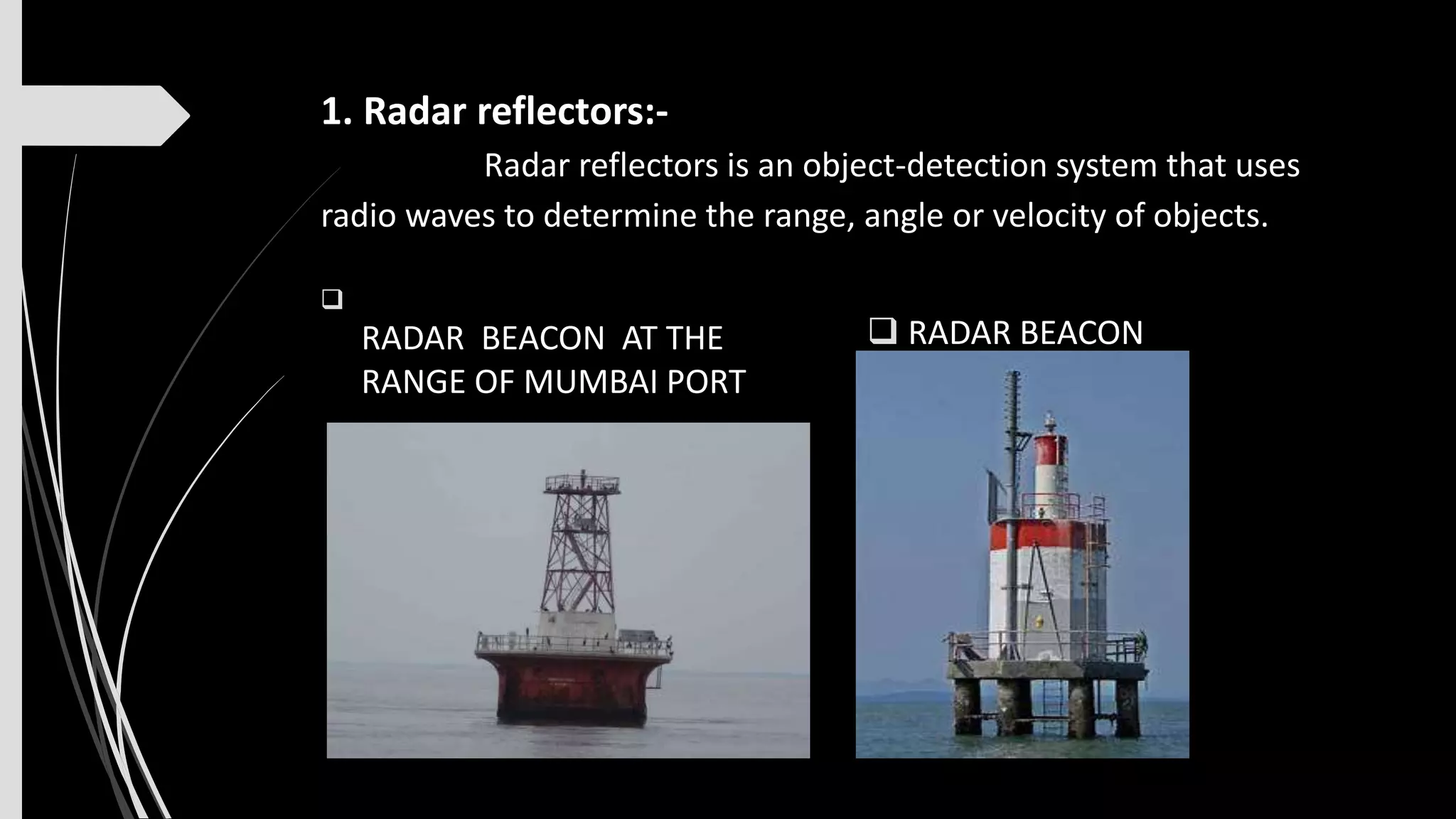
1. Radar reflectors:-
Radar reflectors is an object-detection system that uses
radio waves to determine the range, angle or velocity of objects.

RADAR BEACON AT THE
RANGE OF MUMBAI PORT
 RADAR BEACON
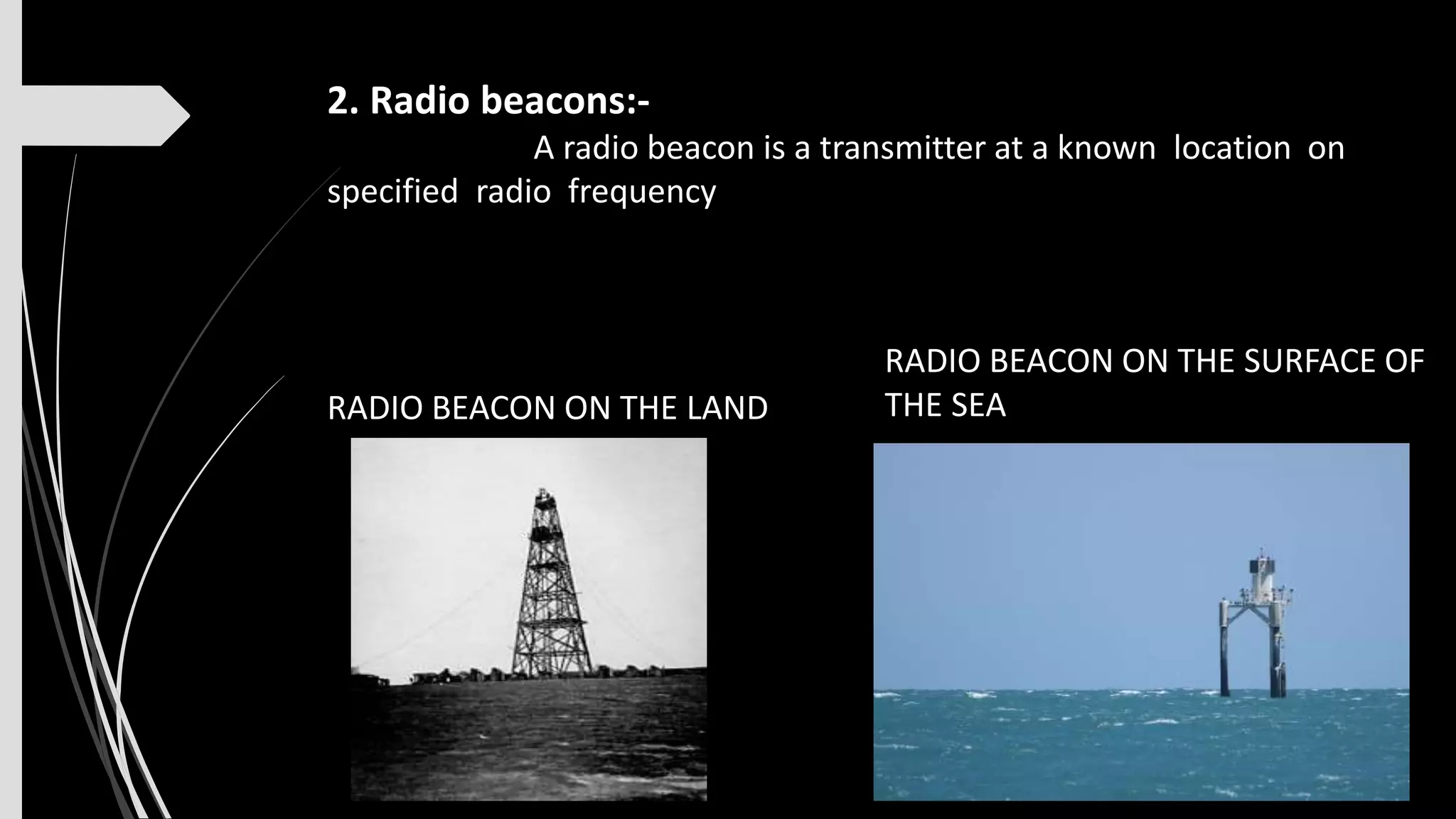
RADIO BEACON ON THE LAND
RADIO BEACON ON THE SURFACE OF
THE SEA
2. Radio beacons:-
A radio beacon is a transmitter at a known location on
specified radio frequency
3. Sonic and visual signals
 Visual beacons range from small, single-pipe structure to
large lighthouse or light station and can be located on land or
water
 There are also used of lights in navigation of ships at harbour,
like fixed light,Occulting light, Flashing light and coloured light
3)Light house:-
 It is a lofty structure popularly built of masonry or reinforced concrete in the
shape of a tall tower on a high pedestal.
 The tower is divided into convenient number of floors, the topmost floor
containing powerful lighting equipment and its operating machinery.
 The lower floors are used, as stores and living rooms necessary for the
maintenance and working of the light station.
 The main parts of a typical lighthouse tower are illustrated in fig.
 Lighthouses may be located on shore or on islands away from the mainland
as in the case of warning light stations
 In the former case, the lighthouse may be easily connected with the nearest
village or township by proper communications, while in the later situation
it is located far habited area.
 In either case as a matter of convenience and urgency, all the requirement
for the efficient and unfailing maintenance and working of the lighthouse
,like stores and staff quarters are provided in the lighthouse shaft.
 Essentially required to assist navigator in conducting the
vessels during night hours. Therefore, the navigator must
have knowledge of the light characteristics of the aids to
navigation. Light house is one of the important lighted
navigational aid, are placed in a height with powerful light to
assist the navigator or wherever a danger requires a warning.
LIGHT HOUSE AT PORTUGLE LIGHT HOUSE AT GOA
Components
 • Even if lighthouse do vary greatly due to their usage and location,
they also have similar components wherever they may be. Each
structure has a light station that is composed of the tower and all its
underlying buildings like the fuel house, living quarters of the keeper,
fog-signaling building, and boathouse.
 •The Lantern Room is where the lamp and lens are located. It is
usually a glassed-in quarter located at the top of the tower structure
where the light is operated by the keeper. The glasses are storm-
proof and there is also a ventilator for the releasing of the smoke and
heat build up. A grounding system and lightning rod are connected to
the Cupola to provide safety against lightning strikes.
 •Just underneath the Lantern Room is the Service Room or Watch
Room. This is where the keeper prepares the lantern and keeps his
watch for the night. Fuel and other important supplies are also kept in
this room.
Dimensions:-
 The heights and dimensions of
lighthouses around the world vary
greatly
depending on their location and
usage.
Light house can be from 80 feet to
200 feet. Depending upon the need
of
the particular space and soil bearing
capacity it very from 50 to 300 feet.
The base of the structure at the
ground level should have a surface
area of not less than four square
meters or 43 square feet.
Some facts about light house
 Lighthouses are painted differently to help mariners identify them during
the day. For example, a lighthouse may be painted all white if its
surroundings/background is dark. The red and white stripes help the
mariner identify the lighthouse if it’s up against a white background, such
as cliffs or rocks.
 The height of a lighthouse takes into account the curvature of the earth, so
the higher light above MHW (mean high water), the further away it can be
seen at sea. But the light should not be so high up that local sailors will not
see it. This is why you will frequently get shorter lighthouses on the top of
cliffs and taller lighthouses built nearer the water surface.
 Originally lighthouses were lit with open fires, only later progressing
through candles, lanterns and electric lights.
 These days, lighthouses are run by machines and remote monitoring. The
automatic sensors decide if there is extra moisture in the air, and if so turn
on the fog signals. Radio signals are used to communicate with the ships.
But when the technology was not so advanced the lighthouses were run
by lighthouse keepers.
FLOATING NAVIGATIONAL AIDS
There are two types
1. Light ships
2. Buoys
1)Light ships:-
 Lightship is a ship which is act as light house. They are used in waters the are
to deep or unsuitable for lighthouse
 First lightship was posted in 1820 in United States in Elizabeth river.
 Afterward, for a time lightships proliferated; but their number has steadily
decreased Light ships mark the entrances to harbours or estuaries, dangerous
shoals lying in much frequented waters.
 Maintenance cost is very high for Light ships when compare to light house.
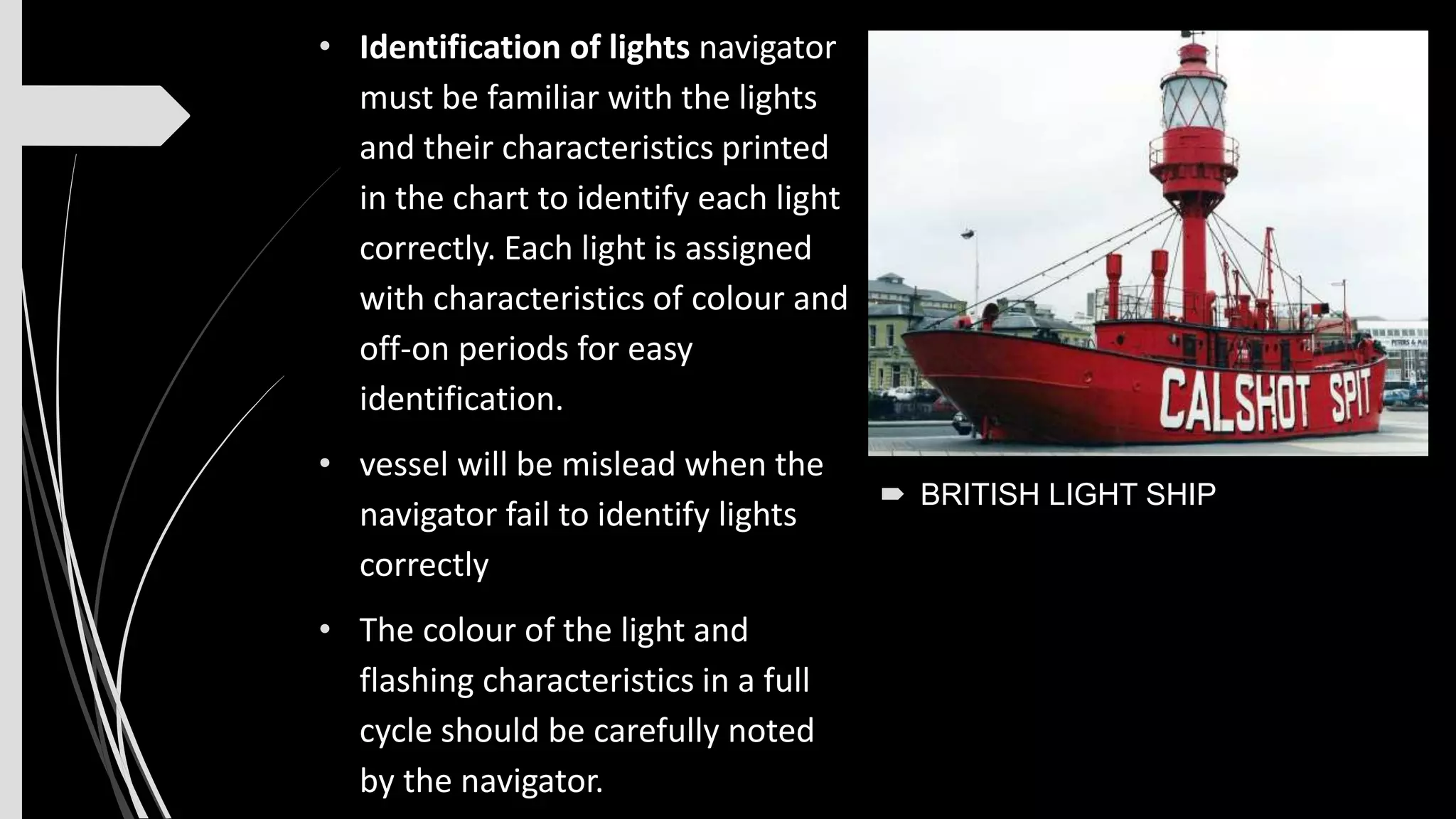
 BRITISH LIGHT SHIP
• Identification of lights navigator
must be familiar with the lights
and their characteristics printed
in the chart to identify each light
correctly. Each light is assigned
with characteristics of colour and
off-on periods for easy
identification.
• vessel will be mislead when the
navigator fail to identify lights
correctly
• The colour of the light and
flashing characteristics in a full
cycle should be carefully noted
by the navigator.
Mooring
 Holding the vessel in position was an important
aspect of lightvessel engineering. Early lightships
used fluke anchors, which are still in use on many
contemporary vessels.
 These were not very satisfactory, since a lightship
has to remain stationary in very rough seas which
other vessels can avoid, and these anchors are
prone to dragging
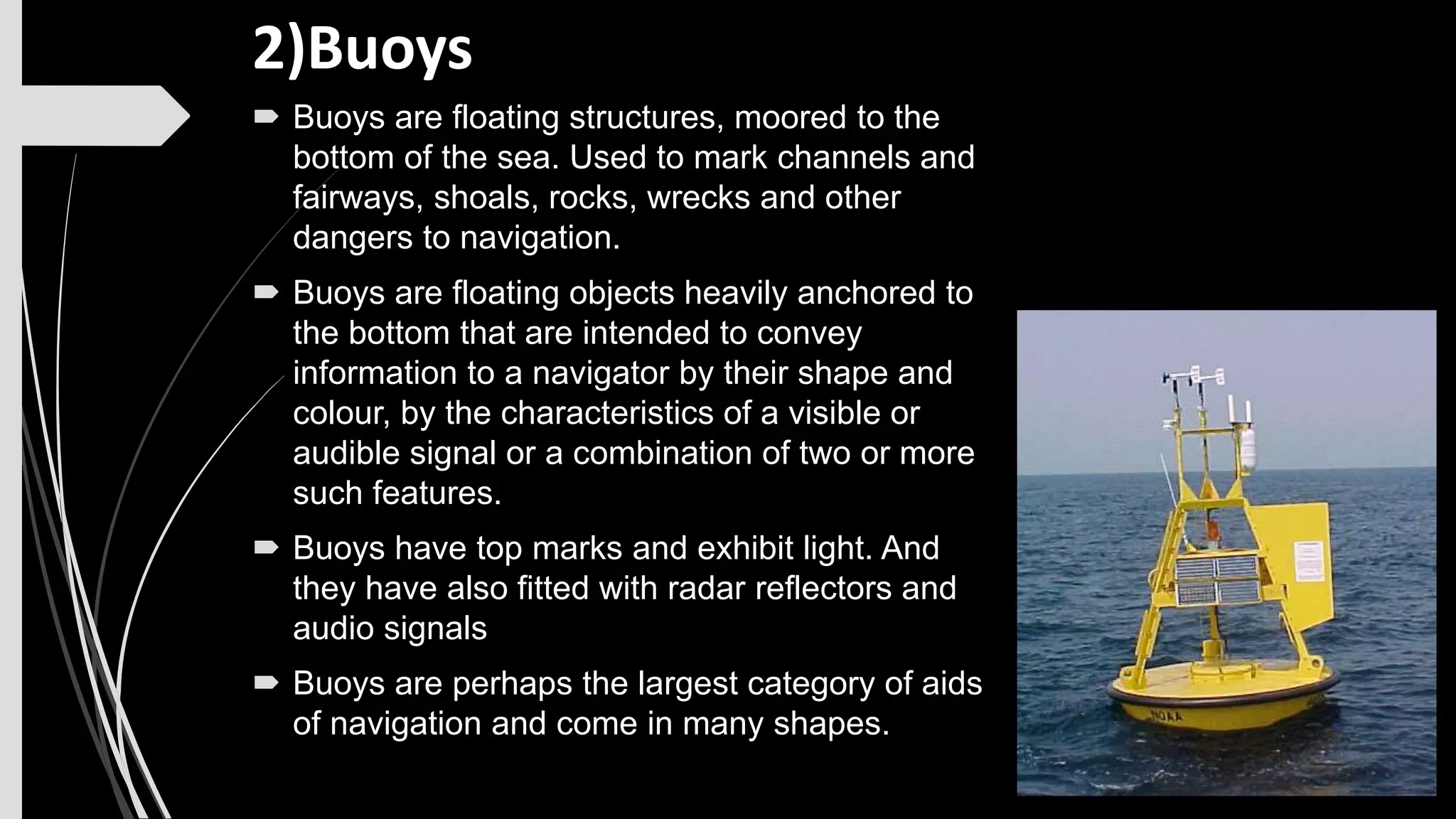
2)Buoys
 Buoys are floating structures, moored to the
bottom of the sea. Used to mark channels and
fairways, shoals, rocks, wrecks and other
dangers to navigation.
 Buoys are floating objects heavily anchored to
the bottom that are intended to convey
information to a navigator by their shape and
colour, by the characteristics of a visible or
audible signal or a combination of two or more
such features.
 Buoys have top marks and exhibit light. And
they have also fitted with radar reflectors and
audio signals
 Buoys are perhaps the largest category of aids
of navigation and come in many shapes.
TYPES OF BUOYS
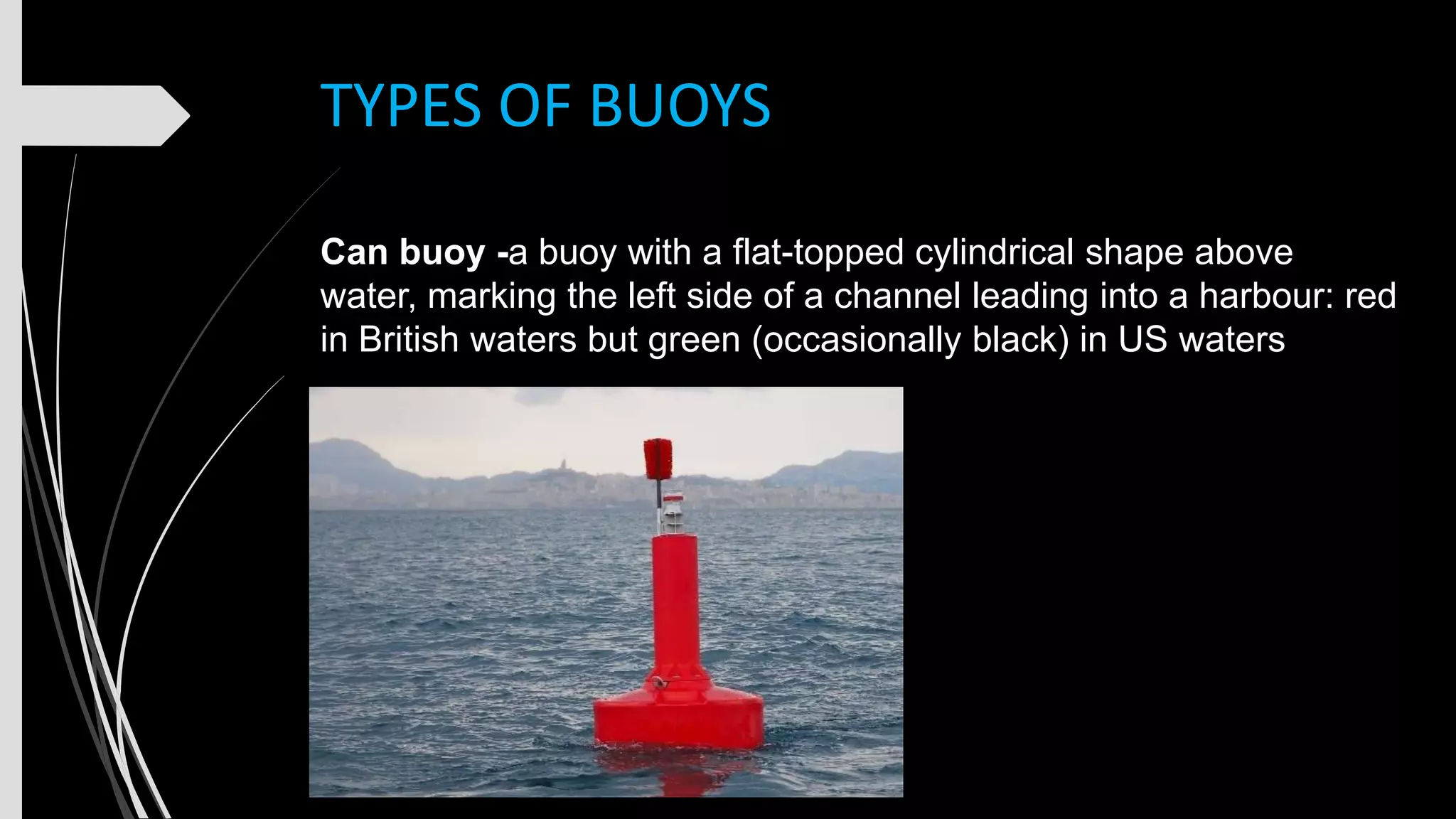
Can buoy -a buoy with a flat-topped cylindrical shape above
water, marking the left side of a channel leading into a harbour: red
in British waters but green (occasionally black) in US waters
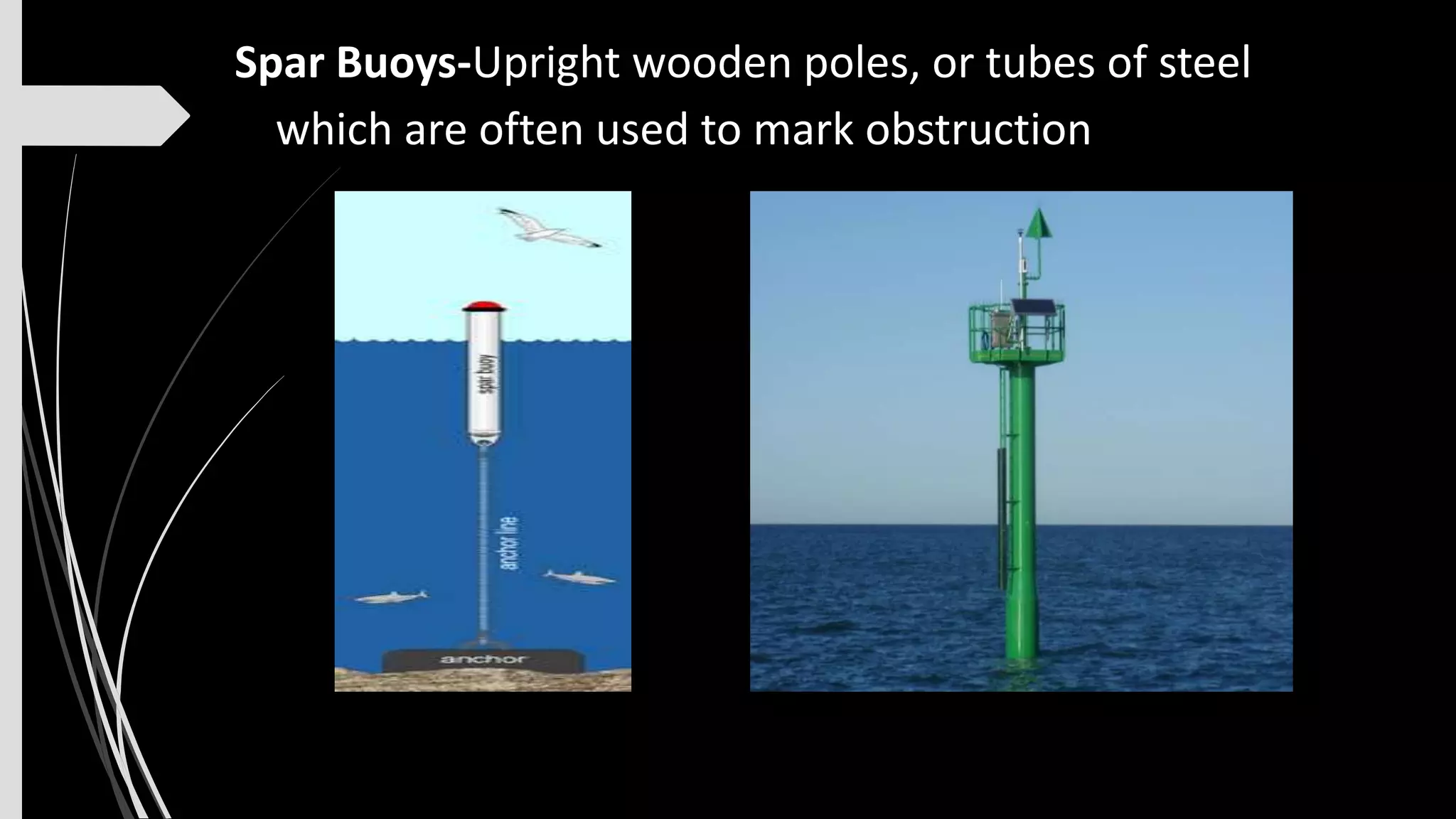
Spar Buoys-Upright wooden poles, or tubes of steel
which are often used to mark obstruction
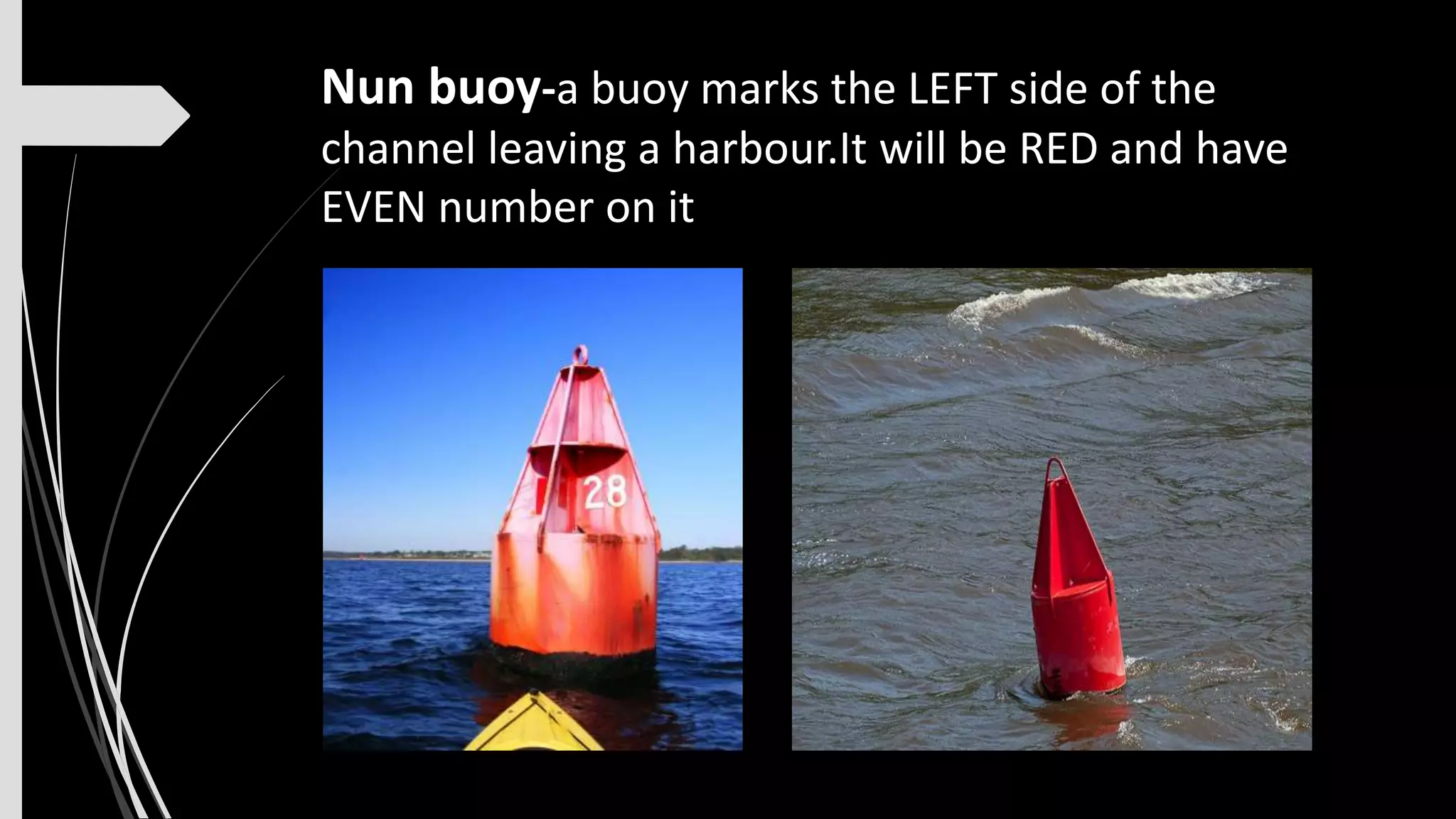
Nun buoy-a buoy marks the LEFT side of the
channel leaving a harbour.It will be RED and have
EVEN number on it
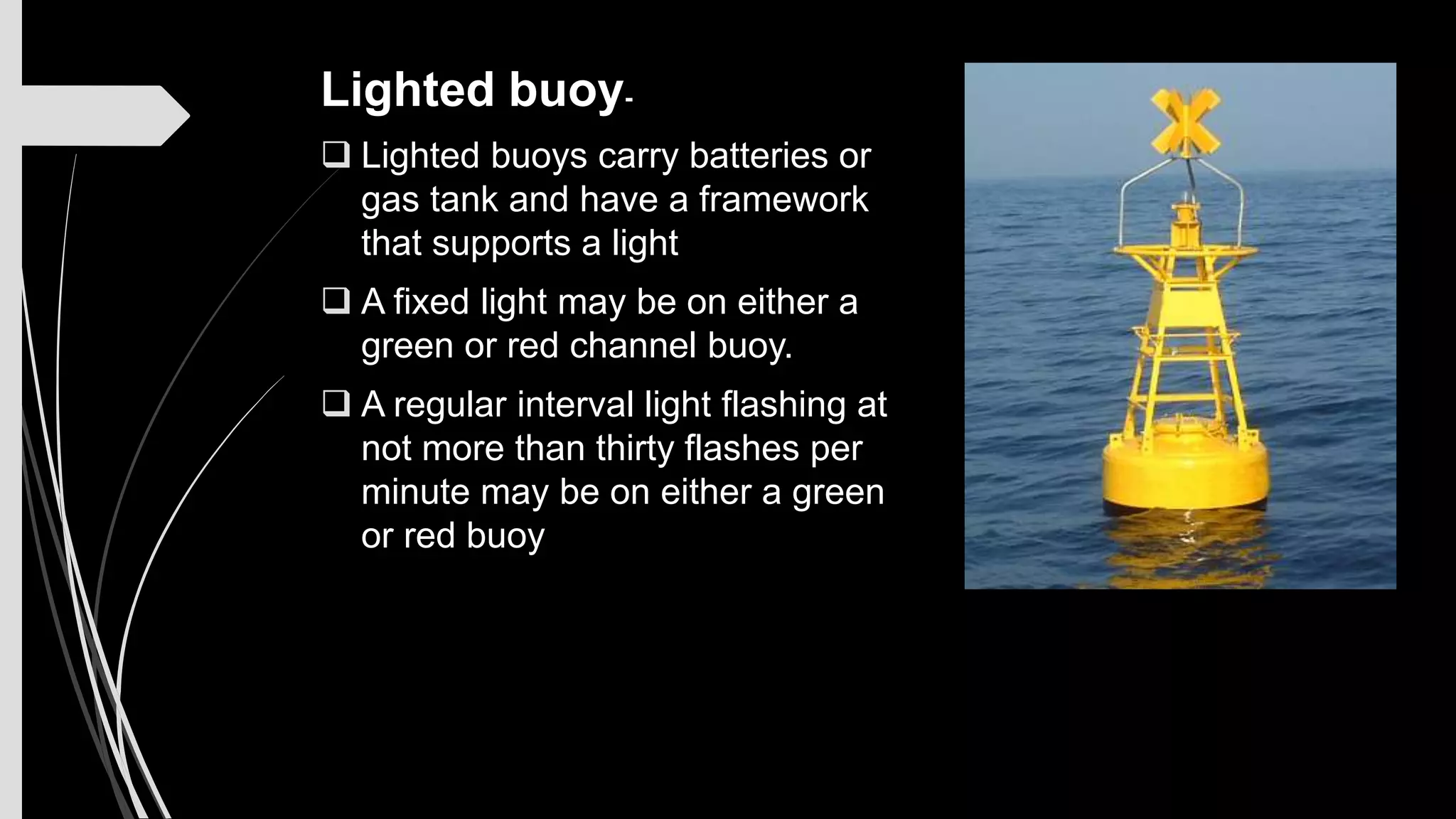
Lighted buoy-
 Lighted buoys carry batteries or
gas tank and have a framework
that supports a light
 A fixed light may be on either a
green or red channel buoy.
 A regular interval light flashing at
not more than thirty flashes per
minute may be on either a green
or red buoy
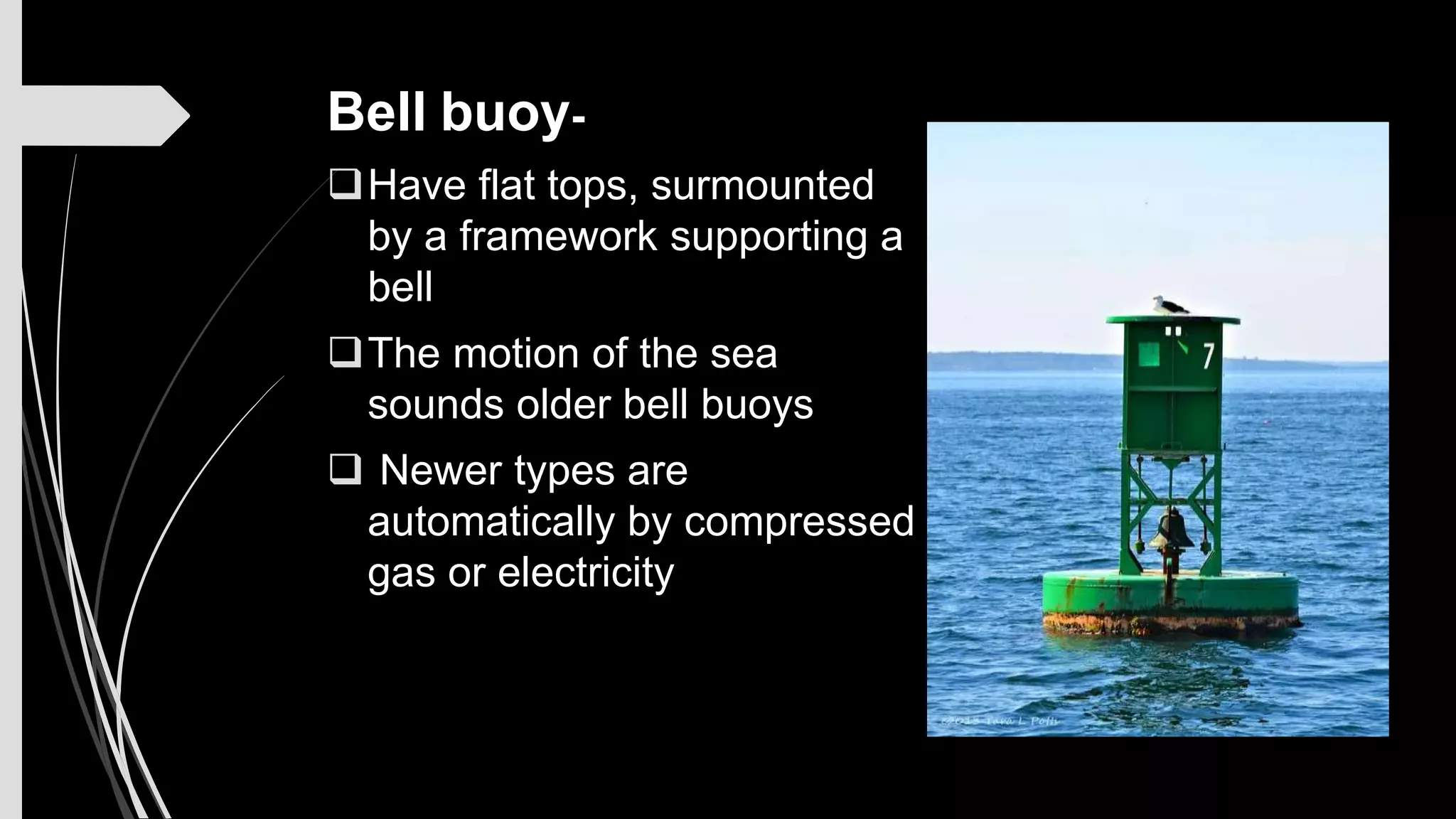
Bell buoy-
Have flat tops, surmounted
by a framework supporting a
bell
The motion of the sea
sounds older bell buoys
 Newer types are
automatically by compressed
gas or electricity
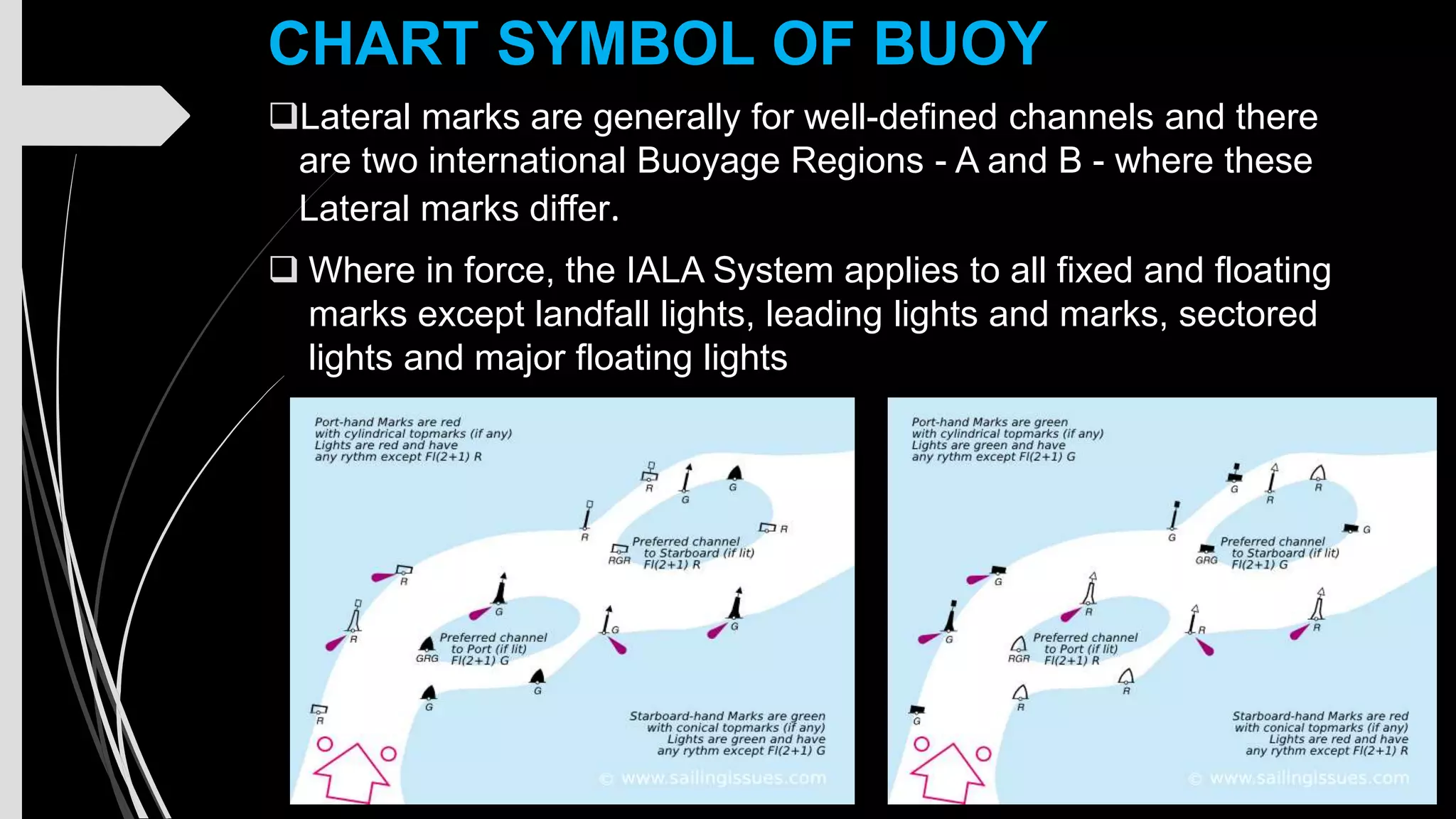
CHART SYMBOL OF BUOY
Lateral marks are generally for well-defined channels and there
are two international Buoyage Regions - A and B - where these
Lateral marks differ.
 Where in force, the IALA System applies to all fixed and floating
marks except landfall lights, leading lights and marks, sectored
lights and major floating lights
NAVIGATIONAL AIDS AT COASTAL LINE OF GUJRAT
LIGHTHOUSE
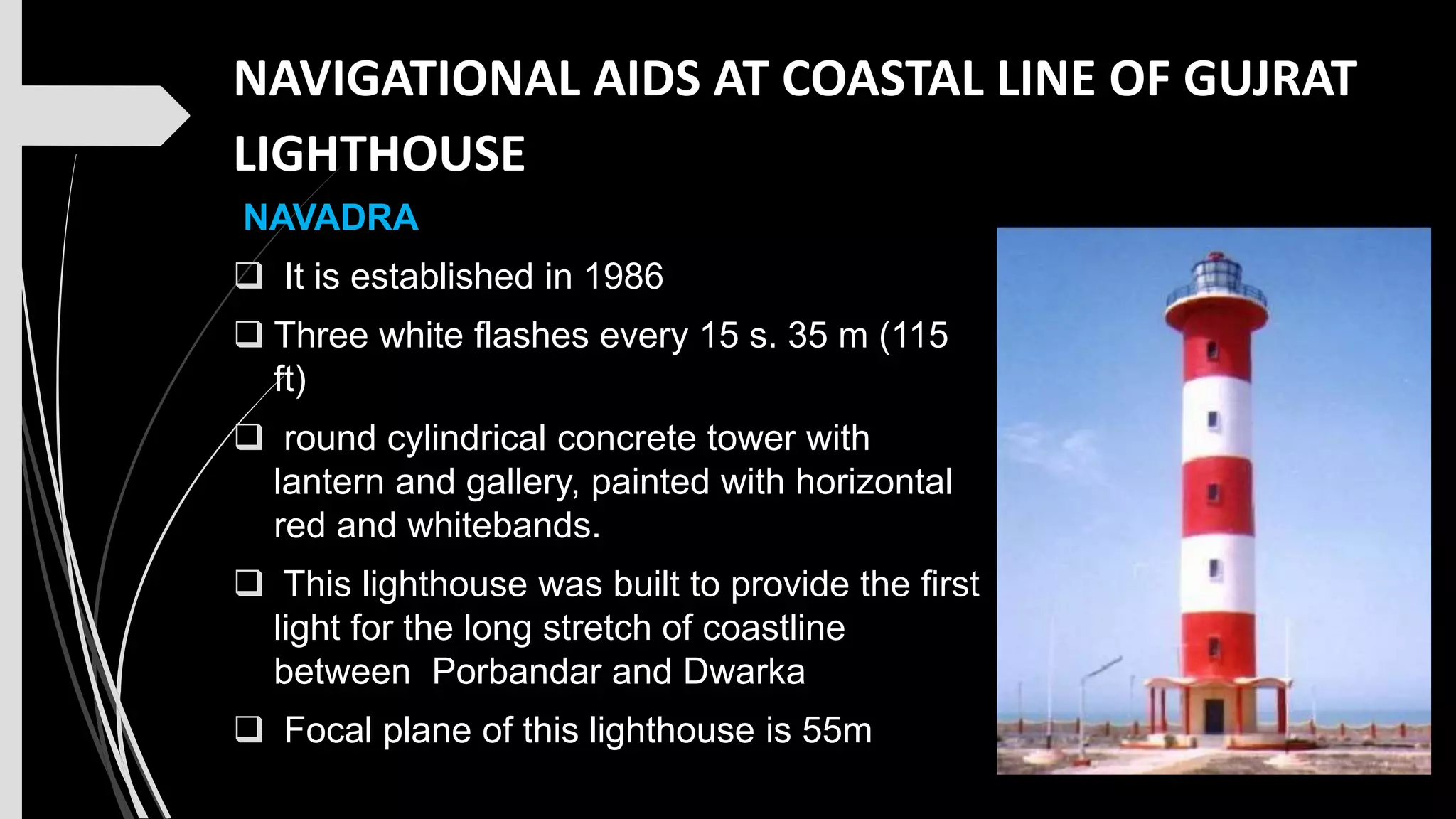
NAVADRA
 It is established in 1986
 Three white flashes every 15 s. 35 m (115
ft)
 round cylindrical concrete tower with
lantern and gallery, painted with horizontal
red and whitebands.
 This lighthouse was built to provide the first
light for the long stretch of coastline
between Porbandar and Dwarka
 Focal plane of this lighthouse is 55m
PIROTAN ISLAND
JAMNAGAR
 It is established in
1958
 Its focal plane 26 m (85
ft);
 White flash every 20 s.
21 m (69 ft) round
masonry tower with
lantern and
 gallery, painted with
horizontal black and
white bands
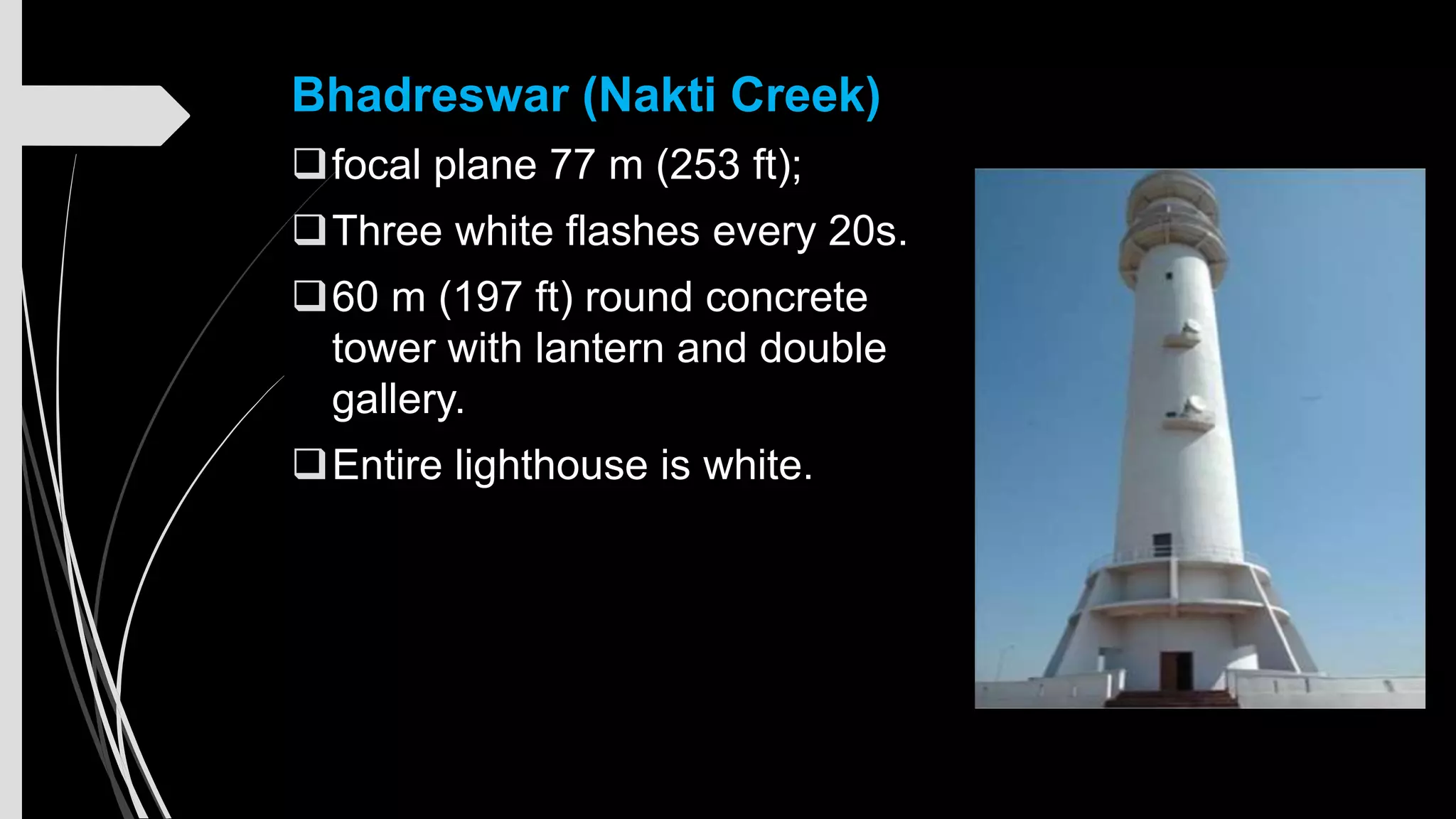
Bhadreswar (Nakti Creek)
focal plane 77 m (253 ft);
Three white flashes every 20s.
60 m (197 ft) round concrete
tower with lantern and double
gallery.
Entire lighthouse is white.
MANDVI
It is established in 1889
This was a round cylindrical
tower with lantern and gallery
mounted on a
round stone tower 17th century
fortress of Mandvi;
The light was listed with a focal
plane of 35 m (115 ft).
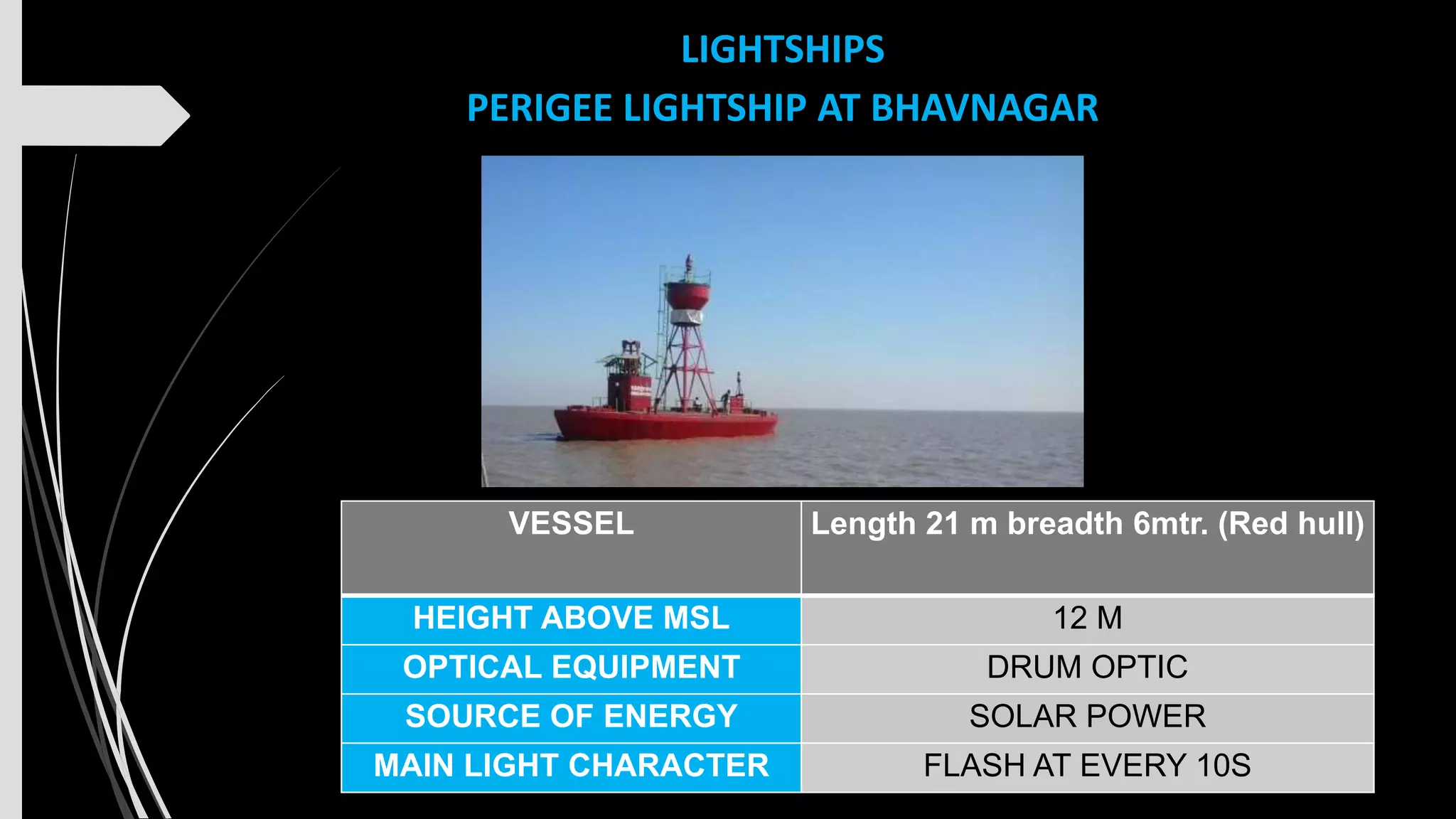
VESSEL Length 21 m breadth 6mtr. (Red hull)
HEIGHT ABOVE MSL 12 M
OPTICAL EQUIPMENT DRUM OPTIC
SOURCE OF ENERGY SOLAR POWER
MAIN LIGHT CHARACTER FLASH AT EVERY 10S
LIGHTSHIPS
PERIGEE LIGHTSHIP AT BHAVNAGAR
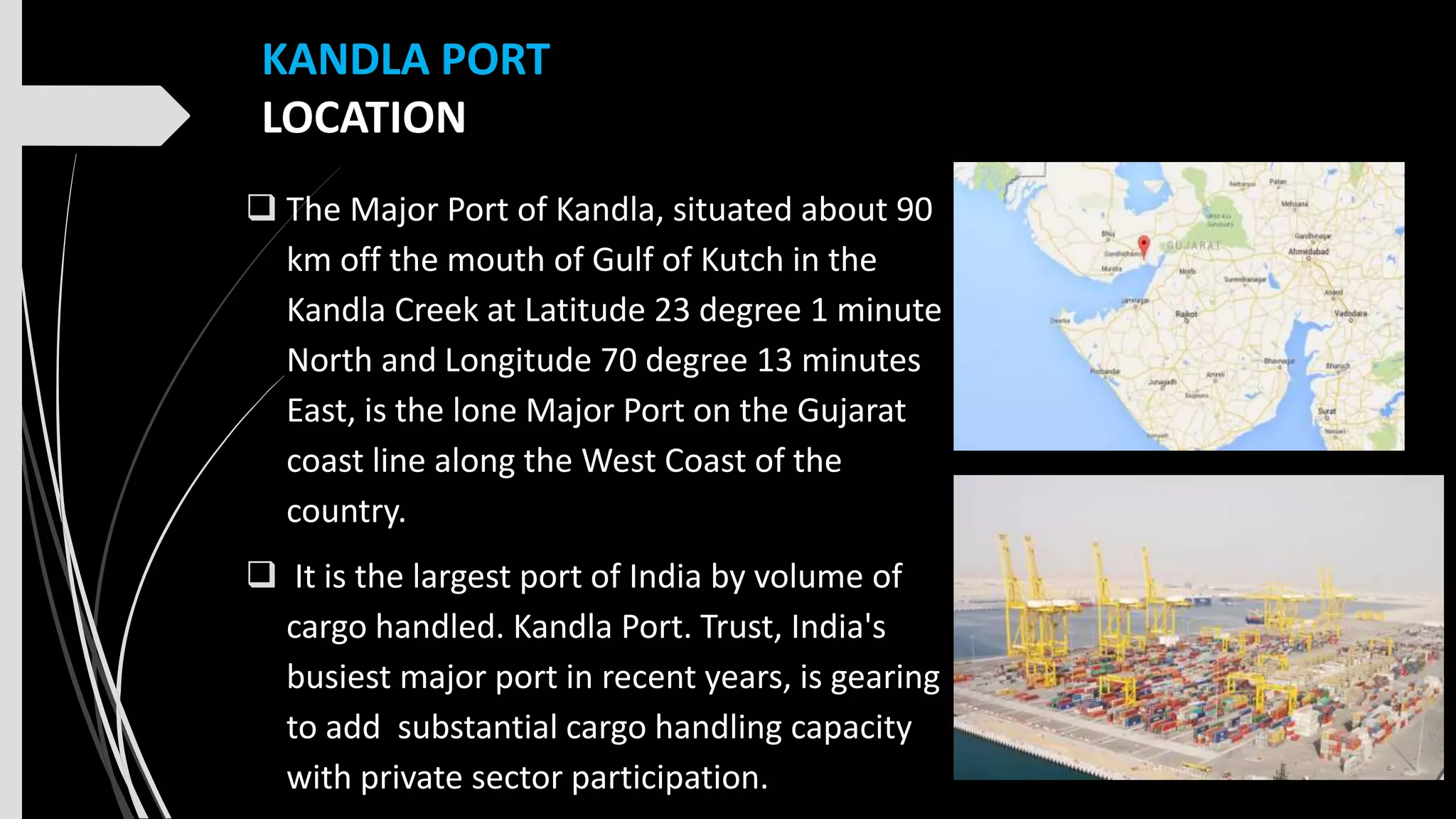
 The Major Port of Kandla, situated about 90
km off the mouth of Gulf of Kutch in the
Kandla Creek at Latitude 23 degree 1 minute
North and Longitude 70 degree 13 minutes
East, is the lone Major Port on the Gujarat
coast line along the West Coast of the
country.
 It is the largest port of India by volume of
cargo handled. Kandla Port. Trust, India's
busiest major port in recent years, is gearing
to add substantial cargo handling capacity
with private sector participation.
KANDLA PORT
LOCATION
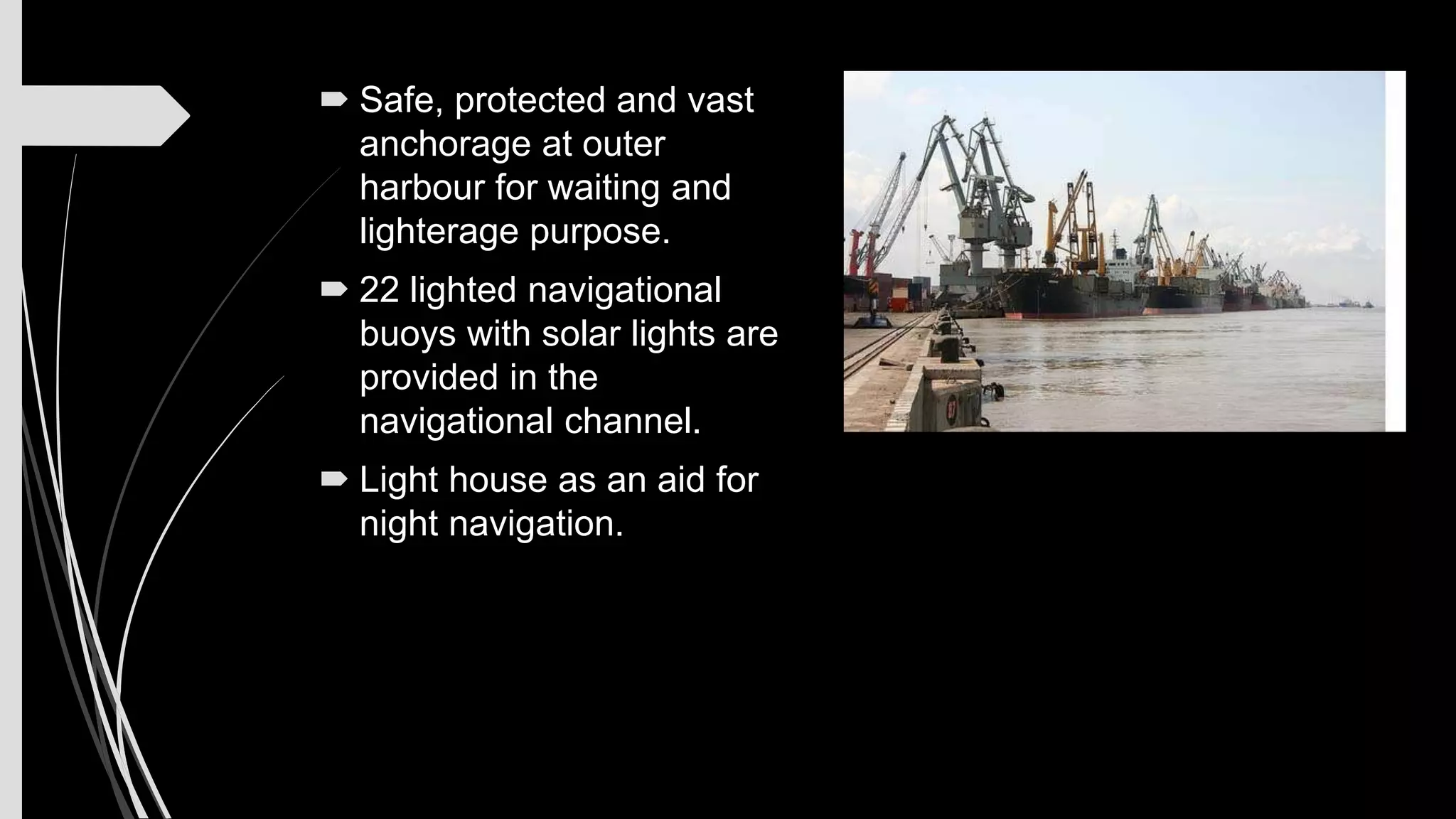
Navigational facilities at Kandla port
 Round-the-clock
navigation
 Permissible draught 12.6
mtrs.
 Ships with 240 mtrs.
length overall and 65,000
DWT are accommodated
presently.
 Safe, protected and vast
anchorage at outer
harbour for waiting and
lighterage purpose.
 22 lighted navigational
buoys with solar lights are
provided in the
navigational channel.
 Light house as an aid for
night navigation.
REFERENCE:- WWW.MARITIMEJOURNAL.COM
WWW.FISH4FUN.COM
BOOK:- S.P. BINDRA(DOCKS AND HARBOUR
THANK YOU

Navigational aids

  • 1.
    1)DHRUV JADAV --43 3)SHYAM BHARADVA --10 2)CHINTAN KHETARIYA -- 54 4)ANIL BARAD --07 CLASS:- S.S. OF B.E. CIVIL THIRD YEAR YEAR:- 2017-2018
  • 2.
    DEFINATION  The term“aid to navigation” means any object or device, external to a vessel that is intended to assist a navigator in fixing his position or determining a safe course past hazards to navigation.  It includes both fixed and floating objects such as lights, light ships, buoys, day beacons, and fog signals, plus electronic aids to navigation such as radio beacons.  They also serve to warn of hidden dangers and assist in making landfall when approaching from the high seas. They also provide a continuous chain of charted marks, showing improved channels and assisting in coastal piloting.
  • 3.
    IMPORTANCE OF NAVIGATIONALAIDS Enhances safety and can act as good safety barriers. Help to improve safety at seas. Finding and safely navigating a narrow channel in a wide expanse of water. Also help mariners in determining their position with respect to land or any navigational hazard or hidden danger.
  • 4.
    TYPES OF NAVIGATIONALAIDS  Depending upon structure………….. There are two types of navigational aids. 1) Fixed structures 2) Floating structures  Depending upon service and visibility…. There are four types of navigational aids 1)Coast approach light station 2)Obstruction light station 3)Approach channel lighting 4)Harbour light signal
  • 5.
    FIXED NAVIGATIONAL STRUCTURES Thereare following three types of fixed navigation structures. 1)Navigational lights of piers:- For the navigational purpose at the port or harbour locate the light system on the piers.
  • 6.
    2)Beacon lights:- A beaconis an intentionally conspicuous device designed to attract attention to a specific location Beacons can also be combined with semaphoric or other indicators to Provide important information, such as the navigation of the ships. Beacons help guide navigators to their destinators. Types of navigational beacons:- 1) Radar reflectors 2) Radio beacons 3) sonic and visual signals
  • 7.
    1. Radar reflectors:- Radarreflectors is an object-detection system that uses radio waves to determine the range, angle or velocity of objects.  RADAR BEACON AT THE RANGE OF MUMBAI PORT  RADAR BEACON
  • 8.
    RADIO BEACON ONTHE LAND RADIO BEACON ON THE SURFACE OF THE SEA 2. Radio beacons:- A radio beacon is a transmitter at a known location on specified radio frequency
  • 9.
    3. Sonic andvisual signals  Visual beacons range from small, single-pipe structure to large lighthouse or light station and can be located on land or water  There are also used of lights in navigation of ships at harbour, like fixed light,Occulting light, Flashing light and coloured light
  • 10.
    3)Light house:-  Itis a lofty structure popularly built of masonry or reinforced concrete in the shape of a tall tower on a high pedestal.  The tower is divided into convenient number of floors, the topmost floor containing powerful lighting equipment and its operating machinery.  The lower floors are used, as stores and living rooms necessary for the maintenance and working of the light station.  The main parts of a typical lighthouse tower are illustrated in fig.  Lighthouses may be located on shore or on islands away from the mainland as in the case of warning light stations  In the former case, the lighthouse may be easily connected with the nearest village or township by proper communications, while in the later situation it is located far habited area.
  • 11.
     In eithercase as a matter of convenience and urgency, all the requirement for the efficient and unfailing maintenance and working of the lighthouse ,like stores and staff quarters are provided in the lighthouse shaft.  Essentially required to assist navigator in conducting the vessels during night hours. Therefore, the navigator must have knowledge of the light characteristics of the aids to navigation. Light house is one of the important lighted navigational aid, are placed in a height with powerful light to assist the navigator or wherever a danger requires a warning.
  • 12.
    LIGHT HOUSE ATPORTUGLE LIGHT HOUSE AT GOA
  • 13.
    Components  • Evenif lighthouse do vary greatly due to their usage and location, they also have similar components wherever they may be. Each structure has a light station that is composed of the tower and all its underlying buildings like the fuel house, living quarters of the keeper, fog-signaling building, and boathouse.  •The Lantern Room is where the lamp and lens are located. It is usually a glassed-in quarter located at the top of the tower structure where the light is operated by the keeper. The glasses are storm- proof and there is also a ventilator for the releasing of the smoke and heat build up. A grounding system and lightning rod are connected to the Cupola to provide safety against lightning strikes.  •Just underneath the Lantern Room is the Service Room or Watch Room. This is where the keeper prepares the lantern and keeps his watch for the night. Fuel and other important supplies are also kept in this room.
  • 14.
    Dimensions:-  The heightsand dimensions of lighthouses around the world vary greatly depending on their location and usage. Light house can be from 80 feet to 200 feet. Depending upon the need of the particular space and soil bearing capacity it very from 50 to 300 feet. The base of the structure at the ground level should have a surface area of not less than four square meters or 43 square feet.
  • 15.
    Some facts aboutlight house  Lighthouses are painted differently to help mariners identify them during the day. For example, a lighthouse may be painted all white if its surroundings/background is dark. The red and white stripes help the mariner identify the lighthouse if it’s up against a white background, such as cliffs or rocks.  The height of a lighthouse takes into account the curvature of the earth, so the higher light above MHW (mean high water), the further away it can be seen at sea. But the light should not be so high up that local sailors will not see it. This is why you will frequently get shorter lighthouses on the top of cliffs and taller lighthouses built nearer the water surface.  Originally lighthouses were lit with open fires, only later progressing through candles, lanterns and electric lights.  These days, lighthouses are run by machines and remote monitoring. The automatic sensors decide if there is extra moisture in the air, and if so turn on the fog signals. Radio signals are used to communicate with the ships. But when the technology was not so advanced the lighthouses were run by lighthouse keepers.
  • 16.
    FLOATING NAVIGATIONAL AIDS Thereare two types 1. Light ships 2. Buoys
  • 17.
    1)Light ships:-  Lightshipis a ship which is act as light house. They are used in waters the are to deep or unsuitable for lighthouse  First lightship was posted in 1820 in United States in Elizabeth river.  Afterward, for a time lightships proliferated; but their number has steadily decreased Light ships mark the entrances to harbours or estuaries, dangerous shoals lying in much frequented waters.  Maintenance cost is very high for Light ships when compare to light house.
  • 18.
     BRITISH LIGHTSHIP • Identification of lights navigator must be familiar with the lights and their characteristics printed in the chart to identify each light correctly. Each light is assigned with characteristics of colour and off-on periods for easy identification. • vessel will be mislead when the navigator fail to identify lights correctly • The colour of the light and flashing characteristics in a full cycle should be carefully noted by the navigator.
  • 19.
    Mooring  Holding thevessel in position was an important aspect of lightvessel engineering. Early lightships used fluke anchors, which are still in use on many contemporary vessels.  These were not very satisfactory, since a lightship has to remain stationary in very rough seas which other vessels can avoid, and these anchors are prone to dragging
  • 20.
    2)Buoys  Buoys arefloating structures, moored to the bottom of the sea. Used to mark channels and fairways, shoals, rocks, wrecks and other dangers to navigation.  Buoys are floating objects heavily anchored to the bottom that are intended to convey information to a navigator by their shape and colour, by the characteristics of a visible or audible signal or a combination of two or more such features.  Buoys have top marks and exhibit light. And they have also fitted with radar reflectors and audio signals  Buoys are perhaps the largest category of aids of navigation and come in many shapes.
  • 21.
    TYPES OF BUOYS Canbuoy -a buoy with a flat-topped cylindrical shape above water, marking the left side of a channel leading into a harbour: red in British waters but green (occasionally black) in US waters
  • 22.
    Spar Buoys-Upright woodenpoles, or tubes of steel which are often used to mark obstruction
  • 23.
    Nun buoy-a buoymarks the LEFT side of the channel leaving a harbour.It will be RED and have EVEN number on it
  • 24.
    Lighted buoy-  Lightedbuoys carry batteries or gas tank and have a framework that supports a light  A fixed light may be on either a green or red channel buoy.  A regular interval light flashing at not more than thirty flashes per minute may be on either a green or red buoy
  • 25.
    Bell buoy- Have flattops, surmounted by a framework supporting a bell The motion of the sea sounds older bell buoys  Newer types are automatically by compressed gas or electricity
  • 26.
    CHART SYMBOL OFBUOY Lateral marks are generally for well-defined channels and there are two international Buoyage Regions - A and B - where these Lateral marks differ.  Where in force, the IALA System applies to all fixed and floating marks except landfall lights, leading lights and marks, sectored lights and major floating lights
  • 27.
    NAVIGATIONAL AIDS ATCOASTAL LINE OF GUJRAT LIGHTHOUSE NAVADRA  It is established in 1986  Three white flashes every 15 s. 35 m (115 ft)  round cylindrical concrete tower with lantern and gallery, painted with horizontal red and whitebands.  This lighthouse was built to provide the first light for the long stretch of coastline between Porbandar and Dwarka  Focal plane of this lighthouse is 55m
  • 28.
    PIROTAN ISLAND JAMNAGAR  Itis established in 1958  Its focal plane 26 m (85 ft);  White flash every 20 s. 21 m (69 ft) round masonry tower with lantern and  gallery, painted with horizontal black and white bands
  • 29.
    Bhadreswar (Nakti Creek) focalplane 77 m (253 ft); Three white flashes every 20s. 60 m (197 ft) round concrete tower with lantern and double gallery. Entire lighthouse is white.
  • 30.
    MANDVI It is establishedin 1889 This was a round cylindrical tower with lantern and gallery mounted on a round stone tower 17th century fortress of Mandvi; The light was listed with a focal plane of 35 m (115 ft).
  • 31.
    VESSEL Length 21m breadth 6mtr. (Red hull) HEIGHT ABOVE MSL 12 M OPTICAL EQUIPMENT DRUM OPTIC SOURCE OF ENERGY SOLAR POWER MAIN LIGHT CHARACTER FLASH AT EVERY 10S LIGHTSHIPS PERIGEE LIGHTSHIP AT BHAVNAGAR
  • 32.
     The MajorPort of Kandla, situated about 90 km off the mouth of Gulf of Kutch in the Kandla Creek at Latitude 23 degree 1 minute North and Longitude 70 degree 13 minutes East, is the lone Major Port on the Gujarat coast line along the West Coast of the country.  It is the largest port of India by volume of cargo handled. Kandla Port. Trust, India's busiest major port in recent years, is gearing to add substantial cargo handling capacity with private sector participation. KANDLA PORT LOCATION
  • 33.
    Navigational facilities atKandla port  Round-the-clock navigation  Permissible draught 12.6 mtrs.  Ships with 240 mtrs. length overall and 65,000 DWT are accommodated presently.
  • 34.
     Safe, protectedand vast anchorage at outer harbour for waiting and lighterage purpose.  22 lighted navigational buoys with solar lights are provided in the navigational channel.  Light house as an aid for night navigation.
  • 35.
  • 36.