BREAK WATERS
A breakwater is a structure constructed for
the purpose of forming an artificial harbor
with a basin so protected from the effect of
waves as to provide safe berthing for
fishing vessels. The type of protection
provided may be by the natural
configuration of the coast or by
construction of artificial carriers
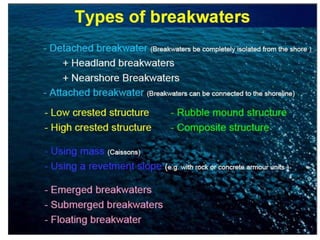
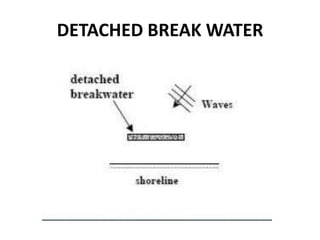
DETACHED BREAK WATER
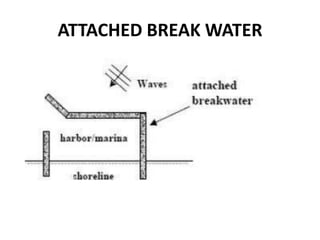
ATTACHED BREAK WATER
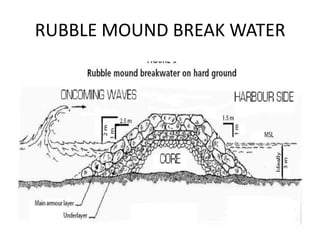
RUBBLE MOUND BREAK WATER
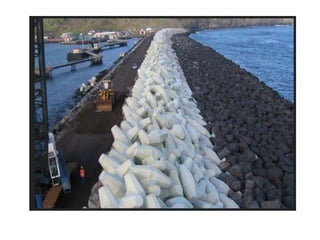
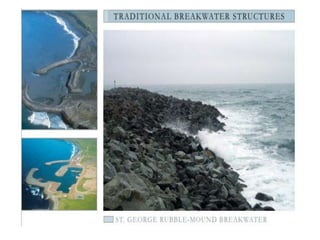
• Rubble mound break waters are structures
  build of quarried rock, usually protected by a
  cover of heavy armour stones or concrete
  armour units.
• The core may partly comprise of other
  materials like limestone or dredged gravel.
• In case of poor foundation conditions, soil
  improvement techniques or use of geo textiles
  can be used.
SELECTION OF TYPE OF BREAKWATER
• Caisson break waters are often preferred in deeper
  water , as the quarried rock quantities for a rubble
  mound increase significantly with increasing depth.
  The depth of water at which the caisson break water
  becomes more economical will vary with location.
  Usually for depth of 15m or above caisson break water
  is preferable.
• When the break water serves as purpose with a port as
  quay wall or storage area, a rubble mound structure
  will require a concrete crest.
• Rubble mound break waters have better wave energy
  dissipation properties due to its rough armour sides,
  hence for break waters of lesser depth rubble mound
  break water is more economical.
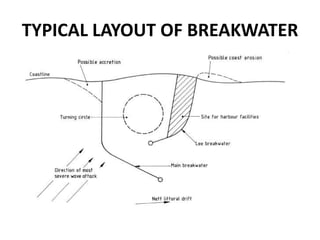
TYPICAL LAYOUT OF BREAKWATER
PARAMETERS FOR THE
  CONSTRUCTION OF A BREAKWATER
• When a breakwater is to be built at a certain location,
   and the environmental impact of such a structure has
   already been evaluated and deemed environmentally
   feasible, the following parameters are required before
   construction can commence:
  • a detailed hydrographic survey of the site;
  • a geotechnical investigation of the sea bed;
  • a wave height investigation or hindcasting;
  • a material needs assessment; and
  • the cross-sectional design of the structure.
Geotechnical investigation
 A geotechnical investigation of the sea bed is required
to determine the type of founding material and its
extent. The results of this investigation will have a
direct bearing on the type of cross-section of the
breakwater. In addition, it is essential to determine
what the coastline consists of, for example:
• soft or hard rock (like coral reefs or granite);
• sand (as found on beaches);
• clay (as in some mangrove areas); and
• soft to very soft clay, silt or mud (as found along
some river banks, mangroves and other tidal areas).
Basic geotechnical investigations
Basic geotechnical investigations normally suffice for small
or artisanal projects, especially when the project site is
remote and access poor. A basic geotechnical investigation
 should be carried out or supervised by an experienced
 engineer or geologist familiar with the local soil conditions.
 The following activities may be carried out in a basic
  investigation using only portable equipment:
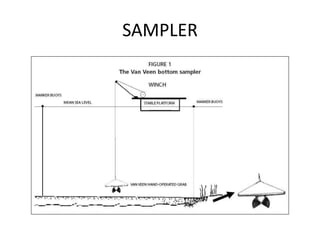
 • retrieval of bottom sediments for laboratory analysis;
 • measurement of bottom layer (loose sediment) thickness;
 • approximate estimation of bearing capacity of the sea
   bed.
SAMPLER
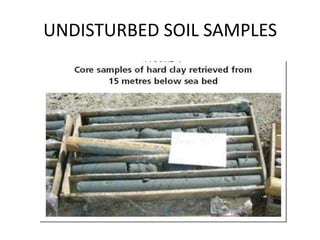
UNDISTURBED SOIL SAMPLES
Once the layer of soft sediment has been
identified (sampled) and measured (pricked),
it is then necessary to determine the hardness
of the underlying layer. The underlying layer
may be rock, clay or compacted sand. If the
layer is rocky, the diver should collect a piece
of the material for laboratory analysis using a
hammer and chisel. For softer types of
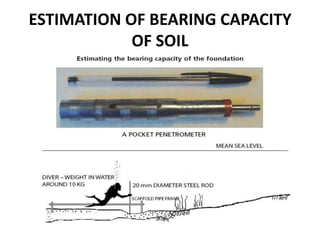
material, the diver (with a submerged weight
of around 10 kilograms) should use a steel
probe (1 metre long, 12 millimetres in
diameter) or pocket penetrometer
ESTIMATION OF BEARING CAPACITY
            OF SOIL
Wave hindcasting
• The height of wave incident on a breakwater
  generally determines the size and behaviour of
  the breakwater.
• It is hence of the utmost importance to obtain
  realistic values of the waves expected in a
  particular area.
• They are generated by the action of wind moving
  over a waterbody; the stronger the wind blows,
  the higher the waves generated. They may vary in
  size from ripples on a pond to large ocean waves
  as high as 10 metres.
METHODS OF WAVE HINDCASTING
       The precise nature of the types of wave
  incident on a particular stretch of shoreline, also
  known as wave hindcasting, may be investigated
  by three different methods:
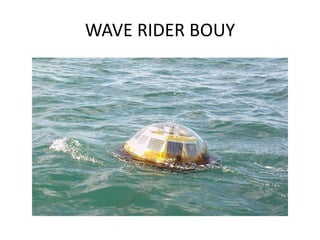
• Method 1 – On-the-spot measurement by special
  electronic equipment, such as a wave rider buoy.
• Method 2 – Prediction by statistical methods on a
  computer – statistical hindcast models may be
  performed on the computer if wind data or
  satellite wave data are available for the area;
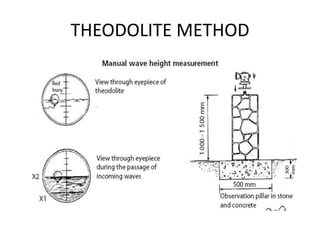
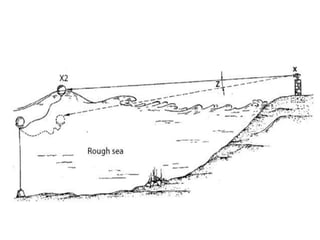
• Method 3 – On-the-spot observation by simple
  optical instruments – the theodolite.
WAVE RIDER BOUY
THEODOLITE METHOD
This method, however, suffers from the following
   drawbacks. The wave heights thus recorded will
   already be distorted by the water depths close to
   the shoreline.
• A human observer can only see waves during
   daylight hours, effectively reducing observation
   time by a half.
• In very bad weather, strong winds and rain
   drastically reduce visibility making it difficult to
   keep the buoy under observation continuously.
• The presence of swell is very difficult to detect,
   especially during a local storm, due to the very
   long time (period) between peaks, typically 15
   seconds or more.
During wave height observations, the
  following additional information should also
  be recorded:
• direction of both the incoming waves and
  wind using the hand-held compass;
• the time difference between each successive
  wave peak, also known as wave period
• the exact position of the buoy with respect to
  the coastline; and
• time of the year when each storm was
  recorded.
Cross-sectional design
• A suitable cross-sectional design for the breakwater has to
  be produced taking into consideration all the previous data,
  for example:
  • water depths (in deep water, solid vertical sides are
  preferred to save on material);
  • type of foundation (if ground is soft and likely to settle,
  then a rubble breakwater is recommended);
  • height of waves (rubble breakwaters are more suitable
  than solid ones in the presence of larger waves); and
  • availability of materials (if no rock quarries are
  available in the vicinity of the project, then rubble
  breakwaters cannot be economically justified).
THUMB RULES FOR DESIGNING
    The following rules of thumb may be applied to very
   small projects with water depths not exceeding 3.0
   metres:
     For rubble mound or rock breakwaters:
• Unaided breakwater design should not be attempted in
   waters deeper than 3 metres.
• If the foundation material is very soft and thick, then a
   geotextile filter mat should be placed under the rock to
   prevent it from sinking and disappearing into the mud
• If a thin layer of loose or soft material exists above a
   hard layer, then this should be removed to expose the
   hard interface and the breakwater built on this surface
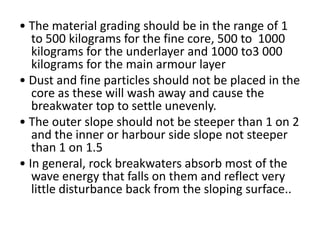
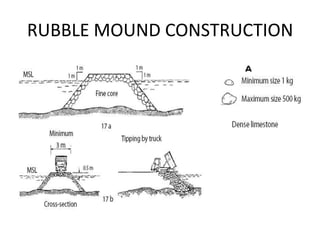
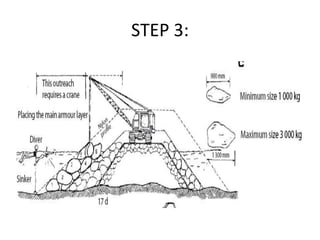
• The material grading should be in the range of 1
   to 500 kilograms for the fine core, 500 to 1000
   kilograms for the underlayer and 1000 to3 000
   kilograms for the main armour layer
• Dust and fine particles should not be placed in the
   core as these will wash away and cause the
   breakwater top to settle unevenly.
• The outer slope should not be steeper than 1 on 2
   and the inner or harbour side slope not steeper
   than 1 on 1.5
• In general, rock breakwaters absorb most of the
   wave energy that falls on them and reflect very
   little disturbance back from the sloping surface..
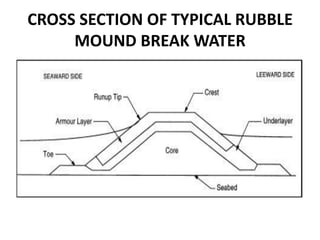
CROSS SECTION OF TYPICAL RUBBLE
     MOUND BREAK WATER
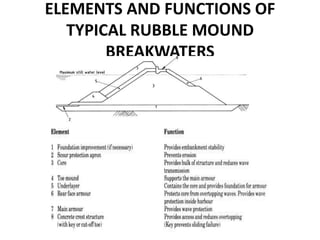
ELEMENTS AND FUNCTIONS OF
   TYPICAL RUBBLE MOUND
        BREAKWATERS
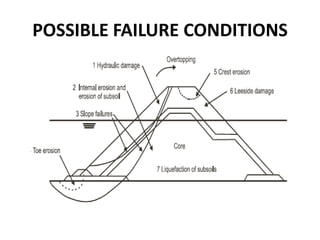
POSSIBLE FAILURE CONDITIONS
CROSS SECTION CONFIGURATION
• Slope angle:
  Side slopes are generally as steep as possible to
  minimise the volume of core material and to reduce
  the reach of cranes working from the crest. However it
  may be possible to develop a less steep slope if the
  cranes operate from a barge. Slopes are typically
  within the range 1V:1.5H to 1V:3H and influence the
  amount of interaction between armour units. As the
  angle increases, the contribution to stability from
  friction and interlocking also increases due to the
  squeezing or increase in slope-parallel forces applied
  by adjacent units.
Layer thickness:
 Armour stability generally increases with an
  increase in armour layer thickness.
 All layers should be constructed thicker than
  designed to allow for settlement, provided the
  armour will tolerate settlement without
  breakage.
 Allowance should also be made for the initial
  settlement that occurs as the units nest into a
  more stable position under wave action.
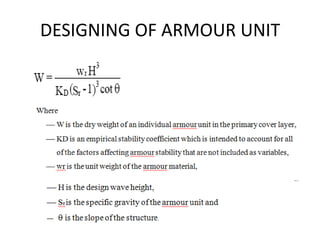
DESIGNING OF ARMOUR UNIT
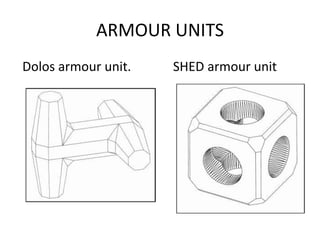
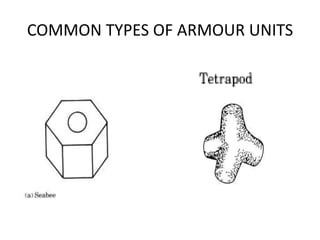
ARMOUR UNITS
Dolos armour unit.   SHED armour unit
COMMON TYPES OF ARMOUR UNITS
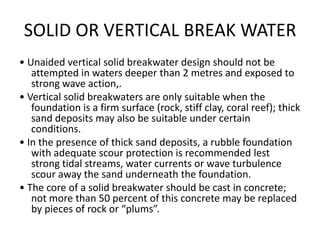
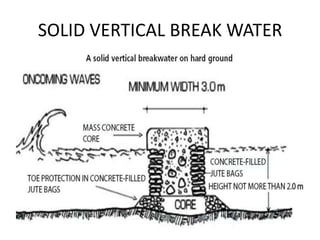
SOLID OR VERTICAL BREAK WATER
• Unaided vertical solid breakwater design should not be
   attempted in waters deeper than 2 metres and exposed to
   strong wave action,.
• Vertical solid breakwaters are only suitable when the
   foundation is a firm surface (rock, stiff clay, coral reef); thick
   sand deposits may also be suitable under certain
   conditions.
• In the presence of thick sand deposits, a rubble foundation
   with adequate scour protection is recommended lest
   strong tidal streams, water currents or wave turbulence
   scour away the sand underneath the foundation.
• The core of a solid breakwater should be cast in concrete;
   not more than 50 percent of this concrete may be replaced
   by pieces of rock or “plums”.
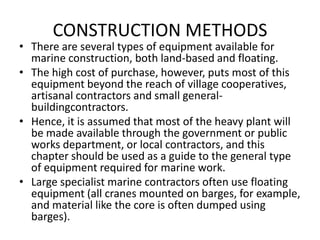
CONSTRUCTION METHODS
• There are several types of equipment available for
  marine construction, both land-based and floating.
• The high cost of purchase, however, puts most of this
  equipment beyond the reach of village cooperatives,
  artisanal contractors and small general-
  buildingcontractors.
• Hence, it is assumed that most of the heavy plant will
  be made available through the government or public
  works department, or local contractors, and this
  chapter should be used as a guide to the general type
  of equipment required for marine work.
• Large specialist marine contractors often use floating
  equipment (all cranes mounted on barges, for example,
  and material like the core is often dumped using
  barges).
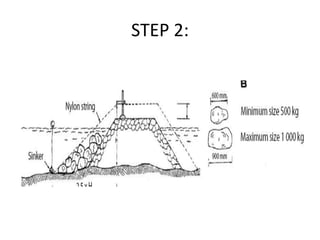
RUBBLE MOUND CONSTRUCTION
STEP 2:
STEP 3:
RUBBLE MOUND BREAK WATER
SOLID VERTICAL BREAK WATER
Break waters
Break waters

Break waters

  • 1.
    BREAK WATERS A breakwateris a structure constructed for the purpose of forming an artificial harbor with a basin so protected from the effect of waves as to provide safe berthing for fishing vessels. The type of protection provided may be by the natural configuration of the coast or by construction of artificial carriers
  • 3.
  • 4.
  • 5.
    RUBBLE MOUND BREAKWATER • Rubble mound break waters are structures build of quarried rock, usually protected by a cover of heavy armour stones or concrete armour units. • The core may partly comprise of other materials like limestone or dredged gravel. • In case of poor foundation conditions, soil improvement techniques or use of geo textiles can be used.
  • 6.
    SELECTION OF TYPEOF BREAKWATER • Caisson break waters are often preferred in deeper water , as the quarried rock quantities for a rubble mound increase significantly with increasing depth. The depth of water at which the caisson break water becomes more economical will vary with location. Usually for depth of 15m or above caisson break water is preferable. • When the break water serves as purpose with a port as quay wall or storage area, a rubble mound structure will require a concrete crest. • Rubble mound break waters have better wave energy dissipation properties due to its rough armour sides, hence for break waters of lesser depth rubble mound break water is more economical.
  • 7.
  • 8.
    PARAMETERS FOR THE CONSTRUCTION OF A BREAKWATER • When a breakwater is to be built at a certain location, and the environmental impact of such a structure has already been evaluated and deemed environmentally feasible, the following parameters are required before construction can commence: • a detailed hydrographic survey of the site; • a geotechnical investigation of the sea bed; • a wave height investigation or hindcasting; • a material needs assessment; and • the cross-sectional design of the structure.
  • 9.
    Geotechnical investigation Ageotechnical investigation of the sea bed is required to determine the type of founding material and its extent. The results of this investigation will have a direct bearing on the type of cross-section of the breakwater. In addition, it is essential to determine what the coastline consists of, for example: • soft or hard rock (like coral reefs or granite); • sand (as found on beaches); • clay (as in some mangrove areas); and • soft to very soft clay, silt or mud (as found along some river banks, mangroves and other tidal areas).
  • 10.
    Basic geotechnical investigations Basicgeotechnical investigations normally suffice for small or artisanal projects, especially when the project site is remote and access poor. A basic geotechnical investigation should be carried out or supervised by an experienced engineer or geologist familiar with the local soil conditions. The following activities may be carried out in a basic investigation using only portable equipment: • retrieval of bottom sediments for laboratory analysis; • measurement of bottom layer (loose sediment) thickness; • approximate estimation of bearing capacity of the sea bed.
  • 11.
  • 12.
  • 13.
    Once the layerof soft sediment has been identified (sampled) and measured (pricked), it is then necessary to determine the hardness of the underlying layer. The underlying layer may be rock, clay or compacted sand. If the layer is rocky, the diver should collect a piece of the material for laboratory analysis using a hammer and chisel. For softer types of material, the diver (with a submerged weight of around 10 kilograms) should use a steel probe (1 metre long, 12 millimetres in diameter) or pocket penetrometer
  • 14.
    ESTIMATION OF BEARINGCAPACITY OF SOIL
  • 15.
    Wave hindcasting • Theheight of wave incident on a breakwater generally determines the size and behaviour of the breakwater. • It is hence of the utmost importance to obtain realistic values of the waves expected in a particular area. • They are generated by the action of wind moving over a waterbody; the stronger the wind blows, the higher the waves generated. They may vary in size from ripples on a pond to large ocean waves as high as 10 metres.
  • 16.
    METHODS OF WAVEHINDCASTING The precise nature of the types of wave incident on a particular stretch of shoreline, also known as wave hindcasting, may be investigated by three different methods: • Method 1 – On-the-spot measurement by special electronic equipment, such as a wave rider buoy. • Method 2 – Prediction by statistical methods on a computer – statistical hindcast models may be performed on the computer if wind data or satellite wave data are available for the area; • Method 3 – On-the-spot observation by simple optical instruments – the theodolite.
  • 17.
  • 18.
  • 20.
    This method, however,suffers from the following drawbacks. The wave heights thus recorded will already be distorted by the water depths close to the shoreline. • A human observer can only see waves during daylight hours, effectively reducing observation time by a half. • In very bad weather, strong winds and rain drastically reduce visibility making it difficult to keep the buoy under observation continuously. • The presence of swell is very difficult to detect, especially during a local storm, due to the very long time (period) between peaks, typically 15 seconds or more.
  • 21.
    During wave heightobservations, the following additional information should also be recorded: • direction of both the incoming waves and wind using the hand-held compass; • the time difference between each successive wave peak, also known as wave period • the exact position of the buoy with respect to the coastline; and • time of the year when each storm was recorded.
  • 22.
    Cross-sectional design • Asuitable cross-sectional design for the breakwater has to be produced taking into consideration all the previous data, for example: • water depths (in deep water, solid vertical sides are preferred to save on material); • type of foundation (if ground is soft and likely to settle, then a rubble breakwater is recommended); • height of waves (rubble breakwaters are more suitable than solid ones in the presence of larger waves); and • availability of materials (if no rock quarries are available in the vicinity of the project, then rubble breakwaters cannot be economically justified).
  • 23.
    THUMB RULES FORDESIGNING The following rules of thumb may be applied to very small projects with water depths not exceeding 3.0 metres: For rubble mound or rock breakwaters: • Unaided breakwater design should not be attempted in waters deeper than 3 metres. • If the foundation material is very soft and thick, then a geotextile filter mat should be placed under the rock to prevent it from sinking and disappearing into the mud • If a thin layer of loose or soft material exists above a hard layer, then this should be removed to expose the hard interface and the breakwater built on this surface
  • 24.
    • The materialgrading should be in the range of 1 to 500 kilograms for the fine core, 500 to 1000 kilograms for the underlayer and 1000 to3 000 kilograms for the main armour layer • Dust and fine particles should not be placed in the core as these will wash away and cause the breakwater top to settle unevenly. • The outer slope should not be steeper than 1 on 2 and the inner or harbour side slope not steeper than 1 on 1.5 • In general, rock breakwaters absorb most of the wave energy that falls on them and reflect very little disturbance back from the sloping surface..
  • 25.
    CROSS SECTION OFTYPICAL RUBBLE MOUND BREAK WATER
  • 26.
    ELEMENTS AND FUNCTIONSOF TYPICAL RUBBLE MOUND BREAKWATERS
  • 27.
  • 28.
    CROSS SECTION CONFIGURATION •Slope angle: Side slopes are generally as steep as possible to minimise the volume of core material and to reduce the reach of cranes working from the crest. However it may be possible to develop a less steep slope if the cranes operate from a barge. Slopes are typically within the range 1V:1.5H to 1V:3H and influence the amount of interaction between armour units. As the angle increases, the contribution to stability from friction and interlocking also increases due to the squeezing or increase in slope-parallel forces applied by adjacent units.
  • 29.
    Layer thickness:  Armourstability generally increases with an increase in armour layer thickness.  All layers should be constructed thicker than designed to allow for settlement, provided the armour will tolerate settlement without breakage.  Allowance should also be made for the initial settlement that occurs as the units nest into a more stable position under wave action.
  • 30.
  • 31.
    ARMOUR UNITS Dolos armourunit. SHED armour unit
  • 32.
    COMMON TYPES OFARMOUR UNITS
  • 34.
    SOLID OR VERTICALBREAK WATER • Unaided vertical solid breakwater design should not be attempted in waters deeper than 2 metres and exposed to strong wave action,. • Vertical solid breakwaters are only suitable when the foundation is a firm surface (rock, stiff clay, coral reef); thick sand deposits may also be suitable under certain conditions. • In the presence of thick sand deposits, a rubble foundation with adequate scour protection is recommended lest strong tidal streams, water currents or wave turbulence scour away the sand underneath the foundation. • The core of a solid breakwater should be cast in concrete; not more than 50 percent of this concrete may be replaced by pieces of rock or “plums”.
  • 35.
    CONSTRUCTION METHODS • Thereare several types of equipment available for marine construction, both land-based and floating. • The high cost of purchase, however, puts most of this equipment beyond the reach of village cooperatives, artisanal contractors and small general- buildingcontractors. • Hence, it is assumed that most of the heavy plant will be made available through the government or public works department, or local contractors, and this chapter should be used as a guide to the general type of equipment required for marine work. • Large specialist marine contractors often use floating equipment (all cranes mounted on barges, for example, and material like the core is often dumped using barges).
  • 36.
  • 37.
  • 38.
  • 39.
  • 40.