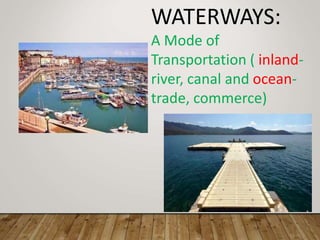
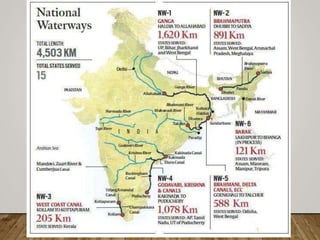
WATERWAYS:
A Mode of
Transportation ( inland-
river, canal and ocean-
trade, commerce)
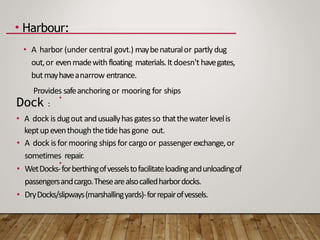
• Harbour:
•
• A harbor (under central govt.) maybenaturalor partly dug
out,or evenmadewithfloating materials.It doesn't havegates,
butmayhaveanarrow entrance.
Provides safeanchoring or mooring for ships
Dock :
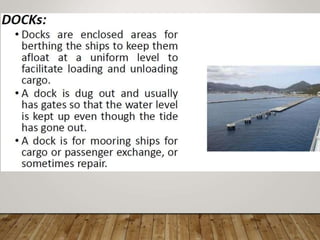
• A dock isdugout andusuallyhasgatesso thatthewaterlevelis
keptupeventhoughthetidehasgone out.
•
• A dock is formooring ships forcargoor passengerexchange,or
sometimes repair.
• WetDocks-forberthingofvesselstofacilitateloadingandunloadingof
passengersandcargo.Thesearealsocalledharbordocks.
• DryDocks/slipways(marshallingyards)-forrepairofvessels.
A port (under state govt.) is alocationon acoast or shore containingone or
more harbors whereships candock andtransferpeopleor cargoto or from land.
•FEATURES OF A HARBOR:
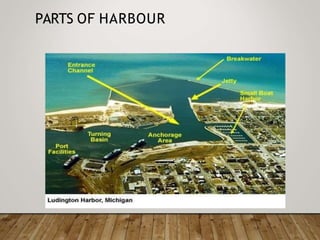
1. EntranceChannels
2. Berthing Basin
3. Break Water (to break momentum of water
waves- inner side of this is made as quay for cargo
referred as mole)
4. Turning Basin
5. Wharves
6. Jetties
•FEATURES OF A HARBOR:
7. Ballast-wateraddedtoimprovestabilityofshipwhenithasdischargedits
cargo
8. Quayage-ratiooflengthofplateformforberthingtotheareaofbasin
9. Mooringfacilities-Dolphins
10.Guidingfacilities-lighthouse(fixedtypefacility).Buoys(floatingtype
facility)
PARTS OF HARBOUR
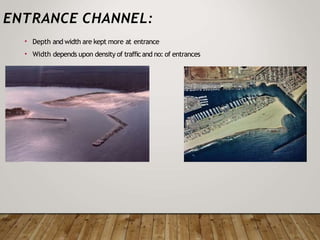
ENTRANCE CHANNEL:
•
•
Depth and width are kept more at entrance
Width depends upon density of trafficand no: of entrances
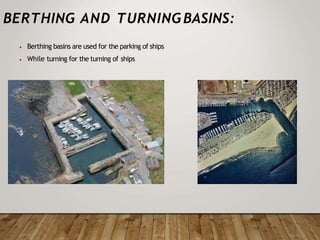
BERTHING AND TURNINGBASINS:
•
•
Berthing basins are used for the parking of ships
While turning for the turning of ships
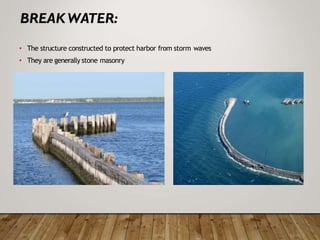
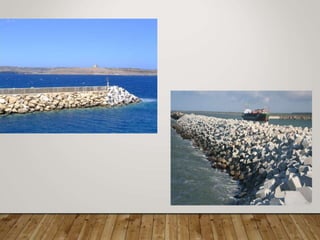
• The structure constructed to protect harbor from storm waves
• They are generally stone masonry
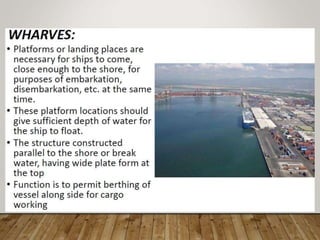
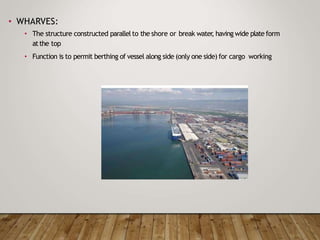
• WHARVES:
• The structure constructed parallelto the shore or break water
, having wide plate form
atthe top
• Function is to permit berthing of vessel along side (only one side) for cargo working
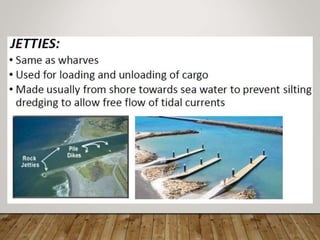
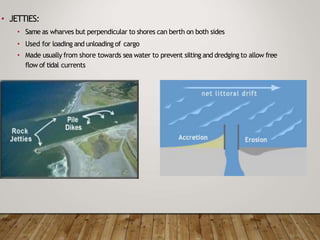
• JETTIES:
• Same as wharves but perpendicular to shores can berth on both sides
• Used for loading and unloading of cargo
• Made usually from shore towards sea water to prevent silting and dredging to allow free
flow of tidal currents
•Based on formation:
1.NATURAL HARBOUR (Bombay and Kandla)
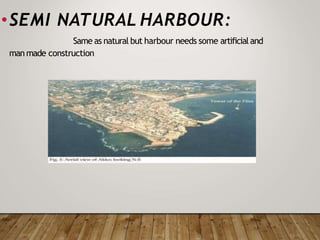
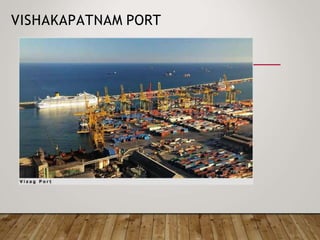
2.SEMI NATURAL HARBOUR (Vishakhapatnam)
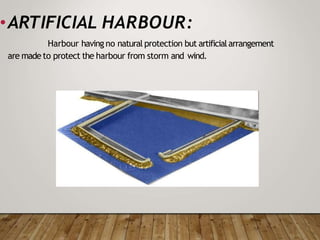
3.ARTIFICIAL HARBOUR (Madras)
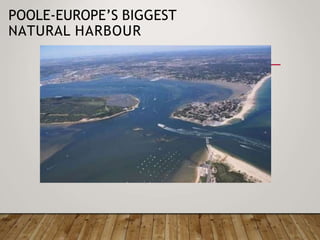
POOLE-EUROPE’S BIGGEST
NATURAL HARBOUR
•SEMI NATURAL HARBOUR:
Same as natural but harbour needs some artificialand
man made construction
VISHAKAPATNAM PORT
•ARTIFICIAL HARBOUR:
Harbour having no natural protection but artificialarrangement
are made to protect the harbour from storm and wind.
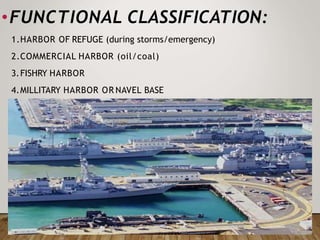
•FUNCTIONAL CLASSIFICATION:
1.HARBOR OF REFUGE (during storms/emergency)
2.COMMERCIAL HARBOR (oil/coal)
3.FISHRY HARBOR
4.MILLITARY HARBOR OR NAVEL BASE
• REQUIREMENTS OF A GOOD HARBOR:
• The depth of aharbor should be sufficient for every type of visiting ships.
• The bottom of harbor should provide secured anchorage to hold the ships against high
winds.
• To prevent destructive waveaction, break water are provided.
• The entrance of aharbor should be wide enough to provide the easy passage of ships.
Natural phenomena’s concerning planning of aharbour are:
Storms
Rainfall
Range of tides
Maximum &minimum temperatures
Direction &intensity of wind etc
•SITE SELECTION:
• Following factors playagreat role in the choice of site
of a harbour.
• 1.Availability of cheapland &contruction material.
• 2.Natural protection from waves & winds
• 3.transport &communication facilities
• 4.industrial development of the locality
• 5.Sea bed,sub soil &foundation conditions
• 6.Avaibility of electrical energy
• 7.Defence &strategic aspects
• 8.traficpotentiality of harbour
Waterways
Waterways
Waterways
Waterways
Waterways
Waterways
Waterways
Waterways
Waterways
Waterways
Waterways
Waterways
Waterways
Waterways
Waterways
Waterways
Waterways
Waterways
Waterways
Waterways
Waterways

Waterways

  • 1.
    WATERWAYS: A Mode of Transportation( inland- river, canal and ocean- trade, commerce)
  • 2.
    • Harbour: • • Aharbor (under central govt.) maybenaturalor partly dug out,or evenmadewithfloating materials.It doesn't havegates, butmayhaveanarrow entrance. Provides safeanchoring or mooring for ships Dock : • A dock isdugout andusuallyhasgatesso thatthewaterlevelis keptupeventhoughthetidehasgone out. • • A dock is formooring ships forcargoor passengerexchange,or sometimes repair. • WetDocks-forberthingofvesselstofacilitateloadingandunloadingof passengersandcargo.Thesearealsocalledharbordocks. • DryDocks/slipways(marshallingyards)-forrepairofvessels.
  • 3.
    A port (understate govt.) is alocationon acoast or shore containingone or more harbors whereships candock andtransferpeopleor cargoto or from land.
  • 4.
    •FEATURES OF AHARBOR: 1. EntranceChannels 2. Berthing Basin 3. Break Water (to break momentum of water waves- inner side of this is made as quay for cargo referred as mole) 4. Turning Basin 5. Wharves 6. Jetties
  • 5.
    •FEATURES OF AHARBOR: 7. Ballast-wateraddedtoimprovestabilityofshipwhenithasdischargedits cargo 8. Quayage-ratiooflengthofplateformforberthingtotheareaofbasin 9. Mooringfacilities-Dolphins 10.Guidingfacilities-lighthouse(fixedtypefacility).Buoys(floatingtype facility)
  • 6.
  • 7.
    ENTRANCE CHANNEL: • • Depth andwidth are kept more at entrance Width depends upon density of trafficand no: of entrances
  • 8.
    BERTHING AND TURNINGBASINS: • • Berthingbasins are used for the parking of ships While turning for the turning of ships
  • 9.
    • The structureconstructed to protect harbor from storm waves • They are generally stone masonry
  • 12.
    • WHARVES: • Thestructure constructed parallelto the shore or break water , having wide plate form atthe top • Function is to permit berthing of vessel along side (only one side) for cargo working
  • 14.
    • JETTIES: • Sameas wharves but perpendicular to shores can berth on both sides • Used for loading and unloading of cargo • Made usually from shore towards sea water to prevent silting and dredging to allow free flow of tidal currents
  • 15.
    •Based on formation: 1.NATURALHARBOUR (Bombay and Kandla) 2.SEMI NATURAL HARBOUR (Vishakhapatnam) 3.ARTIFICIAL HARBOUR (Madras)
  • 16.
  • 17.
    •SEMI NATURAL HARBOUR: Sameas natural but harbour needs some artificialand man made construction
  • 18.
  • 19.
    •ARTIFICIAL HARBOUR: Harbour havingno natural protection but artificialarrangement are made to protect the harbour from storm and wind.
  • 20.
    •FUNCTIONAL CLASSIFICATION: 1.HARBOR OFREFUGE (during storms/emergency) 2.COMMERCIAL HARBOR (oil/coal) 3.FISHRY HARBOR 4.MILLITARY HARBOR OR NAVEL BASE
  • 22.
    • REQUIREMENTS OFA GOOD HARBOR: • The depth of aharbor should be sufficient for every type of visiting ships. • The bottom of harbor should provide secured anchorage to hold the ships against high winds. • To prevent destructive waveaction, break water are provided. • The entrance of aharbor should be wide enough to provide the easy passage of ships.
  • 23.
    Natural phenomena’s concerningplanning of aharbour are: Storms Rainfall Range of tides Maximum &minimum temperatures Direction &intensity of wind etc
  • 24.
    •SITE SELECTION: • Followingfactors playagreat role in the choice of site of a harbour. • 1.Availability of cheapland &contruction material. • 2.Natural protection from waves & winds • 3.transport &communication facilities • 4.industrial development of the locality • 5.Sea bed,sub soil &foundation conditions • 6.Avaibility of electrical energy • 7.Defence &strategic aspects • 8.traficpotentiality of harbour