Topic: BINOMIAL THEOREM AND PROGRESSIONS


BINOMIAL THEOREM
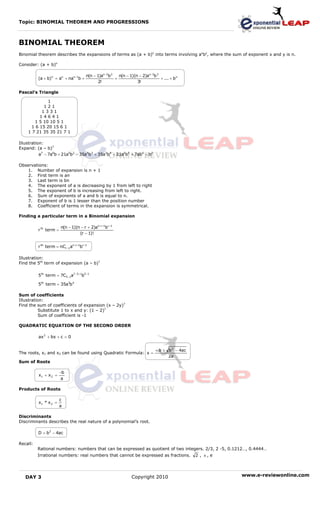
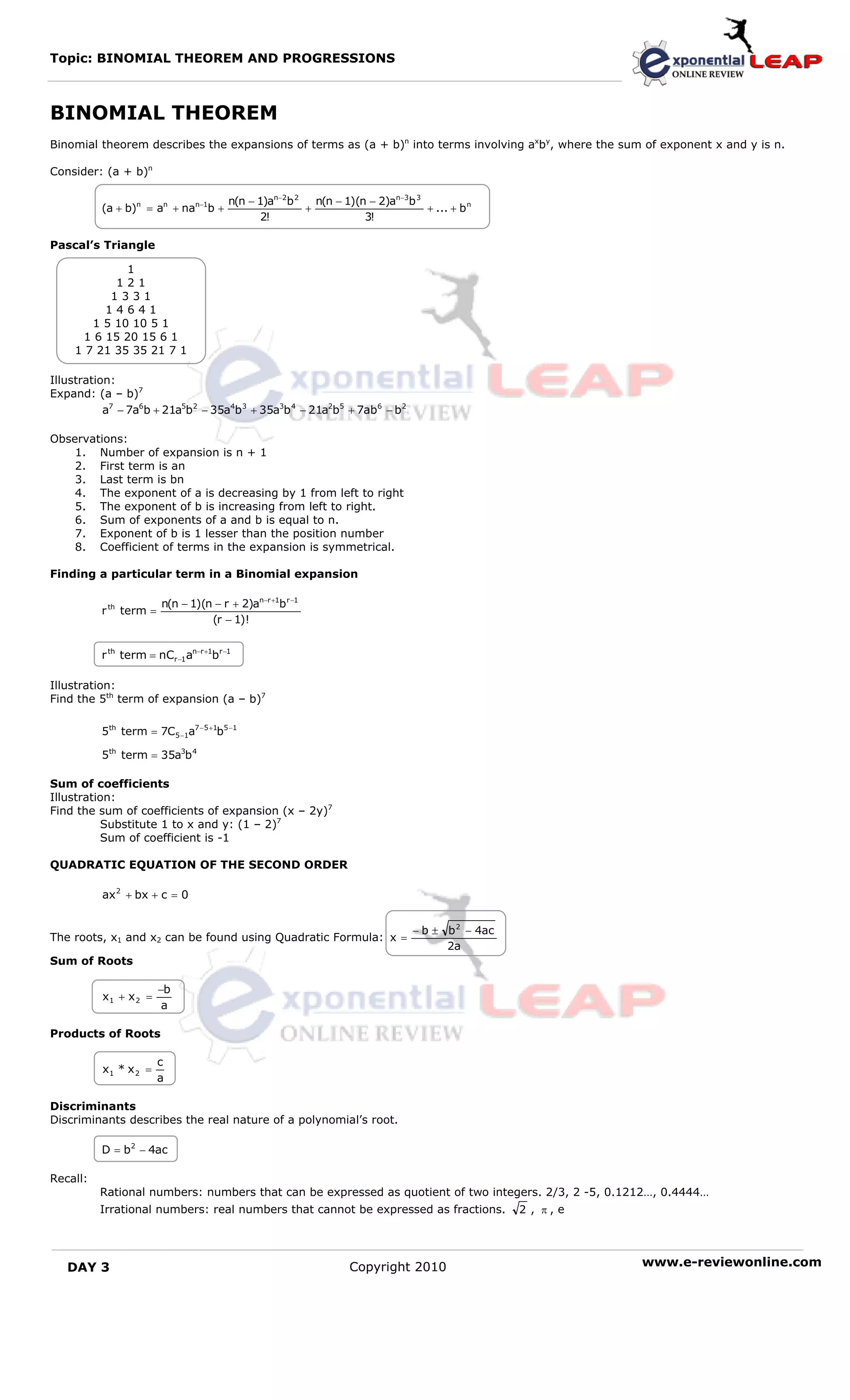
Binomial theorem describes the expansions of terms as (a + b)n into terms involving axby, where the sum of exponent x and y is n.

Consider: (a + b)n

                                       n(n − 1)an−2b 2   n(n − 1)(n − 2)an−3b 3
          (a + b)n = an + nan−1b +                     +                        + ... + b n
                                              2!                   3!

Pascal’s Triangle

             1
           121
          1331
         14641
       1 5 10 10 5 1
     1 6 15 20 15 6 1
    1 7 21 35 35 21 7 1

Illustration:
Expand: (a – b)7
           a7 − 7a6b + 21a5b2 − 35a4b3 + 35a3b 4 − 21a2b5 + 7ab6 − b2

Observations:
    1. Number of expansion is n + 1
    2. First term is an
    3. Last term is bn
    4. The exponent of a is decreasing by 1 from left to right
    5. The exponent of b is increasing from left to right.
    6. Sum of exponents of a and b is equal to n.
    7. Exponent of b is 1 lesser than the position number
    8. Coefficient of terms in the expansion is symmetrical.

Finding a particular term in a Binomial expansion

                        n(n − 1)(n − r + 2)an−r +1b r −1
          r th term =
                                  (r − 1)!


          r th term = nCr −1an−r +1br −1

Illustration:
Find the 5th term of expansion (a – b)7

          5th term = 7C5 −1a7 − 5 +1b5 −1

          5th term = 35a3b 4

Sum of coefficients
Illustration:
Find the sum of coefficients of expansion (x – 2y)7
          Substitute 1 to x and y: (1 – 2)7
          Sum of coefficient is -1

QUADRATIC EQUATION OF THE SECOND ORDER

          ax 2 + bx + c = 0


                                                                              − b ± b 2 − 4ac
The roots, x1 and x2 can be found using Quadratic Formula: x =
                                                                                    2a
Sum of Roots

                        −b
          x1 + x 2 =
                         a

Products of Roots

                        c
          x1 * x 2 =
                        a

Discriminants
Discriminants describes the real nature of a polynomial’s root.

          D = b2 − 4ac

Recall:
          Rational numbers: numbers that can be expressed as quotient of two integers. 2/3, 2 -5, 0.1212…, 0.4444…
          Irrational numbers: real numbers that cannot be expressed as fractions.               2 , π, e


   DAY 3                                                        Copyright 2010                             www.e-reviewonline.com
Topic: BINOMIAL THEOREM AND PROGRESSIONS


                         D = b2 − 4ac                       Nature of roots
                        D=0                                 Equal
                        D>0 not perfect square              Unequal, Real, Irrational
                        D>0 perfect square                  Unequal, Real, Rational
                        D<0                                 Unequal, Imaginary

Remainder Theorem
If a polynomial f(x) is divided by (x – r), the remainder is equal to f(r).

          f(x)           R
               = Q(x) +      , Q=quotient and R=remainder
          x −r          x −r

         f(x) = Q(x)(x − r) + R ; let x=r

         f(r) = Qr(r − r) + R

         f(r) = R

Illustration:
Find the remainder when x 4 − 5x 3 + 7x 2 − 3x + 6 is divided by x + 1.
          R = f(r); r = -1
          R = f(-1) = (-1)4 – 5(-1)3 + 7(-1)2 – 3(-1) + 6
          R = 22


PROGRESSIONS
Arithmetic Progressions
Arithmetic Progressions also known as arithmetic sequence is a series of numbers such that the difference of any successive
members of the sequence is a constant.

1. nth term of Arithmetic Progressions

         an = a1 + (n − 1)d

2. Sum of Arithmetic Progressions


         S=
              n
              2
                (a1 + an )      S=
                                       n
                                       2
                                           [ 2a
                                              1             ]
                                                  + (n − 1) d


3. Arithmetic Mean
         Arithmetic mean or simply “average”, is the sum of two or more terms and then dividing by the number of terms.

                             a1 + a2
                      Am =
                                2

Geometric Progression
Geometric Progressions also known as geometric sequence is a series of numbers where the term after the first is found by
multiplying the previous one by a fixed non-zero number called the common ratio. For example: 2, 6, 18, 54…the common ratio is 3.

1. nth term of Geometric Progressions

                                                                a2  a
         an = a1r n−1           r = common ratio =                 = 3
                                                                a1  a2

2. Sum of Geometric Progressions

         If r < 1.0
              a1 + ran                 a1 (1 − r n )
         S=                     S=
               1−r                        1−r

         If r > 1.0
              ra + a1                  a1 (r n − 1)
         S= n                   S=
                r −1                      r −1


3. Geometric Mean

                    Gm = n a1a2...an

Infinite Geometric Progressions
         Infinite geometric series is an infinite series whose successive terms have a common ratio.

               a1
         S=
              1−r

Harmonic Progressions
      Harmonic progressions is a progressions formed by taking the reciprocals of Arithmetic Progression.

   DAY 3                                                            Copyright 2010                     www.e-reviewonline.com

Day 03

  • 1.
    Topic: BINOMIAL THEOREMAND PROGRESSIONS BINOMIAL THEOREM Binomial theorem describes the expansions of terms as (a + b)n into terms involving axby, where the sum of exponent x and y is n. Consider: (a + b)n n(n − 1)an−2b 2 n(n − 1)(n − 2)an−3b 3 (a + b)n = an + nan−1b + + + ... + b n 2! 3! Pascal’s Triangle 1 121 1331 14641 1 5 10 10 5 1 1 6 15 20 15 6 1 1 7 21 35 35 21 7 1 Illustration: Expand: (a – b)7 a7 − 7a6b + 21a5b2 − 35a4b3 + 35a3b 4 − 21a2b5 + 7ab6 − b2 Observations: 1. Number of expansion is n + 1 2. First term is an 3. Last term is bn 4. The exponent of a is decreasing by 1 from left to right 5. The exponent of b is increasing from left to right. 6. Sum of exponents of a and b is equal to n. 7. Exponent of b is 1 lesser than the position number 8. Coefficient of terms in the expansion is symmetrical. Finding a particular term in a Binomial expansion n(n − 1)(n − r + 2)an−r +1b r −1 r th term = (r − 1)! r th term = nCr −1an−r +1br −1 Illustration: Find the 5th term of expansion (a – b)7 5th term = 7C5 −1a7 − 5 +1b5 −1 5th term = 35a3b 4 Sum of coefficients Illustration: Find the sum of coefficients of expansion (x – 2y)7 Substitute 1 to x and y: (1 – 2)7 Sum of coefficient is -1 QUADRATIC EQUATION OF THE SECOND ORDER ax 2 + bx + c = 0 − b ± b 2 − 4ac The roots, x1 and x2 can be found using Quadratic Formula: x = 2a Sum of Roots −b x1 + x 2 = a Products of Roots c x1 * x 2 = a Discriminants Discriminants describes the real nature of a polynomial’s root. D = b2 − 4ac Recall: Rational numbers: numbers that can be expressed as quotient of two integers. 2/3, 2 -5, 0.1212…, 0.4444… Irrational numbers: real numbers that cannot be expressed as fractions. 2 , π, e DAY 3 Copyright 2010 www.e-reviewonline.com
  • 2.
    Topic: BINOMIAL THEOREMAND PROGRESSIONS D = b2 − 4ac Nature of roots D=0 Equal D>0 not perfect square Unequal, Real, Irrational D>0 perfect square Unequal, Real, Rational D<0 Unequal, Imaginary Remainder Theorem If a polynomial f(x) is divided by (x – r), the remainder is equal to f(r). f(x) R = Q(x) + , Q=quotient and R=remainder x −r x −r f(x) = Q(x)(x − r) + R ; let x=r f(r) = Qr(r − r) + R f(r) = R Illustration: Find the remainder when x 4 − 5x 3 + 7x 2 − 3x + 6 is divided by x + 1. R = f(r); r = -1 R = f(-1) = (-1)4 – 5(-1)3 + 7(-1)2 – 3(-1) + 6 R = 22 PROGRESSIONS Arithmetic Progressions Arithmetic Progressions also known as arithmetic sequence is a series of numbers such that the difference of any successive members of the sequence is a constant. 1. nth term of Arithmetic Progressions an = a1 + (n − 1)d 2. Sum of Arithmetic Progressions S= n 2 (a1 + an ) S= n 2 [ 2a 1 ] + (n − 1) d 3. Arithmetic Mean Arithmetic mean or simply “average”, is the sum of two or more terms and then dividing by the number of terms. a1 + a2 Am = 2 Geometric Progression Geometric Progressions also known as geometric sequence is a series of numbers where the term after the first is found by multiplying the previous one by a fixed non-zero number called the common ratio. For example: 2, 6, 18, 54…the common ratio is 3. 1. nth term of Geometric Progressions a2 a an = a1r n−1 r = common ratio = = 3 a1 a2 2. Sum of Geometric Progressions If r < 1.0 a1 + ran a1 (1 − r n ) S= S= 1−r 1−r If r > 1.0 ra + a1 a1 (r n − 1) S= n S= r −1 r −1 3. Geometric Mean Gm = n a1a2...an Infinite Geometric Progressions Infinite geometric series is an infinite series whose successive terms have a common ratio. a1 S= 1−r Harmonic Progressions Harmonic progressions is a progressions formed by taking the reciprocals of Arithmetic Progression. DAY 3 Copyright 2010 www.e-reviewonline.com