CHAPTER 1
             DIRECTED NUMBERS
Subtopics in this chapter:

1.1   Multiplication and division of integers
1.2   Combined operations
      (Addition, Subtraction, Multiplication and
      Division)
1.3   Positive and Negative Fractions
1.4   Positive and Negative Decimals
1.5   Computations involving Directed Numbers
KEYWORDS


 POSITIVE SIGN   (+)
 NEGATIVE SIGN    (-)
 ADDITION        (+)
 SUBTRACTION      (-)
 GREATER THAN    (>)
 LESS THAN       (<)
1.1      MULTIPLICATION AND DIVISION OF INTEGERS


      Learning Outcome :

       a) Multiply integers and solve problems involving of
       multiplication of integers.
       b) Divide integers and solve problems involving
       division of integers.
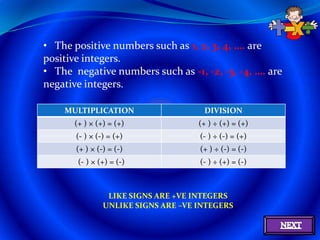
• The positive numbers such as 1, 2, 3, 4, …. are
positive integers.
• The negative numbers such as -1, -2, -3, -4, …. are
negative integers.

    MULTIPLICATION                    DIVISION
      (+ ) × (+) = (+)               (+ ) ÷ (+) = (+)
       (- ) × (-) = (+)              (- ) ÷ (-) = (+)
       (+ ) × (-) = (-)              (+ ) ÷ (-) = (-)
       (- ) × (+) = (-)              (- ) ÷ (+) = (-)


                 LIKE SIGNS ARE +VE INTEGERS
                UNLIKE SIGNS ARE –VE INTEGERS
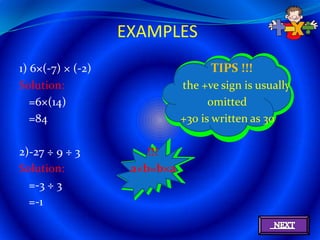
EXAMPLES
1) 6×(-7) × (-2)                    TIPS !!!
Solution:                     the +ve sign is usually
   =6×(14)                          omitted
   =84                        +30 is written as 30

2)-27 ÷ 9 ÷ 3          !!!
Solution:           a×b=b×a
  =-3 ÷ 3
  =-1
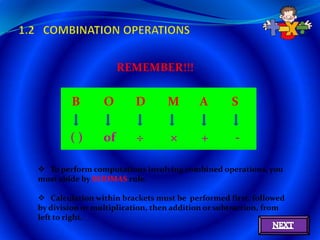
REMEMBER!!!

        B        O       D        M       A        S

        ()       of       ÷       ×        +       -

 To perform computations involving combined operations, you
must abide by BODMAS rule.

 Calculation within brackets must be performed first, followed
by division or multiplication, then addition or subtraction, from
left to right.
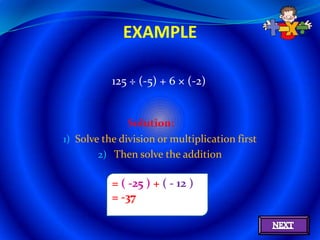
EXAMPLE

           125 ÷ (-5) + 6 × (-2)


               Solution:
1) Solve the division or multiplication first
        2) Then solve the addition

           = ( -25 ) + ( - 12 )
           = -37
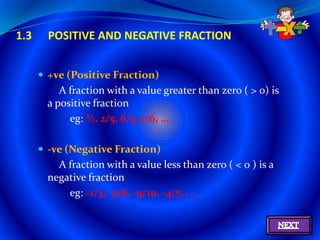
1.3     POSITIVE AND NEGATIVE FRACTION


       +ve (Positive Fraction)
          A fraction with a value greater than zero ( > 0) is
       a positive fraction
            eg: ½, 2/5, 6/5, 1/6, …

       -ve (Negative Fraction)
         A fraction with a value less than zero ( < 0 ) is a
       negative fraction
           eg: -1/3, -5/6, -9/10, -4/7, …
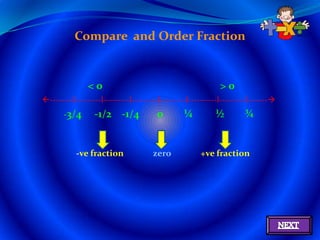
Compare and Order Fraction


               <0                                           >0
--------l---------l---------l---------l---------l----------l---------l-------
       -3/4      -1/2 -1/4            0        ¼          ½         ¾


           -ve fraction              zero            +ve fraction
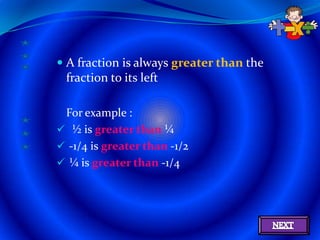
 A fraction is always greater than the
  fraction to its left

 For example :
 ½ is greater than ¼
 -1/4 is greater than -1/2
 ¼ is greater than -1/4
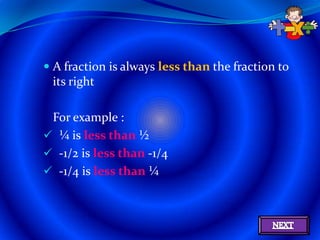
 A fraction is always less than the fraction to
  its right

 For example :
 ¼ is less than ½
 -1/2 is less than -1/4
 -1/4 is less than ¼
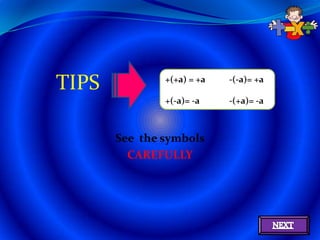
TIPS           +(+a) = +a   -(-a)= +a

               +(-a)= -a    -(+a)= -a


       See the symbols
         CAREFULLY
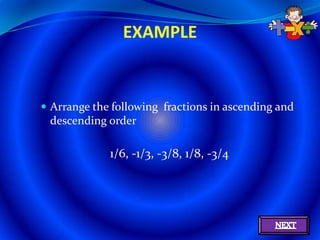
EXAMPLE


 Arrange the following fractions in ascending and
 descending order

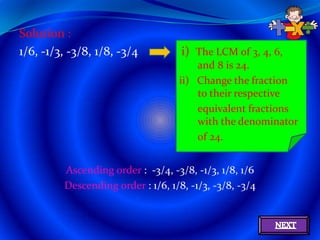
             1/6, -1/3, -3/8, 1/8, -3/4
Solution :
1/6, -1/3, -3/8, 1/8, -3/4          i) The LCM of 3, 4, 6,
                                        and 8 is 24.
                                    ii) Change the fraction
                                        to their respective
                                        equivalent fractions
                                        with the denominator
                                        of 24.


         Ascending order : -3/4, -3/8, -1/3, 1/8, 1/6
         Descending order : 1/6, 1/8, -1/3, -3/8, -3/4
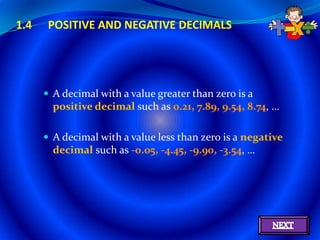
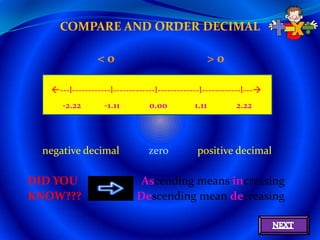
1.4    POSITIVE AND NEGATIVE DECIMALS


       A decimal with a value greater than zero is a
        positive decimal such as 0.21, 7.89, 9.54, 8.74, …

       A decimal with a value less than zero is a negative
        decimal such as -0.05, -4.45, -9.90, -3.54, …
COMPARE AND ORDER DECIMAL

                <o                                   >0

   ---l------------l-------------l-------------l------------l---
      -2.22       -1.11         0.00          1.11        2.22


 negative decimal               zero          positive decimal

DID YOU                      Ascending means increasing
KNOW???                     Descending mean decreasing
1.5        COMPUTATIONS INVOLVING DIRECTED
           NUMBERS

       As integers, computation involving directed numbers
           follow the BODMAS rule.

      a)    Involving two directed numbers
      Eg:      4/5 × (8.2)            solution:
                                        = - (4/5 × 82/10)
                                        = -328/50
                                        = - 6/14/25
      b) Involving the combination of two or more operations on directed
          numbers
      Eg:    [ 55 + (-37)] × 6         solution:
                                        = 18 × 6
                                        = 108
 LET SEE THIS VIDEO…
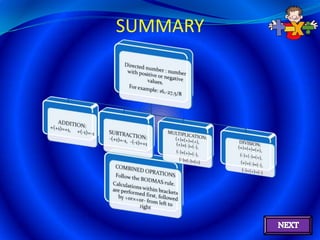
SUMMARY
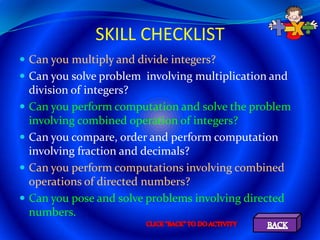
SKILL CHECKLIST
 Can you multiply and divide integers?
 Can you solve problem involving multiplication and
    division of integers?
   Can you perform computation and solve the problem
    involving combined operation of integers?
   Can you compare, order and perform computation
    involving fraction and decimals?
   Can you perform computations involving combined
    operations of directed numbers?
   Can you pose and solve problems involving directed
    numbers.
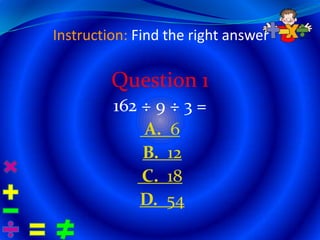
Instruction: Find the right answer

         Question 1
         162 ÷ 9 ÷ 3 =
             A. 6
             B. 12
             C. 18
             D. 54
Question 2
(-8) [ 2 x (-3) x (-7) ] ÷ 4 =
            A. -84
             B. 84
             C. 24
            D. 124
Question 3
4[8 + 0 x ( -4) ] - 6 =
        A. 0
        B. 22
       C. 26
       D. 33
0
13001


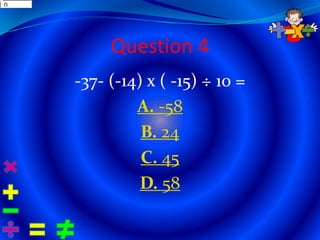
             Question 4
        -37- (-14) x ( -15) ÷ 10 =
                 A. -58
                  B. 24
                  C. 45
                  D. 58
13001
1
03001
13017


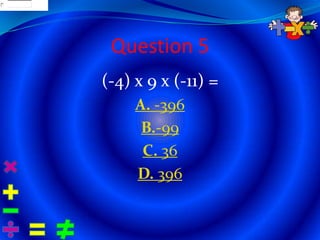
         Question 5
        (-4) x 9 x (-11) =
             A. -396
              B.-99
              C. 36
             D. 396
EXERCISE
NEXT
NEXT
NEXT
CONGRATULATION !!!
    YOU HAVE ANSWERED
      ALL QUESTIONS
        CORRECTLY

YOU ARE AN EXCELLENT LEANER

                              NEXT

Power point (Tugasan Teknologi Pendidikan)

  • 2.
    CHAPTER 1 DIRECTED NUMBERS Subtopics in this chapter: 1.1 Multiplication and division of integers 1.2 Combined operations (Addition, Subtraction, Multiplication and Division) 1.3 Positive and Negative Fractions 1.4 Positive and Negative Decimals 1.5 Computations involving Directed Numbers
  • 3.
    KEYWORDS  POSITIVE SIGN (+)  NEGATIVE SIGN (-)  ADDITION (+)  SUBTRACTION (-)  GREATER THAN (>)  LESS THAN (<)
  • 4.
    1.1 MULTIPLICATION AND DIVISION OF INTEGERS Learning Outcome : a) Multiply integers and solve problems involving of multiplication of integers. b) Divide integers and solve problems involving division of integers.
  • 5.
    • The positivenumbers such as 1, 2, 3, 4, …. are positive integers. • The negative numbers such as -1, -2, -3, -4, …. are negative integers. MULTIPLICATION DIVISION (+ ) × (+) = (+) (+ ) ÷ (+) = (+) (- ) × (-) = (+) (- ) ÷ (-) = (+) (+ ) × (-) = (-) (+ ) ÷ (-) = (-) (- ) × (+) = (-) (- ) ÷ (+) = (-) LIKE SIGNS ARE +VE INTEGERS UNLIKE SIGNS ARE –VE INTEGERS
  • 6.
    EXAMPLES 1) 6×(-7) ×(-2) TIPS !!! Solution: the +ve sign is usually =6×(14) omitted =84 +30 is written as 30 2)-27 ÷ 9 ÷ 3 !!! Solution: a×b=b×a =-3 ÷ 3 =-1
  • 7.
    REMEMBER!!! B O D M A S () of ÷ × + -  To perform computations involving combined operations, you must abide by BODMAS rule.  Calculation within brackets must be performed first, followed by division or multiplication, then addition or subtraction, from left to right.
  • 8.
    EXAMPLE 125 ÷ (-5) + 6 × (-2) Solution: 1) Solve the division or multiplication first 2) Then solve the addition = ( -25 ) + ( - 12 ) = -37
  • 9.
    1.3 POSITIVE AND NEGATIVE FRACTION  +ve (Positive Fraction) A fraction with a value greater than zero ( > 0) is a positive fraction eg: ½, 2/5, 6/5, 1/6, …  -ve (Negative Fraction) A fraction with a value less than zero ( < 0 ) is a negative fraction eg: -1/3, -5/6, -9/10, -4/7, …
  • 10.
    Compare and OrderFraction <0 >0 --------l---------l---------l---------l---------l----------l---------l------- -3/4 -1/2 -1/4 0 ¼ ½ ¾ -ve fraction zero +ve fraction
  • 11.
     A fractionis always greater than the fraction to its left For example :  ½ is greater than ¼  -1/4 is greater than -1/2  ¼ is greater than -1/4
  • 12.
     A fractionis always less than the fraction to its right For example :  ¼ is less than ½  -1/2 is less than -1/4  -1/4 is less than ¼
  • 13.
    TIPS +(+a) = +a -(-a)= +a +(-a)= -a -(+a)= -a See the symbols CAREFULLY
  • 14.
    EXAMPLE  Arrange thefollowing fractions in ascending and descending order 1/6, -1/3, -3/8, 1/8, -3/4
  • 15.
    Solution : 1/6, -1/3,-3/8, 1/8, -3/4 i) The LCM of 3, 4, 6, and 8 is 24. ii) Change the fraction to their respective equivalent fractions with the denominator of 24. Ascending order : -3/4, -3/8, -1/3, 1/8, 1/6 Descending order : 1/6, 1/8, -1/3, -3/8, -3/4
  • 16.
    1.4 POSITIVE AND NEGATIVE DECIMALS  A decimal with a value greater than zero is a positive decimal such as 0.21, 7.89, 9.54, 8.74, …  A decimal with a value less than zero is a negative decimal such as -0.05, -4.45, -9.90, -3.54, …
  • 17.
    COMPARE AND ORDERDECIMAL <o >0 ---l------------l-------------l-------------l------------l--- -2.22 -1.11 0.00 1.11 2.22 negative decimal zero positive decimal DID YOU Ascending means increasing KNOW??? Descending mean decreasing
  • 18.
    1.5 COMPUTATIONS INVOLVING DIRECTED NUMBERS  As integers, computation involving directed numbers follow the BODMAS rule. a) Involving two directed numbers Eg: 4/5 × (8.2) solution: = - (4/5 × 82/10) = -328/50 = - 6/14/25 b) Involving the combination of two or more operations on directed numbers Eg: [ 55 + (-37)] × 6 solution: = 18 × 6 = 108
  • 19.
     LET SEETHIS VIDEO…
  • 20.
  • 21.
    SKILL CHECKLIST  Canyou multiply and divide integers?  Can you solve problem involving multiplication and division of integers?  Can you perform computation and solve the problem involving combined operation of integers?  Can you compare, order and perform computation involving fraction and decimals?  Can you perform computations involving combined operations of directed numbers?  Can you pose and solve problems involving directed numbers.
  • 23.
    Instruction: Find theright answer Question 1 162 ÷ 9 ÷ 3 = A. 6 B. 12 C. 18 D. 54
  • 24.
    Question 2 (-8) [2 x (-3) x (-7) ] ÷ 4 = A. -84 B. 84 C. 24 D. 124
  • 25.
    Question 3 4[8 +0 x ( -4) ] - 6 = A. 0 B. 22 C. 26 D. 33
  • 26.
    0 13001 Question 4 -37- (-14) x ( -15) ÷ 10 = A. -58 B. 24 C. 45 D. 58
  • 27.
    13001 1 03001 13017 Question 5 (-4) x 9 x (-11) = A. -396 B.-99 C. 36 D. 396
  • 28.
  • 32.
  • 33.
  • 34.
  • 50.
    CONGRATULATION !!! YOU HAVE ANSWERED ALL QUESTIONS CORRECTLY YOU ARE AN EXCELLENT LEANER NEXT