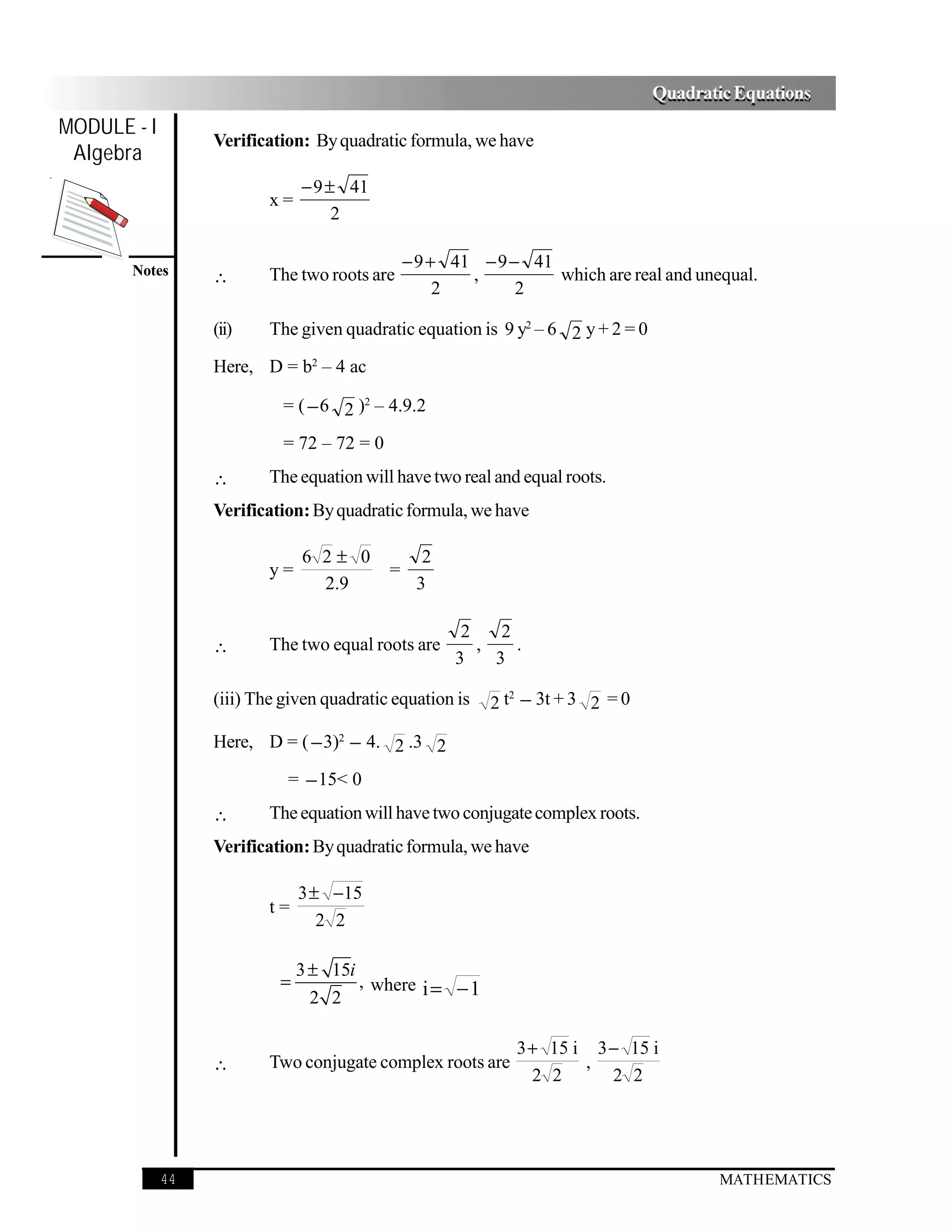
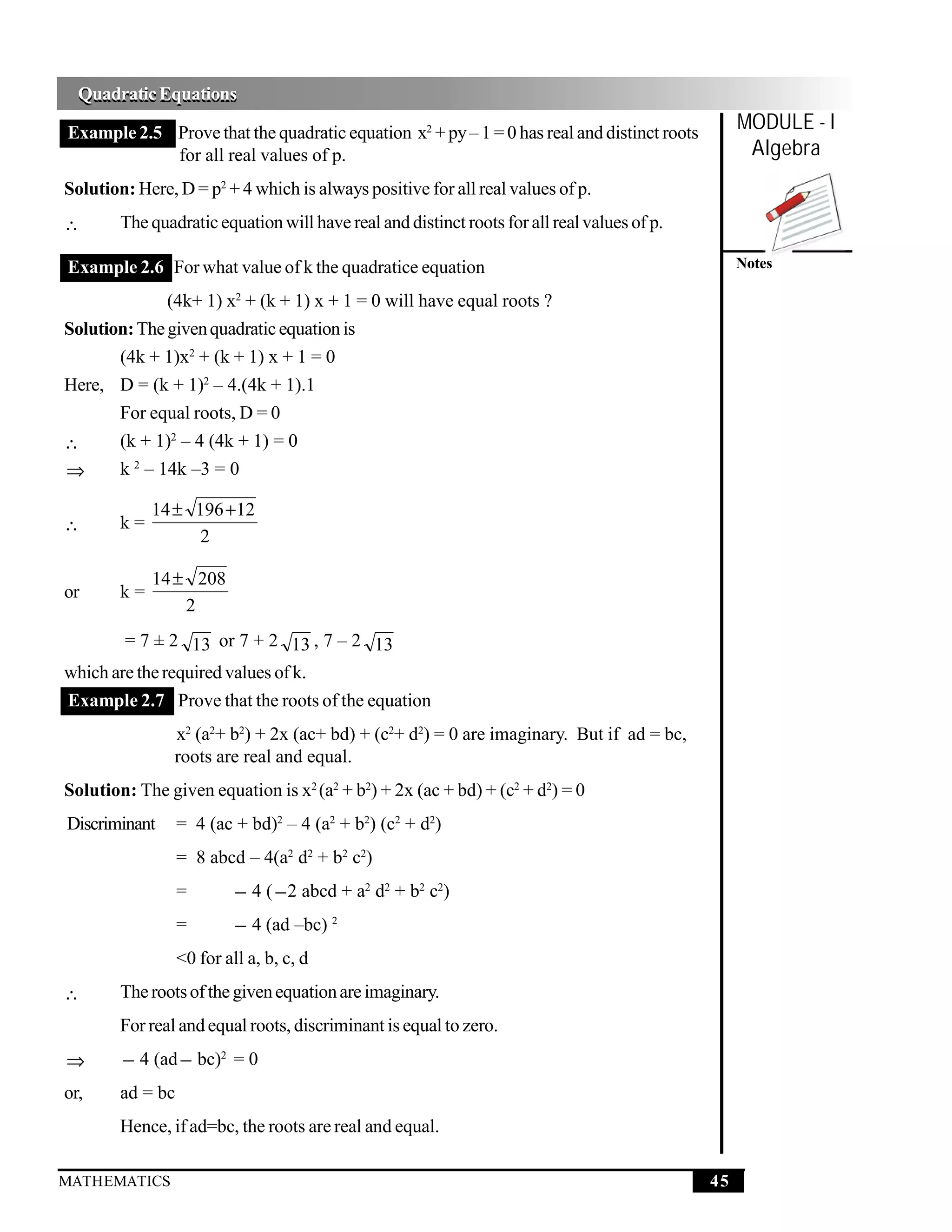
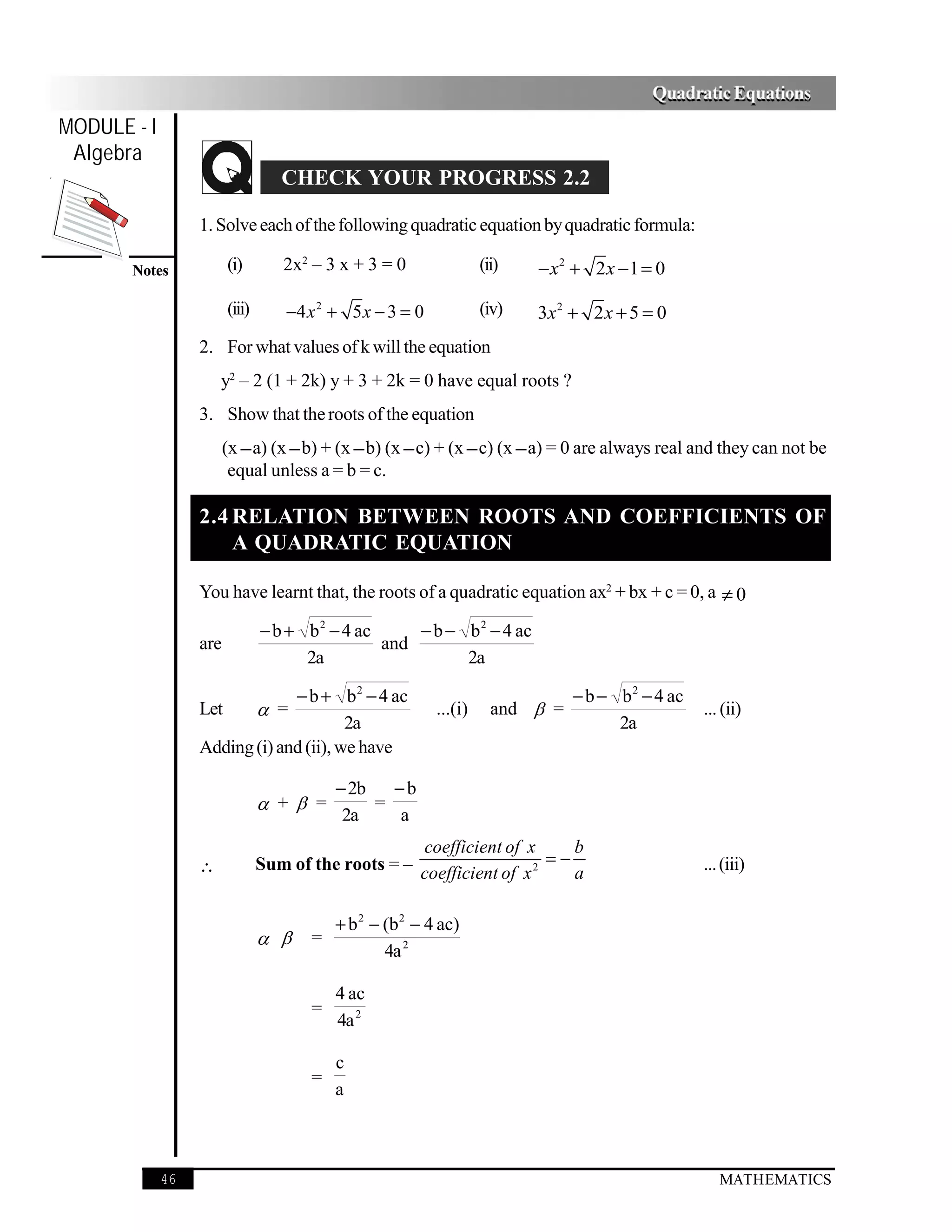
Quadratic Equations
  Quadratic Equations
                                                                                                            MODULE - I
                                                                                                             Algebra


                                                 2
                                                                                                            Notes


              QUADRATIC EQUATIONS
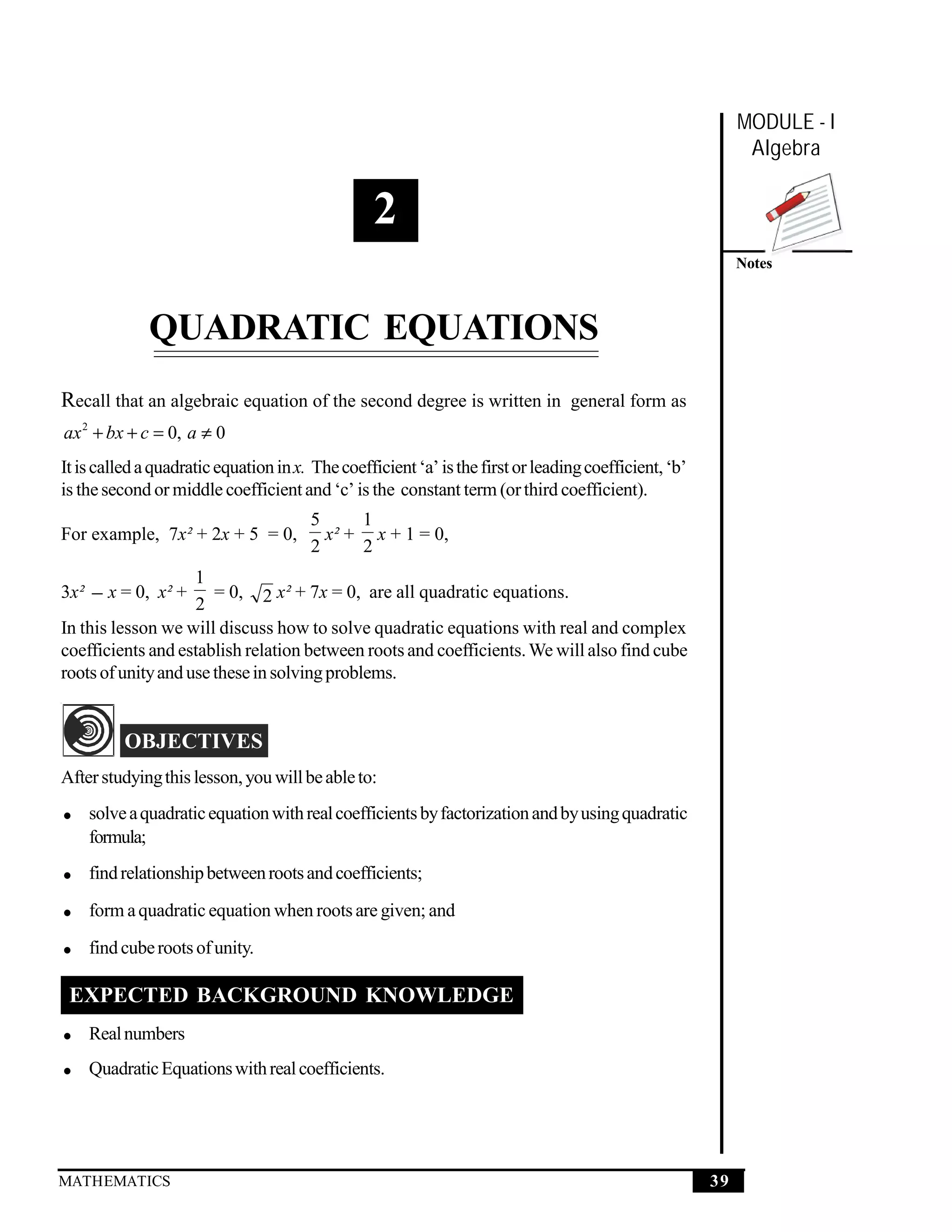
Recall that an algebraic equation of the second degree is written in general form as
ax 2 + bx + c = 0, a ≠ 0
It is called a quadratic equation in x. The coefficient ‘a’ is the first or leading coefficient, ‘b’
is the second or middle coefficient and ‘c’ is the constant term (or third coefficient).
                                       5     1
For example, 7x² + 2x + 5 = 0,           x² + x + 1 = 0,
                                       2     2
                    1
3x² − x = 0, x² +      = 0, 2 x² + 7x = 0, are all quadratic equations.
                    2
In this lesson we will discuss how to solve quadratic equations with real and complex
coefficients and establish relation between roots and coefficients. We will also find cube
roots of unity and use these in solving problems.


          OBJECTIVES
After studying this lesson, you will be able to:

• solve a quadratic equation with real coefficients by factorization and by using quadratic
  formula;

• find relationship between roots and coefficients;

• form a quadratic equation when roots are given; and

• find cube roots of unity.

 EXPECTED BACKGROUND KNOWLEDGE
• Real numbers
• Quadratic Equations with real coefficients.


MATHEMATICS                                                                                            39
Quadratic Equations
MODULE - I
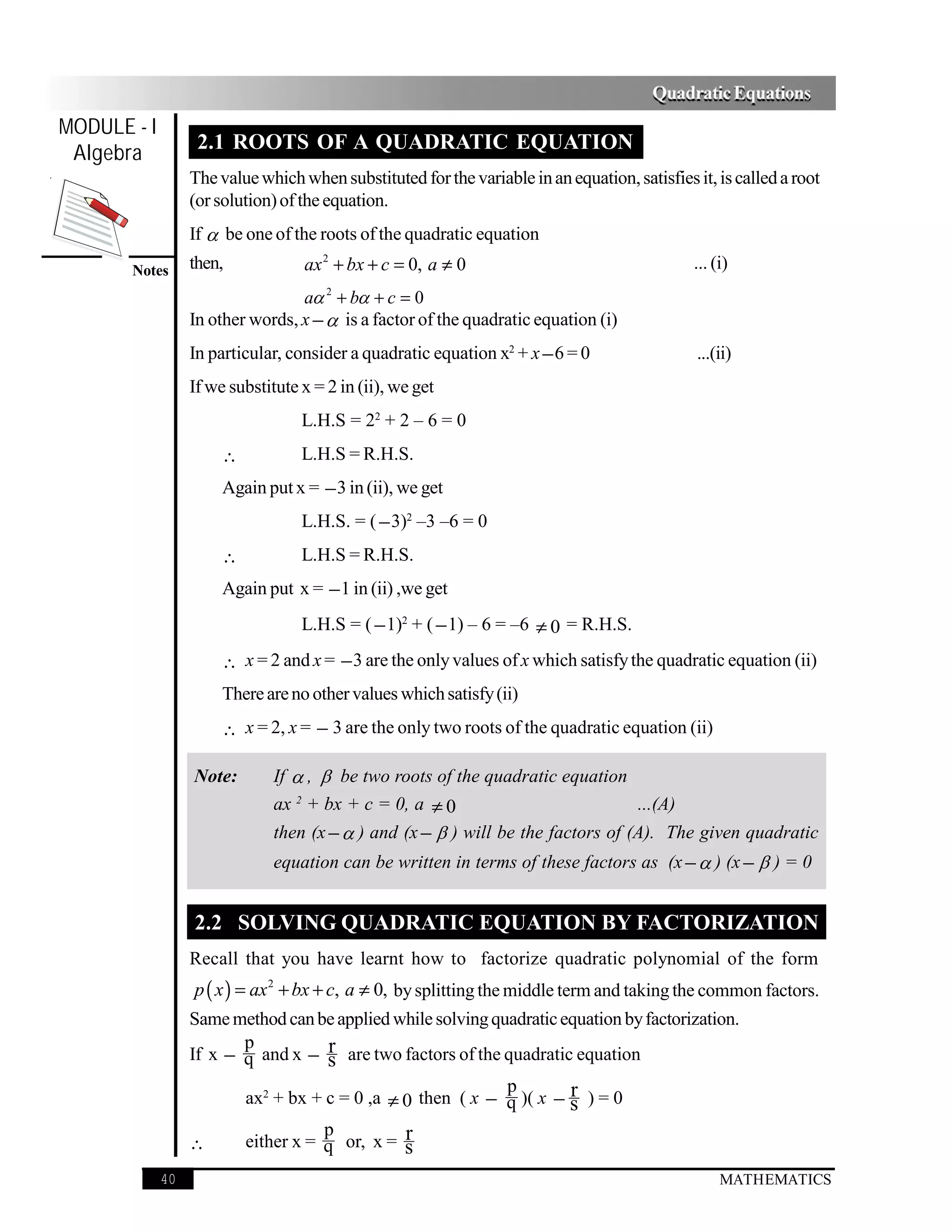
                   2.1 ROOTS OF A QUADRATIC EQUATION
 Algebra
                  The value which when substituted for the variable in an equation, satisfies it, is called a root
                  (or solution) of the equation.
                  If  be one of the roots of the quadratic equation
       Notes      then,            ax 2 + bx + c = 0, a ≠ 0                                   ... (i)
                                  a 2 + b + c = 0
                  In other words, x −  is a factor of the quadratic equation (i)
                  In particular, consider a quadratic equation x2 + x − 6 = 0                  ...(ii)
                  If we substitute x = 2 in (ii), we get
                                   L.H.S = 22 + 2 – 6 = 0
                       ∴           L.H.S = R.H.S.
                       Again put x = − 3 in (ii), we get
                                   L.H.S. = ( − 3)2 –3 –6 = 0
                       ∴           L.H.S = R.H.S.
                       Again put x = − 1 in (ii) ,we get
                                   L.H.S = ( − 1)2 + ( − 1) – 6 = –6 ≠ 0 = R.H.S.

                       ∴ x = 2 and x = − 3 are the only values of x which satisfy the quadratic equation (ii)
                       There are no other values which satisfy (ii)
                       ∴ x = 2, x = − 3 are the only two roots of the quadratic equation (ii)

                  Note:        If  ,  be two roots of the quadratic equation
                               ax 2 + bx + c = 0, a ≠ 0                        ...(A)
                               then (x −  ) and (x −  ) will be the factors of (A). The given quadratic
                               equation can be written in terms of these factors as (x −  ) (x −  ) = 0


                  2.2 SOLVING QUADRATIC EQUATION BY FACTORIZATION
                  Recall that you have learnt how to factorize quadratic polynomial of the form
                  p ( x ) = ax 2 + bx + c , a ≠ 0, by splitting the middle term and taking the common factors.
                  Same method can be applied while solving quadratic equation by factorization.
                         p           r
                  If x − q and x − s are two factors of the quadratic equation
                                                             p        r
                         ax2 + bx + c = 0 ,a ≠ 0 then ( x − q )( x − s ) = 0
                                    p          r
                  ∴      either x = q or, x = s
             40                                                                                    MATHEMATICS
Quadratic Equations
 Quadratic Equations
                                                                                        MODULE - I
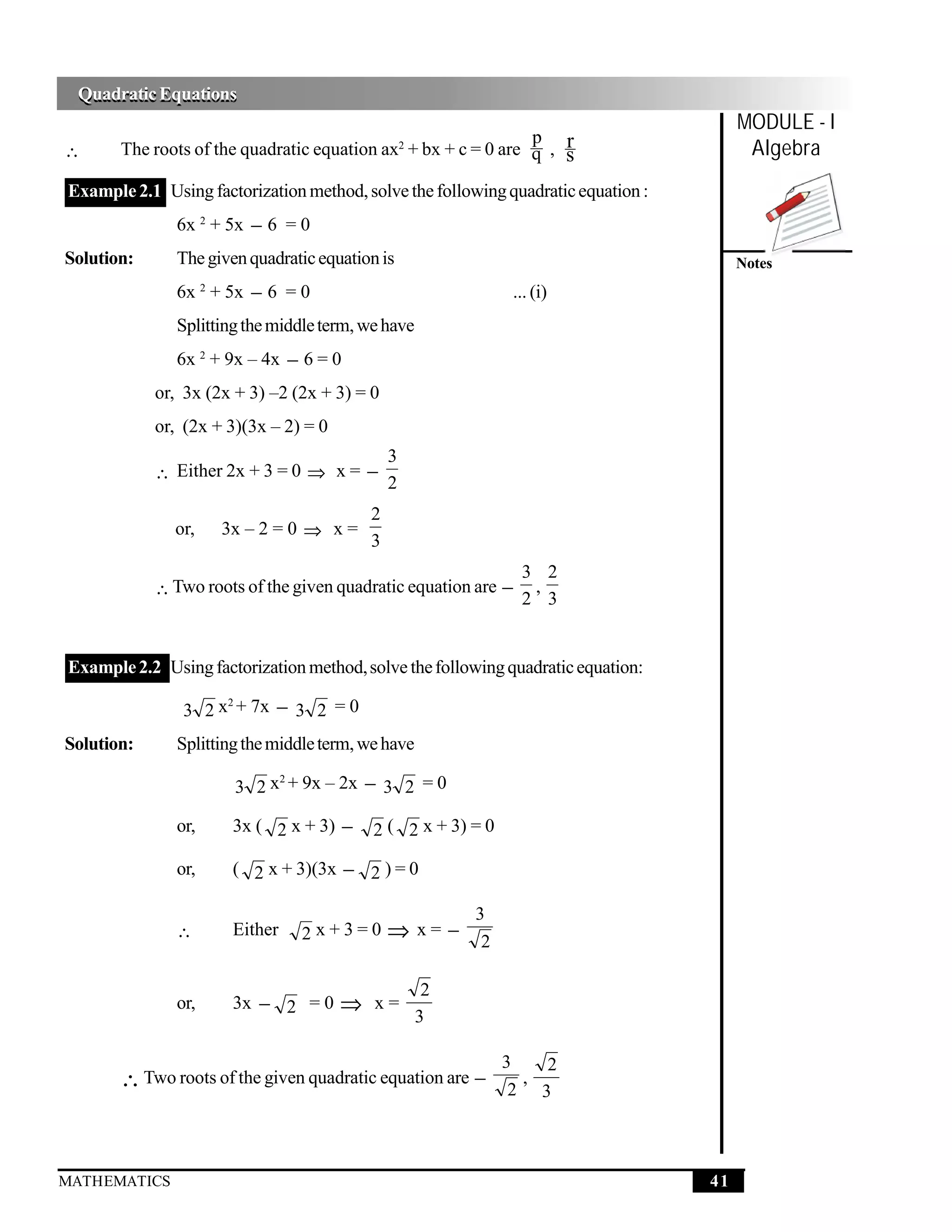
                                                               p r
∴                                                   2
       The roots of the quadratic equation ax + bx + c = 0 are q , s                     Algebra
Example 2.1 Using factorization method, solve the following quadratic equation :
               6x 2 + 5x − 6 = 0
Solution:      The given quadratic equation is                                          Notes
               6x + 5x − 6 = 0
                     2
                                                                  ... (i)
               Splitting the middle term, we have
               6x 2 + 9x – 4x − 6 = 0
            or, 3x (2x + 3) –2 (2x + 3) = 0
            or, (2x + 3)(3x – 2) = 0
                                                3
            ∴ Either 2x + 3 = 0 ⇒ x = −
                                                2
                                            2
              or,        3x – 2 = 0 ⇒ x =
                                            3
                                                                   3 2
            ∴ Two roots of the given quadratic equation are −       ,
                                                                   2 3


Example 2.2 Using factorization method, solve the following quadratic equation:

                3 2 x + 7x − 3 2 = 0
                     2


Solution:      Splitting the middle term, we have

                          3 2 x + 9x – 2x − 3 2 = 0
                               2


               or,        3x ( 2 x + 3) −   2 ( 2 x + 3) = 0

               or,        ( 2 x + 3)(3x − 2 ) = 0

                                                             3
               ∴          Either   2x+3=0       ⇒ x= − 2

                                                         2
               or,        3x − 2 = 0   ⇒ x=
                                                        3

                                                                 3   2
       ∴ Two roots of the given quadratic equation are −           ,
                                                                  2 3


MATHEMATICS                                                                        41
Quadratic Equations
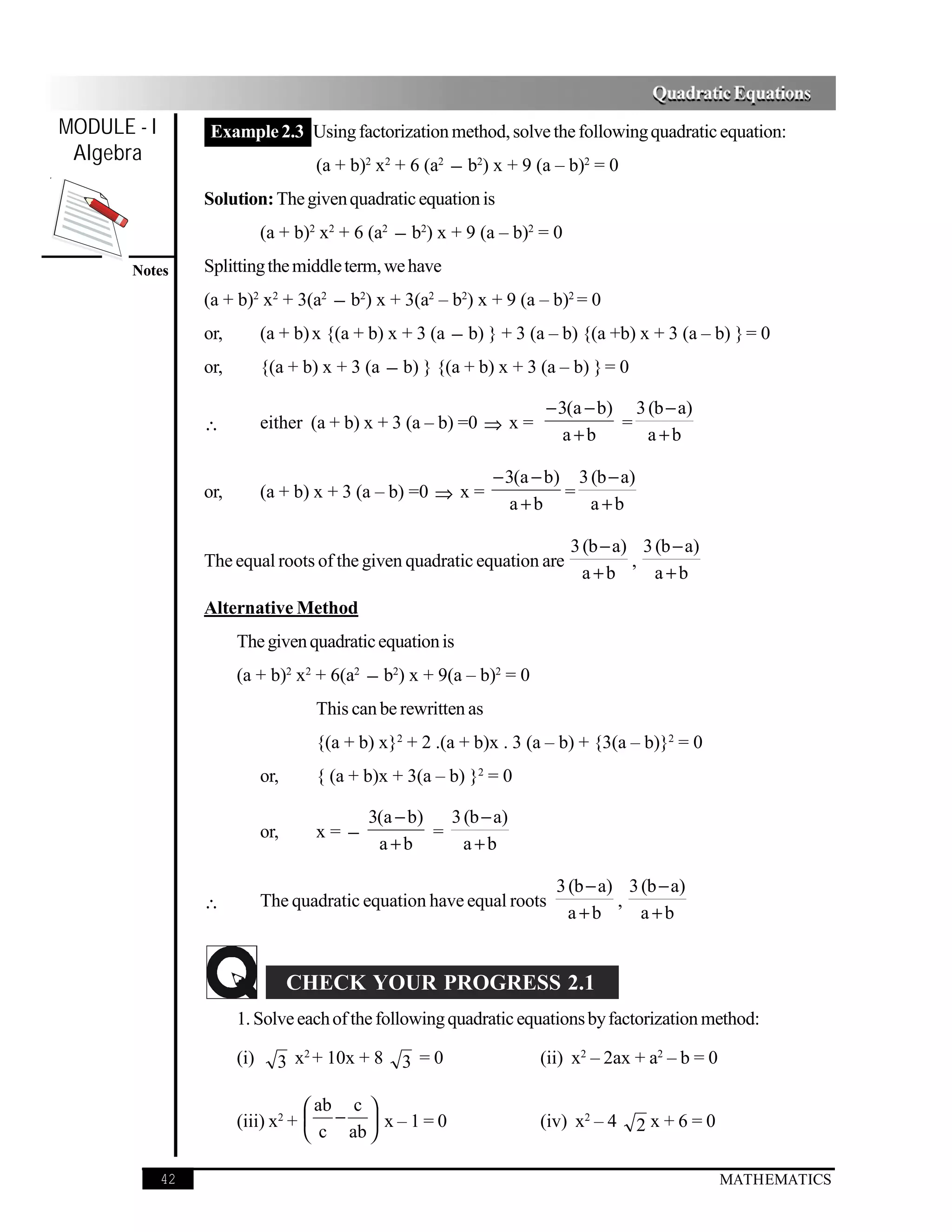
MODULE - I         Example 2.3 Using factorization method, solve the following quadratic equation:
 Algebra
                                      (a + b)2 x2 + 6 (a2 − b2) x + 9 (a – b)2 = 0
                  Solution: The given quadratic equation is
                              (a + b)2 x2 + 6 (a2 − b2) x + 9 (a – b)2 = 0
       Notes      Splitting the middle term, we have
                  (a + b)2 x2 + 3(a2 − b2) x + 3(a2 – b2) x + 9 (a – b)2 = 0
                  or,         (a + b) x {(a + b) x + 3 (a − b) } + 3 (a – b) {(a +b) x + 3 (a – b) } = 0
                  or,         {(a + b) x + 3 (a − b) } {(a + b) x + 3 (a – b) } = 0

                                                                        − 3(a − b) 3 (b − a)
                  ∴           either (a + b) x + 3 (a – b) =0 ⇒ x =               =
                                                                           a+b       a+b

                                                                 − 3(a − b) 3 (b − a)
                  or,         (a + b) x + 3 (a – b) =0 ⇒ x =               =
                                                                    a+b       a+b

                                                                             3 (b − a) 3 (b − a)
                  The equal roots of the given quadratic equation are                 ,
                                                                               a+b       a+b
                  Alternative Method
                        The given quadratic equation is
                        (a + b)2 x2 + 6(a2 − b2) x + 9(a – b)2 = 0
                                      This can be rewritten as
                                      {(a + b) x}2 + 2 .(a + b)x . 3 (a – b) + {3(a – b)}2 = 0
                              or,     { (a + b)x + 3(a – b) }2 = 0

                                             3(a − b)   3 (b − a)
                              or,     x= −            =
                                              a+b         a+b

                                                                         3 (b − a) 3 (b − a)
                  ∴           The quadratic equation have equal roots             ,
                                                                           a+b       a+b


                                    CHECK YOUR PROGRESS 2.1
                        1. Solve each of the following quadratic equations by factorization method:
                                   2
                        (i)     3 x + 10x + 8     3 =0                 (ii) x2 – 2ax + a2 – b = 0

                                    ab c 
                        (iii) x2 +  −  x – 1 = 0                     (iv) x2 – 4      2x+6=0
                                    c ab 

             42                                                                                     MATHEMATICS
Quadratic Equations
      Quadratic Equations
                                                                                                  MODULE - I
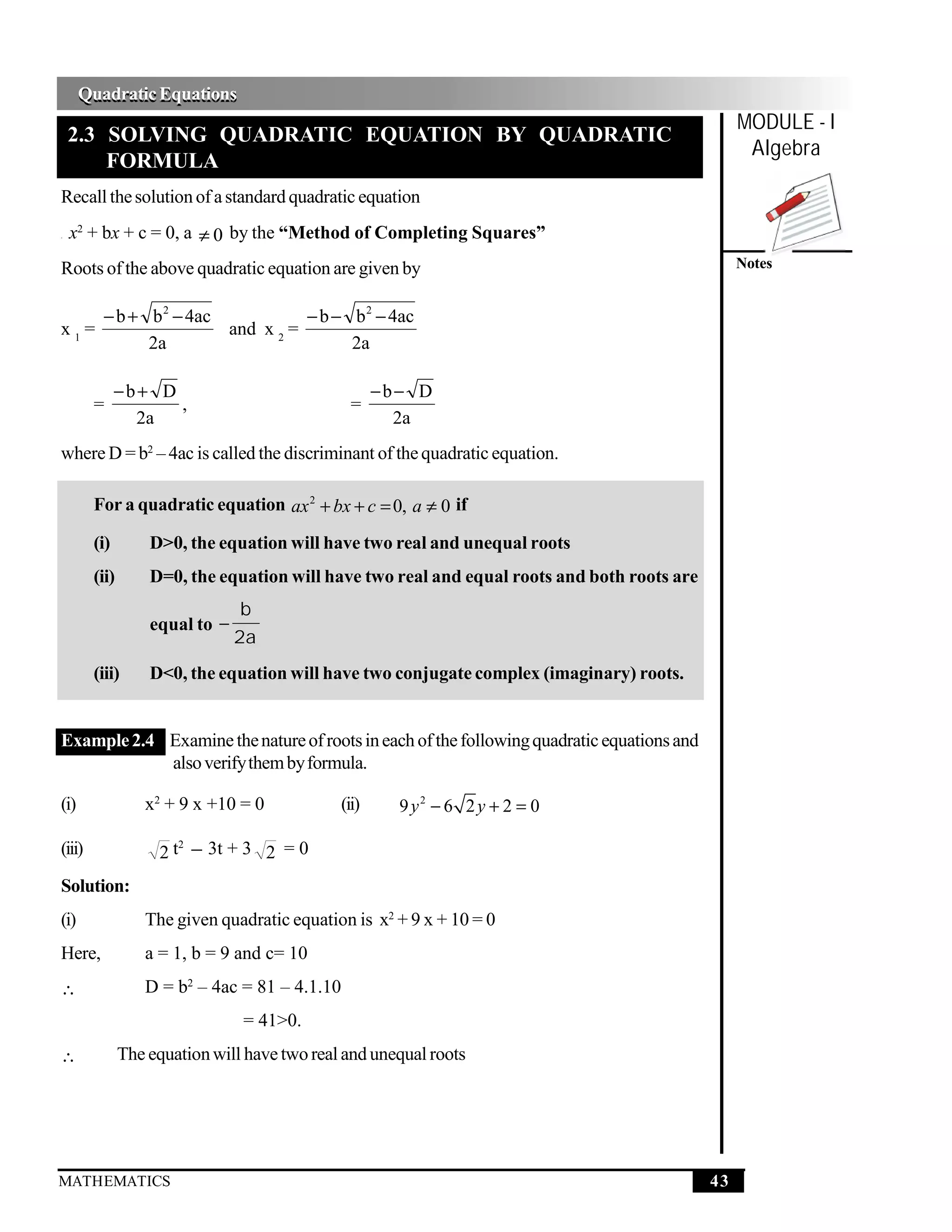
    2.3 SOLVING QUADRATIC EQUATION BY QUADRATIC
                                                                                                   Algebra
        FORMULA
Recall the solution of a standard quadratic equation
a   x2 + bx + c = 0, a ≠ 0 by the “Method of Completing Squares”
Roots of the above quadratic equation are given by                                                Notes


         − b + b 2 − 4ac           − b − b 2 − 4ac
x1=                      and x 2 =
               2a                        2a

              −b+ D                                   −b− D
        =           ,                            =
                2a                                      2a
where D = b2 – 4ac is called the discriminant of the quadratic equation.

        For a quadratic equation ax 2 + bx + c = 0, a ≠ 0 if

        (i)        D>0, the equation will have two real and unequal roots
        (ii)       D=0, the equation will have two real and equal roots and both roots are
                                b
                   equal to −
                                2a
        (iii)      D<0, the equation will have two conjugate complex (imaginary) roots.


Example 2.4 Examine the nature of roots in each of the following quadratic equations and
            also verify them by formula.

(i)               x2 + 9 x +10 = 0             (ii)     9 y2 − 6 2 y + 2 = 0

                    2 t − 3t + 3 2 = 0
                       2
(iii)

Solution:
(i)               The given quadratic equation is x2 + 9 x + 10 = 0
Here,             a = 1, b = 9 and c= 10
∴                 D = b2 – 4ac = 81 – 4.1.10
                                = 41>0.
∴              The equation will have two real and unequal roots


MATHEMATICS                                                                                  43
Quadratic Equations
MODULE - I
                  Verification: By quadratic formula, we have
 Algebra
                               − 9 ± 41
                          x=
                                    2

                                                − 9 + 41 − 9 − 41
       Notes      ∴       The two roots are             ,         which are real and unequal.
                                                     2        2

                  (ii)    The given quadratic equation is 9 y2 – 6 2 y + 2 = 0

                  Here, D = b2 – 4 ac

                            = ( − 6 2 )2 – 4.9.2

                            = 72 – 72 = 0
                  ∴       The equation will have two real and equal roots.
                  Verification: By quadratic formula, we have

                               6 2± 0             2
                          y=                =
                                 2.9             3

                                                       2    2
                  ∴       The two equal roots are        ,    .
                                                      3    3

                                                           2 t − 3t + 3 2 = 0
                                                              2
                  (iii) The given quadratic equation is

                  Here, D = ( − 3)2 − 4. 2 .3 2

                            = − 15< 0
                  ∴       The equation will have two conjugate complex roots.
                  Verification: By quadratic formula, we have

                               3 ± −15
                          t=
                                  2 2

                               3 ± 15i
                           =           , where i = − 1
                                 2 2

                                                              3+ 15 i 3− 15 i
                  ∴       Two conjugate complex roots are            ,
                                                               2 2     2 2


             44                                                                          MATHEMATICS
Quadratic Equations
  Quadratic Equations
Example 2.5 Prove that the quadratic equation x2 + py – 1 = 0 has real and distinct roots
                                                                                                  MODULE - I
            for all real values of p.                                                              Algebra
Solution: Here, D = p2 + 4 which is always positive for all real values of p.
∴       The quadratic equation will have real and distinct roots for all real values of p.

Example 2.6 For what value of k the quadratice equation                                           Notes

              (4k+ 1) x2 + (k + 1) x + 1 = 0 will have equal roots ?
Solution: The given quadratic equation is
        (4k + 1)x2 + (k + 1) x + 1 = 0
Here, D = (k + 1)2 – 4.(4k + 1).1
      For equal roots, D = 0
∴     (k + 1)2 – 4 (4k + 1) = 0
⇒     k 2 – 14k –3 = 0

             14 ± 196 +12
∴       k=
                   2

             14 ± 208
or      k=
                 2
        = 7 ± 2 13 or 7 + 2 13 , 7 – 2 13
which are the required values of k.
Example 2.7 Prove that the roots of the equation
                x2 (a2+ b2) + 2x (ac+ bd) + (c2+ d2) = 0 are imaginary. But if ad = bc,
                roots are real and equal.
Solution: The given equation is x2 (a2 + b2) + 2x (ac + bd) + (c2 + d2) = 0
Discriminant      = 4 (ac + bd)2 – 4 (a2 + b2) (c2 + d2)
                  = 8 abcd – 4(a2 d2 + b2 c2)
                  =        − 4 ( − 2 abcd + a2 d2 + b2 c2)
                  =        − 4 (ad –bc) 2
                  <0 for all a, b, c, d
∴       The roots of the given equation are imaginary.
        For real and equal roots, discriminant is equal to zero.
⇒       − 4 (ad − bc)2 = 0
or,     ad = bc
        Hence, if ad=bc, the roots are real and equal.

MATHEMATICS                                                                                  45
Quadratic Equations
MODULE - I
 Algebra
                                   CHECK YOUR PROGRESS 2.2

                  1. Solve each of the following quadratic equation by quadratic formula:

       Notes            (i)        2x2 – 3 x + 3 = 0                (ii)   − x 2 + 2x − 1 = 0

                        (iii)       −4 x 2 + 5 x − 3 = 0            (iv)   3x 2 + 2 x + 5 = 0
                  2. For what values of k will the equation
                      y2 – 2 (1 + 2k) y + 3 + 2k = 0 have equal roots ?
                  3. Show that the roots of the equation
                        (x − a) (x − b) + (x − b) (x − c) + (x − c) (x − a) = 0 are always real and they can not be
                         equal unless a = b = c.

                  2.4 RELATION BETWEEN ROOTS AND COEFFICIENTS OF
                      A QUADRATIC EQUATION

                  You have learnt that, the roots of a quadratic equation ax2 + bx + c = 0, a ≠ 0

                                − b + b 2 − 4 ac     − b − b 2 − 4 ac
                  are                            and
                                      2a                   2a

                               − b + b 2 − 4 ac                                 − b − b 2 − 4 ac
                  Let            =                        ...(i)     and  =                      ... (ii)
                                        2a                                            2a
                  Adding (i) and (ii), we have

                                           − 2b   −b
                                 + =          =
                                            2a     a
                                                     coefficient of x       b
                  ∴             Sum of the roots = – coefficient of x 2 = − a                      ... (iii)


                                           + b 2 − (b 2 − 4 ac)
                                     =
                                                   4a 2

                                           4 ac
                                       =
                                           4a 2

                                           c
                                       =
                                           a


             46                                                                                       MATHEMATICS
Quadratic Equations
 Quadratic Equations
                                                                                                         MODULE - I
∴
                               constant term       c
       Product of the roots = coefficient of x 2 = a                       ...(iv)                        Algebra

(iii) and (iv) are the required relationships between roots and coefficients of a given quadratic
equation. These relationships helps to find out a quadratic equation when two roots are
given.
                                                                                                         Notes

Example 2.8 If,  ,  are the roots of the equation 3x2 – 5x + 9 = 0 find the value of:

                                                  1   1
                  (a)  2 +  2             (b)     + 2
                                                  2


Solution: (a) It is given that  ,  are the roots of the quadratic equation 3x2 – 5x +9 = 0.

                   5
∴         + =                                        ... (i)
                   3

                 9
and      =       =3                                  ... (ii)
                 3

         2 + 2             = (  +  ) − 2
                                        2
Now,

                                  2
                               5
                            =   − 2.3                [By (i) and (ii)]
                               3

                                  29
                            =−
                                  9

                                       29
∴       The required value is −
                                       9

             1         1     2 +2
(b) Now,         + 2      =
            2                 2 2

                            − 29
                           = 9                         [By (i) and (ii)]
                             9

                                 29
                           =−
                                 81


MATHEMATICS                                                                                         47
Quadratic Equations
MODULE - I        Example 2.9 If  ,  are the roots of the equation 3y2 + 4y + 1 = 0, form a quadratic
 Algebra
                  equation whose roots are  2,  2

                  Solution: It is given that  ,  are two roots of the quadratic equation 3y2 + 4y + 1 = 0.

                  ∴       Sum of the roots
       Notes
                                              coefficient of y
                  i.e.,    +  = − coefficient of y 2

                                         4
                                 =−                                                       ... (i)
                                         3
                                                    cons tan t term
                  Product of the roots i.e.,   = coefficient of y 2

                                                            1
                                                        =                                 ... (ii)
                                                            3
                  Now,  2 +  2 = (  +  )2 – 2  
                                               2
                                    4       1
                                 =  −  − 2.                                    [ By (i) and (ii)]
                                    3       3

                                     16   2
                                 =      −
                                      9   3
                                         10
                                     =
                                          9

                                                  1
                          and  2  2 = (   )2 =                                 [By (i) ]
                                                  9
                  ∴       The required quadratic equation is y2 – (  2 +  2)y +  2  2 = 0
                                 10   1
                  or,     y2 −      y+ =0
                                  9   9
                  or,     9y2 – 10y + 1 = 0

                  Example 2.10               If one root of the equation ax 2 + bx + c = 0, a ≠ 0 be the square of
                                             the other, prove that b3 + ac2 + a2c = 3abc
                  Solution: Let  ,  2 be two roots of the equation ax2 + bx + c = 0.

                                               b
                  ∴        + 2= −                                                       ... (i)
                                               a


             48                                                                                       MATHEMATICS
Quadratic Equations
  Quadratic Equations
                                                                                                  MODULE - I
and      . 2 =
                 c                                                                                 Algebra
                 a

               c
i.e.,   3=      .                               ... (ii)
               a
                                                                                                  Notes
From (i) we have

                            b
         (  + 1) = −
                            a

                                3
                           b      b3
or,     { ( + 1)}  3
                         = −  = − 3
                           a      a

                                            b3
or,      3 (  3 + 3  2 + 3  +1) = −
                                            a3

         c c      b           3

or,          + 3  −  +1 = − b3 ... [ By (i) and (ii)]
         a a      a         a

         c2   3 bc   c   b3
or,         –      +   =– 3
         a2    a2    a   a
or,     ac2 – 3abc + a2c = − b3
or,     b3 + ac2 + a2c = 3abc
which is the required result.

Example 2.11 Find the condition that the roots of the equation ax2 + bx + c = 0 are in the
             ratio m : n
Solution: Let m  and n  be the roots of the equation ax2 +bx + c = 0

                           b
Now, m  + n  = –                                          ... (i)
                           a

                     c
and     mn  2 =                                            ... (ii)
                     a

                                            b
From (i) we have,           (m + n ) = –
                                            a

                           b2
or,      (m + n)2 =
           2
                           a2

MATHEMATICS                                                                                  49
Quadratic Equations
MODULE - I                  c              b2
 Algebra          or,
                            a
                              (m + n)2 = mn 2
                                           a
                                                                         [ By (ii)]

                  or,       ac (m+n)2 = mn b2
                  which is the required condition

       Notes
                                  CHECK YOUR PROGRESS 2.3

                        1. If  ,  are the roots of the equation ay2 + by + c = 0 then find the value of :

                                         1  1                       1   1
                                  (i)     + 2               (ii)     + 4
                                         2
                                                                    4


                        2. If  ,  are the roots of the equation 5x2 – 6x + 3 = 0, form a quadratic equation
                           whose roots are:

                                  (i)  2,  2               (ii)  3  ,   3
                        3. If the roots of the equation ay2 + by + c = 0 be in the ratio 3:4, prove that
                           12b2 = 49 ac
                        4. Find the condition that one root of the quadratic equation px2 – qx + p = 0
                           may be 1 more than the other.

                   2.5 SOLUTION OF A QUADRATIC EQUATION WHEN D < 0

                  Let us consider the following quadratic equation:
                            (a)         Solve for t :
                            t2 + 3t + 4 = 0

                                    − 3 ± 9 −16   −3 ± −7
                  ∴         t=                  =
                                         2            2
                  Here, D= –7 < 0

                                                −3 + −7     −3− − 7
                  ∴         The roots are               and
                                                    2          2

                            − 3 + 7 i −3 − 7 i
                  or,                ,
                                 2        2
                  Thus, the roots are complex and conjugate.


             50                                                                                  MATHEMATICS
Quadratic Equations
  Quadratic Equations
(b)       Solve for y :                                                                           MODULE - I
                                                                                                   Algebra
          − 3y2 + 5 y – 2 = 0

                 − 5 ± 5 − 4(−3).(−2)
∴         y=
                       2(−3)
                                                                                                  Notes

                 − 5 ± −19
or        y=
                     −6
Here, D = − 19 < 0

                          − 5 + 19i    5 − 19i
∴         The roots are             ,−
                             −6          −6
Here, also roots are complex and conjugate. From the above examples , we can make the
following conclusions:
          (i)       D < 0 in both the cases
          (ii)      Roots are complex and conjugate to each other.
Is it always true that complex roots occur in conjugate pairs ?
Let us form a quadratic equation whose roots are
          2 + 3i and 4 – 5i
The equation will be {x – (2 + 3i)} {x – (4 – 5i)} = 0
or,        x2 – (2 + 3i)x – (4 – 5i)x + (2 + 3i) (4 – 5i) = 0
or,        x2 + (–6 + 2i)x + 23 + 2i = 0
which is an equation with complex coefficients.

      Note : If the quadratic equation has two complex roots, which are not conjugate
      of each other, the quadratic equation is an equation with complex coefficients.


 2.6 CUBE ROOTS OF UNITY
Let us consider an equation of degree 3 or more. Any equation of degree 3 can be expressed
as a product of a linear and quadratic equation.
The simplest situation that comes for our consideration is
          x³ − 1 = 0                                        ...(i)
∴         x³ − 1 = (x − 1) (x ² + x + 1) = 0
either x − 1 = 0           or,     x²+x+1=0


MATHEMATICS                                                                                  51
Quadratic Equations
MODULE - I
 Algebra                                                                −1± 3i
                  or,     x=1                      or,        x=
                                                                          2

                                                       1  3i      1  3i
                  ∴       Roots are                1, − +    and − −
                                                       2  2       2  2
       Notes
                  These are called cube roots of unity.
                  Do you see any relationship between two non-real roots of unity obtained above ?
                  Let us try to find the relationship between them

                                      1  3i
                  Let     w=         − +
                                      2  2
                  Squaring both sides, we have
                                               2
                             1  3 i
                          = − +
                             2     
                                 2 
                  w²
                                   

                              1
                          =     (1+ 3 i 2 − 2 3 i)
                              4

                              1
                          =     (1− 3 − 2 3 i)
                              4

                              −2−2 3 i
                          =
                                 4


                          =
                                 (
                              − 2 1+ 3 i   )       =
                                                          (
                                                         − 1+ 3 i   )
                                   4                         2

                                1  3i
                  ∴       w² = − −    = other complex root.
                                2 2
                  ∴       We denote cube roots of unity as 1, w, w²


             52                                                                            MATHEMATICS
Quadratic Equations
     Quadratic Equations
                                                                                           MODULE - I
                      1
Note: If we take w = − −
                         3i
                            , we can verify, that in this case                              Algebra
                      2  2

                      1     3i
         also w2 = − +            = other complex root.
                      2     2
                                                                                           Notes
Thus, square of one complex root is same as the other complex root.

Again, sum of roots i.e., 1+ w + w²

              1  3 i  1               3 i
         1 + − +
              2      + − −               
                  2   2                2 
=
                                         

              1 1
=        1−    −
              2 2
=        1−1
=        0
∴        1 + w + w² = 0
Sum of cube roots of unity is zero.
Product of cube roots of 1
i.e., 1.w.w² = w³ = 1 (since ,w is a root the equation x3 − 1 = 0)

      We can conclude that , if 1, w and w2 are cube roots of unity then
      (i) square of one complex root is same as the other complex root i.e., w2 = w
      (ii) 1+ w + w2 = 0
      (iii) w3 = 1

Let us now consider another equation
         x³ + 1 = 0                                                  ... (ii)
or       (x + 1) (x ² − x + 1) = 0
Either, x + 1 = 0          or,    x² −x+1=0

                                       1± 1− 4
or,      x = −1            or,    x=
                                          2

                                       1± −3
⇒        x = −1            or,    x=
                                         2


MATHEMATICS                                                                           53
Quadratic Equations
MODULE - I
 Algebra          ∴ Roots are − 1,
                                       1
                                         −
                                           3i    1
                                              and +
                                                    3i
                                                       which can also be written as − 1 , − w and − w2
                                       2   2     2  2
                  Therefore, cube roots of − 1 are − 1 , − w and − w2

                        In general, roots of any cubic equation of the form x 3 = ± a3 would be
       Notes
                        ± a , ± aw and ± aw2

                  Example 2.12 If 1, w and w² are cube roots of unity, prove that

                               (a) 1 + w2 + w7 = 0
                               (b) (1 − w + w2) (1 + w – w2) = 4
                               (c) (1 + w)3 − (1 + w2)3 = 0
                               (d) (1 − w + w2)3 = − 8 and (1 + w − w2)3 = − 8
                  Solution:

                  (a)       1 + w2 + w7 = 0

                            L.H.S = 1 + w2 + (w3)2. w

                                   = 1 + w2 + w                       [ since w3 =1]

                                   =0                          [ since 1+ w + w2 = 0]

                                   = R.H.S

                  ∴         L.H.S = R.H.S

                  (b)       (1 − w + w2) (1 + w – w2) = 4
                            L.H.S =         (1 − w + w2) (1 + w – w2)
                                   =        (1 + w2 − w) (1 + w – w2)
                                            (since 1 + w2 = − w and           1 + w = − w2)
                                   =        ( − w − w) ( − w2 –w2)
                                   =        ( − 2w) ( − 2w2)
                                   =        4w3
                                   =        4.1 = 4 =R.H.S

                  ∴         L.H.S = R.H.S


             54                                                                                 MATHEMATICS
Quadratic Equations
     Quadratic Equations

(c)       (1 + w)3 − (1 + w2)3 = 0
                                                                                    MODULE - I
                                                                                     Algebra
          L.H.S =         (1 + w)3 − (1 + w2)3
                   =      ( − w2)3 − ( − w)3             (∴     1 + w = − w2
                   =      − w6 + w3                and   1 + w2 = − w)
                   =      − (w3)2 + 1                                               Notes

                   =      − (1)2 + 1
                   =      0 =R.H.S
∴          L.H.S = R.H.S
(d)       (1 − w + w2)3 = − 8 and (1 + w − w2)3 = − 8
Case I : L.H.S            =       (1 − w + w2)3
                          =       (1 + w2 − w)3
                          =       ( − w − w)3
                          =       ( − 2w)3
                          =       − 8w3
                          =       − 8 = R.H.S
          ∴        L.H.S =        R.H.S
Case II : L.H.S           =       (1 + w − w²)³
                          =       ( − w2 – w2)3
                          =       ( − 2w2)3
                          =       − 8w6
                          =       − 8(w3)2
                          =       − 8 = R.H.S
          ∴        L.H.S =        R.H.S


              CHECK YOUR PROGRESS 2.4

1.      Solve each of the following cubic equations:

        (i) x3 = 27               (ii) x3 = − 27

        (iii) x3 = 64             (iv) x3 = − 64


MATHEMATICS                                                                    55
Quadratic Equations
MODULE - I
                  2.   If 1, w, w2 are cube roots of unity, show that
 Algebra
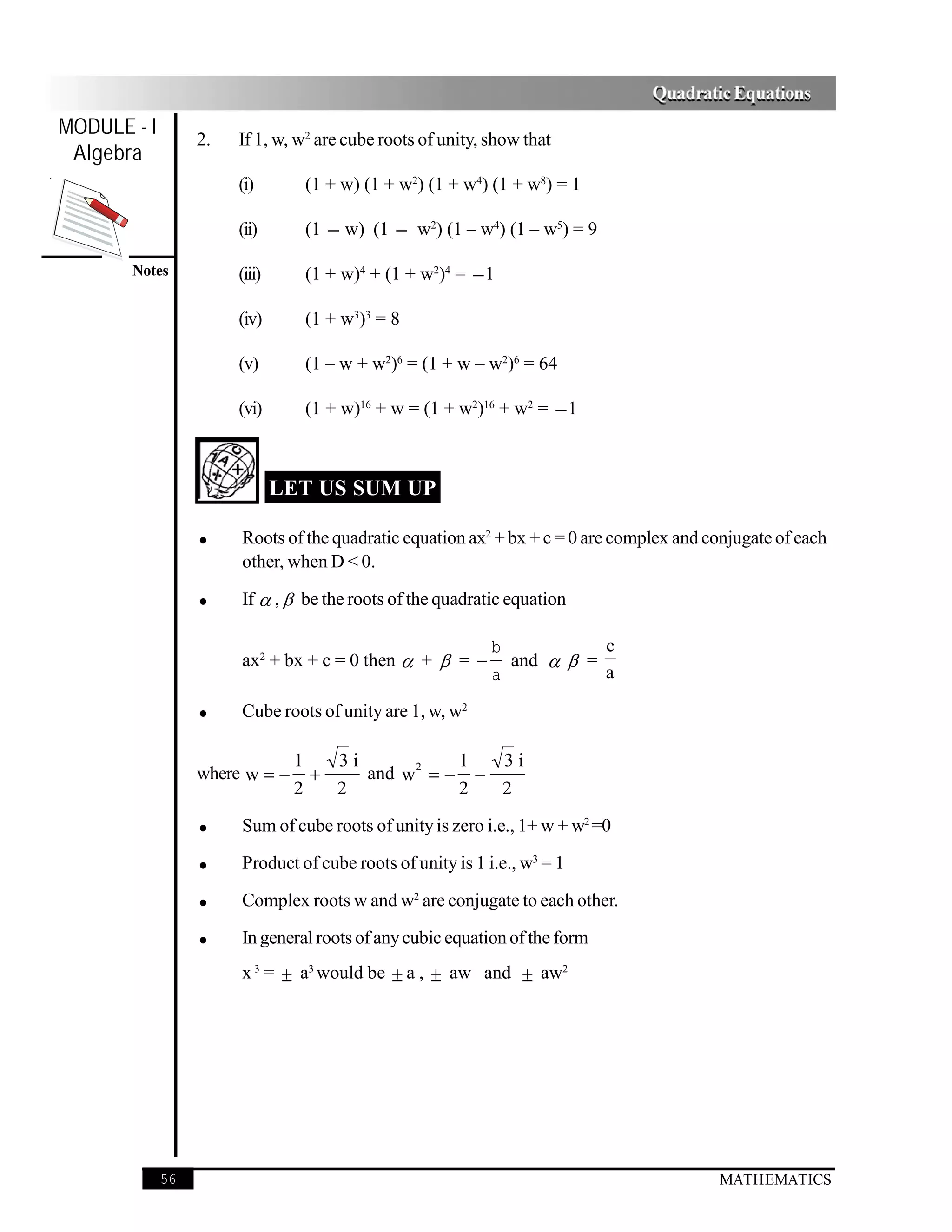
                       (i)       (1 + w) (1 + w2) (1 + w4) (1 + w8) = 1

                       (ii)      (1 − w) (1 − w2) (1 – w4) (1 – w5) = 9

       Notes           (iii)     (1 + w)4 + (1 + w2)4 = − 1

                       (iv)      (1 + w3)3 = 8

                       (v)       (1 – w + w2)6 = (1 + w – w2)6 = 64

                       (vi)      (1 + w)16 + w = (1 + w2)16 + w2 = − 1


                               LET US SUM UP

                  •    Roots of the quadratic equation ax2 + bx + c = 0 are complex and conjugate of each
                       other, when D < 0.

                  •    If  ,  be the roots of the quadratic equation

                                                            b           c
                       ax2 + bx + c = 0 then  +  = −        and   =
                                                            a           a

                  •    Cube roots of unity are 1, w, w2

                                1   3i            1  3i
                  where w = −     +    and w 2 = − −
                                2   2             2  2

                  •    Sum of cube roots of unity is zero i.e., 1+ w + w2 =0

                  •    Product of cube roots of unity is 1 i.e., w3 = 1

                  •    Complex roots w and w2 are conjugate to each other.

                  •    In general roots of any cubic equation of the form
                       x 3 = ± a3 would be ± a , ± aw and ± aw2


             56                                                                          MATHEMATICS
Quadratic Equations
 Quadratic Equations
                                                                                                 MODULE - I
                                                                                                  Algebra
      SUPPORTIVE WEB SITES
      http://www.wikipedia.org
      http://mathworld.wolfram.com
                                                                                                 Notes


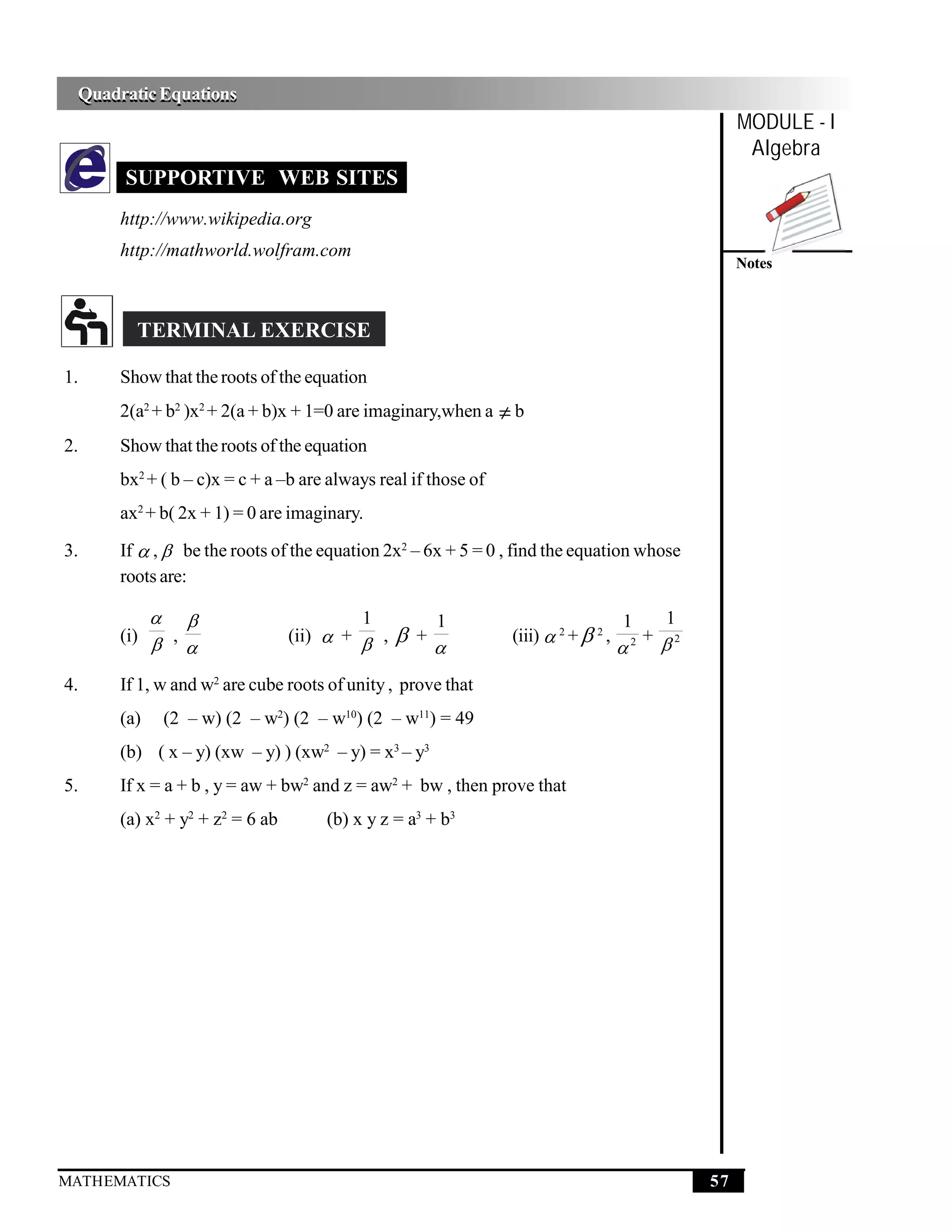
        TERMINAL EXERCISE

1.    Show that the roots of the equation
      2(a2 + b2 )x2 + 2(a + b)x + 1=0 are imaginary,when a ≠ b
2.    Show that the roots of the equation
      bx2 + ( b – c)x = c + a –b are always real if those of
      ax2 + b( 2x + 1) = 0 are imaginary.

3.    If  ,  be the roots of the equation 2x2 – 6x + 5 = 0 , find the equation whose
      roots are:

                                       1           1                             1   1
      (i)  ,                   (ii)  +  ,    +             (iii)  2 +  2 ,     + 2
                                                                                 2


4.    If 1, w and w2 are cube roots of unity , prove that
      (a)       (2 – w) (2 – w2) (2 – w10) (2 – w11) = 49
      (b) ( x – y) (xw – y) ) (xw2 – y) = x3 – y3
5.    If x = a + b , y = aw + bw2 and z = aw2 + bw , then prove that
      (a) x2 + y2 + z2 = 6 ab        (b) x y z = a3 + b3


MATHEMATICS                                                                                 57
Quadratic Equations
MODULE - I
 Algebra
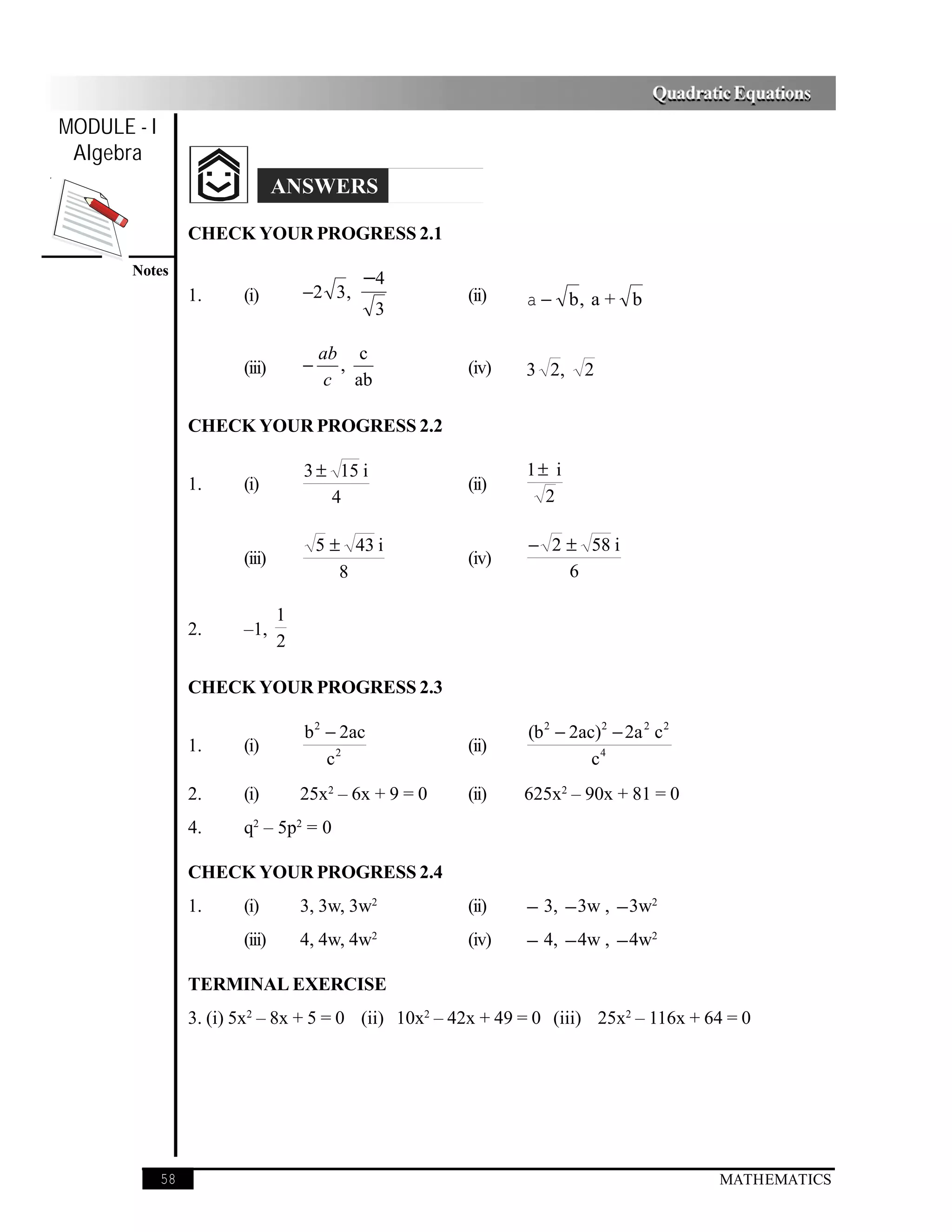
                                 ANSWERS

                  CHECK YOUR PROGRESS 2.1
       Notes
                                              −4
                  1.     (i)         −2 3 ,              (ii)   a − b, a + b
                                                 3

                                         ab c
                         (iii)       −     ,             (iv)   3 2,     2
                                          c ab

                  CHECK YOUR PROGRESS 2.2

                                     3 ± 15 i                   1± i
                  1.     (i)                             (ii)
                                        4                         2

                                         5 ± 43 i               − 2 ± 58 i
                         (iii)                           (iv)
                                            8                       6

                                 1
                  2.     –1,
                                 2

                  CHECK YOUR PROGRESS 2.3

                                     b 2 − 2ac                  (b 2 − 2ac)2 − 2a 2 c 2
                  1.     (i)                             (ii)
                                         c2                               c4
                  2.     (i)         25x2 – 6x + 9 = 0   (ii)   625x2 – 90x + 81 = 0
                  4.     q2 – 5p2 = 0

                  CHECK YOUR PROGRESS 2.4
                  1.     (i)         3, 3w, 3w2          (ii)   − 3, − 3w , − 3w2
                         (iii)       4, 4w, 4w2          (iv)   − 4, − 4w , − 4w2

                  TERMINAL EXERCISE
                  3. (i) 5x2 – 8x + 5 = 0 (ii) 10x2 – 42x + 49 = 0 (iii) 25x2 – 116x + 64 = 0


             58                                                                             MATHEMATICS
Quadratic equations

Quadratic equations

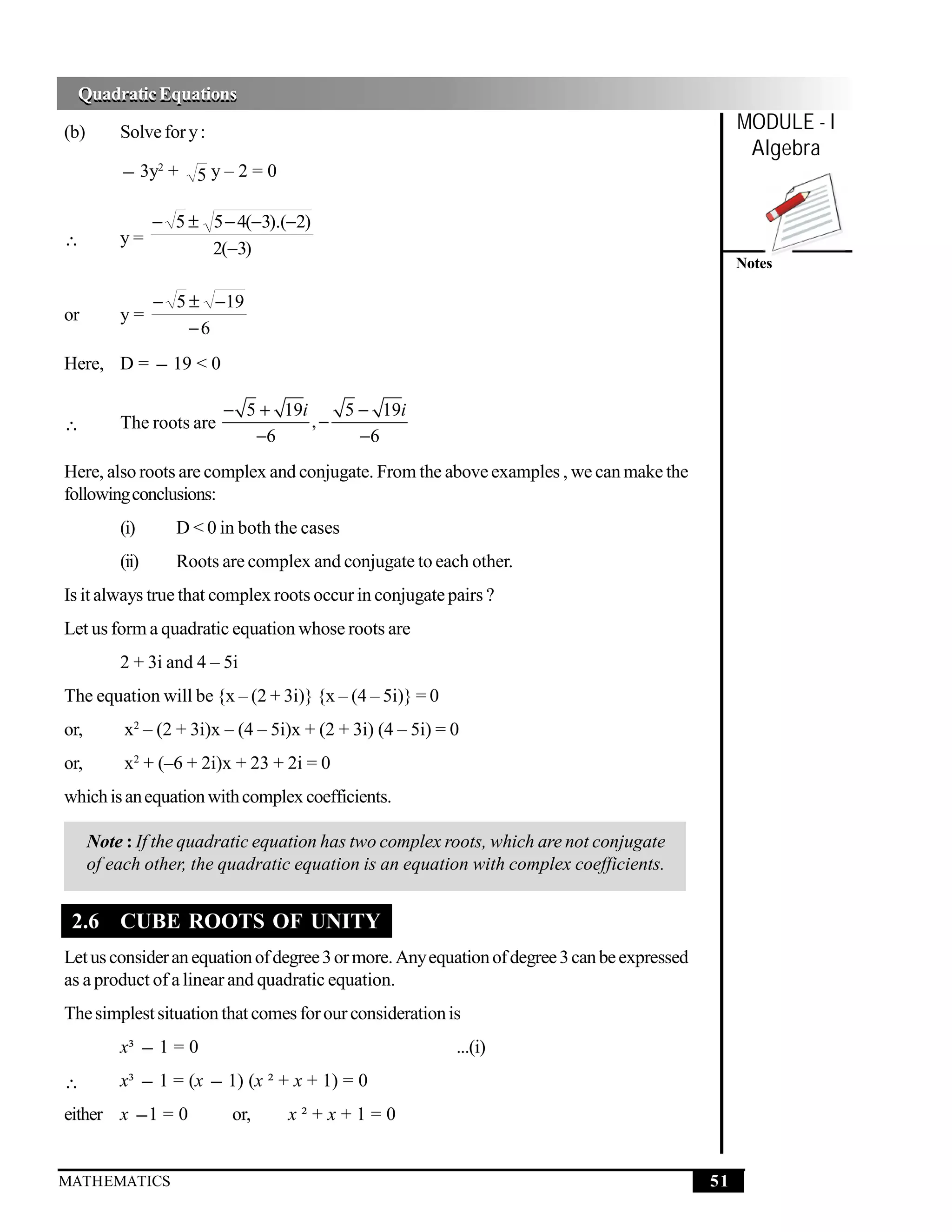
  • 1.
    Quadratic Equations Quadratic Equations MODULE - I Algebra 2 Notes QUADRATIC EQUATIONS Recall that an algebraic equation of the second degree is written in general form as ax 2 + bx + c = 0, a ≠ 0 It is called a quadratic equation in x. The coefficient ‘a’ is the first or leading coefficient, ‘b’ is the second or middle coefficient and ‘c’ is the constant term (or third coefficient). 5 1 For example, 7x² + 2x + 5 = 0, x² + x + 1 = 0, 2 2 1 3x² − x = 0, x² + = 0, 2 x² + 7x = 0, are all quadratic equations. 2 In this lesson we will discuss how to solve quadratic equations with real and complex coefficients and establish relation between roots and coefficients. We will also find cube roots of unity and use these in solving problems. OBJECTIVES After studying this lesson, you will be able to: • solve a quadratic equation with real coefficients by factorization and by using quadratic formula; • find relationship between roots and coefficients; • form a quadratic equation when roots are given; and • find cube roots of unity. EXPECTED BACKGROUND KNOWLEDGE • Real numbers • Quadratic Equations with real coefficients. MATHEMATICS 39
  • 2.
    Quadratic Equations MODULE -I 2.1 ROOTS OF A QUADRATIC EQUATION Algebra The value which when substituted for the variable in an equation, satisfies it, is called a root (or solution) of the equation. If  be one of the roots of the quadratic equation Notes then, ax 2 + bx + c = 0, a ≠ 0 ... (i) a 2 + b + c = 0 In other words, x −  is a factor of the quadratic equation (i) In particular, consider a quadratic equation x2 + x − 6 = 0 ...(ii) If we substitute x = 2 in (ii), we get L.H.S = 22 + 2 – 6 = 0 ∴ L.H.S = R.H.S. Again put x = − 3 in (ii), we get L.H.S. = ( − 3)2 –3 –6 = 0 ∴ L.H.S = R.H.S. Again put x = − 1 in (ii) ,we get L.H.S = ( − 1)2 + ( − 1) – 6 = –6 ≠ 0 = R.H.S. ∴ x = 2 and x = − 3 are the only values of x which satisfy the quadratic equation (ii) There are no other values which satisfy (ii) ∴ x = 2, x = − 3 are the only two roots of the quadratic equation (ii) Note: If  ,  be two roots of the quadratic equation ax 2 + bx + c = 0, a ≠ 0 ...(A) then (x −  ) and (x −  ) will be the factors of (A). The given quadratic equation can be written in terms of these factors as (x −  ) (x −  ) = 0 2.2 SOLVING QUADRATIC EQUATION BY FACTORIZATION Recall that you have learnt how to factorize quadratic polynomial of the form p ( x ) = ax 2 + bx + c , a ≠ 0, by splitting the middle term and taking the common factors. Same method can be applied while solving quadratic equation by factorization. p r If x − q and x − s are two factors of the quadratic equation p r ax2 + bx + c = 0 ,a ≠ 0 then ( x − q )( x − s ) = 0 p r ∴ either x = q or, x = s 40 MATHEMATICS
  • 3.
    Quadratic Equations QuadraticEquations MODULE - I p r ∴ 2 The roots of the quadratic equation ax + bx + c = 0 are q , s Algebra Example 2.1 Using factorization method, solve the following quadratic equation : 6x 2 + 5x − 6 = 0 Solution: The given quadratic equation is Notes 6x + 5x − 6 = 0 2 ... (i) Splitting the middle term, we have 6x 2 + 9x – 4x − 6 = 0 or, 3x (2x + 3) –2 (2x + 3) = 0 or, (2x + 3)(3x – 2) = 0 3 ∴ Either 2x + 3 = 0 ⇒ x = − 2 2 or, 3x – 2 = 0 ⇒ x = 3 3 2 ∴ Two roots of the given quadratic equation are − , 2 3 Example 2.2 Using factorization method, solve the following quadratic equation: 3 2 x + 7x − 3 2 = 0 2 Solution: Splitting the middle term, we have 3 2 x + 9x – 2x − 3 2 = 0 2 or, 3x ( 2 x + 3) − 2 ( 2 x + 3) = 0 or, ( 2 x + 3)(3x − 2 ) = 0 3 ∴ Either 2x+3=0 ⇒ x= − 2 2 or, 3x − 2 = 0 ⇒ x= 3 3 2 ∴ Two roots of the given quadratic equation are − , 2 3 MATHEMATICS 41
  • 4.
    Quadratic Equations MODULE -I Example 2.3 Using factorization method, solve the following quadratic equation: Algebra (a + b)2 x2 + 6 (a2 − b2) x + 9 (a – b)2 = 0 Solution: The given quadratic equation is (a + b)2 x2 + 6 (a2 − b2) x + 9 (a – b)2 = 0 Notes Splitting the middle term, we have (a + b)2 x2 + 3(a2 − b2) x + 3(a2 – b2) x + 9 (a – b)2 = 0 or, (a + b) x {(a + b) x + 3 (a − b) } + 3 (a – b) {(a +b) x + 3 (a – b) } = 0 or, {(a + b) x + 3 (a − b) } {(a + b) x + 3 (a – b) } = 0 − 3(a − b) 3 (b − a) ∴ either (a + b) x + 3 (a – b) =0 ⇒ x = = a+b a+b − 3(a − b) 3 (b − a) or, (a + b) x + 3 (a – b) =0 ⇒ x = = a+b a+b 3 (b − a) 3 (b − a) The equal roots of the given quadratic equation are , a+b a+b Alternative Method The given quadratic equation is (a + b)2 x2 + 6(a2 − b2) x + 9(a – b)2 = 0 This can be rewritten as {(a + b) x}2 + 2 .(a + b)x . 3 (a – b) + {3(a – b)}2 = 0 or, { (a + b)x + 3(a – b) }2 = 0 3(a − b) 3 (b − a) or, x= − = a+b a+b 3 (b − a) 3 (b − a) ∴ The quadratic equation have equal roots , a+b a+b CHECK YOUR PROGRESS 2.1 1. Solve each of the following quadratic equations by factorization method: 2 (i) 3 x + 10x + 8 3 =0 (ii) x2 – 2ax + a2 – b = 0  ab c  (iii) x2 +  −  x – 1 = 0 (iv) x2 – 4 2x+6=0  c ab  42 MATHEMATICS
  • 5.
    Quadratic Equations Quadratic Equations MODULE - I 2.3 SOLVING QUADRATIC EQUATION BY QUADRATIC Algebra FORMULA Recall the solution of a standard quadratic equation a x2 + bx + c = 0, a ≠ 0 by the “Method of Completing Squares” Roots of the above quadratic equation are given by Notes − b + b 2 − 4ac − b − b 2 − 4ac x1= and x 2 = 2a 2a −b+ D −b− D = , = 2a 2a where D = b2 – 4ac is called the discriminant of the quadratic equation. For a quadratic equation ax 2 + bx + c = 0, a ≠ 0 if (i) D>0, the equation will have two real and unequal roots (ii) D=0, the equation will have two real and equal roots and both roots are b equal to − 2a (iii) D<0, the equation will have two conjugate complex (imaginary) roots. Example 2.4 Examine the nature of roots in each of the following quadratic equations and also verify them by formula. (i) x2 + 9 x +10 = 0 (ii) 9 y2 − 6 2 y + 2 = 0 2 t − 3t + 3 2 = 0 2 (iii) Solution: (i) The given quadratic equation is x2 + 9 x + 10 = 0 Here, a = 1, b = 9 and c= 10 ∴ D = b2 – 4ac = 81 – 4.1.10 = 41>0. ∴ The equation will have two real and unequal roots MATHEMATICS 43
  • 6.
    Quadratic Equations MODULE -I Verification: By quadratic formula, we have Algebra − 9 ± 41 x= 2 − 9 + 41 − 9 − 41 Notes ∴ The two roots are , which are real and unequal. 2 2 (ii) The given quadratic equation is 9 y2 – 6 2 y + 2 = 0 Here, D = b2 – 4 ac = ( − 6 2 )2 – 4.9.2 = 72 – 72 = 0 ∴ The equation will have two real and equal roots. Verification: By quadratic formula, we have 6 2± 0 2 y= = 2.9 3 2 2 ∴ The two equal roots are , . 3 3 2 t − 3t + 3 2 = 0 2 (iii) The given quadratic equation is Here, D = ( − 3)2 − 4. 2 .3 2 = − 15< 0 ∴ The equation will have two conjugate complex roots. Verification: By quadratic formula, we have 3 ± −15 t= 2 2 3 ± 15i = , where i = − 1 2 2 3+ 15 i 3− 15 i ∴ Two conjugate complex roots are , 2 2 2 2 44 MATHEMATICS
  • 7.
    Quadratic Equations Quadratic Equations Example 2.5 Prove that the quadratic equation x2 + py – 1 = 0 has real and distinct roots MODULE - I for all real values of p. Algebra Solution: Here, D = p2 + 4 which is always positive for all real values of p. ∴ The quadratic equation will have real and distinct roots for all real values of p. Example 2.6 For what value of k the quadratice equation Notes (4k+ 1) x2 + (k + 1) x + 1 = 0 will have equal roots ? Solution: The given quadratic equation is (4k + 1)x2 + (k + 1) x + 1 = 0 Here, D = (k + 1)2 – 4.(4k + 1).1 For equal roots, D = 0 ∴ (k + 1)2 – 4 (4k + 1) = 0 ⇒ k 2 – 14k –3 = 0 14 ± 196 +12 ∴ k= 2 14 ± 208 or k= 2 = 7 ± 2 13 or 7 + 2 13 , 7 – 2 13 which are the required values of k. Example 2.7 Prove that the roots of the equation x2 (a2+ b2) + 2x (ac+ bd) + (c2+ d2) = 0 are imaginary. But if ad = bc, roots are real and equal. Solution: The given equation is x2 (a2 + b2) + 2x (ac + bd) + (c2 + d2) = 0 Discriminant = 4 (ac + bd)2 – 4 (a2 + b2) (c2 + d2) = 8 abcd – 4(a2 d2 + b2 c2) = − 4 ( − 2 abcd + a2 d2 + b2 c2) = − 4 (ad –bc) 2 <0 for all a, b, c, d ∴ The roots of the given equation are imaginary. For real and equal roots, discriminant is equal to zero. ⇒ − 4 (ad − bc)2 = 0 or, ad = bc Hence, if ad=bc, the roots are real and equal. MATHEMATICS 45
  • 8.
    Quadratic Equations MODULE -I Algebra CHECK YOUR PROGRESS 2.2 1. Solve each of the following quadratic equation by quadratic formula: Notes (i) 2x2 – 3 x + 3 = 0 (ii) − x 2 + 2x − 1 = 0 (iii) −4 x 2 + 5 x − 3 = 0 (iv) 3x 2 + 2 x + 5 = 0 2. For what values of k will the equation y2 – 2 (1 + 2k) y + 3 + 2k = 0 have equal roots ? 3. Show that the roots of the equation (x − a) (x − b) + (x − b) (x − c) + (x − c) (x − a) = 0 are always real and they can not be equal unless a = b = c. 2.4 RELATION BETWEEN ROOTS AND COEFFICIENTS OF A QUADRATIC EQUATION You have learnt that, the roots of a quadratic equation ax2 + bx + c = 0, a ≠ 0 − b + b 2 − 4 ac − b − b 2 − 4 ac are and 2a 2a − b + b 2 − 4 ac − b − b 2 − 4 ac Let  = ...(i) and  = ... (ii) 2a 2a Adding (i) and (ii), we have − 2b −b  + = = 2a a coefficient of x b ∴ Sum of the roots = – coefficient of x 2 = − a ... (iii) + b 2 − (b 2 − 4 ac)   = 4a 2 4 ac = 4a 2 c = a 46 MATHEMATICS
  • 9.
    Quadratic Equations QuadraticEquations MODULE - I ∴ constant term c Product of the roots = coefficient of x 2 = a ...(iv) Algebra (iii) and (iv) are the required relationships between roots and coefficients of a given quadratic equation. These relationships helps to find out a quadratic equation when two roots are given. Notes Example 2.8 If,  ,  are the roots of the equation 3x2 – 5x + 9 = 0 find the value of: 1 1 (a)  2 +  2 (b) + 2 2 Solution: (a) It is given that  ,  are the roots of the quadratic equation 3x2 – 5x +9 = 0. 5 ∴  + = ... (i) 3 9 and  = =3 ... (ii) 3 2 + 2 = (  +  ) − 2 2 Now, 2  5 =   − 2.3 [By (i) and (ii)]  3 29 =− 9 29 ∴ The required value is − 9 1 1 2 +2 (b) Now, + 2 = 2  2 2 − 29 = 9 [By (i) and (ii)] 9 29 =− 81 MATHEMATICS 47
  • 10.
    Quadratic Equations MODULE -I Example 2.9 If  ,  are the roots of the equation 3y2 + 4y + 1 = 0, form a quadratic Algebra equation whose roots are  2,  2 Solution: It is given that  ,  are two roots of the quadratic equation 3y2 + 4y + 1 = 0. ∴ Sum of the roots Notes coefficient of y i.e.,  +  = − coefficient of y 2 4 =− ... (i) 3 cons tan t term Product of the roots i.e.,   = coefficient of y 2 1 = ... (ii) 3 Now,  2 +  2 = (  +  )2 – 2   2  4 1 =  −  − 2. [ By (i) and (ii)]  3 3 16 2 = − 9 3 10 = 9 1 and  2  2 = (   )2 = [By (i) ] 9 ∴ The required quadratic equation is y2 – (  2 +  2)y +  2  2 = 0 10 1 or, y2 − y+ =0 9 9 or, 9y2 – 10y + 1 = 0 Example 2.10 If one root of the equation ax 2 + bx + c = 0, a ≠ 0 be the square of the other, prove that b3 + ac2 + a2c = 3abc Solution: Let  ,  2 be two roots of the equation ax2 + bx + c = 0. b ∴  + 2= − ... (i) a 48 MATHEMATICS
  • 11.
    Quadratic Equations Quadratic Equations MODULE - I and  . 2 = c Algebra a c i.e., 3= . ... (ii) a Notes From (i) we have b  (  + 1) = − a 3  b b3 or, { ( + 1)} 3 = −  = − 3  a a b3 or,  3 (  3 + 3  2 + 3  +1) = − a3 c c  b  3 or,  + 3  −  +1 = − b3 ... [ By (i) and (ii)] a a  a  a c2 3 bc c b3 or, – + =– 3 a2 a2 a a or, ac2 – 3abc + a2c = − b3 or, b3 + ac2 + a2c = 3abc which is the required result. Example 2.11 Find the condition that the roots of the equation ax2 + bx + c = 0 are in the ratio m : n Solution: Let m  and n  be the roots of the equation ax2 +bx + c = 0 b Now, m  + n  = – ... (i) a c and mn  2 = ... (ii) a b From (i) we have,  (m + n ) = – a b2 or,  (m + n)2 = 2 a2 MATHEMATICS 49
  • 12.
    Quadratic Equations MODULE -I c b2 Algebra or, a (m + n)2 = mn 2 a [ By (ii)] or, ac (m+n)2 = mn b2 which is the required condition Notes CHECK YOUR PROGRESS 2.3 1. If  ,  are the roots of the equation ay2 + by + c = 0 then find the value of : 1 1 1 1 (i) + 2 (ii) + 4  2 4 2. If  ,  are the roots of the equation 5x2 – 6x + 3 = 0, form a quadratic equation whose roots are: (i)  2,  2 (ii)  3  ,   3 3. If the roots of the equation ay2 + by + c = 0 be in the ratio 3:4, prove that 12b2 = 49 ac 4. Find the condition that one root of the quadratic equation px2 – qx + p = 0 may be 1 more than the other. 2.5 SOLUTION OF A QUADRATIC EQUATION WHEN D < 0 Let us consider the following quadratic equation: (a) Solve for t : t2 + 3t + 4 = 0 − 3 ± 9 −16 −3 ± −7 ∴ t= = 2 2 Here, D= –7 < 0 −3 + −7 −3− − 7 ∴ The roots are and 2 2 − 3 + 7 i −3 − 7 i or, , 2 2 Thus, the roots are complex and conjugate. 50 MATHEMATICS
  • 13.
    Quadratic Equations Quadratic Equations (b) Solve for y : MODULE - I Algebra − 3y2 + 5 y – 2 = 0 − 5 ± 5 − 4(−3).(−2) ∴ y= 2(−3) Notes − 5 ± −19 or y= −6 Here, D = − 19 < 0 − 5 + 19i 5 − 19i ∴ The roots are ,− −6 −6 Here, also roots are complex and conjugate. From the above examples , we can make the following conclusions: (i) D < 0 in both the cases (ii) Roots are complex and conjugate to each other. Is it always true that complex roots occur in conjugate pairs ? Let us form a quadratic equation whose roots are 2 + 3i and 4 – 5i The equation will be {x – (2 + 3i)} {x – (4 – 5i)} = 0 or, x2 – (2 + 3i)x – (4 – 5i)x + (2 + 3i) (4 – 5i) = 0 or, x2 + (–6 + 2i)x + 23 + 2i = 0 which is an equation with complex coefficients. Note : If the quadratic equation has two complex roots, which are not conjugate of each other, the quadratic equation is an equation with complex coefficients. 2.6 CUBE ROOTS OF UNITY Let us consider an equation of degree 3 or more. Any equation of degree 3 can be expressed as a product of a linear and quadratic equation. The simplest situation that comes for our consideration is x³ − 1 = 0 ...(i) ∴ x³ − 1 = (x − 1) (x ² + x + 1) = 0 either x − 1 = 0 or, x²+x+1=0 MATHEMATICS 51
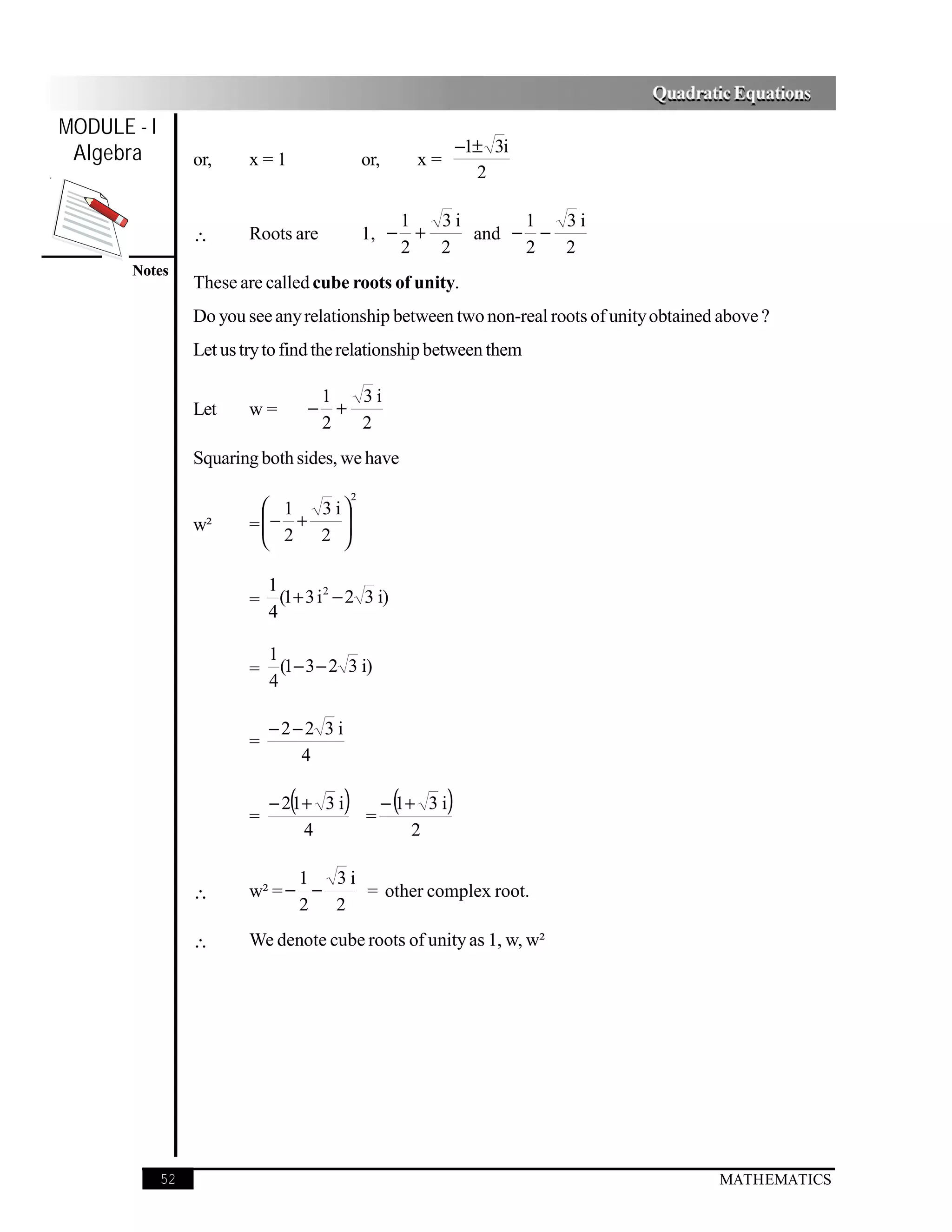
  • 14.
    Quadratic Equations MODULE -I Algebra −1± 3i or, x=1 or, x= 2 1 3i 1 3i ∴ Roots are 1, − + and − − 2 2 2 2 Notes These are called cube roots of unity. Do you see any relationship between two non-real roots of unity obtained above ? Let us try to find the relationship between them 1 3i Let w= − + 2 2 Squaring both sides, we have 2  1 3 i = − +  2  2  w²   1 = (1+ 3 i 2 − 2 3 i) 4 1 = (1− 3 − 2 3 i) 4 −2−2 3 i = 4 = ( − 2 1+ 3 i ) = ( − 1+ 3 i ) 4 2 1 3i ∴ w² = − − = other complex root. 2 2 ∴ We denote cube roots of unity as 1, w, w² 52 MATHEMATICS
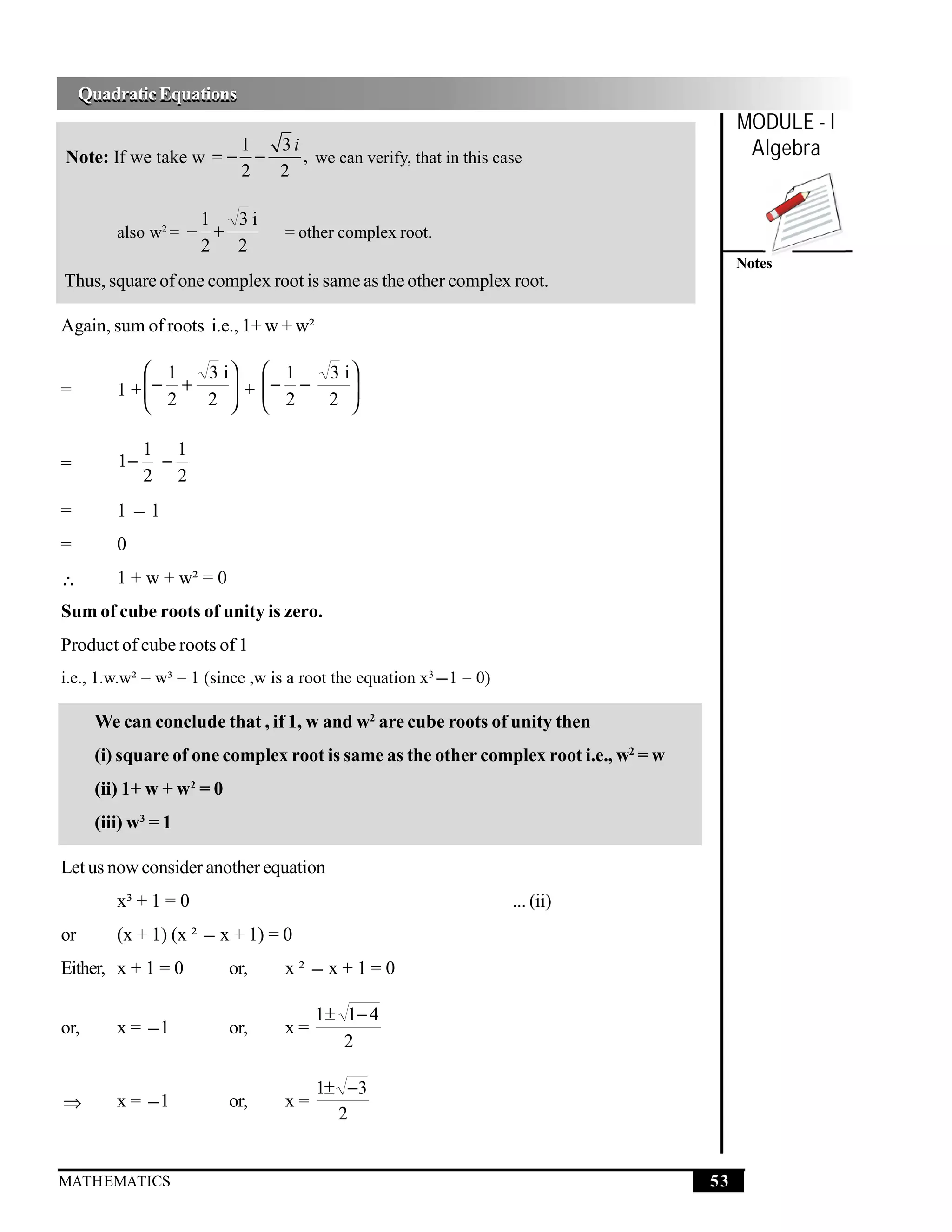
  • 15.
    Quadratic Equations Quadratic Equations MODULE - I 1 Note: If we take w = − − 3i , we can verify, that in this case Algebra 2 2 1 3i also w2 = − + = other complex root. 2 2 Notes Thus, square of one complex root is same as the other complex root. Again, sum of roots i.e., 1+ w + w²  1 3 i  1 3 i 1 + − +  2  + − −  2   2 2  =     1 1 = 1− − 2 2 = 1−1 = 0 ∴ 1 + w + w² = 0 Sum of cube roots of unity is zero. Product of cube roots of 1 i.e., 1.w.w² = w³ = 1 (since ,w is a root the equation x3 − 1 = 0) We can conclude that , if 1, w and w2 are cube roots of unity then (i) square of one complex root is same as the other complex root i.e., w2 = w (ii) 1+ w + w2 = 0 (iii) w3 = 1 Let us now consider another equation x³ + 1 = 0 ... (ii) or (x + 1) (x ² − x + 1) = 0 Either, x + 1 = 0 or, x² −x+1=0 1± 1− 4 or, x = −1 or, x= 2 1± −3 ⇒ x = −1 or, x= 2 MATHEMATICS 53
  • 16.
    Quadratic Equations MODULE -I Algebra ∴ Roots are − 1, 1 − 3i 1 and + 3i which can also be written as − 1 , − w and − w2 2 2 2 2 Therefore, cube roots of − 1 are − 1 , − w and − w2 In general, roots of any cubic equation of the form x 3 = ± a3 would be Notes ± a , ± aw and ± aw2 Example 2.12 If 1, w and w² are cube roots of unity, prove that (a) 1 + w2 + w7 = 0 (b) (1 − w + w2) (1 + w – w2) = 4 (c) (1 + w)3 − (1 + w2)3 = 0 (d) (1 − w + w2)3 = − 8 and (1 + w − w2)3 = − 8 Solution: (a) 1 + w2 + w7 = 0 L.H.S = 1 + w2 + (w3)2. w = 1 + w2 + w [ since w3 =1] =0 [ since 1+ w + w2 = 0] = R.H.S ∴ L.H.S = R.H.S (b) (1 − w + w2) (1 + w – w2) = 4 L.H.S = (1 − w + w2) (1 + w – w2) = (1 + w2 − w) (1 + w – w2) (since 1 + w2 = − w and 1 + w = − w2) = ( − w − w) ( − w2 –w2) = ( − 2w) ( − 2w2) = 4w3 = 4.1 = 4 =R.H.S ∴ L.H.S = R.H.S 54 MATHEMATICS
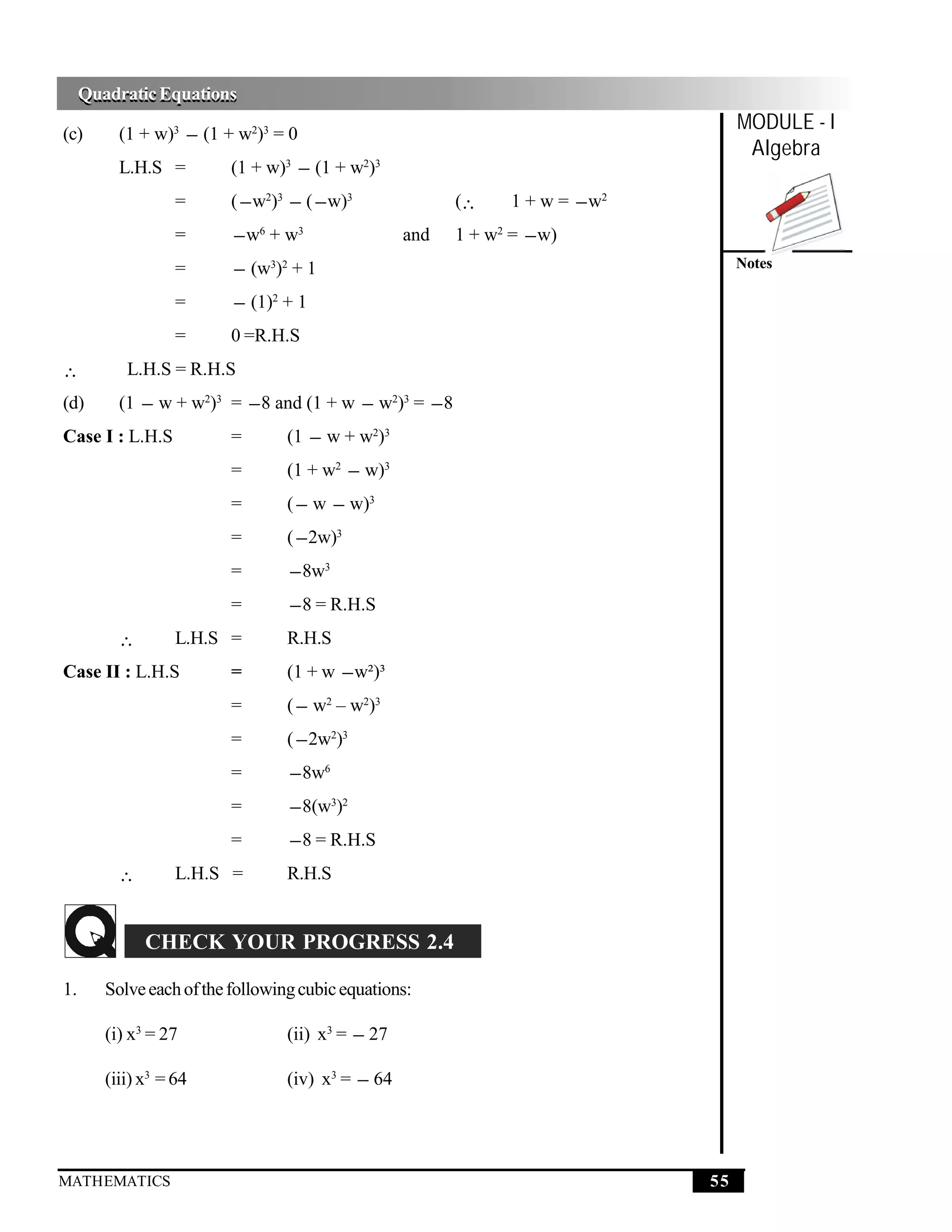
  • 17.
    Quadratic Equations Quadratic Equations (c) (1 + w)3 − (1 + w2)3 = 0 MODULE - I Algebra L.H.S = (1 + w)3 − (1 + w2)3 = ( − w2)3 − ( − w)3 (∴ 1 + w = − w2 = − w6 + w3 and 1 + w2 = − w) = − (w3)2 + 1 Notes = − (1)2 + 1 = 0 =R.H.S ∴ L.H.S = R.H.S (d) (1 − w + w2)3 = − 8 and (1 + w − w2)3 = − 8 Case I : L.H.S = (1 − w + w2)3 = (1 + w2 − w)3 = ( − w − w)3 = ( − 2w)3 = − 8w3 = − 8 = R.H.S ∴ L.H.S = R.H.S Case II : L.H.S = (1 + w − w²)³ = ( − w2 – w2)3 = ( − 2w2)3 = − 8w6 = − 8(w3)2 = − 8 = R.H.S ∴ L.H.S = R.H.S CHECK YOUR PROGRESS 2.4 1. Solve each of the following cubic equations: (i) x3 = 27 (ii) x3 = − 27 (iii) x3 = 64 (iv) x3 = − 64 MATHEMATICS 55
  • 18.
    Quadratic Equations MODULE -I 2. If 1, w, w2 are cube roots of unity, show that Algebra (i) (1 + w) (1 + w2) (1 + w4) (1 + w8) = 1 (ii) (1 − w) (1 − w2) (1 – w4) (1 – w5) = 9 Notes (iii) (1 + w)4 + (1 + w2)4 = − 1 (iv) (1 + w3)3 = 8 (v) (1 – w + w2)6 = (1 + w – w2)6 = 64 (vi) (1 + w)16 + w = (1 + w2)16 + w2 = − 1 LET US SUM UP • Roots of the quadratic equation ax2 + bx + c = 0 are complex and conjugate of each other, when D < 0. • If  ,  be the roots of the quadratic equation b c ax2 + bx + c = 0 then  +  = − and   = a a • Cube roots of unity are 1, w, w2 1 3i 1 3i where w = − + and w 2 = − − 2 2 2 2 • Sum of cube roots of unity is zero i.e., 1+ w + w2 =0 • Product of cube roots of unity is 1 i.e., w3 = 1 • Complex roots w and w2 are conjugate to each other. • In general roots of any cubic equation of the form x 3 = ± a3 would be ± a , ± aw and ± aw2 56 MATHEMATICS
  • 19.
    Quadratic Equations QuadraticEquations MODULE - I Algebra SUPPORTIVE WEB SITES http://www.wikipedia.org http://mathworld.wolfram.com Notes TERMINAL EXERCISE 1. Show that the roots of the equation 2(a2 + b2 )x2 + 2(a + b)x + 1=0 are imaginary,when a ≠ b 2. Show that the roots of the equation bx2 + ( b – c)x = c + a –b are always real if those of ax2 + b( 2x + 1) = 0 are imaginary. 3. If  ,  be the roots of the equation 2x2 – 6x + 5 = 0 , find the equation whose roots are:   1 1 1 1 (i)  , (ii)  +  ,  + (iii)  2 +  2 , + 2   2 4. If 1, w and w2 are cube roots of unity , prove that (a) (2 – w) (2 – w2) (2 – w10) (2 – w11) = 49 (b) ( x – y) (xw – y) ) (xw2 – y) = x3 – y3 5. If x = a + b , y = aw + bw2 and z = aw2 + bw , then prove that (a) x2 + y2 + z2 = 6 ab (b) x y z = a3 + b3 MATHEMATICS 57
  • 20.
    Quadratic Equations MODULE -I Algebra ANSWERS CHECK YOUR PROGRESS 2.1 Notes −4 1. (i) −2 3 , (ii) a − b, a + b 3 ab c (iii) − , (iv) 3 2, 2 c ab CHECK YOUR PROGRESS 2.2 3 ± 15 i 1± i 1. (i) (ii) 4 2 5 ± 43 i − 2 ± 58 i (iii) (iv) 8 6 1 2. –1, 2 CHECK YOUR PROGRESS 2.3 b 2 − 2ac (b 2 − 2ac)2 − 2a 2 c 2 1. (i) (ii) c2 c4 2. (i) 25x2 – 6x + 9 = 0 (ii) 625x2 – 90x + 81 = 0 4. q2 – 5p2 = 0 CHECK YOUR PROGRESS 2.4 1. (i) 3, 3w, 3w2 (ii) − 3, − 3w , − 3w2 (iii) 4, 4w, 4w2 (iv) − 4, − 4w , − 4w2 TERMINAL EXERCISE 3. (i) 5x2 – 8x + 5 = 0 (ii) 10x2 – 42x + 49 = 0 (iii) 25x2 – 116x + 64 = 0 58 MATHEMATICS