Math Science Option 406
Math-Sci
Algebraic Expressions
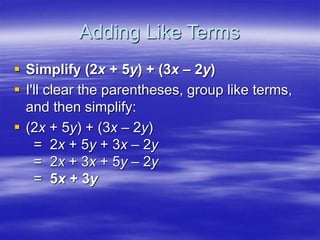
Adding Like Terms
 Simplify (2x + 5y) + (3x – 2y)
 I'll clear the parentheses, group like terms,
and then simplify:
 (2x + 5y) + (3x – 2y)
= 2x + 5y + 3x – 2y
= 2x + 3x + 5y – 2y
= 5x + 3y
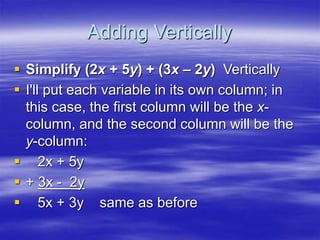
Adding Vertically
 Simplify (2x + 5y) + (3x – 2y) Vertically
 I'll put each variable in its own column; in
this case, the first column will be the x-
column, and the second column will be the
y-column:
 2x + 5y
 + 3x - 2y
 5x + 3y same as before
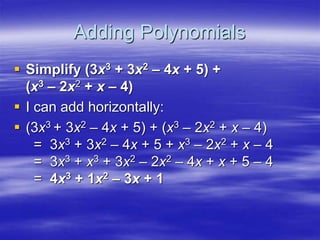
Adding Polynomials
 Simplify (3x3 + 3x2 – 4x + 5) +
(x3 – 2x2 + x – 4)
 I can add horizontally:
 (3x3 + 3x2 – 4x + 5) + (x3 – 2x2 + x – 4)
= 3x3 + 3x2 – 4x + 5 + x3 – 2x2 + x – 4
= 3x3 + x3 + 3x2 – 2x2 – 4x + x + 5 – 4
= 4x3 + 1x2 – 3x + 1
Subtracting Polynomials
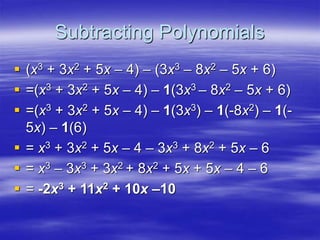
 (x3 + 3x2 + 5x – 4) – (3x3 – 8x2 – 5x + 6)
 =(x3 + 3x2 + 5x – 4) – 1(3x3 – 8x2 – 5x + 6)
 =(x3 + 3x2 + 5x – 4) – 1(3x3) – 1(-8x2) – 1(-
5x) – 1(6)
 = x3 + 3x2 + 5x – 4 – 3x3 + 8x2 + 5x – 6
 = x3 – 3x3 + 3x2 + 8x2 + 5x + 5x – 4 – 6
 = -2x3 + 11x2 + 10x –10
Manipulating Algebraic Expressions
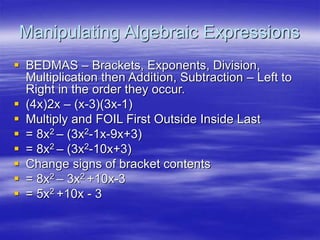
 BEDMAS – Brackets, Exponents, Division,
Multiplication then Addition, Subtraction – Left to
Right in the order they occur.
 (4x)2x – (x-3)(3x-1)
 Multiply and FOIL First Outside Inside Last
 = 8x2 – (3x2-1x-9x+3)
 = 8x2 – (3x2-10x+3)
 Change signs of bracket contents
 = 8x2 – 3x2 +10x-3
 = 5x2 +10x - 3
Polynomial Division
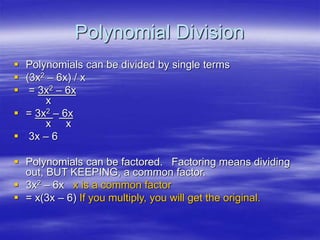
 Polynomials can be divided by single terms
 (3x2 – 6x) / x
 = 3x2 – 6x
x
 = 3x2 – 6x
x x
 3x – 6
 Polynomials can be factored. Factoring means dividing
out, BUT KEEPING, a common factor.
 3x2 – 6x x is a common factor
 = x(3x – 6) If you multiply, you will get the original.
Numerical Division
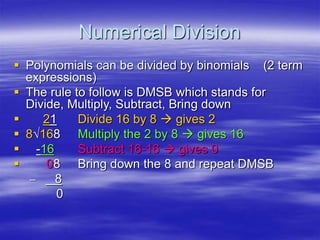
 Polynomials can be divided by binomials (2 term
expressions)
 The rule to follow is DMSB which stands for
Divide, Multiply, Subtract, Bring down
 21 Divide 16 by 8  gives 2
 8√168 Multiply the 2 by 8  gives 16
 -16 Subtract 16-16  gives 0
 08 Bring down the 8 and repeat DMSB
– 8
0
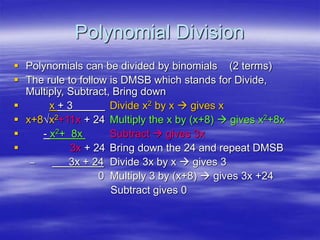
Polynomial Division
 Polynomials can be divided by binomials (2 terms)
 The rule to follow is DMSB which stands for Divide,
Multiply, Subtract, Bring down
 x + 3 Divide x2 by x  gives x
 x+8√x2+11x + 24 Multiply the x by (x+8)  gives x2+8x
 - x2+ 8x Subtract  gives 3x
 3x + 24 Bring down the 24 and repeat DMSB
– 3x + 24 Divide 3x by x  gives 3
0 Multiply 3 by (x+8)  gives 3x +24
Subtract gives 0
Activities
 Do Worksheet 10.1: Q 1, 3
 Do Worksheet 10.2: Q 1,2,3
 Do Worksheet 10.3: Q
 Do Worksheet 10.4: Q
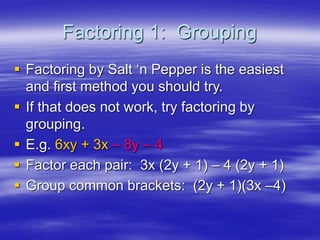
Factoring 1: Grouping
 Factoring by Salt ‘n Pepper is the easiest
and first method you should try.
 If that does not work, try factoring by
grouping.
 E.g. 6xy + 3x – 8y – 4
 Factor each pair: 3x (2y + 1) – 4 (2y + 1)
 Group common brackets: (2y + 1)(3x –4)
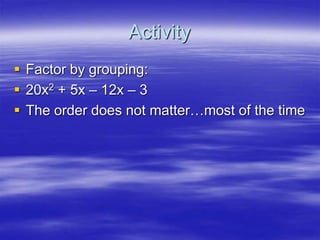
Activity
 Factor by grouping:
 20x2 + 5x – 12x – 3
 The order does not matter…most of the time
Factoring 2a: Salt ‘n Pepper
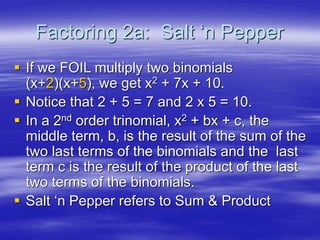
 If we FOIL multiply two binomials
(x+2)(x+5), we get x2 + 7x + 10.
 Notice that 2 + 5 = 7 and 2 x 5 = 10.
 In a 2nd order trinomial, x2 + bx + c, the
middle term, b, is the result of the sum of the
two last terms of the binomials and the last
term c is the result of the product of the last
two terms of the binomials.
 Salt ‘n Pepper refers to Sum & Product
Activity
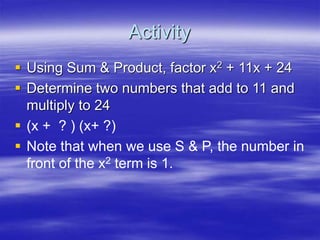
 Using Sum & Product, factor x2 + 11x + 24
 Determine two numbers that add to 11 and
multiply to 24
 (x + ? ) (x+ ?)
 Note that when we use S & P, the number in
front of the x2 term is 1.
Factoring 2b: a ≠ 1
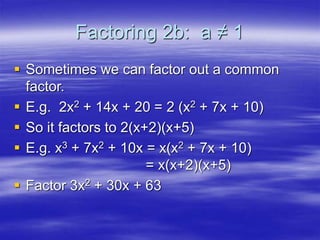
 Sometimes we can factor out a common
factor.
 E.g. 2x2 + 14x + 20 = 2 (x2 + 7x + 10)
 So it factors to 2(x+2)(x+5)
 E.g. x3 + 7x2 + 10x = x(x2 + 7x + 10)
= x(x+2)(x+5)
 Factor 3x2 + 30x + 63
Factoring 2c: No common factor
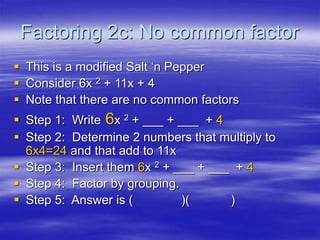
 This is a modified Salt ‘n Pepper
 Consider 6x 2 + 11x + 4
 Note that there are no common factors
 Step 1: Write 6x 2 + ___ + ___ + 4
 Step 2: Determine 2 numbers that multiply to
6x4=24 and that add to 11x
 Step 3: Insert them 6x 2 + ___ + ___ + 4
 Step 4: Factor by grouping.
 Step 5: Answer is ( )( )
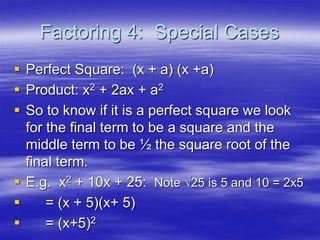
Factoring 4: Special Cases
 Perfect Square: (x + a) (x +a)
 Product: x2 + 2ax + a2
 So to know if it is a perfect square we look
for the final term to be a square and the
middle term to be ½ the square root of the
final term.
 E.g. x2 + 10x + 25: Note √25 is 5 and 10 = 2x5
 = (x + 5)(x+ 5)
 = (x+5)2
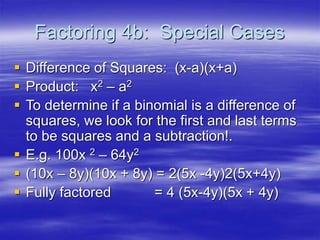
Factoring 4b: Special Cases
 Difference of Squares: (x-a)(x+a)
 Product: x2 – a2
 To determine if a binomial is a difference of
squares, we look for the first and last terms
to be squares and a subtraction!.
 E.g. 100x 2 – 64y2
 (10x – 8y)(10x + 8y) = 2(5x -4y)2(5x+4y)
 Fully factored = 4 (5x-4y)(5x + 4y)
Activities
 Go to page 170-1
 Do Q. 4, 6, 7
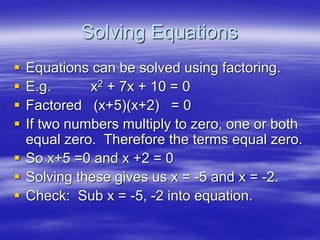
Solving Equations
 Equations can be solved using factoring.
 E.g. x2 + 7x + 10 = 0
 Factored (x+5)(x+2) = 0
 If two numbers multiply to zero, one or both
equal zero. Therefore the terms equal zero.
 So x+5 =0 and x +2 = 0
 Solving these gives us x = -5 and x = -2.
 Check: Sub x = -5, -2 into equation.
Activity
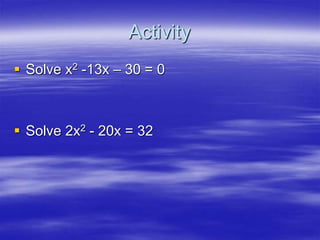
 Solve x2 -13x – 30 = 0
 Solve 2x2 - 20x = 32
Problem Solving
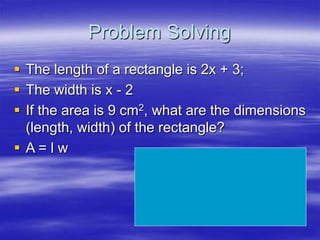
 The length of a rectangle is 2x + 3;
 The width is x - 2
 If the area is 9 cm2, what are the dimensions
(length, width) of the rectangle?
 A = l w
Solution
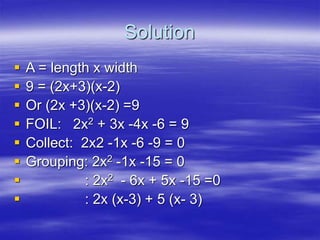
 A = length x width
 9 = (2x+3)(x-2)
 Or (2x +3)(x-2) =9
 FOIL: 2x2 + 3x -4x -6 = 9
 Collect: 2x2 -1x -6 -9 = 0
 Grouping: 2x2 -1x -15 = 0
 : 2x2 - 6x + 5x -15 =0
 : 2x (x-3) + 5 (x- 3)
Continued
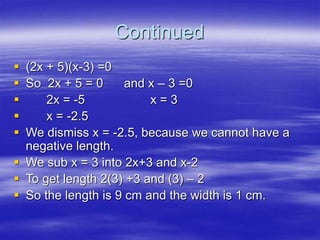
 (2x + 5)(x-3) =0
 So 2x + 5 = 0 and x – 3 =0
 2x = -5 x = 3
 x = -2.5
 We dismiss x = -2.5, because we cannot have a
negative length.
 We sub x = 3 into 2x+3 and x-2
 To get length 2(3) +3 and (3) – 2
 So the length is 9 cm and the width is 1 cm.
Activity
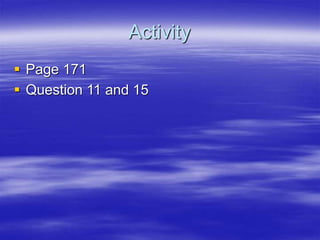
 Page 171
 Question 11 and 15
Quadratic Root Formula
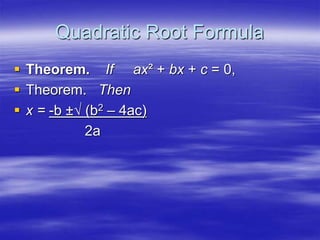
 Theorem. If ax² + bx + c = 0,
 Theorem. Then
 x = -b ±√ (b2 – 4ac)
2a
Quadratic Root Formula
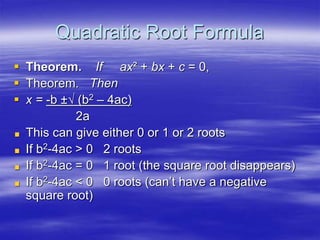
 Theorem. If ax² + bx + c = 0,
 Theorem. Then
 x = -b ±√ (b2 – 4ac)
2a
This can give either 0 or 1 or 2 roots
If b2-4ac > 0 2 roots
If b2-4ac = 0 1 root (the square root disappears)
If b2-4ac < 0 0 roots (can’t have a negative
square root)
Example
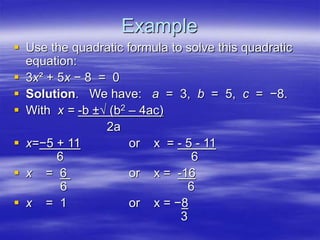
 Use the quadratic formula to solve this quadratic
equation:
 3x² + 5x − 8 = 0
 Solution. We have: a = 3, b = 5, c = −8.
 With x = -b ±√ (b2 – 4ac)
2a
 x=−5 + 11 or x = - 5 - 11
6 6
 x = 6 or x = -16
6 6
 x = 1 or x = −8
3
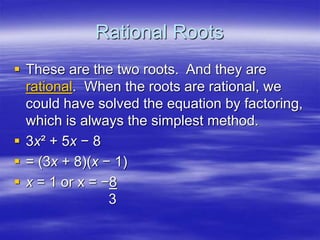
Rational Roots
 These are the two roots. And they are
rational. When the roots are rational, we
could have solved the equation by factoring,
which is always the simplest method.
 3x² + 5x − 8
 = (3x + 8)(x − 1)
 x = 1 or x = −8
3
Activity
 Try page 172, Q 12 d, g

Polynomial math

  • 1.
    Math Science Option406 Math-Sci Algebraic Expressions
  • 2.
    Adding Like Terms Simplify (2x + 5y) + (3x – 2y)  I'll clear the parentheses, group like terms, and then simplify:  (2x + 5y) + (3x – 2y) = 2x + 5y + 3x – 2y = 2x + 3x + 5y – 2y = 5x + 3y
  • 3.
    Adding Vertically  Simplify(2x + 5y) + (3x – 2y) Vertically  I'll put each variable in its own column; in this case, the first column will be the x- column, and the second column will be the y-column:  2x + 5y  + 3x - 2y  5x + 3y same as before
  • 4.
    Adding Polynomials  Simplify(3x3 + 3x2 – 4x + 5) + (x3 – 2x2 + x – 4)  I can add horizontally:  (3x3 + 3x2 – 4x + 5) + (x3 – 2x2 + x – 4) = 3x3 + 3x2 – 4x + 5 + x3 – 2x2 + x – 4 = 3x3 + x3 + 3x2 – 2x2 – 4x + x + 5 – 4 = 4x3 + 1x2 – 3x + 1
  • 5.
    Subtracting Polynomials  (x3+ 3x2 + 5x – 4) – (3x3 – 8x2 – 5x + 6)  =(x3 + 3x2 + 5x – 4) – 1(3x3 – 8x2 – 5x + 6)  =(x3 + 3x2 + 5x – 4) – 1(3x3) – 1(-8x2) – 1(- 5x) – 1(6)  = x3 + 3x2 + 5x – 4 – 3x3 + 8x2 + 5x – 6  = x3 – 3x3 + 3x2 + 8x2 + 5x + 5x – 4 – 6  = -2x3 + 11x2 + 10x –10
  • 6.
    Manipulating Algebraic Expressions BEDMAS – Brackets, Exponents, Division, Multiplication then Addition, Subtraction – Left to Right in the order they occur.  (4x)2x – (x-3)(3x-1)  Multiply and FOIL First Outside Inside Last  = 8x2 – (3x2-1x-9x+3)  = 8x2 – (3x2-10x+3)  Change signs of bracket contents  = 8x2 – 3x2 +10x-3  = 5x2 +10x - 3
  • 7.
    Polynomial Division  Polynomialscan be divided by single terms  (3x2 – 6x) / x  = 3x2 – 6x x  = 3x2 – 6x x x  3x – 6  Polynomials can be factored. Factoring means dividing out, BUT KEEPING, a common factor.  3x2 – 6x x is a common factor  = x(3x – 6) If you multiply, you will get the original.
  • 8.
    Numerical Division  Polynomialscan be divided by binomials (2 term expressions)  The rule to follow is DMSB which stands for Divide, Multiply, Subtract, Bring down  21 Divide 16 by 8  gives 2  8√168 Multiply the 2 by 8  gives 16  -16 Subtract 16-16  gives 0  08 Bring down the 8 and repeat DMSB – 8 0
  • 9.
    Polynomial Division  Polynomialscan be divided by binomials (2 terms)  The rule to follow is DMSB which stands for Divide, Multiply, Subtract, Bring down  x + 3 Divide x2 by x  gives x  x+8√x2+11x + 24 Multiply the x by (x+8)  gives x2+8x  - x2+ 8x Subtract  gives 3x  3x + 24 Bring down the 24 and repeat DMSB – 3x + 24 Divide 3x by x  gives 3 0 Multiply 3 by (x+8)  gives 3x +24 Subtract gives 0
  • 10.
    Activities  Do Worksheet10.1: Q 1, 3  Do Worksheet 10.2: Q 1,2,3  Do Worksheet 10.3: Q  Do Worksheet 10.4: Q
  • 11.
    Factoring 1: Grouping Factoring by Salt ‘n Pepper is the easiest and first method you should try.  If that does not work, try factoring by grouping.  E.g. 6xy + 3x – 8y – 4  Factor each pair: 3x (2y + 1) – 4 (2y + 1)  Group common brackets: (2y + 1)(3x –4)
  • 12.
    Activity  Factor bygrouping:  20x2 + 5x – 12x – 3  The order does not matter…most of the time
  • 13.
    Factoring 2a: Salt‘n Pepper  If we FOIL multiply two binomials (x+2)(x+5), we get x2 + 7x + 10.  Notice that 2 + 5 = 7 and 2 x 5 = 10.  In a 2nd order trinomial, x2 + bx + c, the middle term, b, is the result of the sum of the two last terms of the binomials and the last term c is the result of the product of the last two terms of the binomials.  Salt ‘n Pepper refers to Sum & Product
  • 14.
    Activity  Using Sum& Product, factor x2 + 11x + 24  Determine two numbers that add to 11 and multiply to 24  (x + ? ) (x+ ?)  Note that when we use S & P, the number in front of the x2 term is 1.
  • 15.
    Factoring 2b: a≠ 1  Sometimes we can factor out a common factor.  E.g. 2x2 + 14x + 20 = 2 (x2 + 7x + 10)  So it factors to 2(x+2)(x+5)  E.g. x3 + 7x2 + 10x = x(x2 + 7x + 10) = x(x+2)(x+5)  Factor 3x2 + 30x + 63
  • 16.
    Factoring 2c: Nocommon factor  This is a modified Salt ‘n Pepper  Consider 6x 2 + 11x + 4  Note that there are no common factors  Step 1: Write 6x 2 + ___ + ___ + 4  Step 2: Determine 2 numbers that multiply to 6x4=24 and that add to 11x  Step 3: Insert them 6x 2 + ___ + ___ + 4  Step 4: Factor by grouping.  Step 5: Answer is ( )( )
  • 17.
    Factoring 4: SpecialCases  Perfect Square: (x + a) (x +a)  Product: x2 + 2ax + a2  So to know if it is a perfect square we look for the final term to be a square and the middle term to be ½ the square root of the final term.  E.g. x2 + 10x + 25: Note √25 is 5 and 10 = 2x5  = (x + 5)(x+ 5)  = (x+5)2
  • 18.
    Factoring 4b: SpecialCases  Difference of Squares: (x-a)(x+a)  Product: x2 – a2  To determine if a binomial is a difference of squares, we look for the first and last terms to be squares and a subtraction!.  E.g. 100x 2 – 64y2  (10x – 8y)(10x + 8y) = 2(5x -4y)2(5x+4y)  Fully factored = 4 (5x-4y)(5x + 4y)
  • 19.
    Activities  Go topage 170-1  Do Q. 4, 6, 7
  • 20.
    Solving Equations  Equationscan be solved using factoring.  E.g. x2 + 7x + 10 = 0  Factored (x+5)(x+2) = 0  If two numbers multiply to zero, one or both equal zero. Therefore the terms equal zero.  So x+5 =0 and x +2 = 0  Solving these gives us x = -5 and x = -2.  Check: Sub x = -5, -2 into equation.
  • 21.
    Activity  Solve x2-13x – 30 = 0  Solve 2x2 - 20x = 32
  • 22.
    Problem Solving  Thelength of a rectangle is 2x + 3;  The width is x - 2  If the area is 9 cm2, what are the dimensions (length, width) of the rectangle?  A = l w
  • 23.
    Solution  A =length x width  9 = (2x+3)(x-2)  Or (2x +3)(x-2) =9  FOIL: 2x2 + 3x -4x -6 = 9  Collect: 2x2 -1x -6 -9 = 0  Grouping: 2x2 -1x -15 = 0  : 2x2 - 6x + 5x -15 =0  : 2x (x-3) + 5 (x- 3)
  • 24.
    Continued  (2x +5)(x-3) =0  So 2x + 5 = 0 and x – 3 =0  2x = -5 x = 3  x = -2.5  We dismiss x = -2.5, because we cannot have a negative length.  We sub x = 3 into 2x+3 and x-2  To get length 2(3) +3 and (3) – 2  So the length is 9 cm and the width is 1 cm.
  • 25.
    Activity  Page 171 Question 11 and 15
  • 26.
    Quadratic Root Formula Theorem. If ax² + bx + c = 0,  Theorem. Then  x = -b ±√ (b2 – 4ac) 2a
  • 27.
    Quadratic Root Formula Theorem. If ax² + bx + c = 0,  Theorem. Then  x = -b ±√ (b2 – 4ac) 2a This can give either 0 or 1 or 2 roots If b2-4ac > 0 2 roots If b2-4ac = 0 1 root (the square root disappears) If b2-4ac < 0 0 roots (can’t have a negative square root)
  • 28.
    Example  Use thequadratic formula to solve this quadratic equation:  3x² + 5x − 8 = 0  Solution. We have: a = 3, b = 5, c = −8.  With x = -b ±√ (b2 – 4ac) 2a  x=−5 + 11 or x = - 5 - 11 6 6  x = 6 or x = -16 6 6  x = 1 or x = −8 3
  • 29.
    Rational Roots  Theseare the two roots. And they are rational. When the roots are rational, we could have solved the equation by factoring, which is always the simplest method.  3x² + 5x − 8  = (3x + 8)(x − 1)  x = 1 or x = −8 3
  • 30.
    Activity  Try page172, Q 12 d, g