Adding and Subtracting Real Numbers;
1.3       Properties of Real Numbers


 1.   Add integers.
 2.   Add rational numbers.
 3.   Find the additive inverse of a number.
 4.   Subtract rational numbers.


              Copyright © 2011 Pearson Education, Inc.
Objective 1

 Add integers.


              Copyright © 2011 Pearson Education, Inc.   Slide 1- 2
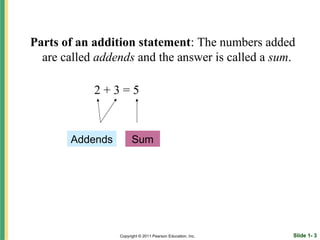
Parts of an addition statement: The numbers added
  are called addends and the answer is called a sum.

            2+3=5


       Addends         Sum


                 Copyright © 2011 Pearson Education, Inc.   Slide 1- 3
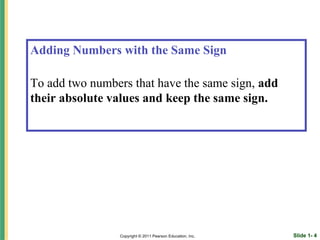
Adding Numbers with the Same Sign

To add two numbers that have the same sign, add
their absolute values and keep the same sign.


                 Copyright © 2011 Pearson Education, Inc.   Slide 1- 4
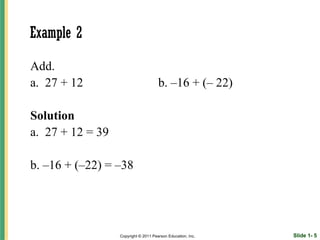
Example 2

Add.
a. 27 + 12                            b. –16 + (– 22)

Solution
a. 27 + 12 = 39

b. –16 + (–22) = –38


                  Copyright © 2011 Pearson Education, Inc.   Slide 1- 5
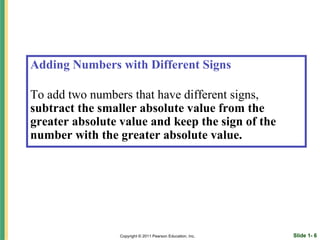
Adding Numbers with Different Signs

To add two numbers that have different signs,
subtract the smaller absolute value from the
greater absolute value and keep the sign of the
number with the greater absolute value.


                 Copyright © 2011 Pearson Education, Inc.   Slide 1- 6
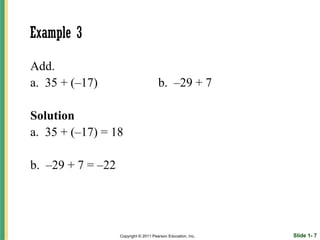
Example 3

Add.
a. 35 + (–17)                          b. –29 + 7

Solution
a. 35 + (–17) = 18

b. –29 + 7 = –22


                   Copyright © 2011 Pearson Education, Inc.   Slide 1- 7
Objective 2

  Add rational numbers.


              Copyright © 2011 Pearson Education, Inc.   Slide 1- 8
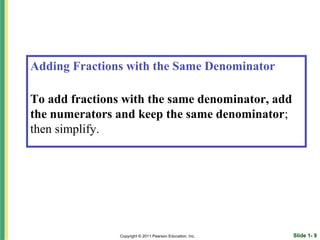
Adding Fractions with the Same Denominator

To add fractions with the same denominator, add
the numerators and keep the same denominator;
then simplify.


                Copyright © 2011 Pearson Education, Inc.   Slide 1- 9
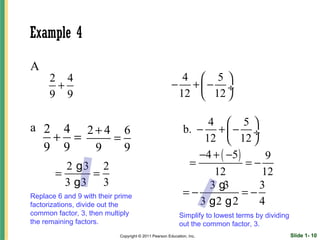
Example 4

A
      2 4                                                4  5
       +                                               − +− ÷
      9 9                                               12  12 

                                                                   4  5
a 2 4 2+4 6                                                  b. − +  − ÷
   + =   =                                                        12  12 
  9 9  9   9
                                                                −4 + ( −5 )      9
         2 g3 2                                               =             =−
       =     =                                                      12         12
         3 g3 3                                                    3 g3        3
Replace 6 and 9 with their prime                             =−             =−
factorizations, divide out the                                   3 g2 g 2      4
common factor, 3, then multiply                            Simplify to lowest terms by dividing
the remaining factors.                                     out the common factor, 3.
                            Copyright © 2011 Pearson Education, Inc.                              Slide 1- 10
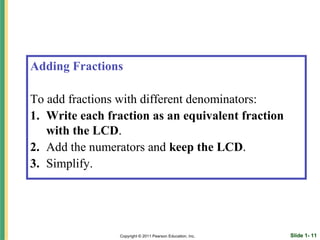
Adding Fractions

To add fractions with different denominators:
1. Write each fraction as an equivalent fraction
   with the LCD.
2. Add the numerators and keep the LCD.
3. Simplify.


                Copyright © 2011 Pearson Education, Inc.   Slide 1- 11
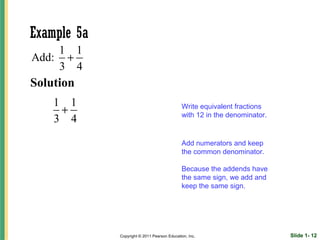
Example 5a
    1 1
Add: +
    3 4
Solution
    1 1
     +                                       Write equivalent fractions
                                             with 12 in the denominator.
    3 4

                                             Add numerators and keep
                                             the common denominator.

                                             Because the addends have
                                             the same sign, we add and
                                             keep the same sign.


             Copyright © 2011 Pearson Education, Inc.                      Slide 1- 12
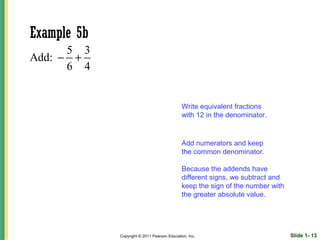
Example 5b
      5 3
Add: − +
      6 4


                                             Write equivalent fractions
                                             with 12 in the denominator.


                                             Add numerators and keep
                                             the common denominator.

                                             Because the addends have
                                             different signs, we subtract and
                                             keep the sign of the number with
                                             the greater absolute value.


             Copyright © 2011 Pearson Education, Inc.                           Slide 1- 13
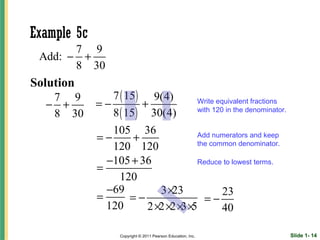
Example 5c
       7 9
 Add: − +
       8 30
Solution
   7 9          7 ( 15 ) 9(4)
  − +        =−         +                                    Write equivalent fractions
   8 30         8 ( 15 ) 30(4)                               with 120 in the denominator.


                105 36
             =−     +              Add numerators and keep
                                   the common denominator.
                120 120
               −105 + 36           Reduce to lowest terms.
             =
                 120
               −69        3 ×23           23
             =     =−                =−
               120     2 ×2 ×2 × ×
                                3 5       40

                  Copyright © 2011 Pearson Education, Inc.                                  Slide 1- 14
Example 6
Bank account :


                 Copyright © 2011 Pearson Education, Inc.   Slide 1- 15
Objective 4

 Subtract rational numbers.


              Copyright © 2011 Pearson Education, Inc.   Slide 1- 16
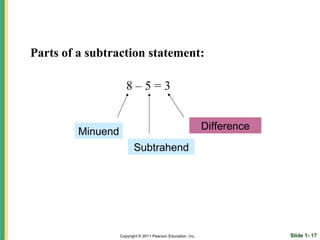
Parts of a subtraction statement:

                      8–5=3


                                                              Difference
         Minuend
                          Subtrahend


                   Copyright © 2011 Pearson Education, Inc.                Slide 1- 17
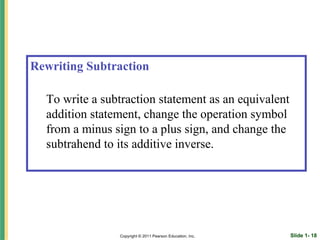
Rewriting Subtraction

  To write a subtraction statement as an equivalent
  addition statement, change the operation symbol
  from a minus sign to a plus sign, and change the
  subtrahend to its additive inverse.


                Copyright © 2011 Pearson Education, Inc.   Slide 1- 18
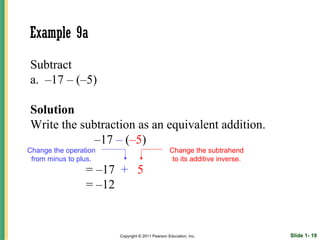
Example 9a
Subtract
a. –17 – (–5)

Solution
Write the subtraction as an equivalent addition.
             –17 – (–5)
Change the operation                             Change the subtrahend
 from minus to plus.                              to its additive inverse.
                 = –17 + 5
                 = –12


                       Copyright © 2011 Pearson Education, Inc.              Slide 1- 19
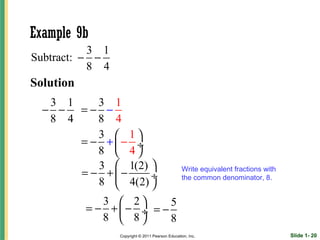
Example 9b
           3 1
Subtract: − −
           8 4
Solution
   3 1    3 1
  − − =− −
   8 4    8 4
          3  1
       = − +− ÷
          8  4
          3  1(2) 
       = − +−     ÷
                                                 Write equivalent fractions with
                                                 the common denominator, 8.
          8  4(2) 
              3  2     5
           = − +− ÷ = −
              8  8     8
                 Copyright © 2011 Pearson Education, Inc.                          Slide 1- 20
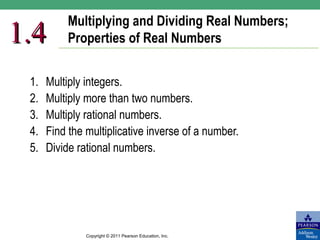
Multiplying and Dividing Real Numbers;
1.4        Properties of Real Numbers


 1.   Multiply integers.
 2.   Multiply more than two numbers.
 3.   Multiply rational numbers.
 4.   Find the multiplicative inverse of a number.
 5.   Divide rational numbers.


               Copyright © 2011 Pearson Education, Inc.
Objective 1

 Multiply integers.


              Copyright © 2011 Pearson Education, Inc.   Slide 1- 22
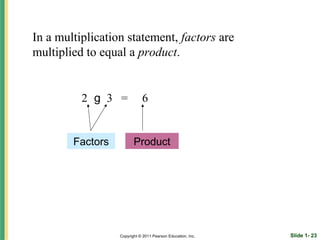
In a multiplication statement, factors are
multiplied to equal a product.


          2 g 3 =            6


        Factors          Product


                  Copyright © 2011 Pearson Education, Inc.   Slide 1- 23
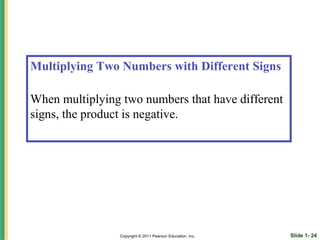
Multiplying Two Numbers with Different Signs

When multiplying two numbers that have different
signs, the product is negative.


                 Copyright © 2011 Pearson Education, Inc.   Slide 1- 24
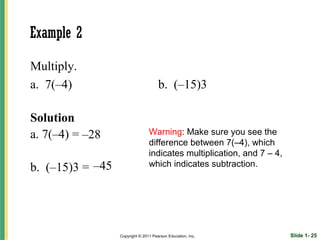
Example 2

Multiply.
a. 7(–4)                              b. (–15)3

Solution
a. 7(–4) = –28                   Warning: Make sure you see the
                                 difference between 7(–4), which
                                 indicates multiplication, and 7 – 4,
b. (–15)3 = –45                  which indicates subtraction.


                  Copyright © 2011 Pearson Education, Inc.              Slide 1- 25
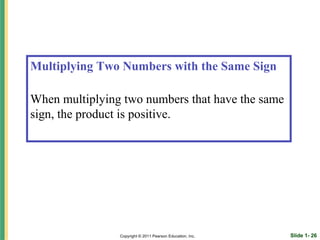
Multiplying Two Numbers with the Same Sign

When multiplying two numbers that have the same
sign, the product is positive.


                Copyright © 2011 Pearson Education, Inc.   Slide 1- 26
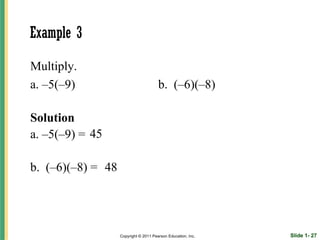
Example 3

Multiply.
a. –5(–9)                              b. (–6)(–8)

Solution
a. –5(–9) = 45

b. (–6)(–8) = 48


                   Copyright © 2011 Pearson Education, Inc.   Slide 1- 27
Objective 2

 Multiply more than two numbers.


              Copyright © 2011 Pearson Education, Inc.   Slide 1- 28
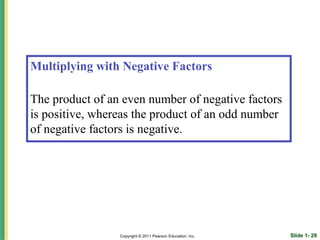
Multiplying with Negative Factors

The product of an even number of negative factors
is positive, whereas the product of an odd number
of negative factors is negative.


                 Copyright © 2011 Pearson Education, Inc.   Slide 1- 29
Objective 3

 Multiply rational numbers.


              Copyright © 2011 Pearson Education, Inc.   Slide 1- 30
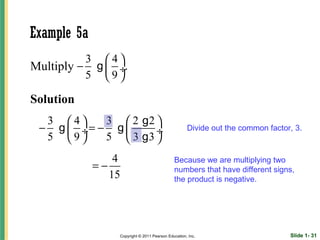
Example 5a
          3 4
Multiply − g  ÷.
          5 9

Solution
  3 4    3  2 g2 
 − g  ÷= − g      ÷                               Divide out the common factor, 3.
  5 9    5  3 g3 
                 4                           Because we are multiplying two
             =−                              numbers that have different signs,
                15                           the product is negative.


                 Copyright © 2011 Pearson Education, Inc.                       Slide 1- 31
Objective 5

 Divide rational numbers.


              Copyright © 2011 Pearson Education, Inc.   Slide 1- 32
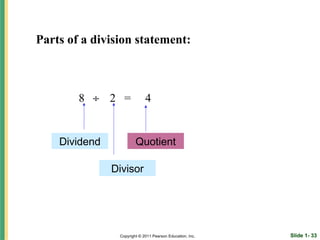
Parts of a division statement:


        8 ÷ 2 =              4


    Dividend            Quotient

               Divisor


                Copyright © 2011 Pearson Education, Inc.   Slide 1- 33
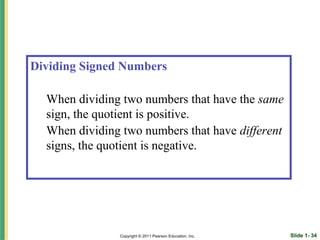
Dividing Signed Numbers

  When dividing two numbers that have the same
  sign, the quotient is positive.
  When dividing two numbers that have different
  signs, the quotient is negative.


               Copyright © 2011 Pearson Education, Inc.   Slide 1- 34
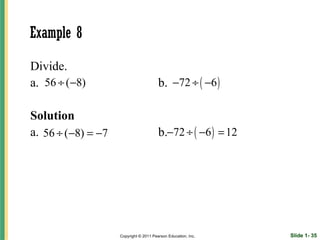
Example 8

Divide.
a. 56 ÷ (−8)                            b. −72 ÷ ( −6 )

Solution
a. 56 ÷ (−8) = −7                       b.−72 ÷ ( −6 ) = 12


                    Copyright © 2011 Pearson Education, Inc.   Slide 1- 35
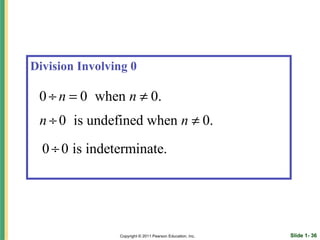
Division Involving 0

 0 ÷ n = 0 when n ≠ 0.
 n ÷ 0 is undefined when n ≠ 0.
  0 ÷ 0 is indeterminate.


                Copyright © 2011 Pearson Education, Inc.   Slide 1- 36
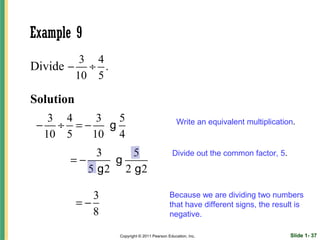
Example 9
         3 4
Divide − ÷ .
        10 5

Solution
   3 4   3   5
 − ÷ =−    g                                   Write an equivalent multiplication.
  10 5  10 4
            3    5                           Divide out the common factor, 5.
       =−     g
          5 g2 2 g2

              3                             Because we are dividing two numbers
           =−                               that have different signs, the result is
              8                             negative.

                  Copyright © 2011 Pearson Education, Inc.                      Slide 1- 37
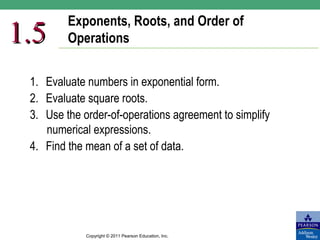
Exponents, Roots, and Order of
1.5      Operations


 1. Evaluate numbers in exponential form.
 2. Evaluate square roots.
 3. Use the order-of-operations agreement to simplify
    numerical expressions.
 4. Find the mean of a set of data.


             Copyright © 2011 Pearson Education, Inc.
Objective 1

 Evaluate numbers in exponential
 form.


              Copyright © 2011 Pearson Education, Inc.   Slide 1- 39
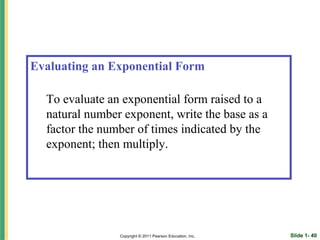
Evaluating an Exponential Form

  To evaluate an exponential form raised to a
  natural number exponent, write the base as a
  factor the number of times indicated by the
  exponent; then multiply.


                Copyright © 2011 Pearson Education, Inc.   Slide 1- 40
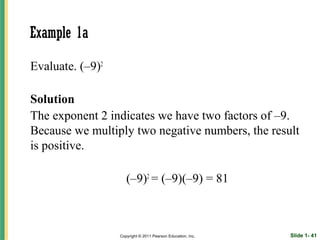
Example 1a

Evaluate. (–9)2

Solution
The exponent 2 indicates we have two factors of –9.
Because we multiply two negative numbers, the result
is positive.

                     (–9)2 = (–9)(–9) = 81


                  Copyright © 2011 Pearson Education, Inc.   Slide 1- 41
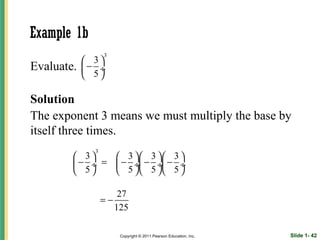
Example 1b
                  3
             3
Evaluate.   − ÷
             5

Solution
The exponent 3 means we must multiply the base by
itself three times.
              3
         3     3  3   3 
         − ÷ =  − ÷ − ÷ − ÷
         5     5  5   5 

                      27
                  =−
                     125

                      Copyright © 2011 Pearson Education, Inc.   Slide 1- 42
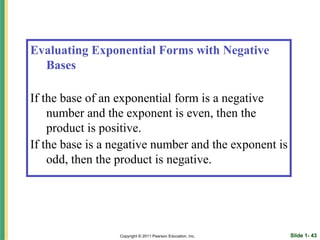
Evaluating Exponential Forms with Negative
  Bases

If the base of an exponential form is a negative
    number and the exponent is even, then the
    product is positive.
If the base is a negative number and the exponent is
    odd, then the product is negative.


                  Copyright © 2011 Pearson Education, Inc.   Slide 1- 43
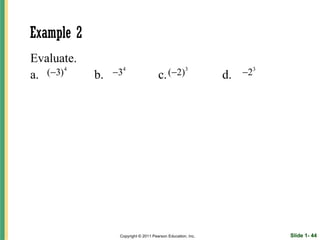
Example 2
Evaluate.
a. (−3) 4   b.   −34                  c. (−2)3               d.   −23


                  Copyright © 2011 Pearson Education, Inc.              Slide 1- 44
Objective 2

 Evaluate square roots.


              Copyright © 2011 Pearson Education, Inc.   Slide 1- 45
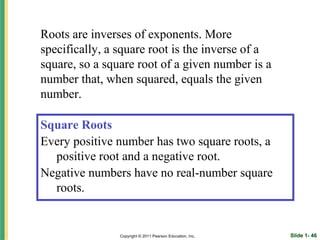
Roots are inverses of exponents. More
specifically, a square root is the inverse of a
square, so a square root of a given number is a
number that, when squared, equals the given
number.

Square Roots
Every positive number has two square roots, a
  positive root and a negative root.
Negative numbers have no real-number square
  roots.


                Copyright © 2011 Pearson Education, Inc.   Slide 1- 46
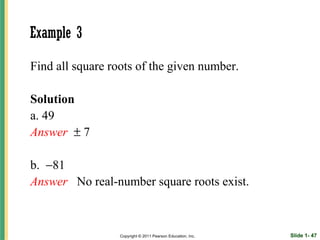
Example 3

Find all square roots of the given number.

Solution
a. 49
Answer ± 7

b. −81
Answer No real-number square roots exist.


                  Copyright © 2011 Pearson Education, Inc.   Slide 1- 47
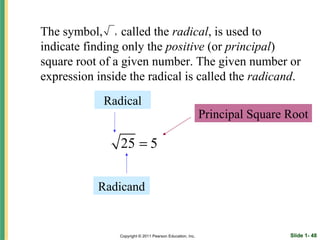
The symbol, , called the radical, is used to
indicate finding only the positive (or principal)
square root of a given number. The given number or
expression inside the radical is called the radicand.
            Radical
                                                           Principal Square Root

                25 = 5

           Radicand


                Copyright © 2011 Pearson Education, Inc.                    Slide 1- 48
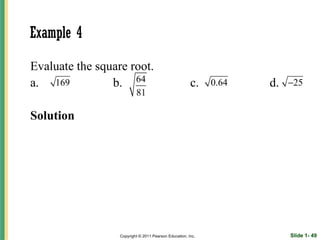
Example 4

Evaluate the square root.
a. 169          b. 64                                  c.    0.64   d.   −25
                          81

Solution


                  Copyright © 2011 Pearson Education, Inc.               Slide 1- 49
Objective 3

 Use the order-of-operations
 agreement to simplify numerical
 expressions.


              Copyright © 2011 Pearson Education, Inc.   Slide 1- 50
Order-of- Operations Agreement

Perform operations in the following order:
1. Within grouping symbols: parentheses ( ),
   brackets [ ], braces { }, above/below fraction
   bars, absolute value | |, and radicals .
2. Exponents/Roots from left to right, in order as
   they occur.
3. Multiplication/Division from left to right, in order
   as they occur.
4. Addition/Subtraction from left to right, in order as
   they occur.
                  Copyright © 2011 Pearson Education, Inc.   Slide 1- 51
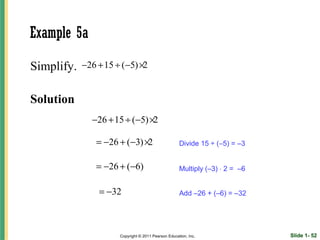
Example 5a

Simplify.   −26 + 15 ÷ (−5) ×2


Solution
              −26 + 15 ÷ (−5) ×2

               = −26 + (−3) ×2                       Divide 15 ÷ (−5) = –3


               = −26 + (−6)                          Multiply (–3) ⋅ 2 = –6


                = −32                                Add –26 + (–6) = –32


                      Copyright © 2011 Pearson Education, Inc.                Slide 1- 52
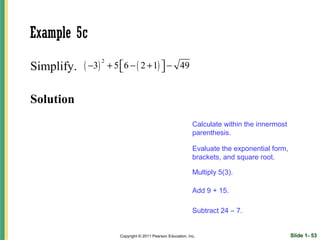
Example 5c

Simplify. ( −3)       + 5 6 − ( 2 + 1)  − 49
                  2
                                       


Solution
                                                               Calculate within the innermost
                                                               parenthesis.

                                                               Evaluate the exponential form,
                                                               brackets, and square root.

                                                               Multiply 5(3).

                                                               Add 9 + 15.

                                                               Subtract 24 – 7.


                         Copyright © 2011 Pearson Education, Inc.                               Slide 1- 53
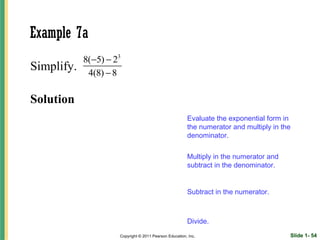
Example 7a
            8(−5) − 23
Simplify.    4(8) − 8

Solution
                                                        Evaluate the exponential form in
                                                        the numerator and multiply in the
                                                        denominator.

                                                        Multiply in the numerator and
                                                        subtract in the denominator.


                                                        Subtract in the numerator.


                                                        Divide.
                     Copyright © 2011 Pearson Education, Inc.                           Slide 1- 54
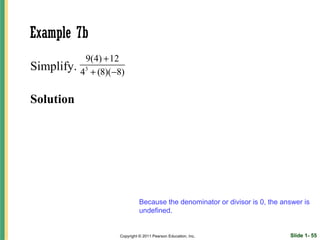
Example 7b
             9(4) + 12
Simplify.   43 + (8)(−8)

Solution


                                Because the denominator or divisor is 0, the answer is
                                undefined.


                      Copyright © 2011 Pearson Education, Inc.                 Slide 1- 55
1.6      Translating Word Phrases to Expressions


 1. Translate word phrases to expressions.


            Copyright © 2011 Pearson Education, Inc.
Objective 1

 Translating word phrases to
 Expressions

Look at the pg


              Copyright © 2011 Pearson Education, Inc.   Slide 1- 57
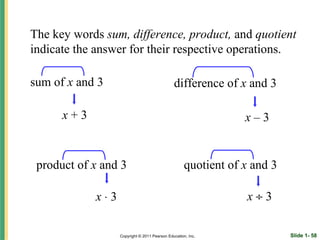
The key words sum, difference, product, and quotient
indicate the answer for their respective operations.

sum of x and 3                                difference of x and 3

      x+3                                                       x–3


 product of x and 3                                 quotient of x and 3

            x⋅3                                                 x÷3

                  Copyright © 2011 Pearson Education, Inc.                Slide 1- 58
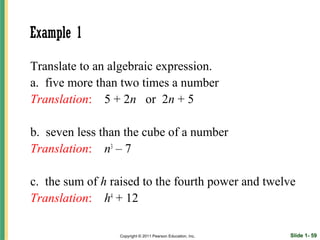
Example 1

Translate to an algebraic expression.
a. five more than two times a number
Translation: 5 + 2n or 2n + 5

b. seven less than the cube of a number
Translation: n3 – 7

c. the sum of h raised to the fourth power and twelve
Translation: h4 + 12

                 Copyright © 2011 Pearson Education, Inc.   Slide 1- 59
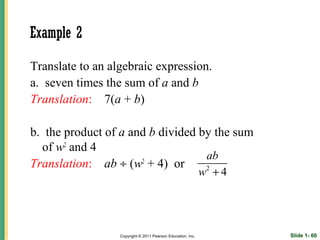
Example 2

Translate to an algebraic expression.
a. seven times the sum of a and b
Translation: 7(a + b)

b. the product of a and b divided by the sum
  of w2 and 4
                                   ab
Translation: ab ÷ (w + 4) or
                      2
                                   2
                                                             w +4


                  Copyright © 2011 Pearson Education, Inc.          Slide 1- 60
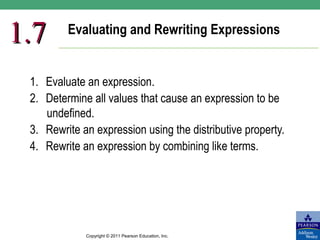
1.7      Evaluating and Rewriting Expressions


 1. Evaluate an expression.
 2. Determine all values that cause an expression to be
    undefined.
 3. Rewrite an expression using the distributive property.
 4. Rewrite an expression by combining like terms.


             Copyright © 2011 Pearson Education, Inc.
Objective 1

 Evaluate an expression.


              Copyright © 2011 Pearson Education, Inc.   Slide 1- 62
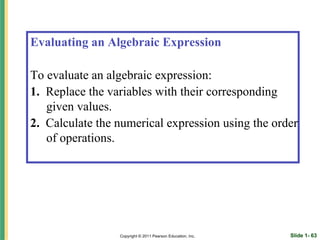
Evaluating an Algebraic Expression

To evaluate an algebraic expression:
1. Replace the variables with their corresponding
   given values.
2. Calculate the numerical expression using the order
   of operations.


                 Copyright © 2011 Pearson Education, Inc.   Slide 1- 63
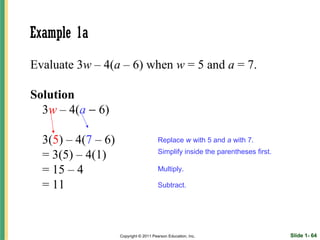
Example 1a
Evaluate 3w – 4(a – 6) when w = 5 and a = 7.

Solution
  3w – 4(a − 6)

  3(5) – 4(7 – 6)                       Replace w with 5 and a with 7.

  = 3(5) – 4(1)                         Simplify inside the parentheses first.

  = 15 – 4                              Multiply.

  = 11                                  Subtract.


                    Copyright © 2011 Pearson Education, Inc.                     Slide 1- 64
Objective 2

 Determine all values that cause an
 expression to be undefined.


              Copyright © 2011 Pearson Education, Inc.   Slide 1- 65
Examples:


            Copyright © 2011 Pearson Education, Inc.   Slide 1- 66
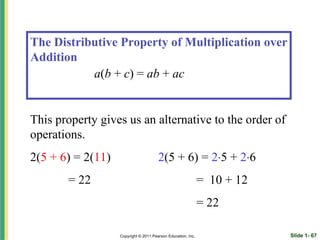
The Distributive Property of Multiplication over
Addition
           a(b + c) = ab + ac


This property gives us an alternative to the order of
operations.
2(5 + 6) = 2(11)                       2(5 + 6) = 2⋅5 + 2⋅6
       = 22                                                   = 10 + 12
                                                              = 22

                   Copyright © 2011 Pearson Education, Inc.               Slide 1- 67

1.3 1.7

  • 1.
    Adding and SubtractingReal Numbers; 1.3 Properties of Real Numbers 1. Add integers. 2. Add rational numbers. 3. Find the additive inverse of a number. 4. Subtract rational numbers. Copyright © 2011 Pearson Education, Inc.
  • 2.
    Objective 1 Addintegers. Copyright © 2011 Pearson Education, Inc. Slide 1- 2
  • 3.
    Parts of anaddition statement: The numbers added are called addends and the answer is called a sum. 2+3=5 Addends Sum Copyright © 2011 Pearson Education, Inc. Slide 1- 3
  • 4.
    Adding Numbers withthe Same Sign To add two numbers that have the same sign, add their absolute values and keep the same sign. Copyright © 2011 Pearson Education, Inc. Slide 1- 4
  • 5.
    Example 2 Add. a. 27+ 12 b. –16 + (– 22) Solution a. 27 + 12 = 39 b. –16 + (–22) = –38 Copyright © 2011 Pearson Education, Inc. Slide 1- 5
  • 6.
    Adding Numbers withDifferent Signs To add two numbers that have different signs, subtract the smaller absolute value from the greater absolute value and keep the sign of the number with the greater absolute value. Copyright © 2011 Pearson Education, Inc. Slide 1- 6
  • 7.
    Example 3 Add. a. 35+ (–17) b. –29 + 7 Solution a. 35 + (–17) = 18 b. –29 + 7 = –22 Copyright © 2011 Pearson Education, Inc. Slide 1- 7
  • 8.
    Objective 2 Add rational numbers. Copyright © 2011 Pearson Education, Inc. Slide 1- 8
  • 9.
    Adding Fractions withthe Same Denominator To add fractions with the same denominator, add the numerators and keep the same denominator; then simplify. Copyright © 2011 Pearson Education, Inc. Slide 1- 9
  • 10.
    Example 4 A 2 4 4  5 + − +− ÷ 9 9 12  12  4  5 a 2 4 2+4 6 b. − +  − ÷ + = = 12  12  9 9 9 9 −4 + ( −5 ) 9 2 g3 2 = =− = = 12 12 3 g3 3 3 g3 3 Replace 6 and 9 with their prime =− =− factorizations, divide out the 3 g2 g 2 4 common factor, 3, then multiply Simplify to lowest terms by dividing the remaining factors. out the common factor, 3. Copyright © 2011 Pearson Education, Inc. Slide 1- 10
  • 11.
    Adding Fractions To addfractions with different denominators: 1. Write each fraction as an equivalent fraction with the LCD. 2. Add the numerators and keep the LCD. 3. Simplify. Copyright © 2011 Pearson Education, Inc. Slide 1- 11
  • 12.
    Example 5a 1 1 Add: + 3 4 Solution 1 1 + Write equivalent fractions with 12 in the denominator. 3 4 Add numerators and keep the common denominator. Because the addends have the same sign, we add and keep the same sign. Copyright © 2011 Pearson Education, Inc. Slide 1- 12
  • 13.
    Example 5b 5 3 Add: − + 6 4 Write equivalent fractions with 12 in the denominator. Add numerators and keep the common denominator. Because the addends have different signs, we subtract and keep the sign of the number with the greater absolute value. Copyright © 2011 Pearson Education, Inc. Slide 1- 13
  • 14.
    Example 5c 7 9 Add: − + 8 30 Solution 7 9 7 ( 15 ) 9(4) − + =− + Write equivalent fractions 8 30 8 ( 15 ) 30(4) with 120 in the denominator. 105 36 =− + Add numerators and keep the common denominator. 120 120 −105 + 36 Reduce to lowest terms. = 120 −69 3 ×23 23 = =− =− 120 2 ×2 ×2 × × 3 5 40 Copyright © 2011 Pearson Education, Inc. Slide 1- 14
  • 15.
    Example 6 Bank account: Copyright © 2011 Pearson Education, Inc. Slide 1- 15
  • 16.
    Objective 4 Subtractrational numbers. Copyright © 2011 Pearson Education, Inc. Slide 1- 16
  • 17.
    Parts of asubtraction statement: 8–5=3 Difference Minuend Subtrahend Copyright © 2011 Pearson Education, Inc. Slide 1- 17
  • 18.
    Rewriting Subtraction To write a subtraction statement as an equivalent addition statement, change the operation symbol from a minus sign to a plus sign, and change the subtrahend to its additive inverse. Copyright © 2011 Pearson Education, Inc. Slide 1- 18
  • 19.
    Example 9a Subtract a. –17– (–5) Solution Write the subtraction as an equivalent addition. –17 – (–5) Change the operation Change the subtrahend from minus to plus. to its additive inverse. = –17 + 5 = –12 Copyright © 2011 Pearson Education, Inc. Slide 1- 19
  • 20.
    Example 9b 3 1 Subtract: − − 8 4 Solution 3 1 3 1 − − =− − 8 4 8 4 3  1 = − +− ÷ 8  4 3  1(2)  = − +− ÷ Write equivalent fractions with the common denominator, 8. 8  4(2)  3  2 5 = − +− ÷ = − 8  8 8 Copyright © 2011 Pearson Education, Inc. Slide 1- 20
  • 21.
    Multiplying and DividingReal Numbers; 1.4 Properties of Real Numbers 1. Multiply integers. 2. Multiply more than two numbers. 3. Multiply rational numbers. 4. Find the multiplicative inverse of a number. 5. Divide rational numbers. Copyright © 2011 Pearson Education, Inc.
  • 22.
    Objective 1 Multiplyintegers. Copyright © 2011 Pearson Education, Inc. Slide 1- 22
  • 23.
    In a multiplicationstatement, factors are multiplied to equal a product. 2 g 3 = 6 Factors Product Copyright © 2011 Pearson Education, Inc. Slide 1- 23
  • 24.
    Multiplying Two Numberswith Different Signs When multiplying two numbers that have different signs, the product is negative. Copyright © 2011 Pearson Education, Inc. Slide 1- 24
  • 25.
    Example 2 Multiply. a. 7(–4) b. (–15)3 Solution a. 7(–4) = –28 Warning: Make sure you see the difference between 7(–4), which indicates multiplication, and 7 – 4, b. (–15)3 = –45 which indicates subtraction. Copyright © 2011 Pearson Education, Inc. Slide 1- 25
  • 26.
    Multiplying Two Numberswith the Same Sign When multiplying two numbers that have the same sign, the product is positive. Copyright © 2011 Pearson Education, Inc. Slide 1- 26
  • 27.
    Example 3 Multiply. a. –5(–9) b. (–6)(–8) Solution a. –5(–9) = 45 b. (–6)(–8) = 48 Copyright © 2011 Pearson Education, Inc. Slide 1- 27
  • 28.
    Objective 2 Multiplymore than two numbers. Copyright © 2011 Pearson Education, Inc. Slide 1- 28
  • 29.
    Multiplying with NegativeFactors The product of an even number of negative factors is positive, whereas the product of an odd number of negative factors is negative. Copyright © 2011 Pearson Education, Inc. Slide 1- 29
  • 30.
    Objective 3 Multiplyrational numbers. Copyright © 2011 Pearson Education, Inc. Slide 1- 30
  • 31.
    Example 5a 3 4 Multiply − g  ÷. 5 9 Solution 3 4 3  2 g2  − g  ÷= − g  ÷ Divide out the common factor, 3. 5 9 5  3 g3  4 Because we are multiplying two =− numbers that have different signs, 15 the product is negative. Copyright © 2011 Pearson Education, Inc. Slide 1- 31
  • 32.
    Objective 5 Dividerational numbers. Copyright © 2011 Pearson Education, Inc. Slide 1- 32
  • 33.
    Parts of adivision statement: 8 ÷ 2 = 4 Dividend Quotient Divisor Copyright © 2011 Pearson Education, Inc. Slide 1- 33
  • 34.
    Dividing Signed Numbers When dividing two numbers that have the same sign, the quotient is positive. When dividing two numbers that have different signs, the quotient is negative. Copyright © 2011 Pearson Education, Inc. Slide 1- 34
  • 35.
    Example 8 Divide. a. 56÷ (−8) b. −72 ÷ ( −6 ) Solution a. 56 ÷ (−8) = −7 b.−72 ÷ ( −6 ) = 12 Copyright © 2011 Pearson Education, Inc. Slide 1- 35
  • 36.
    Division Involving 0 0 ÷ n = 0 when n ≠ 0. n ÷ 0 is undefined when n ≠ 0. 0 ÷ 0 is indeterminate. Copyright © 2011 Pearson Education, Inc. Slide 1- 36
  • 37.
    Example 9 3 4 Divide − ÷ . 10 5 Solution 3 4 3 5 − ÷ =− g Write an equivalent multiplication. 10 5 10 4 3 5 Divide out the common factor, 5. =− g 5 g2 2 g2 3 Because we are dividing two numbers =− that have different signs, the result is 8 negative. Copyright © 2011 Pearson Education, Inc. Slide 1- 37
  • 38.
    Exponents, Roots, andOrder of 1.5 Operations 1. Evaluate numbers in exponential form. 2. Evaluate square roots. 3. Use the order-of-operations agreement to simplify numerical expressions. 4. Find the mean of a set of data. Copyright © 2011 Pearson Education, Inc.
  • 39.
    Objective 1 Evaluatenumbers in exponential form. Copyright © 2011 Pearson Education, Inc. Slide 1- 39
  • 40.
    Evaluating an ExponentialForm To evaluate an exponential form raised to a natural number exponent, write the base as a factor the number of times indicated by the exponent; then multiply. Copyright © 2011 Pearson Education, Inc. Slide 1- 40
  • 41.
    Example 1a Evaluate. (–9)2 Solution Theexponent 2 indicates we have two factors of –9. Because we multiply two negative numbers, the result is positive. (–9)2 = (–9)(–9) = 81 Copyright © 2011 Pearson Education, Inc. Slide 1- 41
  • 42.
    Example 1b 3  3 Evaluate. − ÷  5 Solution The exponent 3 means we must multiply the base by itself three times. 3  3  3  3   3   − ÷ =  − ÷ − ÷ − ÷  5  5  5   5  27 =− 125 Copyright © 2011 Pearson Education, Inc. Slide 1- 42
  • 43.
    Evaluating Exponential Formswith Negative Bases If the base of an exponential form is a negative number and the exponent is even, then the product is positive. If the base is a negative number and the exponent is odd, then the product is negative. Copyright © 2011 Pearson Education, Inc. Slide 1- 43
  • 44.
    Example 2 Evaluate. a. (−3)4 b. −34 c. (−2)3 d. −23 Copyright © 2011 Pearson Education, Inc. Slide 1- 44
  • 45.
    Objective 2 Evaluatesquare roots. Copyright © 2011 Pearson Education, Inc. Slide 1- 45
  • 46.
    Roots are inversesof exponents. More specifically, a square root is the inverse of a square, so a square root of a given number is a number that, when squared, equals the given number. Square Roots Every positive number has two square roots, a positive root and a negative root. Negative numbers have no real-number square roots. Copyright © 2011 Pearson Education, Inc. Slide 1- 46
  • 47.
    Example 3 Find allsquare roots of the given number. Solution a. 49 Answer ± 7 b. −81 Answer No real-number square roots exist. Copyright © 2011 Pearson Education, Inc. Slide 1- 47
  • 48.
    The symbol, ,called the radical, is used to indicate finding only the positive (or principal) square root of a given number. The given number or expression inside the radical is called the radicand. Radical Principal Square Root 25 = 5 Radicand Copyright © 2011 Pearson Education, Inc. Slide 1- 48
  • 49.
    Example 4 Evaluate thesquare root. a. 169 b. 64 c. 0.64 d. −25 81 Solution Copyright © 2011 Pearson Education, Inc. Slide 1- 49
  • 50.
    Objective 3 Usethe order-of-operations agreement to simplify numerical expressions. Copyright © 2011 Pearson Education, Inc. Slide 1- 50
  • 51.
    Order-of- Operations Agreement Performoperations in the following order: 1. Within grouping symbols: parentheses ( ), brackets [ ], braces { }, above/below fraction bars, absolute value | |, and radicals . 2. Exponents/Roots from left to right, in order as they occur. 3. Multiplication/Division from left to right, in order as they occur. 4. Addition/Subtraction from left to right, in order as they occur. Copyright © 2011 Pearson Education, Inc. Slide 1- 51
  • 52.
    Example 5a Simplify. −26 + 15 ÷ (−5) ×2 Solution −26 + 15 ÷ (−5) ×2 = −26 + (−3) ×2 Divide 15 ÷ (−5) = –3 = −26 + (−6) Multiply (–3) ⋅ 2 = –6 = −32 Add –26 + (–6) = –32 Copyright © 2011 Pearson Education, Inc. Slide 1- 52
  • 53.
    Example 5c Simplify. (−3) + 5 6 − ( 2 + 1)  − 49 2   Solution Calculate within the innermost parenthesis. Evaluate the exponential form, brackets, and square root. Multiply 5(3). Add 9 + 15. Subtract 24 – 7. Copyright © 2011 Pearson Education, Inc. Slide 1- 53
  • 54.
    Example 7a 8(−5) − 23 Simplify. 4(8) − 8 Solution Evaluate the exponential form in the numerator and multiply in the denominator. Multiply in the numerator and subtract in the denominator. Subtract in the numerator. Divide. Copyright © 2011 Pearson Education, Inc. Slide 1- 54
  • 55.
    Example 7b 9(4) + 12 Simplify. 43 + (8)(−8) Solution Because the denominator or divisor is 0, the answer is undefined. Copyright © 2011 Pearson Education, Inc. Slide 1- 55
  • 56.
    1.6 Translating Word Phrases to Expressions 1. Translate word phrases to expressions. Copyright © 2011 Pearson Education, Inc.
  • 57.
    Objective 1 Translatingword phrases to Expressions Look at the pg Copyright © 2011 Pearson Education, Inc. Slide 1- 57
  • 58.
    The key wordssum, difference, product, and quotient indicate the answer for their respective operations. sum of x and 3 difference of x and 3 x+3 x–3 product of x and 3 quotient of x and 3 x⋅3 x÷3 Copyright © 2011 Pearson Education, Inc. Slide 1- 58
  • 59.
    Example 1 Translate toan algebraic expression. a. five more than two times a number Translation: 5 + 2n or 2n + 5 b. seven less than the cube of a number Translation: n3 – 7 c. the sum of h raised to the fourth power and twelve Translation: h4 + 12 Copyright © 2011 Pearson Education, Inc. Slide 1- 59
  • 60.
    Example 2 Translate toan algebraic expression. a. seven times the sum of a and b Translation: 7(a + b) b. the product of a and b divided by the sum of w2 and 4 ab Translation: ab ÷ (w + 4) or 2 2 w +4 Copyright © 2011 Pearson Education, Inc. Slide 1- 60
  • 61.
    1.7 Evaluating and Rewriting Expressions 1. Evaluate an expression. 2. Determine all values that cause an expression to be undefined. 3. Rewrite an expression using the distributive property. 4. Rewrite an expression by combining like terms. Copyright © 2011 Pearson Education, Inc.
  • 62.
    Objective 1 Evaluatean expression. Copyright © 2011 Pearson Education, Inc. Slide 1- 62
  • 63.
    Evaluating an AlgebraicExpression To evaluate an algebraic expression: 1. Replace the variables with their corresponding given values. 2. Calculate the numerical expression using the order of operations. Copyright © 2011 Pearson Education, Inc. Slide 1- 63
  • 64.
    Example 1a Evaluate 3w– 4(a – 6) when w = 5 and a = 7. Solution 3w – 4(a − 6) 3(5) – 4(7 – 6) Replace w with 5 and a with 7. = 3(5) – 4(1) Simplify inside the parentheses first. = 15 – 4 Multiply. = 11 Subtract. Copyright © 2011 Pearson Education, Inc. Slide 1- 64
  • 65.
    Objective 2 Determineall values that cause an expression to be undefined. Copyright © 2011 Pearson Education, Inc. Slide 1- 65
  • 66.
    Examples: Copyright © 2011 Pearson Education, Inc. Slide 1- 66
  • 67.
    The Distributive Propertyof Multiplication over Addition a(b + c) = ab + ac This property gives us an alternative to the order of operations. 2(5 + 6) = 2(11) 2(5 + 6) = 2⋅5 + 2⋅6 = 22 = 10 + 12 = 22 Copyright © 2011 Pearson Education, Inc. Slide 1- 67