=
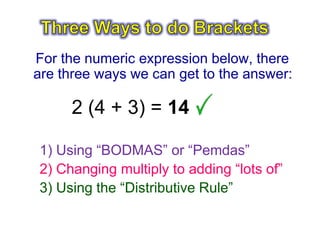
For the numeric expression below, there
are three ways we can get to the answer:

     2 (4 + 3) = 14

1) Using “BODMAS” or “Pemdas”
2) Changing multiply to adding “lots of”
3) Using the “Distributive Rule”
Use “BODMAS” / “Pemdas” Order

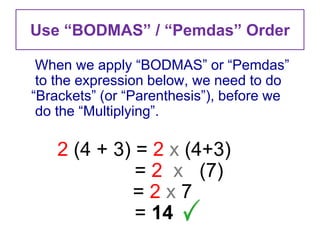
 When we apply “BODMAS” or “Pemdas”
 to the expression below, we need to do
“Brackets” (or “Parenthesis”), before we
 do the “Multiplying”.

    2 (4 + 3) = 2 x (4+3)
              = 2 x (7)
             =2x7
              = 14
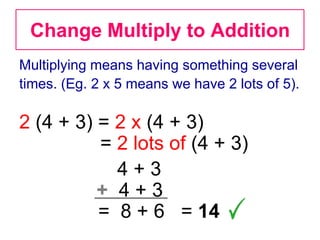
Change Multiply to Addition
Multiplying means having something several
times. (Eg. 2 x 5 means we have 2 lots of 5).

2 (4 + 3) = 2 x (4 + 3)
          = 2 lots of (4 + 3)
            4+3
          + 4+3
          = 8 + 6 = 14
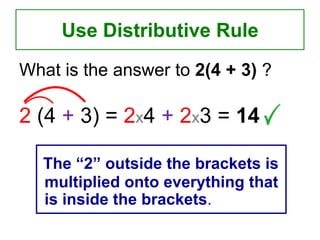
Use Distributive Rule
What is the answer to 2(4 + 3) ?

2 (4 + 3) = 2x4 + 2x3 = 14

   The “2” outside the brackets is
   multiplied onto everything that
   is inside the brackets.
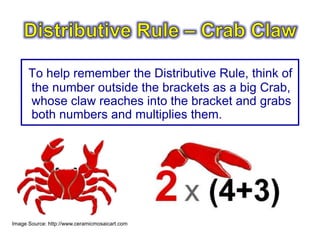
To help remember the Distributive Rule, think of
      the number outside the brackets as a big Crab,
      whose claw reaches into the bracket and grabs
      both numbers and multiplies them.


Image Source: http://www.ceramicmosaicart.com
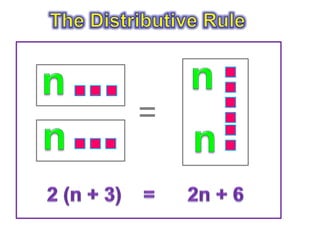
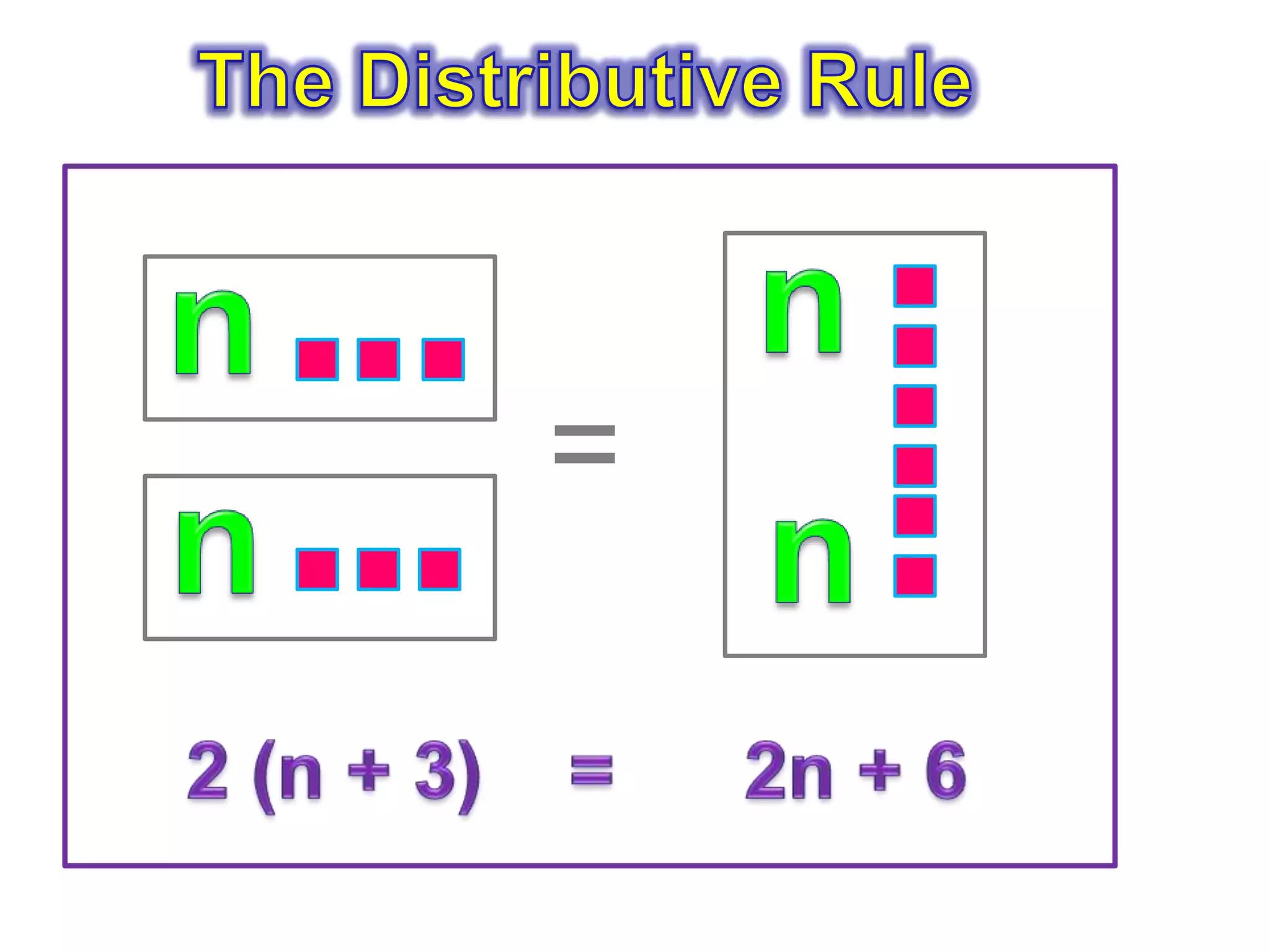
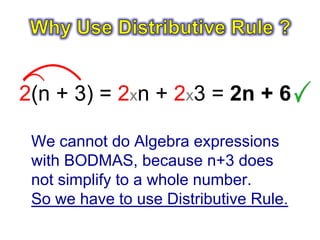
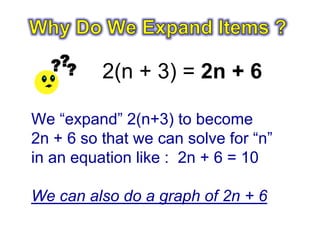
2(n + 3) = 2xn + 2x3 = 2n + 6

 We cannot do Algebra expressions
 with BODMAS, because n+3 does
 not simplify to a whole number.
 So we have to use Distributive Rule.
2(n + 3) = 2n + 6

We “expand” 2(n+3) to become
2n + 6 so that we can solve for “n”
in an equation like : 2n + 6 = 10

We can also do a graph of 2n + 6
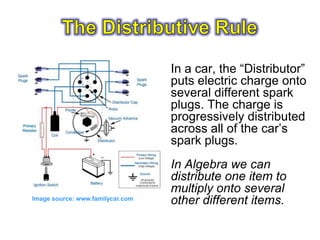
In a car, the “Distributor”
                                  puts electric charge onto
                                  several different spark
                                  plugs. The charge is
                                  progressively distributed
                                  across all of the car’s
                                  spark plugs.
                                  In Algebra we can
                                  distribute one item to
                                  multiply onto several
Image source: www.familycar.com
                                  other different items.
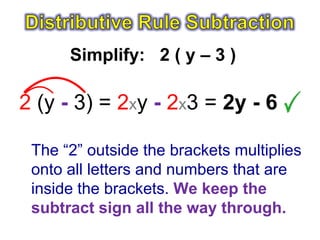
Simplify: 2 ( y – 3 )

2 (y - 3) = 2xy - 2x3 = 2y - 6

 The “2” outside the brackets multiplies
 onto all letters and numbers that are
 inside the brackets. We keep the
 subtract sign all the way through.
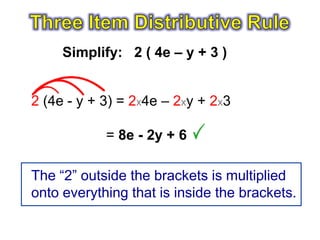
Simplify: 2 ( 4e – y + 3 )


2 (4e - y + 3) = 2x4e – 2xy + 2x3

            = 8e - 2y + 6

The “2” outside the brackets is multiplied
onto everything that is inside the brackets.
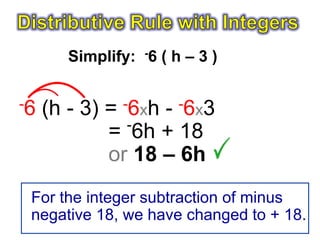
Simplify: -6 ( h – 3 )

-6   (h - 3) = -6xh - -6x3
                -
             = 6h + 18
             or 18 – 6h
 For the integer subtraction of minus
 negative 18, we have changed to + 18.
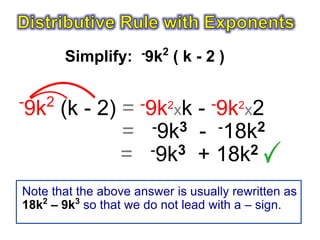
Simplify: -9k2 ( k - 2 )

-     2
    9k (k - 2) = -9k2xk - -9k2x2
               = -9k3 - -18k2
               = -9k3 + 18k2
Note that the above answer is usually rewritten as
18k2 – 9k3 so that we do not lead with a – sign.
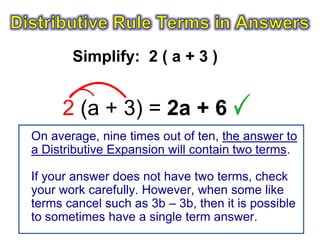
Simplify: 2 ( a + 3 )


     2 (a + 3) = 2a + 6
On average, nine times out of ten, the answer to
a Distributive Expansion will contain two terms.

If your answer does not have two terms, check
your work carefully. However, when some like
terms cancel such as 3b – 3b, then it is possible
to sometimes have a single term answer.
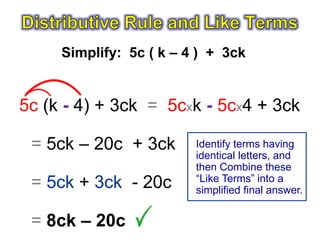
Simplify: 5c ( k – 4 ) + 3ck


5c (k - 4) + 3ck = 5cxk - 5cx4 + 3ck

 = 5ck – 20c + 3ck       Identify terms having
                         identical letters, and
                         then Combine these
                         “Like Terms” into a
 = 5ck + 3ck - 20c       simplified final answer.


 = 8ck – 20c
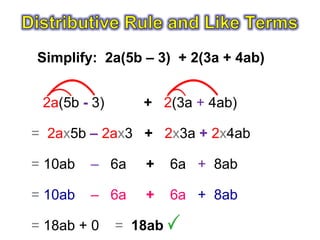
Simplify: 2a(5b – 3) + 2(3a + 4ab)


 2a(5b - 3)      + 2(3a + 4ab)

= 2ax5b – 2ax3 + 2x3a + 2x4ab

= 10ab   – 6a    +     6a + 8ab

= 10ab   – 6a    +     6a + 8ab

= 18ab + 0    = 18ab
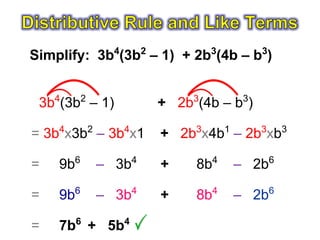
Simplify: 3b4(3b2 – 1) + 2b3(4b – b3)


 3b4(3b2 – 1)       + 2b3(4b – b3)

= 3b4x3b2 – 3b4x1   + 2b3x4b1 – 2b3xb3

=   9b6   – 3b4     +    8b4    – 2b6

=   9b6
          – 3b  4
                    +    8b 4
                                – 2b 6


=   7b6 + 5b4
http://passyworldofmathematics.com

   Visit our site for Free Mathematics PowerPoints

Distributive Property

  • 1.
  • 2.
    For the numericexpression below, there are three ways we can get to the answer: 2 (4 + 3) = 14 1) Using “BODMAS” or “Pemdas” 2) Changing multiply to adding “lots of” 3) Using the “Distributive Rule”
  • 3.
    Use “BODMAS” /“Pemdas” Order When we apply “BODMAS” or “Pemdas” to the expression below, we need to do “Brackets” (or “Parenthesis”), before we do the “Multiplying”. 2 (4 + 3) = 2 x (4+3) = 2 x (7) =2x7 = 14
  • 4.
    Change Multiply toAddition Multiplying means having something several times. (Eg. 2 x 5 means we have 2 lots of 5). 2 (4 + 3) = 2 x (4 + 3) = 2 lots of (4 + 3) 4+3 + 4+3 = 8 + 6 = 14
  • 5.
    Use Distributive Rule Whatis the answer to 2(4 + 3) ? 2 (4 + 3) = 2x4 + 2x3 = 14 The “2” outside the brackets is multiplied onto everything that is inside the brackets.
  • 6.
    To help rememberthe Distributive Rule, think of the number outside the brackets as a big Crab, whose claw reaches into the bracket and grabs both numbers and multiplies them. Image Source: http://www.ceramicmosaicart.com
  • 7.
    2(n + 3)= 2xn + 2x3 = 2n + 6 We cannot do Algebra expressions with BODMAS, because n+3 does not simplify to a whole number. So we have to use Distributive Rule.
  • 8.
    2(n + 3)= 2n + 6 We “expand” 2(n+3) to become 2n + 6 so that we can solve for “n” in an equation like : 2n + 6 = 10 We can also do a graph of 2n + 6
  • 9.
    In a car,the “Distributor” puts electric charge onto several different spark plugs. The charge is progressively distributed across all of the car’s spark plugs. In Algebra we can distribute one item to multiply onto several Image source: www.familycar.com other different items.
  • 10.
    Simplify: 2 (y – 3 ) 2 (y - 3) = 2xy - 2x3 = 2y - 6 The “2” outside the brackets multiplies onto all letters and numbers that are inside the brackets. We keep the subtract sign all the way through.
  • 11.
    Simplify: 2 (4e – y + 3 ) 2 (4e - y + 3) = 2x4e – 2xy + 2x3 = 8e - 2y + 6 The “2” outside the brackets is multiplied onto everything that is inside the brackets.
  • 12.
    Simplify: -6 (h – 3 ) -6 (h - 3) = -6xh - -6x3 - = 6h + 18 or 18 – 6h For the integer subtraction of minus negative 18, we have changed to + 18.
  • 13.
    Simplify: -9k2 (k - 2 ) - 2 9k (k - 2) = -9k2xk - -9k2x2 = -9k3 - -18k2 = -9k3 + 18k2 Note that the above answer is usually rewritten as 18k2 – 9k3 so that we do not lead with a – sign.
  • 14.
    Simplify: 2 (a + 3 ) 2 (a + 3) = 2a + 6 On average, nine times out of ten, the answer to a Distributive Expansion will contain two terms. If your answer does not have two terms, check your work carefully. However, when some like terms cancel such as 3b – 3b, then it is possible to sometimes have a single term answer.
  • 15.
    Simplify: 5c (k – 4 ) + 3ck 5c (k - 4) + 3ck = 5cxk - 5cx4 + 3ck = 5ck – 20c + 3ck Identify terms having identical letters, and then Combine these “Like Terms” into a = 5ck + 3ck - 20c simplified final answer. = 8ck – 20c
  • 16.
    Simplify: 2a(5b –3) + 2(3a + 4ab) 2a(5b - 3) + 2(3a + 4ab) = 2ax5b – 2ax3 + 2x3a + 2x4ab = 10ab – 6a + 6a + 8ab = 10ab – 6a + 6a + 8ab = 18ab + 0 = 18ab
  • 17.
    Simplify: 3b4(3b2 –1) + 2b3(4b – b3) 3b4(3b2 – 1) + 2b3(4b – b3) = 3b4x3b2 – 3b4x1 + 2b3x4b1 – 2b3xb3 = 9b6 – 3b4 + 8b4 – 2b6 = 9b6 – 3b 4 + 8b 4 – 2b 6 = 7b6 + 5b4
  • 18.
    http://passyworldofmathematics.com Visit our site for Free Mathematics PowerPoints