Flaps and Grafts
“….the application of
anatomical knowledge
 to restore form and
      function…”
Graft VS Flap
What is the difference?
What is a Flap?
• 16th century Dutch word “flappe”
  – ….something that hangs broad and loose ,
    fastened only by one side..”
What is a Flap?
• A flap is a unit of tissue that may be transferred
  from a donor to a recipient site while maintaining
  its blood supply.
  – Flaps can be characterized by their component parts
     • cutaneous, musculocutaneous, osseocutaneous
  – Their relationship to the defect
     • local, regional, or distant
  – Nature of the blood supply
     • random versus axial
  – The movement placed on the flap
     • advancement, pivot, transposition, free, pedicled
• Rung 1: Healing by
  secondary intention
• Rung 2: Primary closure
• Rung 3: Delayed primary
  closure
• Rung 4: Split thickness
  graft
• Rung 5: FTSG
• Rung 6: tissue expansion
• Rung 7: Random flap
• Rung 8: Axial flap
• Rung 9: Free Flap

Reconstructive Elevator
• Get off at the right level
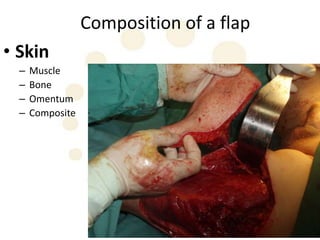
Composition of a flap
• Skin
  –   Muscle
  –   Bone
  –   Omentum
  –   Composite
Composition of a flap
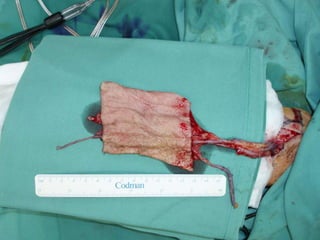
 – Skin

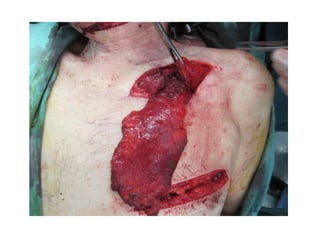
• Muscle
 – Bone
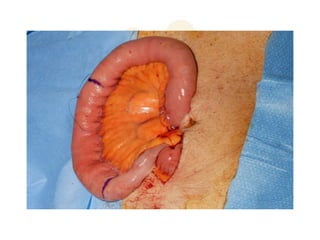
 – Omentum
 – Composite
Composition of a flap
 – Skin
 – Muscle

• Bone
 – Omentum
 – Composite
Composition of a flap
 – Skin
 – Muscle
 – Bone

• Omentum
 – Composite
Composition of a flap
 – Skin
 – Muscle
 – Bone

• Omentum /
  viscera
 – Composite
Composition of a flap
  –   Skin +/- fascia
  –   Muscle (+/- innervation)
  –   Bone
  –   Omentum / viscera
• Composite
Which flap when?
Goals of reconstruction

• Separating the physiological cavities
    – Eg brain, orbit, mouth, neck
•   Protecting the neck vessels
•   Obtaining a healed wound
•   Restore function
•   Restore swallowing
•   No leaks
•   Aesthetics
• Flaps reduce complications by:
  – Obliterating dead space
  – Recruiting healthy well-vascularized tissue into the
    region, which has commonly been irradiated and
    contaminated
  – Tension free closure
  – Interposing flap skin between irradiated wound
    edges
Pharyngeal defects
• Partial defects
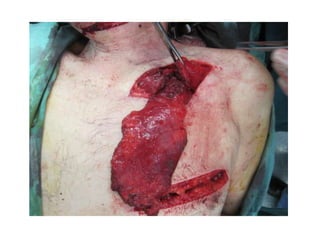
  – Pectoralis major flap with muscle and skin
  – Radial forearm free flap
• Circumferential defects
  – Tubed radial forearm flap or ALT flap
  – Jejunum
Goals of reconstruction:

•   A single stage, reliable reconstruction
•   Prompt discharge from hospital
•   Return of swallowing and speech function
•   No salivary fistulas
Literature Review
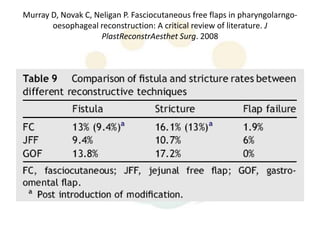
• Nelligan (J PlastReconstrAesthet Surg. 2008)
  reported a fistula rate of:
  – 13% for all fasciocutaneous flaps
     • ALT flap 16.4%
     • radial forearm free flap 14.4%.
  – Jejunum 9.4%
• Charing Cross Study (Moradi et al)
  – fistula rate: 2/43 (4.7%)
  – stricture rate: 6/43 (14%)
Murray D, Novak C, Neligan P. Fasciocutaneous free flaps in pharyngolarngo-
       oesophageal reconstruction: A critical review of literature. J
                    PlastReconstrAesthet Surg. 2008
Voice Restoration (Charing Cross
                 series)
• 22 of 42 received a
  primary (TEP)
• 14 of 42 received a
  secondary TEP
• 36/42 (85%) received
  either a primary or
  secondary TEP
• Voice was reported as:
   – Good in 17 of 39
   – Fair in 11 of 39.
   – 28 of 39 (72%) used their
     tracheoesophageal
     puncture as their primary
     mode of communication
When to eat?
• No scientific evidence on the timing of oral
  intake
• Err on the side of caution if previous
  radiotherapy
• Day 10
Mandible reconstruction
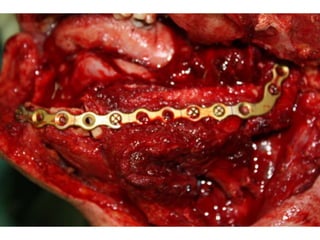
• Osteoradionecrosis (ORN) is a condition of non-vital
  bone in a site of radiation injury
• Characterised by:
   – hypovascularity
   – hypocellularity
   – hypoxia

• ORN occurs when, in the process of otherwise normal
  turnover of bone, the degradative function exceeds
  new bone production
• Can be either spontaneous or the result of an insult
Facial reanimation

• Goal of treatment
  – Rest symmetry
  – Facial function
  – Voluntary function
  – Spontaneous movement
  – Absence of synkinesis
Facial reanimation
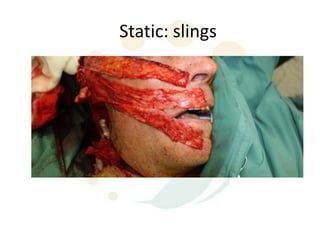
• Static vs dynamic
• Static: Divide face into 1/3rds
  – Upper:
  – Middle:
  – Lower:
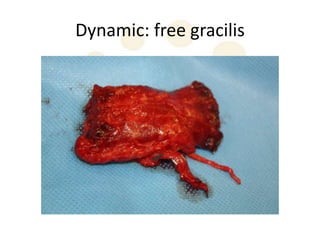
Dynamic: free gracilis
Static: slings
Tongue reconstruction
• Depending on extent of defect and the status
  of the floor of mouth
• Generally use:
  – Radial forearm free flap
  – Ulnar forearm free flap
  – ALT
Radial forearm free flap
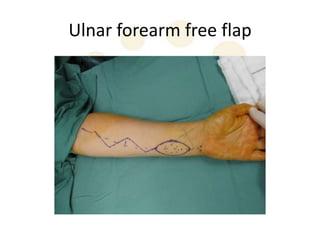
Ulnar forearm free flap
Nsw speech-path-talk-flapvs-grafts

Nsw speech-path-talk-flapvs-grafts

  • 2.
  • 3.
    “….the application of anatomicalknowledge to restore form and function…”
  • 4.
    Graft VS Flap Whatis the difference?
  • 5.
    What is aFlap? • 16th century Dutch word “flappe” – ….something that hangs broad and loose , fastened only by one side..”
  • 6.
    What is aFlap? • A flap is a unit of tissue that may be transferred from a donor to a recipient site while maintaining its blood supply. – Flaps can be characterized by their component parts • cutaneous, musculocutaneous, osseocutaneous – Their relationship to the defect • local, regional, or distant – Nature of the blood supply • random versus axial – The movement placed on the flap • advancement, pivot, transposition, free, pedicled
  • 7.
    • Rung 1:Healing by secondary intention • Rung 2: Primary closure • Rung 3: Delayed primary closure • Rung 4: Split thickness graft • Rung 5: FTSG • Rung 6: tissue expansion • Rung 7: Random flap • Rung 8: Axial flap • Rung 9: Free Flap

  • 8.
  • 9.
    Composition of aflap • Skin – Muscle – Bone – Omentum – Composite
  • 10.
    Composition of aflap – Skin • Muscle – Bone – Omentum – Composite
  • 11.
    Composition of aflap – Skin – Muscle • Bone – Omentum – Composite
  • 12.
    Composition of aflap – Skin – Muscle – Bone • Omentum – Composite
  • 13.
    Composition of aflap – Skin – Muscle – Bone • Omentum / viscera – Composite
  • 14.
    Composition of aflap – Skin +/- fascia – Muscle (+/- innervation) – Bone – Omentum / viscera • Composite
  • 15.
  • 16.
    Goals of reconstruction •Separating the physiological cavities – Eg brain, orbit, mouth, neck • Protecting the neck vessels • Obtaining a healed wound • Restore function • Restore swallowing • No leaks • Aesthetics
  • 17.
    • Flaps reducecomplications by: – Obliterating dead space – Recruiting healthy well-vascularized tissue into the region, which has commonly been irradiated and contaminated – Tension free closure – Interposing flap skin between irradiated wound edges
  • 18.
    Pharyngeal defects • Partialdefects – Pectoralis major flap with muscle and skin – Radial forearm free flap • Circumferential defects – Tubed radial forearm flap or ALT flap – Jejunum
  • 19.
    Goals of reconstruction: • A single stage, reliable reconstruction • Prompt discharge from hospital • Return of swallowing and speech function • No salivary fistulas
  • 36.
    Literature Review • Nelligan(J PlastReconstrAesthet Surg. 2008) reported a fistula rate of: – 13% for all fasciocutaneous flaps • ALT flap 16.4% • radial forearm free flap 14.4%. – Jejunum 9.4% • Charing Cross Study (Moradi et al) – fistula rate: 2/43 (4.7%) – stricture rate: 6/43 (14%)
  • 37.
    Murray D, NovakC, Neligan P. Fasciocutaneous free flaps in pharyngolarngo- oesophageal reconstruction: A critical review of literature. J PlastReconstrAesthet Surg. 2008
  • 38.
    Voice Restoration (CharingCross series) • 22 of 42 received a primary (TEP) • 14 of 42 received a secondary TEP • 36/42 (85%) received either a primary or secondary TEP • Voice was reported as: – Good in 17 of 39 – Fair in 11 of 39. – 28 of 39 (72%) used their tracheoesophageal puncture as their primary mode of communication
  • 39.
    When to eat? •No scientific evidence on the timing of oral intake • Err on the side of caution if previous radiotherapy • Day 10
  • 40.
    Mandible reconstruction • Osteoradionecrosis(ORN) is a condition of non-vital bone in a site of radiation injury • Characterised by: – hypovascularity – hypocellularity – hypoxia • ORN occurs when, in the process of otherwise normal turnover of bone, the degradative function exceeds new bone production • Can be either spontaneous or the result of an insult
  • 46.
    Facial reanimation • Goalof treatment – Rest symmetry – Facial function – Voluntary function – Spontaneous movement – Absence of synkinesis
  • 47.
    Facial reanimation • Staticvs dynamic • Static: Divide face into 1/3rds – Upper: – Middle: – Lower:
  • 48.
  • 49.
  • 50.
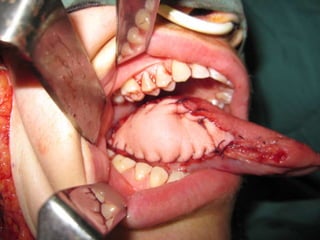
    Tongue reconstruction • Dependingon extent of defect and the status of the floor of mouth • Generally use: – Radial forearm free flap – Ulnar forearm free flap – ALT
  • 53.
  • 54.
  • 55.
  • 56.