TRAUMA FILMS
29 MARCH 2019
phakjiranut maneepradit
✖ผู้หญิงไทย อายุ 19 ปี no U/D
✖CC : แผลฉีกขาดนิ้วโป้งมือขวา 1 hrPTA
✖PI : 1 hrPTA ขณะฟันหัวมันสาปะหลัง ถูกมีดฟันนิ้วโป้ง
มือขวา แผลฉีกขาดลึกถึงเส้นเอ็น กระดกนิ้วโป้งมือขวาไม่ได้ ไปรพช.
จึง refer มา
Case 1
Physical examination
ABCD passed, vital signs stable
Extremities:
Inspection : Laceration wound 1 cm.
deep to tendon
Palpation :
Motion : can’t extend Rt. thumb
Neurovascular : normal sensation ,
radial pulse 2+
diagnosis
Tear Extensor tendon zone III of Right thumb
management
• Set OR for debridement and repair extensor tendon
Rt thumb
Extensor Tendon Injuries
 Injury can be caused by laceration, trauma, or overuse
 zone VI is the most frequently injured zone.
• Mallet Finger
DIP extension splinting
• Disruption of tendon over middle phalanx or
proximal phalanx of thumb (EPL)
• Boutonniere deformity
PIP extension splinting
• Disruption over the proximal phalanx of
digit or metacarpal of thumb (EPL and EPB)
• "Fight bite" common
• Sagittal band rupture
MCP extension splinting
• Nerve and vessel injury likely
• Disruption at the wrist joint
• Must repair retinaculum to prevent
bowstringing
• Usually from penetrating trauma
• Often have associated neurologic injury
treatment
✖ Nonoperative
• immobilization with early protected motion
Indications : lacerations < 50% of tendon in all zones if patient
can extend digit against resistance
o DIP extension splinting
Indications : acute (<12 weeks) Zone 1 injury (mallet finger)
nondisplaced bony mallet
chronic mallet finger (>12 weeks) if joint congruent
o PIP extension splinting
Indications : closed central slip injury (zone III)
o MCP extension splinting
Indications : closed zone V sagittal band rupture
treatment
✖Operative
• immediate I&D
Indications : fight bite to MCP joint
• tendon repair
Indications :laceration > 50% of
tendon width in all zones
• fixation of bony avulsion
Indications : boney mallet finger
with P3 volar subluxation
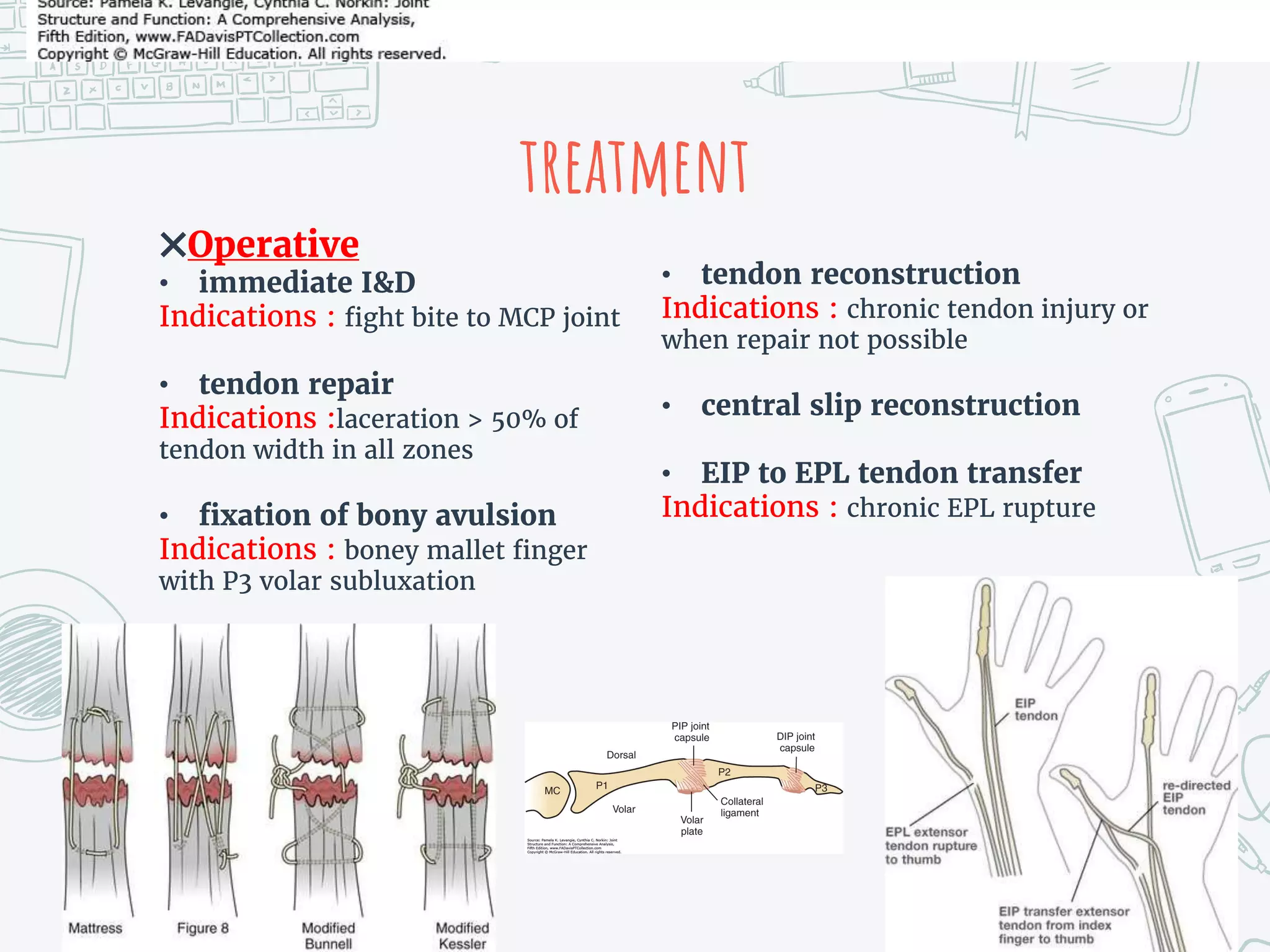
• tendon reconstruction
Indications : chronic tendon injury or
when repair not possible
• central slip reconstruction
• EIP to EPL tendon transfer
Indications : chronic EPL rupture
Complications
✖Adhesion formation
- leads to loss of finger flexion
- common in zone IV and VII and older patients
- prevented with early protected ROM and dynamic splinting (zone IV)
✖Tendon rupture
- causes include poor suture material or surgical technique,
aggressive therapy, and noncompliance
- most frequently during first 7 to 10 days post-op
✖Swan neck deformity
caused by prolonged DIP flexion with dorsal subluxation
of lateral bands and PIP joint hyperextension
✖ Boutonniere deformity(DIP hyperextension)
caused by central slip disruption and lateral band volar
subluxation
✖ผู้ป่วยชายไทย อายุ 75 ปี U/D HT
✖CC : ปวดบวมนิ้วนางมือขวา 3 dPTA
✖PI : 5 dPTA ถูกหนามปักมือขวา ปวดบวมมือขวาเล็กน้อย
ไม่ได้ไปรักษาที่ใด
3 dPTA นิ้วนางมือขวาบวมแดง ขยับได้ลดลง เริ่มมี
หนองไหล ไปรพช. จึง refer มา
Case 2
Physical examination
ABCD passed, vital signs stable
Extremities:
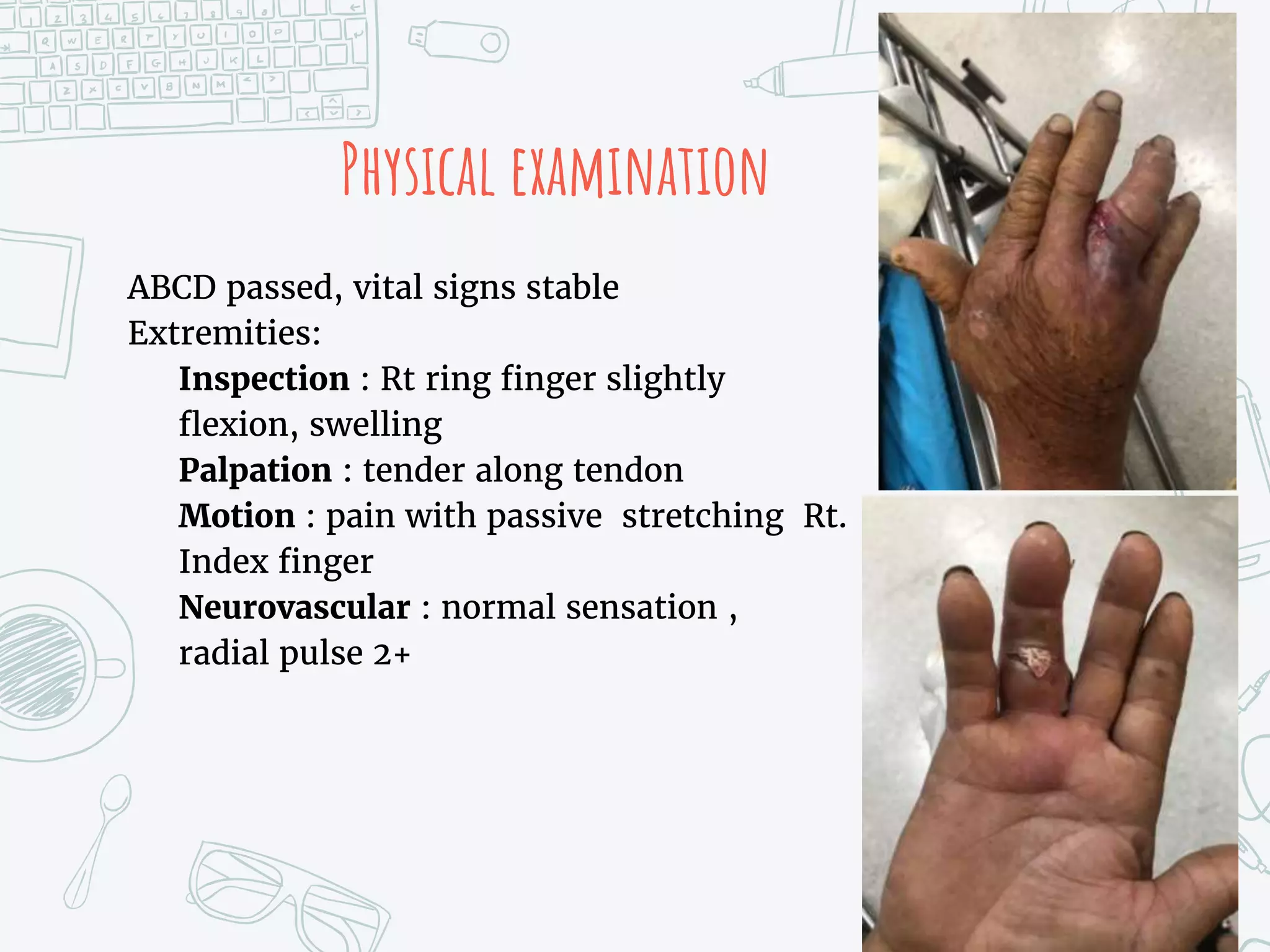
Inspection : Rt ring finger slightly
flexion, swelling
Palpation : tender along tendon
Motion : pain with passive stretching Rt.
Index finger
Neurovascular : normal sensation ,
radial pulse 2+
diagnosis
Flexor tenosynovitis Rt ring finger
management
• Surgery
• IV ATB
flexor tenosynovitis
Anatomy
Synovial sheath
• Extend from the mid-palmar crease at a1 pulley to the DIP
• Small finger continuous with the Ulnar Bursa
• Thumb( FPL) is continuous with the Radial Bursa
Flexor tendon sheath infection
• Flexor tendon sheath infection : penetrating trauma
• More likely at joint flexion creases
• Usual agent: S. Aureus
• Most commonly affected : Ring,Middle& index fingers
• Purulence > destroys gliding > adhesions > loss of function
• destroys the blood supply producing tendon necrosis
Diagnosis
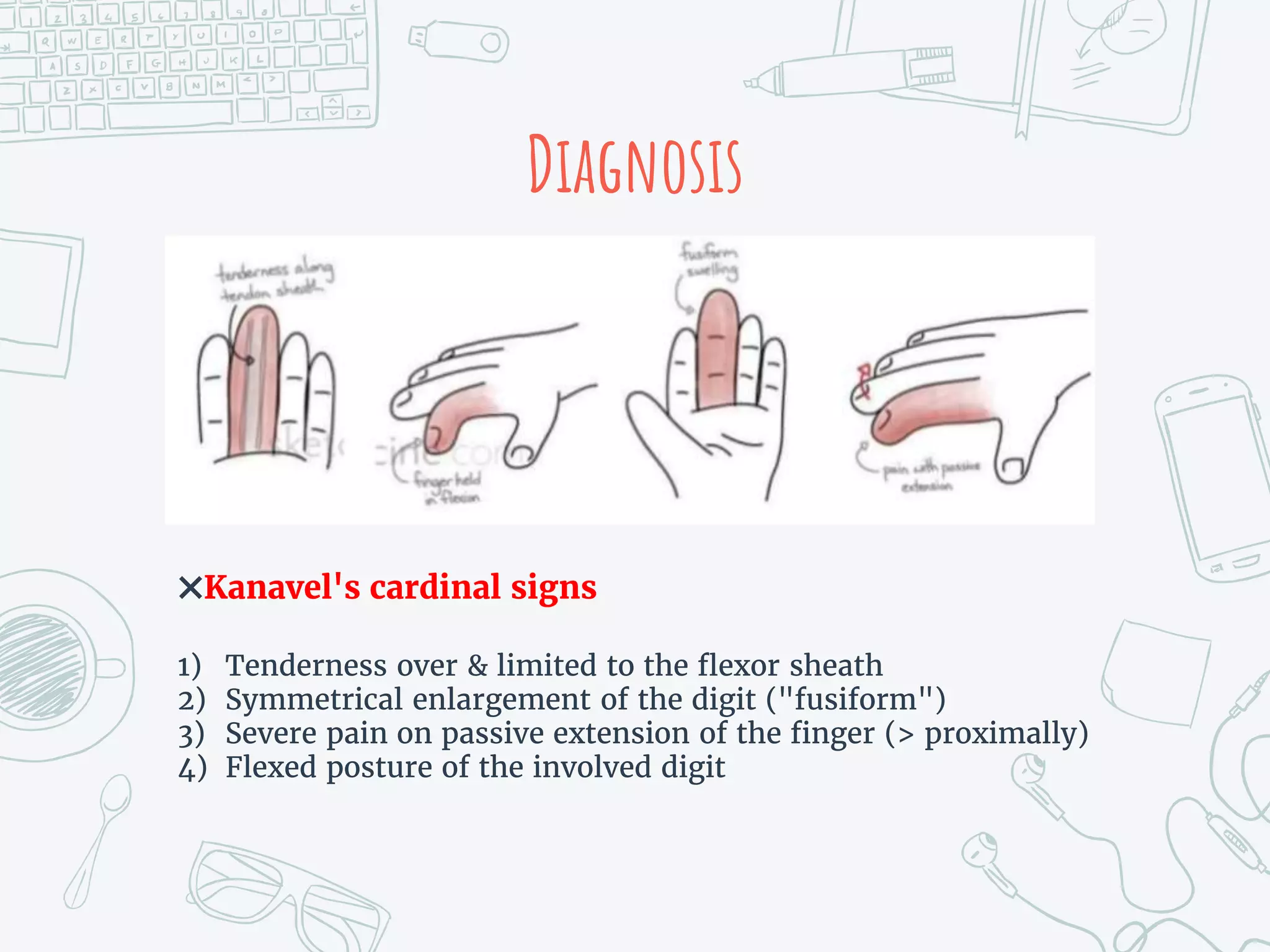
✖Kanavel's cardinal signs
1) Tenderness over & limited to the flexor sheath
2) Symmetrical enlargement of the digit ("fusiform")
3) Severe pain on passive extension of the finger (> proximally)
4) Flexed posture of the involved digit
Treatment
• First 24 hr
• may initially with IV Antibiotics
• Ceftriaxone/ Ciprofloxacin / vancomycin
• Failed ATB in 24 hr -> Surgery
Surgery
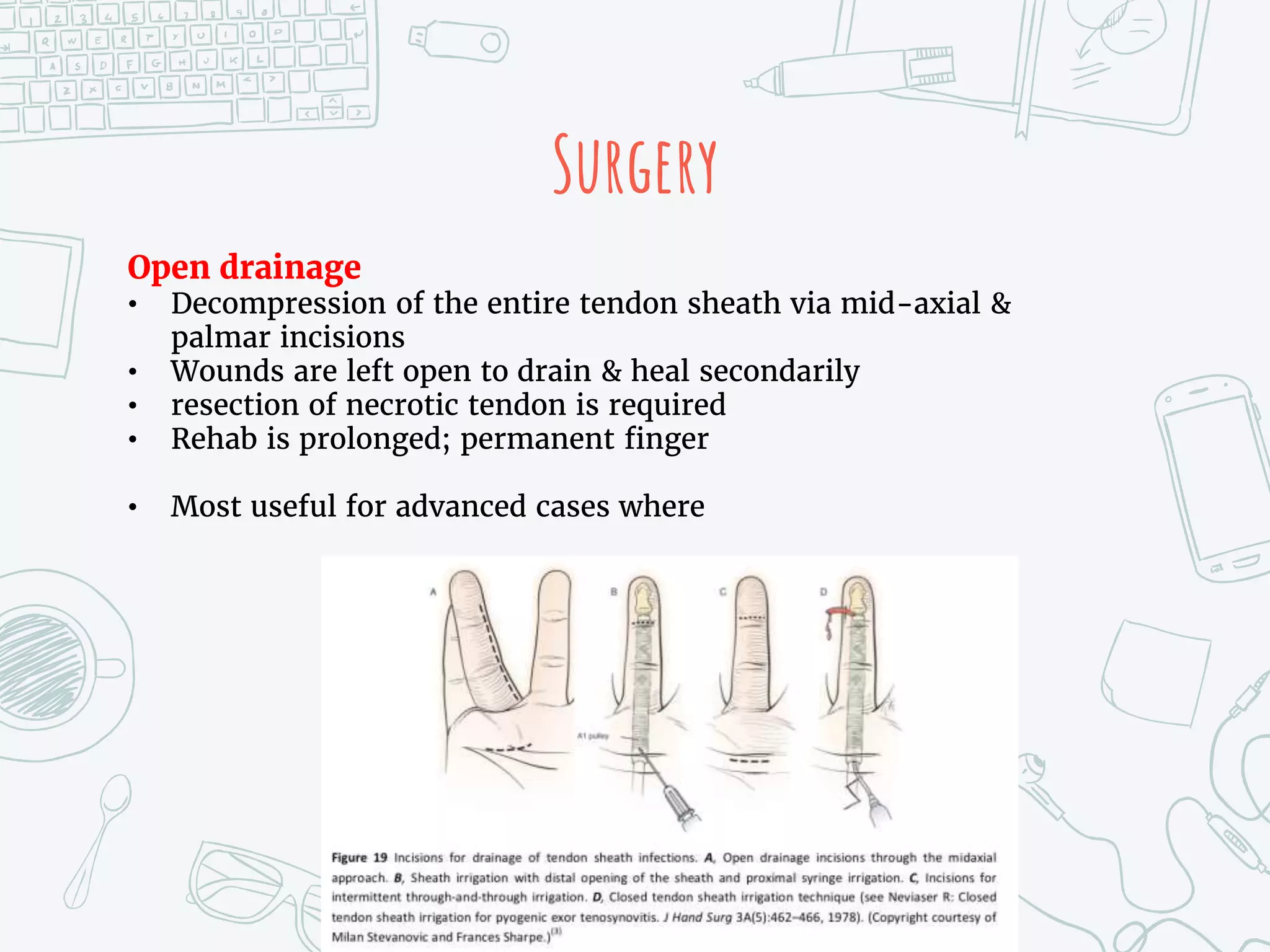
Open drainage
• Decompression of the entire tendon sheath via mid-axial &
palmar incisions
• Wounds are left open to drain & heal secondarily
• resection of necrotic tendon is required
• Rehab is prolonged; permanent finger
• Most useful for advanced cases where
Surgery
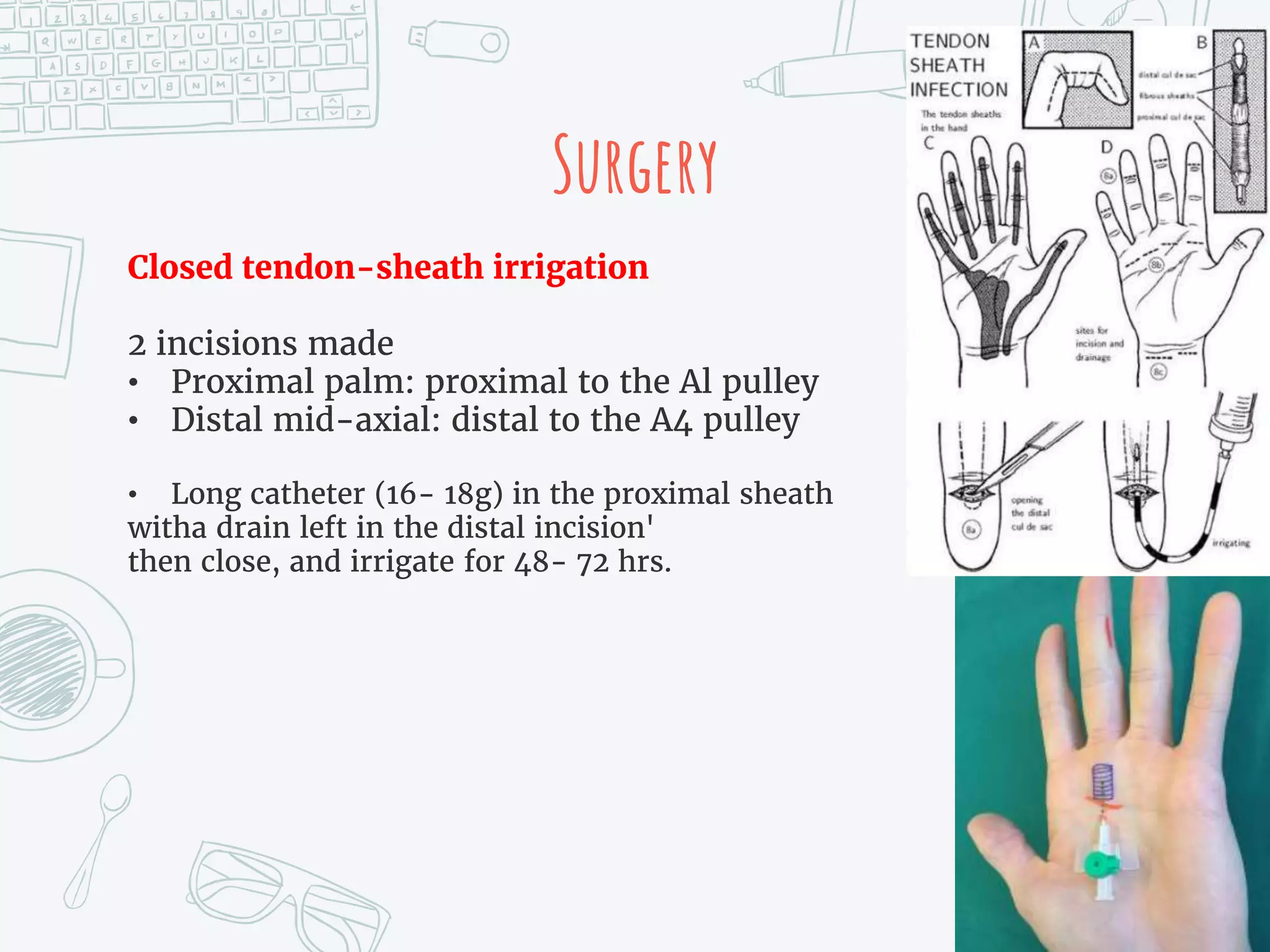
Closed tendon-sheath irrigation
2 incisions made
• Proximal palm: proximal to the Al pulley
• Distal mid-axial: distal to the A4 pulley
• Long catheter (16- 18g) in the proximal sheath
witha drain left in the distal incision'
then close, and irrigate for 48- 72 hrs.
Postop care
• Intravenous antibiotics
• Pain management
• First dressing change between 8 and 12 hours
• Soaks in dilute povidone-iodine solution three times per day with
range-of-motion exercises
• Repeat debridement and irigation in 48 hours if Kanave's signs not
resolving.
Thankyou

Mextensor tendon&amp;teno

  • 1.
    TRAUMA FILMS 29 MARCH2019 phakjiranut maneepradit
  • 2.
    ✖ผู้หญิงไทย อายุ 19ปี no U/D ✖CC : แผลฉีกขาดนิ้วโป้งมือขวา 1 hrPTA ✖PI : 1 hrPTA ขณะฟันหัวมันสาปะหลัง ถูกมีดฟันนิ้วโป้ง มือขวา แผลฉีกขาดลึกถึงเส้นเอ็น กระดกนิ้วโป้งมือขวาไม่ได้ ไปรพช. จึง refer มา Case 1
  • 3.
    Physical examination ABCD passed,vital signs stable Extremities: Inspection : Laceration wound 1 cm. deep to tendon Palpation : Motion : can’t extend Rt. thumb Neurovascular : normal sensation , radial pulse 2+
  • 4.
    diagnosis Tear Extensor tendonzone III of Right thumb
  • 5.
    management • Set ORfor debridement and repair extensor tendon Rt thumb
  • 6.
    Extensor Tendon Injuries Injury can be caused by laceration, trauma, or overuse  zone VI is the most frequently injured zone.
  • 7.
    • Mallet Finger DIPextension splinting • Disruption of tendon over middle phalanx or proximal phalanx of thumb (EPL) • Boutonniere deformity PIP extension splinting • Disruption over the proximal phalanx of digit or metacarpal of thumb (EPL and EPB) • "Fight bite" common • Sagittal band rupture MCP extension splinting • Nerve and vessel injury likely • Disruption at the wrist joint • Must repair retinaculum to prevent bowstringing • Usually from penetrating trauma • Often have associated neurologic injury
  • 8.
    treatment ✖ Nonoperative • immobilizationwith early protected motion Indications : lacerations < 50% of tendon in all zones if patient can extend digit against resistance o DIP extension splinting Indications : acute (<12 weeks) Zone 1 injury (mallet finger) nondisplaced bony mallet chronic mallet finger (>12 weeks) if joint congruent o PIP extension splinting Indications : closed central slip injury (zone III) o MCP extension splinting Indications : closed zone V sagittal band rupture
  • 9.
    treatment ✖Operative • immediate I&D Indications: fight bite to MCP joint • tendon repair Indications :laceration > 50% of tendon width in all zones • fixation of bony avulsion Indications : boney mallet finger with P3 volar subluxation • tendon reconstruction Indications : chronic tendon injury or when repair not possible • central slip reconstruction • EIP to EPL tendon transfer Indications : chronic EPL rupture
  • 10.
    Complications ✖Adhesion formation - leadsto loss of finger flexion - common in zone IV and VII and older patients - prevented with early protected ROM and dynamic splinting (zone IV) ✖Tendon rupture - causes include poor suture material or surgical technique, aggressive therapy, and noncompliance - most frequently during first 7 to 10 days post-op ✖Swan neck deformity caused by prolonged DIP flexion with dorsal subluxation of lateral bands and PIP joint hyperextension ✖ Boutonniere deformity(DIP hyperextension) caused by central slip disruption and lateral band volar subluxation
  • 11.
    ✖ผู้ป่วยชายไทย อายุ 75ปี U/D HT ✖CC : ปวดบวมนิ้วนางมือขวา 3 dPTA ✖PI : 5 dPTA ถูกหนามปักมือขวา ปวดบวมมือขวาเล็กน้อย ไม่ได้ไปรักษาที่ใด 3 dPTA นิ้วนางมือขวาบวมแดง ขยับได้ลดลง เริ่มมี หนองไหล ไปรพช. จึง refer มา Case 2
  • 12.
    Physical examination ABCD passed,vital signs stable Extremities: Inspection : Rt ring finger slightly flexion, swelling Palpation : tender along tendon Motion : pain with passive stretching Rt. Index finger Neurovascular : normal sensation , radial pulse 2+
  • 13.
  • 14.
  • 15.
  • 16.
    Anatomy Synovial sheath • Extendfrom the mid-palmar crease at a1 pulley to the DIP • Small finger continuous with the Ulnar Bursa • Thumb( FPL) is continuous with the Radial Bursa
  • 17.
    Flexor tendon sheathinfection • Flexor tendon sheath infection : penetrating trauma • More likely at joint flexion creases • Usual agent: S. Aureus • Most commonly affected : Ring,Middle& index fingers • Purulence > destroys gliding > adhesions > loss of function • destroys the blood supply producing tendon necrosis
  • 18.
    Diagnosis ✖Kanavel's cardinal signs 1)Tenderness over & limited to the flexor sheath 2) Symmetrical enlargement of the digit ("fusiform") 3) Severe pain on passive extension of the finger (> proximally) 4) Flexed posture of the involved digit
  • 19.
    Treatment • First 24hr • may initially with IV Antibiotics • Ceftriaxone/ Ciprofloxacin / vancomycin • Failed ATB in 24 hr -> Surgery
  • 20.
    Surgery Open drainage • Decompressionof the entire tendon sheath via mid-axial & palmar incisions • Wounds are left open to drain & heal secondarily • resection of necrotic tendon is required • Rehab is prolonged; permanent finger • Most useful for advanced cases where
  • 21.
    Surgery Closed tendon-sheath irrigation 2incisions made • Proximal palm: proximal to the Al pulley • Distal mid-axial: distal to the A4 pulley • Long catheter (16- 18g) in the proximal sheath witha drain left in the distal incision' then close, and irrigate for 48- 72 hrs.
  • 22.
    Postop care • Intravenousantibiotics • Pain management • First dressing change between 8 and 12 hours • Soaks in dilute povidone-iodine solution three times per day with range-of-motion exercises • Repeat debridement and irigation in 48 hours if Kanave's signs not resolving.
  • 23.