Physiology of Skin Grafts
SKIN: Physiology & Function
• Epidermis:
  – protective barrier (against mechanical damage,
    microbe invasion, & water loss)
  – high regenerative capacity
  – Producer of skin appendages (hair, nails, sweat &
    sebaceous glands)
SKIN: Physiology & Function
• Dermis:
  – mechanical strength (collagen & elastin)
  – Barrier to microbe invasion
  – Sensation (point, temp, pressure, proprioception)
  – Thermoregulation (vasomotor activity of blood
    vessels and sweat gland activity)
SKIN: Physiology & Function
• Immunological surveillance
• Most skin is thin, hair-bearing, has sebaceous
  glands
• Skin of palms/soles/flexor surface of digits is
  thick, not hair-bearing, no sebaceous glands
• Vascular supply confined to dermis
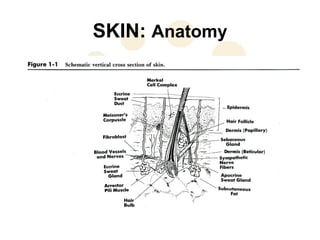
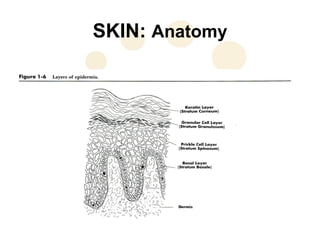
SKIN: Anatomy
SKIN: Anatomy
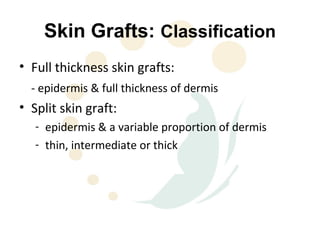
Skin Grafts: Classification
• Full thickness skin grafts:
  - epidermis & full thickness of dermis
• Split skin graft:
   - epidermis & a variable proportion of dermis
   - thin, intermediate or thick
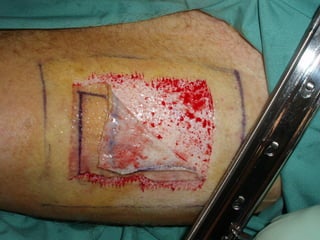
Skin Grafts: SSG
Skin Grafts: Classification
 Autografts
 Isografts
 Allografts
 Xenografts
Skin Grafts: “Process of Take”
• Vascularity of donor site
• Tolerance to ischaemia
• Metabolic activity of the graft
Skin Grafts: “Process of Take”
• 4 Phases:
  – Fibrin adhesion
  – Plasmatic imbibition
  – Revascularization: Inosculation & capillary
    ingrowth
  – Remodelling: Revascularization & fibrous
    attachment in restoring normal histological
    architecture
Skin Grafts: “Process of Take”
• Plasmatic Imbibition:
  – Initially graft ischaemic (24 – 48 hrs)
  – Fibrin adhesion
  – Imbibition allows the graft to survive this period
  – ? Important for nutrition of graft
  – ? Stops drying out
Skin Grafts: “Process of Take”
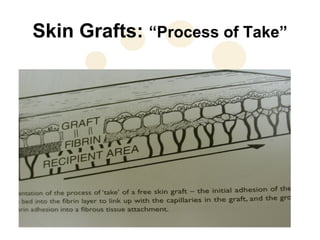
• Inosculation & capillary ingrowth:
  – At 48 hrs
  – Through fibrin layer
  – Capillary buds from recipient bed contact graft
    vessels
  – Open channels (neo-vascularization)
     pink graft
Skin Grafts: “Process of Take”
• Revascularization & fibrous attachment:
   – Connection of graft & host vessels via anastomoses
     (inosculation)
   – Formation of new vascular channels by invasion of graft
     (neovascularisation)
   – Combination of old & new vessels (revascularisation)
   – Fibroblast proliferation: conversion of fibrin adhesion 
     fibrous tissue attachment (anchorage within 4 days)
Skin Grafts: “Process of Take”
Skin Graft Take: Epidermis

Days     Histological changes

0–4      Epithelium doubles; crusting, scaling of epidermis;
         swelling of nuclei & cytoplasm; epithelial cell
         migration to surface; mitosis of follicular & granular
         cells

3        ++ mitotic activity in SSG not FTSG


4–8      Proliferation & thickening of epithelium (up to 7x)
         desquamation

Week 4   Epidermis returned to normal thickness
Skin Graft Take: Epidermis

Day   Histochemical changes

4     Increased RNA in basal cells, indicating protein
      synthesis


10    RNA returns to normal
Skin Graft Take: Dermis
• Fibrous component:

Collagen        Hyalinized early and progressively replaced
                with new fibres by 6 weeks;
                Turned over 3-4X faster than normal skin.

Elastin         Accounts for resilience;
                Days 3-7 fragment;
                Replaced 4-6 weeks.

Extracellular   Proteins direct the behaviour of
matrix          keratinocytes;
                Communication between keratinocytes &
                fibroblasts.
Skin Graft Take: Dermis
• Appendages:
 - sweating dependent on no. of transplanted sweat glands &
 degree of sympathetic reinnervation; will sweat like recipient
 site in FTSG only
 - sebaceous gland activity mostly in thicker grafts: SSG usually
 dry & shiny
 - hair grows from FTSG if well taken with no complications
Skin Graft Healing
• Initially white then pinkens with new blood
  supply
• Lymphatic drainage by day 6
• Collagen replacement from day 7 to week 6
• Vascular remodelling for months
Skin Graft Healing
• Contraction:
  - shrinks immediately due to elastic recoil:             – FTSG
  40%; medium SSG 20%; thin SSG 10%.
  - secondary contracture as heals:
   - FTSG remains same size after above       shrinkage;
   - SSG will contract as much as possible;
   - more dermis = less contraction
   - ? Due to myofibroblasts
Skin Graft Healing
• Reinnervation:
  – from margins to bed;
  – 4/52 to 2 years;
  – Depends on graft thickness and bed;
  – Uneventful healing leads to near normal 2PD;
  – Cold sensitivity can be a problem.
Skin Graft Expansion
• Based on principle that wounds
  reepithelialized from the periphery
• Expansion provides larger areas from which
  epithelium can grow
• Larger areas can be covered with less skin
Skin Graft Expansion
• Meshing
  - covers large area
  - easier to contour
  - fluid can drain through holes
  - cosmetic results less than ideal
  - various mesh ratio
Skin Graft Survival
•   Meticulous technique
•   Atraumatic graft handling
•   Well vascularized bed
•   Haemostasis
•   Immobilization
•   No proximal constricting bandages
Skin Graft Failure
•   Haematoma
•   Infection
•   Seroma
•   Mobility
•   Inappropriate bed
•   Dependency
•   Arterial insufficiency
•   Venous congestion
•   Lymphatic stasis
•   Technical – upside-down

Skin grafts

  • 2.
  • 3.
    SKIN: Physiology &Function • Epidermis: – protective barrier (against mechanical damage, microbe invasion, & water loss) – high regenerative capacity – Producer of skin appendages (hair, nails, sweat & sebaceous glands)
  • 4.
    SKIN: Physiology &Function • Dermis: – mechanical strength (collagen & elastin) – Barrier to microbe invasion – Sensation (point, temp, pressure, proprioception) – Thermoregulation (vasomotor activity of blood vessels and sweat gland activity)
  • 5.
    SKIN: Physiology &Function • Immunological surveillance • Most skin is thin, hair-bearing, has sebaceous glands • Skin of palms/soles/flexor surface of digits is thick, not hair-bearing, no sebaceous glands • Vascular supply confined to dermis
  • 6.
  • 7.
  • 8.
    Skin Grafts: Classification •Full thickness skin grafts: - epidermis & full thickness of dermis • Split skin graft: - epidermis & a variable proportion of dermis - thin, intermediate or thick
  • 9.
  • 11.
    Skin Grafts: Classification Autografts  Isografts  Allografts  Xenografts
  • 12.
    Skin Grafts: “Processof Take” • Vascularity of donor site • Tolerance to ischaemia • Metabolic activity of the graft
  • 13.
    Skin Grafts: “Processof Take” • 4 Phases: – Fibrin adhesion – Plasmatic imbibition – Revascularization: Inosculation & capillary ingrowth – Remodelling: Revascularization & fibrous attachment in restoring normal histological architecture
  • 14.
    Skin Grafts: “Processof Take” • Plasmatic Imbibition: – Initially graft ischaemic (24 – 48 hrs) – Fibrin adhesion – Imbibition allows the graft to survive this period – ? Important for nutrition of graft – ? Stops drying out
  • 15.
    Skin Grafts: “Processof Take” • Inosculation & capillary ingrowth: – At 48 hrs – Through fibrin layer – Capillary buds from recipient bed contact graft vessels – Open channels (neo-vascularization)  pink graft
  • 16.
    Skin Grafts: “Processof Take” • Revascularization & fibrous attachment: – Connection of graft & host vessels via anastomoses (inosculation) – Formation of new vascular channels by invasion of graft (neovascularisation) – Combination of old & new vessels (revascularisation) – Fibroblast proliferation: conversion of fibrin adhesion  fibrous tissue attachment (anchorage within 4 days)
  • 17.
  • 18.
    Skin Graft Take:Epidermis Days Histological changes 0–4 Epithelium doubles; crusting, scaling of epidermis; swelling of nuclei & cytoplasm; epithelial cell migration to surface; mitosis of follicular & granular cells 3 ++ mitotic activity in SSG not FTSG 4–8 Proliferation & thickening of epithelium (up to 7x) desquamation Week 4 Epidermis returned to normal thickness
  • 19.
    Skin Graft Take:Epidermis Day Histochemical changes 4 Increased RNA in basal cells, indicating protein synthesis 10 RNA returns to normal
  • 20.
    Skin Graft Take:Dermis • Fibrous component: Collagen Hyalinized early and progressively replaced with new fibres by 6 weeks; Turned over 3-4X faster than normal skin. Elastin Accounts for resilience; Days 3-7 fragment; Replaced 4-6 weeks. Extracellular Proteins direct the behaviour of matrix keratinocytes; Communication between keratinocytes & fibroblasts.
  • 21.
    Skin Graft Take:Dermis • Appendages: - sweating dependent on no. of transplanted sweat glands & degree of sympathetic reinnervation; will sweat like recipient site in FTSG only - sebaceous gland activity mostly in thicker grafts: SSG usually dry & shiny - hair grows from FTSG if well taken with no complications
  • 22.
    Skin Graft Healing •Initially white then pinkens with new blood supply • Lymphatic drainage by day 6 • Collagen replacement from day 7 to week 6 • Vascular remodelling for months
  • 23.
    Skin Graft Healing •Contraction: - shrinks immediately due to elastic recoil: – FTSG 40%; medium SSG 20%; thin SSG 10%. - secondary contracture as heals: - FTSG remains same size after above shrinkage; - SSG will contract as much as possible; - more dermis = less contraction - ? Due to myofibroblasts
  • 24.
    Skin Graft Healing •Reinnervation: – from margins to bed; – 4/52 to 2 years; – Depends on graft thickness and bed; – Uneventful healing leads to near normal 2PD; – Cold sensitivity can be a problem.
  • 25.
    Skin Graft Expansion •Based on principle that wounds reepithelialized from the periphery • Expansion provides larger areas from which epithelium can grow • Larger areas can be covered with less skin
  • 26.
    Skin Graft Expansion •Meshing - covers large area - easier to contour - fluid can drain through holes - cosmetic results less than ideal - various mesh ratio
  • 27.
    Skin Graft Survival • Meticulous technique • Atraumatic graft handling • Well vascularized bed • Haemostasis • Immobilization • No proximal constricting bandages
  • 28.
    Skin Graft Failure • Haematoma • Infection • Seroma • Mobility • Inappropriate bed • Dependency • Arterial insufficiency • Venous congestion • Lymphatic stasis • Technical – upside-down