1 of 7 © Boardworks Ltd 2009
2 of 7 © Boardworks Ltd 2009
Evidence for sub-levels
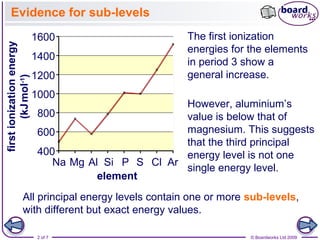
The first ionization
energies for the elements
in period 3 show a
general increase.
All principal energy levels contain one or more sub-levels,
with different but exact energy values.
However, aluminium’s
value is below that of
magnesium. This suggests
that the third principal
energy level is not one
single energy level.
element
firstionizationenergy
(kJmol-1
)
600
800
1000
1200
1400
Na Mg Al P Ar
400
Si S Cl
1600
3 of 7 © Boardworks Ltd 2009
The sub-levels
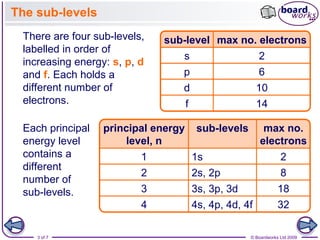
There are four sub-levels,
labelled in order of
increasing energy: s, p, d
and f. Each holds a
different number of
electrons.
max no. electronssub-level
14f
10d
6p
2s
4s, 4p, 4d, 4f
3s, 3p, 3d
2s, 2p
1s
324
183
82
21
sub-levels max no.
electrons
principal energy
level, n
Each principal
energy level
contains a
different
number of
sub-levels.
4 of 7 © Boardworks Ltd 2009
Levels and sub-levels
5 of 7 © Boardworks Ltd 2009
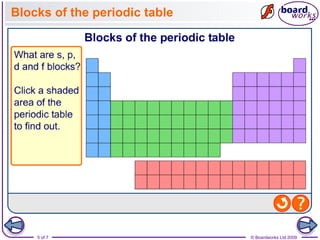
Blocks of the periodic table
6 of 7 © Boardworks Ltd 2009
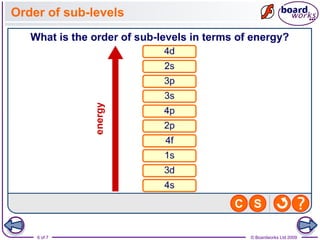
Order of sub-levels
7 of 7 © Boardworks Ltd 2009
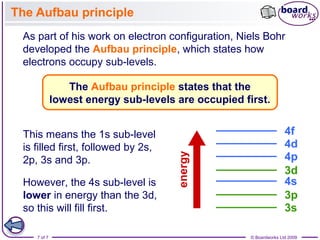
The Aufbau principle
As part of his work on electron configuration, Niels Bohr
developed the Aufbau principle, which states how
electrons occupy sub-levels.
The Aufbau principle states that the
lowest energy sub-levels are occupied first.
This means the 1s sub-level
is filled first, followed by 2s,
2p, 3s and 3p.
However, the 4s sub-level is
lower in energy than the 3d,
so this will fill first.

Electron arrangement part 2 energy sub-levels

  • 1.
    1 of 7© Boardworks Ltd 2009
  • 2.
    2 of 7© Boardworks Ltd 2009 Evidence for sub-levels The first ionization energies for the elements in period 3 show a general increase. All principal energy levels contain one or more sub-levels, with different but exact energy values. However, aluminium’s value is below that of magnesium. This suggests that the third principal energy level is not one single energy level. element firstionizationenergy (kJmol-1 ) 600 800 1000 1200 1400 Na Mg Al P Ar 400 Si S Cl 1600
  • 3.
    3 of 7© Boardworks Ltd 2009 The sub-levels There are four sub-levels, labelled in order of increasing energy: s, p, d and f. Each holds a different number of electrons. max no. electronssub-level 14f 10d 6p 2s 4s, 4p, 4d, 4f 3s, 3p, 3d 2s, 2p 1s 324 183 82 21 sub-levels max no. electrons principal energy level, n Each principal energy level contains a different number of sub-levels.
  • 4.
    4 of 7© Boardworks Ltd 2009 Levels and sub-levels
  • 5.
    5 of 7© Boardworks Ltd 2009 Blocks of the periodic table
  • 6.
    6 of 7© Boardworks Ltd 2009 Order of sub-levels
  • 7.
    7 of 7© Boardworks Ltd 2009 The Aufbau principle As part of his work on electron configuration, Niels Bohr developed the Aufbau principle, which states how electrons occupy sub-levels. The Aufbau principle states that the lowest energy sub-levels are occupied first. This means the 1s sub-level is filled first, followed by 2s, 2p, 3s and 3p. However, the 4s sub-level is lower in energy than the 3d, so this will fill first.

Editor's Notes

  • #3 Boardworks AS Chemistry Electron Arrangement Teacher notes See the ‘ Trends in Group 2 ’ presentation for information about the shielding effect.
  • #4 Boardworks AS Chemistry Electron Arrangement Teacher notes The electron arrangement at levels above n = 4 is: n = 5: sub-levels = 5s, 5p, 5d, 5f n = 6: sub-levels = 6s, 6p, 6d, 6f n = 7: sub-levels = 7s, 7p, 7d, 7f
  • #5 Teacher notes The electron arrangement at levels above n = 4 is: n = 5: sub-levels = 5s, 5p, 5d, 5f n = 6: sub-levels = 6s, 6p, 6d, 6f n = 7: sub-levels = 7s, 7p, 7d, 7f
  • #6 Boardworks AS Chemistry Electron Arrangement
  • #7 Boardworks AS Chemistry Electron Arrangement
  • #8 Teacher notes The word ‘aufbau’ is German for ‘construction’.