Hallmark’s Process
Structure and Its SAP COE
Key Discussion Points for Today’s Webinar
• The “Business” must lead transformation of their process
• Large initiatives can provide foundation for process focus and change management
• Formal process roles need to be right-sized and emphasized
• Process integration failures shine the light on criticality of process
• Sustainment takes constant effort and subordination of silo agendas
• An engaged process leadership team and center of excellence jointly
help to prevent retrenchment to siloed thinking and operation
President & CEO: Don Hall Jr.
NA President: Dave Hall
Founded: 1910 by J.C. Hall
Headquarters: Kansas City
Ownership: Private
Revenues: $3.9 billion in 2013
Employees: 11,300 full-time + 20,500 part-time worldwide
(Hallmark and subsidiaries)
Creative talent: 500+ artists, designers, stylists, writers, editors, web
designers, and photographers
Products: 10,000 new & redesigned cards/yr
Available products: 49,000 at any time
U.S. distribution: 40,000 retail outlets
Gold Crown stores: 2,800
U.S. subsidiaries: 8 related businesses in Hallmark family of companies,
including Crayola LLC
Hallmark facts
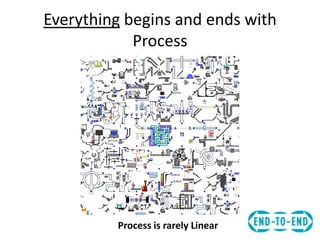
Everything begins and ends with
Process
5Process is rarely Linear
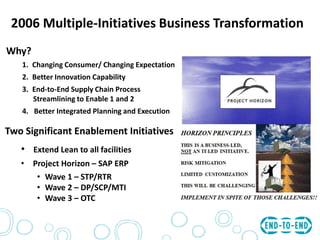
2006 Multiple-Initiatives Business Transformation
Why?
1. Changing Consumer/ Changing Expectation
2. Better Innovation Capability
3. End-to-End Supply Chain Process
Streamlining to Enable 1 and 2
4. Better Integrated Planning and Execution
Two Significant Enablement Initiatives
• Extend Lean to all facilities
• Project Horizon – SAP ERP
• Wave 1 – STP/RTR
• Wave 2 – DP/SCP/MTI
• Wave 3 – OTC
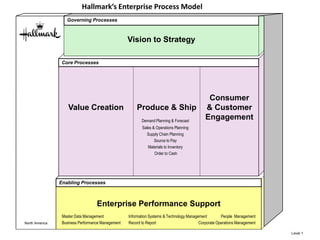
Enterprise Performance Support
Consumer
& Customer
Engagement
Produce & ShipValue Creation
Vision to Strategy
Core Processes
North America
Governing Processes
Enabling Processes
Demand Planning & Forecast
Sales & Operations Planning
Supply Chain Planning
Source to Pay
Materials to Inventory
Order to Cash
Master Data Management
Business Performance Management
People Management
Corporate Operations Management
Information Systems & Technology Management
Record to Report
Level 1
Hallmark’s Enterprise Process Model
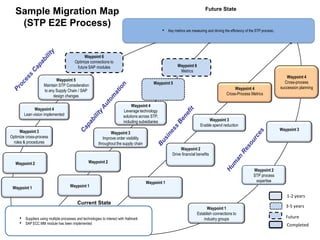
Sample Migration Map
(STP E2E Process)
• Suppliers using multiple processes and technologies to interact with Hallmark
• SAP ECC MM module has been implemented
• Key metrics are measuring and driving the efficiency of the STP process;.
Current State
1-2 years
Completed
Future State
3-5 years
Future
Waypoint 2
Waypoint 3
Improve order visibility
throughout the supply chain
Waypoint 2
Drive financial benefits
Waypoint 4
Cross-Process Metrics
Waypoint 2
STP process
expertise
Waypoint 1
Establish connections to
industry groups
Waypoint 3
Waypoint 4
Cross-process
succession planning
Waypoint 1
Waypoint 3
Optimize cross-process
roles & procedures
Waypoint 4
Lean vision implemented
Waypoint 5
Maintain STP Consideration
to any Supply Chain / SAP
design changes
Waypoint 1
Waypoint 2
Waypoint 4
Leverage technology
solutions across STP,
including subsidiaries
Waypoint 1
Waypoint 3
Enable spend reduction
Waypoint 6
Optimize connections to
future SAP modules Waypoint 6
Metrics
Waypoint 5
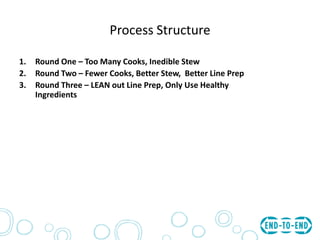
1. Round One – Too Many Cooks, Inedible Stew
2. Round Two – Fewer Cooks, Better Stew, Better Line Prep
3. Round Three – LEAN out Line Prep, Only Use Healthy
Ingredients
Process Structure
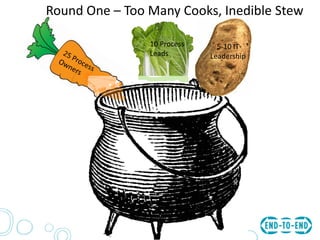
Round One – Too Many Cooks, Inedible Stew
10 Process
Leads
5-10 IT
Leadership
Formal Process Roles
• Process Champion (senior executive level)
• Process Owner (senior manager - business)
• Process Lead (middle-manager business)
• Sub-process Owner (business)
• Portfolio Owner (IT)
• Process Catalysts
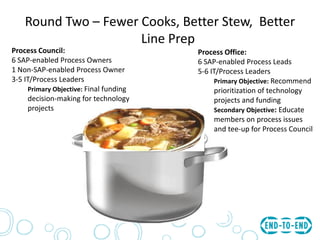
Round Two – Fewer Cooks, Better Stew, Better
Line Prep
Process Council:
6 SAP-enabled Process Owners
1 Non-SAP-enabled Process Owner
3-5 IT/Process Leaders
Primary Objective: Final funding
decision-making for technology
projects
Process Office:
6 SAP-enabled Process Leads
5-6 IT/Process Leaders
Primary Objective: Recommend
prioritization of technology
projects and funding
Secondary Objective: Educate
members on process issues
and tee-up for Process Council
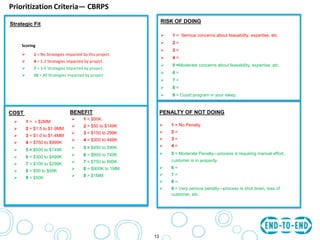
Strategic Fit
Scoring
 1 = No Strategies impacted by this project.
 4 = 1-2 Strategies impacted by project.
 7 = 3-4 Strategies impacted by project.
 10 = All Strategies impacted by project.
COST
 1 = > $2MM
 2 = $1.5 to $1.9MM
 3 = $1.0 to $1.4MM
 4 = $750 to $999K
 5 = $500 to $749K
 6 = $300 to $499K
 7 = $100 to $299K
 8 = $50 to $99K
 9 < $50K
BENEFIT
 1 < $50K.
 2 = $50 to $149K
 3 = $150 to 299K
 4 = $300 to 449K
 5 = $450 to 599K
 6 = $600 to 749K
 7 = $750 to 899K
 8 = $900K to 1MM
 9 > $1MM
13
RISK OF DOING
 1 = Serious concerns about feasability, expertise, etc.
 2 =
 3 =
 4 =
 5 =Moderate concerns about feasability, expertise, etc.
 6 =
 7 =
 8 =
 9 = Could program in your sleep.
PENALTY OF NOT DOING
 1 = No Penalty
 2 =
 3 =
 4 =
 5 = Moderate Penalty—process is requiring manual effort,
customer is in jeopardy.
 6 =
 7 =
 8 =
 9 = Very serious penalty—process is shut down, loss of
customer, etc.
Prioritization Criteria— CBRPS
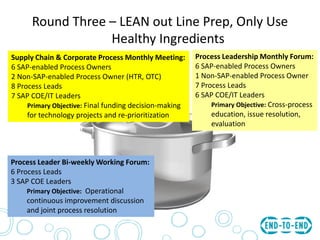
Round Three – LEAN out Line Prep, Only Use
Healthy Ingredients
Supply Chain & Corporate Process Monthly Meeting:
6 SAP-enabled Process Owners
2 Non-SAP-enabled Process Owner (HTR, OTC)
8 Process Leads
7 SAP COE/IT Leaders
Primary Objective: Final funding decision-making
for technology projects and re-prioritization
Process Leadership Monthly Forum:
6 SAP-enabled Process Owners
1 Non-SAP-enabled Process Owner
7 Process Leads
6 SAP COE/IT Leaders
Primary Objective: Cross-process
education, issue resolution,
evaluation
Process Leader Bi-weekly Working Forum:
6 Process Leads
3 SAP COE Leaders
Primary Objective: Operational
continuous improvement discussion
and joint process resolution
SAP Center of Excellence
• Originally proposed as Process Integration Center
• True end-to-end process thinkers and business integrators who possess deep technical/
process knowledge needed now and in the future to work up-down-across processes.
• The charge of this team would be to:
1. Intentionally create opportunities to increase employee efficiency
2. Optimize the “entire” end-to-end process by leveraging SAP knowledge and using Lean tools
3. Ensure guardrails around data, process, and technology standardization are rigorously (and
continuously) applied with “limited to no” customization of software.
4. Simplify, clarify, and execute our integrated business process design
• Only special ingredient or “special sauce” is cross-process problem solving and ideation
• This is the company’s “brain trust” of technical business and process knowledge - most importantly, they
understand how the process is connected and integrated
• Splitting the brain trust back into previous areas is like severing the connection in the human brain; what
keeps these blades sharp is the mutual interaction and learning to understand the entire system
• They are the guardians of the overall design – advocating for simplification and clarification in the design
and resisting creating a patchwork quilt of non-integrated and disparate systems
Frontiers and Challenges
• How to best use the process catalysts, since change management resources are no
longer able to facilitate training for these important process agents
• Keeping the process flame alive, as inexperienced leaders or process advocates move
into or out of SAP-enabled areas
• Creating better rotation opportunities both into and out of the SAP COE
• As the SAP landscape increases past the supply chain area into other functional silos,
how should the COE be maintained so that this unique integrated ideation and cross-
process problem solving does not become just another pool of technology analysts?
• Ensuring linkage of strategic goals to end-to end process continues to be understood
and incorporated in both planning and execution – drivers still the same as during
business transformation efforts
Let the Dialogue Begin!

Hallmark's Process Journey and Center of Excellence for Integration

  • 1.
  • 2.
    Key Discussion Pointsfor Today’s Webinar • The “Business” must lead transformation of their process • Large initiatives can provide foundation for process focus and change management • Formal process roles need to be right-sized and emphasized • Process integration failures shine the light on criticality of process • Sustainment takes constant effort and subordination of silo agendas • An engaged process leadership team and center of excellence jointly help to prevent retrenchment to siloed thinking and operation
  • 3.
    President & CEO:Don Hall Jr. NA President: Dave Hall Founded: 1910 by J.C. Hall Headquarters: Kansas City Ownership: Private Revenues: $3.9 billion in 2013 Employees: 11,300 full-time + 20,500 part-time worldwide (Hallmark and subsidiaries) Creative talent: 500+ artists, designers, stylists, writers, editors, web designers, and photographers Products: 10,000 new & redesigned cards/yr Available products: 49,000 at any time U.S. distribution: 40,000 retail outlets Gold Crown stores: 2,800 U.S. subsidiaries: 8 related businesses in Hallmark family of companies, including Crayola LLC Hallmark facts
  • 5.
    Everything begins andends with Process 5Process is rarely Linear
  • 6.
    2006 Multiple-Initiatives BusinessTransformation Why? 1. Changing Consumer/ Changing Expectation 2. Better Innovation Capability 3. End-to-End Supply Chain Process Streamlining to Enable 1 and 2 4. Better Integrated Planning and Execution Two Significant Enablement Initiatives • Extend Lean to all facilities • Project Horizon – SAP ERP • Wave 1 – STP/RTR • Wave 2 – DP/SCP/MTI • Wave 3 – OTC
  • 7.
    Enterprise Performance Support Consumer &Customer Engagement Produce & ShipValue Creation Vision to Strategy Core Processes North America Governing Processes Enabling Processes Demand Planning & Forecast Sales & Operations Planning Supply Chain Planning Source to Pay Materials to Inventory Order to Cash Master Data Management Business Performance Management People Management Corporate Operations Management Information Systems & Technology Management Record to Report Level 1 Hallmark’s Enterprise Process Model
  • 8.
    Sample Migration Map (STPE2E Process) • Suppliers using multiple processes and technologies to interact with Hallmark • SAP ECC MM module has been implemented • Key metrics are measuring and driving the efficiency of the STP process;. Current State 1-2 years Completed Future State 3-5 years Future Waypoint 2 Waypoint 3 Improve order visibility throughout the supply chain Waypoint 2 Drive financial benefits Waypoint 4 Cross-Process Metrics Waypoint 2 STP process expertise Waypoint 1 Establish connections to industry groups Waypoint 3 Waypoint 4 Cross-process succession planning Waypoint 1 Waypoint 3 Optimize cross-process roles & procedures Waypoint 4 Lean vision implemented Waypoint 5 Maintain STP Consideration to any Supply Chain / SAP design changes Waypoint 1 Waypoint 2 Waypoint 4 Leverage technology solutions across STP, including subsidiaries Waypoint 1 Waypoint 3 Enable spend reduction Waypoint 6 Optimize connections to future SAP modules Waypoint 6 Metrics Waypoint 5
  • 9.
    1. Round One– Too Many Cooks, Inedible Stew 2. Round Two – Fewer Cooks, Better Stew, Better Line Prep 3. Round Three – LEAN out Line Prep, Only Use Healthy Ingredients Process Structure
  • 10.
    Round One –Too Many Cooks, Inedible Stew 10 Process Leads 5-10 IT Leadership
  • 11.
    Formal Process Roles •Process Champion (senior executive level) • Process Owner (senior manager - business) • Process Lead (middle-manager business) • Sub-process Owner (business) • Portfolio Owner (IT) • Process Catalysts
  • 12.
    Round Two –Fewer Cooks, Better Stew, Better Line Prep Process Council: 6 SAP-enabled Process Owners 1 Non-SAP-enabled Process Owner 3-5 IT/Process Leaders Primary Objective: Final funding decision-making for technology projects Process Office: 6 SAP-enabled Process Leads 5-6 IT/Process Leaders Primary Objective: Recommend prioritization of technology projects and funding Secondary Objective: Educate members on process issues and tee-up for Process Council
  • 13.
    Strategic Fit Scoring  1= No Strategies impacted by this project.  4 = 1-2 Strategies impacted by project.  7 = 3-4 Strategies impacted by project.  10 = All Strategies impacted by project. COST  1 = > $2MM  2 = $1.5 to $1.9MM  3 = $1.0 to $1.4MM  4 = $750 to $999K  5 = $500 to $749K  6 = $300 to $499K  7 = $100 to $299K  8 = $50 to $99K  9 < $50K BENEFIT  1 < $50K.  2 = $50 to $149K  3 = $150 to 299K  4 = $300 to 449K  5 = $450 to 599K  6 = $600 to 749K  7 = $750 to 899K  8 = $900K to 1MM  9 > $1MM 13 RISK OF DOING  1 = Serious concerns about feasability, expertise, etc.  2 =  3 =  4 =  5 =Moderate concerns about feasability, expertise, etc.  6 =  7 =  8 =  9 = Could program in your sleep. PENALTY OF NOT DOING  1 = No Penalty  2 =  3 =  4 =  5 = Moderate Penalty—process is requiring manual effort, customer is in jeopardy.  6 =  7 =  8 =  9 = Very serious penalty—process is shut down, loss of customer, etc. Prioritization Criteria— CBRPS
  • 14.
    Round Three –LEAN out Line Prep, Only Use Healthy Ingredients Supply Chain & Corporate Process Monthly Meeting: 6 SAP-enabled Process Owners 2 Non-SAP-enabled Process Owner (HTR, OTC) 8 Process Leads 7 SAP COE/IT Leaders Primary Objective: Final funding decision-making for technology projects and re-prioritization Process Leadership Monthly Forum: 6 SAP-enabled Process Owners 1 Non-SAP-enabled Process Owner 7 Process Leads 6 SAP COE/IT Leaders Primary Objective: Cross-process education, issue resolution, evaluation Process Leader Bi-weekly Working Forum: 6 Process Leads 3 SAP COE Leaders Primary Objective: Operational continuous improvement discussion and joint process resolution
  • 15.
    SAP Center ofExcellence • Originally proposed as Process Integration Center • True end-to-end process thinkers and business integrators who possess deep technical/ process knowledge needed now and in the future to work up-down-across processes. • The charge of this team would be to: 1. Intentionally create opportunities to increase employee efficiency 2. Optimize the “entire” end-to-end process by leveraging SAP knowledge and using Lean tools 3. Ensure guardrails around data, process, and technology standardization are rigorously (and continuously) applied with “limited to no” customization of software. 4. Simplify, clarify, and execute our integrated business process design • Only special ingredient or “special sauce” is cross-process problem solving and ideation • This is the company’s “brain trust” of technical business and process knowledge - most importantly, they understand how the process is connected and integrated • Splitting the brain trust back into previous areas is like severing the connection in the human brain; what keeps these blades sharp is the mutual interaction and learning to understand the entire system • They are the guardians of the overall design – advocating for simplification and clarification in the design and resisting creating a patchwork quilt of non-integrated and disparate systems
  • 16.
    Frontiers and Challenges •How to best use the process catalysts, since change management resources are no longer able to facilitate training for these important process agents • Keeping the process flame alive, as inexperienced leaders or process advocates move into or out of SAP-enabled areas • Creating better rotation opportunities both into and out of the SAP COE • As the SAP landscape increases past the supply chain area into other functional silos, how should the COE be maintained so that this unique integrated ideation and cross- process problem solving does not become just another pool of technology analysts? • Ensuring linkage of strategic goals to end-to end process continues to be understood and incorporated in both planning and execution – drivers still the same as during business transformation efforts
  • 17.