Change Management Skills
Development
Kristian Åsberg
Restricted
RH/2013-05
Presentation
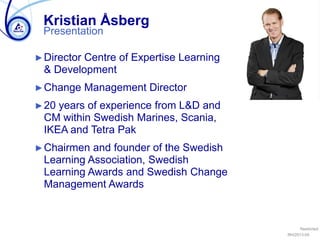
Kristian Åsberg
►Director Centre of Expertise Learning
& Development
►Change Management Director
►20 years of experience from L&D and
CM within Swedish Marines, Scania,
IKEA and Tetra Pak
►Chairmen and founder of the Swedish
Learning Association, Swedish
Learning Awards and Swedish Change
Management Awards
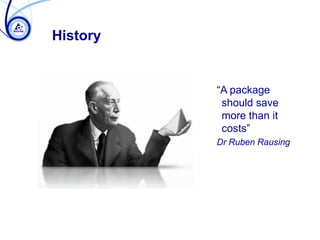
History
“A package
should save
more than it
costs”
Dr Ruben Rausing
Tetra Pak
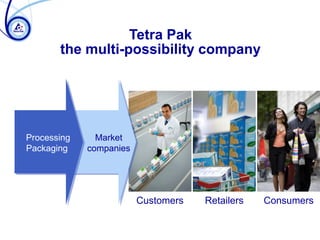
the multi-possibility company
ConsumersRetailersCustomers
Market
companies
Processing
Packaging
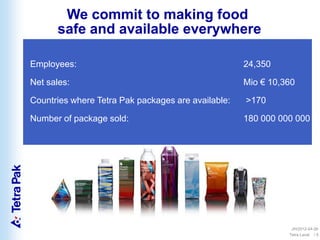
We commit to making food
safe and available everywhere
Employees: 24,350
Net sales: Mio € 10,360
Countries where Tetra Pak packages are available: >170
Number of package sold: 180 000 000 000
JH/2012-04-26
/ 5Tetra Laval
Change Management
Internal
Agenda
►Why Change Management?
►Where are we?
►Roles and competence for Change Management
►Where do we want to go?
Why Change
Management?
Internal
KÅ/2012-02-22
Current situation
► Tetra Pak manages around 1,500 projects a
year – some with a considerable change
management component
► We have not supported change in a
uniformed way
► Change management will be needed for our
capabilities development, competitiveness
and to support 2020 strategy
► There has been an insufficient collaboration
between HR, Communications and Business
Transformation to drive improvements in how
we manage change
► Change Management is key to project
success – research shows that effective and
integrated project, change and financial
management is required for success
Tetra Pak Internal
2009-04-23, KA, AB Tetra Pak
How it looks today
Therefore we need to:
► Be responsive and flexible during times of
change
► Have one common approach and a
supporting organisation
► Execute change faster
► Ensure that the desired changes stick
Business need
The increasing competitiveness and pace of change in
our industry requires us to change and continuously
improve faster and more effectively.
Internal
KÅ/2012-02-22
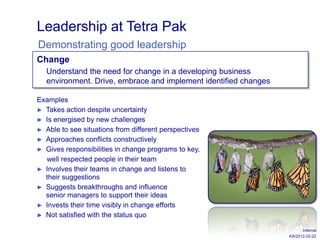
Change
Understand the need for change in a developing business
environment. Drive, embrace and implement identified changes
Examples
► Takes action despite uncertainty
► Is energised by new challenges
► Able to see situations from different perspectives
► Approaches conflicts constructively
► Gives responsibilities in change programs to key,
well respected people in their team
► Involves their teams in change and listens to
their suggestions
► Suggests breakthroughs and influence
senior managers to support their ideas
► Invests their time visibly in change efforts
► Not satisfied with the status quo
Leadership at Tetra Pak
Demonstrating good leadership
Internal
KÅ/2012-02-22
Where are we?
Internal
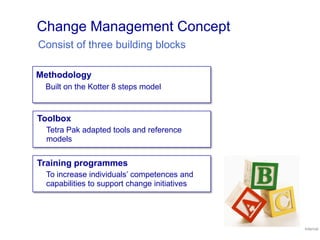
Methodology
Built on the Kotter 8 steps model
Change Management Concept
Consist of three building blocks
Toolbox
Tetra Pak adapted tools and reference
models
Training programmes
To increase individuals’ competences and
capabilities to support change initiatives
Internal
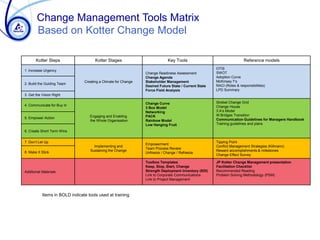
Kotter Steps Kotter Stages Key Tools Reference models
1 .Increase Urgency
Creating a Climate for Change
Change Readiness Assessment
Change Agenda
Stakeholder Management
Desired Future State / Current State
Force Field Analysis
OTIS
SWOT
Adoption Curve
McKinsey 7’s
RACI (Roles & responsibilities)
LPD Summary
2. Build the Guiding Team
3. Get the Vision Right
4. Communicate for Buy In
Engaging and Enabling
the Whole Organisation
Change Curve
3 Box Model
Networking
PACK
Rainbow Model
Low Hanging Fruit
Strebel Change Grid
Change House
3 A’s Model
W Bridges Transition
Communication Guidelines for Managers Handbook
Training guidelines and plans
5. Empower Action
6. Create Short Term Wins
7. Don’t Let Up
Implementing and
Sustaining the Change
Empowerment
Team Process Review
Unfreeze / Change / Refreeze
Tipping Point
Conflict Management Strategies (Killmann)
Reward accomplishments & milestones
Change Effect Survey
8. Make It Stick
Additional Materials
Toolbox Templates
Keep, Stop, Start, Change
Strength Deployment Inventory (SDI)
Link to Corporate Communications
Link to Project Management
JP Kotter Change Management presentation
Facilitation Checklist
Recommended Reading
Problem Solving Methodology (PSM)
Items in BOLD indicate tools used at training
Change Management Tools Matrix
Based on Kotter Change Model
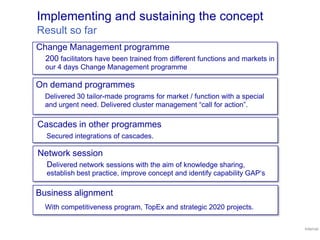
Implementing and sustaining the concept
Result so far
Cascades in other programmes
Secured integrations of cascades.
On demand programmes
Delivered 30 tailor-made programs for market / function with a special
and urgent need. Delivered cluster management “call for action”.
Change Management programme
200 facilitators have been trained from different functions and markets in
our 4 days Change Management programme
Network session
Delivered network sessions with the aim of knowledge sharing,
establish best practice, improve concept and identify capability GAP‘s
Internal
Business alignment
With competitiveness program, TopEx and strategic 2020 projects.
Roles and competence
for Change Management
Internal
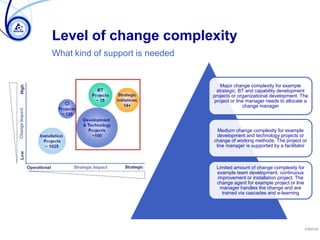
Level of change complexity
Major change complexity for example
strategic, BT and capability development
projects or organizational development. The
project or line manager needs to allocate a
change manager
Medium change complexity for example
development and technology projects or
change of working methods. The project or
line manager is supported by a facilitator
Limited amount of change complexity for
example team development, continuous
improvement or installation project. The
change agent for example project or line
manager handles the change and are
trained via cascades and e-learning
What kind of support is needed
Internal
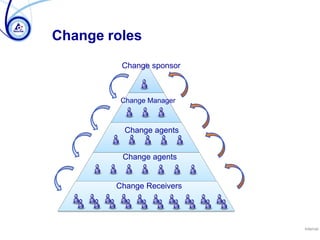
Change roles
Change sponsor
Change Manager
Change agents
Change Receivers
Change agents
Internal
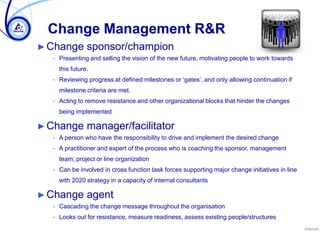
►Change sponsor/champion
− Presenting and selling the vision of the new future, motivating people to work towards
this future.
− Reviewing progress at defined milestones or ‘gates’, and only allowing continuation if
milestone criteria are met.
− Acting to remove resistance and other organizational blocks that hinder the changes
being implemented
►Change manager/facilitator
− A person who have the responsibility to drive and implement the desired change
− A practitioner and expert of the process who is coaching the sponsor, management
team, project or line organization
− Can be involved in cross function task forces supporting major change initiatives in line
with 2020 strategy in a capacity of internal consultants
►Change agent
− Cascading the change message throughout the organisation
− Looks out for resistance, measure readiness, assess existing people/structures
Change Management R&R
Internal
Where do we want to
go?
Internal
Change Management
Highest rate of
project failure,
turnover and
productivity loss
Highest
probability of
success
People-dependent
without any formal
practices or plans
Little or no change management appliedAdhoc or
absentLevel 1
Many different
tactics used
inconsistently
Some elements of change management are
being applied in isolated projects
Isolated
projectsLevel 2
Examples of best
practices evident
Comprehensive approach for managing
change is being applied in multiple projects
Multiple
projectsLevel 3
Selection of
common approach
Organization-wide standards and methods
are broadly deployed for managing and
leading change
Organizational
standardsLevel 4
Continuous
process
improvement in
place
Change management competency is evident
in all levels of the organization and is part of
the organization’s culture and intellectual
property.
Organizational
competencyLevel 5
Highest rate of
project failure,
turnover and
productivity loss
Highest
probability of
success
People-dependent
without any formal
practices or plans
Little or no change management appliedAdhoc or
absentLevel 1
Many different
tactics used
inconsistently
Some elements of change management are
being applied in isolated projects
Isolated
projectsLevel 2
Examples of best
practices evident
Comprehensive approach for managing
change is being applied in multiple projects
Multiple
projectsLevel 3
A common
approach
Organization-wide standards and methods
are broadly deployed for managing and
leading change
Organizational
standardsLevel 4
Continuous
process
improvement in
place
Change management competency is evident
in all levels of the organization and is part of
our organizational culture.
Organizational
competencyLevel 5
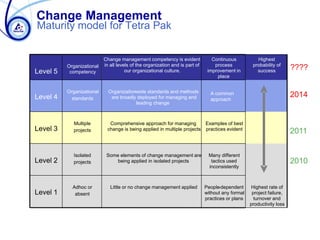
Maturity model for Tetra Pak
2010
2011
2014
????
► The Why!
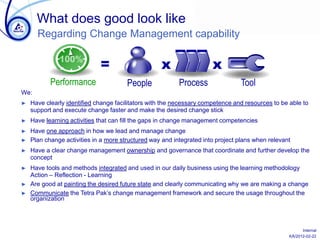
What does good look like
Regarding Change Management capability
We:
► Have clearly identified change facilitators with the necessary competence and resources to be able to
support and execute change faster and make the desired change stick
► Have learning activities that can fill the gaps in change management competencies
► Have one approach in how we lead and manage change
► Plan change activities in a more structured way and integrated into project plans when relevant
► Have a clear change management ownership and governance that coordinate and further develop the
concept
► Have tools and methods integrated and used in our daily business using the learning methodology
Action – Reflection - Learning
► Are good at painting the desired future state and clearly communicating why we are making a change
► Communicate the Tetra Pak’s change management framework and secure the usage throughout the
organization
People Process ToolPerformance
= x x
Internal
KÅ/2012-02-22
► The Why!
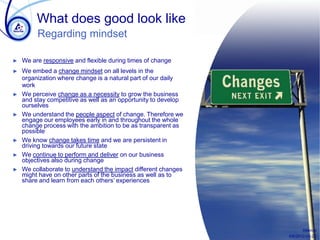
► We are responsive and flexible during times of change
► We embed a change mindset on all levels in the
organization where change is a natural part of our daily
work
► We perceive change as a necessity to grow the business
and stay competitive as well as an opportunity to develop
ourselves
► We understand the people aspect of change. Therefore we
engage our employees early in and throughout the whole
change process with the ambition to be as transparent as
possible
► We know change takes time and we are persistent in
driving towards our future state
► We continue to perform and deliver on our business
objectives also during change
► We collaborate to understand the impact different changes
might have on other parts of the business as well as to
share and learn from each others’ experiences
What does good look like
Regarding mindset
Internal
KÅ/2012-02-22
Restricted
RH/2013-05
Thank You
Processing Faculty

TetraPak Develops Change Management Skills

  • 1.
  • 2.
    Restricted RH/2013-05 Presentation Kristian Åsberg ►Director Centreof Expertise Learning & Development ►Change Management Director ►20 years of experience from L&D and CM within Swedish Marines, Scania, IKEA and Tetra Pak ►Chairmen and founder of the Swedish Learning Association, Swedish Learning Awards and Swedish Change Management Awards
  • 3.
    History “A package should save morethan it costs” Dr Ruben Rausing
  • 4.
    Tetra Pak the multi-possibilitycompany ConsumersRetailersCustomers Market companies Processing Packaging
  • 5.
    We commit tomaking food safe and available everywhere Employees: 24,350 Net sales: Mio € 10,360 Countries where Tetra Pak packages are available: >170 Number of package sold: 180 000 000 000 JH/2012-04-26 / 5Tetra Laval
  • 6.
  • 7.
    Agenda ►Why Change Management? ►Whereare we? ►Roles and competence for Change Management ►Where do we want to go?
  • 8.
  • 9.
    Current situation ► TetraPak manages around 1,500 projects a year – some with a considerable change management component ► We have not supported change in a uniformed way ► Change management will be needed for our capabilities development, competitiveness and to support 2020 strategy ► There has been an insufficient collaboration between HR, Communications and Business Transformation to drive improvements in how we manage change ► Change Management is key to project success – research shows that effective and integrated project, change and financial management is required for success Tetra Pak Internal 2009-04-23, KA, AB Tetra Pak How it looks today
  • 10.
    Therefore we needto: ► Be responsive and flexible during times of change ► Have one common approach and a supporting organisation ► Execute change faster ► Ensure that the desired changes stick Business need The increasing competitiveness and pace of change in our industry requires us to change and continuously improve faster and more effectively. Internal KÅ/2012-02-22
  • 11.
    Change Understand the needfor change in a developing business environment. Drive, embrace and implement identified changes Examples ► Takes action despite uncertainty ► Is energised by new challenges ► Able to see situations from different perspectives ► Approaches conflicts constructively ► Gives responsibilities in change programs to key, well respected people in their team ► Involves their teams in change and listens to their suggestions ► Suggests breakthroughs and influence senior managers to support their ideas ► Invests their time visibly in change efforts ► Not satisfied with the status quo Leadership at Tetra Pak Demonstrating good leadership Internal KÅ/2012-02-22
  • 12.
  • 13.
    Methodology Built on theKotter 8 steps model Change Management Concept Consist of three building blocks Toolbox Tetra Pak adapted tools and reference models Training programmes To increase individuals’ competences and capabilities to support change initiatives Internal
  • 14.
    Kotter Steps KotterStages Key Tools Reference models 1 .Increase Urgency Creating a Climate for Change Change Readiness Assessment Change Agenda Stakeholder Management Desired Future State / Current State Force Field Analysis OTIS SWOT Adoption Curve McKinsey 7’s RACI (Roles & responsibilities) LPD Summary 2. Build the Guiding Team 3. Get the Vision Right 4. Communicate for Buy In Engaging and Enabling the Whole Organisation Change Curve 3 Box Model Networking PACK Rainbow Model Low Hanging Fruit Strebel Change Grid Change House 3 A’s Model W Bridges Transition Communication Guidelines for Managers Handbook Training guidelines and plans 5. Empower Action 6. Create Short Term Wins 7. Don’t Let Up Implementing and Sustaining the Change Empowerment Team Process Review Unfreeze / Change / Refreeze Tipping Point Conflict Management Strategies (Killmann) Reward accomplishments & milestones Change Effect Survey 8. Make It Stick Additional Materials Toolbox Templates Keep, Stop, Start, Change Strength Deployment Inventory (SDI) Link to Corporate Communications Link to Project Management JP Kotter Change Management presentation Facilitation Checklist Recommended Reading Problem Solving Methodology (PSM) Items in BOLD indicate tools used at training Change Management Tools Matrix Based on Kotter Change Model
  • 15.
    Implementing and sustainingthe concept Result so far Cascades in other programmes Secured integrations of cascades. On demand programmes Delivered 30 tailor-made programs for market / function with a special and urgent need. Delivered cluster management “call for action”. Change Management programme 200 facilitators have been trained from different functions and markets in our 4 days Change Management programme Network session Delivered network sessions with the aim of knowledge sharing, establish best practice, improve concept and identify capability GAP‘s Internal Business alignment With competitiveness program, TopEx and strategic 2020 projects.
  • 16.
    Roles and competence forChange Management Internal
  • 17.
    Level of changecomplexity Major change complexity for example strategic, BT and capability development projects or organizational development. The project or line manager needs to allocate a change manager Medium change complexity for example development and technology projects or change of working methods. The project or line manager is supported by a facilitator Limited amount of change complexity for example team development, continuous improvement or installation project. The change agent for example project or line manager handles the change and are trained via cascades and e-learning What kind of support is needed Internal
  • 18.
    Change roles Change sponsor ChangeManager Change agents Change Receivers Change agents Internal
  • 19.
    ►Change sponsor/champion − Presentingand selling the vision of the new future, motivating people to work towards this future. − Reviewing progress at defined milestones or ‘gates’, and only allowing continuation if milestone criteria are met. − Acting to remove resistance and other organizational blocks that hinder the changes being implemented ►Change manager/facilitator − A person who have the responsibility to drive and implement the desired change − A practitioner and expert of the process who is coaching the sponsor, management team, project or line organization − Can be involved in cross function task forces supporting major change initiatives in line with 2020 strategy in a capacity of internal consultants ►Change agent − Cascading the change message throughout the organisation − Looks out for resistance, measure readiness, assess existing people/structures Change Management R&R Internal
  • 20.
    Where do wewant to go? Internal
  • 21.
    Change Management Highest rateof project failure, turnover and productivity loss Highest probability of success People-dependent without any formal practices or plans Little or no change management appliedAdhoc or absentLevel 1 Many different tactics used inconsistently Some elements of change management are being applied in isolated projects Isolated projectsLevel 2 Examples of best practices evident Comprehensive approach for managing change is being applied in multiple projects Multiple projectsLevel 3 Selection of common approach Organization-wide standards and methods are broadly deployed for managing and leading change Organizational standardsLevel 4 Continuous process improvement in place Change management competency is evident in all levels of the organization and is part of the organization’s culture and intellectual property. Organizational competencyLevel 5 Highest rate of project failure, turnover and productivity loss Highest probability of success People-dependent without any formal practices or plans Little or no change management appliedAdhoc or absentLevel 1 Many different tactics used inconsistently Some elements of change management are being applied in isolated projects Isolated projectsLevel 2 Examples of best practices evident Comprehensive approach for managing change is being applied in multiple projects Multiple projectsLevel 3 A common approach Organization-wide standards and methods are broadly deployed for managing and leading change Organizational standardsLevel 4 Continuous process improvement in place Change management competency is evident in all levels of the organization and is part of our organizational culture. Organizational competencyLevel 5 Maturity model for Tetra Pak 2010 2011 2014 ????
  • 22.
    ► The Why! Whatdoes good look like Regarding Change Management capability We: ► Have clearly identified change facilitators with the necessary competence and resources to be able to support and execute change faster and make the desired change stick ► Have learning activities that can fill the gaps in change management competencies ► Have one approach in how we lead and manage change ► Plan change activities in a more structured way and integrated into project plans when relevant ► Have a clear change management ownership and governance that coordinate and further develop the concept ► Have tools and methods integrated and used in our daily business using the learning methodology Action – Reflection - Learning ► Are good at painting the desired future state and clearly communicating why we are making a change ► Communicate the Tetra Pak’s change management framework and secure the usage throughout the organization People Process ToolPerformance = x x Internal KÅ/2012-02-22
  • 23.
    ► The Why! ►We are responsive and flexible during times of change ► We embed a change mindset on all levels in the organization where change is a natural part of our daily work ► We perceive change as a necessity to grow the business and stay competitive as well as an opportunity to develop ourselves ► We understand the people aspect of change. Therefore we engage our employees early in and throughout the whole change process with the ambition to be as transparent as possible ► We know change takes time and we are persistent in driving towards our future state ► We continue to perform and deliver on our business objectives also during change ► We collaborate to understand the impact different changes might have on other parts of the business as well as to share and learn from each others’ experiences What does good look like Regarding mindset Internal KÅ/2012-02-22
  • 24.