Presenter – Patrick Acheampong
                September 2011
   What do you mean by global?
   Start with the Why
   Key factors to consider (location, people,
    culture, processes, technology)
   Change management strategies
   Managing your global centre
   Measuring and sustaining success
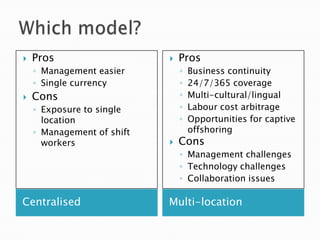
   Pros                       Pros
    ◦ Management easier         ◦   Business continuity
    ◦ Single currency           ◦   24/7/365 coverage
   Cons                        ◦   Multi-cultural/lingual
    ◦ Exposure to single        ◦   Labour cost arbitrage
      location                  ◦   Opportunities for captive
    ◦ Management of shift           offshoring
      workers                  Cons
                                ◦ Management challenges
                                ◦ Technology challenges
                                ◦ Collaboration issues

Centralised                 Multi-location
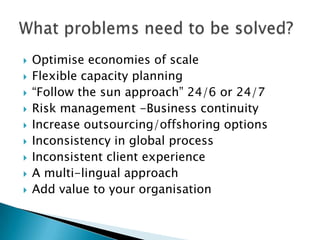
   Optimise economies of scale
   Flexible capacity planning
   ―Follow the sun approach‖ 24/6 or 24/7
   Risk management -Business continuity
   Increase outsourcing/offshoring options
   Inconsistency in global process
   Inconsistent client experience
   A multi-lingual approach
   Add value to your organisation
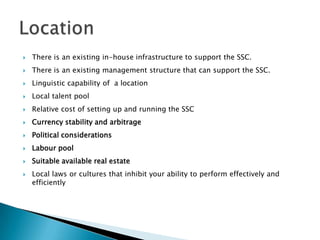
   There is an existing in-house infrastructure to support the SSC.
   There is an existing management structure that can support the SSC.
   Linguistic capability of a location
   Local talent pool
   Relative cost of setting up and running the SSC
   Currency stability and arbitrage
   Political considerations
   Labour pool
   Suitable available real estate
   Local laws or cultures that inhibit your ability to perform effectively and
    efficiently
   If you begin with ―who‖ rather than ―what‖, you can more easily adapt to a changing world.
   If you have the right people onboard, the problem of how to motivate and manage people largely
    goes away.
   If you have the wrong people, it doesn‘t matter whether you discover the right direction; you still
    won‘t have a great shared services organisation.
   Specific knowledge and skills are teachable traits. Traits such as character, work ethic, basic
    intelligence, dedication to fulfilling commitments, and values are more ingrained.
   When you know you need to make a people change, actThe only way to deliver to the people who
    are achieving is to not burden them with the people who are not achieving.
   When in doubt, don‘t hire. Keep looking. Avoid hiring selfish, negative, or egotistical people –
    don‘t make exceptions to this.
   The right people want to be part of a winning team and contribute to producing visible tangible
    results. When the right people see a simple plan with a compelling vision, they are more likely to
    say ―count me in.
   Hire bi-lingual staff where appropriate
   Put your best people on the biggest opportunities, not the biggest problems


                                Hire for will, not for skill
   If you have the right people on the bus, they will do everything within their
    power to help the SSC succeed, not because of what they will get for it, but
    because they cannot imagine settling for anything less.

   The right people will do the right things and deliver the best results they‘re
    capable of, regardless of the incentive system.

   Compensation and incentives are important. The purpose of a
    compensation system should not be to get the right behaviours from the
    wrong people, but to get the right people on the bus in the first place, and
    to keep them there.

   Hire people who believe who believe in what you‘re doing, not people who
    just want to work for the money.


              It’s Who You Pay, Not How You Pay Them
   Working in a global HR SCC requires a different skill set and mind
    set
   Top SSC‘s provide 40 hours per year training on average
   Invest in cross cultural training
   Customer service
   Project management
   Technology skills
   Remote working and networking
   Language skills
   Lean process methodology


What's worse than training staff and them leaving? Not training
people and them staying

                                                                         11
   Create a culture of achievement and continuous
    improvement
   Instill a passion for metrics
   Cross cultural sensitivities
   Create a global identity and set of values
   Cultural exchange visits


           Culture eats strategy for breakfast
   Be
    ◦ Agile
    ◦ Scalable
    ◦ Sustainable
   Do
    ◦ Create efficiencies
    ◦ Create value
   Have
    ◦ KPI‘s
    ◦ SLA‘s
    ◦ No geographical regulatory restrictions
   Outsourcing will become a functional necessity.
As service providers mature, outsourcing entire business
processes will become commonplace.
Based on the economic theory of comparative advantage, a
specialist (an outsourcing provider) that provides a service to many
has a far lower cost than an internal function that provides a service
to a few. The end result is an economic advantage for both.
Progressive shared services organizations will integrate business
process outsourcing—both full service and discrete— into their
business strategies
A multi-location global SSC provides for closer vendor
management of a low cost outsourcer
   Use technology to underpin well designed processes, not replicate badly
    designed ones – Avoid automating failure!
   Clean the data and keep it clean through auditing. It makes for more robust
    workflow, reporting/business intelligence and self service.
   Don‘t try to make ERP do much more than they were designed to do. Simple
    in-house applications can be cheaper and more effective, especially at
    upgrade time.
   A modular rather than big bang implementation approach means a quicker
    ‗time to market‘.
   Web apps facilitate remote working.
   Leverage existing technology to keep costs down.
   Access to technology for your client base.
   Build internally, or buy externally?
   Shun technology fads AND pioneer the application of technology
   Technology should be subservient to the needs of your SSC operation, not
    the other way round
   Automating routine processes reduces the need for manual intervention,
    errors, labour costs.
   Provide a platform for growth without necessarily increasing cost. Cost per
    transaction should reduce as volumes increase.
   Improved auditability and compliance with regulators.
   Manage risk through tighter control. Well-designed and automated
    processes provide a perfect platform for implementing appropriate controls.
   Consistency of process leads to greater data integrity.
   Lower training costs (eventually)
   Disaster recovery resilience
   Ease of use for clients. Fewer queries for the SSC
   Effective and efficient transaction measurement – ―what gets measured gets
    managed‖
   The right technologies accelerate momentum towards your goals
   Payroll
    ◦   Online payslips
   Recruitment
    ◦   Psychometric testing
    ◦   Screening
    ◦   Job applications
   Self Service – Manager and Employee
    ◦   Updating personal data
    ◦   Managing employees data
    ◦   Viewing performance reviews
    ◦   Kiosks
   Business Intelligence/Reporting
    ◦   Dashboards
    ◦   Metrics
    ◦   KPI and SLA tracking
   Document Management
    ◦   Increased staff productivity due to a reduction in time spent looking for documents as well as recreating, filing, copying
        and scanning documents.
    ◦   A reduction in the cost of storing paper documents
    ◦   Better control of the security, monitoring and flow of information
   ERM/CRM
    ◦   Web portal - More effective management of client issues
    ◦   Knowledge Base
    ◦   Call centre/service desk
    ◦   Consistent answers- Less shopping for answers
   Collaboration tools – email is not your best collaboration tool!
   Project Management
   BPM/Workflow
   Utilise a structured change management approach from the initiation of the
    project
   Have dedicated resources on the project, not part time
   Create a shared vision at the beginning of the project, it is important to
    define common needs and drivers for transitioning from a local to a global
    shared services and how these are linked to the overall organisational
    vision.
   Show the destination of the change journey and the benefits
   Active and visible participation by senior leaders in all geographies
   Advocacy by management levels including middle managers and front-line
    supervisors
   Communications that describe the need for change, the impact on
    employees and the benefits to the employee (answering WIIFM)
   Do your homework to avoid ―yeah but we‘re different syndrome‖. Learn
    various cultural cues and work styles
   Generate some quick wins
   Regular surveys
   Create a forum for regular SSC performance reviews with customers.
   Create a forum for regular SSC performance reviews with the SSC staff.
   The use of KPI‘s and SLA‘s to monitor SSC performance.
    ◦ An SLA for each process and task within the SSC.
    ◦ Specific measurable targets.
    ◦ Tools to allow reporting on SLA‘s.
    ◦ Review the SLA‘s on a regular basis to ensure they are still relevant.
   Comp and non-comp incentives to address staff morale and retention issues
   Regular, structured staff training. Primarily in the areas of:
    ◦ Process re-engineering
    ◦ Technology
    ◦ Customer service


―If your company isn‘t going through so much change you can‘t
stand it, it won‘t even be around in 5 years‖ – Connie Podesta
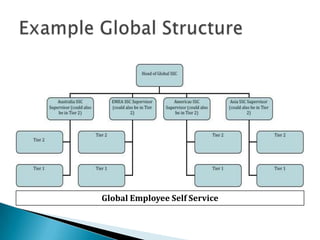
Global Employee Self Service
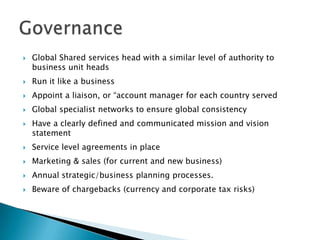
   Global Shared services head with a similar level of authority to
    business unit heads
   Run it like a business
   Appoint a liaison, or ―account manager for each country served
   Global specialist networks to ensure global consistency
   Have a clearly defined and communicated mission and vision
    statement
   Service level agreements in place
   Marketing & sales (for current and new business)
   Annual strategic/business planning processes.
   Beware of chargebacks (currency and corporate tax risks)
   Continuous improvement program
   Form quality improvement teams
   Robust Business Continuity Plan
   Adequate risk profile monitoring
Celebrate Success!!!!
   What do you mean by global?
   Start with the Why
   Key factors to consider (location, people,
    culture, processes, technology)
   Change management strategies
   Managing your global centre
   Measuring and sustaining success
Globalising HR shared Services

Globalising HR shared Services

  • 1.
    Presenter – PatrickAcheampong September 2011
  • 2.
    What do you mean by global?  Start with the Why  Key factors to consider (location, people, culture, processes, technology)  Change management strategies  Managing your global centre  Measuring and sustaining success
  • 4.
    Pros  Pros ◦ Management easier ◦ Business continuity ◦ Single currency ◦ 24/7/365 coverage  Cons ◦ Multi-cultural/lingual ◦ Exposure to single ◦ Labour cost arbitrage location ◦ Opportunities for captive ◦ Management of shift offshoring workers  Cons ◦ Management challenges ◦ Technology challenges ◦ Collaboration issues Centralised Multi-location
  • 6.
    Optimise economies of scale  Flexible capacity planning  ―Follow the sun approach‖ 24/6 or 24/7  Risk management -Business continuity  Increase outsourcing/offshoring options  Inconsistency in global process  Inconsistent client experience  A multi-lingual approach  Add value to your organisation
  • 8.
    There is an existing in-house infrastructure to support the SSC.  There is an existing management structure that can support the SSC.  Linguistic capability of a location  Local talent pool  Relative cost of setting up and running the SSC  Currency stability and arbitrage  Political considerations  Labour pool  Suitable available real estate  Local laws or cultures that inhibit your ability to perform effectively and efficiently
  • 9.
    If you begin with ―who‖ rather than ―what‖, you can more easily adapt to a changing world.  If you have the right people onboard, the problem of how to motivate and manage people largely goes away.  If you have the wrong people, it doesn‘t matter whether you discover the right direction; you still won‘t have a great shared services organisation.  Specific knowledge and skills are teachable traits. Traits such as character, work ethic, basic intelligence, dedication to fulfilling commitments, and values are more ingrained.  When you know you need to make a people change, actThe only way to deliver to the people who are achieving is to not burden them with the people who are not achieving.  When in doubt, don‘t hire. Keep looking. Avoid hiring selfish, negative, or egotistical people – don‘t make exceptions to this.  The right people want to be part of a winning team and contribute to producing visible tangible results. When the right people see a simple plan with a compelling vision, they are more likely to say ―count me in.  Hire bi-lingual staff where appropriate  Put your best people on the biggest opportunities, not the biggest problems Hire for will, not for skill
  • 10.
    If you have the right people on the bus, they will do everything within their power to help the SSC succeed, not because of what they will get for it, but because they cannot imagine settling for anything less.  The right people will do the right things and deliver the best results they‘re capable of, regardless of the incentive system.  Compensation and incentives are important. The purpose of a compensation system should not be to get the right behaviours from the wrong people, but to get the right people on the bus in the first place, and to keep them there.  Hire people who believe who believe in what you‘re doing, not people who just want to work for the money. It’s Who You Pay, Not How You Pay Them
  • 11.
    Working in a global HR SCC requires a different skill set and mind set  Top SSC‘s provide 40 hours per year training on average  Invest in cross cultural training  Customer service  Project management  Technology skills  Remote working and networking  Language skills  Lean process methodology What's worse than training staff and them leaving? Not training people and them staying 11
  • 12.
    Create a culture of achievement and continuous improvement  Instill a passion for metrics  Cross cultural sensitivities  Create a global identity and set of values  Cultural exchange visits Culture eats strategy for breakfast
  • 14.
    Be ◦ Agile ◦ Scalable ◦ Sustainable  Do ◦ Create efficiencies ◦ Create value  Have ◦ KPI‘s ◦ SLA‘s ◦ No geographical regulatory restrictions
  • 15.
    Outsourcing will become a functional necessity. As service providers mature, outsourcing entire business processes will become commonplace. Based on the economic theory of comparative advantage, a specialist (an outsourcing provider) that provides a service to many has a far lower cost than an internal function that provides a service to a few. The end result is an economic advantage for both. Progressive shared services organizations will integrate business process outsourcing—both full service and discrete— into their business strategies A multi-location global SSC provides for closer vendor management of a low cost outsourcer
  • 16.
    Use technology to underpin well designed processes, not replicate badly designed ones – Avoid automating failure!  Clean the data and keep it clean through auditing. It makes for more robust workflow, reporting/business intelligence and self service.  Don‘t try to make ERP do much more than they were designed to do. Simple in-house applications can be cheaper and more effective, especially at upgrade time.  A modular rather than big bang implementation approach means a quicker ‗time to market‘.  Web apps facilitate remote working.  Leverage existing technology to keep costs down.  Access to technology for your client base.  Build internally, or buy externally?  Shun technology fads AND pioneer the application of technology  Technology should be subservient to the needs of your SSC operation, not the other way round
  • 17.
    Automating routine processes reduces the need for manual intervention, errors, labour costs.  Provide a platform for growth without necessarily increasing cost. Cost per transaction should reduce as volumes increase.  Improved auditability and compliance with regulators.  Manage risk through tighter control. Well-designed and automated processes provide a perfect platform for implementing appropriate controls.  Consistency of process leads to greater data integrity.  Lower training costs (eventually)  Disaster recovery resilience  Ease of use for clients. Fewer queries for the SSC  Effective and efficient transaction measurement – ―what gets measured gets managed‖  The right technologies accelerate momentum towards your goals
  • 18.
    Payroll ◦ Online payslips  Recruitment ◦ Psychometric testing ◦ Screening ◦ Job applications  Self Service – Manager and Employee ◦ Updating personal data ◦ Managing employees data ◦ Viewing performance reviews ◦ Kiosks  Business Intelligence/Reporting ◦ Dashboards ◦ Metrics ◦ KPI and SLA tracking  Document Management ◦ Increased staff productivity due to a reduction in time spent looking for documents as well as recreating, filing, copying and scanning documents. ◦ A reduction in the cost of storing paper documents ◦ Better control of the security, monitoring and flow of information  ERM/CRM ◦ Web portal - More effective management of client issues ◦ Knowledge Base ◦ Call centre/service desk ◦ Consistent answers- Less shopping for answers  Collaboration tools – email is not your best collaboration tool!  Project Management  BPM/Workflow
  • 20.
    Utilise a structured change management approach from the initiation of the project  Have dedicated resources on the project, not part time  Create a shared vision at the beginning of the project, it is important to define common needs and drivers for transitioning from a local to a global shared services and how these are linked to the overall organisational vision.  Show the destination of the change journey and the benefits  Active and visible participation by senior leaders in all geographies  Advocacy by management levels including middle managers and front-line supervisors  Communications that describe the need for change, the impact on employees and the benefits to the employee (answering WIIFM)  Do your homework to avoid ―yeah but we‘re different syndrome‖. Learn various cultural cues and work styles  Generate some quick wins
  • 21.
    Regular surveys  Create a forum for regular SSC performance reviews with customers.  Create a forum for regular SSC performance reviews with the SSC staff.  The use of KPI‘s and SLA‘s to monitor SSC performance. ◦ An SLA for each process and task within the SSC. ◦ Specific measurable targets. ◦ Tools to allow reporting on SLA‘s. ◦ Review the SLA‘s on a regular basis to ensure they are still relevant.  Comp and non-comp incentives to address staff morale and retention issues  Regular, structured staff training. Primarily in the areas of: ◦ Process re-engineering ◦ Technology ◦ Customer service ―If your company isn‘t going through so much change you can‘t stand it, it won‘t even be around in 5 years‖ – Connie Podesta
  • 23.
  • 24.
    Global Shared services head with a similar level of authority to business unit heads  Run it like a business  Appoint a liaison, or ―account manager for each country served  Global specialist networks to ensure global consistency  Have a clearly defined and communicated mission and vision statement  Service level agreements in place  Marketing & sales (for current and new business)  Annual strategic/business planning processes.  Beware of chargebacks (currency and corporate tax risks)
  • 27.
    Continuous improvement program  Form quality improvement teams  Robust Business Continuity Plan  Adequate risk profile monitoring
  • 28.
  • 29.
    What do you mean by global?  Start with the Why  Key factors to consider (location, people, culture, processes, technology)  Change management strategies  Managing your global centre  Measuring and sustaining success

Editor's Notes

  • #20 Getting to why is the most critical part of the globalising question. If you can’t effectively answer this question, then you shouldn’t start globalising your shared services centre. Every activity should begin with a vision, purpose, goals and objectives. These dreams are not likely to be realise without an effective strategy