©2014 FCB Partners. All rights reserved.
Brad Power and Steve Stanton
Webinar: March 25, 2014
CoExistence: Today’s Performance Engine AND
Tomorrow’s Innovation Energy
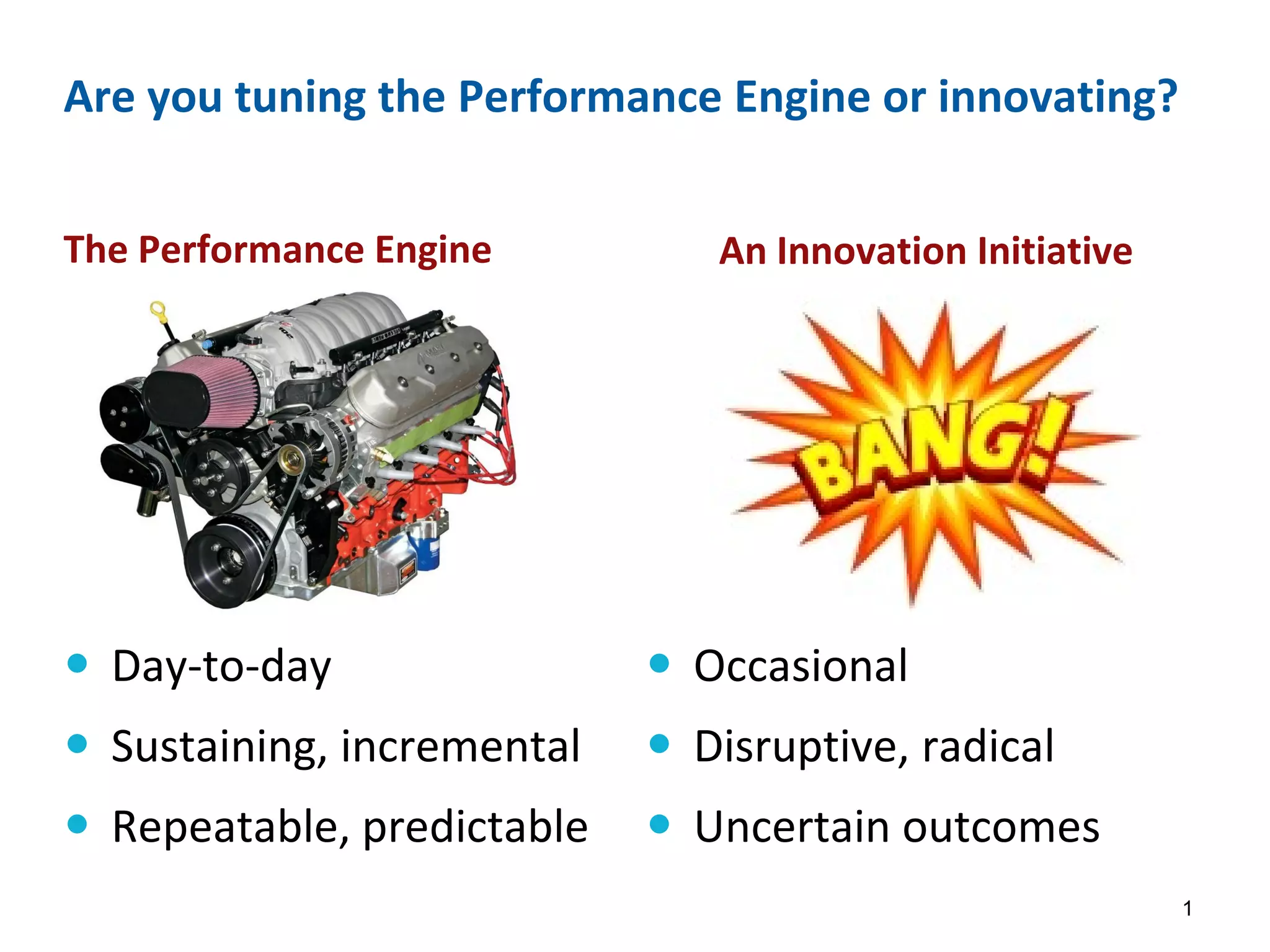
Are you tuning the Performance Engine or innovating?
The Performance Engine An Innovation Initiative
 Day-to-day
 Sustaining, incremental
 Repeatable, predictable
 Occasional
 Disruptive, radical
 Uncertain outcomes
1
Can you create an organization that embraces
continuous innovation? Why now?
Drivers
 Social, mobile, “Big Data”, cloud,
sensors, cameras
 Software is eating the world
Threats
 Shorter produce lifecycles
Opportunities: Role Models
 High tech disruptor: Google
 Retail and high tech disruptor:
Amazon
 Product disruptor: 3M
2
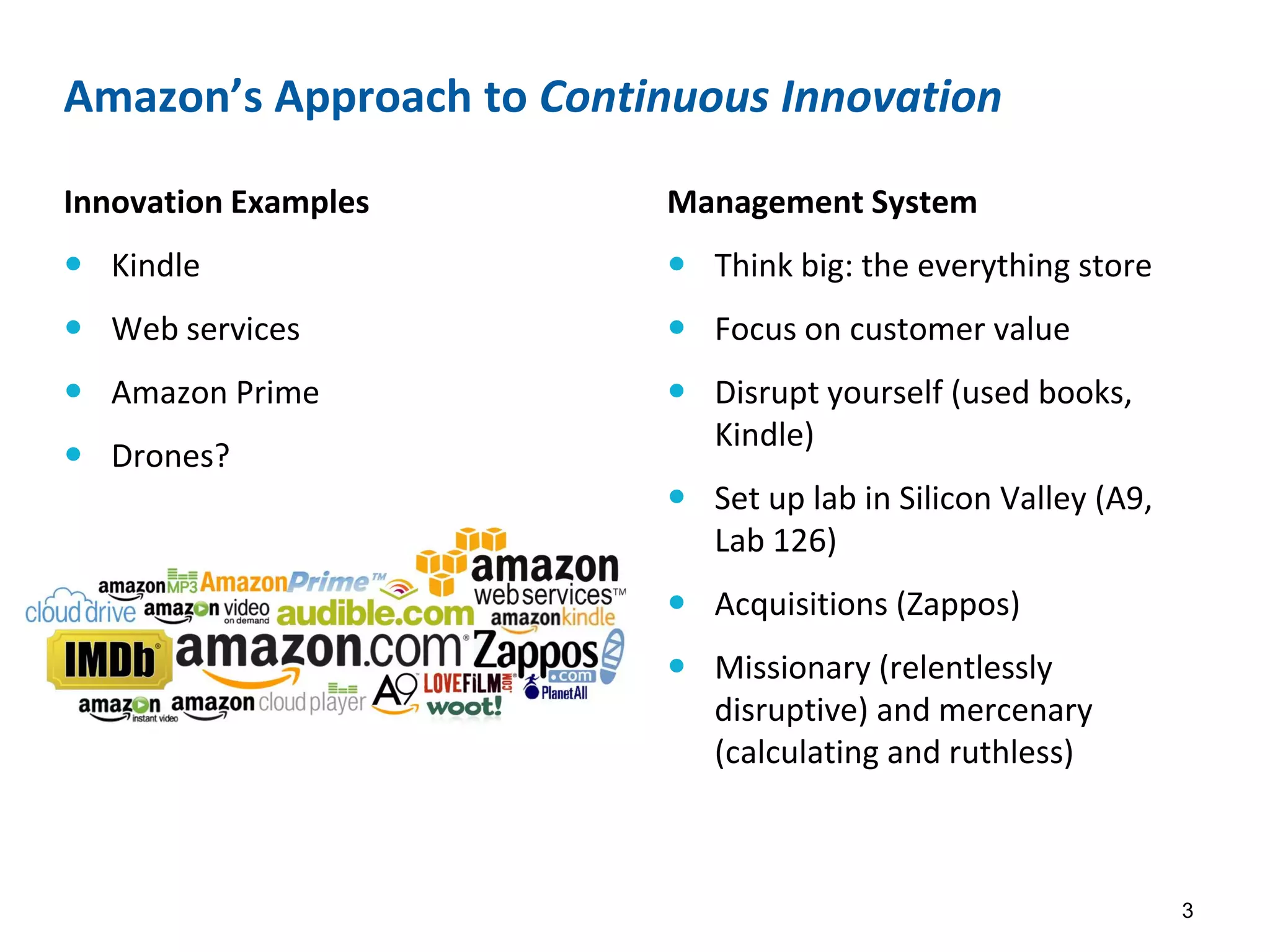
Amazon’s Approach to Continuous Innovation
Innovation Examples
 Kindle
 Web services
 Amazon Prime
 Drones?
Management System
 Think big: the everything store
 Focus on customer value
 Disrupt yourself (used books,
Kindle)
 Set up lab in Silicon Valley (A9,
Lab 126)
 Acquisitions (Zappos)
 Missionary (relentlessly
disruptive) and mercenary
(calculating and ruthless)
3
Google’s Approach to Continuous Innovation
Innovation Examples
 Driverless car, maps
 YouTube
 Google Glass
 Google Fiber, Project Loon
 Google Goggles
Management System
 Google[x] (moonshots)
 Acquisitions (Makani)
 20% time
 Quick demos
 Run lots of experiments and let the
market decide
 Fail fast and learn, scale up quickly
if it shows promise
 Culture of openness, analytical
rigor, and respect for workers
4
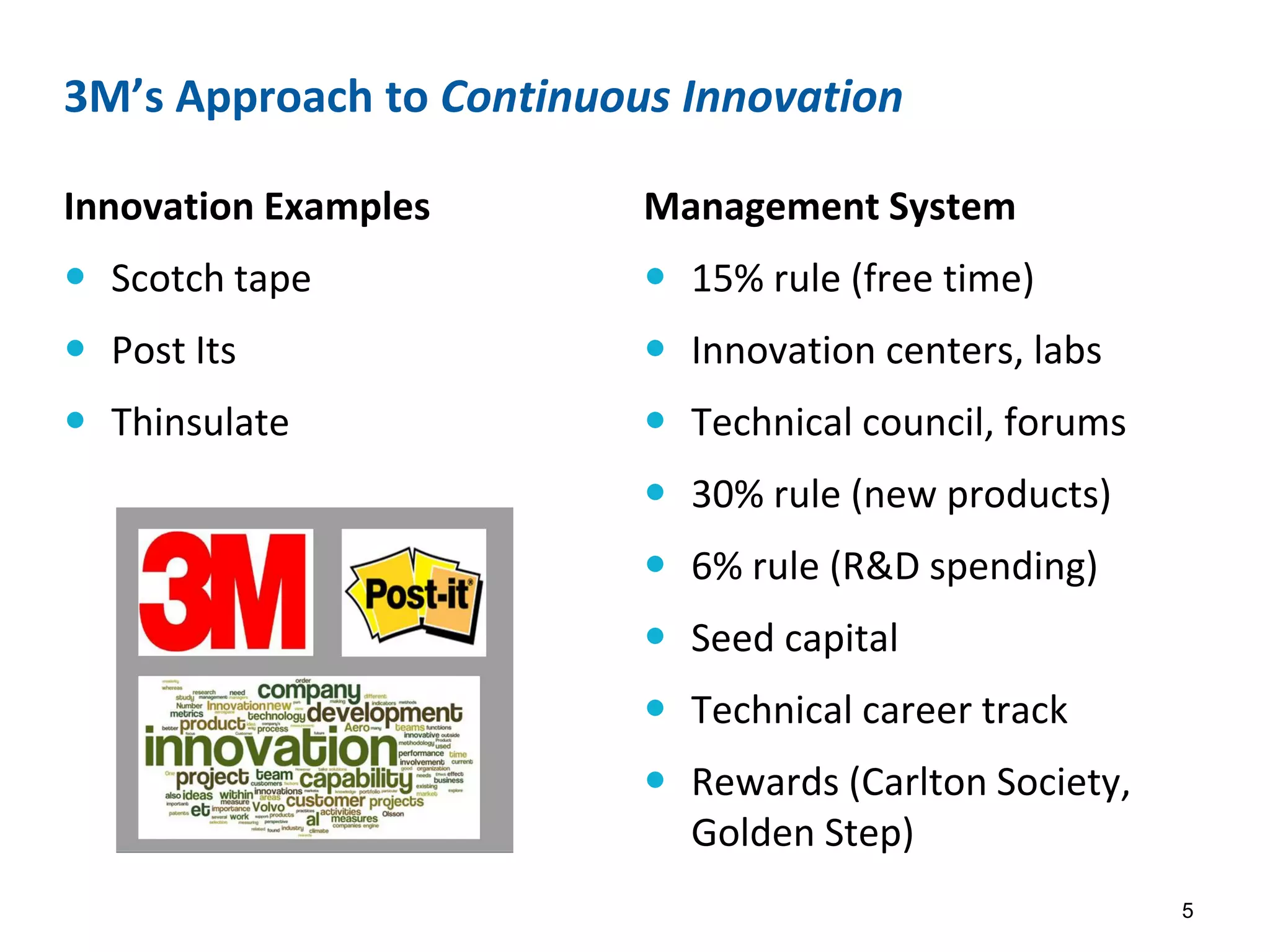
3M’s Approach to Continuous Innovation
Innovation Examples
 Scotch tape
 Post Its
 Thinsulate
Management System
 15% rule (free time)
 Innovation centers, labs
 Technical council, forums
 30% rule (new products)
 6% rule (R&D spending)
 Seed capital
 Technical career track
 Rewards (Carlton Society,
Golden Step)
5
6©2014 FCB Partners. All rights reserved.
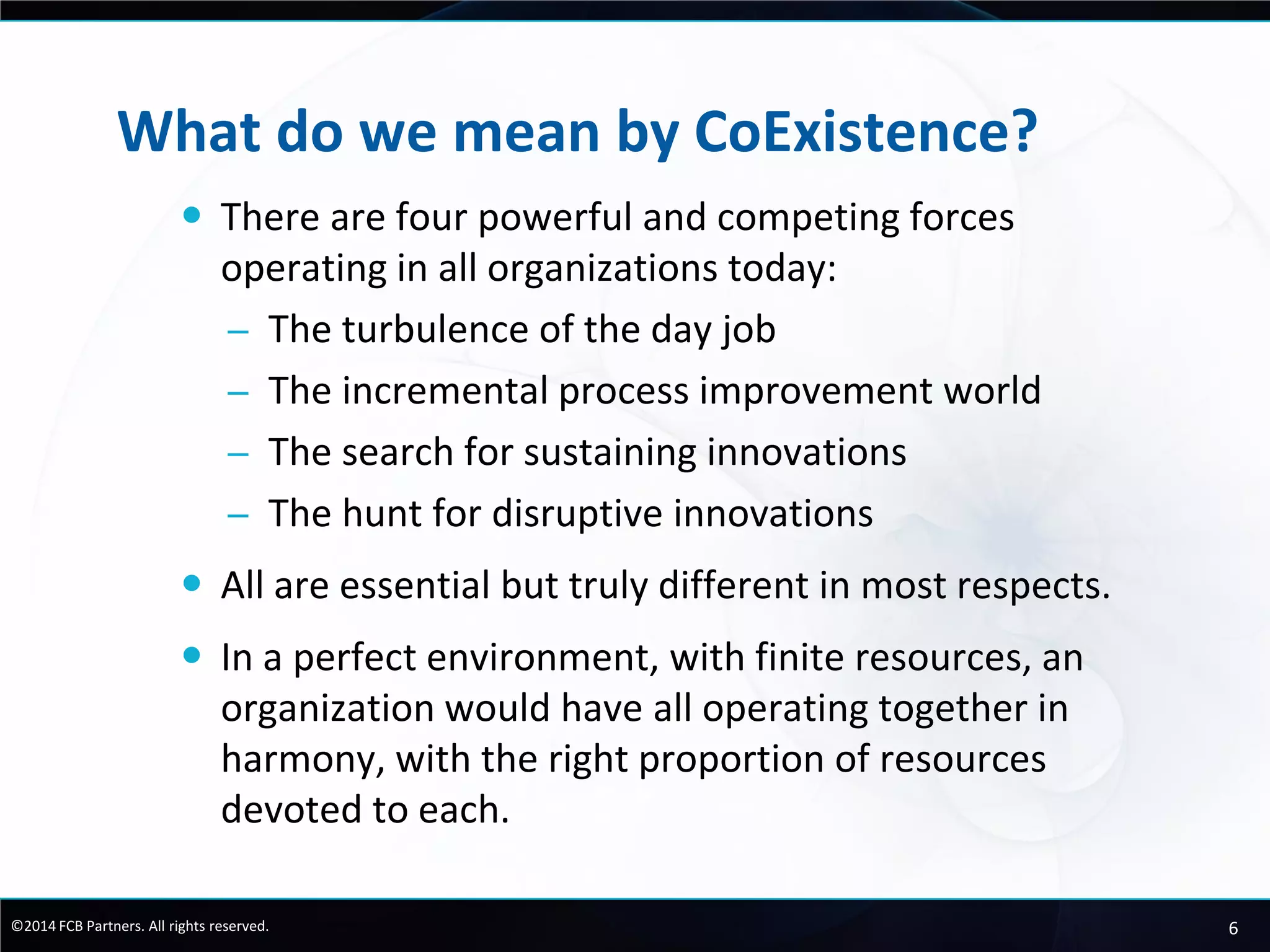
What do we mean by CoExistence?
 There are four powerful and competing forces
operating in all organizations today:
– The turbulence of the day job
– The incremental process improvement world
– The search for sustaining innovations
– The hunt for disruptive innovations
 All are essential but truly different in most respects.
 In a perfect environment, with finite resources, an
organization would have all operating together in
harmony, with the right proportion of resources
devoted to each.
7©2014 FCB Partners. All rights reserved.
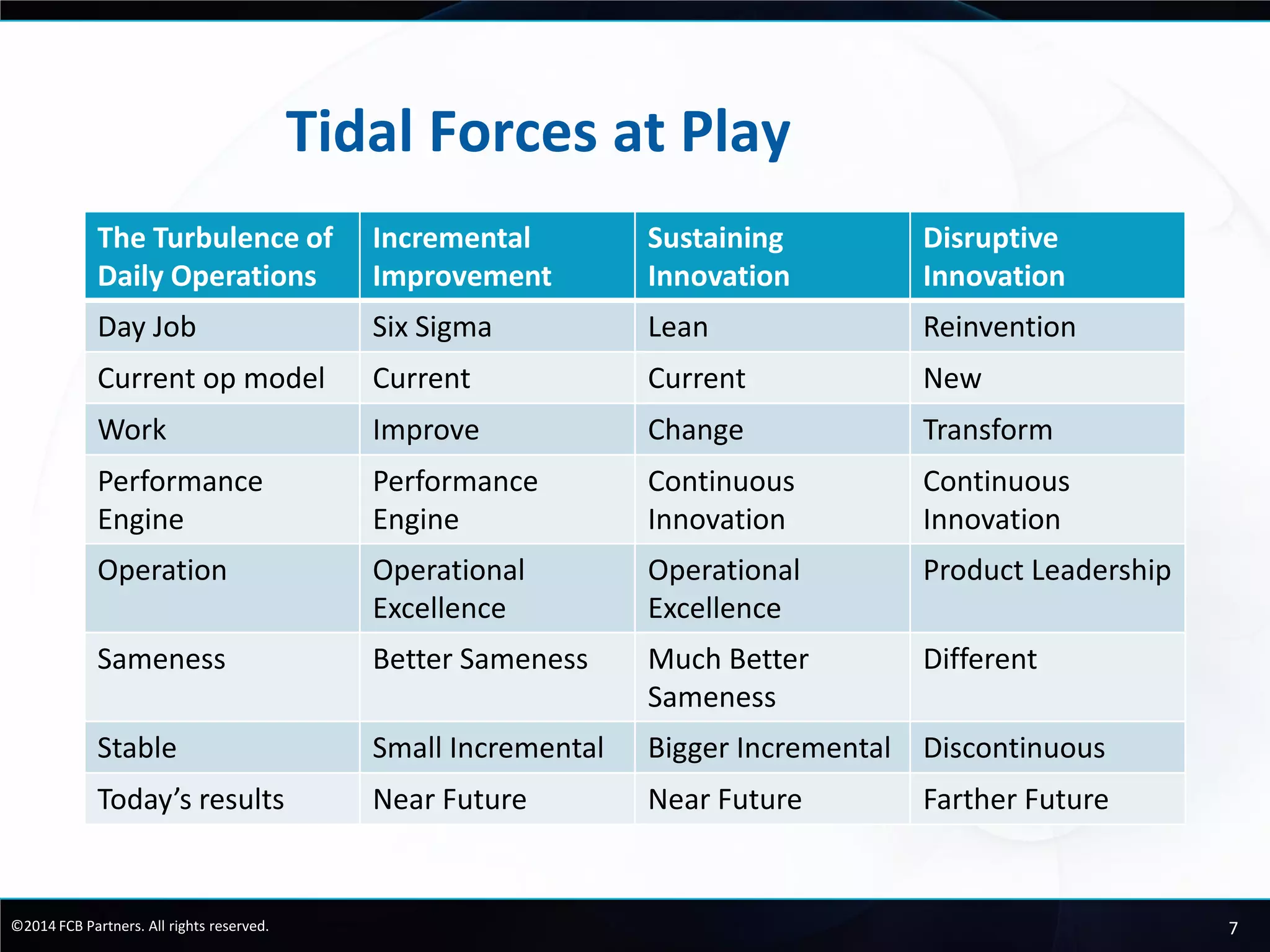
Tidal Forces at Play
The Turbulence of
Daily Operations
Incremental
Improvement
Sustaining
Innovation
Disruptive
Innovation
Day Job Six Sigma Lean Reinvention
Current op model Current Current New
Work Improve Change Transform
Performance
Engine
Performance
Engine
Continuous
Innovation
Continuous
Innovation
Operation Operational
Excellence
Operational
Excellence
Product Leadership
Sameness Better Sameness Much Better
Sameness
Different
Stable Small Incremental Bigger Incremental Discontinuous
Today’s results Near Future Near Future Farther Future
8©2014 FCB Partners. All rights reserved.
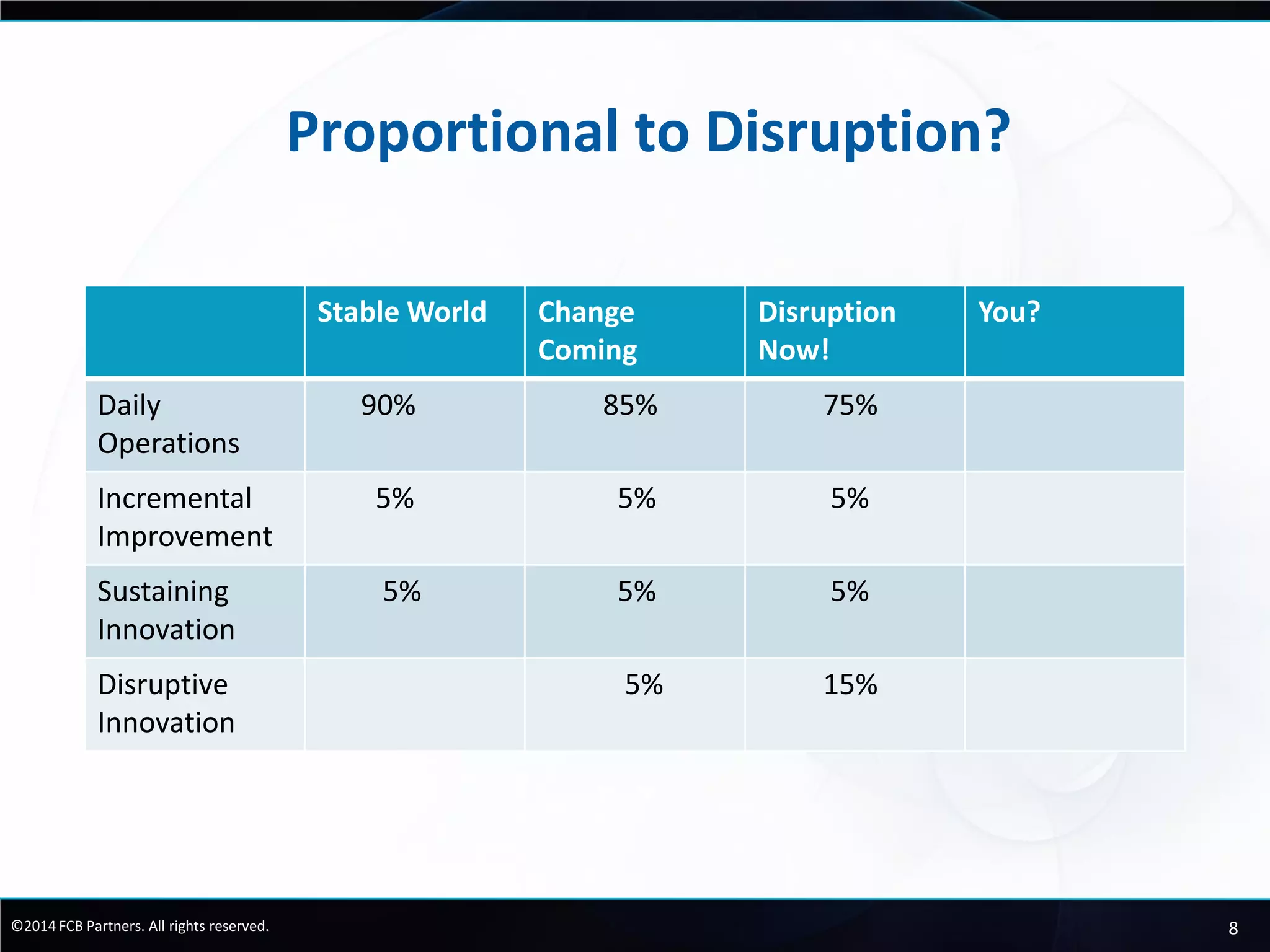
Proportional to Disruption?
Stable World Change
Coming
Disruption
Now!
You?
Daily
Operations
90% 85% 75%
Incremental
Improvement
5% 5% 5%
Sustaining
Innovation
5% 5% 5%
Disruptive
Innovation
5% 15%
9©2014 FCB Partners. All rights reserved.
However…
 On one hand, organizations absolutely must drive their
Performance Engines to produce the processes and results
that are needed for today’s customers.
 On the other hand organizations must also generate
Continuous Innovation Energy to prepare for and evolve
into successful futures.
 In many organizations, these two imperatives are in direct
conflict and resource investment is imbalanced.
 In reality, for most large traditional companies, as they
compete for scarce resources, almost always the
Performance Engine wins the lion’s share.
 Sustained success requires a well designed and evolving
strategic balance between the Performance Engine and
Continuous Innovation.
10©2014 FCB Partners. All rights reserved.
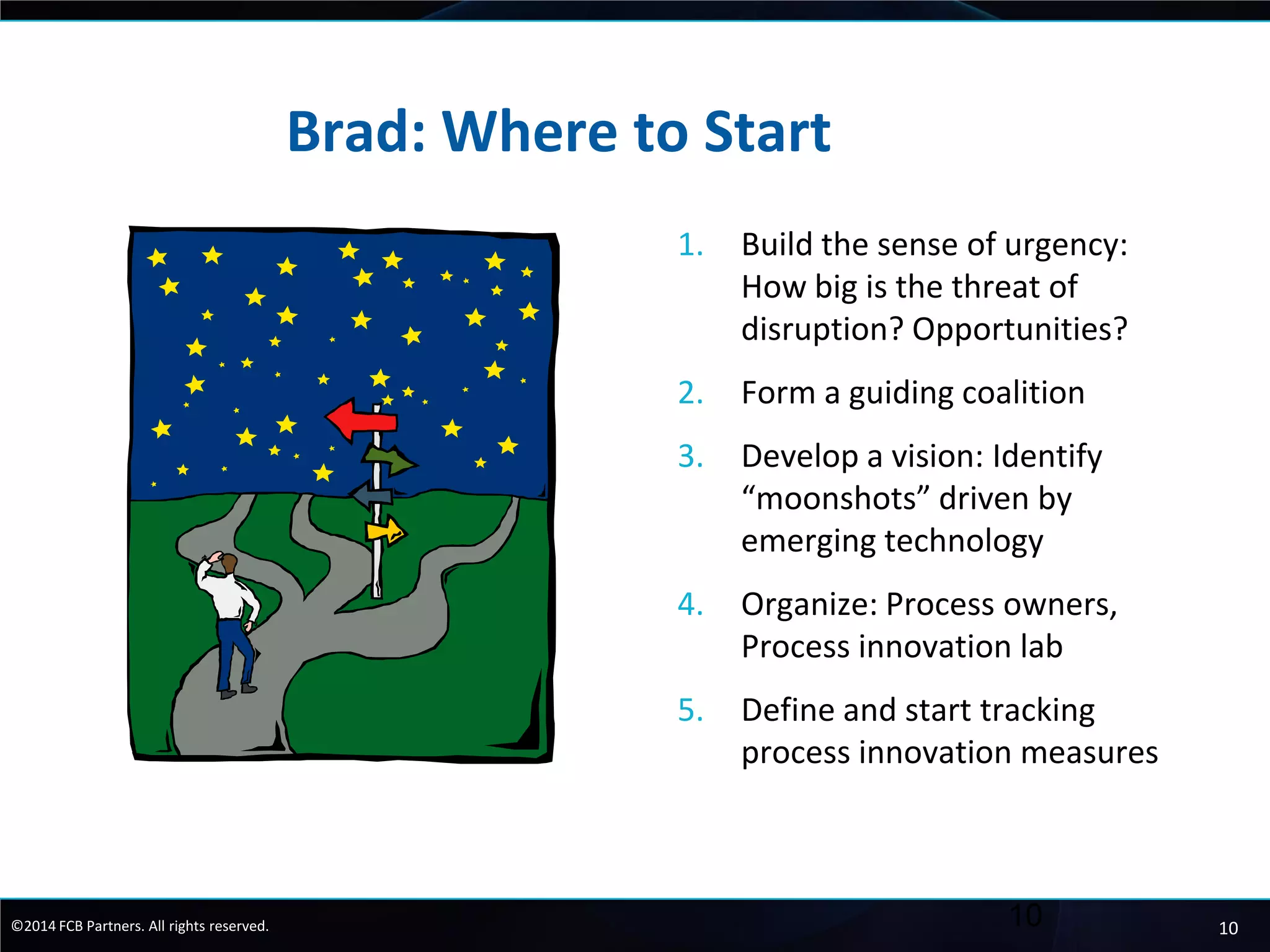
Brad: Where to Start
1. Build the sense of urgency:
How big is the threat of
disruption? Opportunities?
2. Form a guiding coalition
3. Develop a vision: Identify
“moonshots” driven by
emerging technology
4. Organize: Process owners,
Process innovation lab
5. Define and start tracking
process innovation measures
10
11©2014 FCB Partners. All rights reserved.
Steve: Where to Start
1. Measure and allocate resources explicitly across 4
domains
2. Ensure discrete sponsorship for each domain
3. Do less
4. Sharpen strategy and strategic planning
outcomes
5. Dramatically improve sensing processes
6. Be even more paranoid
7. Have balanced measures and executive incentives
8. Think Big, Start small, Learn Fast

CoExistence: Today’s Performance Engine and Tomorrow’s Innovation Energy

  • 1.
    ©2014 FCB Partners.All rights reserved. Brad Power and Steve Stanton Webinar: March 25, 2014 CoExistence: Today’s Performance Engine AND Tomorrow’s Innovation Energy
  • 2.
    Are you tuningthe Performance Engine or innovating? The Performance Engine An Innovation Initiative  Day-to-day  Sustaining, incremental  Repeatable, predictable  Occasional  Disruptive, radical  Uncertain outcomes 1
  • 3.
    Can you createan organization that embraces continuous innovation? Why now? Drivers  Social, mobile, “Big Data”, cloud, sensors, cameras  Software is eating the world Threats  Shorter produce lifecycles Opportunities: Role Models  High tech disruptor: Google  Retail and high tech disruptor: Amazon  Product disruptor: 3M 2
  • 4.
    Amazon’s Approach toContinuous Innovation Innovation Examples  Kindle  Web services  Amazon Prime  Drones? Management System  Think big: the everything store  Focus on customer value  Disrupt yourself (used books, Kindle)  Set up lab in Silicon Valley (A9, Lab 126)  Acquisitions (Zappos)  Missionary (relentlessly disruptive) and mercenary (calculating and ruthless) 3
  • 5.
    Google’s Approach toContinuous Innovation Innovation Examples  Driverless car, maps  YouTube  Google Glass  Google Fiber, Project Loon  Google Goggles Management System  Google[x] (moonshots)  Acquisitions (Makani)  20% time  Quick demos  Run lots of experiments and let the market decide  Fail fast and learn, scale up quickly if it shows promise  Culture of openness, analytical rigor, and respect for workers 4
  • 6.
    3M’s Approach toContinuous Innovation Innovation Examples  Scotch tape  Post Its  Thinsulate Management System  15% rule (free time)  Innovation centers, labs  Technical council, forums  30% rule (new products)  6% rule (R&D spending)  Seed capital  Technical career track  Rewards (Carlton Society, Golden Step) 5
  • 7.
    6©2014 FCB Partners.All rights reserved. What do we mean by CoExistence?  There are four powerful and competing forces operating in all organizations today: – The turbulence of the day job – The incremental process improvement world – The search for sustaining innovations – The hunt for disruptive innovations  All are essential but truly different in most respects.  In a perfect environment, with finite resources, an organization would have all operating together in harmony, with the right proportion of resources devoted to each.
  • 8.
    7©2014 FCB Partners.All rights reserved. Tidal Forces at Play The Turbulence of Daily Operations Incremental Improvement Sustaining Innovation Disruptive Innovation Day Job Six Sigma Lean Reinvention Current op model Current Current New Work Improve Change Transform Performance Engine Performance Engine Continuous Innovation Continuous Innovation Operation Operational Excellence Operational Excellence Product Leadership Sameness Better Sameness Much Better Sameness Different Stable Small Incremental Bigger Incremental Discontinuous Today’s results Near Future Near Future Farther Future
  • 9.
    8©2014 FCB Partners.All rights reserved. Proportional to Disruption? Stable World Change Coming Disruption Now! You? Daily Operations 90% 85% 75% Incremental Improvement 5% 5% 5% Sustaining Innovation 5% 5% 5% Disruptive Innovation 5% 15%
  • 10.
    9©2014 FCB Partners.All rights reserved. However…  On one hand, organizations absolutely must drive their Performance Engines to produce the processes and results that are needed for today’s customers.  On the other hand organizations must also generate Continuous Innovation Energy to prepare for and evolve into successful futures.  In many organizations, these two imperatives are in direct conflict and resource investment is imbalanced.  In reality, for most large traditional companies, as they compete for scarce resources, almost always the Performance Engine wins the lion’s share.  Sustained success requires a well designed and evolving strategic balance between the Performance Engine and Continuous Innovation.
  • 11.
    10©2014 FCB Partners.All rights reserved. Brad: Where to Start 1. Build the sense of urgency: How big is the threat of disruption? Opportunities? 2. Form a guiding coalition 3. Develop a vision: Identify “moonshots” driven by emerging technology 4. Organize: Process owners, Process innovation lab 5. Define and start tracking process innovation measures 10
  • 12.
    11©2014 FCB Partners.All rights reserved. Steve: Where to Start 1. Measure and allocate resources explicitly across 4 domains 2. Ensure discrete sponsorship for each domain 3. Do less 4. Sharpen strategy and strategic planning outcomes 5. Dramatically improve sensing processes 6. Be even more paranoid 7. Have balanced measures and executive incentives 8. Think Big, Start small, Learn Fast