Domina Petric, MD
Peripheral auditory
mechanisms
› Auditory system transduces sound waves into
distinct patterns of neural activity that are
integrated with other sensations.
› Sound waves are collected and amplified by
physical structures in the external and middle ear
for transfer to neural elements in the inner ear.
› Biomechanichal properties of the inner ear
decompose complex sound waves into sinusoidal
components.
Auditory function
› Frequency, amplitude and phase are encoded in
the firing of the receptor cell.
› Tonotopy is the systematic representation of
sound frequencies.
› Tonotopy is preserved in the inner ear and
throughout central processing stations.
› In the brainstem the auditory information is first
processed and divided into several parallel
pathways.
Auditory function
Auditory function
Brainstem centers relay the information to the midbrain
(inferior colliculus).
Midbrain projects to the auditory thalamus (medial
geniculate complex).
Auditory cortex recieves inputs from the thalamus and
processes more complex aspects of sounds (for example
speech).
Amplitude is the intensity
of sound.
Frequency is the pitch of
the tone (sound).
Sound
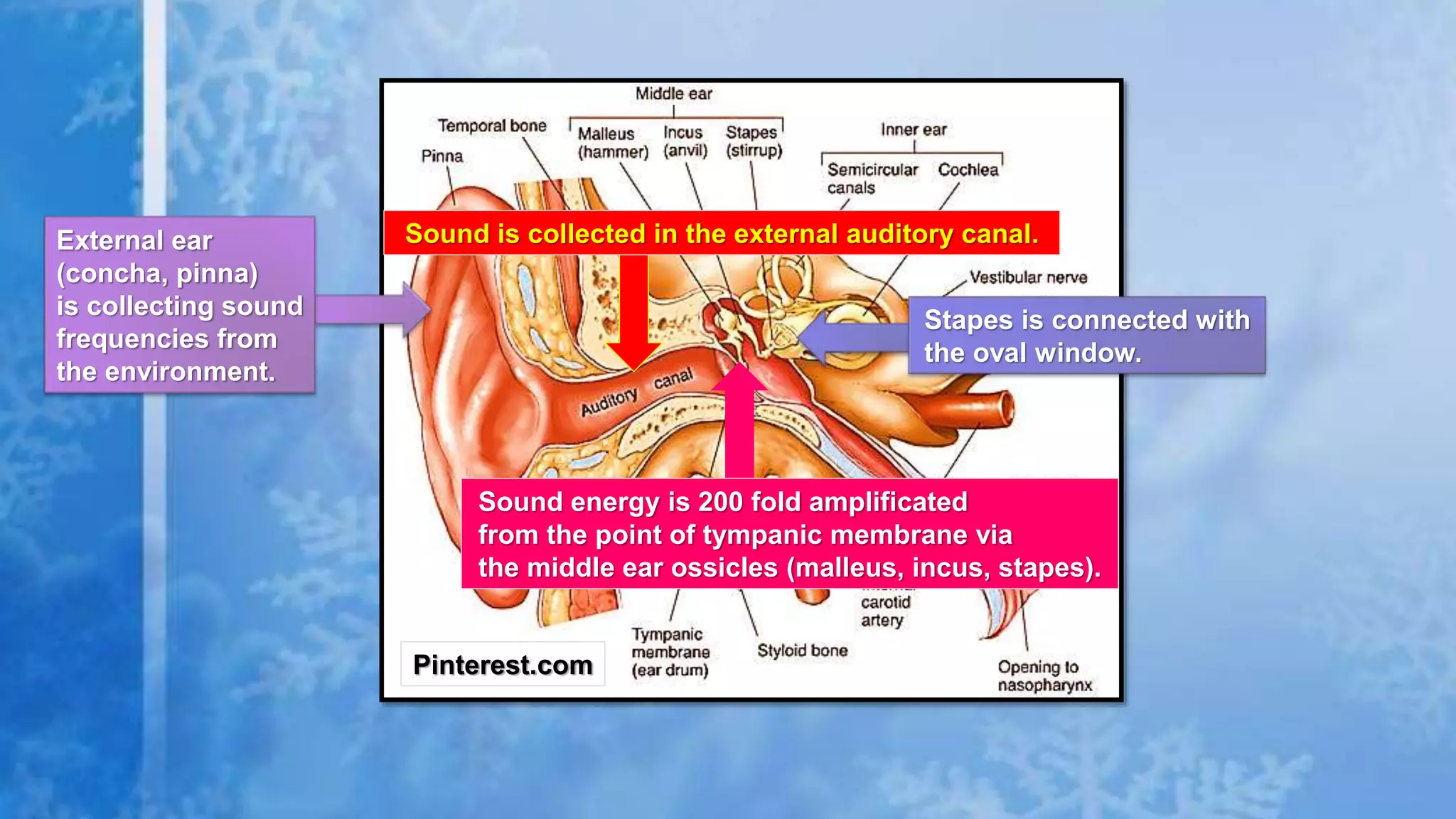
Pinterest.com
External ear
(concha, pinna)
is collecting sound
frequencies from
the environment.
Sound is collected in the external auditory canal.
Sound energy is 200 fold amplificated
from the point of tympanic membrane via
the middle ear ossicles (malleus, incus, stapes).
Stapes is connected with
the oval window.
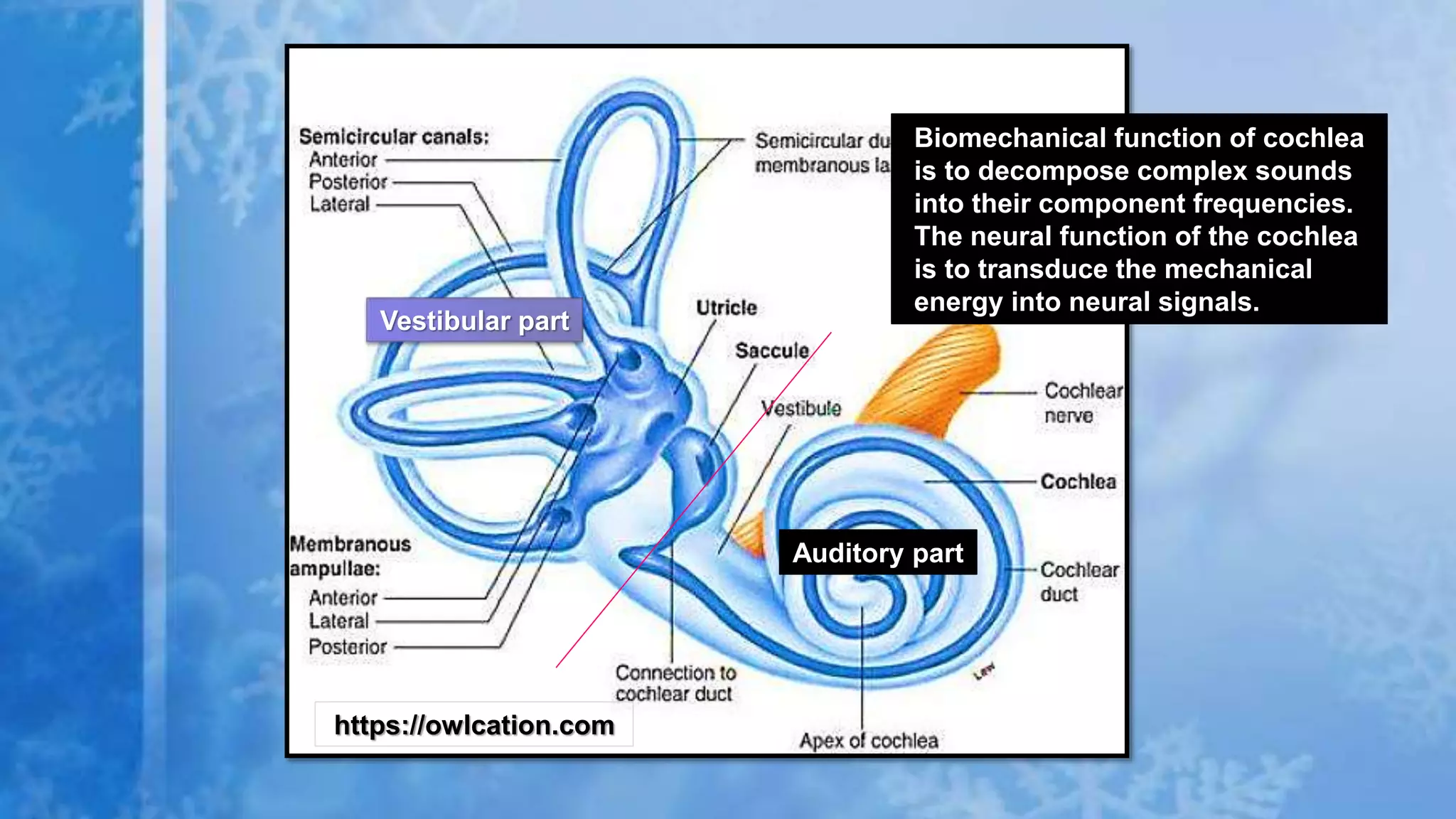
https://owlcation.com
Auditory part
Vestibular part
Biomechanical function of cochlea
is to decompose complex sounds
into their component frequencies.
The neural function of the cochlea
is to transduce the mechanical
energy into neural signals.
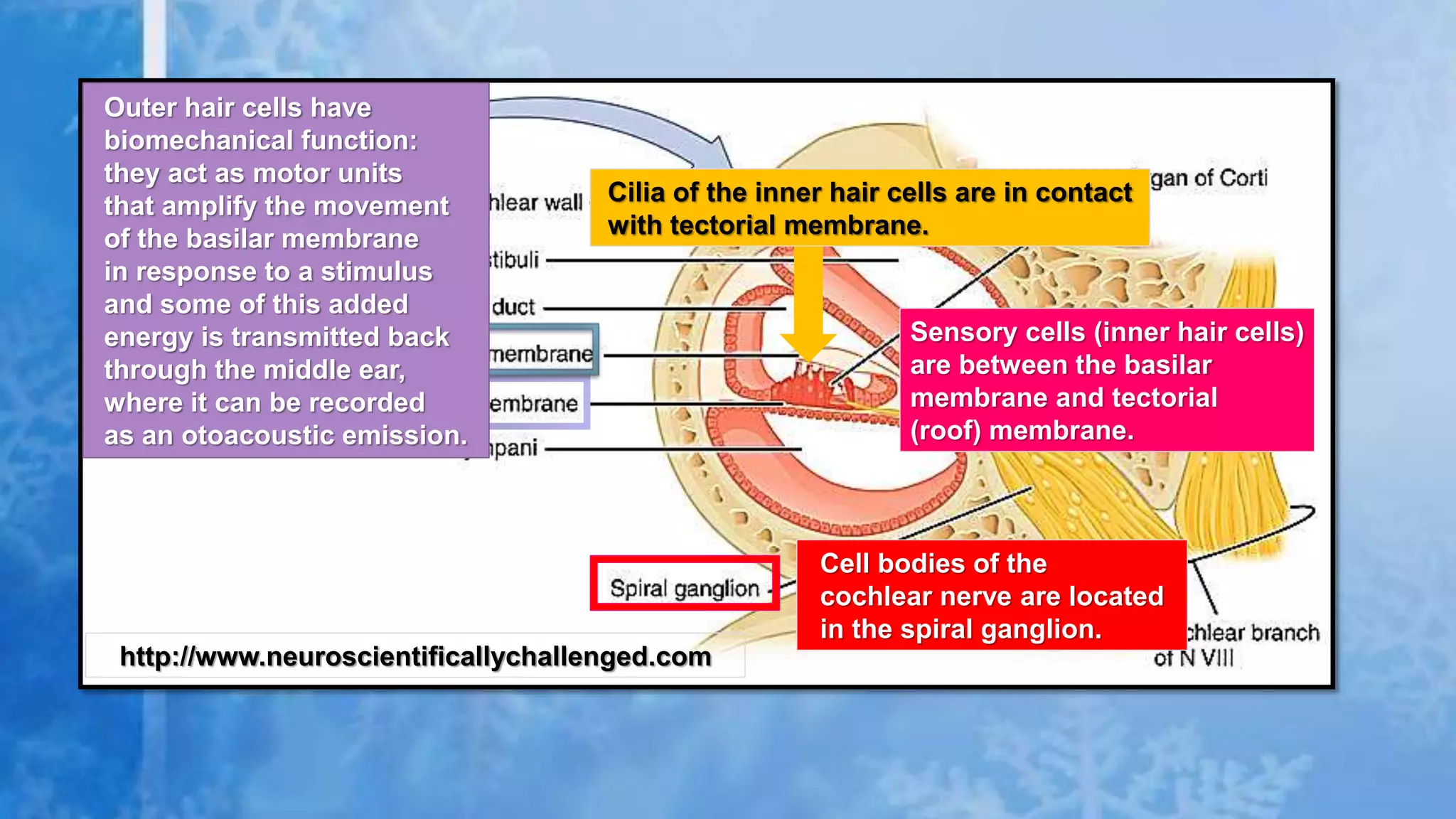
http://www.neuroscientificallychallenged.com
Sensory cells (inner hair cells)
are between the basilar
membrane and tectorial
(roof) membrane.
Cilia of the inner hair cells are in contact
with tectorial membrane.
Cell bodies of the
cochlear nerve are located
in the spiral ganglion.
Outer hair cells have
biomechanical function:
they act as motor units
that amplify the movement
of the basilar membrane
in response to a stimulus
and some of this added
energy is transmitted back
through the middle ear,
where it can be recorded
as an otoacoustic emission.
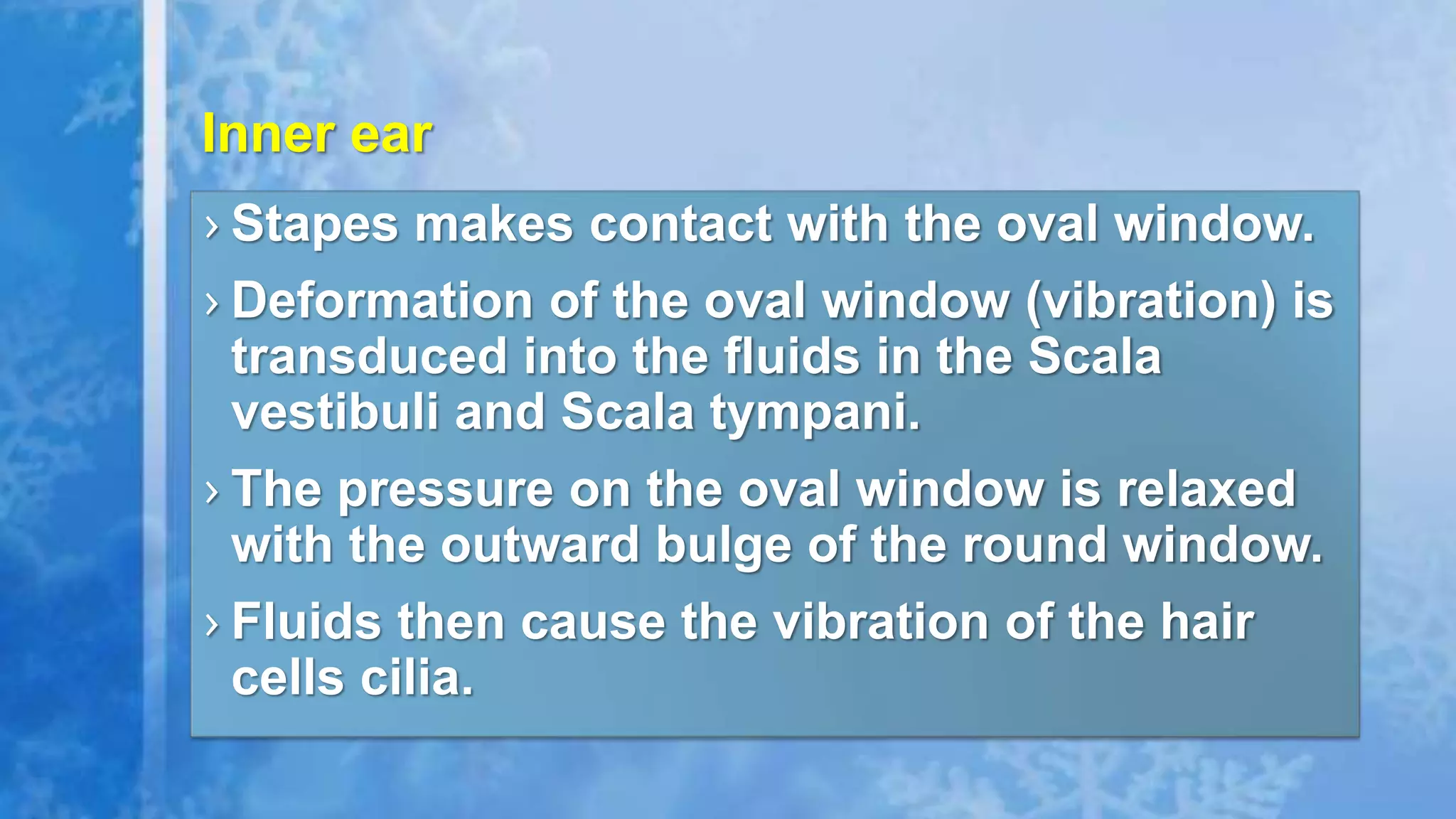
› Stapes makes contact with the oval window.
› Deformation of the oval window (vibration) is
transduced into the fluids in the Scala
vestibuli and Scala tympani.
› The pressure on the oval window is relaxed
with the outward bulge of the round window.
› Fluids then cause the vibration of the hair
cells cilia.
Inner ear
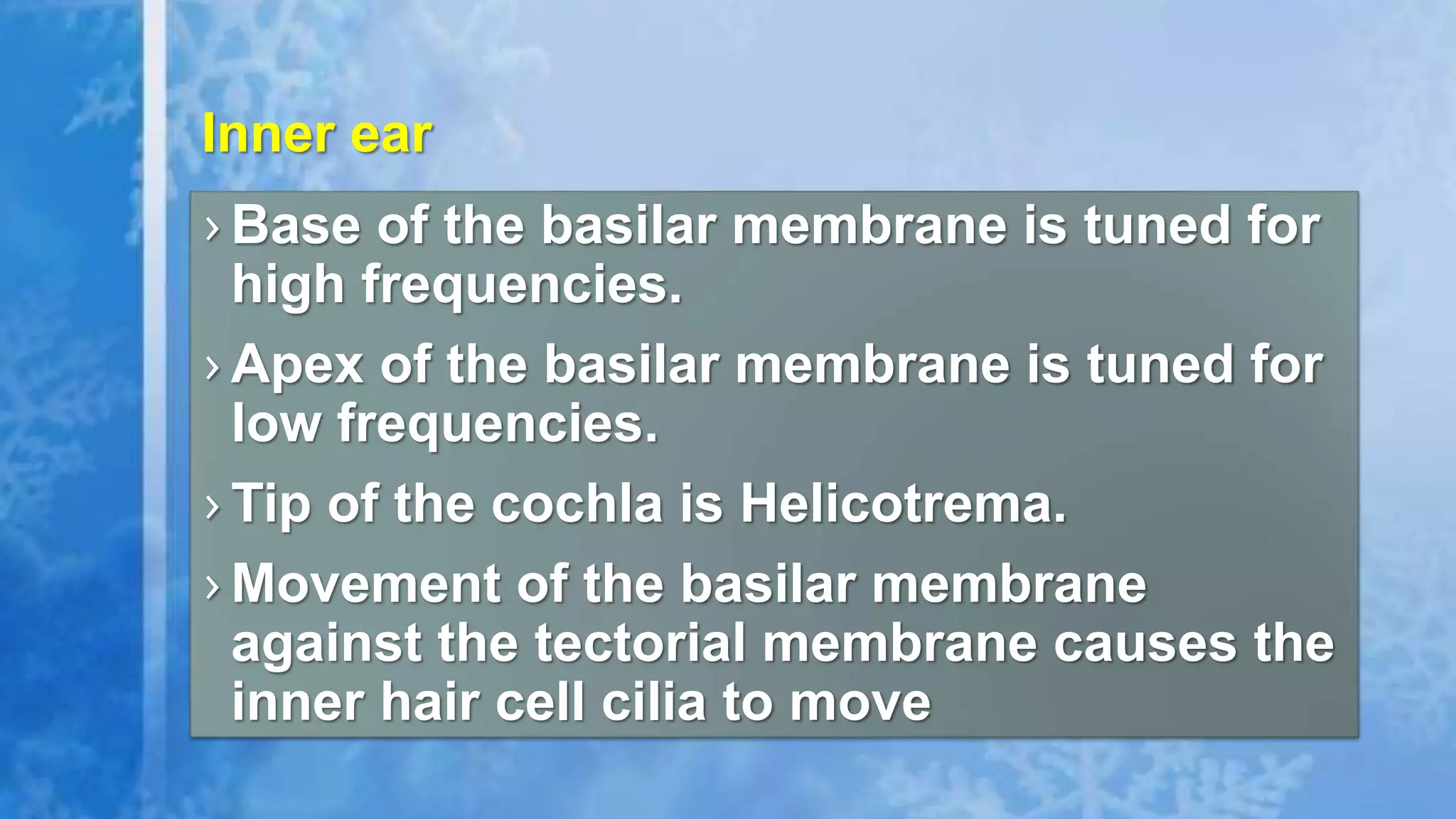
› Base of the basilar membrane is tuned for
high frequencies.
› Apex of the basilar membrane is tuned for
low frequencies.
› Tip of the cochla is Helicotrema.
› Movement of the basilar membrane
against the tectorial membrane causes the
inner hair cell cilia to move
Inner ear
› Movement of hair cells stereocilia causes opening of
the ion channels, ion influx and generation of the
graded potential in the inner hair cells.
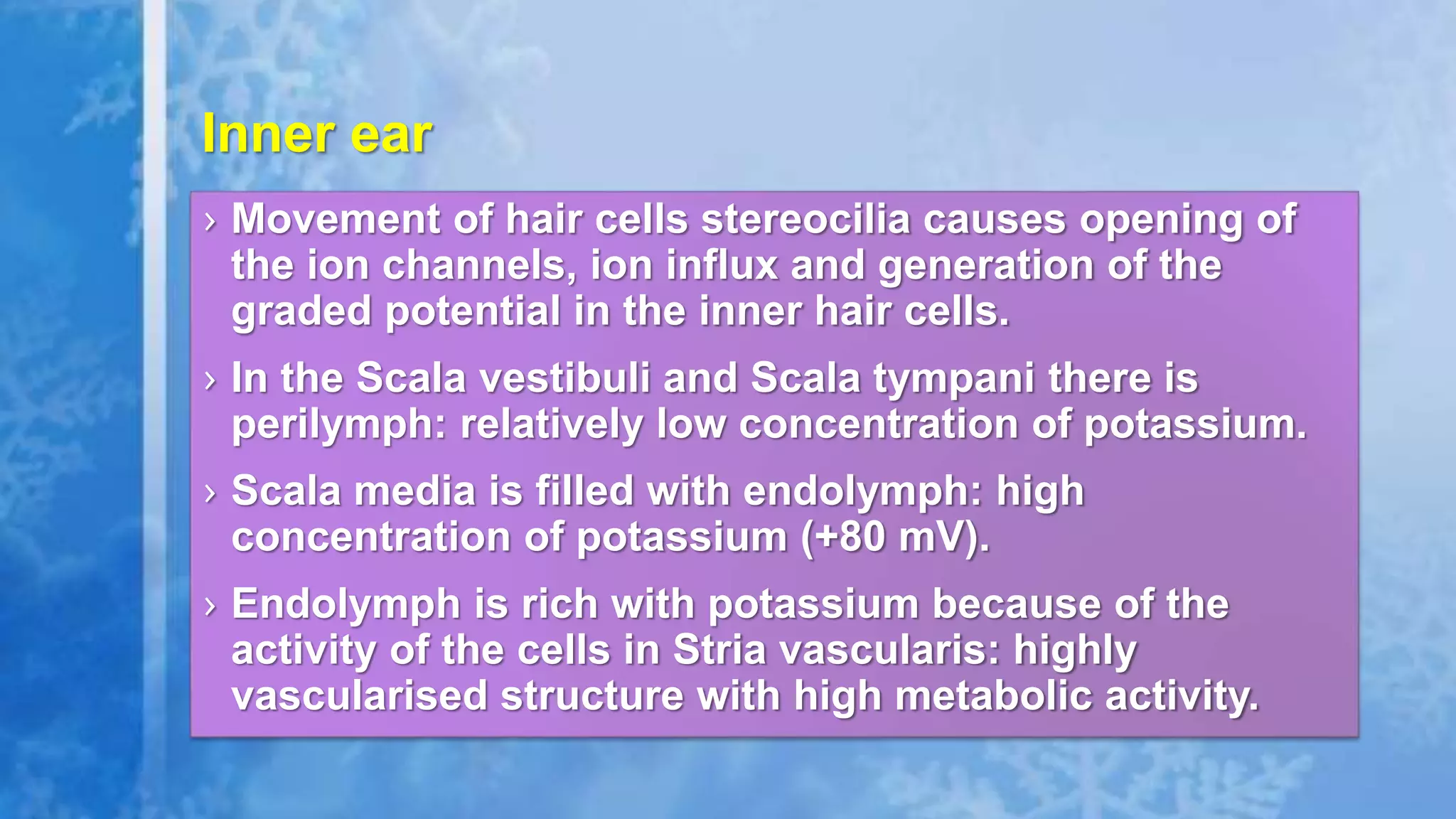
› In the Scala vestibuli and Scala tympani there is
perilymph: relatively low concentration of potassium.
› Scala media is filled with endolymph: high
concentration of potassium (+80 mV).
› Endolymph is rich with potassium because of the
activity of the cells in Stria vascularis: highly
vascularised structure with high metabolic activity.
Inner ear
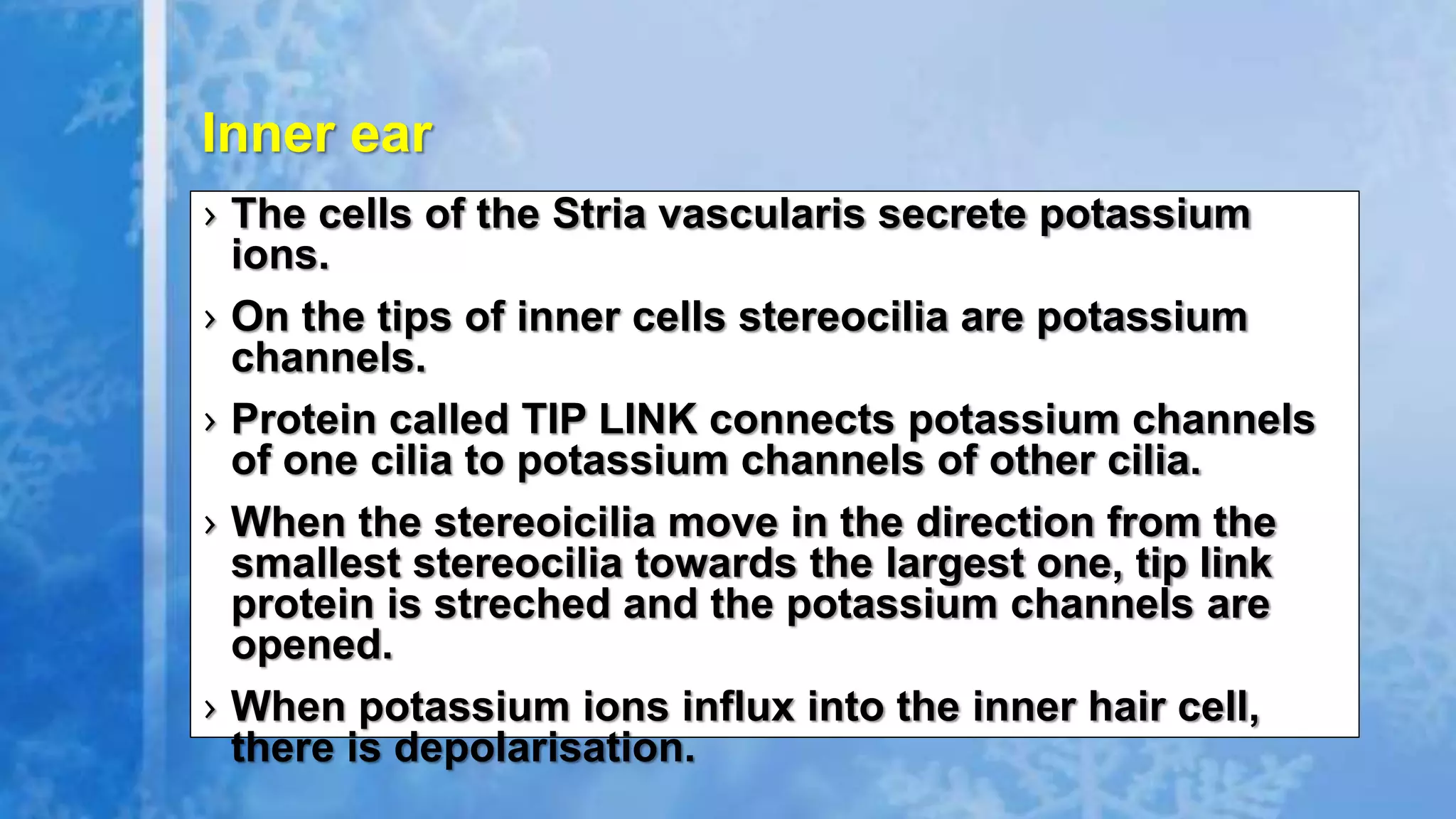
› The cells of the Stria vascularis secrete potassium
ions.
› On the tips of inner cells stereocilia are potassium
channels.
› Protein called TIP LINK connects potassium channels
of one cilia to potassium channels of other cilia.
› When the stereoicilia move in the direction from the
smallest stereocilia towards the largest one, tip link
protein is streched and the potassium channels are
opened.
› When potassium ions influx into the inner hair cell,
there is depolarisation.
Inner ear
› Graded potential of inner hair cell opens the voltage
gated calcium channels on the lateral sides of the
inner hair cell.
› Calcium rushes in through the basal lateral aspects of
the inner hair cell.
› Then occurs calcium dependent exocytosis of
synaptic vesicles.
› Neurotransmitter is released from the vesicles and
makes contact with receptors at the peripheral end of
the spiral ganglion processes.
Inner ear
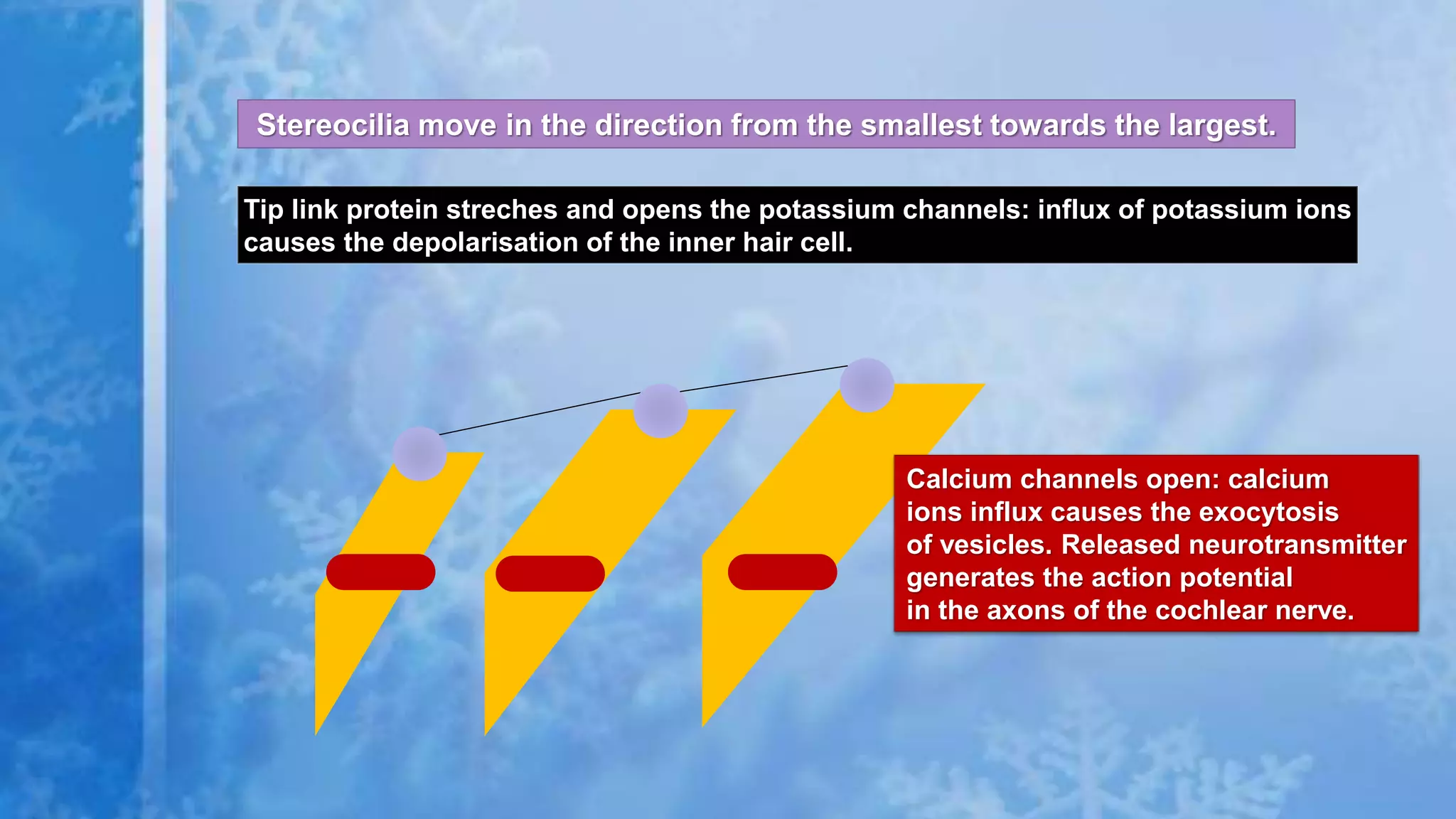
Stereocilia move in the direction from the smallest towards the largest.
Tip link protein streches and opens the potassium channels: influx of potassium ions
causes the depolarisation of the inner hair cell.
Calcium channels open: calcium
ions influx causes the exocytosis
of vesicles. Released neurotransmitter
generates the action potential
in the axons of the cochlear nerve.
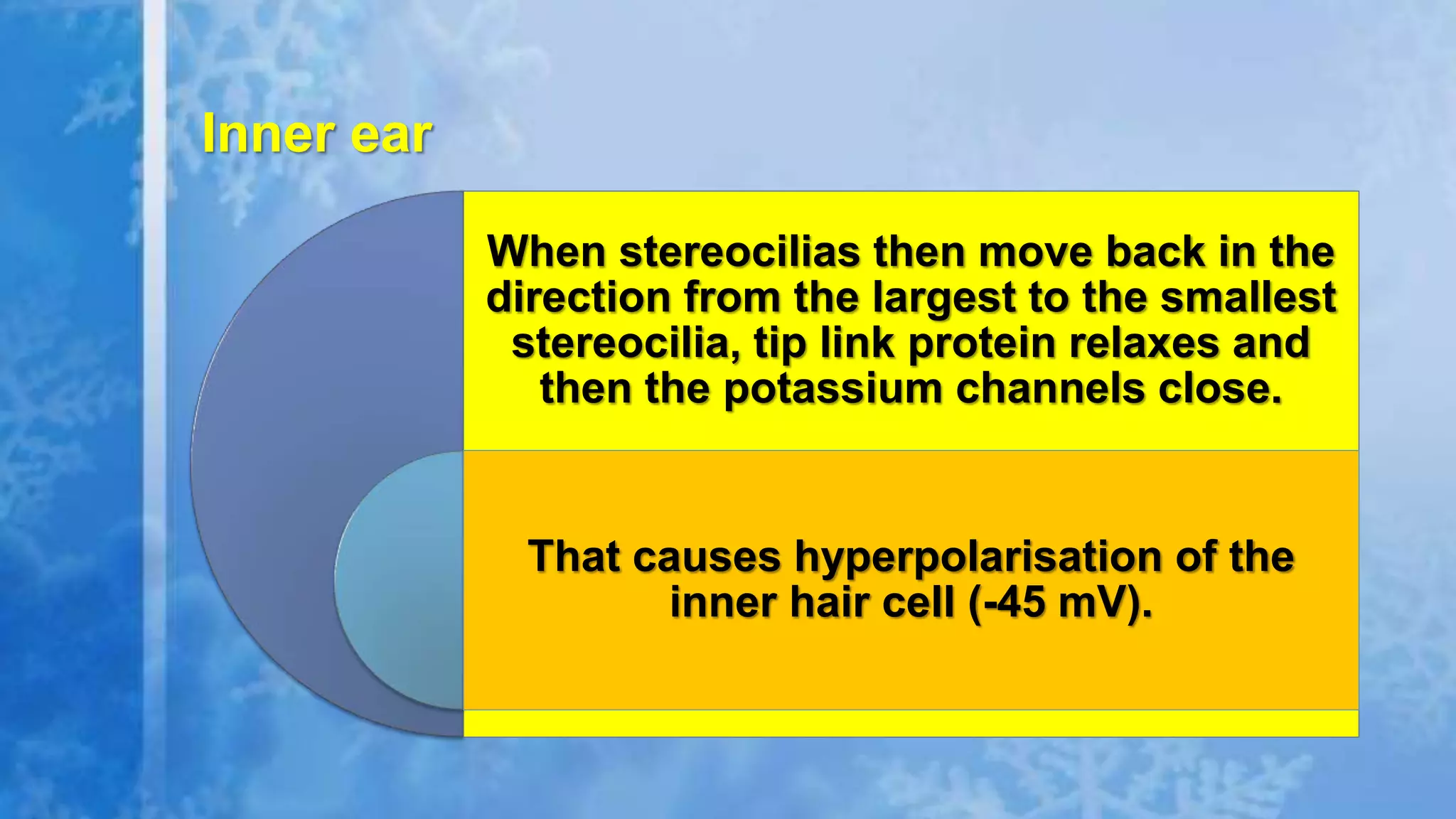
When stereocilias then move back in the
direction from the largest to the smallest
stereocilia, tip link protein relaxes and
then the potassium channels close.
That causes hyperpolarisation of the
inner hair cell (-45 mV).
Inner ear
Different axon of the auditory nerve has its own
BEST frequency: at that specific frequency has
the low treshold for action potential.
Tonotopic map from the basilar membrane is
preserved as the tonotopic map in the auditory
nerve.
Auditory nerve
Human ear hears from 20 Hz to 20 kHz.
Helicotrema: 20 Hz.
Base of the basilar membrane: 20 kHz.
› https://www.coursera.org/learn/medical-
neuroscience: Leonard E. White, PhD,
Duke University
› Pinterest.com
› https://owlcation.com
› http://www.neuroscientificallychallenged.com
Literature

Peripheral auditory mechanisms

  • 1.
    Domina Petric, MD Peripheralauditory mechanisms
  • 2.
    › Auditory systemtransduces sound waves into distinct patterns of neural activity that are integrated with other sensations. › Sound waves are collected and amplified by physical structures in the external and middle ear for transfer to neural elements in the inner ear. › Biomechanichal properties of the inner ear decompose complex sound waves into sinusoidal components. Auditory function
  • 3.
    › Frequency, amplitudeand phase are encoded in the firing of the receptor cell. › Tonotopy is the systematic representation of sound frequencies. › Tonotopy is preserved in the inner ear and throughout central processing stations. › In the brainstem the auditory information is first processed and divided into several parallel pathways. Auditory function
  • 4.
    Auditory function Brainstem centersrelay the information to the midbrain (inferior colliculus). Midbrain projects to the auditory thalamus (medial geniculate complex). Auditory cortex recieves inputs from the thalamus and processes more complex aspects of sounds (for example speech).
  • 5.
    Amplitude is theintensity of sound. Frequency is the pitch of the tone (sound). Sound
  • 6.
    Pinterest.com External ear (concha, pinna) iscollecting sound frequencies from the environment. Sound is collected in the external auditory canal. Sound energy is 200 fold amplificated from the point of tympanic membrane via the middle ear ossicles (malleus, incus, stapes). Stapes is connected with the oval window.
  • 7.
    https://owlcation.com Auditory part Vestibular part Biomechanicalfunction of cochlea is to decompose complex sounds into their component frequencies. The neural function of the cochlea is to transduce the mechanical energy into neural signals.
  • 8.
    http://www.neuroscientificallychallenged.com Sensory cells (innerhair cells) are between the basilar membrane and tectorial (roof) membrane. Cilia of the inner hair cells are in contact with tectorial membrane. Cell bodies of the cochlear nerve are located in the spiral ganglion. Outer hair cells have biomechanical function: they act as motor units that amplify the movement of the basilar membrane in response to a stimulus and some of this added energy is transmitted back through the middle ear, where it can be recorded as an otoacoustic emission.
  • 9.
    › Stapes makescontact with the oval window. › Deformation of the oval window (vibration) is transduced into the fluids in the Scala vestibuli and Scala tympani. › The pressure on the oval window is relaxed with the outward bulge of the round window. › Fluids then cause the vibration of the hair cells cilia. Inner ear
  • 10.
    › Base ofthe basilar membrane is tuned for high frequencies. › Apex of the basilar membrane is tuned for low frequencies. › Tip of the cochla is Helicotrema. › Movement of the basilar membrane against the tectorial membrane causes the inner hair cell cilia to move Inner ear
  • 11.
    › Movement ofhair cells stereocilia causes opening of the ion channels, ion influx and generation of the graded potential in the inner hair cells. › In the Scala vestibuli and Scala tympani there is perilymph: relatively low concentration of potassium. › Scala media is filled with endolymph: high concentration of potassium (+80 mV). › Endolymph is rich with potassium because of the activity of the cells in Stria vascularis: highly vascularised structure with high metabolic activity. Inner ear
  • 12.
    › The cellsof the Stria vascularis secrete potassium ions. › On the tips of inner cells stereocilia are potassium channels. › Protein called TIP LINK connects potassium channels of one cilia to potassium channels of other cilia. › When the stereoicilia move in the direction from the smallest stereocilia towards the largest one, tip link protein is streched and the potassium channels are opened. › When potassium ions influx into the inner hair cell, there is depolarisation. Inner ear
  • 13.
    › Graded potentialof inner hair cell opens the voltage gated calcium channels on the lateral sides of the inner hair cell. › Calcium rushes in through the basal lateral aspects of the inner hair cell. › Then occurs calcium dependent exocytosis of synaptic vesicles. › Neurotransmitter is released from the vesicles and makes contact with receptors at the peripheral end of the spiral ganglion processes. Inner ear
  • 14.
    Stereocilia move inthe direction from the smallest towards the largest. Tip link protein streches and opens the potassium channels: influx of potassium ions causes the depolarisation of the inner hair cell. Calcium channels open: calcium ions influx causes the exocytosis of vesicles. Released neurotransmitter generates the action potential in the axons of the cochlear nerve.
  • 15.
    When stereocilias thenmove back in the direction from the largest to the smallest stereocilia, tip link protein relaxes and then the potassium channels close. That causes hyperpolarisation of the inner hair cell (-45 mV). Inner ear
  • 16.
    Different axon ofthe auditory nerve has its own BEST frequency: at that specific frequency has the low treshold for action potential. Tonotopic map from the basilar membrane is preserved as the tonotopic map in the auditory nerve. Auditory nerve Human ear hears from 20 Hz to 20 kHz. Helicotrema: 20 Hz. Base of the basilar membrane: 20 kHz.
  • 17.
    › https://www.coursera.org/learn/medical- neuroscience: LeonardE. White, PhD, Duke University › Pinterest.com › https://owlcation.com › http://www.neuroscientificallychallenged.com Literature