OCCLUSION EFFECTS—
           THE NEURAL CHALLENGES


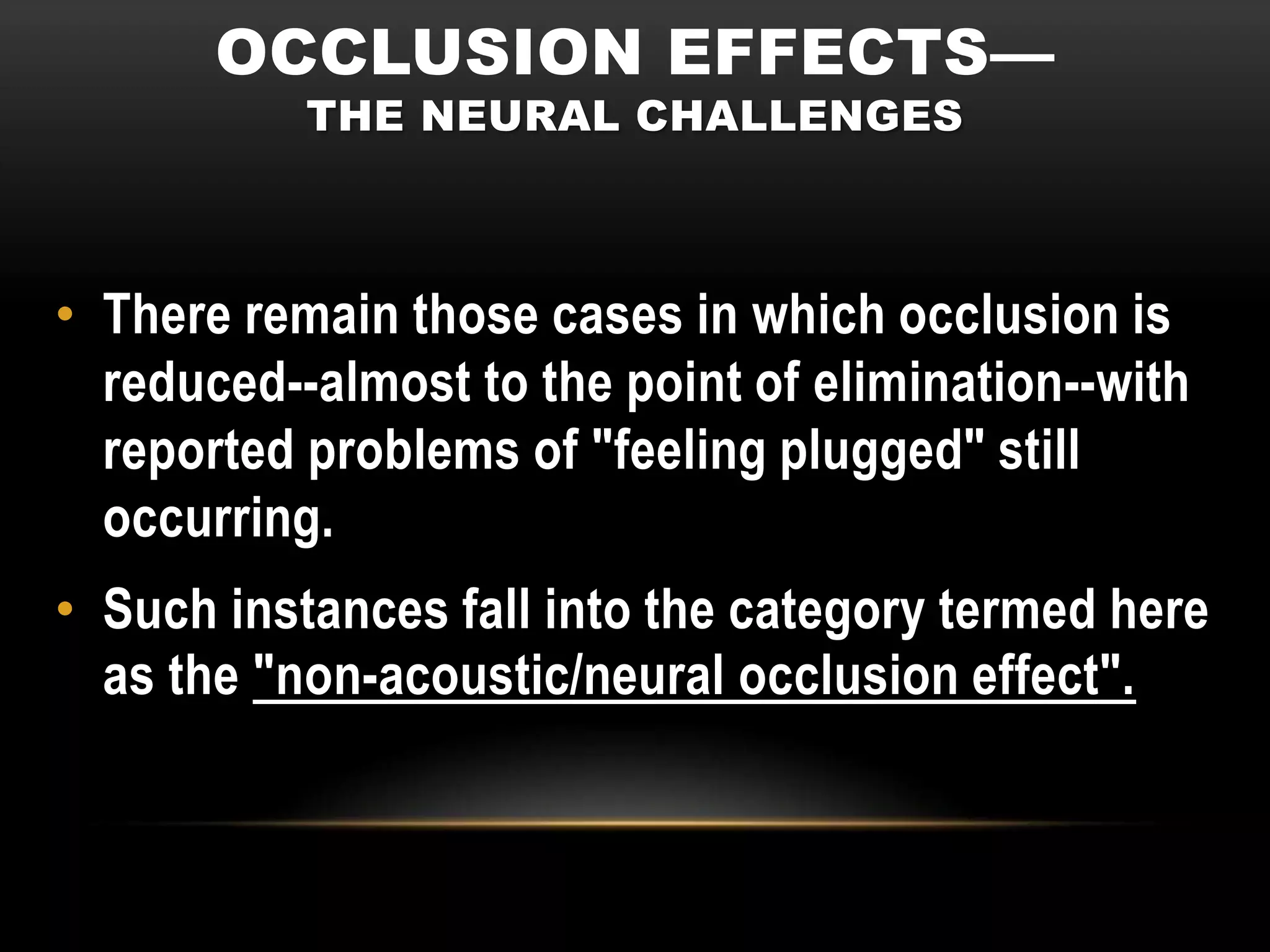
• There remain those cases in which occlusion is
  reduced--almost to the point of elimination--with
  reported problems of "feeling plugged" still
  occurring.
• Such instances fall into the category termed here
  as the "non-acoustic/neural occlusion effect".
OCCLUSION EFFECTS—
           THE NEURAL CHALLENGES


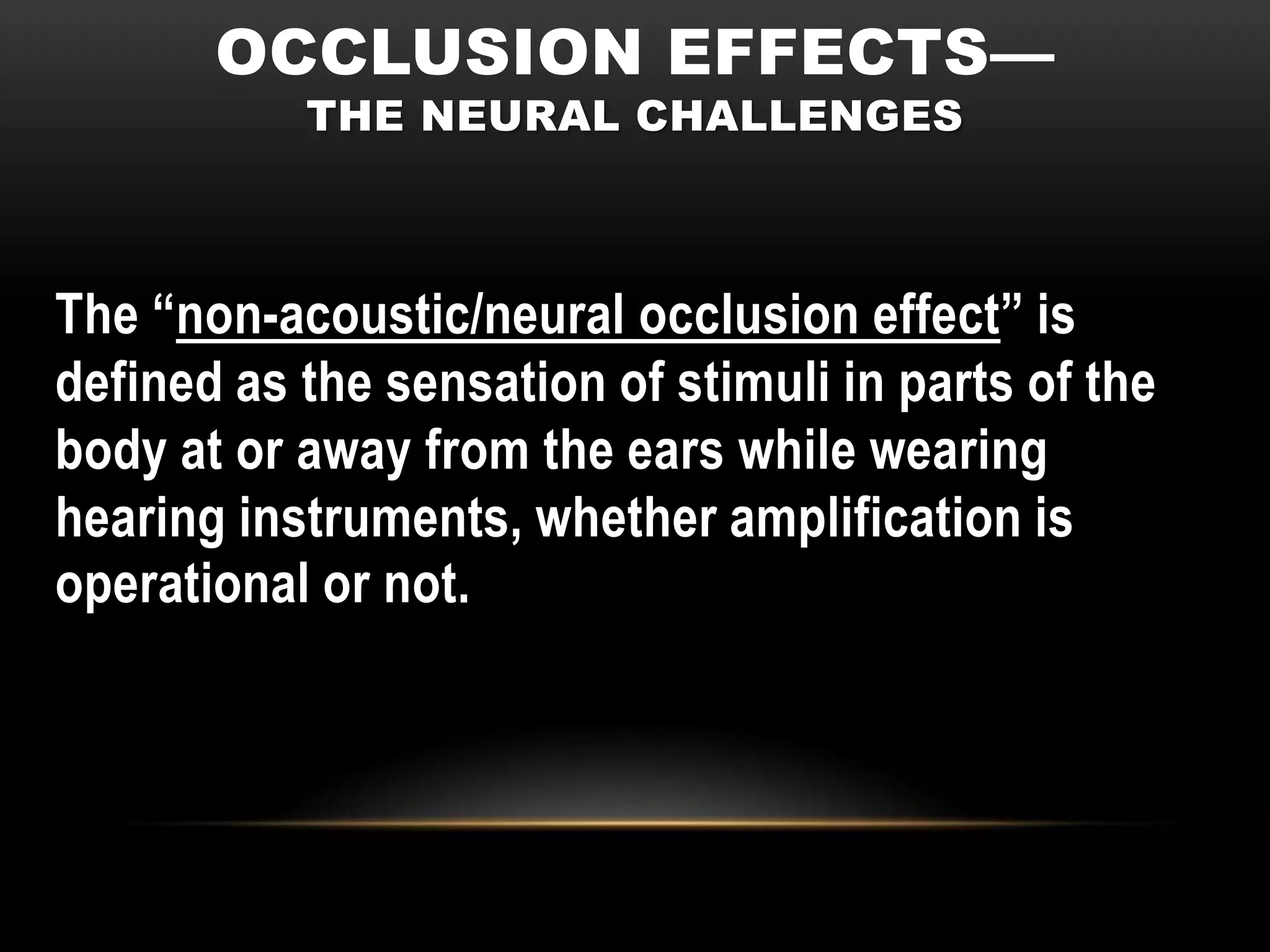
The “non-acoustic/neural occlusion effect” is
defined as the sensation of stimuli in parts of the
body at or away from the ears while wearing
hearing instruments, whether amplification is
operational or not.
OCCLUSION EFFECTS—
           THE NEURAL CHALLENGES


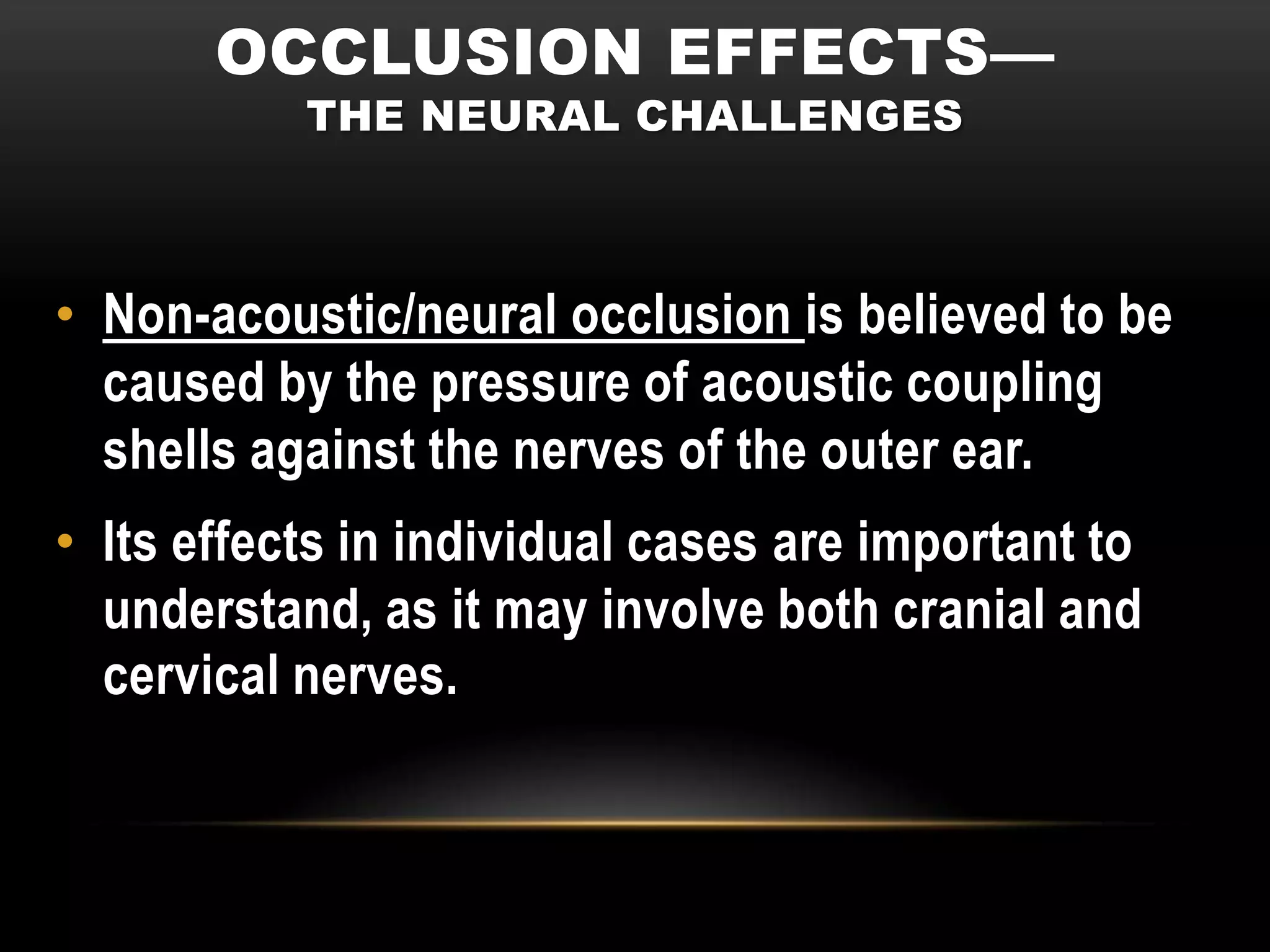
• Non-acoustic/neural occlusion is believed to be
  caused by the pressure of acoustic coupling
  shells against the nerves of the outer ear.
• Its effects in individual cases are important to
  understand, as it may involve both cranial and
  cervical nerves.
OCCLUSION EFFECTS—
           THE NEURAL CHALLENGES

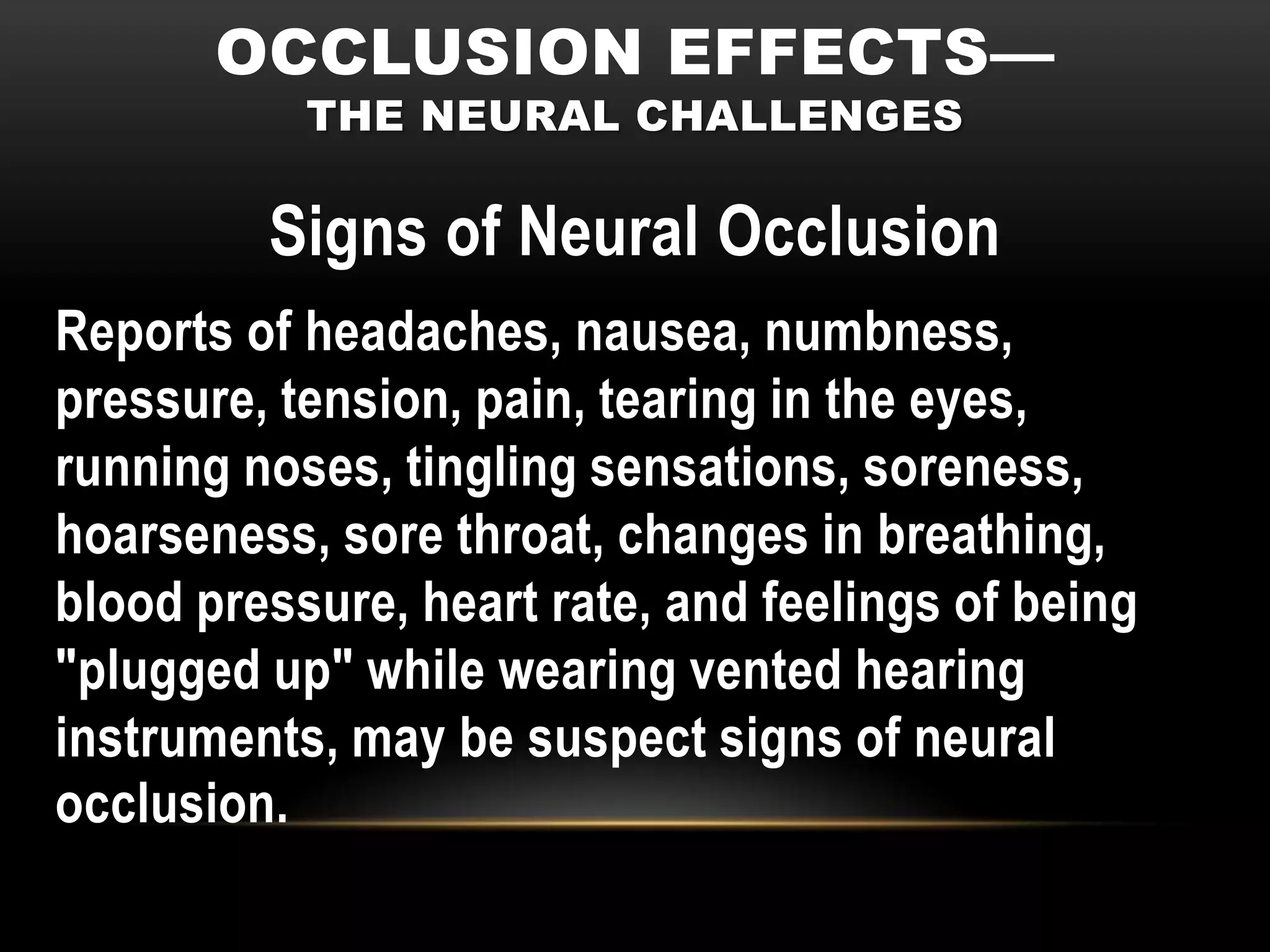
         Signs of Neural Occlusion
Reports of headaches, nausea, numbness,
pressure, tension, pain, tearing in the eyes,
running noses, tingling sensations, soreness,
hoarseness, sore throat, changes in breathing,
blood pressure, heart rate, and feelings of being
"plugged up" while wearing vented hearing
instruments, may be suspect signs of neural
occlusion.
OCCLUSION EFFECTS—
           THE NEURAL CHALLENGES


• The literature on the nerve endings found in and
  around the outer ear reveals numerous
  discrepancies in location of individual nerves.
• This fact demonstrates the broad variability in
  final development of the structures of the human
  body.
OCCLUSION EFFECTS—
           THE NEURAL CHALLENGES

The descriptions of neural pathways are intended
as general guidelines only.
Individual variation should be regarded as a
constant possibility.
In addition, the nerves found in the outer ear do
not follow straight line courses like those
frequently found in anatomic diagrams. They
usually form spiraling patterns of individual
neurons whose course is often subject to
meandering.
OCCLUSION EFFECTS—
           THE NEURAL CHALLENGES


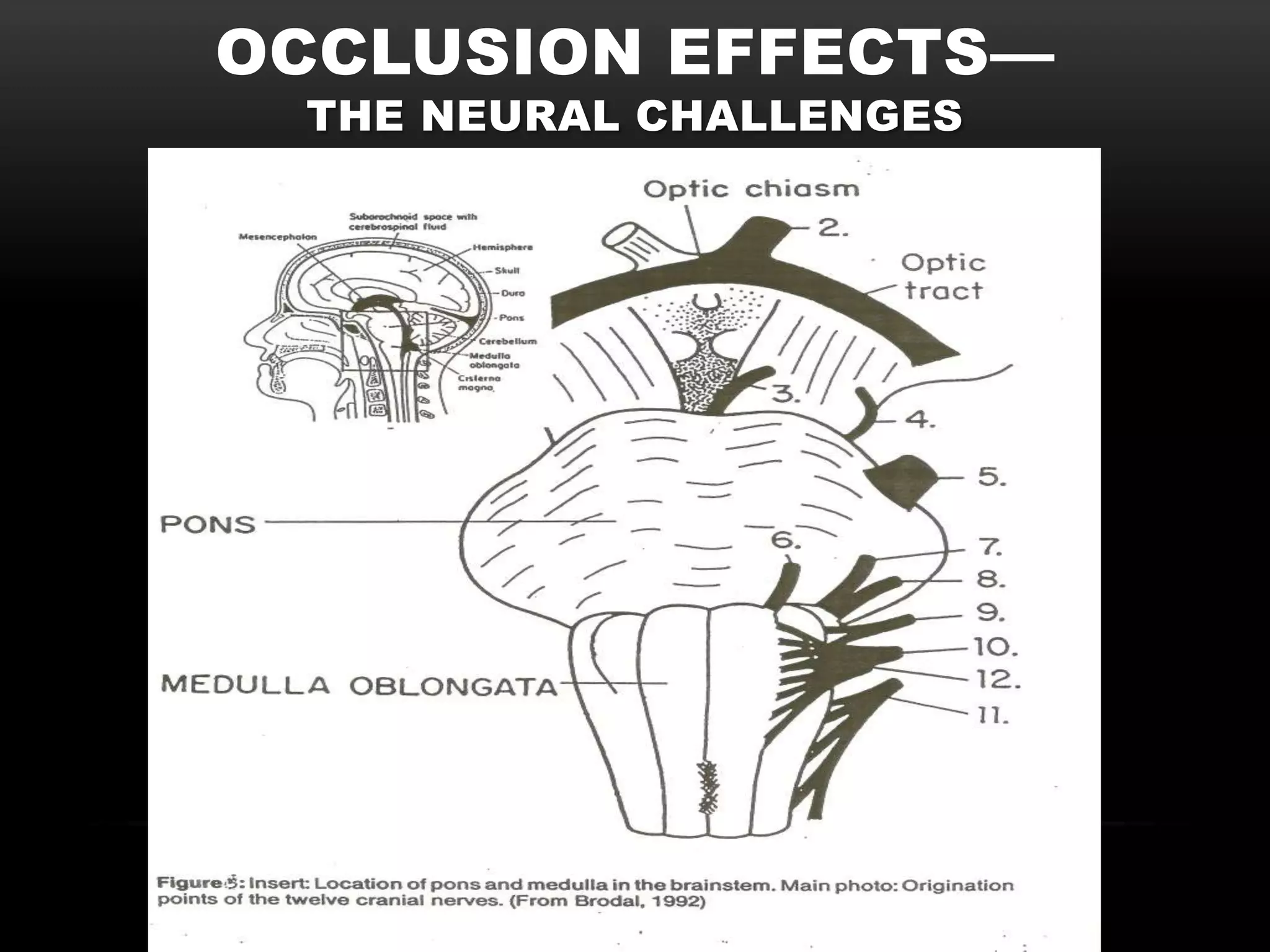
• There are four cranial nerves involved in the
  process of sensory innervations of the outer ear.
  They are: Cranial nerves V, VII, IX, and X.
• The Cranial nerves originate in the Pons and
  Medulla in the brainstem (see FIGURE 5).
OCCLUSION EFFECTS—
 THE NEURAL CHALLENGES
OCCLUSION EFFECTS—
           THE NEURAL CHALLENGES

Please note:
Both Cranial and Cervical nerves can generally be
regarded as major communication points between
the brain and body for intake of sensory (afferent)
information and execution of motor (efferent)
activities.
OCCLUSION EFFECTS—
           THE NEURAL CHALLENGES

  The Vth (trigeminal) Cranial Nerve
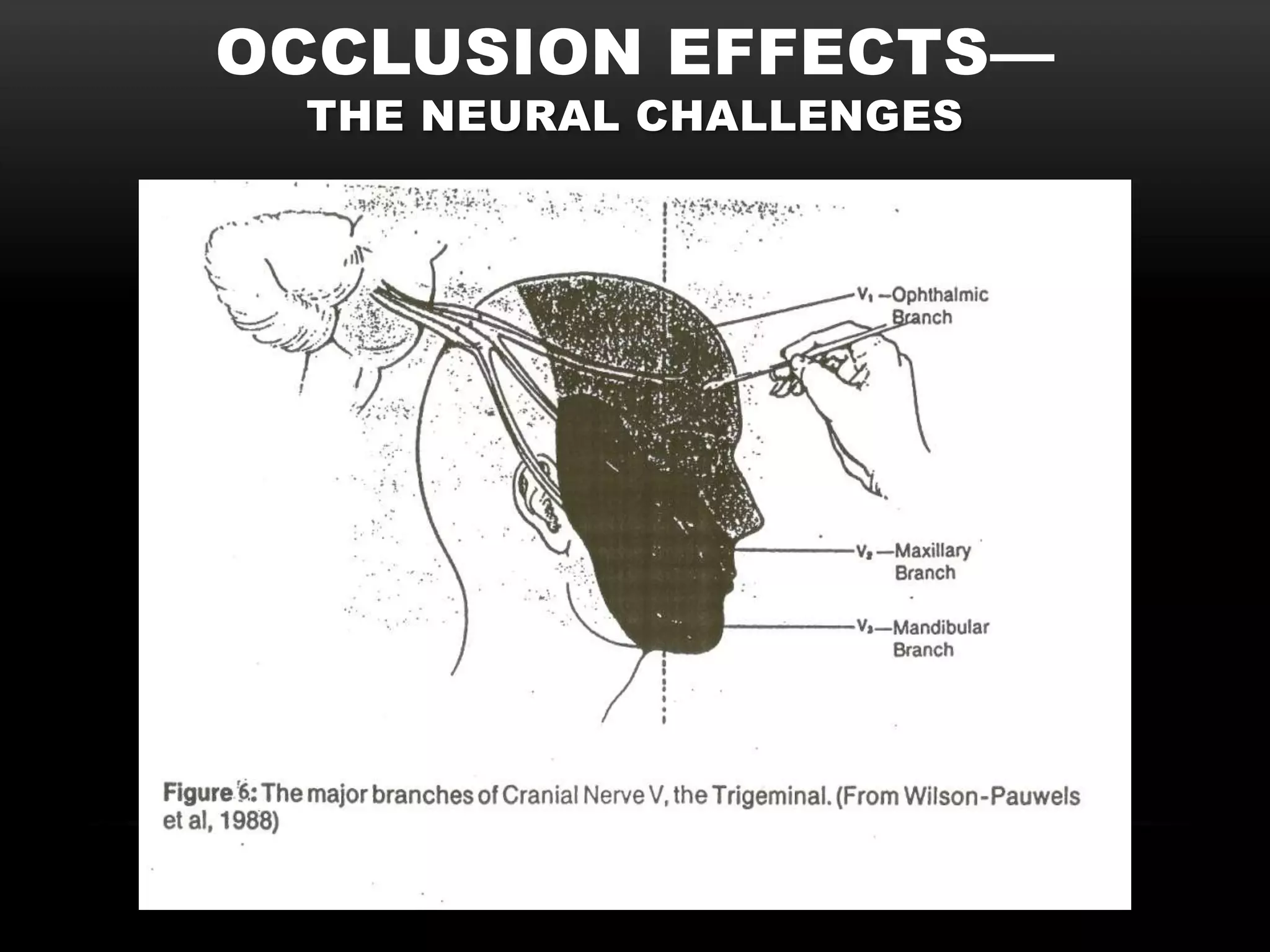
• The Vth (trigeminal) cranial nerve is divided into
  three major branches: the ophthalmic, maxillary,
  and mandibular.
• One division of the mandibular branch is the
  auricular-temporal nerve, which provides sensory
  innervations to the top and front walls of the
  external auditory meatus, to the tragus, and to
  the crest of the helix.
OCCLUSION EFFECTS—
 THE NEURAL CHALLENGES
OCCLUSION EFFECTS—
           THE NEURAL CHALLENGES
The ophthalmic branch proceeds across the top of
the temporal muscle and around the front of the
face just above the brow.
Patients who report headache and/or muscle
tension in this area following insertion of their
hearing instrument may be triggering a neural arc
and stimulating contraction of the muscles above
the brow and along the upper side of the face.
 Those contractions would then be registered by
the Trigeminal (Vth cranial) as feelings of tension,
etc.
OCCLUSION EFFECTS—
           THE NEURAL CHALLENGES

The mandibular division of Vth cranial nerve
provides the sensory input from the lower teeth
and jaw, motor control of the tensor tympani and
the muscles of mastication.
The external ear canal initiated neural activity
leading to stimulation of the muscles and nerves of
the mandible, may be reported as pain deep in the
ear, lower jaw pain, pain in the lower teeth, tension
in the cheeks or mouth, difficulty in chewing, or
pain at the temporal-mandibular joint.
OCCLUSION EFFECTS—
           THE NEURAL CHALLENGES

Please note:
Since the tensor tympani is directly involved in the
acoustic reflex, it is possible that insertion of an
acoustic coupling could result in the acoustic
reflex “firing” thus, causing damping of the sound
transmission through the ossicles and resulting in
a reported feeling of occlusion.
OCCLUSION EFFECTS—
           THE NEURAL CHALLENGES

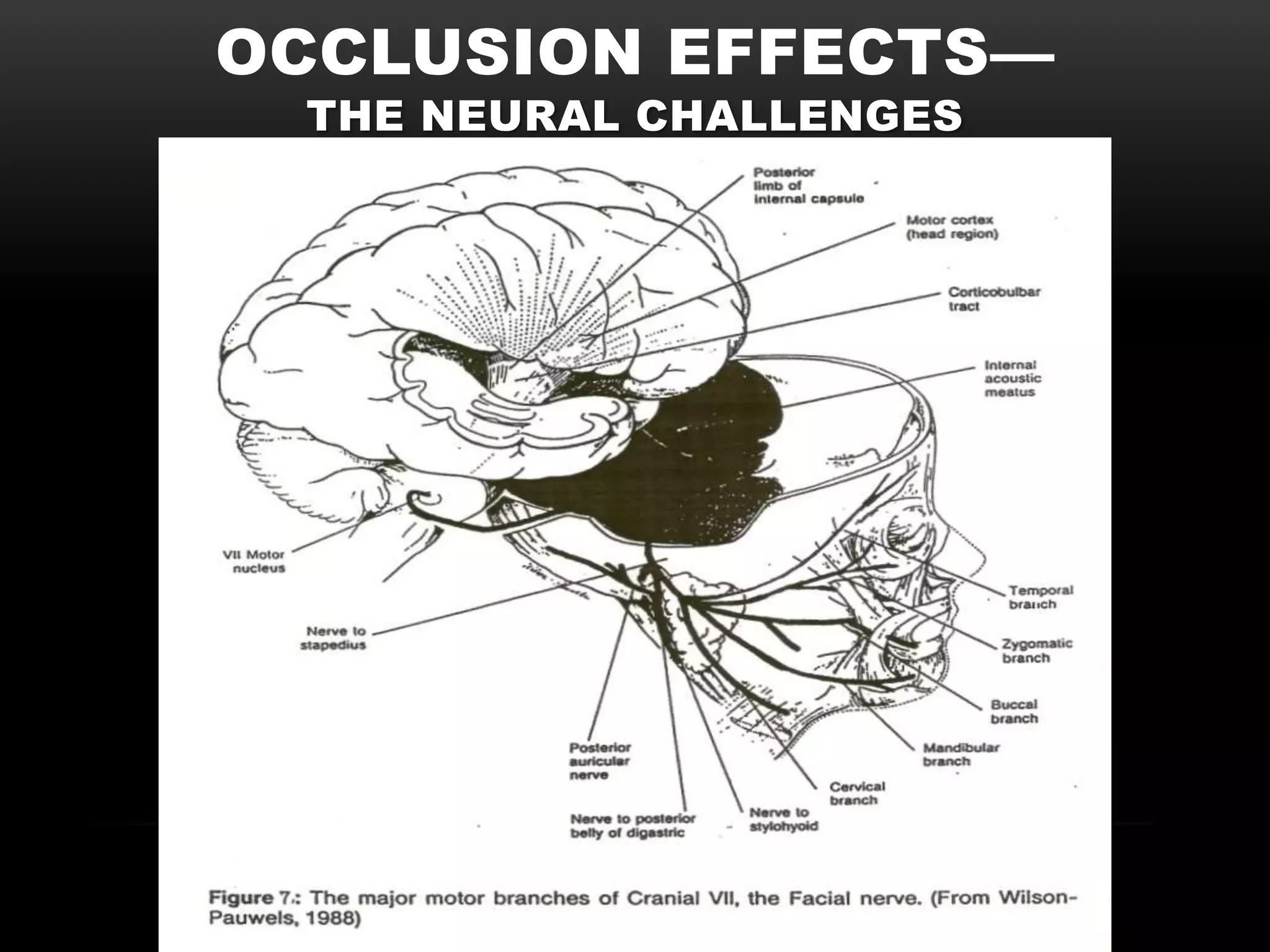
 The VIIth Cranial (facial) Nerve
• The VIIth cranial (facial) nerve, is predominantly
  a motor neuron.
• It does have sensory loci on the back of the
  auricle and in the concha.
• In some reports, the nerve has been found to
  branch from its sensory array at the tympanic
  membrane to and through the external ear canal
  to join the peripheral nerves in the auricle.
OCCLUSION EFFECTS—
          THE NEURAL CHALLENGES

 The VIIth Cranial (facial) Nerve
The chorda tympani branch of Cranial VII controls
contraction of the stapedius muscle as well as
providing the sensation of taste in the anterior
2/3rds of the tongue.
OCCLUSION EFFECTS—
           THE NEURAL CHALLENGES

 The VIIth Cranial (facial) Nerve
The facial nerve is unique among the twelve cranial
nerves, in that it normally is inherently capable of
cross-communication with:
• cranial nerves V, VIII, and IX, X, and
• the upper cervical nerves #2 & #3.
OCCLUSION EFFECTS—
 THE NEURAL CHALLENGES
OCCLUSION EFFECTS—
           THE NEURAL CHALLENGES

Please Note:
The neural cross-communication process is not
fully understood, but lends general support to the
idea that individual neural stimuli could influence
other neural pathway responses.
OCCLUSION EFFECTS—
           THE NEURAL CHALLENGES

• Innervations of Cranial VII (facial) nerve could
  cause muscle tension in the face which would be
  sensed by neurons of the cranial Vth
  (trigeminal).
• The Vth (trigeminal), with its' numerous
  branches, may create changes in the sense of
  taste, a runny nose, tearing or dryness in the
  eyes, either dryness or excess saliva in the
  mouth, and/or tension in the eyelids.
OCCLUSION EFFECTS—
           THE NEURAL CHALLENGES

 The VIIth Cranial (facial) Nerve
Please note:
Contraction of the stapedius could cause feelings
of occlusion as well as increased sensitivity to low
frequency sounds—they will have difficulty
modulating their own voice.
OCCLUSION EFFECTS—
          THE NEURAL CHALLENGES

The IXth (glossopharyngeal) Nerve
• The Glossopharyngeal cranial nerve IX,
  innervates sensation to the mucous membrane
  of the tympanic cavity, as well as controlling
  motor activity in opening and closing the
  Eustachian tube.
• Branches of cranial IX have been found to extend
  into the ear canal.
OCCLUSION EFFECTS—
           THE NEURAL CHALLENGES

 The IXth (glossopharyngeal) Nerve

• The primary sensory divisions of this nerve are
  involved in the back of the tongue and mouth,
  and the top of the throat.
• They could produce complaints of numbness,
  soreness, and tension in these areas.
OCCLUSION EFFECTS—
           THE NEURAL CHALLENGES

        The Xth (Vagus) Nerve
• Most hearing instrument specialists are familiar
  with the occasional cough response when
  inserting an impression block.
• The cough reflex is generated through Arnold's
  branch of the Vagus nerve, Cranial X.
• The Vagus provides sensory innervations to the
  bottom and back walls of the external meatus.
OCCLUSION EFFECTS—
           THE NEURAL CHALLENGES

       The Xth (Vagus) Nerve

Since one branch of Cranial X also provides
monitoring of blood pressure, reports of hearing
aid wearers with rapid heart rate and increased
blood pressure may have much more than an
emotional basis!
OCCLUSION EFFECTS—
           THE NEURAL CHALLENGES

        The Xth (Vagus) Nerve

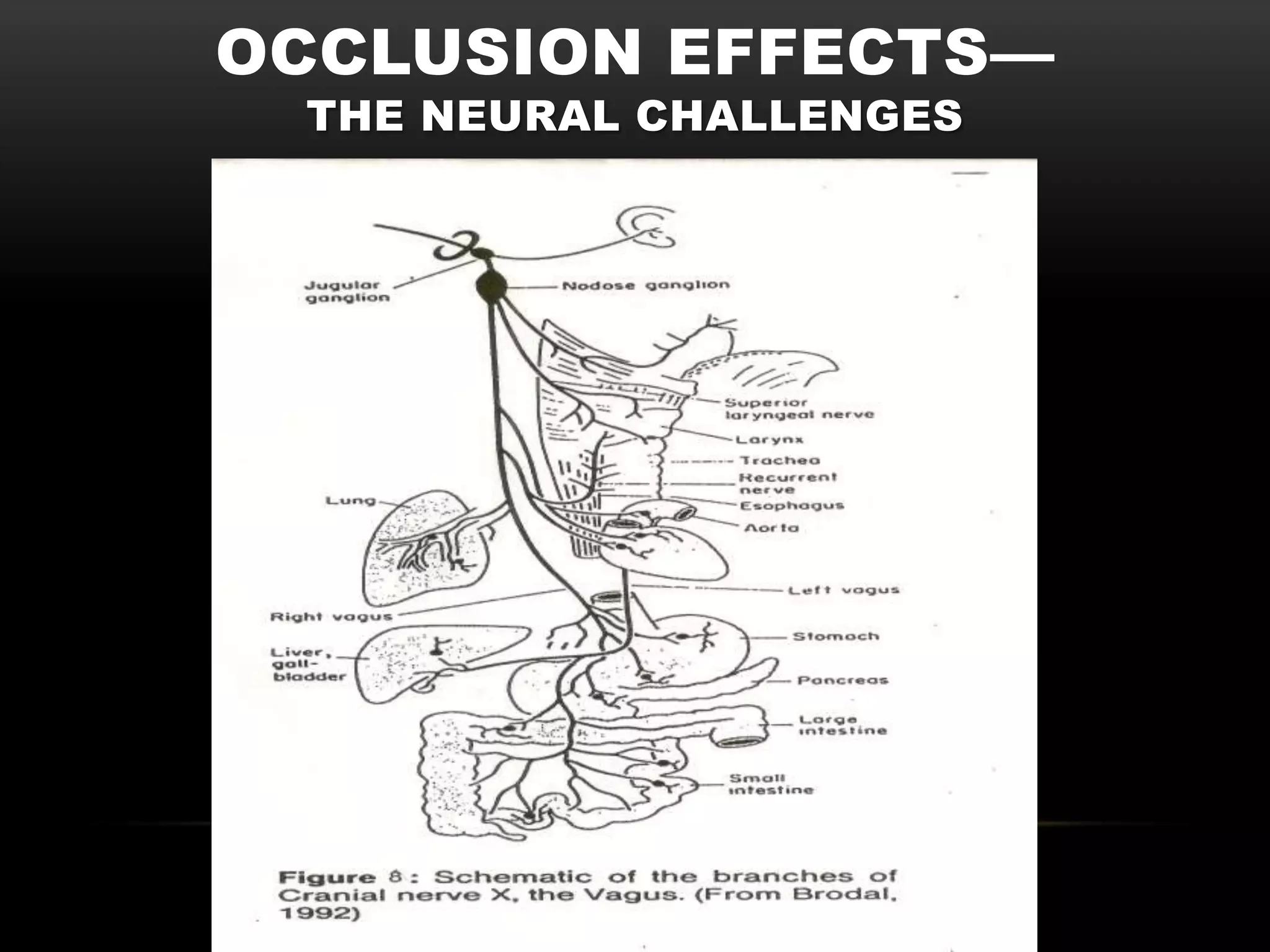
It travels through the body, innervating the
recurrent laryngeal nerves on each side of the
larynx, parts of the lungs, the pericardial sac
around the heart, and parts of the stomach and
intestines.
OCCLUSION EFFECTS—
 THE NEURAL CHALLENGES
OCCLUSION EFFECTS—
           THE NEURAL CHALLENGES

        The Xth (Vagus) Nerve
• Identification of this innervation following
  insertion of the hearing instrument. May involve:
  hoarseness in the voice, coughing, chest pain,
  changes in breathing patterns, changes in heart
  rate, and nausea.
• Note: reports of heart problems and vomiting
  are found in the literature, but should be
  considered an extremely rare instance.
OCCLUSION EFFECTS—
           THE NEURAL CHALLENGES

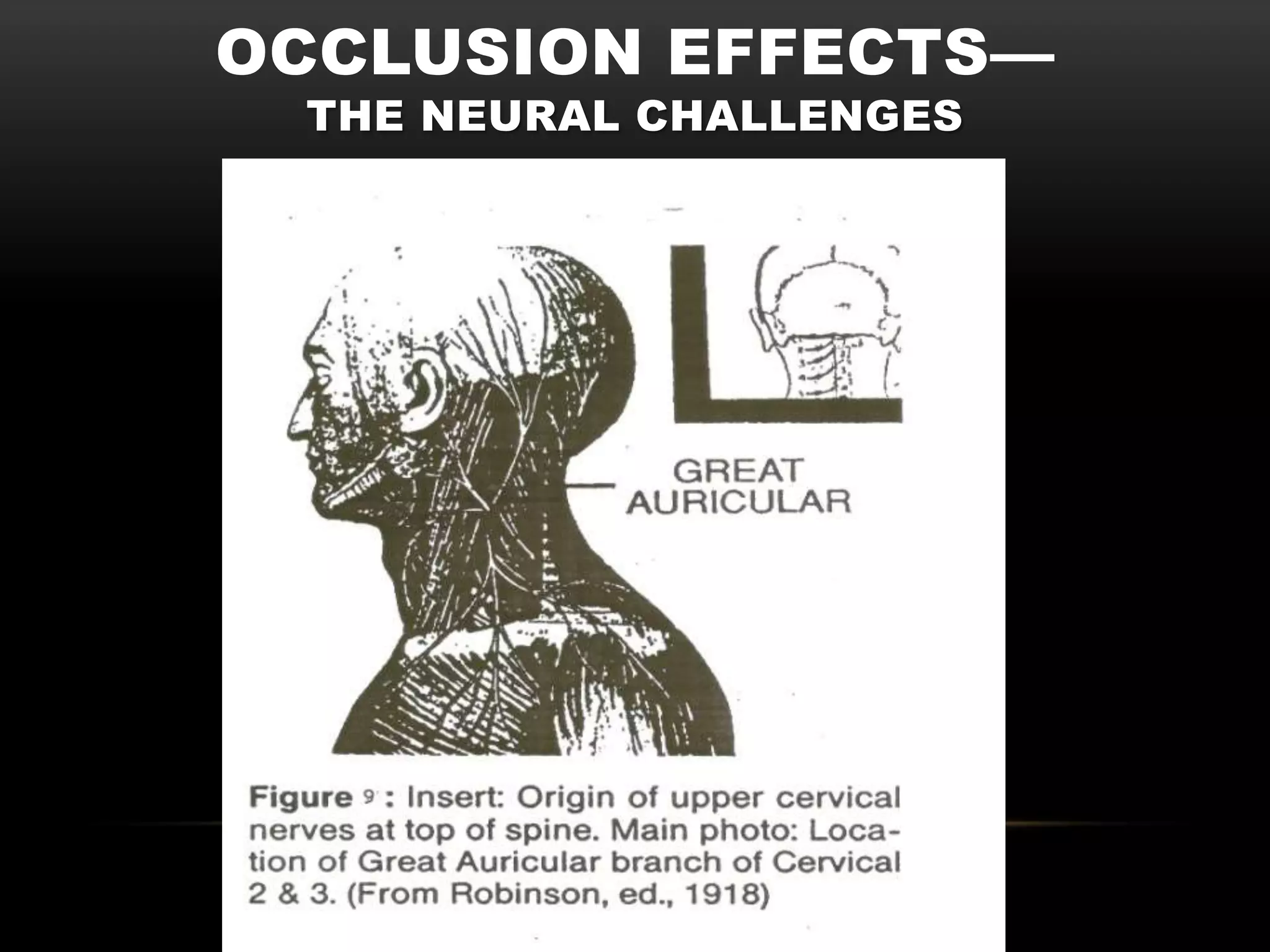
       Cervical Nerves #2 & #3
• Cervical nerves 2 and 3 join to form the great
  auricular nerve, receiving sensory information
  from the helix, anti-helix, lobule, and the mastoid
  process.
• This is likely the location of stimulation for the
  reported problems of tension in the neck and the
  feeling of tightness in the neck experienced in
  some hearing instrument users after insertion of
  their aids.
OCCLUSION EFFECTS—
 THE NEURAL CHALLENGES
OCCLUSION EFFECTS—
           THE NEURAL CHALLENGES

      Cervical Nerves #2 & #3
The reported problems of tension and the feeling
of tightness in the neck after hearing instrument
insertion, is a direct connection between the Xth
(Vagus) nerve and Cervical 2 and 3; thus,
increasing the potential for these complaints even
when the instruments involved do not place direct
pressure on the helix, anti-helix, or the mastoid.
OCCLUSION EFFECTS—
           THE NEURAL CHALLENGES

  Temporal Mandibular Joint (TMJ)
• Of special concern in cases involving non-
  acoustic occlusion effects is the role of the
  temporal-mandibular joint.
• Since the TMJ induces movement in the ear
  canal, the presence of an acoustic coupler could
  cause more pressure on the nerves in the area of
  the TMJ than would normally be found.
OCCLUSION EFFECTS—
           THE NEURAL CHALLENGES


When neuropathy due to trauma, disease
processes, chemical changes, heredity, or aging
causes alterations in the normal transfer of neuro-
electrical signals, the result could be multiple
stimuli from a single sensory event. This neuro-
electrical "short circuit" is presumed to be the
basic process involved in non-acoustic occlusion.
OCCLUSION EFFECTS—
           THE NEURAL CHALLENGES

The presence of and pressure from an occluding
object in the ear canal could cause a cross-firing of
the nerve, stimulating another nerve. It is likely that
the most common cross-firing patterns occur
within single major neural pathways.
OCCLUSION EFFECTS—
          THE NEURAL CHALLENGES


It becomes increasingly evident that suggestions
concerning the value and applicability of the
principles of reflexology and acupressure,
stemming from the concept of neural interaction as
the norm rather than an exception may reflect a
true understanding of the afferent/efferent
connections and the behavioral effects of these
nerve branches.
OCCLUSION EFFECTS—
          THE NEURAL CHALLENGES


It is clear that the tactile reality of wearing an
instrument must be considered in the fitting
of hearing aids along with the acoustic needs
of the patient.

Occlusion effects -the neural challenges

  • 1.
    OCCLUSION EFFECTS— THE NEURAL CHALLENGES • There remain those cases in which occlusion is reduced--almost to the point of elimination--with reported problems of "feeling plugged" still occurring. • Such instances fall into the category termed here as the "non-acoustic/neural occlusion effect".
  • 2.
    OCCLUSION EFFECTS— THE NEURAL CHALLENGES The “non-acoustic/neural occlusion effect” is defined as the sensation of stimuli in parts of the body at or away from the ears while wearing hearing instruments, whether amplification is operational or not.
  • 3.
    OCCLUSION EFFECTS— THE NEURAL CHALLENGES • Non-acoustic/neural occlusion is believed to be caused by the pressure of acoustic coupling shells against the nerves of the outer ear. • Its effects in individual cases are important to understand, as it may involve both cranial and cervical nerves.
  • 4.
    OCCLUSION EFFECTS— THE NEURAL CHALLENGES Signs of Neural Occlusion Reports of headaches, nausea, numbness, pressure, tension, pain, tearing in the eyes, running noses, tingling sensations, soreness, hoarseness, sore throat, changes in breathing, blood pressure, heart rate, and feelings of being "plugged up" while wearing vented hearing instruments, may be suspect signs of neural occlusion.
  • 5.
    OCCLUSION EFFECTS— THE NEURAL CHALLENGES • The literature on the nerve endings found in and around the outer ear reveals numerous discrepancies in location of individual nerves. • This fact demonstrates the broad variability in final development of the structures of the human body.
  • 6.
    OCCLUSION EFFECTS— THE NEURAL CHALLENGES The descriptions of neural pathways are intended as general guidelines only. Individual variation should be regarded as a constant possibility. In addition, the nerves found in the outer ear do not follow straight line courses like those frequently found in anatomic diagrams. They usually form spiraling patterns of individual neurons whose course is often subject to meandering.
  • 7.
    OCCLUSION EFFECTS— THE NEURAL CHALLENGES • There are four cranial nerves involved in the process of sensory innervations of the outer ear. They are: Cranial nerves V, VII, IX, and X. • The Cranial nerves originate in the Pons and Medulla in the brainstem (see FIGURE 5).
  • 8.
    OCCLUSION EFFECTS— THENEURAL CHALLENGES
  • 9.
    OCCLUSION EFFECTS— THE NEURAL CHALLENGES Please note: Both Cranial and Cervical nerves can generally be regarded as major communication points between the brain and body for intake of sensory (afferent) information and execution of motor (efferent) activities.
  • 10.
    OCCLUSION EFFECTS— THE NEURAL CHALLENGES The Vth (trigeminal) Cranial Nerve • The Vth (trigeminal) cranial nerve is divided into three major branches: the ophthalmic, maxillary, and mandibular. • One division of the mandibular branch is the auricular-temporal nerve, which provides sensory innervations to the top and front walls of the external auditory meatus, to the tragus, and to the crest of the helix.
  • 11.
    OCCLUSION EFFECTS— THENEURAL CHALLENGES
  • 12.
    OCCLUSION EFFECTS— THE NEURAL CHALLENGES The ophthalmic branch proceeds across the top of the temporal muscle and around the front of the face just above the brow. Patients who report headache and/or muscle tension in this area following insertion of their hearing instrument may be triggering a neural arc and stimulating contraction of the muscles above the brow and along the upper side of the face. Those contractions would then be registered by the Trigeminal (Vth cranial) as feelings of tension, etc.
  • 13.
    OCCLUSION EFFECTS— THE NEURAL CHALLENGES The mandibular division of Vth cranial nerve provides the sensory input from the lower teeth and jaw, motor control of the tensor tympani and the muscles of mastication. The external ear canal initiated neural activity leading to stimulation of the muscles and nerves of the mandible, may be reported as pain deep in the ear, lower jaw pain, pain in the lower teeth, tension in the cheeks or mouth, difficulty in chewing, or pain at the temporal-mandibular joint.
  • 14.
    OCCLUSION EFFECTS— THE NEURAL CHALLENGES Please note: Since the tensor tympani is directly involved in the acoustic reflex, it is possible that insertion of an acoustic coupling could result in the acoustic reflex “firing” thus, causing damping of the sound transmission through the ossicles and resulting in a reported feeling of occlusion.
  • 15.
    OCCLUSION EFFECTS— THE NEURAL CHALLENGES The VIIth Cranial (facial) Nerve • The VIIth cranial (facial) nerve, is predominantly a motor neuron. • It does have sensory loci on the back of the auricle and in the concha. • In some reports, the nerve has been found to branch from its sensory array at the tympanic membrane to and through the external ear canal to join the peripheral nerves in the auricle.
  • 16.
    OCCLUSION EFFECTS— THE NEURAL CHALLENGES The VIIth Cranial (facial) Nerve The chorda tympani branch of Cranial VII controls contraction of the stapedius muscle as well as providing the sensation of taste in the anterior 2/3rds of the tongue.
  • 17.
    OCCLUSION EFFECTS— THE NEURAL CHALLENGES The VIIth Cranial (facial) Nerve The facial nerve is unique among the twelve cranial nerves, in that it normally is inherently capable of cross-communication with: • cranial nerves V, VIII, and IX, X, and • the upper cervical nerves #2 & #3.
  • 18.
    OCCLUSION EFFECTS— THENEURAL CHALLENGES
  • 19.
    OCCLUSION EFFECTS— THE NEURAL CHALLENGES Please Note: The neural cross-communication process is not fully understood, but lends general support to the idea that individual neural stimuli could influence other neural pathway responses.
  • 20.
    OCCLUSION EFFECTS— THE NEURAL CHALLENGES • Innervations of Cranial VII (facial) nerve could cause muscle tension in the face which would be sensed by neurons of the cranial Vth (trigeminal). • The Vth (trigeminal), with its' numerous branches, may create changes in the sense of taste, a runny nose, tearing or dryness in the eyes, either dryness or excess saliva in the mouth, and/or tension in the eyelids.
  • 21.
    OCCLUSION EFFECTS— THE NEURAL CHALLENGES The VIIth Cranial (facial) Nerve Please note: Contraction of the stapedius could cause feelings of occlusion as well as increased sensitivity to low frequency sounds—they will have difficulty modulating their own voice.
  • 22.
    OCCLUSION EFFECTS— THE NEURAL CHALLENGES The IXth (glossopharyngeal) Nerve • The Glossopharyngeal cranial nerve IX, innervates sensation to the mucous membrane of the tympanic cavity, as well as controlling motor activity in opening and closing the Eustachian tube. • Branches of cranial IX have been found to extend into the ear canal.
  • 23.
    OCCLUSION EFFECTS— THE NEURAL CHALLENGES The IXth (glossopharyngeal) Nerve • The primary sensory divisions of this nerve are involved in the back of the tongue and mouth, and the top of the throat. • They could produce complaints of numbness, soreness, and tension in these areas.
  • 24.
    OCCLUSION EFFECTS— THE NEURAL CHALLENGES The Xth (Vagus) Nerve • Most hearing instrument specialists are familiar with the occasional cough response when inserting an impression block. • The cough reflex is generated through Arnold's branch of the Vagus nerve, Cranial X. • The Vagus provides sensory innervations to the bottom and back walls of the external meatus.
  • 25.
    OCCLUSION EFFECTS— THE NEURAL CHALLENGES The Xth (Vagus) Nerve Since one branch of Cranial X also provides monitoring of blood pressure, reports of hearing aid wearers with rapid heart rate and increased blood pressure may have much more than an emotional basis!
  • 26.
    OCCLUSION EFFECTS— THE NEURAL CHALLENGES The Xth (Vagus) Nerve It travels through the body, innervating the recurrent laryngeal nerves on each side of the larynx, parts of the lungs, the pericardial sac around the heart, and parts of the stomach and intestines.
  • 27.
    OCCLUSION EFFECTS— THENEURAL CHALLENGES
  • 28.
    OCCLUSION EFFECTS— THE NEURAL CHALLENGES The Xth (Vagus) Nerve • Identification of this innervation following insertion of the hearing instrument. May involve: hoarseness in the voice, coughing, chest pain, changes in breathing patterns, changes in heart rate, and nausea. • Note: reports of heart problems and vomiting are found in the literature, but should be considered an extremely rare instance.
  • 29.
    OCCLUSION EFFECTS— THE NEURAL CHALLENGES Cervical Nerves #2 & #3 • Cervical nerves 2 and 3 join to form the great auricular nerve, receiving sensory information from the helix, anti-helix, lobule, and the mastoid process. • This is likely the location of stimulation for the reported problems of tension in the neck and the feeling of tightness in the neck experienced in some hearing instrument users after insertion of their aids.
  • 30.
    OCCLUSION EFFECTS— THENEURAL CHALLENGES
  • 31.
    OCCLUSION EFFECTS— THE NEURAL CHALLENGES Cervical Nerves #2 & #3 The reported problems of tension and the feeling of tightness in the neck after hearing instrument insertion, is a direct connection between the Xth (Vagus) nerve and Cervical 2 and 3; thus, increasing the potential for these complaints even when the instruments involved do not place direct pressure on the helix, anti-helix, or the mastoid.
  • 32.
    OCCLUSION EFFECTS— THE NEURAL CHALLENGES Temporal Mandibular Joint (TMJ) • Of special concern in cases involving non- acoustic occlusion effects is the role of the temporal-mandibular joint. • Since the TMJ induces movement in the ear canal, the presence of an acoustic coupler could cause more pressure on the nerves in the area of the TMJ than would normally be found.
  • 33.
    OCCLUSION EFFECTS— THE NEURAL CHALLENGES When neuropathy due to trauma, disease processes, chemical changes, heredity, or aging causes alterations in the normal transfer of neuro- electrical signals, the result could be multiple stimuli from a single sensory event. This neuro- electrical "short circuit" is presumed to be the basic process involved in non-acoustic occlusion.
  • 34.
    OCCLUSION EFFECTS— THE NEURAL CHALLENGES The presence of and pressure from an occluding object in the ear canal could cause a cross-firing of the nerve, stimulating another nerve. It is likely that the most common cross-firing patterns occur within single major neural pathways.
  • 35.
    OCCLUSION EFFECTS— THE NEURAL CHALLENGES It becomes increasingly evident that suggestions concerning the value and applicability of the principles of reflexology and acupressure, stemming from the concept of neural interaction as the norm rather than an exception may reflect a true understanding of the afferent/efferent connections and the behavioral effects of these nerve branches.
  • 36.
    OCCLUSION EFFECTS— THE NEURAL CHALLENGES It is clear that the tactile reality of wearing an instrument must be considered in the fitting of hearing aids along with the acoustic needs of the patient.