CARE CONFERENCE
HAEMORRHOID
SRN NOORHAZAMIN HAMID
NURSING EDUCATION SERVICES
At the end of this session, you will be
able to :
State the definition of
haemorrhoid.
List the etiology of haemorrhoid.
Identify the pathophysiology of
haemorrhoid.
State the sign & symptom of
haemorrhoid.
LEARNING OBJECTIVES cont.
Identify the complication of
haemorrhoid.
Identify the nursing intervention &
appreciate the nursing care for
haemorrhoid patient.
Doctor = Dr DA
Diagnosis
= THROMBOSED
PILES
Mr. F was admitted to
5XX-1 with complaint of :
 PR Bleeding
 PR Pain
 Constipation
 Lethargic
Medical history
- Sinusitis (July 2011)
- HPT (Jan 2012)
Surgical history
- I&D abscess Lt big toe
(26/4/11)
- Exc. Wart Rt heel (2006)
Family medical history
- HPT (Both parents)
Allergic
- ? Antibiotic taken from
GP (facial swelling)
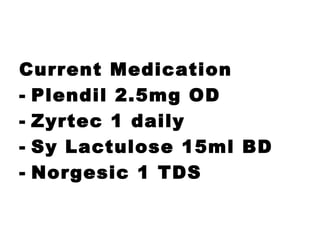
Current Medication
- Plendil 2.5mg OD
- Zyrtec 1 daily
- Sy Lactulose 15ml BD
- Norgesic 1 TDS
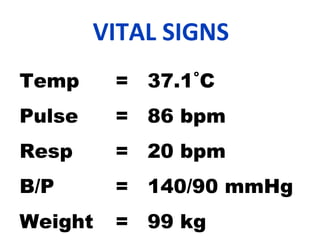
VITAL SIGNS
Temp = 37.1˚C
Pulse = 86 bpm
Resp = 20 bpm
B/P = 140/90 mmHg
Weight = 99 kg
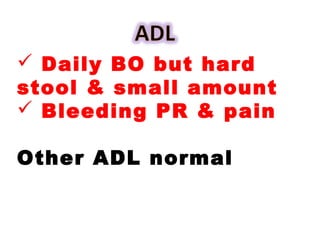
 Daily BO but hard
stool & small amount
 Bleeding PR & pain
Other ADL normal
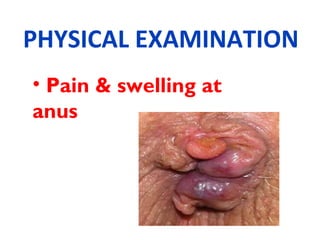
PHYSICAL EXAMINATION
• Pain & swelling at
anus
S/B Dr DA :
HAEMORRHOIDECTOMY under Spinal on
12/6/12
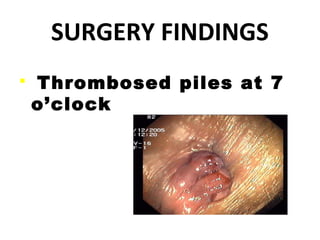
SURGERY FINDINGS
 Thrombosed piles at 7
o’clock
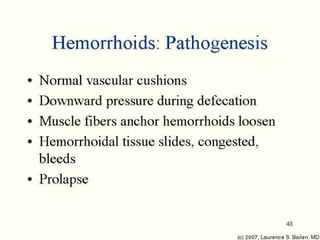
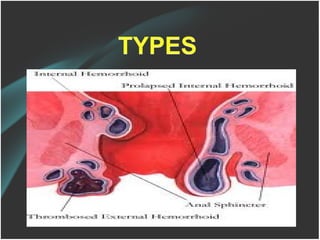
HAEMORRHOID
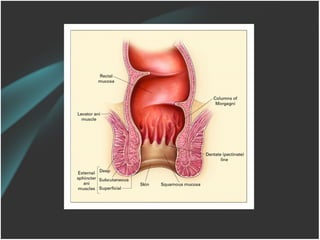
• A network of small veins (blood vessels)
within the inside lining of the anus and lower
rectum become wider and engorged with
more blood than usual.
• These engorged veins and the overlying
tissue may then form into one or more small
swellings called haemorrhoids.
WHAT CAUSES IT?
 Low fiber intake
 Low fluid intake
 Frequent constipation & straining
 Pregnancy
 Hereditary
 Painkiller
 Aging
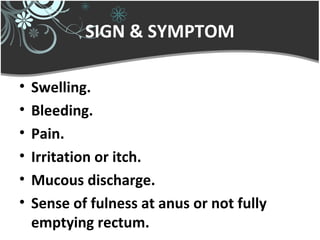
SIGN & SYMPTOM
• Swelling.
• Bleeding.
• Pain.
• Irritation or itch.
• Mucous discharge.
• Sense of fulness at anus or not fully
emptying rectum.
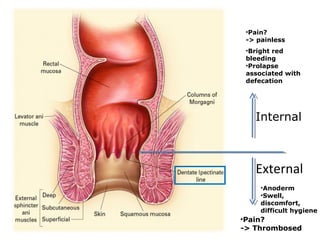
External
Internal
•Anoderm
•Swell,
discomfort,
difficult hygiene
•Pain?
-> Thrombosed
•Pain?
-> painless
•Bright red
bleeding
•Prolapse
associated with
defecation
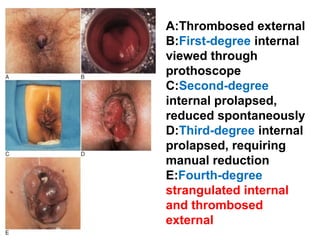
A:Thrombosed external
B:First-degree internal
viewed through
prothoscope
C:Second-degree
internal prolapsed,
reduced spontaneously
D:Third-degree internal
prolapsed, requiring
manual reduction
E:Fourth-degree
strangulated internal
and thrombosed
external
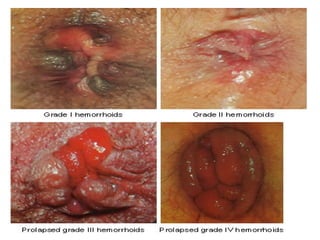
GRADE 1
• Small swellings on the inside lining of
the back passage.
• They cannot be seen or felt from
outside the anus.
GRADE 2
• Are larger.
• They may be partly pushed out
(prolapse) from the anus when you go
to the toilet, but quickly spring back
inside again.
GRADE 3
• Hang out (prolapse) from the anus.
• You may feel one or more as small, soft
lumps that hang from the anus.
• However, you can push them back
inside the anus with a finger.
GRADE 4
• Permanently hang down from within
the anus, and you cannot push them
back inside.
• They sometimes become quite large.
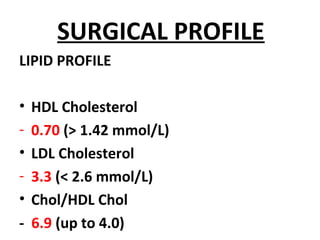
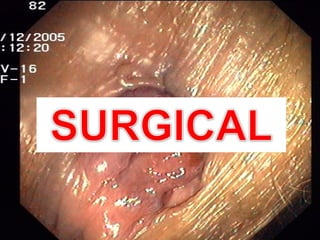
SURGICAL PROFILE
LIPID PROFILE
• HDL Cholesterol
- 0.70 (> 1.42 mmol/L)
• LDL Cholesterol
- 3.3 (< 2.6 mmol/L)
• Chol/HDL Chol
- 6.9 (up to 4.0)
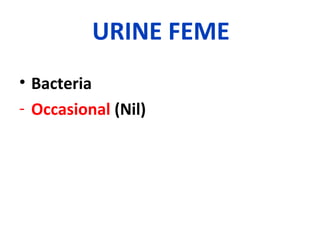
URINE FEME
• Bacteria
- Occasional (Nil)
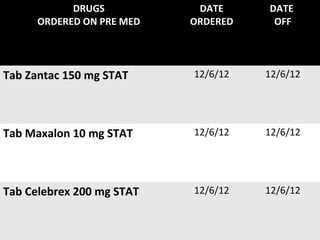
DRUGS
ORDERED ON PRE MED
DATE
ORDERED
DATE
OFF
Tab Zantac 150 mg STAT 12/6/12 12/6/12
Tab Maxalon 10 mg STAT 12/6/12 12/6/12
Tab Celebrex 200 mg STAT 12/6/12 12/6/12
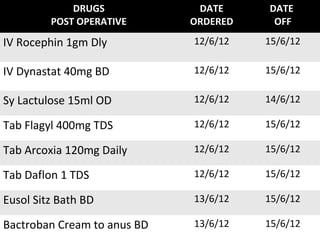
DRUGS
POST OPERATIVE
DATE
ORDERED
DATE
OFF
IV Rocephin 1gm Dly 12/6/12 15/6/12
IV Dynastat 40mg BD 12/6/12 15/6/12
Sy Lactulose 15ml OD 12/6/12 14/6/12
Tab Flagyl 400mg TDS 12/6/12 15/6/12
Tab Arcoxia 120mg Daily 12/6/12 15/6/12
Tab Daflon 1 TDS 12/6/12 15/6/12
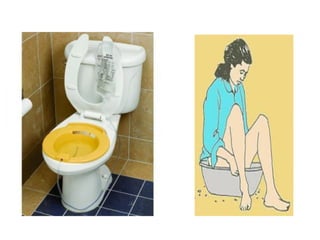
Eusol Sitz Bath BD 13/6/12 15/6/12
Bactroban Cream to anus BD 13/6/12 15/6/12

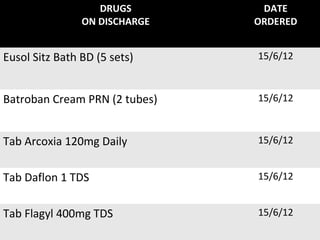
DRUGS
ON DISCHARGE
DATE
ORDERED
Eusol Sitz Bath BD (5 sets) 15/6/12
Batroban Cream PRN (2 tubes) 15/6/12
Tab Arcoxia 120mg Daily 15/6/12
Tab Daflon 1 TDS 15/6/12
Tab Flagyl 400mg TDS 15/6/12
Alteration in comfort
related to anal pain.
NURSING DIAGNOSIS
 Alteration in emotional
status anxiety related to
surgical procedure and
bleeding piles.
NURSING DIAGNOSIS
 Potential bleeding
related to abrasion at
anus.
NURSING DIAGNOSIS
NURSING DIAGNOSIS
 Potential bleeding related
to surgical wound.
NURSING DIAGNOSIS
Potential infection related
to surgical incision.
NURSING DIAGNOSIS
 Alteration in ADL related to
post spinal anaesthesia.
NURSING DIAGNOSIS
 Potential infection
related to intravenous
cannula insertion.
NURSING DIAGNOSIS
 Potential infection related
to CBD catherization.
NURSING DIAGNOSIS
 Knowledge deficit related
to treatment regime and
post operative hygeine care.
Haemorrhoid
Haemorrhoid

Haemorrhoid