CHILD HEALTH NURSING
Introduction
Mr. Sachin Sharma
Assistant Professor
Child Health Nursing Department
2ND G.N.M. UNIT-1
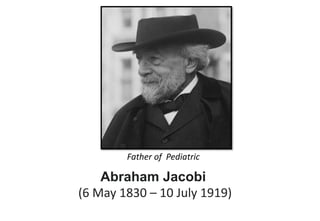
Abraham Jacobi
(6 May 1830 – 10 July 1919)
Father of Pediatric
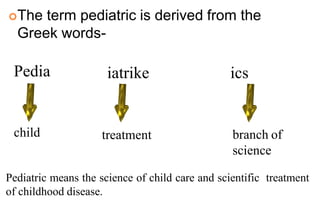
The term pediatric is derived from the
Greek words-
3
Pedia iatrike ics
child treatment branch of
science
Pediatric means the science of child care and scientific treatment
of childhood disease.
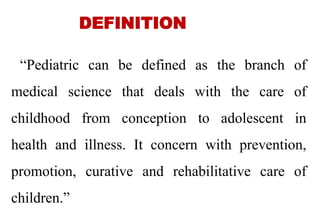
DEFINITION
“Pediatric can be defined as the branch of
medical science that deals with the care of
childhood from conception to adolescent in
health and illness. It concern with prevention,
promotion, curative and rehabilitative care of
children.”
4
TERMINOLOGIES
Neonate: Aneonate is a child under 28 days of age.
Infant: Infancy is the period from birth through the completion
of the 12th month of life.
Toddler: Toddlers are children between the age of 13 months to
3 years of age.
Preschoolers/early childhood: Children between the age of 3–5-
year-old are called preschoolers.
School-going children/middle childhood: Children between the
age group of 6 and 11 years are called as school- going children.
Adolescence: It is the phase of life between childhood and
adulthood. Early adolescence is the age group between 12 and
18 years.
Late adolescence is the age group between 19 and 21 years.
A. Modern concept in child health care
B. Trends in pediatric nursing
C. Role of pediatric nurses in child care
D. Emerging challenges, nursing
process related to pediatric
nursing
E. Concept of preventive pediatric
F. Vital statistics related to pediatrics
as per the NRHS and Goal
TABLE OF CONTENTS
TOPICS FOR DISCUSSION
by Mr. Sachin Sharma (M.Sc. N.)
6
A. MODERN CONCEPT
IN
CHILD HEALTH CARE
by Mr. Sachin Sharma (M.Sc. N.)
7
MODERN CONCEPT IN CHILD
HEALTH CARE
1. In recent years, due to advancement of
technology child health care has changed
dramatically.
2. Today, Pediatrician's study and practice, sub-
specialty of pediatrics focusing on specific types
of ailments and health conditions in children.
3. Modern concept have significantly changed
the health care system and role of the
nurses to care for the child's health.
4. As the advancement occurs in medical science
and other related fields, the child health concept
was also changed to promote health of mothers
and children, so that nation will get healthy
mothers and healthy children.
by Mr. Sachin Sharma (M.Sc. N.)
8
Traditional
Concept
Pediatric
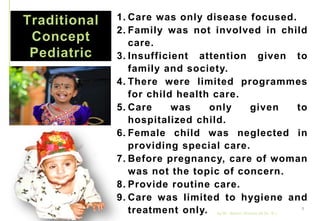
1. Care was only disease focused.
2. Family was not involved in child
care.
3. Insufficient attention given to
family and society.
4. There were limited programmes
for child health care.
5. Care was only given to
hospitalized child.
6. Female child was neglected in
providing special care.
7. Before pregnancy, care of woman
was not the topic of concern.
8. Provide routine care.
9. Care was limited to hygiene and
treatment only. by Mr. Sachin Sharma (M.Sc. N.)
9
Modern
Concept
Pediatric
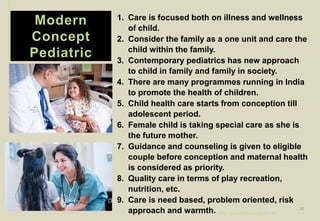
1. Care is focused both on illness and wellness
of child.
2. Consider the family as a one unit and care the
child within the family.
3. Contemporary pediatrics has new approach
to child in family and family in society.
4. There are many programmes running in India
to promote the health of children.
5. Child health care starts from conception till
adolescent period.
6. Female child is taking special care as she is
the future mother.
7. Guidance and counseling is given to eligible
couple before conception and maternal health
is considered as priority.
8. Quality care in terms of play recreation,
nutrition, etc.
9. Care is need based, problem oriented, risk
approach and warmth. by Mr. Sachin Sharma (M.Sc. N.)
10
B. TRENDS IN PEDIATRIC
NURSING
CHILD HEALTH NURSING
by Mr. Sachin Sharma (M.Sc. N.)
11
TRENDS IN PEDIATRIC NURSING
1. Scientific treatment from infancy to adolescence.
2. Administration of vaccines for preventable disease.
3. Monthly assessment of growth and development.
4. Focus on prevention.
5. Advancement of science and technology in medical field.
6. Practice by registered nurses and pediatricians.
7. Problem-solving approach.
8. Evidence-based practices.
9. Family centered care.
10.Regular laboratory examination in schools, families and
communities.
11.Knowledgeable health workers.
12.Focus on promotion of child health.
13.Providing ordered medical therapies in home and hospital.
14.Motivate people and families to participate in childcare.
15.Educate and aware public about communicable diseases.
by Mr. Sachin Sharma (M.Sc. N.)
12
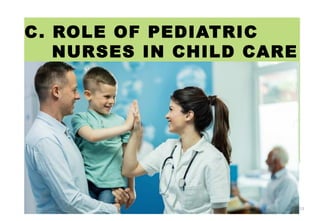
C. ROLE OF PEDIATRIC
NURSES IN CHILD CARE
CHILD HEALTH NURSING
by Mr. Sachin Sharma (M.Sc. N.)
13
WHAT IS ROLE OF
PEDIATRIC NURSE??
ROLE OF PEDIATRIC NURSE
The role of the pediatric nurse is
both caring and curing.
• Caring is a continuous process in both wellness
and illness at refers as helping guiding and
counselling.
• Curing refers to the act of diagnosis and
management usually during illness.
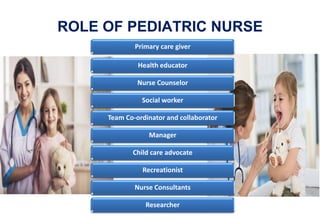
ROLE OF PEDIATRIC NURSE
Primary care giver
Health educator
Nurse Counselor
Social worker
Team Co-ordinator and collaborator
Manager
Child care advocate
Recreationist
Nurse Consultants
Researcher
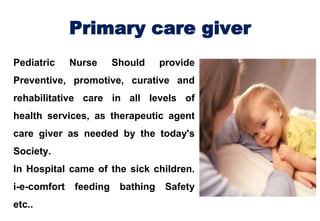
Primary care giver
Pediatric Nurse Should provide
Preventive, promotive, curative and
rehabilitative care in all levels of
health services, as therapeutic agent
care giver as needed by the today's
Society.
In Hospital came of the sick children.
i-e-comfort feeding bathing Safety
etc..
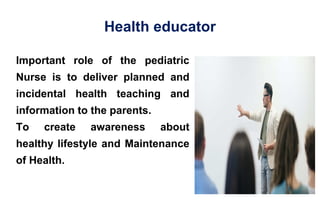
Health educator
Important role of the pediatric
Nurse is to deliver planned and
incidental health teaching and
information to the parents.
To create awareness about
healthy lifestyle and Maintenance
of Health.
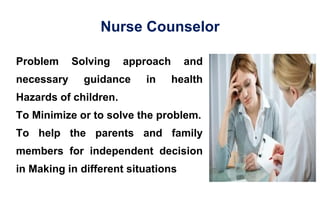
Nurse Counselor
Problem Solving approach and
necessary guidance in health
Hazards of children.
To Minimize or to solve the problem.
To help the parents and family
members for independent decision
in Making in different situations
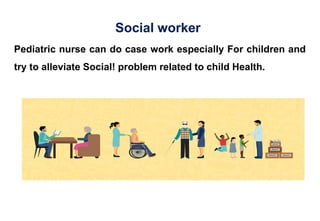
Social worker
Pediatric nurse can do case work especially For children and
try to alleviate Social! problem related to child Health.
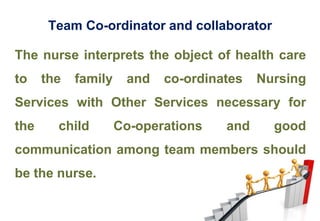
Team Co-ordinator and collaborator
The nurse interprets the object of health care
to the family and co-ordinates Nursing
Services with Other Services necessary for
the child Co-operations and good
communication among team members should
be the nurse.
Manager
The pediatric nurse is the Manager of pediatric care
units in hospital Clinics and Community.
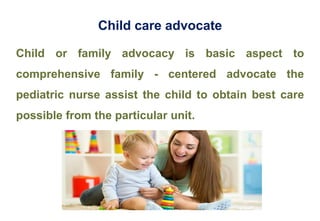
Child care advocate
Child or family advocacy is basic aspect to
comprehensive family - centered advocate the
pediatric nurse assist the child to obtain best care
possible from the particular unit.
Recreationist
This Supportive role of pediatric Nurse is important
for the child to adjust to the Crisis imposed by
illness hospitalization.
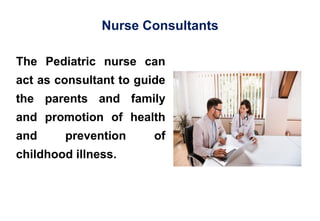
Nurse Consultants
The Pediatric nurse can
act as consultant to guide
the parents and family
and promotion of health
and prevention of
childhood illness.
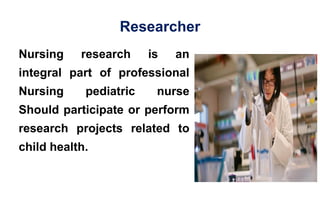
Researcher
Nursing research is an
integral part of professional
Nursing pediatric nurse
Should participate or perform
research projects related to
child health.
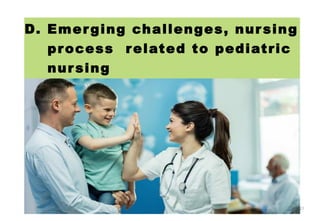
D. Emerging challenges, nursing
process related to pediatric
nursing
by Mr. Sachin Sharma (M.Sc. N.)
27
• Emergencies of medical specialty &
super specialty education on training of
pediatric nurse.
• Nurses required up to date.
• Increasing number of psychological
problem among children need attention
of pediatric nurse in child care.
• Nurse must be confidence & engaged to
advocate for the child protection in
these situation in hospital and
community.
by Mr. Sachin Sharma (M.Sc. N.)
28
EMERGING CHALLENGES
Conti…
• Poverty & illness are two big obstricles
need to over come to improve child
health.
• Childhood illness lead to frustrating &
stressful situation.
• Emphasis on quality care. (Special
attention on care)
• Increasing care and nursing practiced
which need for specialized approach.
by Mr. Sachin Sharma (M.Sc. N.)
29
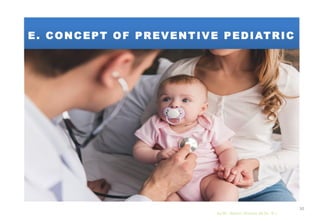
E. CONCEPT OF PREVENTIVE PEDIATRIC
by Mr. Sachin Sharma (M.Sc. N.)
30
1. Concept
2. Aims of Preventive Pediatric
3. Aspects of preventive pediatric
4. Levels of preventive pediatric
5. Preventive pediatric in different age group.
by Mr. Sachin Sharma (M.Sc. N.)
31
TABLE OF CONTENTS
TOPICS FOR DISCUSSION
1. CONCEPT
by Mr. Sachin Sharma (M.Sc. N.)
32
2. AIMS OF PREVENTIVE PEDIATRIC
by Mr. Sachin Sharma (M.Sc. N.)
33
3. ASPECTS OF PREVENTIVE PEDIATRIC
by Mr. Sachin Sharma (M.Sc. N.)
34
4. LEVELS OF PREVENTIVE PEDIATRIC
by Mr. Sachin Sharma (M.Sc. N.)
35
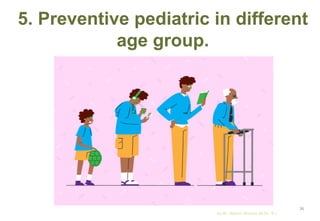
5. Preventive pediatric in different
age group.
by Mr. Sachin Sharma (M.Sc. N.)
36
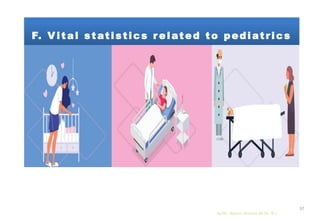
F. V ital statistics r elated to pediatrics
by Mr. Sachin Sharma (M.Sc. N.)
37
Definition:-
Vital statistics are conventionally numerical
records of marriage births, sickness, and death by
which the health and growth of community may be
studied. Or It is a branch of biometry deals with data
and law of human mortality, morbidity, &
demography.
by Mr. Sachin Sharma (M.Sc. N.)
38
Community Health:
• To describe the level of community health, to
diagnose community illness & to discover
solutions to health problems.
by Mr. Sachin Sharma (M.Sc. N.)
39
Purpose:-
Administrative purpose:
• It provides clues for administrative action to
create administrative standards of health
activities.
by Mr. Sachin Sharma (M.Sc. N.)
40
Conti….
Conti….
Health programmed organization:
• To determine success or failure of specific health
programmed or undertake overall evaluation of
public health work.
by Mr. Sachin Sharma (M.Sc. N.)
41
Legislation purpose:
• To promote health legislation at local, state, &
national level.
by Mr. Sachin Sharma (M.Sc. N.)
42
Conti….
Government Purpose:
• To develope, policies, procedure at state and
central level.
by Mr. Sachin Sharma (M.Sc. N.)
43
Conti….
Uses:-
1)To evaluate the impact of various National Health Programmes.
2)To plan for better future measures of disease control.
3)To explain the hereditary nature of the disease.
4)To plan and evaluate economic and social development.
5)It is a primary tool in research activities.
6)To determine the health status of individual.
7)To compare the health status of individual one nation with others.
by Mr. Sachin Sharma (M.Sc. N.)
44
Sources of Vital Statistics:-
by Mr. Sachin Sharma (M.Sc. N.)
45
1. Civil Registration System: It is defined as the
continuous permanent and compulsory recording of
the occurrence of vital events like live births, deaths,
fetal deaths, marriages, divorces, as well as, judicial
separation, adoption. Civil registration is performed
under a law and regulation so as to provide legal
basis to the records and certificate made from
system.
by Mr. Sachin Sharma (M.Sc. N.)
46
2. National Sample Survey: The data collected
from the census are not very reliable and available
only once in 10 years. In absence of reliable data
from the civil registration system, Sample
registration system (SRS), the need for reliable
statistics at national and state levels is being met
through sample surveys launched from time to time.
by Mr. Sachin Sharma (M.Sc. N.)
47
3. Sample Registration System: In this system,
there is continuous enumeration of births and
deaths in a sample of villages/urban blocks by a
resident part-time enumerator and then an
independent six monthly retrospective survey by a
full time supervisor.
by Mr. Sachin Sharma (M.Sc. N.)
48
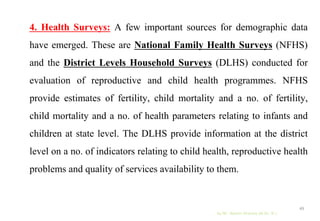
4. Health Surveys: A few important sources for demographic data
have emerged. These are National Family Health Surveys (NFHS)
and the District Levels Household Surveys (DLHS) conducted for
evaluation of reproductive and child health programmes. NFHS
provide estimates of fertility, child mortality and a no. of fertility,
child mortality and a no. of health parameters relating to infants and
children at state level. The DLHS provide information at the district
level on a no. of indicators relating to child health, reproductive health
problems and quality of services availability to them.
by Mr. Sachin Sharma (M.Sc. N.)
49
Important Vital Statistics
by Mr. Sachin Sharma (M.Sc. N.)
50
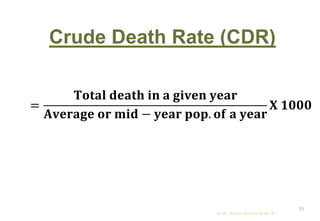
Crude Death Rate (CDR)
by Mr. Sachin Sharma (M.Sc. N.)
51
=
𝐓𝐨𝐭𝐚𝐥 𝐝𝐞𝐚𝐭𝐡 𝐢𝐧 𝐚 𝐠𝐢𝐯𝐞𝐧 𝐲𝐞𝐚𝐫
𝐀𝐯𝐞𝐫𝐚𝐠𝐞 𝐨𝐫 𝐦𝐢𝐝 − 𝐲𝐞𝐚𝐫 𝐩𝐨𝐩. 𝐨𝐟 𝐚 𝐲𝐞𝐚𝐫
𝐗 𝟏𝟎𝟎𝟎
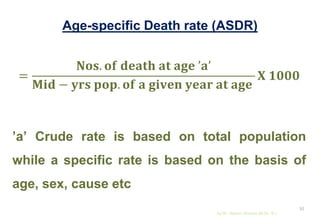
Age-specific Death rate (ASDR)
=
𝐍𝐨𝐬. 𝐨𝐟 𝐝𝐞𝐚𝐭𝐡 𝐚𝐭 𝐚𝐠𝐞 ’𝐚’
𝐌𝐢𝐝 − 𝐲𝐫𝐬 𝐩𝐨𝐩. 𝐨𝐟 𝐚 𝐠𝐢𝐯𝐞𝐧 𝐲𝐞𝐚𝐫 𝐚𝐭 𝐚𝐠𝐞
𝐗 𝟏𝟎𝟎𝟎
’a’ Crude rate is based on total population
while a specific rate is based on the basis of
age, sex, cause etc
by Mr. Sachin Sharma (M.Sc. N.)
52
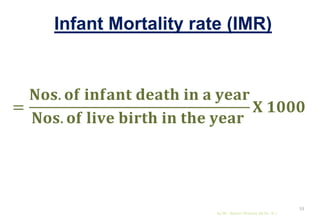
Infant Mortality rate (IMR)
=
𝐍𝐨𝐬. 𝐨𝐟 𝐢𝐧𝐟𝐚𝐧𝐭 𝐝𝐞𝐚𝐭𝐡 𝐢𝐧 𝐚 𝐲𝐞𝐚𝐫
𝐍𝐨𝐬. 𝐨𝐟 𝐥𝐢𝐯𝐞 𝐛𝐢𝐫𝐭𝐡 𝐢𝐧 𝐭𝐡𝐞 𝐲𝐞𝐚𝐫
𝐗 𝟏𝟎𝟎𝟎
by Mr. Sachin Sharma (M.Sc. N.)
53
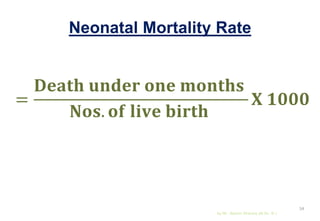
Neonatal Mortality Rate
=
𝐃𝐞𝐚𝐭𝐡 𝐮𝐧𝐝𝐞𝐫 𝐨𝐧𝐞 𝐦𝐨𝐧𝐭𝐡𝐬
𝐍𝐨𝐬. 𝐨𝐟 𝐥𝐢𝐯𝐞 𝐛𝐢𝐫𝐭𝐡
𝐗 𝟏𝟎𝟎𝟎
by Mr. Sachin Sharma (M.Sc. N.)
54
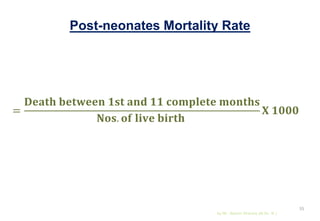
Post-neonates Mortality Rate
=
𝐃𝐞𝐚𝐭𝐡 𝐛𝐞𝐭𝐰𝐞𝐞𝐧 𝟏𝐬𝐭 𝐚𝐧𝐝 𝟏𝟏 𝐜𝐨𝐦𝐩𝐥𝐞𝐭𝐞 𝐦𝐨𝐧𝐭𝐡𝐬
𝐍𝐨𝐬. 𝐨𝐟 𝐥𝐢𝐯𝐞 𝐛𝐢𝐫𝐭𝐡
𝐗 𝟏𝟎𝟎𝟎
by Mr. Sachin Sharma (M.Sc. N.)
55
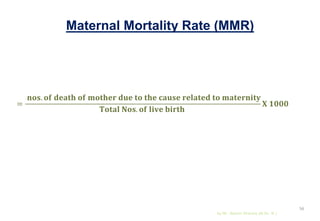
Maternal Mortality Rate (MMR)
=
𝐧𝐨𝐬. 𝐨𝐟 𝐝𝐞𝐚𝐭𝐡 𝐨𝐟 𝐦𝐨𝐭𝐡𝐞𝐫 𝐝𝐮𝐞 𝐭𝐨 𝐭𝐡𝐞 𝐜𝐚𝐮𝐬𝐞 𝐫𝐞𝐥𝐚𝐭𝐞𝐝 𝐭𝐨 𝐦𝐚𝐭𝐞𝐫𝐧𝐢𝐭𝐲
𝐓𝐨𝐭𝐚𝐥 𝐍𝐨𝐬. 𝐨𝐟 𝐥𝐢𝐯𝐞 𝐛𝐢𝐫𝐭𝐡
𝐗 𝟏𝟎𝟎𝟎
by Mr. Sachin Sharma (M.Sc. N.)
56
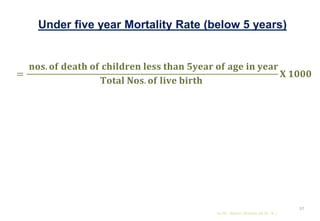
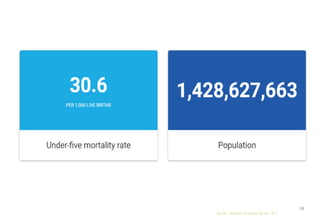
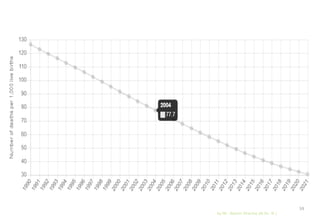
Under five year Mortality Rate (below 5 years)
=
𝐧𝐨𝐬. 𝐨𝐟 𝐝𝐞𝐚𝐭𝐡 𝐨𝐟 𝐜𝐡𝐢𝐥𝐝𝐫𝐞𝐧 𝐥𝐞𝐬𝐬 𝐭𝐡𝐚𝐧 𝟓𝐲𝐞𝐚𝐫 𝐨𝐟 𝐚𝐠𝐞 𝐢𝐧 𝐲𝐞𝐚𝐫
𝐓𝐨𝐭𝐚𝐥 𝐍𝐨𝐬. 𝐨𝐟 𝐥𝐢𝐯𝐞 𝐛𝐢𝐫𝐭𝐡
𝐗 𝟏𝟎𝟎𝟎
by Mr. Sachin Sharma (M.Sc. N.)
57
by Mr. Sachin Sharma (M.Sc. N.)
58
by Mr. Sachin Sharma (M.Sc. N.)
59
by Mr. Sachin Sharma (M.Sc. N.)
THANK YOU
60

Second Year G.N.M. UNIT-1 Introduction.pdf

  • 1.
    CHILD HEALTH NURSING Introduction Mr.Sachin Sharma Assistant Professor Child Health Nursing Department 2ND G.N.M. UNIT-1
  • 2.
    Abraham Jacobi (6 May1830 – 10 July 1919) Father of Pediatric
  • 3.
    The term pediatricis derived from the Greek words- 3 Pedia iatrike ics child treatment branch of science Pediatric means the science of child care and scientific treatment of childhood disease.
  • 4.
    DEFINITION “Pediatric can bedefined as the branch of medical science that deals with the care of childhood from conception to adolescent in health and illness. It concern with prevention, promotion, curative and rehabilitative care of children.” 4
  • 5.
    TERMINOLOGIES Neonate: Aneonate isa child under 28 days of age. Infant: Infancy is the period from birth through the completion of the 12th month of life. Toddler: Toddlers are children between the age of 13 months to 3 years of age. Preschoolers/early childhood: Children between the age of 3–5- year-old are called preschoolers. School-going children/middle childhood: Children between the age group of 6 and 11 years are called as school- going children. Adolescence: It is the phase of life between childhood and adulthood. Early adolescence is the age group between 12 and 18 years. Late adolescence is the age group between 19 and 21 years.
  • 6.
    A. Modern conceptin child health care B. Trends in pediatric nursing C. Role of pediatric nurses in child care D. Emerging challenges, nursing process related to pediatric nursing E. Concept of preventive pediatric F. Vital statistics related to pediatrics as per the NRHS and Goal TABLE OF CONTENTS TOPICS FOR DISCUSSION by Mr. Sachin Sharma (M.Sc. N.) 6
  • 7.
    A. MODERN CONCEPT IN CHILDHEALTH CARE by Mr. Sachin Sharma (M.Sc. N.) 7
  • 8.
    MODERN CONCEPT INCHILD HEALTH CARE 1. In recent years, due to advancement of technology child health care has changed dramatically. 2. Today, Pediatrician's study and practice, sub- specialty of pediatrics focusing on specific types of ailments and health conditions in children. 3. Modern concept have significantly changed the health care system and role of the nurses to care for the child's health. 4. As the advancement occurs in medical science and other related fields, the child health concept was also changed to promote health of mothers and children, so that nation will get healthy mothers and healthy children. by Mr. Sachin Sharma (M.Sc. N.) 8
  • 9.
    Traditional Concept Pediatric 1. Care wasonly disease focused. 2. Family was not involved in child care. 3. Insufficient attention given to family and society. 4. There were limited programmes for child health care. 5. Care was only given to hospitalized child. 6. Female child was neglected in providing special care. 7. Before pregnancy, care of woman was not the topic of concern. 8. Provide routine care. 9. Care was limited to hygiene and treatment only. by Mr. Sachin Sharma (M.Sc. N.) 9
  • 10.
    Modern Concept Pediatric 1. Care isfocused both on illness and wellness of child. 2. Consider the family as a one unit and care the child within the family. 3. Contemporary pediatrics has new approach to child in family and family in society. 4. There are many programmes running in India to promote the health of children. 5. Child health care starts from conception till adolescent period. 6. Female child is taking special care as she is the future mother. 7. Guidance and counseling is given to eligible couple before conception and maternal health is considered as priority. 8. Quality care in terms of play recreation, nutrition, etc. 9. Care is need based, problem oriented, risk approach and warmth. by Mr. Sachin Sharma (M.Sc. N.) 10
  • 11.
    B. TRENDS INPEDIATRIC NURSING CHILD HEALTH NURSING by Mr. Sachin Sharma (M.Sc. N.) 11
  • 12.
    TRENDS IN PEDIATRICNURSING 1. Scientific treatment from infancy to adolescence. 2. Administration of vaccines for preventable disease. 3. Monthly assessment of growth and development. 4. Focus on prevention. 5. Advancement of science and technology in medical field. 6. Practice by registered nurses and pediatricians. 7. Problem-solving approach. 8. Evidence-based practices. 9. Family centered care. 10.Regular laboratory examination in schools, families and communities. 11.Knowledgeable health workers. 12.Focus on promotion of child health. 13.Providing ordered medical therapies in home and hospital. 14.Motivate people and families to participate in childcare. 15.Educate and aware public about communicable diseases. by Mr. Sachin Sharma (M.Sc. N.) 12
  • 13.
    C. ROLE OFPEDIATRIC NURSES IN CHILD CARE CHILD HEALTH NURSING by Mr. Sachin Sharma (M.Sc. N.) 13
  • 14.
    WHAT IS ROLEOF PEDIATRIC NURSE??
  • 15.
    ROLE OF PEDIATRICNURSE The role of the pediatric nurse is both caring and curing. • Caring is a continuous process in both wellness and illness at refers as helping guiding and counselling. • Curing refers to the act of diagnosis and management usually during illness.
  • 16.
    ROLE OF PEDIATRICNURSE Primary care giver Health educator Nurse Counselor Social worker Team Co-ordinator and collaborator Manager Child care advocate Recreationist Nurse Consultants Researcher
  • 17.
    Primary care giver PediatricNurse Should provide Preventive, promotive, curative and rehabilitative care in all levels of health services, as therapeutic agent care giver as needed by the today's Society. In Hospital came of the sick children. i-e-comfort feeding bathing Safety etc..
  • 18.
    Health educator Important roleof the pediatric Nurse is to deliver planned and incidental health teaching and information to the parents. To create awareness about healthy lifestyle and Maintenance of Health.
  • 19.
    Nurse Counselor Problem Solvingapproach and necessary guidance in health Hazards of children. To Minimize or to solve the problem. To help the parents and family members for independent decision in Making in different situations
  • 20.
    Social worker Pediatric nursecan do case work especially For children and try to alleviate Social! problem related to child Health.
  • 21.
    Team Co-ordinator andcollaborator The nurse interprets the object of health care to the family and co-ordinates Nursing Services with Other Services necessary for the child Co-operations and good communication among team members should be the nurse.
  • 22.
    Manager The pediatric nurseis the Manager of pediatric care units in hospital Clinics and Community.
  • 23.
    Child care advocate Childor family advocacy is basic aspect to comprehensive family - centered advocate the pediatric nurse assist the child to obtain best care possible from the particular unit.
  • 24.
    Recreationist This Supportive roleof pediatric Nurse is important for the child to adjust to the Crisis imposed by illness hospitalization.
  • 25.
    Nurse Consultants The Pediatricnurse can act as consultant to guide the parents and family and promotion of health and prevention of childhood illness.
  • 26.
    Researcher Nursing research isan integral part of professional Nursing pediatric nurse Should participate or perform research projects related to child health.
  • 27.
    D. Emerging challenges,nursing process related to pediatric nursing by Mr. Sachin Sharma (M.Sc. N.) 27
  • 28.
    • Emergencies ofmedical specialty & super specialty education on training of pediatric nurse. • Nurses required up to date. • Increasing number of psychological problem among children need attention of pediatric nurse in child care. • Nurse must be confidence & engaged to advocate for the child protection in these situation in hospital and community. by Mr. Sachin Sharma (M.Sc. N.) 28 EMERGING CHALLENGES
  • 29.
    Conti… • Poverty &illness are two big obstricles need to over come to improve child health. • Childhood illness lead to frustrating & stressful situation. • Emphasis on quality care. (Special attention on care) • Increasing care and nursing practiced which need for specialized approach. by Mr. Sachin Sharma (M.Sc. N.) 29
  • 30.
    E. CONCEPT OFPREVENTIVE PEDIATRIC by Mr. Sachin Sharma (M.Sc. N.) 30
  • 31.
    1. Concept 2. Aimsof Preventive Pediatric 3. Aspects of preventive pediatric 4. Levels of preventive pediatric 5. Preventive pediatric in different age group. by Mr. Sachin Sharma (M.Sc. N.) 31 TABLE OF CONTENTS TOPICS FOR DISCUSSION
  • 32.
    1. CONCEPT by Mr.Sachin Sharma (M.Sc. N.) 32
  • 33.
    2. AIMS OFPREVENTIVE PEDIATRIC by Mr. Sachin Sharma (M.Sc. N.) 33
  • 34.
    3. ASPECTS OFPREVENTIVE PEDIATRIC by Mr. Sachin Sharma (M.Sc. N.) 34
  • 35.
    4. LEVELS OFPREVENTIVE PEDIATRIC by Mr. Sachin Sharma (M.Sc. N.) 35
  • 36.
    5. Preventive pediatricin different age group. by Mr. Sachin Sharma (M.Sc. N.) 36
  • 37.
    F. V italstatistics r elated to pediatrics by Mr. Sachin Sharma (M.Sc. N.) 37
  • 38.
    Definition:- Vital statistics areconventionally numerical records of marriage births, sickness, and death by which the health and growth of community may be studied. Or It is a branch of biometry deals with data and law of human mortality, morbidity, & demography. by Mr. Sachin Sharma (M.Sc. N.) 38
  • 39.
    Community Health: • Todescribe the level of community health, to diagnose community illness & to discover solutions to health problems. by Mr. Sachin Sharma (M.Sc. N.) 39 Purpose:-
  • 40.
    Administrative purpose: • Itprovides clues for administrative action to create administrative standards of health activities. by Mr. Sachin Sharma (M.Sc. N.) 40 Conti….
  • 41.
    Conti…. Health programmed organization: •To determine success or failure of specific health programmed or undertake overall evaluation of public health work. by Mr. Sachin Sharma (M.Sc. N.) 41
  • 42.
    Legislation purpose: • Topromote health legislation at local, state, & national level. by Mr. Sachin Sharma (M.Sc. N.) 42 Conti….
  • 43.
    Government Purpose: • Todevelope, policies, procedure at state and central level. by Mr. Sachin Sharma (M.Sc. N.) 43 Conti….
  • 44.
    Uses:- 1)To evaluate theimpact of various National Health Programmes. 2)To plan for better future measures of disease control. 3)To explain the hereditary nature of the disease. 4)To plan and evaluate economic and social development. 5)It is a primary tool in research activities. 6)To determine the health status of individual. 7)To compare the health status of individual one nation with others. by Mr. Sachin Sharma (M.Sc. N.) 44
  • 45.
    Sources of VitalStatistics:- by Mr. Sachin Sharma (M.Sc. N.) 45
  • 46.
    1. Civil RegistrationSystem: It is defined as the continuous permanent and compulsory recording of the occurrence of vital events like live births, deaths, fetal deaths, marriages, divorces, as well as, judicial separation, adoption. Civil registration is performed under a law and regulation so as to provide legal basis to the records and certificate made from system. by Mr. Sachin Sharma (M.Sc. N.) 46
  • 47.
    2. National SampleSurvey: The data collected from the census are not very reliable and available only once in 10 years. In absence of reliable data from the civil registration system, Sample registration system (SRS), the need for reliable statistics at national and state levels is being met through sample surveys launched from time to time. by Mr. Sachin Sharma (M.Sc. N.) 47
  • 48.
    3. Sample RegistrationSystem: In this system, there is continuous enumeration of births and deaths in a sample of villages/urban blocks by a resident part-time enumerator and then an independent six monthly retrospective survey by a full time supervisor. by Mr. Sachin Sharma (M.Sc. N.) 48
  • 49.
    4. Health Surveys:A few important sources for demographic data have emerged. These are National Family Health Surveys (NFHS) and the District Levels Household Surveys (DLHS) conducted for evaluation of reproductive and child health programmes. NFHS provide estimates of fertility, child mortality and a no. of fertility, child mortality and a no. of health parameters relating to infants and children at state level. The DLHS provide information at the district level on a no. of indicators relating to child health, reproductive health problems and quality of services availability to them. by Mr. Sachin Sharma (M.Sc. N.) 49
  • 50.
    Important Vital Statistics byMr. Sachin Sharma (M.Sc. N.) 50
  • 51.
    Crude Death Rate(CDR) by Mr. Sachin Sharma (M.Sc. N.) 51 = 𝐓𝐨𝐭𝐚𝐥 𝐝𝐞𝐚𝐭𝐡 𝐢𝐧 𝐚 𝐠𝐢𝐯𝐞𝐧 𝐲𝐞𝐚𝐫 𝐀𝐯𝐞𝐫𝐚𝐠𝐞 𝐨𝐫 𝐦𝐢𝐝 − 𝐲𝐞𝐚𝐫 𝐩𝐨𝐩. 𝐨𝐟 𝐚 𝐲𝐞𝐚𝐫 𝐗 𝟏𝟎𝟎𝟎
  • 52.
    Age-specific Death rate(ASDR) = 𝐍𝐨𝐬. 𝐨𝐟 𝐝𝐞𝐚𝐭𝐡 𝐚𝐭 𝐚𝐠𝐞 ’𝐚’ 𝐌𝐢𝐝 − 𝐲𝐫𝐬 𝐩𝐨𝐩. 𝐨𝐟 𝐚 𝐠𝐢𝐯𝐞𝐧 𝐲𝐞𝐚𝐫 𝐚𝐭 𝐚𝐠𝐞 𝐗 𝟏𝟎𝟎𝟎 ’a’ Crude rate is based on total population while a specific rate is based on the basis of age, sex, cause etc by Mr. Sachin Sharma (M.Sc. N.) 52
  • 53.
    Infant Mortality rate(IMR) = 𝐍𝐨𝐬. 𝐨𝐟 𝐢𝐧𝐟𝐚𝐧𝐭 𝐝𝐞𝐚𝐭𝐡 𝐢𝐧 𝐚 𝐲𝐞𝐚𝐫 𝐍𝐨𝐬. 𝐨𝐟 𝐥𝐢𝐯𝐞 𝐛𝐢𝐫𝐭𝐡 𝐢𝐧 𝐭𝐡𝐞 𝐲𝐞𝐚𝐫 𝐗 𝟏𝟎𝟎𝟎 by Mr. Sachin Sharma (M.Sc. N.) 53
  • 54.
    Neonatal Mortality Rate = 𝐃𝐞𝐚𝐭𝐡𝐮𝐧𝐝𝐞𝐫 𝐨𝐧𝐞 𝐦𝐨𝐧𝐭𝐡𝐬 𝐍𝐨𝐬. 𝐨𝐟 𝐥𝐢𝐯𝐞 𝐛𝐢𝐫𝐭𝐡 𝐗 𝟏𝟎𝟎𝟎 by Mr. Sachin Sharma (M.Sc. N.) 54
  • 55.
    Post-neonates Mortality Rate = 𝐃𝐞𝐚𝐭𝐡𝐛𝐞𝐭𝐰𝐞𝐞𝐧 𝟏𝐬𝐭 𝐚𝐧𝐝 𝟏𝟏 𝐜𝐨𝐦𝐩𝐥𝐞𝐭𝐞 𝐦𝐨𝐧𝐭𝐡𝐬 𝐍𝐨𝐬. 𝐨𝐟 𝐥𝐢𝐯𝐞 𝐛𝐢𝐫𝐭𝐡 𝐗 𝟏𝟎𝟎𝟎 by Mr. Sachin Sharma (M.Sc. N.) 55
  • 56.
    Maternal Mortality Rate(MMR) = 𝐧𝐨𝐬. 𝐨𝐟 𝐝𝐞𝐚𝐭𝐡 𝐨𝐟 𝐦𝐨𝐭𝐡𝐞𝐫 𝐝𝐮𝐞 𝐭𝐨 𝐭𝐡𝐞 𝐜𝐚𝐮𝐬𝐞 𝐫𝐞𝐥𝐚𝐭𝐞𝐝 𝐭𝐨 𝐦𝐚𝐭𝐞𝐫𝐧𝐢𝐭𝐲 𝐓𝐨𝐭𝐚𝐥 𝐍𝐨𝐬. 𝐨𝐟 𝐥𝐢𝐯𝐞 𝐛𝐢𝐫𝐭𝐡 𝐗 𝟏𝟎𝟎𝟎 by Mr. Sachin Sharma (M.Sc. N.) 56
  • 57.
    Under five yearMortality Rate (below 5 years) = 𝐧𝐨𝐬. 𝐨𝐟 𝐝𝐞𝐚𝐭𝐡 𝐨𝐟 𝐜𝐡𝐢𝐥𝐝𝐫𝐞𝐧 𝐥𝐞𝐬𝐬 𝐭𝐡𝐚𝐧 𝟓𝐲𝐞𝐚𝐫 𝐨𝐟 𝐚𝐠𝐞 𝐢𝐧 𝐲𝐞𝐚𝐫 𝐓𝐨𝐭𝐚𝐥 𝐍𝐨𝐬. 𝐨𝐟 𝐥𝐢𝐯𝐞 𝐛𝐢𝐫𝐭𝐡 𝐗 𝟏𝟎𝟎𝟎 by Mr. Sachin Sharma (M.Sc. N.) 57
  • 58.
    by Mr. SachinSharma (M.Sc. N.) 58
  • 59.
    by Mr. SachinSharma (M.Sc. N.) 59
  • 60.
    by Mr. SachinSharma (M.Sc. N.) THANK YOU 60