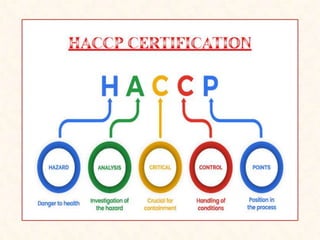
HACCP
Hazard Analysis Critical Control Point (HACCP)
• HACCP is: Preventive, not reactive.
• A management tool used to protect the food
supply against biological, chemical and physical
hazards.
History
HACCP was introduced for the first time in USA, during the
National Conference on food security in 1971 (American Public
Health Association,1972)
The first industry application was developed by a team of food
scientists and engineers from the Pillsbury Company, The Natick
Research Lab. and National Aeronautics and Space Administration
(NASA) for astronaut feeding during the NASA manned space
program.
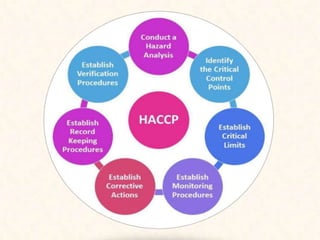
HACCP Principles
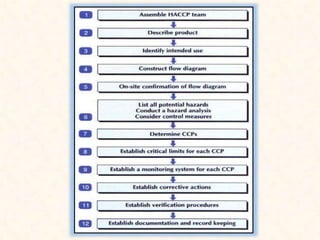
HACCP is a two-part system
• The first part focuses on defining the nature of the
product being produced and developing a flow diagram
which details each operational step in the process.
• The second part of HACCP consists of applying the seven
principles.
7 Principles of HACCP
Principle 1-Conduct a hazard analysis
• A hazard is defined as a biological, chemical, or physical agent that is
reasonably likely to cause illness or injury in the absence of its control.
• There are three types of food hazard:
-Physical
- Chemical
-Biological.
• The purpose of the hazard analysis is to develop a list of hazards that
are of such significance that they are reasonably likely to cause illness or
injury if not effectively controlled.
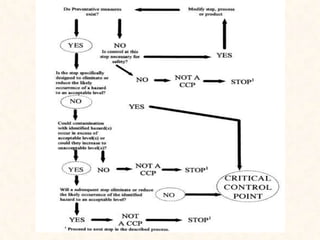
Principle 2-Determine the critical control points
• A critical control point (CCP) is defined as a step at which control can be
applied and is essential to prevent or eliminate a food safety hazard, or
reduce it to an acceptable level.
• There are two types of CCPs, CCP1 & CCP2
-CCP1 will ensure the control of a hazard.
-CCP2 will minimise the hazard, but will not ensure its control.
• Examples of CCPs could include thermal processing, chilling, testing
ingredients for chemical residues, product formulation control, and
testing product for metal contamination.
Principle 3-Establish critical limits
• Critical limits are boundaries which are used to judge whether the operation is
producing safe product.
• It can be a maximum and/or minimum value to which a biological, chemical or
physical parameter must be controlled at a CCP to prevent, eliminate, or reduce to
an acceptable level the occurrence of a food safety hazard.
• Failure to achieve the critical limit means that the CCP is not in control and the
food being produced must be considered unsafe.
Principle 4-Establish monitoring procedures
• Monitoring is a planned sequence of observations or measurements to assess and
to produce an accurate record for future use in verification.
• Monitoring at CCP is done to determine whether or not the critical limit(s),
established for each CCP, is being met.
• The main methods to monitor a CCP are –
-Visual examination
-Sensory evaluation
-Physical measurement
-Chemical testing
-Microbiological analysis
Principle 5-Establish corrective actions
• Corrective actions are taken when the results of monitoring at the CCP
indicate a loss of control.
• When there is a deviation from established critical limits, corrective action is
necessary.
• As recommended by the NACMCF (1998), corrective actions are
predetermined components of a written HACCP plan. However, while FDA’s
rules (1995) require that corrective actions be taken, they are not required to
be predetermined.
• Corrective actions include the following elements:
(a) determine and correct the cause of noncompliance
(b) determine the disposition of noncompliant product
(c) record the corrective actions that have been taken.
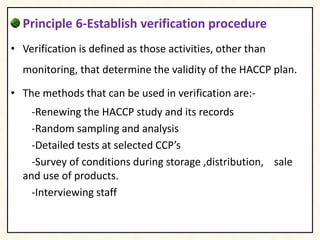
Principle 6-Establish verification procedure
• Verification is defined as those activities, other than
monitoring, that determine the validity of the HACCP plan.
• The methods that can be used in verification are:-
-Renewing the HACCP study and its records
-Random sampling and analysis
-Detailed tests at selected CCP’s
-Survey of conditions during storage ,distribution, sale
and use of products.
-Interviewing staff
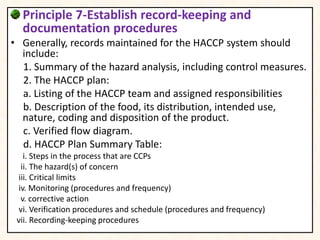
Principle 7-Establish record-keeping and
documentation procedures
• Generally, records maintained for the HACCP system should
include:
1. Summary of the hazard analysis, including control measures.
2. The HACCP plan:
a. Listing of the HACCP team and assigned responsibilities
b. Description of the food, its distribution, intended use,
nature, coding and disposition of the product.
c. Verified flow diagram.
d. HACCP Plan Summary Table:
i. Steps in the process that are CCPs
ii. The hazard(s) of concern
iii. Critical limits
iv. Monitoring (procedures and frequency)
v. corrective action
vi. Verification procedures and schedule (procedures and frequency)
vii. Recording-keeping procedures
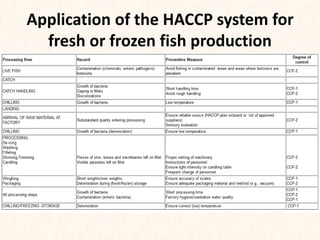
Application of the HACCP system for
fresh or frozen fish production
HACCP Team
1. Chairman : Convene the group , directs the work of the team , ensure
that the concept is properly applied.
2. Process expert: Should possess detailed knowledge about the
production process, require to draw up the initial flow diagram.
3. Engineer: Should have good knowledge and understanding of the
mechanical operations and performances of the processing stages.
4. Microbiologist: Specialists with understanding of particular hazards
and associated risks.
5. Technical Secretary: Recording of team’s progress , results of analysis
etc.
HACCP (Hazard analysis criticle control point)

HACCP (Hazard analysis criticle control point)

  • 1.
  • 2.
    Hazard Analysis CriticalControl Point (HACCP) • HACCP is: Preventive, not reactive. • A management tool used to protect the food supply against biological, chemical and physical hazards.
  • 4.
    History HACCP was introducedfor the first time in USA, during the National Conference on food security in 1971 (American Public Health Association,1972) The first industry application was developed by a team of food scientists and engineers from the Pillsbury Company, The Natick Research Lab. and National Aeronautics and Space Administration (NASA) for astronaut feeding during the NASA manned space program.
  • 5.
    HACCP Principles HACCP isa two-part system • The first part focuses on defining the nature of the product being produced and developing a flow diagram which details each operational step in the process. • The second part of HACCP consists of applying the seven principles.
  • 7.
    7 Principles ofHACCP Principle 1-Conduct a hazard analysis • A hazard is defined as a biological, chemical, or physical agent that is reasonably likely to cause illness or injury in the absence of its control. • There are three types of food hazard: -Physical - Chemical -Biological. • The purpose of the hazard analysis is to develop a list of hazards that are of such significance that they are reasonably likely to cause illness or injury if not effectively controlled.
  • 8.
    Principle 2-Determine thecritical control points • A critical control point (CCP) is defined as a step at which control can be applied and is essential to prevent or eliminate a food safety hazard, or reduce it to an acceptable level. • There are two types of CCPs, CCP1 & CCP2 -CCP1 will ensure the control of a hazard. -CCP2 will minimise the hazard, but will not ensure its control. • Examples of CCPs could include thermal processing, chilling, testing ingredients for chemical residues, product formulation control, and testing product for metal contamination.
  • 9.
    Principle 3-Establish criticallimits • Critical limits are boundaries which are used to judge whether the operation is producing safe product. • It can be a maximum and/or minimum value to which a biological, chemical or physical parameter must be controlled at a CCP to prevent, eliminate, or reduce to an acceptable level the occurrence of a food safety hazard. • Failure to achieve the critical limit means that the CCP is not in control and the food being produced must be considered unsafe. Principle 4-Establish monitoring procedures • Monitoring is a planned sequence of observations or measurements to assess and to produce an accurate record for future use in verification. • Monitoring at CCP is done to determine whether or not the critical limit(s), established for each CCP, is being met. • The main methods to monitor a CCP are – -Visual examination -Sensory evaluation -Physical measurement -Chemical testing -Microbiological analysis
  • 10.
    Principle 5-Establish correctiveactions • Corrective actions are taken when the results of monitoring at the CCP indicate a loss of control. • When there is a deviation from established critical limits, corrective action is necessary. • As recommended by the NACMCF (1998), corrective actions are predetermined components of a written HACCP plan. However, while FDA’s rules (1995) require that corrective actions be taken, they are not required to be predetermined. • Corrective actions include the following elements: (a) determine and correct the cause of noncompliance (b) determine the disposition of noncompliant product (c) record the corrective actions that have been taken.
  • 11.
    Principle 6-Establish verificationprocedure • Verification is defined as those activities, other than monitoring, that determine the validity of the HACCP plan. • The methods that can be used in verification are:- -Renewing the HACCP study and its records -Random sampling and analysis -Detailed tests at selected CCP’s -Survey of conditions during storage ,distribution, sale and use of products. -Interviewing staff
  • 12.
    Principle 7-Establish record-keepingand documentation procedures • Generally, records maintained for the HACCP system should include: 1. Summary of the hazard analysis, including control measures. 2. The HACCP plan: a. Listing of the HACCP team and assigned responsibilities b. Description of the food, its distribution, intended use, nature, coding and disposition of the product. c. Verified flow diagram. d. HACCP Plan Summary Table: i. Steps in the process that are CCPs ii. The hazard(s) of concern iii. Critical limits iv. Monitoring (procedures and frequency) v. corrective action vi. Verification procedures and schedule (procedures and frequency) vii. Recording-keeping procedures
  • 14.
    Application of theHACCP system for fresh or frozen fish production
  • 16.
    HACCP Team 1. Chairman: Convene the group , directs the work of the team , ensure that the concept is properly applied. 2. Process expert: Should possess detailed knowledge about the production process, require to draw up the initial flow diagram. 3. Engineer: Should have good knowledge and understanding of the mechanical operations and performances of the processing stages. 4. Microbiologist: Specialists with understanding of particular hazards and associated risks. 5. Technical Secretary: Recording of team’s progress , results of analysis etc.