Hazard analysis and
critical control point
in aquaculture
Term paper-1st semester
To- Proff. K Riji. John.
Health management in aquaculture AAH(503)
BY- Harapriya Behera
I.D no-I-17-TN-03-002-M-F-048
HACCP
• HACCP concept has taken on a genuinely global perspective in both the
production and inspection of fish and fishery products. The system is to be
applied throughout the food chain from primary production to final consumption
• HACCP: A systematic approach to the identification, evaluation, and control of
food safety hazards. HACCP Plan: The written document which is based upon
the principles of HACCP and which delineates the procedures to be followed.
HACCP System: The result of the implementation of the HACCP Plan.
• . Hazard: A biological, chemical, or physical agent that is reasonably likely to
cause illness or injury in the absence of its control.
• Hazard Analysis: The process of collecting and evaluating information on
hazards associated with the food under consideration to decide which are
significant and must be addressed in the HACCP plan
• Critical Control Point: A step at which control can be applied and is essential to
prevent or eliminate hazard or reduce it to an acceptable level.
• Critical Limit: A maximum and/or minimum value to which a biological,
chemical or physical parameter must be controlled at a CCP to prevent, eliminate
or reduce to an acceptable level the occurrence of hazard.
• Deviation: Failure to meet a critical limit. HACCP Team: The group of people
who are responsible for developing, implementing and maintaining the HACCP
system.
Prerequisite programmes:
1. Building and Equipment design
2. Cleaning and Sanitization
3. Proper facilities
4. Storage of feed(Cold, Dry, Chemical)
5. Service (Potable Water, ventilation)
6. Personal Hygiene
7. Good Hygienic Habits
8. Waste management
9. Pest control
10. Approved drugSuppliers
11. Operational Control
(policy, procedures, work instructions)
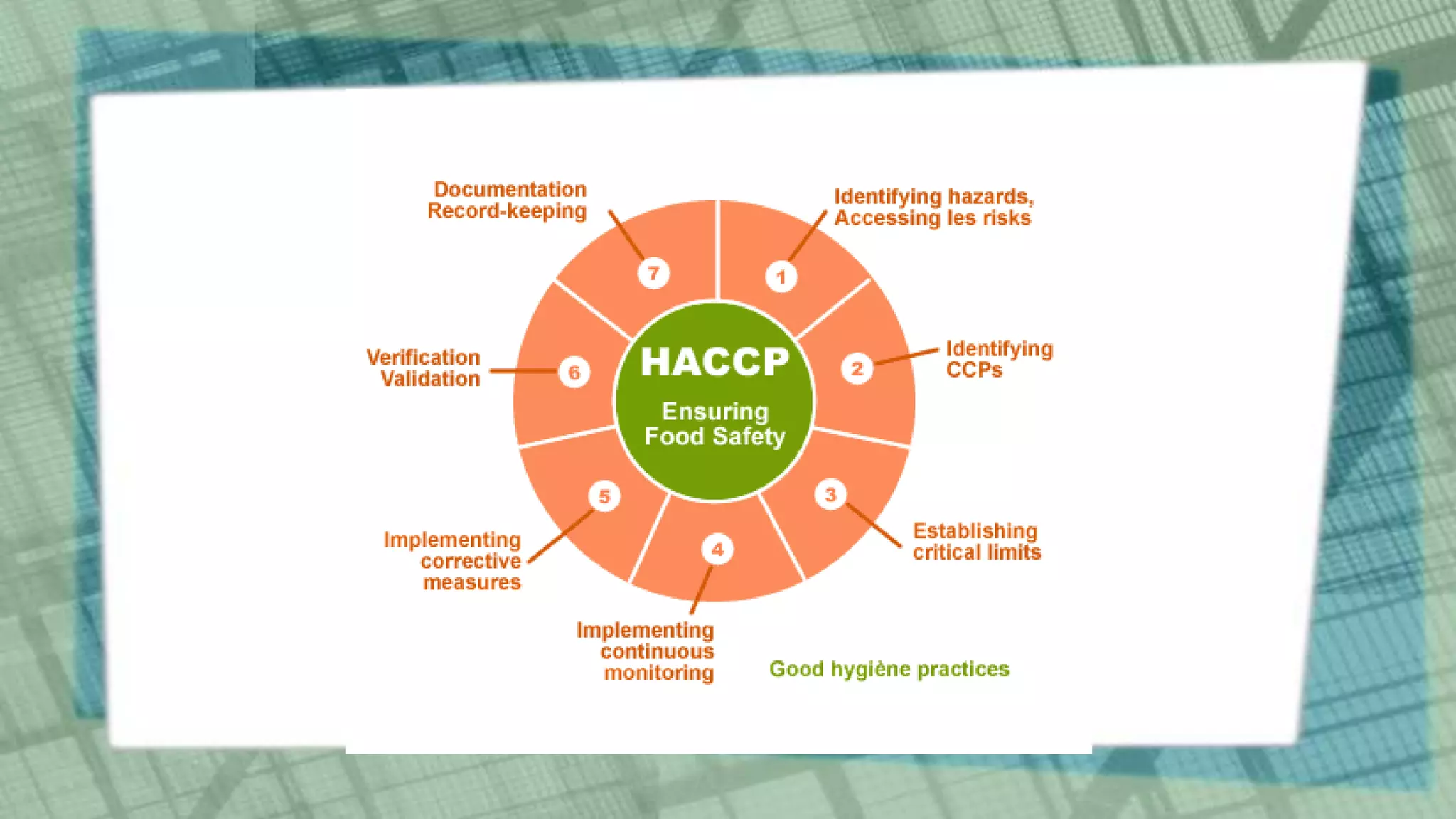
(Principle 1) - Conduct a hazard analysis :
• The purpose of the hazard analysis is to develop a list of hazards that are of such
significance that they are reasonably likely to cause illness or injury if not
effectively controlled.
• Consequently, in the context of HACCP, the word ‘hazard’ is always limited to
safety.
• All seven principles are equally important and must ultimately be integrated into
an overall plan.,
.
(Principle 2) – Determine the critical control points:
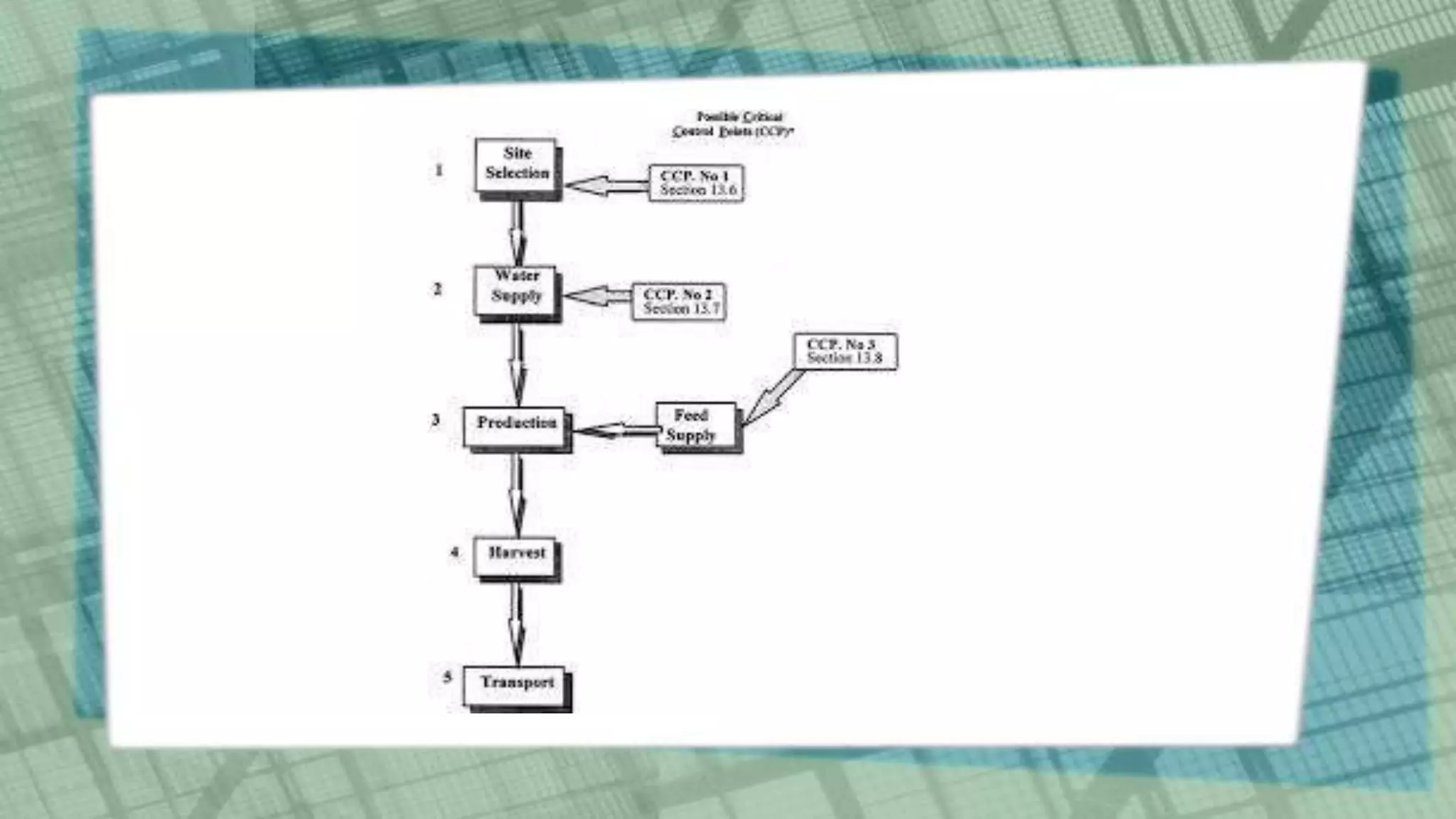
• A critical control point (CCP) is defined as a step at which control can be applied
and is essential to prevent or eliminate a food safety hazard, or reduce into an
acceptable level.
•
(Principle 3) - Establish critical limits :
• A critical limit is a parameter, established at CCPs, which targets conditions
essential for the production of safe food.
• It can be a maximum and/or minimum value to which a biological, chemical or
physical parameter must be controlled at a CCP to prevent, eliminate, or reduce
to an acceptable level the occurrence of a food safety hazard.
• Failure to achieve the critical limit means that the CCP is not in control and the
food being produced must be considered unsafe.
(Principle 4) -Establish monitoring procedures :
• Monitoring is a planned sequence of observations or measurements to assess
whether a CCP is under control and to produce an accurate record for future use
in verification.
• Monitoring serves three main purposes:
first,
it is essential to food safety management in that it facilitates tracking of an
operation. If monitoring indicates that there is a trend toward loss of control, then
action can be taken to bring the process back into control before a deviation from a
critical limit occurs.
Cont,
• Second,
monitoring is used to determine when there is a loss of control and a critical limit
deviation occurs at a CCP, i.e., exceeding or not meeting a critical limit. When a
deviation occurs, an appropriate corrective action must be taken.
• Third,
it provides written documentation for use in verification.
(Principle 5) - Establish corrective actions:
• When there is a deviation from established critical limits, corrective action is
necessary.
• As recommended by the NACMCF (1998), corrective actions are predetermined
components of a written HACCP plan.
• However, while FDA’s rules (1995) require that corrective actions be taken, they
are not required to be predetermined.
cont,
Corrective actions include the following elements:
(a) Determine and correct the cause of noncompliance;
(b) determine the disposition of non- compliant product; and
(c) record the corrective actions that have been taken.
(Principle 6) - Establish verification procedures:
• Verification is defined as those activities, other than monitoring, that determine
the validity of the HACCP plan.
. The activities (other than monitoring) that determine the validity of the plan
include:
• Evaluating whether the facility’s HACCP system is functioning according to the
written plan.
• 2. Determining (initial validation) if the plan is scientifically and technically
sound, that all hazards have been identified, and that if the HACCP plan is
properly implemented these hazards would be effectively controlled. This
includes determining if CCPs have been properly identified and that the critical
limits are scientifically valid for hazards being controlled.
• Equipment calibration is also part of validation.
• 3. A subsequent validation (sometimes referred to as revalidation) is necessary if
there is an unexplained system failure; a significant product, process, or
packaging change occurs; or a new hazard is recognized.
• 4. A periodic comprehensive verification should be conducted, even if there have
been no substantive changes to the plan. FDA requires that seafood processors
review their plan on an annual basis.
(Principle 7) - Establish record-keeping and
documentation procedures:
• Generally, records maintained for the HACCP system should include:
• 1. Summary of the hazard analysis, including rationale for determining hazards
and control measures. (FDA does not require a written hazard analysis).
• 2. The HACCP plan:
• a. Listing of the HACCP team and assigned responsibilities (not requiredby FDA)
• b. Description of the food, its distribution, intended use, and consumer(not
required by FDA)
• c. Verified flow diagram (not required by FDA)
Cont,
d. HACCP Plan Summary Table:
i. steps in the process that are CCPs
ii. the hazard(s) of concern
iii. critical limits
iv. monitoring (procedures and frequency) v. corrective action
vi. verification procedures and schedule (procedures and frequency)
vii. Recording-keeping procedures
Thank you..

Hazard analysis and critical control point in aquaculture

  • 1.
    Hazard analysis and criticalcontrol point in aquaculture Term paper-1st semester To- Proff. K Riji. John. Health management in aquaculture AAH(503) BY- Harapriya Behera I.D no-I-17-TN-03-002-M-F-048
  • 2.
    HACCP • HACCP concepthas taken on a genuinely global perspective in both the production and inspection of fish and fishery products. The system is to be applied throughout the food chain from primary production to final consumption • HACCP: A systematic approach to the identification, evaluation, and control of food safety hazards. HACCP Plan: The written document which is based upon the principles of HACCP and which delineates the procedures to be followed. HACCP System: The result of the implementation of the HACCP Plan. • . Hazard: A biological, chemical, or physical agent that is reasonably likely to cause illness or injury in the absence of its control. • Hazard Analysis: The process of collecting and evaluating information on hazards associated with the food under consideration to decide which are significant and must be addressed in the HACCP plan
  • 3.
    • Critical ControlPoint: A step at which control can be applied and is essential to prevent or eliminate hazard or reduce it to an acceptable level. • Critical Limit: A maximum and/or minimum value to which a biological, chemical or physical parameter must be controlled at a CCP to prevent, eliminate or reduce to an acceptable level the occurrence of hazard. • Deviation: Failure to meet a critical limit. HACCP Team: The group of people who are responsible for developing, implementing and maintaining the HACCP system.
  • 4.
    Prerequisite programmes: 1. Buildingand Equipment design 2. Cleaning and Sanitization 3. Proper facilities 4. Storage of feed(Cold, Dry, Chemical) 5. Service (Potable Water, ventilation) 6. Personal Hygiene 7. Good Hygienic Habits 8. Waste management 9. Pest control 10. Approved drugSuppliers 11. Operational Control (policy, procedures, work instructions)
  • 6.
    (Principle 1) -Conduct a hazard analysis : • The purpose of the hazard analysis is to develop a list of hazards that are of such significance that they are reasonably likely to cause illness or injury if not effectively controlled. • Consequently, in the context of HACCP, the word ‘hazard’ is always limited to safety. • All seven principles are equally important and must ultimately be integrated into an overall plan., .
  • 7.
    (Principle 2) –Determine the critical control points: • A critical control point (CCP) is defined as a step at which control can be applied and is essential to prevent or eliminate a food safety hazard, or reduce into an acceptable level. •
  • 8.
    (Principle 3) -Establish critical limits : • A critical limit is a parameter, established at CCPs, which targets conditions essential for the production of safe food. • It can be a maximum and/or minimum value to which a biological, chemical or physical parameter must be controlled at a CCP to prevent, eliminate, or reduce to an acceptable level the occurrence of a food safety hazard. • Failure to achieve the critical limit means that the CCP is not in control and the food being produced must be considered unsafe.
  • 9.
    (Principle 4) -Establishmonitoring procedures : • Monitoring is a planned sequence of observations or measurements to assess whether a CCP is under control and to produce an accurate record for future use in verification. • Monitoring serves three main purposes: first, it is essential to food safety management in that it facilitates tracking of an operation. If monitoring indicates that there is a trend toward loss of control, then action can be taken to bring the process back into control before a deviation from a critical limit occurs.
  • 10.
    Cont, • Second, monitoring isused to determine when there is a loss of control and a critical limit deviation occurs at a CCP, i.e., exceeding or not meeting a critical limit. When a deviation occurs, an appropriate corrective action must be taken. • Third, it provides written documentation for use in verification.
  • 11.
    (Principle 5) -Establish corrective actions: • When there is a deviation from established critical limits, corrective action is necessary. • As recommended by the NACMCF (1998), corrective actions are predetermined components of a written HACCP plan. • However, while FDA’s rules (1995) require that corrective actions be taken, they are not required to be predetermined.
  • 12.
    cont, Corrective actions includethe following elements: (a) Determine and correct the cause of noncompliance; (b) determine the disposition of non- compliant product; and (c) record the corrective actions that have been taken.
  • 13.
    (Principle 6) -Establish verification procedures: • Verification is defined as those activities, other than monitoring, that determine the validity of the HACCP plan. . The activities (other than monitoring) that determine the validity of the plan include: • Evaluating whether the facility’s HACCP system is functioning according to the written plan. • 2. Determining (initial validation) if the plan is scientifically and technically sound, that all hazards have been identified, and that if the HACCP plan is properly implemented these hazards would be effectively controlled. This includes determining if CCPs have been properly identified and that the critical limits are scientifically valid for hazards being controlled.
  • 14.
    • Equipment calibrationis also part of validation. • 3. A subsequent validation (sometimes referred to as revalidation) is necessary if there is an unexplained system failure; a significant product, process, or packaging change occurs; or a new hazard is recognized. • 4. A periodic comprehensive verification should be conducted, even if there have been no substantive changes to the plan. FDA requires that seafood processors review their plan on an annual basis.
  • 15.
    (Principle 7) -Establish record-keeping and documentation procedures: • Generally, records maintained for the HACCP system should include: • 1. Summary of the hazard analysis, including rationale for determining hazards and control measures. (FDA does not require a written hazard analysis). • 2. The HACCP plan: • a. Listing of the HACCP team and assigned responsibilities (not requiredby FDA) • b. Description of the food, its distribution, intended use, and consumer(not required by FDA) • c. Verified flow diagram (not required by FDA)
  • 16.
    Cont, d. HACCP PlanSummary Table: i. steps in the process that are CCPs ii. the hazard(s) of concern iii. critical limits iv. monitoring (procedures and frequency) v. corrective action vi. verification procedures and schedule (procedures and frequency) vii. Recording-keeping procedures
  • 18.