BIFERTILIZERS
Dr. V.P.Saini
Dean
College of Fisheries Kishanganj
The term 'Biofertilizer' itself means 'Live
Fertilizer'.
 contain live or latent beneficial microbes
which help to fix atmospheric nitrogen,
solubilize and mobilize phosphorus,
translocate minor elements (Zinc, Copper,
etc.,) to the plants, produce plant growth
promoting hormones, vitamins, amino acids
and control plant pathogenic fungi.
 Extremely advantageous in enriching the
soil fertility and fulfilling the plant nutrient
requirements by supplying the organic
nutrients through microorganism and their
byproduct.
Biofertilizer
 Biofertilizers are environmentally safe or eco-
friendly as they do not contain any chemicals
which are harmful to the living soil.
 Biofertilizers are eco-friendly organic agro-
input and more cost effective than chemical
fertilizers.
 Biofertilizers like Rhizobium, Azotobacter and
blue green algae (BGA) are in use since long
time ago.
 Rhizobium inoculant is used for leguminous
crops.
 Azotobacter can be used with crops like wheat,
maize, mustard, cotton, potato and other
vegetable crops.
Why Biofertilizers
Cont...
 Blue green algae belonging to
genera Nostoc, Anabaena, fix
atmospheric nitrogen and are used
as inoculants for paddy crop grown
both under upland and low land
conditions.
 Anabaena in association with water
fern Azolla contributes nitrogen up
to 60 Kg/ha/season and also
enriches soils with organic matter.
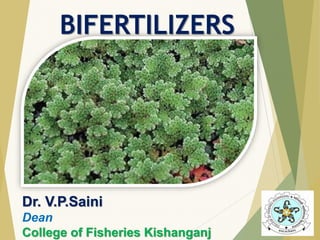
AZOLLA
 Azollae, a free-floating aquatic fern fixing atmospheric
nitrogen through the cyanobacterium. Anabaena azolla,
present in its dorsal leaves, is one of the potential
nitrogenous biofertilizers.
 Its high nitrogen-fixing capacity, rapid multiplication as also
decomposition rates resulting in quick nutrient release
have made it an ideal nutrient input in farming systems.
 Azolla is a heterosporous fern belonging to the family
Azollaceae with seven living species.
 Proliferation of Azolla is basically through vegetative
propagation but sexual reproduction occurs during
temporary adverse environmental conditions .
Potentials of Azolla
 Though Azolla is capable of absorbing nitrogen from its
environment, Anabaena meets the entire N2
requirements of Azolla–Anabaena association.

 The mean daily N2 fixing rates of a developed Azolla
mat are in the range of 1.0–2.6 kg/ha and a comparison
with the process of industrial production of nitrogenous
fertilizers would indicate the efficacy of biological
nitrogen fixation.
 While the latter carried out by the enzyme nitrogenase
 The normal doubling time of Azolla plants is
three days and one kg. of phosphorus
applied results in 4-5 kg. of nitrogen,
through Azolla, i.e. about 1.5 – 2.0 t of fresh
biomass.
 Azolla can survive in a wide pH range of 3.5
to 10.0 with an optimum of 4.5–7.0
 withstand salinities of up to 10 ppt.
 With a dry weight range of 4.8–7.1% among
different species, the nitrogen and carbon
contents are in the ranges of 1.96–5.30% and
41.5–45.3% respectively.
Cont....
 The ranges of elemental composition are
phosphorus 0.10–1.59% potassium 0.31–5.97%
calcium 0.45–1.70%, magnesium 0.22–0.66%
and sulphur 0.22–0.73%.
 Added to these are its high rates of
decomposition with mean daily loss rates of
1.36–4.57% of the initial weight and nitrogen
release rates of 1.25% which make Azolla a
potential biofertilizer in aquaculture systems.
 The percentage ranges of other constituents
on dry weight basis are crude protein 13.0-
30.0, crude fat 4.4–6.3, cellulose 5.6–15.2,
hemicellulose 9.8–17.9, lignin 9.3–34.8 and
ash 9.7–23.8.
A perusal of the published accounts on Azolla
reveals that it is a multifaceted and
multipurpose bio-resource. It can be used as:
 green manure specially for rice;
 mosquito-controlling agent;
 Water purifier-capable of absorbing the
nutrients from the eutrophic waters;
 poultry and duck feed; fish feed
 source of nitrogen;
 Antifungal agent
 natural biofertiliser; and
 source of hydrogen gas
Cultivation of Azolla
 It is necessary to cultivate Azolla
separately for aquaculture and resort to
periodic application in fish ponds.
 A system suitable for such cultivation
comprises a network of earthen raceways
(10.0 x 1.5 x 0.3 m) with facilities for
water supply and drainage.
 The operation in each raceway consists of
application of Azolla inoculum (6 kg),
phosphatic fertilizer (50g single super
phosphate) and pesticide (carbofuron dip
for inoculum at 1.2 ppm), maintenance of
water depth of 5–10 cm and harvesting 18–
24 kg in a week’s time.
 The maintenance includes periodic
removal of superficial earth layers with
organic accumulation, dyke
maintenance, application of bleaching
powder for crab menace and algal
blooms, etc.
 A unit of 0.1 ha area that can hold about
50 raceways is suitable for a family to be
taken up as cottage industry in rural
areas.
 Azolla can be cultured in puddles,
drainage and shallow water stretches, at
the outlets of ponds and tanks and
hence prime agricultural land need not
be used.
Applications in fish farming
 Azolla is useful in aquaculture practices
primarily as a nitrogenous biofertilizer.

 Its high decomposition rates also make it a
suitable substrate for enriching the
detritus food chain or for microbial
processing such as composting prior to
application in ponds.
 Further, Azolla can serve as an ingredient
of supplementary feeds and as forage for
grass carp too.
 Studies made on Azolla biofertilization have shown
that the nutrient requirements of composite carp
culture could be met through application of Azolla
alone at the rate of 40t/ha/yr providing over 100 kg of
nitrogen, 25 kg of phosphorus and 90 kg of potassium
in addition to about 1500 kg of organic matter.
 This amounts to total substitution of chemical
fertilizers along with environmental upkeep through
organic manuring.
 On the basis of the operation of Azolla culture system
at CIFA farm over a period of three years, it is
observed that about 1 tonne of Azolla biomass could
be harvested every week from a water spread area of
650m2, with a phosphorus input-nitrogen output ratio
of 1:4.80.
 With an approximate water to land ratio of 1 : 0.5 the
total land requirement of such an Azolla farm is 0.1
ha.
 For fertilizing 1ha of water area at the above
suggested rate of 40t/ha/yr, about 550m2 of
water spread is required (1.5kg/m2/week;
42t/yr) with the total area of 800m2,
accounting for 6% if the area to be fertilized.
 Larger production plots (20m x 5m) could be
provided reducing the total land area required
for mass cultivation.
 There would however be regional variations
depending on the agro-climatic conditions, as
some species of Azolla give poor yields during
low temperatures in winter.
 Azolla is a new aquaculture input with high
potentials in both fertilization and trophic
enrichment.
 Studies are also being made with regard
to reduction of land requirement and
production costs through in situ
cultivation in shallow zones or floating
platforms in fish ponds, use of organic
inputs like biogas slurry, etc.
 The costs may be reduced further if the
Azolla culture system is managed by the
farmer or by his household members.
 The technology would pave the way for
economic, eco-friendly and environment
– conserving fertilization in aquaculture.
 The suggested application rate of
Azolla to meet the nutrient
requirements in carp polyculture (and
substitute for chemical nitrogenous
fertilizer) is 40 tons/ha/year.
 This requires an area of about 800 sq
m, a unit that could be taken up as a
subsidiary farming activity.
 Along with the environmental
benefits, a saving of up to 30-35%
over the traditional manuring
practices is estimated.
THANKS

BIOFERTILIZERS (AZOLLA FARMING)

  • 1.
  • 2.
    The term 'Biofertilizer'itself means 'Live Fertilizer'.  contain live or latent beneficial microbes which help to fix atmospheric nitrogen, solubilize and mobilize phosphorus, translocate minor elements (Zinc, Copper, etc.,) to the plants, produce plant growth promoting hormones, vitamins, amino acids and control plant pathogenic fungi.  Extremely advantageous in enriching the soil fertility and fulfilling the plant nutrient requirements by supplying the organic nutrients through microorganism and their byproduct. Biofertilizer
  • 3.
     Biofertilizers areenvironmentally safe or eco- friendly as they do not contain any chemicals which are harmful to the living soil.  Biofertilizers are eco-friendly organic agro- input and more cost effective than chemical fertilizers.  Biofertilizers like Rhizobium, Azotobacter and blue green algae (BGA) are in use since long time ago.  Rhizobium inoculant is used for leguminous crops.  Azotobacter can be used with crops like wheat, maize, mustard, cotton, potato and other vegetable crops. Why Biofertilizers
  • 4.
    Cont...  Blue greenalgae belonging to genera Nostoc, Anabaena, fix atmospheric nitrogen and are used as inoculants for paddy crop grown both under upland and low land conditions.  Anabaena in association with water fern Azolla contributes nitrogen up to 60 Kg/ha/season and also enriches soils with organic matter.
  • 5.
    AZOLLA  Azollae, afree-floating aquatic fern fixing atmospheric nitrogen through the cyanobacterium. Anabaena azolla, present in its dorsal leaves, is one of the potential nitrogenous biofertilizers.  Its high nitrogen-fixing capacity, rapid multiplication as also decomposition rates resulting in quick nutrient release have made it an ideal nutrient input in farming systems.  Azolla is a heterosporous fern belonging to the family Azollaceae with seven living species.  Proliferation of Azolla is basically through vegetative propagation but sexual reproduction occurs during temporary adverse environmental conditions .
  • 6.
    Potentials of Azolla Though Azolla is capable of absorbing nitrogen from its environment, Anabaena meets the entire N2 requirements of Azolla–Anabaena association.   The mean daily N2 fixing rates of a developed Azolla mat are in the range of 1.0–2.6 kg/ha and a comparison with the process of industrial production of nitrogenous fertilizers would indicate the efficacy of biological nitrogen fixation.  While the latter carried out by the enzyme nitrogenase
  • 7.
     The normaldoubling time of Azolla plants is three days and one kg. of phosphorus applied results in 4-5 kg. of nitrogen, through Azolla, i.e. about 1.5 – 2.0 t of fresh biomass.  Azolla can survive in a wide pH range of 3.5 to 10.0 with an optimum of 4.5–7.0  withstand salinities of up to 10 ppt.  With a dry weight range of 4.8–7.1% among different species, the nitrogen and carbon contents are in the ranges of 1.96–5.30% and 41.5–45.3% respectively.
  • 8.
    Cont....  The rangesof elemental composition are phosphorus 0.10–1.59% potassium 0.31–5.97% calcium 0.45–1.70%, magnesium 0.22–0.66% and sulphur 0.22–0.73%.  Added to these are its high rates of decomposition with mean daily loss rates of 1.36–4.57% of the initial weight and nitrogen release rates of 1.25% which make Azolla a potential biofertilizer in aquaculture systems.  The percentage ranges of other constituents on dry weight basis are crude protein 13.0- 30.0, crude fat 4.4–6.3, cellulose 5.6–15.2, hemicellulose 9.8–17.9, lignin 9.3–34.8 and ash 9.7–23.8.
  • 9.
    A perusal ofthe published accounts on Azolla reveals that it is a multifaceted and multipurpose bio-resource. It can be used as:  green manure specially for rice;  mosquito-controlling agent;  Water purifier-capable of absorbing the nutrients from the eutrophic waters;  poultry and duck feed; fish feed  source of nitrogen;  Antifungal agent  natural biofertiliser; and  source of hydrogen gas
  • 10.
    Cultivation of Azolla It is necessary to cultivate Azolla separately for aquaculture and resort to periodic application in fish ponds.  A system suitable for such cultivation comprises a network of earthen raceways (10.0 x 1.5 x 0.3 m) with facilities for water supply and drainage.  The operation in each raceway consists of application of Azolla inoculum (6 kg), phosphatic fertilizer (50g single super phosphate) and pesticide (carbofuron dip for inoculum at 1.2 ppm), maintenance of water depth of 5–10 cm and harvesting 18– 24 kg in a week’s time.
  • 11.
     The maintenanceincludes periodic removal of superficial earth layers with organic accumulation, dyke maintenance, application of bleaching powder for crab menace and algal blooms, etc.  A unit of 0.1 ha area that can hold about 50 raceways is suitable for a family to be taken up as cottage industry in rural areas.  Azolla can be cultured in puddles, drainage and shallow water stretches, at the outlets of ponds and tanks and hence prime agricultural land need not be used.
  • 12.
    Applications in fishfarming  Azolla is useful in aquaculture practices primarily as a nitrogenous biofertilizer.   Its high decomposition rates also make it a suitable substrate for enriching the detritus food chain or for microbial processing such as composting prior to application in ponds.  Further, Azolla can serve as an ingredient of supplementary feeds and as forage for grass carp too.
  • 13.
     Studies madeon Azolla biofertilization have shown that the nutrient requirements of composite carp culture could be met through application of Azolla alone at the rate of 40t/ha/yr providing over 100 kg of nitrogen, 25 kg of phosphorus and 90 kg of potassium in addition to about 1500 kg of organic matter.  This amounts to total substitution of chemical fertilizers along with environmental upkeep through organic manuring.  On the basis of the operation of Azolla culture system at CIFA farm over a period of three years, it is observed that about 1 tonne of Azolla biomass could be harvested every week from a water spread area of 650m2, with a phosphorus input-nitrogen output ratio of 1:4.80.  With an approximate water to land ratio of 1 : 0.5 the total land requirement of such an Azolla farm is 0.1 ha.
  • 14.
     For fertilizing1ha of water area at the above suggested rate of 40t/ha/yr, about 550m2 of water spread is required (1.5kg/m2/week; 42t/yr) with the total area of 800m2, accounting for 6% if the area to be fertilized.  Larger production plots (20m x 5m) could be provided reducing the total land area required for mass cultivation.  There would however be regional variations depending on the agro-climatic conditions, as some species of Azolla give poor yields during low temperatures in winter.  Azolla is a new aquaculture input with high potentials in both fertilization and trophic enrichment.
  • 15.
     Studies arealso being made with regard to reduction of land requirement and production costs through in situ cultivation in shallow zones or floating platforms in fish ponds, use of organic inputs like biogas slurry, etc.  The costs may be reduced further if the Azolla culture system is managed by the farmer or by his household members.  The technology would pave the way for economic, eco-friendly and environment – conserving fertilization in aquaculture.
  • 16.
     The suggestedapplication rate of Azolla to meet the nutrient requirements in carp polyculture (and substitute for chemical nitrogenous fertilizer) is 40 tons/ha/year.  This requires an area of about 800 sq m, a unit that could be taken up as a subsidiary farming activity.  Along with the environmental benefits, a saving of up to 30-35% over the traditional manuring practices is estimated.
  • 17.