VIVEKANANDHA
ARTS AND SCIENCE COLLEGE FOR WOMEN
VEERACHIPALAYAM -636007, SANKARI, TAMIL NADU
DEPARTMENT OF MICROBIOLOGY
SUBJECT: FOOD MICROBIOLOGY
TOPIC: HAZARD ANALYSIS AND CRITICAL CONTROL POINTS
SUBJECGT INCHARGE: SUBMITTED BY:
DR. R. DINESH KUMAR, T. SHARMILA,
ASSISTANT PROFESSOR, III- BSC MICROBIOLOGY
DEPARTMENT OF MICROBIOLOGY, DEPARTMENT OF MICROBIOLOGY,
VIAAS, SANKARI. VIAAS, SANKARI.
HAZARD ANALYSIS AND CRITICAL CONTROL POINTS
CONTENTS
 Introduction
 Definition
 History of HACCP
 Practicing HACCP
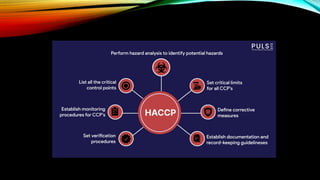
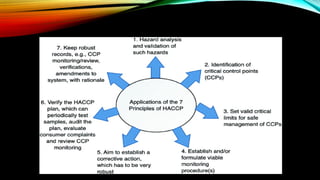
 Principles of HACCP
1 . Condutct a hazard analysis .
2 . Determine the critical control points. (CCPs )
3 . Establish critical limits .
4 . Establish monitoring procedures .
5 . Establish corrective actions .
6 . Establish verification procedures .
7 . Establish record – keeping and documentation procedures .
 Benefits of HACCP
 Reference
INTRODUCTION OF HACCP
• The HACCP concept was advanced in 1971 by H.E. Bauman and other
scientist at the Pillsbury company in collaboration with national aeronautics
and space administration ( NASA )and the U.S. Army research laboratories .
• It is now widely embraced by the food industries and by the govermment
regularity agencies around the world as a most cost effective means of
minimizing the occurrence of food born biological ,chemical and physical
hazards .
• The national advisory committee on microbiological criteria for foods
reconvened a hazard analysis and critical control point ( HACCP ) working
group in 1995.
• The primary goal was to review the committee’ s November 1992 HACCP
document comparing it to current HACCP guidance prepared by the codex
committee on food hygiene . Based upon its review the committee made
the HACCP .
HACCP DEFINITION
• A system which identifies evaluates and controls hazards which are
significant for food safety.
• Developed in early 1970’s in USA for NASA and US Army. Its purpose is to
ensure safety rather than detect.
• HACCP is designed for use in all segments of the food industry from
growing , harvesting, processing, manufacturing, distributing, and
merchandising to preparing food for consumption.
• It is the means of securing food safety from harvesting to consumption . Tool
to identify the hazards and applying the major for the food safety .
• HACCP can be applied in every step of food processing .
BRIEF HISTORY OF HACCP
• Developed in the 1960 ‘ s by the Pillsbury corporation and NASA to ensure
food safety for the first manned space missions
- It was determined that food safety was a significant risk to the first
manned space missions .
• In the 1970 ‘ s HACCP was adopted for food safety within the US .
• By the 1980 ‘s HACCP us was spread throughout the United States and
Europe .
- This would enable global trade standards this move is vital to the creation
of a global economy .
PRACTICING HACCP
• Personal Hygiene :
 Uniform
 Nails
 Hair
 Bruises
 Diseases
• Work Practices :
 Tools of trade
 Dusters
 Sanitary wipes
• Storage :
 Stores
 Kitchen food storage
 Raw meat storage
 Cooked meat storage
 Refrigerator
 Blast chillers
• Handling food correctly :
 Hot & cold
 Complete thawing
 Complete cooking
PRINCIPLES OF HACCP
1 . Conduct a hazard analysis :
 Hazard analysis is the very first step
 All the potential hazards are identified in this step
 The hazard is defined as the any physical ,chemical and biological agent
possess the possible risk or threat to the health .
 The basic physical hazards are metal contamination presence of inedible
items .
 Any method that can control these hazards needs to be adopted .
2 . Determination of critical control point :
 CCP stands for critical control point .
 At this step the control measures can be applied .
 CCP is essential to prevent or eliminate hazard or to reduce it to an
acceptable level .
 Examples of CCP s may include : cooking ,chilling ,metal detection, setting
into suitable temperature .
 CCP provides “ kill step “ (destroys bacteria ) or a control step ( prevents or
slows down the rate of bacteria ) .
3 . Establish critical limits :
 Once the CCP is identified critical limit points needs to be assigned for each
CCP .
 There can be one or more critical limits for each CCP .
 Critical limits are defined as the maximum and or minimum value of CCP
such that the hazards are controlled and food safety is assured .
 Critical limits must be defined on the scientific grounds and basis .
 Critical limits are usually based on factors such as : temperature ,time,
physical, dimensions ,humidity ,moisture level , water activity ,Ph ,regulatory
levels, etc ..
4 . Establish monitoring procedures :
 Generally refers to the planning and carrying out monitoring for CCP .
 Monitoring should be done on regular basis .
 Monitoring technique may differ based on the CCP .
 Monitoring is necessary to identify the deviation and apply the effective
measures .
 Monitoring is also necessary for future purpose and verification as
monitoring process is documented .
5 . Establish corrective actions :
 Corrective action is taken when the critical limit is not met .
 Corrective action are pre- decided for each CCP .
 These actions make sure that no any harmful product reaches the market for
consumption .
 How ever ideal circumstances do not always prevail and deviations from
established processes may occur .
 An important purpose of corrective actions is to prevent foods which may be
hazardous from reaching consumers .
 Where there is a deviation from established critical limits , corrective actions are
necessary .
6 . Establish verification procedures :
 HACCP plan must be validated .
 For testing the validity of the plan several steps can be taken such as
checking out the random samples ,reviewing the process confirming that the
CCP are under control .
 Verification activities can be carried out by the external hired officers or the
internal members .
 No matter who performs the verification it should be unbiased and fairly
carried out .
7 . Establish record – keeping and documentation
procedures :
 Record keeping is must in HACCP .
 Records maintained should have the records or information regarding
HACCP plan ,CCP critical limits ,monitoring ,corrective action ,all the procedures
including the verification procedures .
 Record keeping is necessary of validation and proper application of
HACCP .
BENEFITS OF HACCP
• Ensures the consumer regarding the safety of the product .
• Prioritizes food safety and works to eliminate any kind of hazard .
• Necessary for the consistent quality products .
• Provides the framework to produce foods safely and to prove they wera
produced safely .
• Prevents from the possible health outcomes that could have occurred due
to mishandling during food production steps .
• HACCP is also necessary for obtaining validation .
• There are clear benefits of implementing HACCP for all sector government
food industry and consumers alike .
1 . Benefits to consumers :
• Reduced risk of food borne disease .
• Increased awareness of basic hygiene .
• Increased confidence in the food supply .
• Improved quality of life ( health and socio – economic ).
•
2 . Benefits to industry :
• Increased consumer and /or government confidence .
• Reduced legal and insurance costs .
• Increased market access .
• Reduction in production costs .
• Improved product consistency .
• Improved staff – management commitment to food safety .
• Decreased business risk .
I. Benefits to governments :
• Improved public health .
• More efficient and targeted food control .
• Reduced public health costs .
• Trade facilitation .
II . Barriers :
• Lack of government commitment .
• Lack of customer and business demand .
• Absences of legal requirements .
• Financial constraints .
• Human resource constraints .
REFERENCES
• https :// www.fda. Gov / food /hazard –analysis –critical- control-point –
haccp/haccp –principles –application –guidelines .
• www.slideshare . Com
• https ://food .unl .edu/seven –principles –haccp .
THANK YOU

HAZARD ANALYSIS AND CRITICAL CONTROL.pptx

  • 1.
    VIVEKANANDHA ARTS AND SCIENCECOLLEGE FOR WOMEN VEERACHIPALAYAM -636007, SANKARI, TAMIL NADU DEPARTMENT OF MICROBIOLOGY SUBJECT: FOOD MICROBIOLOGY TOPIC: HAZARD ANALYSIS AND CRITICAL CONTROL POINTS SUBJECGT INCHARGE: SUBMITTED BY: DR. R. DINESH KUMAR, T. SHARMILA, ASSISTANT PROFESSOR, III- BSC MICROBIOLOGY DEPARTMENT OF MICROBIOLOGY, DEPARTMENT OF MICROBIOLOGY, VIAAS, SANKARI. VIAAS, SANKARI.
  • 2.
    HAZARD ANALYSIS ANDCRITICAL CONTROL POINTS
  • 3.
    CONTENTS  Introduction  Definition History of HACCP  Practicing HACCP  Principles of HACCP 1 . Condutct a hazard analysis . 2 . Determine the critical control points. (CCPs ) 3 . Establish critical limits . 4 . Establish monitoring procedures . 5 . Establish corrective actions . 6 . Establish verification procedures . 7 . Establish record – keeping and documentation procedures .  Benefits of HACCP  Reference
  • 4.
    INTRODUCTION OF HACCP •The HACCP concept was advanced in 1971 by H.E. Bauman and other scientist at the Pillsbury company in collaboration with national aeronautics and space administration ( NASA )and the U.S. Army research laboratories . • It is now widely embraced by the food industries and by the govermment regularity agencies around the world as a most cost effective means of minimizing the occurrence of food born biological ,chemical and physical hazards .
  • 5.
    • The nationaladvisory committee on microbiological criteria for foods reconvened a hazard analysis and critical control point ( HACCP ) working group in 1995. • The primary goal was to review the committee’ s November 1992 HACCP document comparing it to current HACCP guidance prepared by the codex committee on food hygiene . Based upon its review the committee made the HACCP .
  • 6.
    HACCP DEFINITION • Asystem which identifies evaluates and controls hazards which are significant for food safety. • Developed in early 1970’s in USA for NASA and US Army. Its purpose is to ensure safety rather than detect. • HACCP is designed for use in all segments of the food industry from growing , harvesting, processing, manufacturing, distributing, and merchandising to preparing food for consumption.
  • 7.
    • It isthe means of securing food safety from harvesting to consumption . Tool to identify the hazards and applying the major for the food safety . • HACCP can be applied in every step of food processing .
  • 9.
    BRIEF HISTORY OFHACCP • Developed in the 1960 ‘ s by the Pillsbury corporation and NASA to ensure food safety for the first manned space missions - It was determined that food safety was a significant risk to the first manned space missions . • In the 1970 ‘ s HACCP was adopted for food safety within the US . • By the 1980 ‘s HACCP us was spread throughout the United States and Europe . - This would enable global trade standards this move is vital to the creation of a global economy .
  • 10.
    PRACTICING HACCP • PersonalHygiene :  Uniform  Nails  Hair  Bruises  Diseases • Work Practices :  Tools of trade  Dusters  Sanitary wipes
  • 11.
    • Storage : Stores  Kitchen food storage  Raw meat storage  Cooked meat storage  Refrigerator  Blast chillers • Handling food correctly :  Hot & cold  Complete thawing  Complete cooking
  • 13.
    PRINCIPLES OF HACCP 1. Conduct a hazard analysis :  Hazard analysis is the very first step  All the potential hazards are identified in this step  The hazard is defined as the any physical ,chemical and biological agent possess the possible risk or threat to the health .  The basic physical hazards are metal contamination presence of inedible items .  Any method that can control these hazards needs to be adopted .
  • 14.
    2 . Determinationof critical control point :  CCP stands for critical control point .  At this step the control measures can be applied .  CCP is essential to prevent or eliminate hazard or to reduce it to an acceptable level .  Examples of CCP s may include : cooking ,chilling ,metal detection, setting into suitable temperature .  CCP provides “ kill step “ (destroys bacteria ) or a control step ( prevents or slows down the rate of bacteria ) .
  • 15.
    3 . Establishcritical limits :  Once the CCP is identified critical limit points needs to be assigned for each CCP .  There can be one or more critical limits for each CCP .  Critical limits are defined as the maximum and or minimum value of CCP such that the hazards are controlled and food safety is assured .  Critical limits must be defined on the scientific grounds and basis .  Critical limits are usually based on factors such as : temperature ,time, physical, dimensions ,humidity ,moisture level , water activity ,Ph ,regulatory levels, etc ..
  • 16.
    4 . Establishmonitoring procedures :  Generally refers to the planning and carrying out monitoring for CCP .  Monitoring should be done on regular basis .  Monitoring technique may differ based on the CCP .  Monitoring is necessary to identify the deviation and apply the effective measures .  Monitoring is also necessary for future purpose and verification as monitoring process is documented .
  • 17.
    5 . Establishcorrective actions :  Corrective action is taken when the critical limit is not met .  Corrective action are pre- decided for each CCP .  These actions make sure that no any harmful product reaches the market for consumption .  How ever ideal circumstances do not always prevail and deviations from established processes may occur .  An important purpose of corrective actions is to prevent foods which may be hazardous from reaching consumers .  Where there is a deviation from established critical limits , corrective actions are necessary .
  • 18.
    6 . Establishverification procedures :  HACCP plan must be validated .  For testing the validity of the plan several steps can be taken such as checking out the random samples ,reviewing the process confirming that the CCP are under control .  Verification activities can be carried out by the external hired officers or the internal members .  No matter who performs the verification it should be unbiased and fairly carried out .
  • 19.
    7 . Establishrecord – keeping and documentation procedures :  Record keeping is must in HACCP .  Records maintained should have the records or information regarding HACCP plan ,CCP critical limits ,monitoring ,corrective action ,all the procedures including the verification procedures .  Record keeping is necessary of validation and proper application of HACCP .
  • 20.
    BENEFITS OF HACCP •Ensures the consumer regarding the safety of the product . • Prioritizes food safety and works to eliminate any kind of hazard . • Necessary for the consistent quality products . • Provides the framework to produce foods safely and to prove they wera produced safely . • Prevents from the possible health outcomes that could have occurred due to mishandling during food production steps . • HACCP is also necessary for obtaining validation .
  • 21.
    • There areclear benefits of implementing HACCP for all sector government food industry and consumers alike . 1 . Benefits to consumers : • Reduced risk of food borne disease . • Increased awareness of basic hygiene . • Increased confidence in the food supply . • Improved quality of life ( health and socio – economic ). •
  • 22.
    2 . Benefitsto industry : • Increased consumer and /or government confidence . • Reduced legal and insurance costs . • Increased market access . • Reduction in production costs . • Improved product consistency . • Improved staff – management commitment to food safety . • Decreased business risk .
  • 23.
    I. Benefits togovernments : • Improved public health . • More efficient and targeted food control . • Reduced public health costs . • Trade facilitation . II . Barriers : • Lack of government commitment . • Lack of customer and business demand . • Absences of legal requirements . • Financial constraints . • Human resource constraints .
  • 24.
    REFERENCES • https ://www.fda. Gov / food /hazard –analysis –critical- control-point – haccp/haccp –principles –application –guidelines . • www.slideshare . Com • https ://food .unl .edu/seven –principles –haccp .
  • 25.