Meeting the Requirements of the
1998 Minnesota Food Code
Minnesota Department of Agriculture, Dairy and Food Inspection Division
625 Robert St. N., St. Paul, MN 55155-2538 • 651-201-6027
1-1
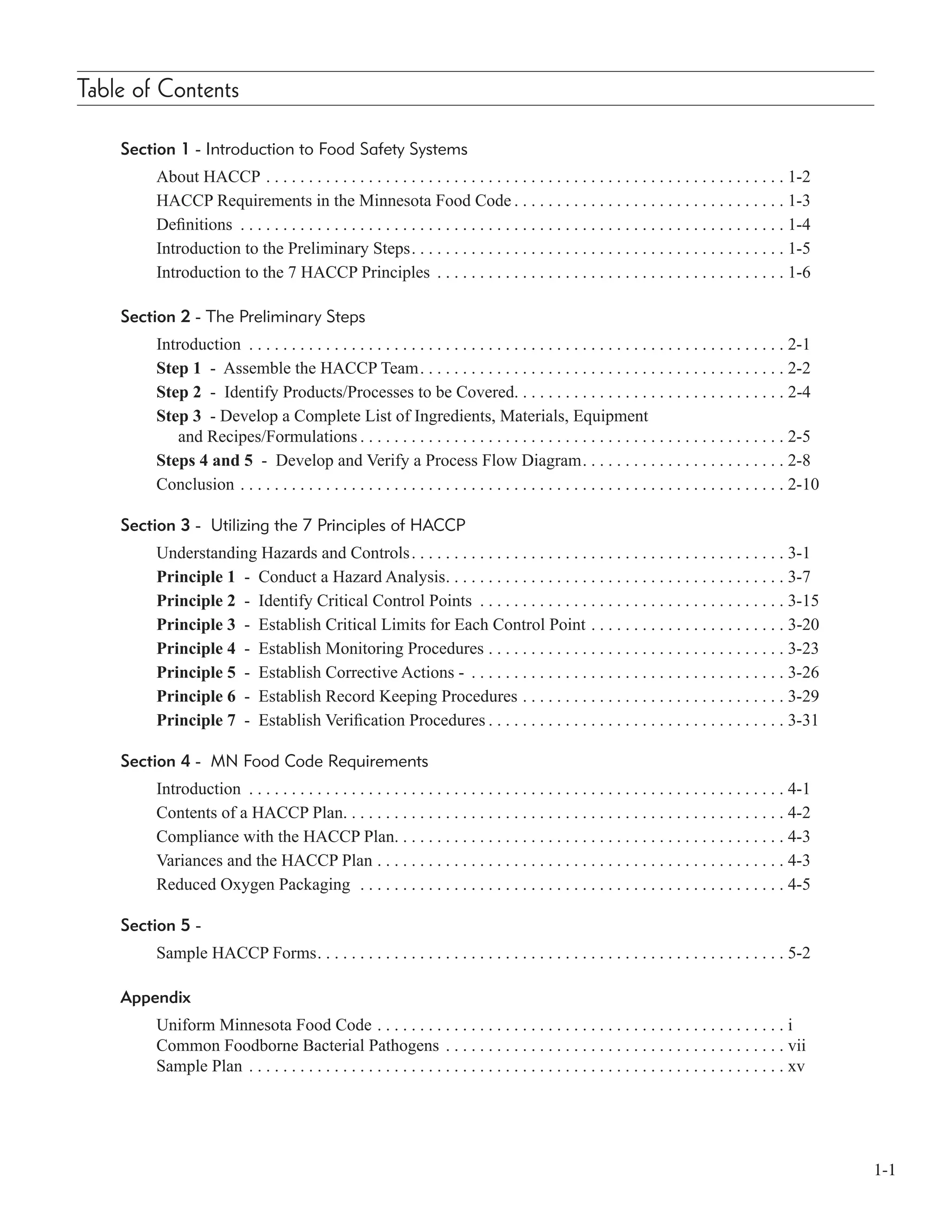
Table of Contents
Section 1 - Introduction to Food Safety Systems
About HACCP . . . . . . . . . . . . . . . . . . . . . . . . . . . . . . . . . . . . . . . . . . . . . . . . . . . . . . . . . . . . . 1-2
HACCP Requirements in the Minnesota Food Code . . . . . . . . . . . . . . . . . . . . . . . . . . . . . . . . 1-3
Definitions . . . . . . . . . . . . . . . . . . . . . . . . . . . . . . . . . . . . . . . . . . . . . . . . . . . . . . . . . . . . . . . . 1-4
Introduction to the Preliminary Steps. . . . . . . . . . . . . . . . . . . . . . . . . . . . . . . . . . . . . . . . . . . . 1-5
Introduction to the 7 HACCP Principles . . . . . . . . . . . . . . . . . . . . . . . . . . . . . . . . . . . . . . . . . 1-6
Section 2 - The Preliminary Steps
Introduction . . . . . . . . . . . . . . . . . . . . . . . . . . . . . . . . . . . . . . . . . . . . . . . . . . . . . . . . . . . . . . . 2-1
Step 1 - Assemble the HACCP Team. . . . . . . . . . . . . . . . . . . . . . . . . . . . . . . . . . . . . . . . . . . 2-2
Step 2 - Identify Products/Processes to be Covered. . . . . . . . . . . . . . . . . . . . . . . . . . . . . . . . 2-4
Step 3 - Develop a Complete List of Ingredients, Materials, Equipment
and Recipes/Formulations . . . . . . . . . . . . . . . . . . . . . . . . . . . . . . . . . . . . . . . . . . . . . . . . . . 2-5
Steps 4 and 5 - Develop and Verify a Process Flow Diagram. . . . . . . . . . . . . . . . . . . . . . . . 2-8
Conclusion . . . . . . . . . . . . . . . . . . . . . . . . . . . . . . . . . . . . . . . . . . . . . . . . . . . . . . . . . . . . . . . . 2-10
Section 3 - Utilizing the 7 Principles of HACCP
Understanding Hazards and Controls. . . . . . . . . . . . . . . . . . . . . . . . . . . . . . . . . . . . . . . . . . . . 3-1
Principle 1 - Conduct a Hazard Analysis. . . . . . . . . . . . . . . . . . . . . . . . . . . . . . . . . . . . . . . . 3-7
Principle 2 - Identify Critical Control Points . . . . . . . . . . . . . . . . . . . . . . . . . . . . . . . . . . . . 3-15
Principle 3 - Establish Critical Limits for Each Control Point . . . . . . . . . . . . . . . . . . . . . . . 3-20
Principle 4 - Establish Monitoring Procedures . . . . . . . . . . . . . . . . . . . . . . . . . . . . . . . . . . . 3-23
Principle 5 - Establish Corrective Actions - . . . . . . . . . . . . . . . . . . . . . . . . . . . . . . . . . . . . . 3-26
Principle 6 - Establish Record Keeping Procedures . . . . . . . . . . . . . . . . . . . . . . . . . . . . . . . 3-29
Principle 7 - Establish Verification Procedures . . . . . . . . . . . . . . . . . . . . . . . . . . . . . . . . . . . 3-31
Section 4 - MN Food Code Requirements
Introduction . . . . . . . . . . . . . . . . . . . . . . . . . . . . . . . . . . . . . . . . . . . . . . . . . . . . . . . . . . . . . . . 4-1
Contents of a HACCP Plan. . . . . . . . . . . . . . . . . . . . . . . . . . . . . . . . . . . . . . . . . . . . . . . . . . . . 4-2
Compliance with the HACCP Plan. . . . . . . . . . . . . . . . . . . . . . . . . . . . . . . . . . . . . . . . . . . . . . 4-3
Variances and the HACCP Plan . . . . . . . . . . . . . . . . . . . . . . . . . . . . . . . . . . . . . . . . . . . . . . . . 4-3
Reduced Oxygen Packaging . . . . . . . . . . . . . . . . . . . . . . . . . . . . . . . . . . . . . . . . . . . . . . . . . . 4-5
Section 5 -
Sample HACCP Forms. . . . . . . . . . . . . . . . . . . . . . . . . . . . . . . . . . . . . . . . . . . . . . . . . . . . . . . 5-2
Appendix
Uniform Minnesota Food Code . . . . . . . . . . . . . . . . . . . . . . . . . . . . . . . . . . . . . . . . . . . . . . . . i
Common Foodborne Bacterial Pathogens . . . . . . . . . . . . . . . . . . . . . . . . . . . . . . . . . . . . . . . . vii
Sample Plan . . . . . . . . . . . . . . . . . . . . . . . . . . . . . . . . . . . . . . . . . . . . . . . . . . . . . . . . . . . . . . . xv
1-2
About HACCP
What is HACCP?
The Hazard Analysis Critical Control Point system is a preventative system for assuring the safe production
of food products. It is based on a common sense application of technical and scientific principles to a food
production process.
The most basic concept underlying HACCP is that of prevention. The food processor/handler should have
sufficient information concerning the food and the related procedures they are using, so they will be able to
identify where a food safety problem may occur and how it will occur. If the ‘where’ and ‘how’ are known,
prevention becomes easy and obvious, and finished product inspection and testing becomes needless. The
HACCP program deals with control of factors affecting the ingredients, product and process. The objective
is to make the product safely, and be able to prove that the product has been made safely. The where and
how are the HA (Hazard Analysis) part of HACCP. The proof of the control of the processes and conditions
is the CCP (Critical Control Point) part. Flowing from this basic concept, HACCP is simply a methodical
and systematic application of the appropriate science and technology to plan, control and document the safe
production of foods.
HACCP is not the only method in ensuring that safe food products are manufactured. The plan will be
successful when other procedures are in place such as sanitation standard operating procedures (SSOP’s) and
by using good manufacturing practices (GMP’s). Although the Minnesota Food Code does not require them,
these programs are fundamental in the development of a successful HACCP plan. SSOP’s should include
personal hygiene practices as well as daily sanitation of the food contact surfaces and equipment. Good
sanitation practices are the foundation of manufacturing and preparing safe food.
HACCP is a management system in which food safety is addressed through the analysis and control of
biological, chemical, and physical hazards from raw material production, procurement and handling, to
manufacturing, distribution, and consumption of the finished product. For successful implementation of an
HACCP plan, management must be strongly committed to the HACCP concept. A firm committed to HACCP
by top management, provides company employees with the sense of importance of producing safe food.
Introduction to Food
Safety Systems
1
Section
1-3
HACCP Requirements in the Minnesota Food Code
The Minnesota Food Code is the state rule that governs retail food
establishments. With the adoption of the Minnesota Food Code in September
1998, retail food establishments that conduct certain food processes or
operations are required to operate under a HACCP plan.
Processes or operations that require HACCP:
1. Smoking or curing food, except for smoking done for the purpose of imparting flavor only, and
not as a part of the part of the cooking process.
2. Using food additives or adding components, including vinegar, as a method to preserve food
(rather than to enhance its flavor) or change food into a non-potentially hazardous food.
3. Using a reduced oxygen method of packaging food.
4. Food Establishments that apply for a variance to:
- use more than one tagged shellstock container at a
time.
- deviate from required cooking times and
temperatures for raw animal foods.
- use molluscan shellfish life support system
display tanks to store and display shellfish that
are offered for sale.
Timing/Effective Dates
After January 26, 2000 existing food establishments with these operations must have that plan available
on site for review.
After July 1, 1999, new or extensively remodeled food establishments with these operations must submit
a HACCP plan for approval as part of the plan review.
Additional MN Food Code Requirements
While the process of developing a HACCP plan is a rather universal one, the Minnesota Food Code
requires some additional components that need to be included as part of the firms HACCP plan.
Section 4 provides details on the additional requirements such as standard operating procedures, duties
of the person in charge. HACCP plans that cover reduced oxygen packaging operations, must include
several additional pieces of information.
1-4
CP Decision Tree: A sequence of questions to assist
in determining whether a control point is a CCP.
Continuous Monitoring: Uninterrupted collection
and recording of data such as temperature
on a stripchart, or a continuous recording
thermometer.
Control: (a) To manage the conditions of an
operation to maintain compliance with
established criteria. (b) The state where correct
procedures are being followed and criteria are
being met.
Control Measure: Any action or activity that can be
used to prevent, eliminate or reduce a significant
hazard.
Control Point: Any step at which biological,
chemical, or physical factors can be controlled.
Corrective Action: Procedures followed when a
deviation occurs.
Criterion: A requirement on which a judgment or
decision can be based.
Critical Control Point (CCP): A point, step or
procedure at which control can be applied and
is essential to prevent or eliminate a food safety
hazard, or reduce it to an acceptable level.
Critical Defect: A deviation at a CCP which may
result in a hazard.
Critical Limit: A maximum and/or minimum value
to which a biological, chemical or physical
parameter must be controlled at a CCP to
prevent, eliminate or reduce to an acceptable
level the occurrence of a food safety hazard.
Deviation: Failure to meet a critical limit.
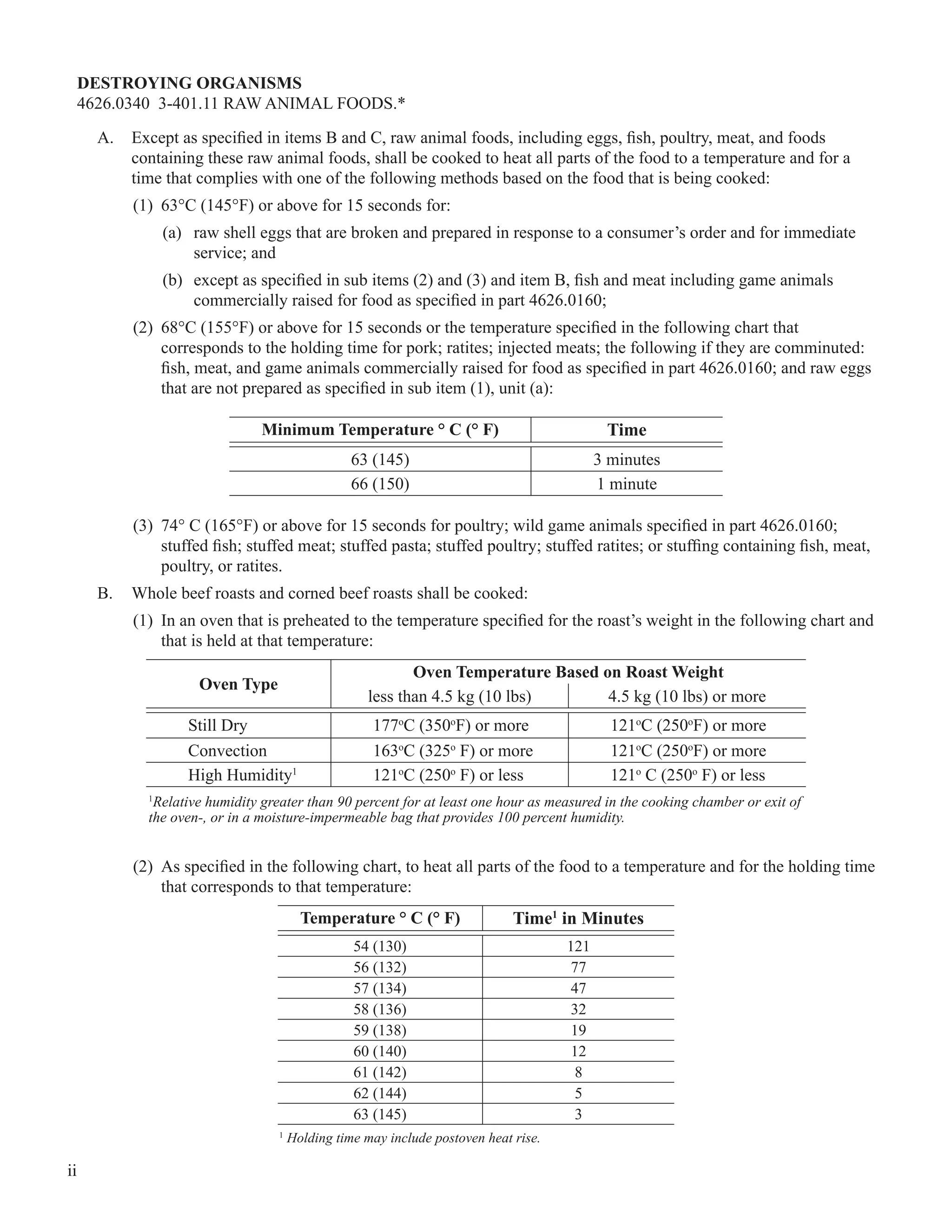
Food Code: Minnesota Rules 4626
HACCP: A systematic approach to identification,
evaluation, and control of food safety hazards.
HACCP Plan: The written document which is
based upon the principles of HACCP and
which delineates the procedures to be followed
to assure the control of specific process or
procedure.
Definitions:
HACCP System: The result of the implementation of
the HACCP Plan procedures to be followed.
HACCP Team: The group of people who are
responsible for developing, implementing and
maintaining the HACCP system.
Hazard: A biological, chemical, or physical agent
that is reasonably likely to cause a food to be
unsafe for consumption.
Hazard Analysis: The process of collecting and
evaluating information on hazards associated
with the food under consideration to decide
which are significant and must be addressed in
the HACCP plan.
Monitor: To conduct a planned sequence of
observations or measurements to assess whether
a CCP is under control and to produce an
accurate record for future use in verification.
Prerequisite Programs: Procedures, including
Good Manufacturing Practices, that address
operational conditions providing the foundation
for the HACCP system.
Preventative Measure: Physical, chemical, or other
factors that can be used to control an identified
health hazard.
Sensitive Ingredient: An ingredient known to have
been associated with a hazard for which there is
a reason for concern.
Severity: The seriousness of the effect(s) of a hazard.
Step: A point, procedure, operation or stage in the
food system from primarily production to final
consumption.
Validation: That element of verification focused on
collecting and evaluating scientific and technical
information to determine if the HACCP plan,
when properly implemented, will effectively
control the hazards.
Verification: Those activities such as methods,
procedures, or tests in addition to monitoring,
that determines if the HACCP system is in
compliance with the HACCP plan and/or
whether the HACCP plan needs modification and
revalidation.
1-5
An Introduction to Preliminary Steps
The development of a HACCPplan is a logical step-by-step process. Each step builds on the information gathered
from the previous step. The process works better if you take some preliminary steps. You may wish to use the
example forms located in Section 5 or you may want to create your own forms.
1. Assemble the HACCP Team
The first thing that must be done is to bring together individuals in your facility who have a working
knowledge of the various processing steps and operations in your facility. This group will be your
“HACCP team.” It is understood that in some smaller establishments, the ‘team’ may be very small and
may even consist of one person - the owner/operator.
2. Identify Products/Foods/Processes that must be covered by the HACCP plan
Next, the HACCP team should write a categorization of the types of potentially hazardous foods that
are covered. Foods and processes with similar characteristics can be grouped together.
3. Develop a List of Ingredients, materials, equipment and recipes/formulations.
The third step is for the team to thoroughly review each product and write down all of the ingredients,
materials, and equipment used in the preparation of a food and also to write down formulations or
recipes that show methods and control measures that address the food safety concerns involved.
4. Develop a Process Flow Diagram
At the fourth step, the HACCP team will draw a flow diagram that shows all the steps in the production
process (everything from receiving through distribution.)
5. Verify the Process Flow Diagram
The final step is to take this flow diagram and verify its accuracy. The HACCP team can do this by
having an impartial person do a “walk-through” of the entire production process, checking to see
if there is anything missing from the diagram. This should be done by someone who knows, or is
familiar with the production process.
1-6
An Introduction to the 7 HACCP Steps
Principle 1: Conduct a Hazard Analysis
The hazard analysis looks at different factors that could affect the safety of your product. This analysis is
done for each step in your production process. It’s important to remember that you are dealing with safety, not
quality issues.
The hazard analysis is actually completed in two stages. The first stage identifies food safety hazards that
are present in your process. The second stage evaluates these food safety hazards as to whether they are
“reasonably likely to occur.” If the HACCP team decides that a food safety hazard is likely to occur, then
they need to find and list any preventive measures that could be used to control those food safety hazards.
Preventive measures are defined as: “Physical, chemical, or other means that can be used to control an
identified food safety hazard.”
Principle 2: Identify Critical Control Points (CCP’s)
A critical control point is defined as “A point, step or procedure in a food process at which control can be
applied and, as a result, a food safety hazard can be prevented, eliminated, or reduced to acceptable levels.
The HACCP team uses the list of food safety hazards and preventative measures they developed during the
previous hazard analysis step to determine their critical control points. CCP’s may include, but are not limited to:
• Chilling or freezing
• Cooking
• Certain processing procedures; smoking, curing, acidification
Steps that are CCP’s in one facility may or may not be CCP’s in your facility. When making a HACCP plan,
each facility must look at the unique conditions present in that facility.
Principle 3: Establish Critical Limits for Each CCP
A critical limit is defined as “The maximum or minimum value to which a physical, biological, or chemical
hazard must be controlled at a critical control point to prevent, eliminate, or reduce to an acceptable level the
occurrence of the identified food safety hazard.” Critical limits serve as boundaries of safety for each CCP.
Often they are a numerical value (whether that is temperature, pH, etc.) that must be reached to assure that a
food safety hazard has been controlled.
[ A note about Critical Limits -- When your HACCP team establishes critical limits for your specific facility,
know that those limits may never be less strict than the current regulatory standards.]
INGREDIENT RELATED HAZARDS: As you evaluate the hazards in your process, don’t forget about
ingredient related hazards. Everything that goes into your product needs to be evaluated. Ingredient
specifications, provided by your supplier, should give you details on the materials/ingredients being sold,
including statements that the materials/ingredients are of food grade and are free of harmful components.
For example, the ingredient specification for dried legumes (beans) might state that there will be fewer that 5
small rocks or stones per ten pound bag and that no harmful pesticides were used in the growing process.
1-7
Principle 4:
Establish CCPMonitoring Procedures
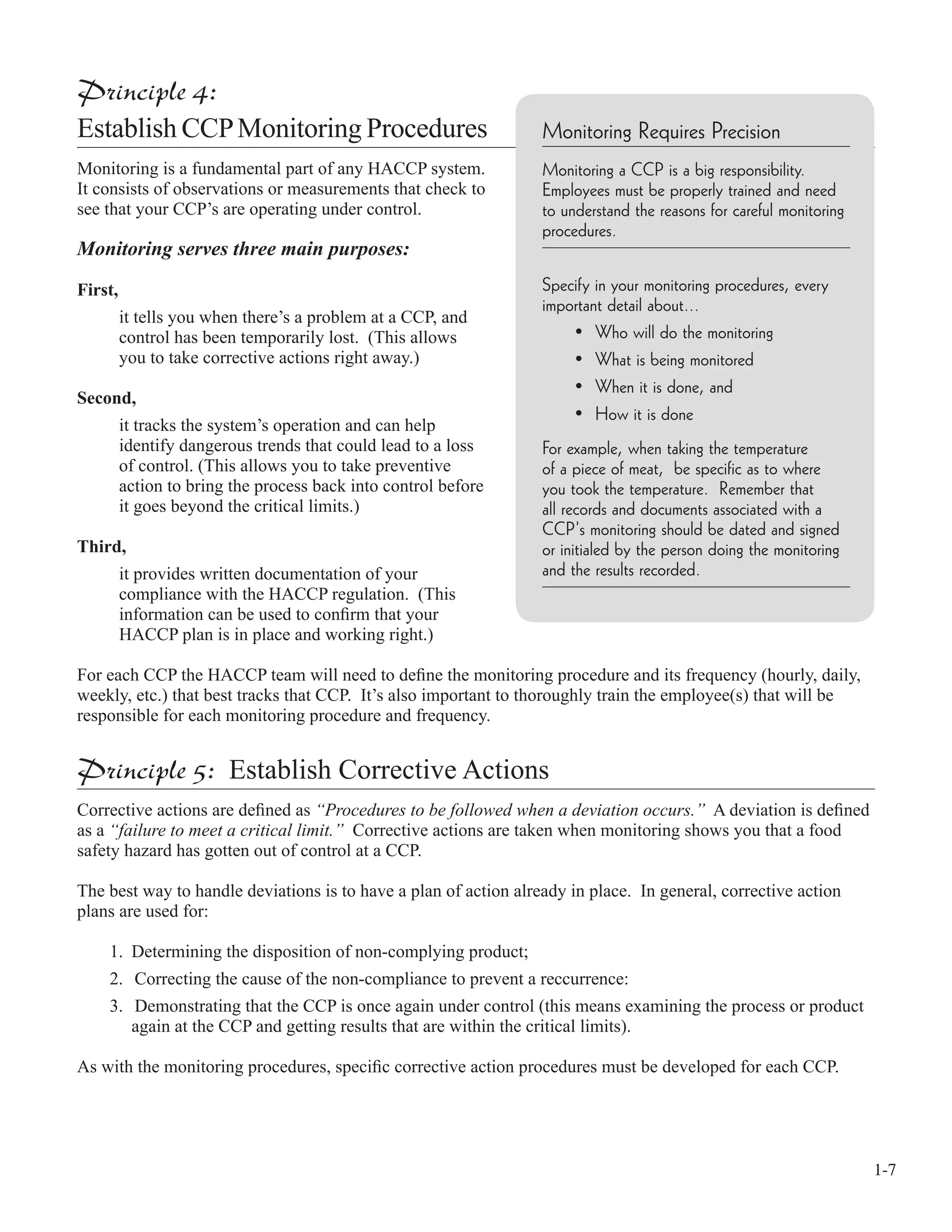
Monitoring is a fundamental part of any HACCP system.
It consists of observations or measurements that check to
see that your CCP’s are operating under control.
Monitoring serves three main purposes:
First,
it tells you when there’s a problem at a CCP, and
control has been temporarily lost. (This allows
you to take corrective actions right away.)
Second,
it tracks the system’s operation and can help
identify dangerous trends that could lead to a loss
of control. (This allows you to take preventive
action to bring the process back into control before
it goes beyond the critical limits.)
Third,
it provides written documentation of your
compliance with the HACCP regulation. (This
information can be used to confirm that your
HACCP plan is in place and working right.)
For each CCP the HACCP team will need to define the monitoring procedure and its frequency (hourly, daily,
weekly, etc.) that best tracks that CCP. It’s also important to thoroughly train the employee(s) that will be
responsible for each monitoring procedure and frequency.
Principle 5: Establish Corrective Actions
Corrective actions are defined as “Procedures to be followed when a deviation occurs.” A deviation is defined
as a “failure to meet a critical limit.” Corrective actions are taken when monitoring shows you that a food
safety hazard has gotten out of control at a CCP.
The best way to handle deviations is to have a plan of action already in place. In general, corrective action
plans are used for:
1. Determining the disposition of non-complying product;
2. Correcting the cause of the non-compliance to prevent a reccurrence:
3. Demonstrating that the CCP is once again under control (this means examining the process or product
again at the CCP and getting results that are within the critical limits).
As with the monitoring procedures, specific corrective action procedures must be developed for each CCP.
Monitoring Requires Precision
Monitoring a CCP is a big responsibility.
Employees must be properly trained and need
to understand the reasons for careful monitoring
procedures.
Specify in your monitoring procedures, every
important detail about...
• Who will do the monitoring
• What is being monitored
• When it is done, and
• How it is done
For example, when taking the temperature
of a piece of meat, be specific as to where
you took the temperature. Remember that
all records and documents associated with a
CCP’s monitoring should be dated and signed
or initialed by the person doing the monitoring
and the results recorded.
1-8
Principle 6: Establish Recordkeeping Procedures
Record keeping procedures are important in making and keeping an HACCP system effective. Every time
monitoring procedures are done, corrective actions are taken, or production equipment is serviced, a detailed
record of that activity is made. This continual recording of this information allows you to keep track of
everything that goes on in your facility.
You can think of HACCP records in two ways, development forms and day-to-day “working” logs. The
development forms are all of the supporting documentation that go into building your first HACCP plan. The
“working” logs are the sheets of paper where you collect the details of what happen on the production floor.
You may wish to use the example forms located in Section 5, or you may wish to create your own forms.
Generally, the records kept in the total HACCP system include the following:
• The HACCP plan itself and all supporting documentation.
• Records (including product codes) documenting the day-to-day functioning of the HACCP system
such as daily monitoring logs, deviation/corrective action logs, and verification logs.
Principle 7: Establish Verification Procedures
Every establishment should validate the HACCP plan’s adequacy in controlling the food safety hazards
identified during the hazard analysis, and should verify that the plan is being effectively implemented.
1. Initial validation. Upon completion of the hazard analysis and development of the HACCP plan, the
establishment shall conduct activities designed to determine that the HACCP plan is functioning as
intended. During this HACCP plan validation period, the establishment shall repeatedly test the adequacy
of the CCP’S, critical limits, monitoring and record keeping procedures, and corrective actions set forth in
the HACCP plan. Validation also encompasses reviews of the records themselves, routinely generated by
the HACCP system, in the context of other validation activities.
2. Ongoing verification activities. Ongoing verification activities include, but are not limited to:
• The calibration of process-monitoring instruments
• Direct observations of monitoring activities and corrective actions; and
• The review of records.
3. Reassessment of the HACCP plan. Every establishment should reassess the adequacy of the HACCP plan
at least annually and whenever any changes occur that could affect the hazard analysis or alter the HACCP
plan. Such changes may include, but are not limited to, changes in: raw materials or source of raw
materials; product formulation; processing methods or systems; production volume; personnel; packaging:
product distribution systems; or, the intended use or consumers of the finished product. One reassessment
should be performed by an individual trained in HACCP principles. The HACCP plan should be modified
immediately whenever a reassessment reveals that the plan no longer meets the requirements of the Food Code.
4. Reassessment of the hazard analysis. Any establishment that does not have a HACCP plan because a
hazard analysis has revealed no food safety hazards that are reasonably likely to occur should reassess the
adequacy of the hazard analysis whenever a change occurs that could reasonably affect whether a food
safety hazard exists. Such changes may include, but are not limited to changes in: raw materials or source
of raw materials; product formulation; processing methods or systems; production volume; packaging;
finished product distribution systems or the intended use or consumers of the finished product.
Verification procedures help make the HACCP plan work correctly.
1-9
A Note
About
Recordkeeping
“No matter
what type
of record
(development
or log) every
record must be
titled, dated
and signed or
initialed by the
activity. In the
development
process, this
person is
normally the
leader of the
HACCP team
who has been
trained in
HACCP. For
the day-to-
day logs, the
person would be
whomever was
assigned the
responsibility of
the procedure,
such as the
monitoring
person.”
Notes
2-1
Introduction
Now that you have a general understanding of HACCP, let’s get down to the specifics. Developing a
HACCP plan starts with the collection of important information. This fact-finding process is called the
Preliminary Steps.
They are:
1. Assemble the HACCP team.
2. Identify Products and Processes
3. Develop a complete list of ingredients, raw materials, equipment, recipes and formulations.
4. Develop a process flow diagram that completely describes your purpose.
5. Verify the process flow diagram.
A Note from the Minnesota Department of Agriculture:
In order to show you how an HACCP plan is put together, we are going to show you examples of filled-out
HACCP development forms. The thought of filling out all these forms can be a bit overwhelming at first,
however, it is a straightforward process. We are going to be using an “Example Facility” to show you what
each one of these forms might look like when completed.
The Preliminary Steps
Section
2
2-2
Step 1: Assemble the HACCP Team
YOUR FIRST TASK in developing a HACCP plan is to
assemble your HACCP team. The HACCP team consists of
individual(s) who will gather the necessary information for
your HACCP plan.
The HACCP team needs to be aware of the following:
• Your product/process
• Any food safety programs you already have
• Food safety hazards of concern
• The seven principles of HACCP
In a very small facility, perhaps only one individual is available
to be on the HACCP team. This is perfectly acceptable,
however, you can get help from as many people as you need to
make the team function effectively.
The HACCP team will begin by collecting scientific data. Remember, the team isn’t limited to internal
resources. If needed, outside expertise is available through the Minnesota Department of Agriculture, state
extension offices, trade or professional associations, consultants, universities and libraries.
However you decide to approach it, your HACCP team is ultimately responsible for building your
HACCP plan.
Working with the “HACCP Team” Form
The Example Facility has six HACCP team members. One of whom is not only the general manager, but is also
the owner. It is important to list all the team members and to state clearly what their HACCP team role is. (As
you might think, filling out this form is realtively simple.) Don’t forget to sign and date the form.
[A note about the forms. As with all HACCP forms and logs, the person who is responsible for an
activity (whether it be drafting the forms, or doing the monitoring) should be the one who signs and dates
the form or log.]
The First Meeting
Who should be there, and what
should we do? Here’s a sample
agenda.
• First, describe your product -
what it is and where it is going.
• Next, gather a complete list of
ingredients
2-3
Step 1
HACCP Team Form
Developed by: _________________________ Date ____________Cindy Jones 12/10/98
Team Members Role
Cindy Jones General Manager
Mary Weston Quality Control
Mark Baker Wet Room Supervisor
Susan Smith Packing Supervisor
Joe Jones Extension Service
Pam Smith Local Microbilogist
2-4
Step 2: Identify Products/Processes to be Covered
NEXT, make a complete listing of all the products and processes that must be covered under a HACCP plan.
The foods should be categorized by the types of processes that must be covered. The Minnesota Food Code
requires HACCP plans for certain processes. In addition, the requirements for reduced oxygen packaged foods
limit the types of foods that can be packaged in this manner. Review the Minnesota Food Code Requirements
in the Appendix for more details.
Product/Process Description Form
The following is an example of a format that could be used to list the products covered. This sample lists many types
products and processes for this establishment - a typical store would not likely have all of these processes.
Developed by: _________________________ Date ____________Cindy Jones 12/10/98
2-5
Step 3: Develop a Complete List of Ingredients,
Materials, Equipment and Recipes/Fomulations
THE THIRD STEP is for the team to thoroughly review each product or process and write down all of the
ingredients, materials and equipment used in the preparation or sale of a food and also to write down formulations
or recipes that show methods and control measures that address the food safety concerns involved.
The ingredients list may be as simple as the recipe format listed below or may be more detailed as shown on the
following page. As you can see on the following examples, ingredients and materials fall into several categories.
If the category does not apply to your product/process, you don’t have to write anything in that space.
[If you use pre-packaged or pre-blended ingredients such as a seasoning mix, you can list it by blend (mix) name
and just staple that products information to the back of your Ingredients Form.]
Be sure a recipe is listed for every product you produce.
Ring Bologna
FULL BATCH
50 lbs pork trim
50 lbs beef trim
6 lbs (1 full package) of xyz brand bologna seasoning
4 oz (1 full package) of Quick Cure with sodium nitrite
10 lbs. of water
Casings - natural beef casing
Also list procedures for producing the product.
Smokehouse Operations Formulation/Recipe
2-6
Beef Jerky
Fully cooked, Ready-to-eat
Step 3
Ingredients and Raw Materials Form
Product/Process Name: _______________________________________
Product/Examples: ___________________________________________
Developed by: _________________________ Date ____________Cindy Jones 12/10/98
Meat/Poultry and Byproducts Nonmeat Food Ingredients Binders/Extenders
50 lbs. Beef Rounds
Spices/Flavorings Restricted Ingredients Preservatives/Addifiers
___ oz. Garlic
___ oz. Pepper (black)
___ oz. Soy Sauce
___ oz. Sodium Nitrite
Liquid Packaging Materials Other
___ lb. Tap Water Vacuum Plastic Pouch
Assorted Labels
2-7
An additional requirement is to include a listing of all equipment and materials (such as packaging materials)
used for each product produced or each type of process. This information can be written in list form and be
categorized for the different processes.
Equipment List
Store Name ________________________________________________________________
Street Address ______________________________________________________________
City__________________________________ State_______ Zip Code ______________
General J’s Market
123 XYZ Street
Anytown MN 55555
Smokehouse Operations Equipment List
• Walk-in Cooler: Brand ______________________Size_____________________
Other products/Operations Supported __________________________________
• Grinder: Brand ____________________Model_____________________
• Mixer: Brand ____________________Model_____________________
• Stuffer: Brand ____________________Model ____________________
• Smokehouse: Brand ____________________Model_____________________
Smoke generator/liquid smoke _________________________________________
• Digital Thermometer __________________________________________________
• Assorted measuring container, hand utensils, lugs, totes, etc. ______________________
________________________________________________________________
Reduced Oxygen Packaging Equipment List
• Slicer: Brand _________________ Model #_____________________
• Vacuum Packaging Machine_____________________________________________
• Digital Thermometer __________________________________________________
• Assorted knives, tongs, trays, lugs, totes, hand utensils, etc. ______________________
________________________________________________________________
• Vacuum plastic pouch_________________________________________________
• Scale/labeling machine ________________________________________________
2-8
Step 4& 5: Develop and Verify a Process Flow Diagram
AT STEPS 4 AND 5 the team will create a document that will be used over and over again in the HACCP plan
development process. The HACCP team needs to look closely at the production process and make a flow diagram
that shows all the steps used to prepare the product. You don’t need to include steps that are not directly under
your control, such as distribution.
The flow diagram doesn’t need to be complex. Looking at your facility’s floor plan can help you visualize the
process from receiving to shipping. To find all the food safety hazards in your process you need to know exactly
what steps that product/process goes through.
After the HACCP team has completed the flow diagram, it needs to be checked for accuracy. To do this, walk
through the facility and make sure that the steps listed on the diagram realistically describe what occurs during
the production process. If possible, have someone who didn’t make the flow diagram do the “walk-through.”
Working with the “Process Flow Diagram Development and Verification” Form
The Example Facility divided their flow diagram into three paths. Each of these
paths represents one or more ingredients or raw materials. It made sense to
combine certain categories. They grouped all meat items into “Meat”, all-non-
meat food ingredients such as spices and preservatives into “Other Ingredients”,
which just left “Packaging Materials.” These three categories represent the
three main process routes that occur in their facility.
After the HACCP team completed their drawing, the flow diagram was
checked, signed and dated. In the Example Facility as each step was verified
they placed a check mark. The form must be signed and dated again after it is
checked/reviewed.
2-9
Developed by: _________________________ Date ____________
Verified by: ___________________________ Date ____________
Cindy Jones 12/10/98
Mary Weston 12/12/98
Steps 4 & 5
Process Flow Diagram Development
& Verification Form
Product/Process Name__________________________________________Beef Jerky/Heat Treated, Shelf Stable
Flow Diagram:
MEAT OTHER INGREDIENTS PACKAGING
Receiving Receiving Receiving
Storage Storage Storage
Slicing Weighing
Marinating Mixing
Hanging
Cooking
Cooling
Packaging
Storage
Retail Sales
rework
2-10
Conclusion:
The Example Facility has successfully completed the fact-finding part of the HACCP development process. Your
work through the preliminary steps should have produced two tangible pieces of information:
1. A comprehensive list of ingredients and raw materials, and
2. A step-by-step production process breakdown, laid out simply in a flow diagram.
With this information you are now ready to proceed to the next stage: Utilizing the 7 Principles of
HACCP.
3-1
Understanding Hazards and Controls
This section is about using the seven principles of HACCP. Already you have gathered all of te specific information
about our facilities paroducts and processes. Now you’ll put that information to use. When you have worked
throught the principles of HACCP, you’ll have a complete HACCP plan.
Before we start with the first principal, we need to quickly review two important ideas; Food Safety Hazards and
Preventative Measures. Hazards are defined as any biological, chemical or physical property that is reasonably
lickly to cause food to be unsafe for human consumption.
Utilizing the 7 Principles
of HACCP
Section
3-2
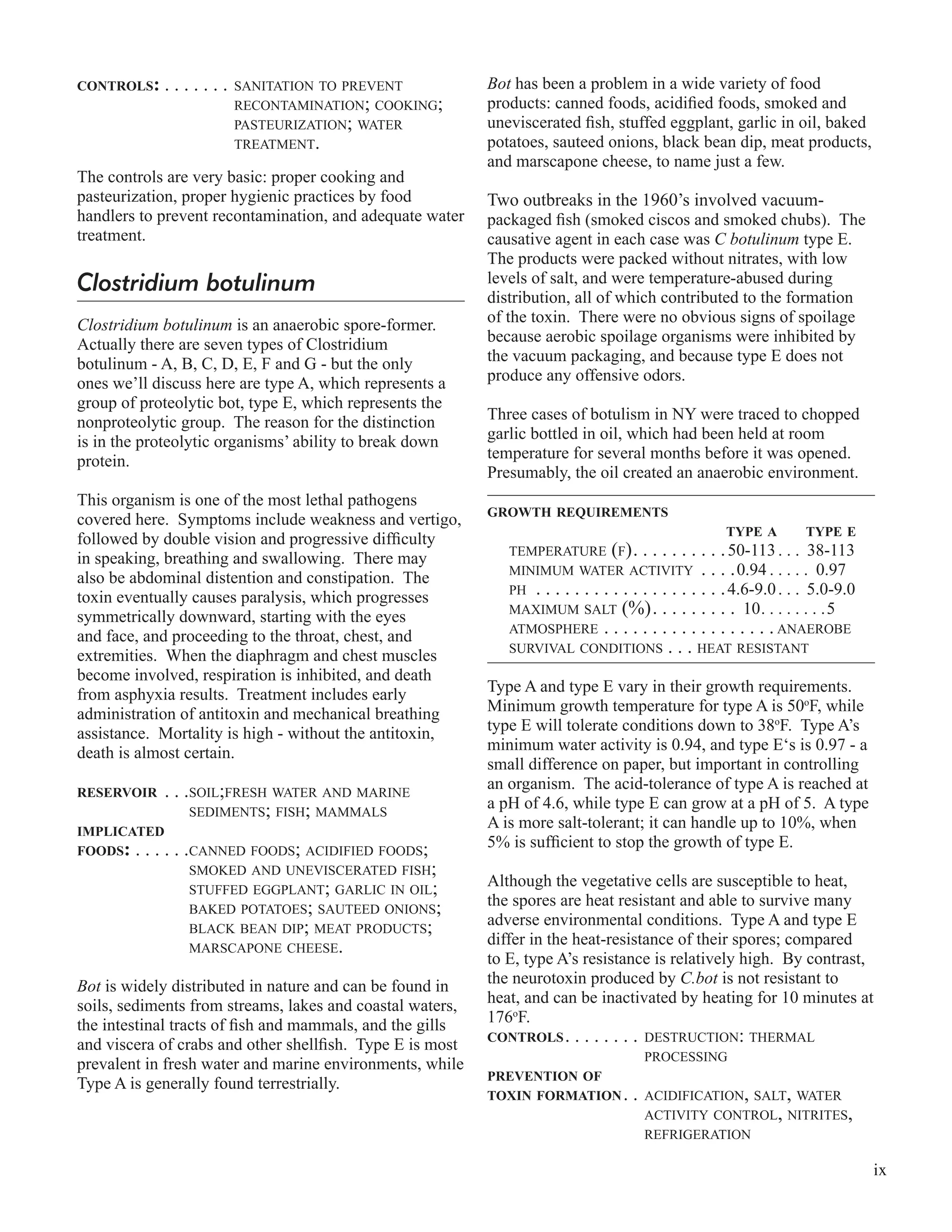
Biological hazards can be bacteria, parasites, or viruses.
Bacteria, parasites, or viruses that cause illness are
called pathogens. In most cases, pathogens must grow
or multiply in food to certain levels in order to cause
foodborne illness. The following factors can affect the
growth of pathogens:
Nutrients
Bacteria require food and water to carry on their life
processes. Since what you are producing is a food
product, nutrients are going to be available. Equipment
that contains food residue can also be a nutrient source
for bacteria.
Temperatures
Another essential factor that affects the growth of
bacteria is temperature. Growth can occur over a wide
range of temperatures from about 14°F to 194°F, but
individual bacteria have much narrower temperature
ranges for growth.
Time
It’s not just the temperature that’s the problem; it’s the
time at these temperatures that can affect growth of
bacteria. The goal is to minimize the time of exposure
of foods to temperatures where bacteria grow most
quickly.
Moisture
The amount of available moisture in a food is measured
as water activity. When substances like salt and sugar
are added to water is tied up and is less available to
the bacteria. The water activity of some foods is listed
below:
Food Water Activity
Fresh meats, fish, fruits, and vegetables 0.98 or above
Cured meat, processed cheese, bread 0.93 – 0.98
Dried meat, aged cheddar cheese 0.85 – 0.93
Cereal, flour, jam, nuts, salted fish 0.60 – 0.85
Chocolate, honey, noodles 0.60 or below
Most bacteria will not grow when the water activity is 0.85 or less. Many yeasts and molds can grow
below this level but this is a spoilage concern and generally not a food safety concern.
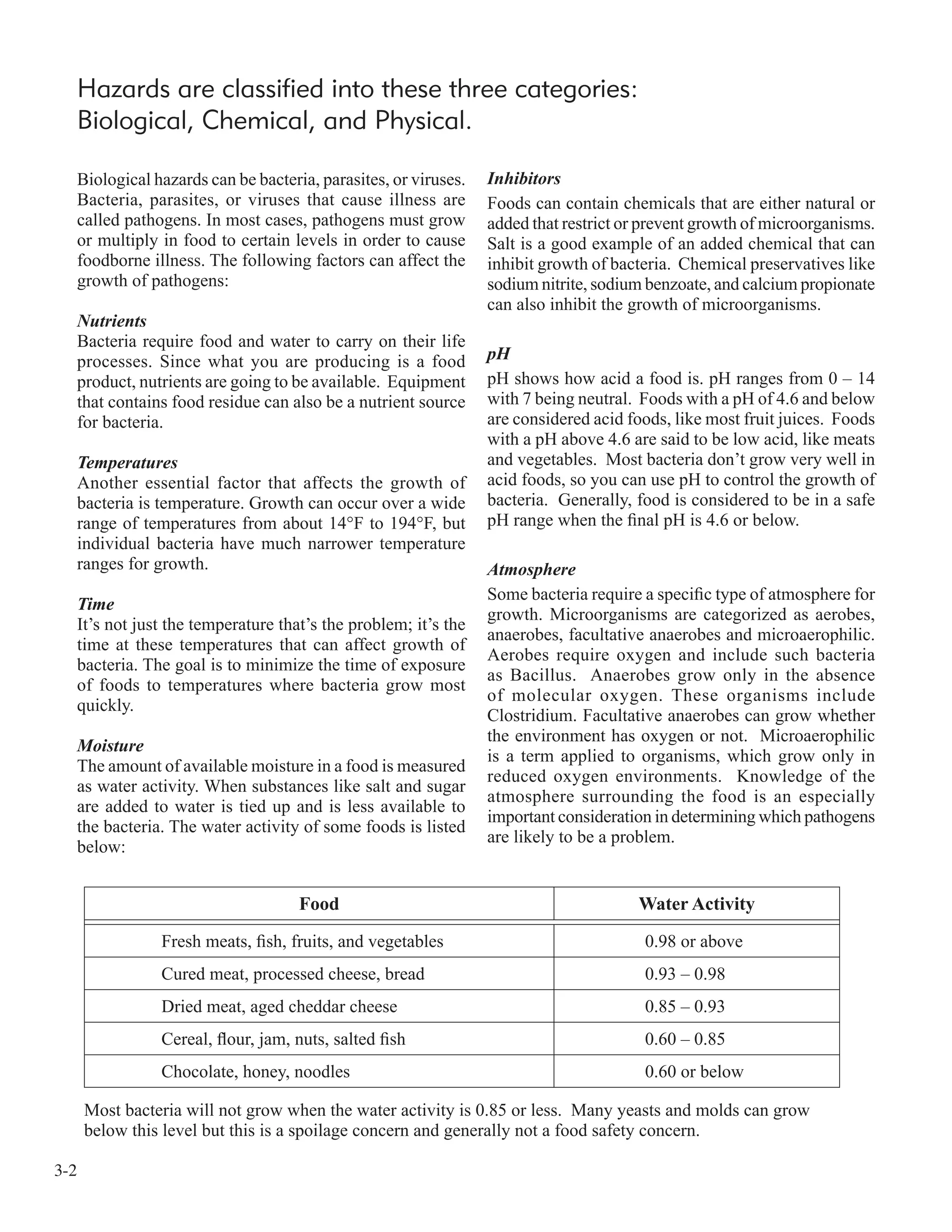
Hazards are classified into these three categories:
Biological, Chemical, and Physical.
Inhibitors
Foods can contain chemicals that are either natural or
added that restrict or prevent growth of microorganisms.
Salt is a good example of an added chemical that can
inhibit growth of bacteria. Chemical preservatives like
sodium nitrite, sodium benzoate, and calcium propionate
can also inhibit the growth of microorganisms.
pH
pH shows how acid a food is. pH ranges from 0 – 14
with 7 being neutral. Foods with a pH of 4.6 and below
are considered acid foods, like most fruit juices. Foods
with a pH above 4.6 are said to be low acid, like meats
and vegetables. Most bacteria don’t grow very well in
acid foods, so you can use pH to control the growth of
bacteria. Generally, food is considered to be in a safe
pH range when the final pH is 4.6 or below.
Atmosphere
Some bacteria require a specific type of atmosphere for
growth. Microorganisms are categorized as aerobes,
anaerobes, facultative anaerobes and microaerophilic.
Aerobes require oxygen and include such bacteria
as Bacillus. Anaerobes grow only in the absence
of molecular oxygen. These organisms include
Clostridium. Facultative anaerobes can grow whether
the environment has oxygen or not. Microaerophilic
is a term applied to organisms, which grow only in
reduced oxygen environments. Knowledge of the
atmosphere surrounding the food is an especially
important consideration in determining which pathogens
are likely to be a problem.
3-3
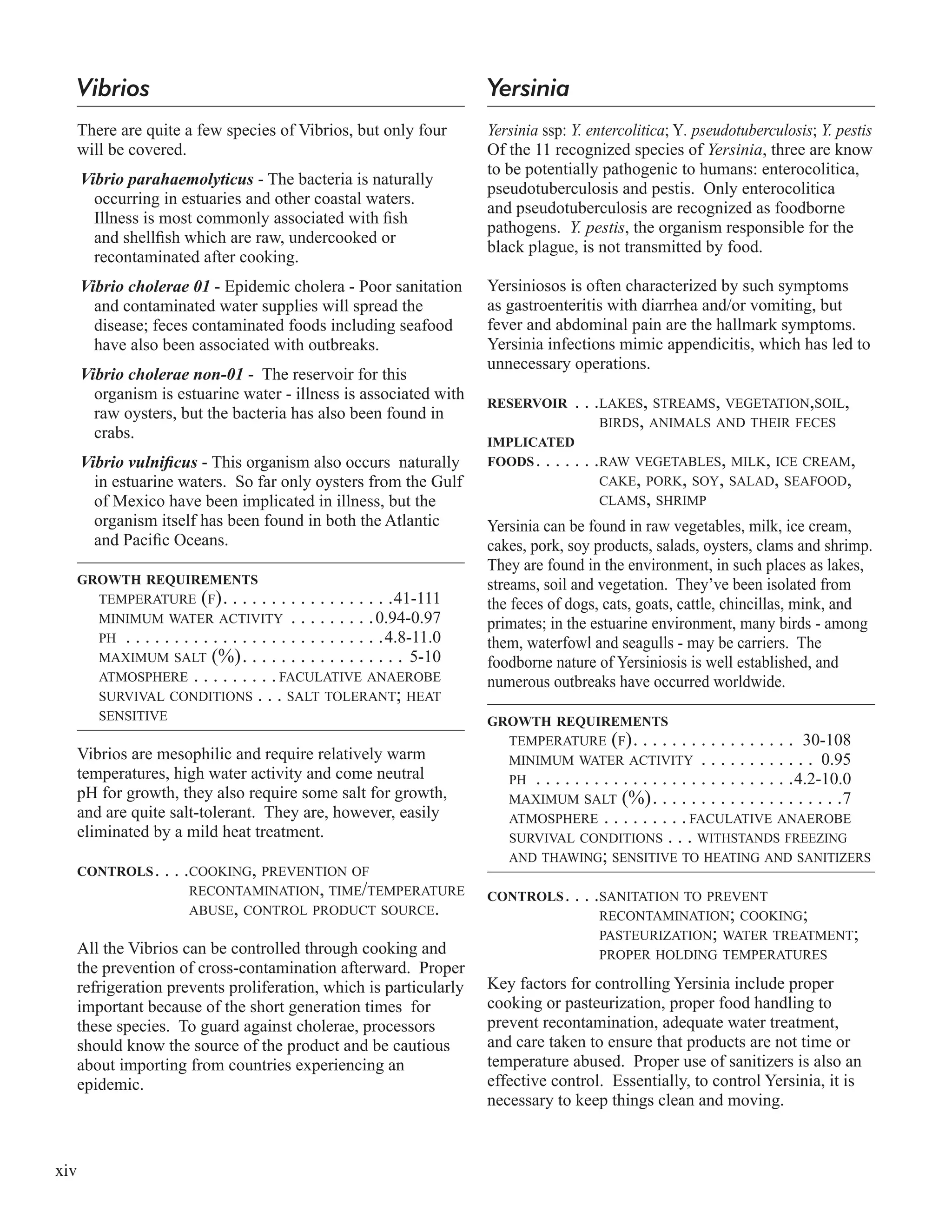
Table3-1listssomeofthemostimportantcharacteristics
of growth for common foodborne pathogens. The
appendix at the end of this manual lists more detailed
information on specific food borne bacterial pathogens.
Use this information in evaluating your foods or
processes for potential bacterial hazards.
Chemical Hazards
A wide variety of chemicals are routinely used in the
production and processing of foods. Some examples of
common types of chemicals are listed in table 3-2.While
these types of chemicals may not be hazards if used
properly, some can cause illness if not used properly.
Therefore, the hazard analysis must consider whether
any of these chemicals is used in a manner which creates
a significant food safety problem.
Table 3-1
BACTERIA - CHARACTERISTICS OF GROWTH
Pathogens
Temperature for
Growth (F°)
pH
Minimum Water
Activity (Aw
)
Bacillus cereus 39 – 131 4.3 – 9.3 0.92
Campylabacter jejuni 86 – 113.7 4.9 – 9.5 0.99
Clostridium botulinum 38 – 118
A: 4.6
E: 5.9
A: 0.94
E: 0.97
Clostridium perfringens 50 – 125 5.0 – 9.0 0.93
Escherichia coli 45 – 121 4.0 – 9.0 0.95
Listeria monocytogenes 31 – 113 4.4 – 9.4 0.92
Salmonella 41 – 115 3.7 – 9.5 0.94
Shigella 43 – 117 4.8 – 9.3 0.96
Staphylococcus aureus 45 – 122 4.0 – 10 0.83
Vibrios 41 – 111 4.8 – 11 0.94 – 0.97
Yersinis enterocolitica 30 – 108 4.2 – 10 0.95
Physical Hazards
Physical hazards are represented by foreign objects or
extraneous matter that are not normally found in food.
The presence of these items typically result in personal
injuries such as a broken tooth, cut mouth, or a case of
choking. Examples of Physical hazards are found in
Table 3-3. In some instances, physical contaminants
may also include “filth” such as mold mats, insects, and
rodent droppings.Although extraneous matter normally
categorized as filth may not actually injure a consumer,
some of these items can also contribute biological
hazards. For example, rodents and their droppings are
known to carry Salmonella species.
3-4
Table 3-2
EXAMPLES OF CHEMICAL HAZARDS
Location Hazard
Raw Materials
Pesticides, antibiotics, hormones, toxins,
fertilizers, fungicides, heavy metals, PCB’s
Color additives, inks, indirect additives,
packaging materials
Processing
Direct food additives -
preservatives (high level of nitrates)
flavor enhancers
color additives
Indirect food additives -
boiler water additives
peeling aids
defoaming agents
Building and Equipment Maintenance Lubricants, paints, coatings
Sanitation Pesticides, cleaners, sanitizers
Storage and Shipping All types of chemicals
Table 3-3
EXAMPLES OF PHYSICAL HAZARDS
Cause Source
Glass Bottles, jars, light fixtures, utensils, gauge covers, thermometers
Metal Nuts, bolts, screws, steel wool, wire, meat hooks
Stones Raw materials
Plastics Packaging materials, raw materials
Bone Raw materials, improper plant processing
Bullet/BB shot/Needles Animals shot in field, hypodermic needles used for injections
Jewelry/Other Rings, watches, pens, pencils, buttons, etc.
3-5
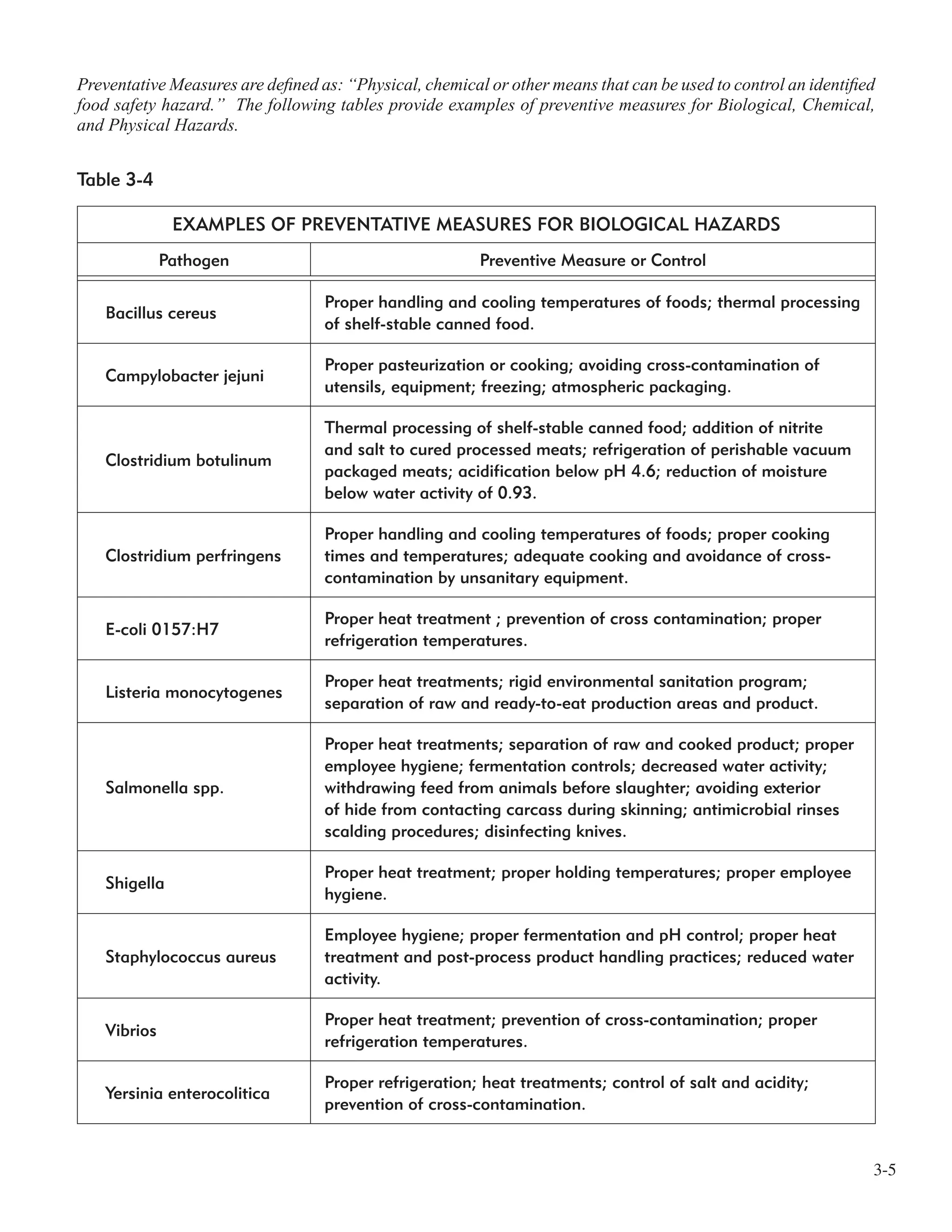
Preventative Measures are defined as: “Physical, chemical or other means that can be used to control an identified
food safety hazard.” The following tables provide examples of preventive measures for Biological, Chemical,
and Physical Hazards.
Table 3-4
EXAMPLES OF PREVENTATIVE MEASURES FOR BIOLOGICAL HAZARDS
Pathogen Preventive Measure or Control
Bacillus cereus
Proper handling and cooling temperatures of foods; thermal processing
of shelf-stable canned food.
Campylobacter jejuni
Proper pasteurization or cooking; avoiding cross-contamination of
utensils, equipment; freezing; atmospheric packaging.
Clostridium botulinum
Thermal processing of shelf-stable canned food; addition of nitrite
and salt to cured processed meats; refrigeration of perishable vacuum
packaged meats; acidification below pH 4.6; reduction of moisture
below water activity of 0.93.
Clostridium perfringens
Proper handling and cooling temperatures of foods; proper cooking
times and temperatures; adequate cooking and avoidance of cross-
contamination by unsanitary equipment.
E-coli 0157:H7
Proper heat treatment ; prevention of cross contamination; proper
refrigeration temperatures.
Listeria monocytogenes
Proper heat treatments; rigid environmental sanitation program;
separation of raw and ready-to-eat production areas and product.
Salmonella spp.
Proper heat treatments; separation of raw and cooked product; proper
employee hygiene; fermentation controls; decreased water activity;
withdrawing feed from animals before slaughter; avoiding exterior
of hide from contacting carcass during skinning; antimicrobial rinses
scalding procedures; disinfecting knives.
Shigella
Proper heat treatment; proper holding temperatures; proper employee
hygiene.
Staphylococcus aureus
Employee hygiene; proper fermentation and pH control; proper heat
treatment and post-process product handling practices; reduced water
activity.
Vibrios
Proper heat treatment; prevention of cross-contamination; proper
refrigeration temperatures.
Yersinia enterocolitica
Proper refrigeration; heat treatments; control of salt and acidity;
prevention of cross-contamination.
3-6
You should now be able to identify many types of hazards. You should also know where to begin looking for their
preventative measures.
Table 3-5
EXAMPLES OF PREVENTIVE MEASURES FOR CHEMICAL HAZARDS
Hazard Preventive Measure
Naturally-occuring
Substances
Supplier warranty or guarantee; verification program to test each
supplier’s compliance with the warranty or guarantee.
Added Hazardous
Chemicals
Detailed specifications for each raw material and ingredient; warranty
or letter or guarantee fro the supplier; visiting suppliers; requirement
that supplier operates with a HACCP plan.
In-Process Chemicals
Identify and list all direct and indirect food additives and color
additives; check that each chemical is approved; check that each
chemical is properly used; record the use of any restricted ingredients.
Table 3-6
EXAMPLES OF PREVENTIVE MEASURES FOR PHYSICAL HAZARDS
Hazard Preventive Measure
Foreign objects in raw
materials
Supplier’s HACCP plan; use of specifications, letters of guarantee;
vendor inspections and certification; in-line magnets; screens, traps,
and filters; in-house inspections of raw materials.
Foreign objects in
packaging materials,
cleaning compounds, etc.
Supplier’s HACCP plan; use of specifications, letters of guarantee;
vendor inspections and certification, in-house inspections of raw
materials.
Foreign objects introduced
by processing operations
or employee practices
In-line metal detectors; visual product examinations; proper
maintenance of equipment; frequent equipment inspections.
3-7
Principle 1: Hazard Analysis
Conduct a hazard analysis. Prepare a list of steps in the process where significant
hazards occur and describe the preventative measures.
A thorough hazard analysis is one of the keys to building an effective
HACCP plan. The hazard analysis process involves identifying hazards that
are reasonably likely to occur in the absence of control and their preventive
measures. In the first “Identification” stage, the HACCP team identifies and
lists food safety hazards that may be introduced or increased at each step in
the production process.
Then, in the second “Evaluation” stage, each food safety hazards is evaluated
based on how likely it is to occur. The term “reasonably likely to occur” is the
ruler against which each hazard can be measured. Also during this evaluation
stage the HACCP team investigates the appropriate preventative measures that
will control the “likely to occur” food safety hazards.
[Hazards can vary greatly from one store to another due to differences in sources
of ingredients, product formulations, processing equipment, processing methods,
duration of the processes, and storage methods. Make sure that your hazard
analysis takes into account what’s unique about your establishment.]
Hazard Identification and Evaluation
The following steps can help you and the HACCP team get started conducting your hazard analysis.
1 Here are some questions you can ask yourself to better understand the hazard identification
process:
• Are additives or preservatives added to the product to kill or inhibit the growth of bacteria?
• Will the amount of acidic ingredients affect the growth/survival of bacteria?
• Does the product need to be refrigerated/frozen or kept dry in storage and during transit?
2 Second, look at the product ingredients that you listed earlier. In order to find all of the food safety
hazards that are reasonably likely to occur, you need to know detailed characteristics about all the
ingredients used in your process, as well as possible ingredient interactions.
Here are some questions you can ask about the ingredients:
• Could these ingredients contain any pathogenic bacteria, dangerous chemicals, or harmful
physical objects?
• If contaminated or mishandled, could the ingredients or materials support the growth of
pathogenic bacteria?
• Are hazardous chemicals used in growing, harvesting, processing or packaging an ingredient?
• Is this ingredient hazardous if used in excessive amounts?
Preventive Measures:
When determining the appropriate
preventative measure for an
existing food safety hazard, keep
in mind the wealth of regulatory,
scientific, and historical support.
Over the years, both industry and
regulators have done a lot of work
in identifying food safety hazards
and preventative measures that can
be used to control them in food
production. Don’t think that you
have to go it alone in this search.
3-8
3 Third, determine if any food safety hazards exist for each processing step listed in the process flow
diagram.
Here are some questions you can ask for each production step:
• Could contaminants reach the product during this processing
step?
• Could this step create a situation where an ingredient, work
in process, or finished product becomes contaminated with
pathogens?
• Could this step introduce a chemical or physical hazard into the
product?
Possibilities for the three questions above include: worker
handling, contaminated equipment or materials, cross-
contamination from raw materials, leaking valves or pipes,
splashing, etc.
• Could bacteria multiply during this process step to the point
where they became a hazard? Consider product temperature,
hold temperature, etc.
KEEP GOOD NOTES: A summary of the HACCP team meetings and the reasons for each decision
during the hazard analysis should be kept for future reference. These documents will be a great help to
you when you have to review and update your hazard analysis and HACCP plan.
Finding Preventive Measures
Now that you have a good idea of what you’re looking for in the way of hazards. Use the example tables
of preventive measures on pages 3-5 through 3-6 to use as a reference to find out some ways to keep those
hazards under control.
It is sometimes the case that more than one preventive measure may be required to control a specific hazard,
or that more than one hazard may be controlled by one preventive measure. As you go through the hazard
analysis, you may recognize preventive measures already in place in your production processes.
The key to a successful hazard analysis is to link the preventive measures to the food safety hazards you have
just identified.
How can you be sure that
you are producing safe food?
A properly functioning HACCP
system assures the safety of your
product. Critical Control Points
exist in your establishment already.
HACCP helps you to identify and
use them to control food safety
hazards. The system of HACCP,
(specifically the correct identification
and monitoring of CCP’s) is what
makes the answer to that question a
sure thing.
Here’s A Tip
When sitting down to figure out which steps in
your process might or might not be CCP’s, a
common pitfall is to name too many.
3-9
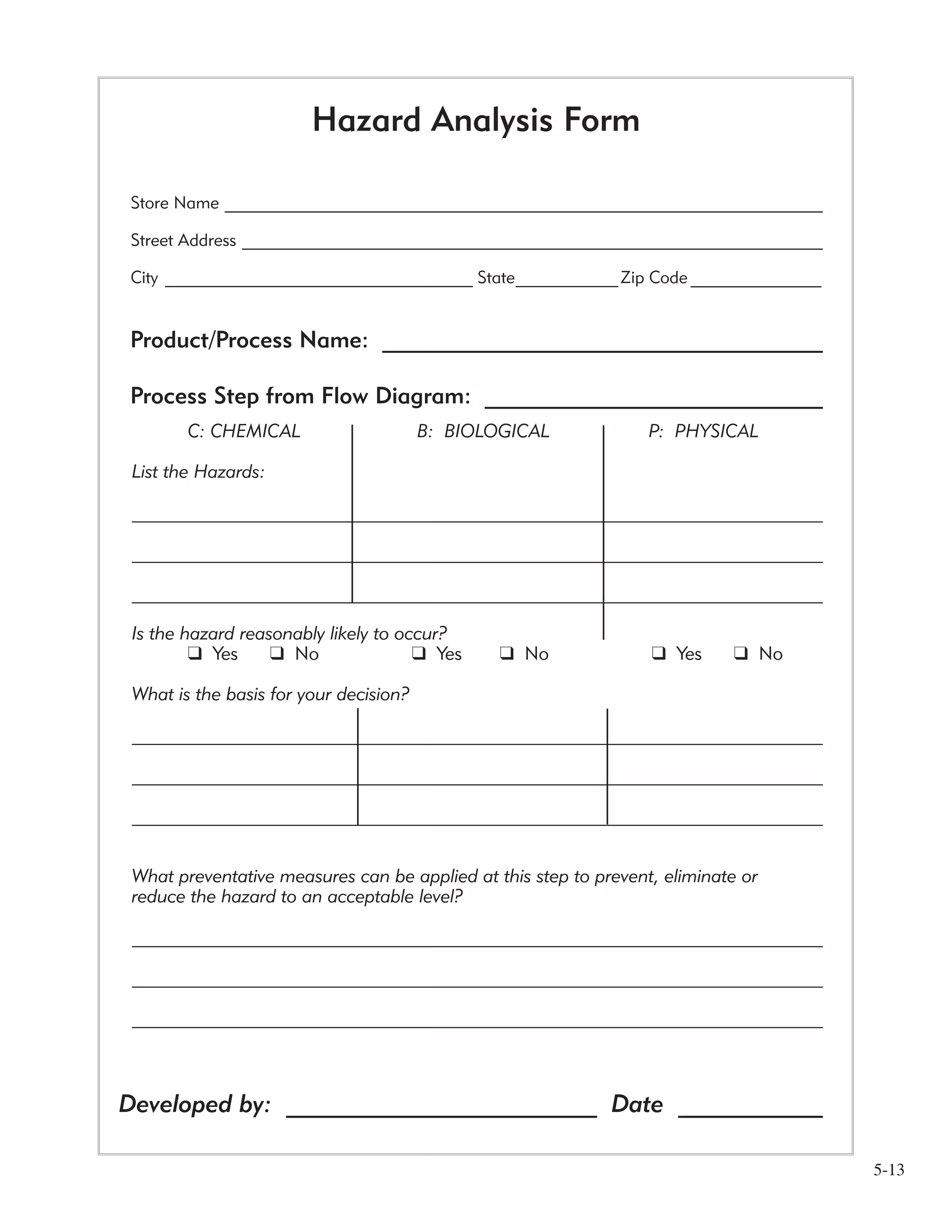
Working with the “Hazard Analysis” Form
To explain how this form works, we are going to show you three production steps for which the Example
Facility did a hazard analysis. The form is structured so that the three food safety hazard categories (chemical,
biological, physical) are addressed in each of the four questions. Don’t forget that you need to fill out the top
of the form with the appropriate information, such as the product/process name, and the process steps from the
flow diagram. You also need to sign or initial and date the form when it’s complete.
The first production step we’re going to look at is receiving meat.
1 For the first question all you need to do is state what food safety hazards are present at that step.
The Example Facility listed pesticides, hormones, and antibiotics as a chemical hazard. They listed
pathogenic bacteria as a biological hazard because bacteria is found on all raw meat. They also listed
plastic and bone fragments as physical hazards because the meat comes to them in plastic sheaths.
2 The second question asks you to decide whether or not the hazard is reasonably likely to occur at that
step. The Example Facility answered “No” for the chemical, “Yes” for the biological, and “No” for the
Physical.
3 The third question is where you explain why you answered “Yes” or “No”, to the question of
“reasonably likely to occur.” For the chemical hazard, the Example Facility’s justification is that these
sources are normally within defined limits. For the biological hazard they assume that the bacteria is
on the meat prior to arrival, so that it continues to be a potential hazard. They said “No” to both the
plastic and bone fragments because in both cases there has never historically been a problem with these
types of physical hazards in their facility.
[This “historical” basis for deciding whether a food safety hazard is “reasonably likely
to occur” is perfectly legitimate. If your facility has a clean track record regarding
a particular hazard, it’s fine to include that information in your HACCP plan. All
information must be documented.]
4 The final question on the hazard analysis form is the place where you write the specific preventive
measure(s) that will control the hazard you said was likely to occur. With each shipment of meat
the Example Facility receives they feel that the “Letter of Guarantee” from their supplier reasonably
assures them the meat has been kept at a temperature adequate to control bacterial growth. However,
just because they have one preventive measure hasn’t stopped
them from also having a second preventive measure. They also
visually check the condition and temperature of the truck and
meat products, to make sure everything meets their
standards.
3-10
3-11
The second production step we’re going to look at is cooking.
1 List the hazards. The Example Facility listed a chemical hazard of sanitizing chemicals because it’s
possible that traces of these substances could be on the equipment from the last time it was cleaned.
They also listed a biological hazard because bacteria is unavoidable on all raw meat.
[If you don’t find a particular type of hazard at a step it’s okay to write “Non Identified”
as the Example Facility did.]
2 Is it “reasonably likely to occur”? They answered “No” for the chemical hazard, and “Yes” for the
biological hazard.
3 What is the basis for your decision? The Example Facility decided the sanitizing chemicals
wouldn’t be a hazard likely to occur because their proper use is thoroughly covered by existing
Sanitation Standard Operating Procedures (SSOP’S). They decided “Yes” for the biological hazard for
the same reason as in the preceding process step.
[When working on your HACCP plan, you might want to revisit your SSOP’s]
4 What are the preventive measures? The Example Facility identified two preventive measures,
cooking and water activity reduction for the biological hazard. They said this is because the cooking
and the water activity reduction will help to reduce the hazard.
3-12
3-13
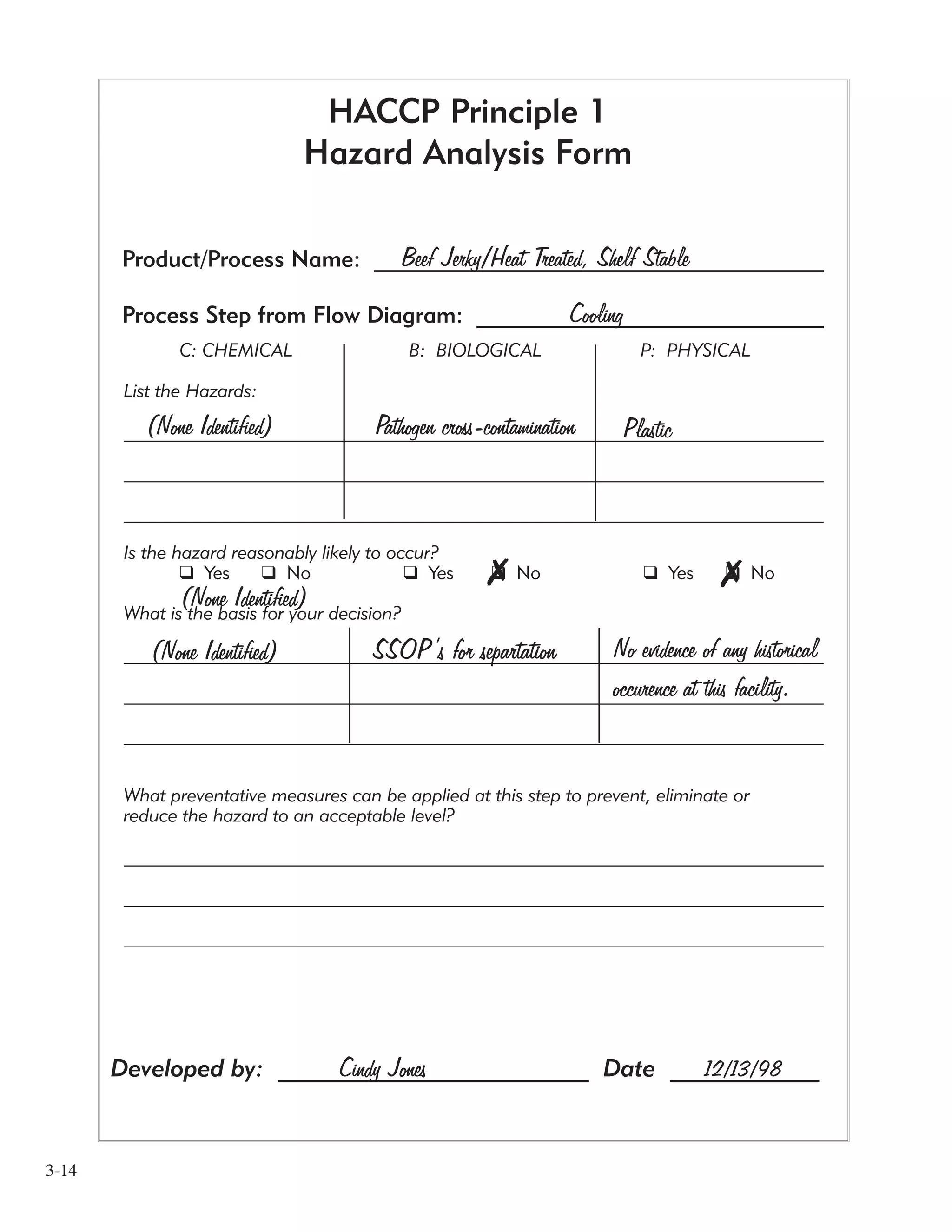
The third production step we’re going to look at is cooling.
1 List the hazards. The Example Facility listed the biological hazard of cross-contamination because
any time when you have raw and finished product in the same facility the possibility for the raw product
to cross-contaminate the finished product exists. The Example Facility also listed plastic as a physical
hazard because this is the step where they “Pull” the jerky strips off the cooking trees into large plastic
barrels.
2 Is it “reasonably likely to occur”? The Example Facility answered, “No” for the biological, and “No”
for the physical.
3 What is the basis for your decision? The Example Facility said that the biological hazard was not
likely to occur because the raw and cooked products are strictly kept apart as called for in their SSOP’s.
They said “No” to the physical hazard because the plastic barrels that are used are made of an extremely
sturdy type of plastic and there’s never historically been a problem with plastic shavings at this facility
getting into the jerky.
4 What are the preventive measures? There aren’t any preventive measures listed here because no food
safety hazards were found to be reasonably likely to occur.
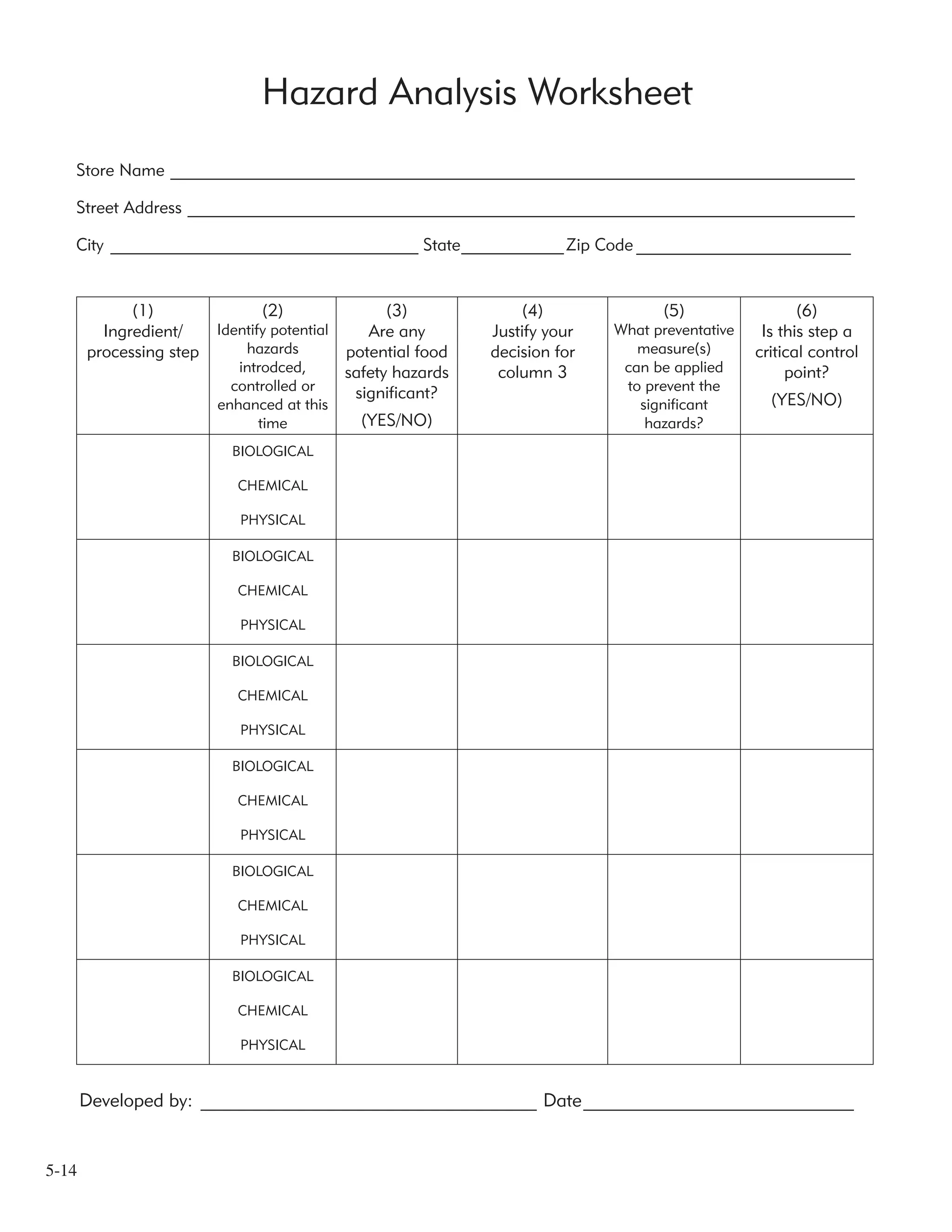
These forms are just one way of documenting the
hazard analysis process. An alternative form can
be found on page 5-14.
3-14
3-15
Numbering your CCP’s:
Once you’ve been through your entire production process and have successfully identified all the CCP’s
there’s one more thing you need to do to get that CCP set up. You need to organize them. Feel free to
do this anyway that works for your business.
One easy way to accomplish this is to develop a simple numbering system. It’s a good idea to always write
“CCP” before the numbers - this can make your documents easier to understand. For instance you could
write it like: CCP#1, CCP#2, CCP#3.
Also remember that you could have more than one CCP (for a designated food safety hazard) at a given
process step or one CCP may control more than one hazard. In this case you might want to include the
letter “B”, “C” or “P” to identify whether it is a biological, chemical or physical hazard. For example:
CCP#1B, CCP#1C, CCP#2P, CCP#2C.
Principle 2: Identify Critical Control Points
A critical control point is defined as “A point, step or procedure in a food process at which control can be
applied and is essential to prevent or eliminate a food hazard or reduce it to an acceptable level.” Everything
in your HACCP plan revolves around the proper identification of CCPs.
Some of the most common CCPs are:
• Chilling or freezing to a specified temperature to prevent bacteria from growing.
• Cooking that must occur for a specific time and temperature in order to destroy bacteria.
• Prevention of cross-contamination between raw and cooked product.
• Certain processing procedures, such as filling and sealing cans, mixing and spicing, etc.
• “pH”.
• Holding at proper refrigeration temperatures.
These are just a few examples of possible CCPs. Different facilities, preparing the same food, can identify
different food safety hazards and different critical control points. Usually no two stores have the same floor
plan, equipment, or ingredients. The CCPs you identify will reflect the uniqueness of your processing facility.
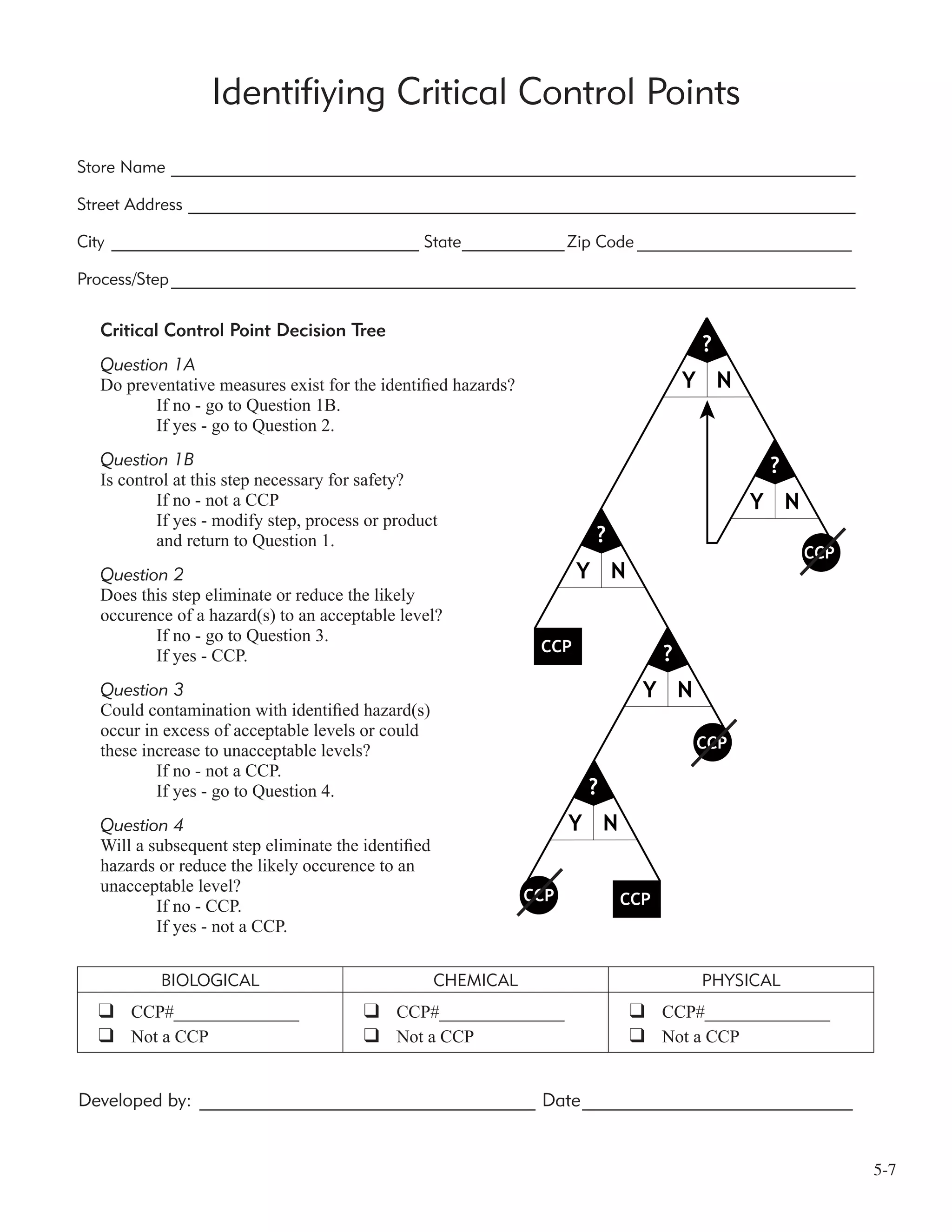
One of the tools used to help determine critical control points is a “CCP Decision Tree.” The use of a Decision
Tree to identify significant hazards is not necessary for you to meet regulatory requirements. However,
the thought process may be helpful for your team; you want to make sure that your HACCP system meets
regulatory requirements.
Working with the “CCP Decision Tree” Form
3-16
The Example Facility used the CCP Decision Tree to take a closer look at both of the steps in their process
where they determined food safety hazards were reasonably likely to occur. [Go ahead and read the four
questions on the form and then we’ll look at each one in detail. Again, this approach is not necessary to meet
regulatory requirements.
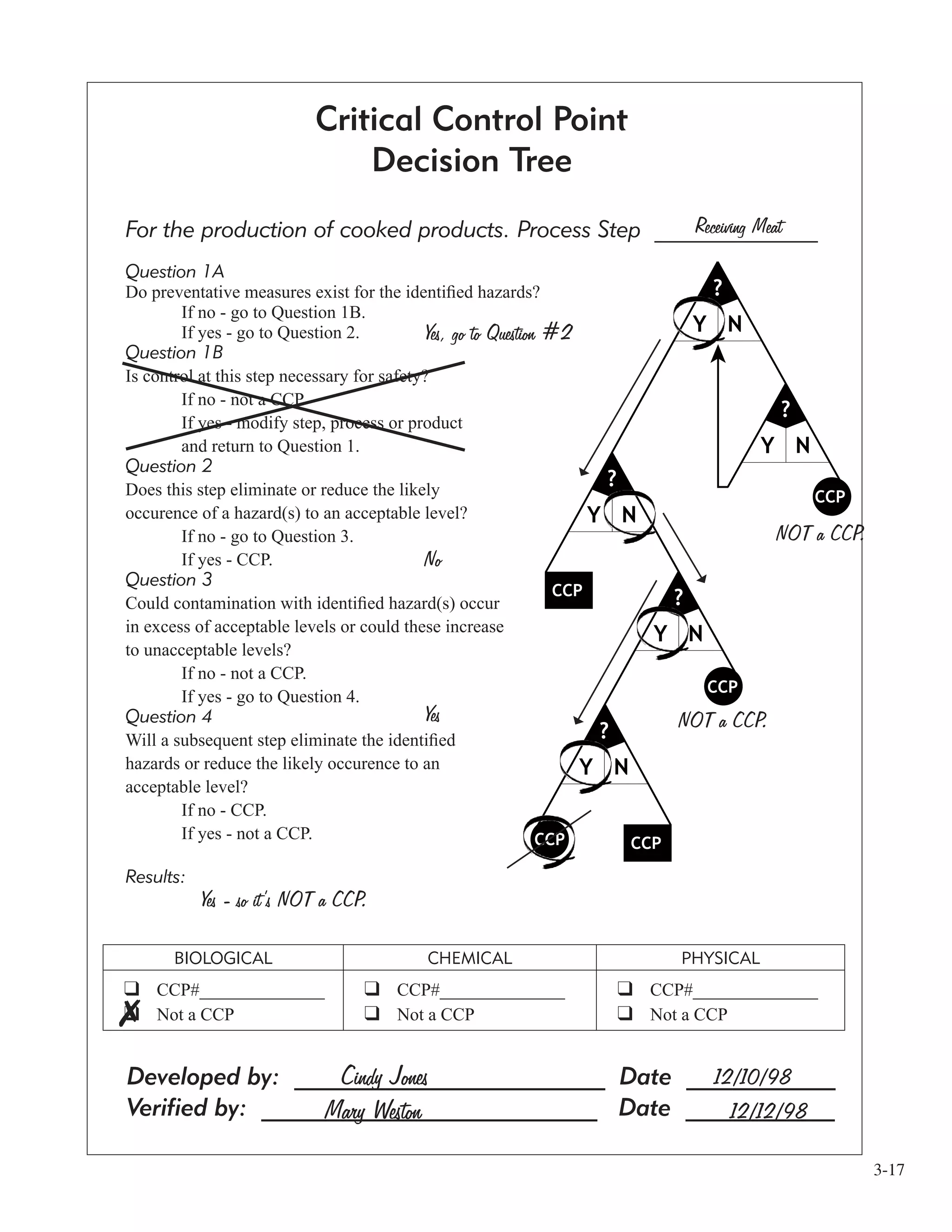
The first step they looked at was receiving meat.
Question 1a
The Example Facility answered “Yes” because the “Letter of Guarantee” from the supplier, and checking
the temperature of the truck and products are the preventive measures for this biological hazard.
Question 1b
If you answered “Yes” for question 1a, then you don’t need to worry about question 1b. (If you haven’t
yet identified a preventive measure for a food safety hazard, question 1b will not let you move down the
CCP Decision Tree until you do.)
Question 2
This question asks whether or not this step “prevents, eliminate, or reduces” to acceptable levels, the
food safety hazard you are working with. The Example Facility said “No” because simply receiving the
meat doesn’t mean the hazard is controlled.
Question 3
The Example Facility said “Yes” here because, if not controlled, the biological hazard could get worse.
Question 4
Here the HACCP team must decide if this step is the last point at which control could be applied to the
hazard. In this case the Example Facility found that, in fact, a later step (i.e. cooking) could control this
biological food safety hazard. This process step was not a CCP.
3-17
Critical Control Point
Decision Tree
Developed by: _________________________ Date ____________
Verified by: ___________________________ Date ____________
Cindy Jones 12/10/98
Mary Weston 12/12/98
For the production of cooked products. Process Step ______________
Question 1A
Do preventative measures exist for the identified hazards?
If no - go to Question 1B.
If yes - go to Question 2.
Question 1B
Is control at this step necessary for safety?
If no - not a CCP
If yes - modify step, process or product
and return to Question 1.
Question 2
Does this step eliminate or reduce the likely
occurence of a hazard(s) to an acceptable level?
If no - go to Question 3.
If yes - CCP.
Question 3
Could contamination with identified hazard(s) occur
in excess of acceptable levels or could these increase
to unacceptable levels?
If no - not a CCP.
If yes - go to Question 4.
Question 4
Will a subsequent step eliminate the identified
hazards or reduce the likely occurence to an
acceptable level?
If no - CCP.
If yes - not a CCP.
Results:
Yes, go to Question #2
No
Yes
Yes - so it’s NOT a CCP.
Receiving Meat
NOT a CCP.
NOT a CCP.
BIOLOGICAL CHEMICAL PHYSICAL
CCP#______________
Not a CCP
CCP#______________
Not a CCP
CCP#______________
Not a CCP
3-18
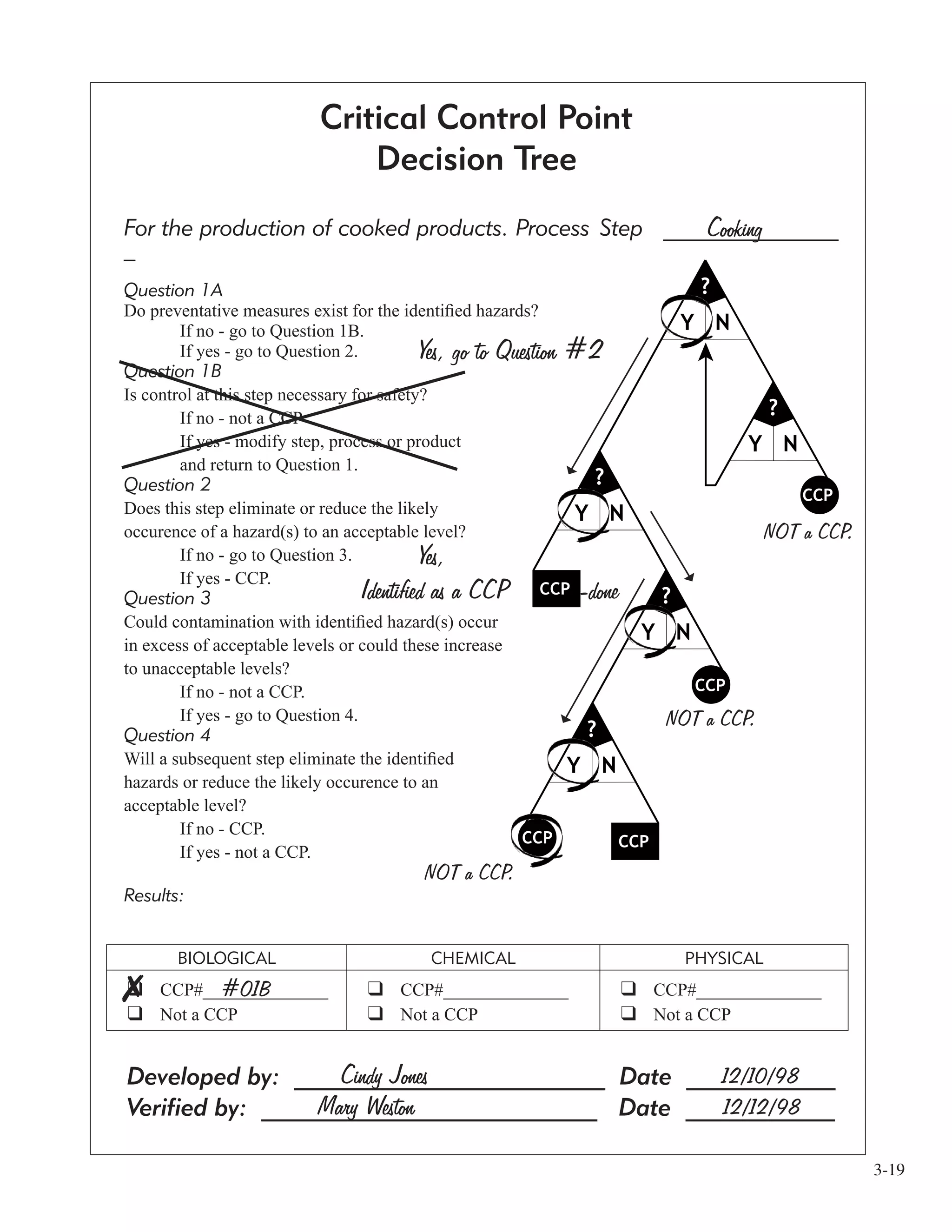
The second step they looked at was cooking.
Question 1a
The Example Facility answered “Yes” here because they had identified the preventive measure of
cooking (i.e. time and temperature) for this step.
Question 1b
As in the receiving example, move on to question 2.
Question 2
The Example Facility said that “Yes” cooking would eliminate the hazard at this step. They stopped here
at question 2 because they reached a positive result...their CCP. Thus, there wasn’t any need to go on to
questions 3 and 4.
[After finding all the CCP’s in your process, the HACCP team needs to organize them. At the bottom of
the CCP Decision Tree Form the Example Facility named the cooking CCP “CCP#01B”. The “01” tells
them what number the CCP is, and the “B” tells them it is a biological food safety hazard.]
3-19
Developed by: _________________________ Date ____________
Verified by: ___________________________ Date ____________
Cindy Jones 12/10/98
Mary Weston 12/12/98
For the production of cooked products. Process Step _______________
_
Question 1A
Do preventative measures exist for the identified hazards?
If no - go to Question 1B.
If yes - go to Question 2.
Question 1B
Is control at this step necessary for safety?
If no - not a CCP
If yes - modify step, process or product
and return to Question 1.
Question 2
Does this step eliminate or reduce the likely
occurence of a hazard(s) to an acceptable level?
If no - go to Question 3.
If yes - CCP.
Question 3
Could contamination with identified hazard(s) occur
in excess of acceptable levels or could these increase
to unacceptable levels?
If no - not a CCP.
If yes - go to Question 4.
Question 4
Will a subsequent step eliminate the identified
hazards or reduce the likely occurence to an
acceptable level?
If no - CCP.
If yes - not a CCP.
Results:
Yes, go to Question #2
Yes,
Identified as a CCP -done
Cooking
#01B
Critical Control Point
Decision Tree
NOT a CCP.
NOT a CCP.
NOT a CCP.
BIOLOGICAL CHEMICAL PHYSICAL
CCP#______________
Not a CCP
CCP#______________
Not a CCP
CCP#______________
Not a CCP
3-20
Principle 3: Establish Critical Limits for Each
Critical Control Point
A critical limit is defined as “The maximum or minimum value to
which a physical, biological, or chemical hazard must be controlled
at a critical control point to prevent, eliminate, or reduce to an
acceptable level the occurrence of the identified food safety
hazard.” You can think of a critical limit as a boundary of safety
for a CCP. The critical limit is the numerical value that must be
reached to assure that hazards have been controlled. An example
would be that “all sausage products must be cooked to 155o
F for 15
seconds.”
Each CCP will have at least one (possibly more) preventive measures that need
to be controlled to assure this prevention, elimination or reduction of food safety
hazards. To be effective, each critical limit should be:
1. Based on proven factual information.
A few ways that information and recommendations for appropriate limits can be obtained are: from
regulatory requirements, scientific literature, and consultation with experts. If regulatory requirements
exist they must be met or exceeded.
2. Objectives are measurable or observable, such as time and temperature.
3. Appropriate and reasonable for the food product and operation.
You should consider the type of equipment, the volume of product being produced, how the critical
limit will be monitored and frequency of monitoring.
4. Specifics
When drafting your critical limits be specific in your language.. Use action words, and be specific when
naming people and equipment. An example could be “bake, uncovered in preheated 350o
F oven to an
internal temperature of 165o
F for 15 seconds.”
The HACCP team will find that many critical limits for your identified CCP’s have already been established.
In some cases you’ll need more than one critical limit to control a particular hazard. For example, the
typical critical limits for cooked beef pattied are time/temperature, patty thickness, and conveyor speed. It is
important that you identify all the critical limits for each of your products.
Making sure each Critical Control Point has critical limits is the responsibility of each establishment. The
HACCP team may want to get help from outside HACCP experts when establishing critical limits. Remember
that the critical limits must be able to maintain control over the food safety hazard. Once the team has
identified all the limits, enter them onto the Critical Limits form.
3-21
Working with the “Critical Limits” Form
For each CCP the Example Facility has a separate page of critical limits.
1. Under the “Limit” heading.
The Example Facility noted an internal temperature of 165o
F for 15 seconds as the established critical
limit. They then decided that the preventive measure of cooking at 190o
F oven temperature for 3
hours would satisfy the critical limit.
2. Under the “Source” Heading.
The Example Facility’s first source is regulatory and scientific. They decided to take the established
regulatory limits and use them, but then they also sent out samples of their finished product to be
scientifically analyzed. The results of the lab tests confirmed that their critical limits were enough.
[The source is the “evidence” that backs up your critical limits. The source provides that the critical
limits you cite will effectively control the food safety hazards. Sources for critical limits can be
scientific, regulatory or historical. The HACCP team has to find at least one source for each of your
critical limits, but you can always put more if you want.]
Here are some controls commonly used as preventative measures.
• Time and Temp - The temperature “danger zone” for biological hazards is between
40o
F and 140o
F. Bacteria grows fast! They have the ability to multiply rapidly. Knowing
this shows that controlling how long the product is in the danger zone (if at all) presents
itself as an extremely effective critical limit.
•pH - The pH of a food product is the level of its acidity or alkalinity. The pH is
measured on a scale of 0 to 14. The middle of the scale, pH=7.0, is considered
neutral. Altering a food product’s pH, such as adding an acidic substance like vinegar
or soy sauce will decrease the growth rate of the bacteria.
• Water Activity - In addition to warm temperatures and a median pH, bacteria also need
water to grow. Water activity (AW
) refers to the amount of water in a food product that
is available, or free, for bacteria to use for growth and multiplication. Solutes (salts and
vinegars), as well as dehydration, decrease the available water and can reduce bacterial
growth.
When determining your critical limits make sure you file your supporting
documentation with your HACCP plan. This documentation will help
validate that the limits have been properly established. These could be
things such as letters from outside HACCP experts, or scientific reports,
or lab test results. By holding onto these supporting documents you also
provide verification material when needed.
Documenting
the
Source
3-22
3-23
Principle 4: Establish Monitoring Procedures
Monitoring involves a series of observations and/or measurements that are used to make sure a CCP is under
control. The HACCP team can think of monitoring activities as the checks-and-balances for each CCP. When
someone monitors, they are “checking to see” that the critical limits are being met.
What are the 3 things monitoring can do for you?
• shows you when a deviation from a critical limit has happened. For example, an employee tests
the temperature of some beef patties and discovers that the internal temperature has gone above the
established critical limit of 40o
F. If not caught here, this would be a potentially serious health risk to
consumers.
• helps you identify trends in your process that will allow you to predict a loss of control at a CCP. For
example, a facility may monitor the temperature of a cold storage area at 6 am., 8a.m., and 10 a.m.
Each time, the temperature is within acceptable limits, but it is steadily climbing toward the high end
of the range. This information points towards a trend, and the facility should take action to prevent the
temperature from exceeding the critical limits.
• produces written records for use in future HACCP plan verification steps.
Written monitoring records will prove very valuable to your operation, should a serious problem along
the production line occur. The records you keep prove that your company has established and carried out
effective monitoring techniques.
Monitoring procedures can be thought of as continuous or non-continuous.
• Continuous monitoring is the constant monitoring of a critical control point.
• Non-continuous monitoring is the scheduled monitoring of a critical control point.
Continuous monitoring is always preferred when feasible. Continuous monitoring at a CCP is usually done
with built-in measuring equipment, such as a recording thermometer used at a cooking step. This type of
monitoring is preferred because it yields a permanent record. To make sure these activities stay accurate, you
need to regularly check the monitoring equipment to make sure that it is calibrated correctly.
If continuous monitoring isn’t feasible for your CCP then the HACCP team will need to establish non-
continuous monitoring procedures. Non-continuous doesn’t mean random. The team should decide in the
development phase what the monitoring schedule should be. When you use non-continuous monitoring,
make sure that it’s scheduled often enough to keep the food safety hazards under control. Expert advice from
people with knowledge of practical statistics and statistical process control will be important in making your
decisions. Types of non-continuous monitoring procedures include visual examinations, monitoring ingredient
specifications, measurements of pH or water activity (Aw), taking product temperatures, etc.
Who’s Responsible?
Make sure to assign a specific person to be responsible for the monitoring
of a CCP. The Example Facility has a designated shift leader/cook who is
responsible for monitoring the cooking CCP. The person who actually
does the monitoring must be the person who signs and dates all the
records at the time of monitoring.
3-24
Monitoring will be most effective when:
• The HACCP plan clearly identifies the employee(s) responsible for monitoring.
• Employees are trained in the proper testing procedures, the established critical limits, the methods of
recording monitoring results, and the actions to be taken when critical limits are exceeded.
• Employee(s) understand the purpose and importance of monitoring.
The last step in establishing your monitoring procedures is to develop the Monitoring Log(s) where the
monitoring person will record the date for each CCP. Due to the variety of monitoring procedures, the HACCP
team may need to developed different logs to record the monitoring data at different CCP’s. When your
HACCP system is up and running, you will use these logs to track the day-to-day HACCP activities. Sample
logs are provided in the Appendix.
Working with the “Monitoring Procedures” Form
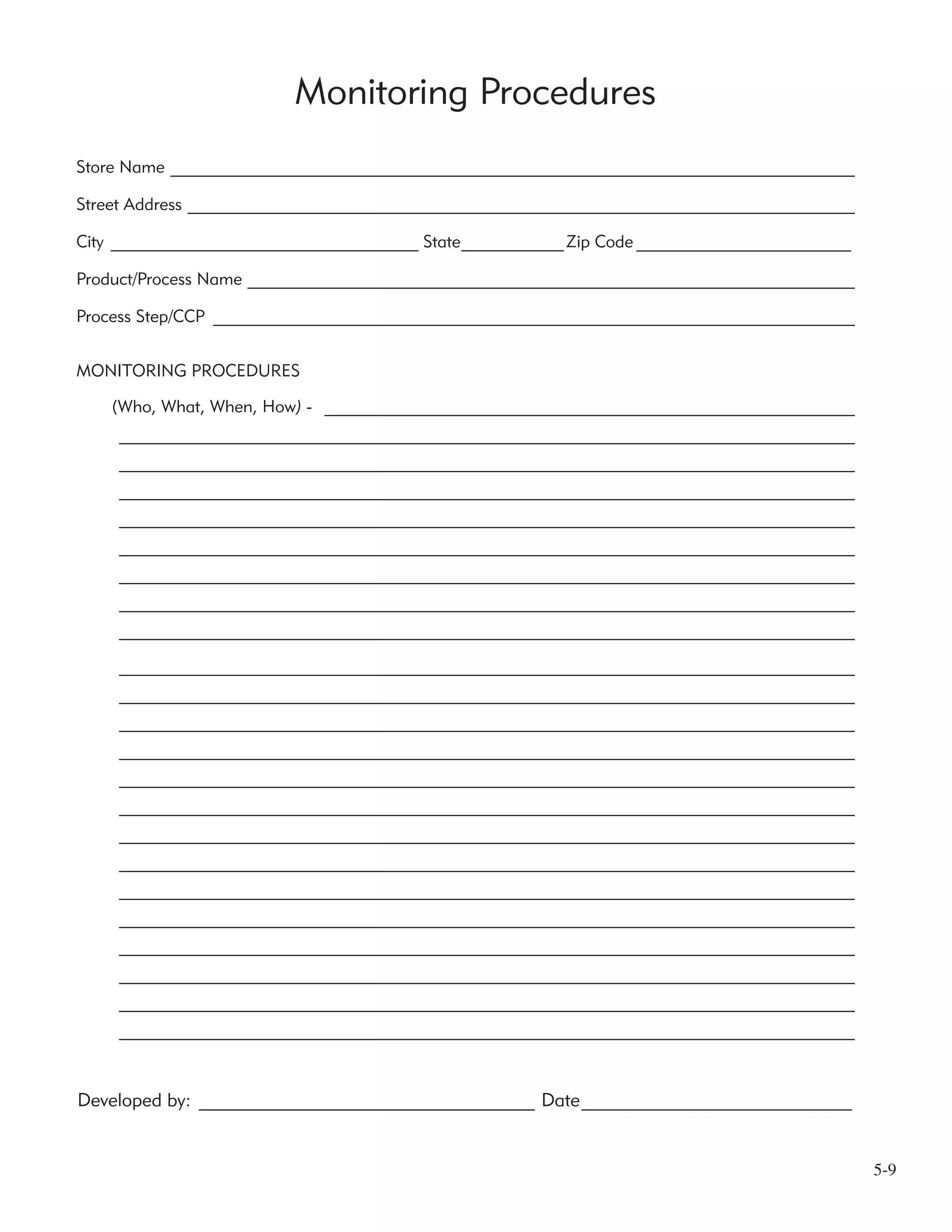
The form that is shown as an example on the next page is to be used as a tool in the development of your
HACCP plan. The information on this form is the “Who, What, When and How” of monitoring.
For the Example Facility:
• The Who is the cook on duty.
• The What is the temperature of the oven.
• The When is non-continuously - every 60 minutes, (+ 5 minutes), and
• The How is with the oven temperature gauge.
The Example Store felt this type of non-continuous monitoring would be effective because of the consistent
heat environment of the oven. Their logic was that if the temperature taken at the beginning and end of the
cooking cycle was the same, it could reasonably be assumed that it was okay for the whole cooking cycle.
Remembering your Monitoring
The key to effective and reliable monitoring is to keep it simple and build it into the employees’
normal routines. When establishing a time for the actual monitoring procedure, allow some
flexibility. For example, if you say you will monitor a CCP at 10 a.m. and the person is not
there at exactly 10 a.m., you could be opening yourself up for problems. It is suggested that
you specify a period of time during which monitoring will occur. For example, write your time as
“10a.m. +/-- 10 minutes”or “between the time period of 10 a.m. and 10:15 a.m.”
3-25
Developed by: _________________________ Date ____________Cindy Jones 12/10/98
Product/Process Name: _______________________________________
Process Step/CCP: ____________________________________________
Beef Jerky/Heat Treated, Shelf Stable
Cooking CCP #01B
Monitoring Procedures - (Who, What, When, How) ________________________________
_____________________________________________________________________________
_____________________________________________________________________________
_____________________________________________________________________________
_____________________________________________________________________________
_____________________________________________________________________________
_____________________________________________________________________________
_____________________________________________________________________________
_____________________________________________________________________________
_____________________________________________________________________________
_____________________________________________________________________________
_____________________________________________________________________________
_____________________________________________________________________________
_____________________________________________________________________________
The cook on duty records the oven temperature at intervals of 60 minutes, (+ 5 minutes)
starting when a “lot” is placed in the oven and ending when the “lot” is removed from oven.
Each oven is monitored individually using an oven temperature gauge.
HACCP Principle 4
Monitoring Procedures Form
3-26
Principle 5: Establish Corrective Actions
Corrective Action can be defined as “Procedures to be followed when a deviation occurs.” A deviation is
defined as a “failure to meet a critical limit.”
Deviations can and do occur. After the HACCP team has established strict monitoring procedures, the next
step is to draft corrective actions to be taken immediately when there is a loss of control at a CCP.
Corrective action may include, but is not limited to the following procedures:
1. Identifying and eliminating the cause of the deviation,
2. Demonstrating that the CCP is once again under control. (This means examining the process or product
again at that CCP and getting results that are within the critical limits.),
3. Taking steps to prevent a recurrence of the deviation,
4. Making sure that no adulterated product enters commerce, and
5. When to discard product.
6. Maintaining detailed records of the corrective actions.
If a deviation occurs that is not covered by a specific corrective action in your HACCP plan, or if some
unforeseen hazard arises, appropriate steps should be taken. These steps shall include, but not be
limited to:
1. Segregate and hold any affected product until its acceptability can be determined.
2. Determine the acceptability of the affected product for distribution.
3. Do not allow product that is injurious to health or is otherwise adulterated to enter commerce.
4. Reassess and, if necessary, modify your HACCP plan to properly address this type of deviation in the
future.
5. Maintain detailed records of your actions.
Some examples of corrective actions are:
• Changing the process and holding the product for further evaluation.
• Empowering the monitoring personnel to stop the line when a deviation occurs. They should have the
authority to hold all “lots” of a product not in compliance.
• Rely on an approved alternate process that can be substituted for one that is out of control at the
specific CCP.
• Additional cooking time.
• Quickly cooling product.
Whatever type of corrective actions the HACCP team establishes, records for each one need to be kept
that include:
• That the deviation was identified.
• The reason for holding the product, the time and date of the hold, the amount of the product involved,
and the disposition and/or release of the product.
• The actions that were taken to prevent the deviation from recurring.
• The dated signature of the employee who was responsible for taking the corrective action.
As with monitoring logs, the HACCP team also needs to develop the log(s) for the corrective action results.
3-27
Working with the “Corrective Action Procedures” Form
The Example Facility’s corrective action form outlines exactly what they think should be done if a problem
occurs with the CCP#01B.
• Under the “Problem” heading.
They state the critical limit that has been established for this CCP.
• Under the “Disposition of Product” heading.
If a deviation occurs, they have noted that the initial disposition would be to hold the product “lot”, and
try to rework it if possible. The “rework” would consist of fixing the temperature and re-cooking the
jerky.
• Under “Corrective Action Procedures/Steps” heading.
As you can see, the Example Facility listed quite specific corrective actions for this CCP. Their
directions are written concisely, and in the order they should be performed.
• Under the “Who is Responsible” heading.
They are specific in naming a particular person.
• Under the “Compliance Procedures” heading.
The Example Facility has projected that if this deviation happens at this CCP it will probably be
because something went wrong with the thermostat in the oven. They list here what will probably
need to be done to make sure this doesn’t happen again. (If this deviation were to actually happen, the
monitoring person would write on the corrective action log what he or she did to fix the problem, and
what they did to make sure it wouldn’t happen again.)
Stopping Production
The more ownership the employees feel they have in the HACCP system, the more effective
they will be in ensuring that your facility produces safe food.
One idea is to empower the person responsible for monitoring to be able to stop production
when and if a deviation occurs. This accomplishes two important functions.
• First, it prevents the potentially hazardous product from continuing down the production
line.
• Second, it makes timely communication easier; thus you find out what’s happening in
your facility as soon as possible.
3-28
Developed by: _________________________ Date ____________
Product/Process Name: _______________________________________
Process Step/CCP: ____________________________________________
Beef Jerky/Heat Treated, Shelf Stable
Cooking CCP # 01B
Problem - (Critical limit exceeded) _______________________________________________
____________________________________________________________________________
Disposition of product - (Hold, Rework, Condemn)_________________________________
_____________________________________________________________________________
Corrective action procedures/steps _______________________________________________
_____________________________________________________________________________
_____________________________________________________________________________
_____________________________________________________________________________
_____________________________________________________________________________
__________________________________________________________________________
Who is responsible for performing these corrective actions?__________________________
__________________________________________________________________________
Compliance procedures________________________________________________________
_____________________________________________________________________________
_____________________________________________________________________________
1.Identify and segregate affected product, place on hold.
2. Rework if possible, otherwise condemn product: Reestablish correct cooking procedures (i.e.
fix oven temp. settings, or move product to other oven for rework.)
3. Determine cause of deviation: broken oven thermostat.
4. Take steps to prevent recurrence: recalibrate/replace thermostat
5. Notify Quality Control Supervisor a.s.a.p.
John Smith - Cook
on duty
Recalibrate/Replace oven thermostat.
Monitor CCP as usual during rework.
Oven temp, below 190 degrees Fahrenheit
Hold, rework if possible.
HACCP Principle 5
Corrective Action Procedures Form
Cindy Jones 12/14/98
3-29
Principle 6: Establish Record Keeping Procedures
The records you keep for HACCP can make all the difference! Good HACCP records - meaning that they are
accurate and complete - can be a great help to you. Here’s why:
• Records make it possible to trace ingredients, in-process operations, or finished products, should a
problem occur.
• Records help you identify trends in your production line.
• Records serve as written documentation of your facility’s compliance with the HACCP regulations.
Well maintained records protect both your customers and YOU.
Your HACCP records should include your development forms and your daily logs for each CCP. You should
also keep your hazard analysis development forms, your CCP determination sheets, a list of critical limits for
each food safety hazard, clear corrective action instructions, and a copy of your compiled HACCP plan. When
first establishing your recordkeeping procedures, it’s better to think of the different kinds of records you’ll need
in two ways.
First, there are records that are used for development for archival purposes; such as your Hazard Analysis,
and your CCP decision making tool.
Second, there are records that you will work with on a day-to-day basis. These are the logs we’ve been
discussing such as the monitoring or corrective action logs. As we’ve said before, the HACCP team
will need to create these logs for each CCP in your process.
The Minnesota Food Code requires that you keep records on specified information; see page 4-3 for further
detail. Regardless of the type of record, all HACCP records must contain at least the following information:
• Title and date of record.
• Product identification,
• Signature of employee making entry,
• A place for the reviewer’s signature, and
• An orderly manner for entering the required data.
Working with the “Recordkeeping
Procedures” Form
• Under the “Records” heading.
You can see that the Example Facility has filled out
their Recordkeeping Form making sure to list both the
development forms (the hazard analysis), and the logs.
[One last note about the records you keep. When developing and
working with your forms and logs remember to use ink (ballpoint
pen) - no pencils. On all records, whenever you make a change,
mark through the original and initial. Do not erase, white out,
or mark the original so that it is unreadable.]
Tips on Designing Records
One way to approach development
of the recordkeeping requirements
of your HACCP system is to
review the records you already
keep, and see if they are suitable,
in their present form or with minor
modifications, to serve the purposes
of your HACCP system. The best
recordkeeping system is usually
the simplest one that can easily
be integrated into the existing
operation.
Place a blank copy of all logs/forms in the HAACP plan to show how you record this information.
3-30
HACCP Principle 6
Recordkeeping Procedures Form
Developed by: _________________________ Date ____________Cindy Jones 12/10/98
Name: Hazard Analysis
Location: Office File
Cabinet
Name: Deviation /
Corrective Action Log
Location: Oven Room Wall
Name: HACCP Plan Re-
view Sheet - For each CCP
Location: Oven Room Wall
Name: Process - Monitoring
Equipment Calibration Log
- For each CCP
Location: Oven Room Wall
Name: Monitoring Log -
For each CCP
Location: Oven Room Wall
Name: Verification Proce-
dures & Results Log - For
each CCP
Location: Oven Room Wall
Product/Process Name: _______________________________________
Process Step/CCP: ____________________________________________
Records
Beef Jerky/Heat Treated, Shelf Stable
Cooking CCP # 01B
3-31
Principle 7: Establish Verification Procedures
Your team needs to decide on what procedures the facility will perform to verify that the HACCP system is
working effectively and how often these actions will be performed. Verification uses methods, procedures,
or tests in addition to those used in monitoring to see whether the HACCP system is in compliance with the
HACCP plan or whether the HACCP plan needs modification. There are three types of verification. These are
initial validation, ongoing verification, and reassessment of the HACCP plan.
Initial Validation
Validation is defined as” the specific and technical process for determining that the CCP’s and associated
critical limits are adequate and sufficient to control likely hazards.” The initial validation of your HACCP plan
is the process by which your establishment proves that what is written in the HACCP plan will be effective in
preventing, eliminating, or reducing food safety hazards. This validation activity is the exclusive responsibility
of your establishment.
You carry out this validation by gathering evidence that supports your HACCP plan. The data you bring
together can come from many sources. Such sources may include scientific literature, product testing results,
regulatory requirements, and /or industry standards. Companies have a lot of flexibility in the compilation of
this information in regards to the sources and the amounts of such data.
[Most likely, you already have the majority of the validation information you need. When you conducted your
hazard analysis and researched the sources for your critical limits, you were collecting data that could also be
used to validate your entire HACCP plan.
Ongoing Verification
Verification is “the use of methods, procedures , or tests in addition to those used in monitoring, to determine
whether the HACCP system is operating as intended.” After a HACCP plan has been initially validated and
put into action, verification activities continue on an ongoing basis.
Simply stated, you need to verify that your HACCP system is working the way you expected. There are
several ways to do this, here are a few: (these aren’t the only ones)
• Calibrate your monitoring equipment.
• Sample your product.
• Review your monitoring and corrective action logs.
• Personally inspect your facility’s operations.
Whatever types of ongoing verification activities you decide to
use, they should be included in your HACCP plan along with
the specifics on your CCP’s, critical limits, monitoring, and
corrective actions. Also, the HACCP team needs to identify the
schedules for conducting the verification checks.
3-32
Reassessment of the HACCP Plan
It is a good idea to reassess the adequacy of your plan at least once a year and whenever any new changes
occur that could affect the hazard analysis or alter the HACCP plan. Here are a few, but not all, of the changes
that would require modification to your HACCP plan.
1. Potential new hazards are identified that may be introduced into the process.
2. New ingredients are added, or when an ingredient supplier is changed.
3. The process steps or procedures are changed.
4. New or different processing equipment is introduced.
5. Production volume changes.
6. Personnel changes.
Your reassessment should include a review of the existing HACCP plan, including the product evaluation, hazard
analysis, critical control points, critical limits, monitoring procedures, corrective actions and recordkeeping
procedures.
Working with the “Verification Procedures” Form
It’s important to remember that verification procedures are ongoing activities. For each CCP you will need a
monitoring log, a deviation/corrective action log, and an equipment calibration log. These logs are the continual
verification that HACCP is being done effectively.
(Like the monitoring form in principle 4, the information on this form is the “Who, What, When and How” of
verification.)
For the Example Facility:
• The Who is the quality control supervisor.
• The What is each one of the three activities they need for their process,
• The When is specified after each activity, and
• The How would be determined as needed by the quality control supervisor.
Finishing Your HACCP Plan
Each form that is used in the development of the HACCP plan and the HACCP plan itself needs to be reviewed
in its entirety and signed and dated by the responsible official on the HACCP team. This person must make sure
that the HACCP plan is complete. This assures the HACCP team that only the most complete and up-to-date plan
is being used.
The HACCP System
The HACCPPlan is a written document that is based on the 7 principles of HACCP.A HACCPSystem is the results
of the implementation of the HACCPplan. It includes the written HACCPplan itself but also any records produced,
verification data and any prerequisite programs (either written plans or records for GMPs and SSOPs)
The HACCP system produces real results. HACCP is a way of getting and keeping control over your entire
production process.
3-33
Developed by: _________________________ Date ____________
Verification Procedures - (Who, What, When, How) ______________________________
___________________________________________________________________________
____________________________________________________________________________
___________________________________________________________________________
___________________________________________________________________________
___________________________________________________________________________
___________________________________________________________________________
___________________________________________________________________________
___________________________________________________________________________
___________________________________________________________________________
___________________________________________________________________________
____________________________________________________________________________
___________________________________________________________________________
___________________________________________________________________________
Product/Process Name: _______________________________________
Process Step/CCP: ____________________________________________
Beef Jerky/Heat Treated, Shelf Stable
Cooking CCP # 01B
Thermometer calibration - Weekly
Random observation of monitoring - Daily
Review relevant records - Daily, prior to shipment
Deviation response review - Ongoing
Quality Control Supervisor
HACCP Principle 7
Verification Procedures Form
Cindy Jones 12/10/98
4-1
Introduction
HACCP is a universal preventative system for assuring the safe production of food products.
The Preliminary Steps and Seven Principles of HACCP can be applied to most any food
production process including agriculture production, food processing, retail food preparation,
and distribution systems. Previous sections in this manual have focused on the basics of
developing a HACCP plan.
The Minnesota Food Code regulation applies to retail food establishments such as grocery
stores, restaurants, meat markets, convenience stores, bakeries, etc. Processes that require
operation under a HACCP plan were previously discussed in Section 1. Also included there
was timing of HACCP plans. It is important to note that new or extensively remodeled
establishments must submit the HACCP plan to the regulatory authority before the start of
operation for approval in conjunction with the facility plan review.
In this book, Section 2 focused on Preliminary Steps. Basically, the preliminary steps is a
method to collect information that is used in developing the HACCP plan. The Minnesota
Food Code requires that some of the preliminary steps information become part of your official
HACCP plan. Section 3 of this book focuses on developing the HACCP plan itself using the
Seven Principles. The Minnesota rule requires that most (although not all) of this information
become part of your official HACCP plan. In addition, the Minnesota Food code requires that
the HACCP plan for your retail food establishment contain some additional components. A
complete reference to the applicable Minnesota rules is provided in the Appendix.
Minnesota Food Code
Requirement
Section
4
4-2
Contents of a HACCP Plan
Minnesota Rules 4626.1735 - (8-201.14) state that for a food establishment that is required to have
a HACCP plan, the plan and specifications shall include:
1. A categorization of the types of potentially hazardous foods that are specified in the menu.
*This information was collected in Preliminary Steps – Number 2. See page 1-5 for more information. Be
sure that this is included as one of the documents in your official HACCP plan.
2.. A flow diagram by specific food or category types identifying critical control points and providing
information on the following:
a. Ingredients, materials and equipment used in the preparation of a food.
b. Formulations or recipes that delineate methods and procedural control measures that address the
food safety concerns involved.
*This information was collected in Preliminary Steps – Number 3 and 4. See page 1-5 for more
information. Be sure that this is included as one of the documents in your official HACCP plan.
3. A statement of Standard Operating Procedures for the plan identifying:
a. Critical control points.
b. Critical limits for each critical control point.
c. The method and frequency for monitoring and controlling each critical control point by the food
employee designated by the person in charge.
d. The method and frequency for the Person in Charge to routinely verify that the food employee is
following standard operating procedures and monitoring critical control points. (verification)
e. Action to be taken by the Person in Charge if the critical control points are not met. (corrective
action)
f. Records to be maintained by the Person in Charge to demonstrate that the HACCP plan is
properly operated and managed.
*Items 3a – f should all be included as part of your HACCP plan as developed in Section
3. The Person in Charge is ultimately responsible for ensuring that critical control points
are monitored and corrective action is taken as necessary and that records are maintained to
document this. The day-to-day activities could be assigned to an employee working in the HACCP
operation.
4. Additional scientific data or other information as required by the regulatory authority supporting the
determination that food safety is not compromised by the proposal.
*Types of information that might need to be included here are validation data, or data to support a variance.
4-3
Compliance with the HACCP Plan
Minnesota Rules 4626.1730, Subp.3 state that in order to be in Compliance with the HACCP Plan a
licensee shall:
A. Comply with a properly prepared HACCP plan, and
B. Maintain and provide to the regulatory authority, on request, the records specified in part 4626.1735 ,
item A, sub-items (3) and (4) that demonstrate that the following are routinely employed:
1. Procedures for monitoring critical control points.
2. Monitoring of critical control points.
3. Verification of the effectiveness of an operation or process.
4. Necessary corrective actions if there is a failure at a critical control point.
When the rule requires that you prepare a HACCP plan for a certain operation, this HACCP plan
does, in effect, become part of the rule for your establishment. You must comply with your properly
prepared HACCP plan. By complying with the Standard Operating Procedures you have prepared as
part of your HACCP plan and when you have followed the steps in this publication for developing
a HACCP plan, you will have the necessary information to develop records that demonstrate that
critical point monitoring procedures are detailed and followed, that the process is verified for
effectiveness and that necessary corrective actions are taken as necessary.
Variances and the HACCP Plan
In several cases, when an establishment applies for a variance, the firm may be required to prepare and comply
with a HACCP plan for that operation. Operations that have this requirement are as follows:
1. Using more than one tagged shellstock container at a time
2. Deviating from required cook times and temperature for raw animal foods
3. Using molluscan shellfish life support system display tanks to store and display shellfish that
are offered for sale.
It is important to remember that the firm must first apply for and be granted a variance in prior to
conducting these operations.
4-4
1. Tagged Shellstock
Minnesota Rules 4626.0220, B (2) (b) states that that using more than one tagged or labeled container of
shellstock at a time requires obtaining a variance from the regulatory authority based on a HACCP plan that
includes procedures.
The HACCP facility must include procedures that:
1. includes procedures that preserve source identification by using a record keeping system that keeps the
tags or labels in choronological order correlated to the date when, or dates during which, the shellstock
are sold or served, AND
2. ensure the shellstock from one tagged or labeled container are not co-mingled with shell stock from
another container before being ordered by the consumer.
2. Deviating from Required Cook Times/Temperautres
MN Rules 4626.00340C states that the required cooking times and temperatures for raw animal foods do
not apply if the regulatory authority grants a variance based on a HACCP plan that:
1. documents scientific data or other information showing that a lesser time and temperature regimen
results in a safe food, AND
2. verifies that equipment and procedures for food preparation and training of food employees at the food
establishment meet the condition of the variance.
3. Sale of Product from Molluscan Shellfish Life Support System Display Tanks
Minnesota Rules 4626.0610 B states that Molluscan shellfish life support tanks used to store and display
shellfish that are offered for human consumption shall be operated and maintained according to a variance
granted by the regulatory authority with a HACCP plan that:
1. water used with fish other than molluscan shellfish does not flow into the molluscan tank,
2. the safety and quality of the shellfish as they were received are not compromised by use of the tank,
AND
3. the identity of the source of the shellstock is retained as specified in 4626.0220 (see requirements as
stated above)
The Minnesota Food Code has specific requirements for Variances requests. The appendix at the back of
this publication provides the rule language - see parts 4626.1690 through 4626.1715. Contact the
Dairy and Food Inspection Division for more information on applying for a variance.
4-5
Reduced Oxygen Packaging
REDUCED OXYGEN PACKAGING (ROP) is defined as any packaging procedure that results in a reduced
oxygen level in a sealed packaged. You may be more familiar with the term ‘vacuum packaging’ which is one
type of reduced oxygen packaging method. Another term used is ‘Modified Atmosphere Packaging”, this is a
process that uses a gas flushing and sealing process in a one time modification of the atmospheric contents of the
package.
If reduced oxygen packaging is one of the processes that are included in your HACCP plan, the Minnesota Food
Code requires that additional information be included. These items can be included in the formal HACCP plan
or as separate documents.
Reduced Oxygen Packaging Criteria
Minnesota Rules 4626.0420 - (3-502.12)
The HACCP plan shall:
1. Identify the food to be packaged.
This information was collected in Preliminary Steps – Number 2. See page 1-5 for more information.
If adequate detail was provided on this list, this requirement will have been met. Specific brand names
of products would not need to be included as long as the products meet the requirements as listed in
number 2 below. Be sure that this list is included as one of the documents in your official HACCP plan.
2. Limit the food to be packaged to a food that does not support the growth of Clostridium botulinum
because the food:
a. has a water activity of 0.91 or less
b. has a pH of 4.6 or less
c. is a food with a high level of competing organisms, including raw meat, raw poultry, or a
naturally cultured standardized cheese, OR
d. is a meat or poultry product that is
i. cured at a state inspected or USDA inspected meat facility and received in an intact
package, or
ii. cured using approved substances (nitrates/nitrites)
The MN Food code limits the types of foods that can be packaged by a reduced oxygen method at the retail
level. A store’s HACCP plan must clearly state the foods that can be packaged using a reduced oxygen
packaging method. Only specific products on this list can be reduced oxygen packaged. By limiting the types
of food that can be Reduced Oxygen Packaged to those on the list, an additional barrier to the growth and
toxin formation of Clostridium botulinum is provided and thereby helps to ensure a safe product.
In addition, except for fish that is frozen before, during, and after packaging, a food establishment shall not
package fish using a reduced oxygen packaging method.
4-6
The following are examples of foods that DO NOT meet the above requirements and therefore
MAY NOT be reduced oxygen packaged:
• Cooked turkey (including whole or sliced turkey breast)
• Cooked roast beef
• Sandwich spread (including ham salad, chicken salad, etc.)
• Cooked fresh sausage (not cured/smoked such as bratwurst)
• Raw or smoked fish
• Processed salads (such as potato salad, cole slaw).
3. Specify how the food will be maintained at 41°F or below.
Maintaining the food at a temperature of 41°F or less is the primary barrier to the growth of Clostridium
botulinum. Because temperature maintenance is such a vital factor to ensuring food safety, the method for
ensuring this must be addressed in the HACCP plan.
4. Describe how the food will be prominently and conspicuously labeled on the principal display panel in
bold type on a contrasting background with instructions to:
a. Keep Refrigerated or Frozen
b. Discard the food if within 14 calendar days of its packaging it is not served (if for on premise
consumption) or consumed (if served or sold for off premise consumption)
In addition to the normal mandatory labeling requirements, ROP foods must be labeled to include the
above statements. These statements might be included on the same label with the other information or
may be add-on stickers. As stated, these statements must be on the principal display panel (generally the
front of the package) and must be conspicuous so that the consumer is readily made aware of these special
requirements. For more information on mandatory labeling requirements, contact the Dairy and Food
Inspection Division. Be sure that these labeling requirements are addressed in the HACCP plan as part of
standard operating procedures.
The following is
an example of the
label with the
required information:
4-7
5. Limit the shelf life to no more than 14 days from packaging to consumption, or the original
manufacturer’s “sell by” or “use by” date, whichever occurs first, unless a variance has been granted.
Pathogens, including Listeria monocytogenes may be a hazard even at refrigeration temperatures.
Therefore, it is necessary to limit the shelf life of ROP products. Ensure that this is addressed in the HACCP
plan.
6. Include operational procedures that:
a. Comply with part 4626.0225 relating to contamination from hands.
This section of the MN Food Code discusses handwashing and direct hand contact with food. The
entire rule reference is listed in the appendix. Directionto employees must be provided as part of the
operating procedures.
b. Identify a designated area and the method by which:
i. Physical barriers or methods of separation of raw foods and ready to eat foods minimize
cross contamination; and
ii. Access to the processing equipment is restricted to responsible trained personnel familiar
with the potential hazards of the operation
As with any food processing operation, contamination between raw and ready to eat food
can potentially create a serious food safety hazard. In addition, untrained personnel might
contribute to hazardous food handling practices or the packaging of unapproved foods. Be sure
operating procedures address these potential food safety hazards.
c. Delineate cleaning and sanitization procedures for food contact surfaces.
Properly cleaned and sanitized food contact surfaces are critical to ensuring a safe, sanitary
operation. Use of approved cleaners and sanitizers will reduce levels of pathogenic organisms
to prevent cross contamination of the product. Ensure that a complete, detailed operating
procedure for cleaning and sanitizing is included in the HACCP plan.
7. Describe the training program that ensures that the individual responsible for the reduced oxygen
packaging operation understands the :
a. Concepts required for a safe operation
b. Equipment and facilities; and
c. Procedures specified in sub-item 6 and Standard Operating Procedures for the HACCP plan.
A training program for employees conducting ROP operations is essential to producing a safe product.
Areas to be included might be – limiting foods to be packaged, temperature control, separation of raw and
ready to eat, employee health and hygiene. A thorough understanding of how equipment operates, product
flow as well as the standard operating procedures for the facility will also add to product safety. Ensure that
these items are addressed.
5-1
Sample Forms
Section
5
5-2
HACCP Team
Developed by: ____________________________________ Date_____________________________
Store Name ________________________________________________________________________________
Street Address ______________________________________________________________________________
City ____________________________________ State____________Zip Code _______________________
Team Members Role
5-3
Product/Process Covered
Developed by: ____________________________________ Date_____________________________
Store Name ________________________________________________________________________________
Street Address ______________________________________________________________________________
City ____________________________________ State____________Zip Code _______________________
Product/Process Covered Under the HACCP Plan
Smoking/Curing
______________________________________________________________________________________
______________________________________________________________________________________
______________________________________________________________________________________
______________________________________________________________________________________
______________________________________________________________________________________
Reduced Oxygen Packaging
______________________________________________________________________________________
______________________________________________________________________________________
______________________________________________________________________________________
______________________________________________________________________________________
______________________________________________________________________________________
Food Additives
______________________________________________________________________________________
______________________________________________________________________________________
______________________________________________________________________________________
______________________________________________________________________________________
______________________________________________________________________________________
Variances
______________________________________________________________________________________
______________________________________________________________________________________
______________________________________________________________________________________
______________________________________________________________________________________
______________________________________________________________________________________
5-4
Ingredients and Raw Materials
Developed by: ____________________________________ Date_____________________________
Store Name ________________________________________________________________________________
Street Address ______________________________________________________________________________
City ____________________________________ State____________Zip Code _______________________
Product/Process Category_____________________________________________________________________
Product Examples ___________________________________________________________________________
Meat Poultry and Byproducts Nonmeat Food Ingredients Binders/Extenders
Spices/Flavorings Restricted Ingredients Preservatives/Acidifiers
Liquid Packaging Materials Other
5-5
Process Flow Diagram
Verified by: _______________________________________ Date_____________________________
Store Name ________________________________________________________________________________
Street Address ______________________________________________________________________________
City ____________________________________ State____________Zip Code _______________________
Product/Process Name _______________________________________________________________________
Flow Diagram
Developed by: ____________________________________ Date_____________________________
5-6
Equipment List
Developed by: ____________________________________ Date_____________________________
Store Name ________________________________________________________________________________
Street Address ______________________________________________________________________________
City ____________________________________ State____________Zip Code _______________________
Process ____________________________________________________________________________________
______________________________________________________________________________________
______________________________________________________________________________________
______________________________________________________________________________________
______________________________________________________________________________________
______________________________________________________________________________________
______________________________________________________________________________________
______________________________________________________________________________________
______________________________________________________________________________________
______________________________________________________________________________________
______________________________________________________________________________________
______________________________________________________________________________________
______________________________________________________________________________________
______________________________________________________________________________________
______________________________________________________________________________________
______________________________________________________________________________________
______________________________________________________________________________________
______________________________________________________________________________________
______________________________________________________________________________________
______________________________________________________________________________________
______________________________________________________________________________________
______________________________________________________________________________________
______________________________________________________________________________________
______________________________________________________________________________________
______________________________________________________________________________________
______________________________________________________________________________________
______________________________________________________________________________________
5-7
Identifiying Critical Control Points
Developed by: ____________________________________ Date_____________________________
Store Name ________________________________________________________________________________
Street Address ______________________________________________________________________________
City ____________________________________ State____________Zip Code _______________________
Process/Step________________________________________________________________________________
Critical Control Point Decision Tree
Question 1A
Do preventative measures exist for the identified hazards?
If no - go to Question 1B.
If yes - go to Question 2.
Question 1B
Is control at this step necessary for safety?
If no - not a CCP
If yes - modify step, process or product
and return to Question 1.
Question 2
Does this step eliminate or reduce the likely
occurence of a hazard(s) to an acceptable level?
If no - go to Question 3.
If yes - CCP.
Question 3
Could contamination with identified hazard(s)
occur in excess of acceptable levels or could
these increase to unacceptable levels?
If no - not a CCP.
If yes - go to Question 4.
Question 4
Will a subsequent step eliminate the identified
hazards or reduce the likely occurence to an
unacceptable level?
If no - CCP.
If yes - not a CCP.
BIOLOGICAL CHEMICAL PHYSICAL
CCP#______________
Not a CCP
CCP#______________
Not a CCP
CCP#______________
Not a CCP
5-8
Critical Limits
Developed by: ____________________________________ Date_____________________________
Store Name ________________________________________________________________________________
Street Address ______________________________________________________________________________
City ____________________________________ State____________Zip Code _______________________
Product/Process Name _______________________________________________________________________
Process Step/CCP ___________________________________________________________________________
CRITICAL LIMITS
Limit (time, temp, pH, etc.) - _____________________________________________________________
______________________________________________________________________________________
______________________________________________________________________________________
______________________________________________________________________________________
______________________________________________________________________________________
______________________________________________________________________________________
______________________________________________________________________________________
______________________________________________________________________________________
______________________________________________________________________________________
______________________________________________________________________________________
Source (cite a regulation, scientific document, other resource) - ________________________________
______________________________________________________________________________________
______________________________________________________________________________________
______________________________________________________________________________________
______________________________________________________________________________________
______________________________________________________________________________________
______________________________________________________________________________________
______________________________________________________________________________________
______________________________________________________________________________________
______________________________________________________________________________________
______________________________________________________________________________________
______________________________________________________________________________________
______________________________________________________________________________________
5-9
Monitoring Procedures
Developed by: ____________________________________ Date_____________________________
Store Name ________________________________________________________________________________
Street Address ______________________________________________________________________________
City ____________________________________ State____________Zip Code _______________________
Product/Process Name _______________________________________________________________________
Process Step/CCP ___________________________________________________________________________
MONITORING PROCEDURES
(Who, What, When, How) - ______________________________________________________________
______________________________________________________________________________________
______________________________________________________________________________________
______________________________________________________________________________________
______________________________________________________________________________________
______________________________________________________________________________________
______________________________________________________________________________________
______________________________________________________________________________________
______________________________________________________________________________________
______________________________________________________________________________________
______________________________________________________________________________________
______________________________________________________________________________________
______________________________________________________________________________________
______________________________________________________________________________________
______________________________________________________________________________________
______________________________________________________________________________________
______________________________________________________________________________________
______________________________________________________________________________________
______________________________________________________________________________________
______________________________________________________________________________________
______________________________________________________________________________________
______________________________________________________________________________________
______________________________________________________________________________________
5-10
Corrective Action Procedures
Developed by: ____________________________________ Date_____________________________
Store Name ________________________________________________________________________________
Street Address ______________________________________________________________________________
City ____________________________________ State____________Zip Code _______________________
Product/Process Name _______________________________________________________________________
Process Step/CCP ___________________________________________________________________________
Problem (critical limit exceeded) - _____________________________________________________________
___________________________________________________________________________________________
___________________________________________________________________________________________
Disposition of Product (hold, rework, condemn) - ________________________________________________
___________________________________________________________________________________________
___________________________________________________________________________________________
___________________________________________________________________________________________
___________________________________________________________________________________________
Corrective Action Procedure/Steps - ____________________________________________________________
___________________________________________________________________________________________
___________________________________________________________________________________________
___________________________________________________________________________________________
___________________________________________________________________________________________
Who is responsible for performing these corrective actions?- _______________________________________
___________________________________________________________________________________________
___________________________________________________________________________________________
___________________________________________________________________________________________
___________________________________________________________________________________________
Compliance Procedures- _____________________________________________________________________
___________________________________________________________________________________________
___________________________________________________________________________________________
___________________________________________________________________________________________
___________________________________________________________________________________________
5-11
Recordkeeping Procedures
Developed by: ____________________________________ Date_____________________________
Store Name ________________________________________________________________________________
Street Address ______________________________________________________________________________
City ____________________________________ State____________Zip Code _______________________
Product/Process Name _______________________________________________________________________
RECORDS
Name and Location
5-12
Verification Procedures
Developed by: ____________________________________ Date_____________________________
Store Name ________________________________________________________________________________
Street Address ______________________________________________________________________________
City ____________________________________ State____________Zip Code _______________________
Product/Process Name _______________________________________________________________________
VERIFICATION PROCEDURES
(Who, What, When, How) - ______________________________________________________________
______________________________________________________________________________________
______________________________________________________________________________________
______________________________________________________________________________________
______________________________________________________________________________________
______________________________________________________________________________________
______________________________________________________________________________________
______________________________________________________________________________________
______________________________________________________________________________________
______________________________________________________________________________________
______________________________________________________________________________________
______________________________________________________________________________________
______________________________________________________________________________________
______________________________________________________________________________________
______________________________________________________________________________________
______________________________________________________________________________________
______________________________________________________________________________________
______________________________________________________________________________________
______________________________________________________________________________________
______________________________________________________________________________________
______________________________________________________________________________________
______________________________________________________________________________________
______________________________________________________________________________________
______________________________________________________________________________________
5-13
Store Name ______________________________________________________________________
Street Address ____________________________________________________________________
City ____________________________________ State____________Zip Code ______________
5-14
Hazard Analysis Worksheet
Developed by: ____________________________________ Date_____________________________
(1)
Ingredient/
processing step
(2)
Identify potential
hazards
introdced,
controlled or
enhanced at this
time
(3)
Are any
potential food
safety hazards
significant?
(YES/NO)
(4)
Justify your
decision for
column 3
(5)
What preventative
measure(s)
can be applied
to prevent the
significant
hazards?
(6)
Is this step a
critical control
point?
(YES/NO)
BIOLOGICAL
CHEMICAL
PHYSICAL
BIOLOGICAL
CHEMICAL
PHYSICAL
BIOLOGICAL
CHEMICAL
PHYSICAL
BIOLOGICAL
CHEMICAL
PHYSICAL
BIOLOGICAL
CHEMICAL
PHYSICAL
BIOLOGICAL
CHEMICAL
PHYSICAL
Store Name ________________________________________________________________________________
Street Address ______________________________________________________________________________
City ____________________________________ State____________Zip Code _______________________
5-15
HACCP Plan
(1)
Critical
Control
Poin
(CCP)
(2)
Significant
Hazards
(3)
Critical Limits
for each
Preventative
Measure
(4) (5) (6) (7) (8)
Corrective
Action(s)
(9)
Records
(10)
Verification
Monitoring
What How Freq-
uency
Who
Store Name ________________________________________________________________________________
Street Address ______________________________________________________________________________
City ____________________________________ State____________Zip Code _______________________
Product/Process ______________________________________________ Date _______________________
5-16
HACCPPlan
StoreName_________________________________________________StoreAddress____________________________________________________
Product/Process______________________________________________Developedby_____________________Date__________________________
CCPHazardCriticalLimits
Monitoring
Corrective
Action(s)
VerificationRecordsWhatHowFreq-
uency
Who
i
Appendix
Uniform Minnesota Food Code and Common Foodborne Bacterial Pathogens
Uniform Minnesota Food Code, Chapter 4626 HACCP References
DEFINITIONS
4626.0020
Subp. 40. HACCPplan, “HACCPplan” means a written document that delineates the formal procedures for following
the hazard analysis critical control point principles developed by the NationalAdvisory Committee on Microbiological
Criteria for Foods.
4626.0030 2-102.11 DEMONSTRATION.*
Based on the risks of forborne illness inherent to the food operation, during inspections and upon request by the
regulatory authority, the person in charge shall demonstrate to the regulatory authority knowledge of foodborne disease
prevention, application of the hazard analysis critical control point principles when a HACCP plan is required under
part 4626.1730, and the requirements of the Code. The areas of knowledge are:
M. Identifying critical control points in the operation from purchasing through sale or service that may
contribute to foodborne illness and explaining steps taken to ensure that the points are controlled when a
HACCP plan is required by part 4626.1_730;
N. explaining the details of how the person in charge and food employees comply with the HACCP plan if a
plan is required.
4626.0220 3-203.12 SHELLSTOCK; MAINTAINING IDENTIFICATION.*
A. Except as specified in item B, sub item (2), shellstock tags shall remain attached to the container in which
the shellstock are received until the container is empty.
B. The identity of the source of shellstock that are sold or served shall be maintained by retaining shellstock
tags or labels-for 90 calendar days from the date the container is emptied by:
(1) using an approved recordkeeping system that keeps the tags or labels in chronological order correlated to
the date when, or dates during which, the shellstock are sold or served; and
(2) if shellstock are removed from their tagged or labeled container:
(a) using only one tagged or labeled container at a time; or
(b) using more than one tagged or labeled container at a time and obtaining a variance from the regulatory
authority as specified in parts 4626.1690 to 4626.171 5 based on a HACCP plan developed according
to parts 4626.1 730 and 4626.1 735 that:
i. is submitted by the licensee and approved by the regulatory authority as specified in parts 4626.1690
to 4626.1 71 5;
ii. preserves source identification by using a recordkeeping system specified in sub item (1); and
iii. ensures that shellstock from one tagged or labeled container are not commingled with shellstock
from another container before being ordered by the consumer.
Sample Plan
ii
DESTROYING ORGANISMS
4626.0340 3-401.11 RAW ANIMAL FOODS.*
A. Except as specified in items B and C, raw animal foods, including eggs, fish, poultry, meat, and foods
containing these raw animal foods, shall be cooked to heat all parts of the food to a temperature and for a
time that complies with one of the following methods based on the food that is being cooked:
(1) 63°C (145°F) or above for 15 seconds for:
(a) raw shell eggs that are broken and prepared in response to a consumer’s order and for immediate
service; and
(b) except as specified in sub items (2) and (3) and item B, fish and meat including game animals
commercially raised for food as specified in part 4626.0160;
(2) 68°C (155°F) or above for 15 seconds or the temperature specified in the following chart that
corresponds to the holding time for pork; ratites; injected meats; the following if they are comminuted:
fish, meat, and game animals commercially raised for food as specified in part 4626.0160; and raw eggs
that are not prepared as specified in sub item (1), unit (a):
Minimum Temperature ° C (° F) Time
63 (145) 3 minutes
66 (150) 1 minute
(3) 74° C (165°F) or above for 15 seconds for poultry; wild game animals specified in part 4626.0160;
stuffed fish; stuffed meat; stuffed pasta; stuffed poultry; stuffed ratites; or stuffing containing fish, meat,
poultry, or ratites.
B. Whole beef roasts and corned beef roasts shall be cooked:
(1) In an oven that is preheated to the temperature specified for the roast’s weight in the following chart and
that is held at that temperature:
Oven Type
Oven Temperature Based on Roast Weight
less than 4.5 kg (10 lbs) 4.5 kg (10 lbs) or more
Still Dry 177o
C (350o
F) or more 121o
C (250o
F) or more
Convection 163o
C (325o
F) or more 121o
C (250o
F) or more
High Humidity1
121o
C (250o
F) or less 121o
C (250o
F) or less
1
Relative humidity greater than 90 percent for at least one hour as measured in the cooking chamber or exit of
the oven-, or in a moisture-impermeable bag that provides 100 percent humidity.
(2) As specified in the following chart, to heat all parts of the food to a temperature and for the holding time
that corresponds to that temperature:
Temperature ° C (° F) Time1
in Minutes
54 (130) 121
56 (132) 77
57 (134) 47
58 (136) 32
59 (138) 19
60 (140) 12
61 (142) 8
62 (144) 5
63 (145) 3
1
Holding time may include postoven heat rise.
iii
C. Items A and B do not apply if:
(1) The food is a raw animal food, including raw egg, raw fish, raw-marinated fish, raw molluscan shellfish,
steak tartare, or a partially cooked food including lightly cooked fish, rare meat, and soft cooked eggs
that is served or offered for sale in a ready-to-eat form, when the food is prepared in that fashion at the
request of the consumer; or
(2) The regulatory authority grants a variance from item A or B as specified in part 4626.1695, based on a
HACCP plan that:
(a) is submitted by the licensee and approved as specified in part 4626.1695;
(b) documents scientific data or other information showing that a lesser time and temperature regimen
results in a safe food; and
(c) verifies that equipment and procedures for food preparation and training of food employees at the
food establishment meet the conditions of the variance.
4626.0415 3-502.11 SPECIALIZED PROCESSING HACCP REQUIREMENTS.*
A HACCP plan shall be prepared by a food establishment before:
A. smoking or curing food, except for smoking done for the purpose of imparting flavor only and not as a part
of the cooking process;
B. using food additives or adding components, including vinegar, to:
(1) preserve food rather than to enhance flavor; or
(2) render a food so that it is not potentially hazardous; or
C. using a reduced oxygen method of packaging food.
4626.0420 3-502.12 REDUCED OXYGEN PACKAGING; CRITERIA.*
A. A food establishment that packages potentially hazardous food using a reduced oxygen packaging method
shall have a HACCP plan that contains the information specified in part 4626.1735, item A, sub item (4).
B. A HACCP plan under item A shall:
(1) identify the food to be packaged;
(2) limit the food packaged to a food that does not support the growth of Clostridium botulinum because
the food:
(a) has an Aw
of 0.91 or less;
(b) has a pH of 4.6 or less;
(c) is a food with a high level of competing organisms, including raw meat, raw poultry, or a naturally
cultured standardized cheese; or
(d) is a meat or poultry product:
i. cured at a food processing plant regulated by the United States Department of Agriculture and
received at the food establishment in intact package; or
ii. cured using substances specified in Code of Federal Regulations, title 9, sections 318.7 and
381.147;
(3) specify how the food will be maintained at 5°C (41°F) or below;
(4) describe how the packages will be prominently and conspicuously labeled on the principal display
panel: In bold type on a contrasting background, with instructions to:
(a) keep refrigerated or frozen; and
(b) discard the food if within 14 calendar days of its packaging it is not served for on-premises
consumption, or consumed if served or sold for off-premises consumption unless a variance,
including a HACCP plan, has been granted by the regulatory authority under parts 4626.1690 to
4626.1715;
iv
(5) limit the shelf life to no more than 14 calendar days from packaging to consumption or the original
manufacturer’s “sell by” or “use by” date, whichever occurs first, unless a variance, including a HACCP
plan, has been granted under parts 4626.1690 to 4626.1715;
(6) include operational procedures that:
(a) comply with part 4626.0225 relating to contamination from hands;
(b) identify a designated area and the method by which:
i. physical barriers or methods of separation of raw foods and ready-to-eat foods minimize cross
contamination; and
ii. access to the processing equipment is restricted to responsible trained personnel familiar with the
potential hazards of the operation; and
(c) delineate cleaning and sanitization procedures for food-contact surfaces; and
(7) describe the training program that ensures that the individual responsible for the reduced oxygen
packaging operation understands the:
(a) concepts required for a safe operation;
(b) equipment and facilities; and
(c) procedures specified in sub item (6) and part 4626.1735, item A, sub item (3).
C. Except for fish that is frozen before, during, and after packaging, a food establishment shall not package fish
using a reduced oxygen packaging method.
D. If a variance from item B, sub item (2), is requested according to parts 4626.1690 to 4626.1715, the
variance request shall include a HACCP plan.
4626.0610 4-204.1 1 0 MOLLUSCAN SHELLFISH TANKS.
A. Except as specified in item B, molluscan shellfish life support system display tanks shall be used only to
display shellfish that are not offered for human consumption and shall be conspicuously marked so that it is
obvious to the consumer that the shellfish are for display only.
B. Molluscan shellfish life support system display tanks used to store and display shellfish that are offered for
human consumption shall be operated and maintained according to a variance granted by the regulatory
authority as specified in parts 4626.1690 to 4626.1715, with a HACCP plan as required in parts 4626.1730
and 4626.1735 that:
(1) is submitted by the licensee and approved by the regulatory authority as specified in parts 4626.1 690 to
4626.171 5; and
(2) ensures that:
(a) water used with fish other than molluscan shellfish does not flow into the molluscan tank;
(b) the safety and quality of the shellfish as they were received are not compromised by use of the tank;
and
(c) the identity of the source of the shellstock is retained as specified in part 4626.0220.
626.1690 8-103.10 VARIANCE REQUEST; PROCEDURES.
Pursuant to Minnesota Statutes, section 14.05, subdivision 4, a party may ask the regulatory authority to grant a variance
from the provisions of the Code according to parts 4626.1690 to 4626.1715.
A. A variance shall not be requested nor shall one be granted from:
(1) part 4626.0020, subpart 35;
(2) parts 4626.0040 to 4626.0060;
(3) parts 4626.0065 to 4626.0100;
(4) parts 4626.0105 to 4626.0120;
v
(5) part 4626.1565;
(6) parts 4626.1590 and 4626.1595; and
(7) parts 4626.1600 to 4626.1675.
B. The applicant for a variance shall be the party to whom the rule applies.
C. The party requesting the variance shall submit the request in writing to the regulatory authority with the
appropriate fee, if required. A request shall contain:
(1 ) the specified language in the rule or rules from which the variance is requested;
(2) the reasons why the rule cannot be met;
(3) the alternative measures that will be taken to ensure a comparable degree of protection to health or the
environment if a variance is granted;
(4) the length of time for which the variance is requested;
(5) a statement that the party applying for the variance will comply with the terms of the variance, if
granted; and
(6) other relevant information the regulatory authority determines necessary to properly evaluate the
request for the variance.
4626.1695 CRITERIA FOR DECISION. *
The regulatory authority may grant a variance if:
A. The variance was requested in the manner prescribed in part 4626.1690;
B. The variance will have no potential adverse effect on public health, safety, or the environment;
C. The alternative measures to be taken, if any, are equivalent to or superior to those prescribed;
D. Strict compliance with the rule will impose an undue burden on the applicant;
E. The variance does not vary a statutory standard or preempt federal law or rule; and
F. The variance has only future effect.
4626.1700 8-103.12 CONDITIONS; HACCP; NOTIFICATION OF DECISION. *
A. In granting a variance, the regulatory authority may attach conditions that the regulatory authority
determines are needed to protect the public health, safety, or the environment.
B. If a HACCP plan is required to verify that the variance provides protection to the public health, safety, and
environment that is equivalent to or superior to those prescribed in rule or law, the licensee shall:
(1) comply with the HACCP plan and procedures submitted and approved as the basis for the variance; and
(2) maintain and provide to the regulatory authority, on request, the records specified in part 4626.1735,
item A, sub items (3) and (4), that demonstrate that the following are routinely employed:
(a) procedures for monitoring critical control points;
(b) monitoring of the critical control points;
(c) verification of the effectiveness of an operation or process; and
(d) necessary corrective actions if there is failure at a critical control point.
C. The regulatory authority shall notify the party in writing of the regulatory authority’s decision to grant or
deny the variance.
(1 ) If a variance is granted, the notification shall specify the period of time for which the variance shall be
effective and the alternative measures or conditions, if any, the applicant shall meet.
(2) If a variance is denied, the regulatory authority shall specify the reasons for the denial.
vi
4626.1705 8-103.13 EFFECT OF ALTERNATIVE MEASURES OR CONDITIONS.
A. Alternative measures or conditions attached to a variance have the force and effect of law.
B. If a party violates alternative measures or conditions attached to a variance, the party is subject to the
enforcement actions and penalties provided in law or rule.
C. A party to whom a variance has been issued shall notify the regulatory authority in writing within 30 days of
a material change in the conditions upon which the variance was granted.
4626.1710 RENEWAL OF VARIANCE. *
A. A request for the renewal of a variance shall be submitted to the regulatory authority in writing 30 days
before its expiration date.
B. Renewal requests shall contain the information specified in part 4626.1690.
C. The regulatory authority shall renew a variance if the party continues to satisfy the criteria specified in part
4626.1695 and demonstrates compliance with the alternative measures or conditions imposed at the time the
original variance was approved.
D. This part does not apply if there has been a material change in the conditions upon which the variance was granted.
4626.1715 DENIAL, REVOCATION, OR REFUSAL-TO RENEW; APPEALS.
A. The regulatory authority shall deny, revoke, or refuse to renew a variance if the regulatory authority
determines that the criteria in part 4626.1695 or the conditions in part 4626.1700 are not met.
B. A party may appeal the denial, revocation, or refusal to renew a variance by requesting, in writing, a
contested case hearing under the Administrative Procedures Act, Minnesota Statutes, chapter 14, within 30
days of receipt of the notice of denial, revocation, or refusal to renew the variance.
4626.1730 8-201.13 WHEN A HACCP PLAN IS REQUIRED.
Subpart 1. Types of activities that require a HACCP plan,
The following activities require a license applicant or licensee to prepare a HACCP plan:
A. Cooking raw animal foods under part 4626.0340, item C, sub item (2);
B. Specialized processing under part 4626.0415;
C. Operating and maintaining molluscan shellfish tanks under part 4626.061 0, item B;
D. Removing tags or labels from shellstock under part 4626.0220, item B, sub item (2); and
E. Reduced oxygen packaging under part 4626.0420.
Subp. 2. Timing of HACCP plan requirements.
A. As of January 26, 2000, food establishments engaged in activities requiring a HACCP plan under subpart 1
must have a HACCP plan available on-site for review and verification by the regulatory authority.
B. For new food establishments or those extensively remodeled after July 1, 1999, a HACCP plan shall be
submitted to the regulatory authority before the start of operation for approval in conjunction with the plan
review required in part 4626.1720.
Subp. 3. Compliance with HACCP plan. A licensee shall:
A. Comply with a properly prepared and approved, if applicable under subpart 2, item B, HACCP plan; and;
B. Maintain and provide to the regulatory authority, on request, the records specified in part 4626.1735, item A,
sub items (3) and (4), that demonstrate that the following are routinely employed:
(1) Procedures for monitoring critical control points;
(2) Monitoring of the critical control points;
(3) Verification of the effectiveness of an operation or process; and
(4) Necessary corrective actions if there is failure at a critical control point.
vii
4626.1735 8-201.14 CONTENTS OF HACCP PLAN.
A. For a food establishment that is required in part 4626.1730, subpart 1, items A to D, to have a HACCP plan,
the plan and specifications shall include:
(1) A categorization of the types of potentially hazardous foods that are specified in the menu, including
soups and sauces, salads, meat roasts or other bulk, solid foods, or other foods that are specified by the
regulatory authority;
(2) A flow diagram by specific food or category type identifying critical control points and providing
information on the following:
(a) ingredients, materials, and equipment used in the preparation of a food; and
(b) formulations or recipes that delineate methods and procedural control measures that address the
food safety concerns involved;
(3) A statement of standard operating procedures for the plan under consideration including clearly
identifying:
(a) each critical control point;
(b) the critical limits for each critical control point;
(c) the method and frequency for monitoring and controlling each critical control point by the food
employee designated by the person in charge;
(d) the method and frequency for the person in charge to routinely verify that the food employee is
following standard operating procedures and monitoring critical control points;
(e) action to be taken by the person in charge if the critical limits for each critical control point are not
met; and
(f) records to be maintained by the person in charge to demonstrate that the HACCP plan is properly
operated and managed; and(4) Additional scientific data or other information, as required by the
regulatory authority, supporting the determination that food safety is not compromised by the
proposal.
B. For a food establishment that is required in part 4626.1730, subpart 1, item E, to have a HACCP plan, the
plan must be prepared as specified under part 4626.0420.
viii
Common Foodborne
Bacterial Pathogens
Bacillus cereus
Bacillus cereus is an aerobic spore farmer. Two types
of toxins can be produced, one results in diarrheal
syndrome and the other in emetic syndrome.
RESERVOIR . .WIDELY DISTRIBUTED IN THE
ENVIRONMENT.
IMPLICATED
FOODS. . . . . . .RICE, MEATS, DAIRY PRODUCTS,
VEGETABLES, FISH, PASTA, SAUCES, PUDDINGS, SOUPS,
PASTRIES AND SALADS.
B. cereus is widely distributed throughout the
environment. It has been isolated from a variety of
foods, meats, dairy products, vegetables, fish and rice.
The bacteria can be found in starchy foods such as
potato, pasta and cheese products, and food mixtures
such as sauces, puddings, soups, casseroles, pastries and
salads.
GROWTH REQUIREMENTS
TEMPERATURE (F). . . . . . . . . . . . . . . . . 39-131
MINIMUM WATER ACTIVITY . . . . . . . . . . . . 0.92
PH . . . . . . . . . . . . . . . . . . . . . . . . . . . 4.3-9.3
MAXIMUM SALT (%). . . . . . . . . . . . . . . . . . .18
ATMOSPHERE . . . . . . . . . . . . . . . . . . . . AEROBE
SURVIVAL CONDITIONS . . . SALT-TOLERANT,
SPORES ARE HEAT RESISTANT
This organism will grow at temperatures as low as 39o
F,
at a pH as low as 4.3, and at salt concentrations as high
as 18%. Unlike other pathogens, it is an aerobe, and
will grow only in the presence of oxygen. Both the
spores and the emetic toxin are heat-resistant.
CONTROLS. . . . . . . . REFRIGERATION
CONTROL OF BACILLUS CEREUS
CAN BE ACHIEVED THROUGH
PROPER REFRIGERATION.
Campylobacter
Campylobacter jejuni infection, called
Campylobacteriosis, causes diarrhea, which may
be watery or sticky and maintain blood. Estimated
numbers of cases of campylobacteriosis exceed 2-
4 million per year, is considered the leading cause
of human diarrheal illness in the United States, and
is reported to cause more disease than Shigella and
Salmonella spp. combined.
RESERVOIR . . .CHICKENS, COWS, FLIES, CATS, PUPPIES
IMPLICATED
FOODS. . . . . . .RAW OR UNDERCOOKED CHICKEN,
MEAT, SEAFOOD, CLAMS, MILK,
EGGS, NON-CHLORINATED WATER,
RECONTAMINATED READY-TO-EAT
FOODS.
Raw and undercooked chicken, raw and improperly
pasteurized milk, raw clams, and non-chlorinated
water have been implicated in campylobacteriosis The
organism has been isolated from crabmeat. It’s carried
by healthy chickens and cows, and can be isolated from
flies, cats and puppies.
GROWTH REQUIREMENTS
TEMPERATURE (F). . . . . . . . . . . . . . . . . .86-113
MINIMUM WATER ACTIVITY . . . . . . . . . . . . 0.99
PH . . . . . . . . . . . . . . . . . . . . . . . . . . .4.39-9.5
MAXIMUM SALT (%). . . . . . . . . . . . . . . . . . 1.5
ATMOSPHERE . . . . . . . . . . . . .MICROAEROPHILIC
SURVIVAL CONDITIONS . . . SENSITIVE TO DRYING,
HEATING, DISINFECTION, ACID, AIR
The thing that makes “Campy” unique is its very
special oxygen requirements. It’s micro-aerophilic,
which means it requires reduced levels of oxygen to
grow: about 3-15% oxygen (conditions similar to the
intestinal tract). Another point worth noting is that it
will not grow at temperatures below 86o
F, or at salt
levels above 1.5%. The organism is considered fragile
and sensitive to environmental stresses like drying,
heating, disinfection, acid and air which is 21% oxygen.
It requires a high water activity and fairly neutral pH for
growth.
ix
CONTROLS: . . . . . . . SANITATION TO PREVENT
RECONTAMINATION; COOKING;
PASTEURIZATION; WATER
TREATMENT.
The controls are very basic: proper cooking and
pasteurization, proper hygienic practices by food
handlers to prevent recontamination, and adequate water
treatment.
Clostridium botulinum
Clostridium botulinum is an anaerobic spore-former.
Actually there are seven types of Clostridium
botulinum - A, B, C, D, E, F and G - but the only
ones we’ll discuss here are type A, which represents a
group of proteolytic bot, type E, which represents the
nonproteolytic group. The reason for the distinction
is in the proteolytic organisms’ ability to break down
protein.
This organism is one of the most lethal pathogens
covered here. Symptoms include weakness and vertigo,
followed by double vision and progressive difficulty
in speaking, breathing and swallowing. There may
also be abdominal distention and constipation. The
toxin eventually causes paralysis, which progresses
symmetrically downward, starting with the eyes
and face, and proceeding to the throat, chest, and
extremities. When the diaphragm and chest muscles
become involved, respiration is inhibited, and death
from asphyxia results. Treatment includes early
administration of antitoxin and mechanical breathing
assistance. Mortality is high - without the antitoxin,
death is almost certain.
RESERVOIR . . .SOIL;FRESH WATER AND MARINE
SEDIMENTS; FISH; MAMMALS
IMPLICATED
FOODS: . . . . . .CANNED FOODS; ACIDIFIED FOODS;
SMOKED AND UNEVISCERATED FISH;
STUFFED EGGPLANT; GARLIC IN OIL;
BAKED POTATOES; SAUTEED ONIONS;
BLACK BEAN DIP; MEAT PRODUCTS;
MARSCAPONE CHEESE.
Bot is widely distributed in nature and can be found in
soils, sediments from streams, lakes and coastal waters,
the intestinal tracts of fish and mammals, and the gills
and viscera of crabs and other shellfish. Type E is most
prevalent in fresh water and marine environments, while
Type A is generally found terrestrially.
Bot has been a problem in a wide variety of food
products: canned foods, acidified foods, smoked and
uneviscerated fish, stuffed eggplant, garlic in oil, baked
potatoes, sauteed onions, black bean dip, meat products,
and marscapone cheese, to name just a few.
Two outbreaks in the 1960’s involved vacuum-
packaged fish (smoked ciscos and smoked chubs). The
causative agent in each case was C botulinum type E.
The products were packed without nitrates, with low
levels of salt, and were temperature-abused during
distribution, all of which contributed to the formation
of the toxin. There were no obvious signs of spoilage
because aerobic spoilage organisms were inhibited by
the vacuum packaging, and because type E does not
produce any offensive odors.
Three cases of botulism in NY were traced to chopped
garlic bottled in oil, which had been held at room
temperature for several months before it was opened.
Presumably, the oil created an anaerobic environment.
GROWTH REQUIREMENTS
TYPE A TYPE E
TEMPERATURE (F). . . . . . . . . .50-113. . . 38-113
MINIMUM WATER ACTIVITY . . . .0.94 . . . . . 0.97
PH . . . . . . . . . . . . . . . . . . . .4.6-9.0. . . 5.0-9.0
MAXIMUM SALT (%). . . . . . . . . 10. . . . . . . .5
ATMOSPHERE . . . . . . . . . . . . . . . . . . ANAEROBE
SURVIVAL CONDITIONS . . . HEAT RESISTANT
Type A and type E vary in their growth requirements.
Minimum growth temperature for type A is 50o
F, while
type E will tolerate conditions down to 38o
F. Type A’s
minimum water activity is 0.94, and type E‘s is 0.97 - a
small difference on paper, but important in controlling
an organism. The acid-tolerance of type A is reached at
a pH of 4.6, while type E can grow at a pH of 5. A type
A is more salt-tolerant; it can handle up to 10%, when
5% is sufficient to stop the growth of type E.
Although the vegetative cells are susceptible to heat,
the spores are heat resistant and able to survive many
adverse environmental conditions. Type A and type E
differ in the heat-resistance of their spores; compared
to E, type A’s resistance is relatively high. By contrast,
the neurotoxin produced by C.bot is not resistant to
heat, and can be inactivated by heating for 10 minutes at
176o
F.
CONTROLS. . . . . . . . DESTRUCTION: THERMAL
PROCESSING
PREVENTION OF
TOXIN FORMATION. . ACIDIFICATION, SALT, WATER
ACTIVITY CONTROL, NITRITES,
REFRIGERATION
x
There are two primary strategies to control C. bot.
The first is destruction of the spores by heat (thermal
processing). The second is to alter the food to inhibit
toxin production - something which can be achieved
by acidification, controlling water activity, the use of
salt and preservatives, and refrigeration. Water activity,
salt and pH can each be individually considered a full
barrier to growth, but very often these single barriers - a
pH of 4.6 or 10% salt - are not used because they result
in a product which is unacceptable to consumers. For
this reason multiple barriers are used.
One example of a product using multiple barriers is
pasteurized crabmeat stored under refrigeration; here,
type E is destroyed by the pasteurization process,
while type A is controlled by the refrigerated storage.
(Remember that type E is more sensitive to heat, while
type A’s minimum growth temperature is 50o
F.)
Another example of multiple barriers is hot-smoked,
vacuum packaged fish. Vacuum packaging provides
the anaerobic environment necessary for the growth of
C. bot, even as it inhibits the normal aerobic spoilage
flora which would otherwise offer competition and give
telltale signs of spoilage. So heat is used to weaken the
spores of type E, which are then further controlled by
the use of salt, sometimes in combination with nitrites.
Finally spores of type A are controlled by refrigeration.
Vacuum-packaging of foods which are minimally
processed, like sous vide products, allows the survival
of C. bot spores while completely wiping out competing
microflora. If no control barriers are present, the C.
bot may grow and produce toxin, particularly if there is
temperature abuse. Given the frequency of temperature
abuse documented at the retail and consumer levels,
this process is safe only if temperatures are carefully
controlled to below 38o
F throughout distribution.
Vacuum-packaging is also used to extend the shelf-life
of the product. Since this provides additional time for
toxin development, such food must be considered a high
risk.
Clostridium perfringens
Clostridium perfringens is an anaerobic spore former
and one of the most common agents of foodborne
gastroenteritis. Perfringens poisoning, the disease
caused by the organism, is characterized by intense
abdominal cramps and diarrhea.
RESERVOIR . . .HUMANS, DOMESTIC AND WILD
ANIMALS, SOIL, SEDIMENT
IMPLICATED
FOODS. . . . . . .MEAT, POULTRY, GRAVY, CASSEROLES
C. perfringens is widely distributed in the environment
and is frequently in the intestines of humans and many
domestic and wild animals. Spores of the organism
persist in soil and sediments.
C. perfringens has been found in beef, pork, lamb,
chicken, turkey, stews, casseroles, and gravy.
GROWTH REQUIREMENTS
TEMPERATURE (F). . . . . . . . . . . . . . . . . 50-125
MINIMUM WATER ACTIVITY . . . . . . . . . . . . 0.93
PH . . . . . . . . . . . . . . . . . . . . . . . . . . . 5.0-9.0
MAXIMUM SALT (%). . . . . . . . . . . . . . . . . . . .7
ATMOSPHERE . . . . . . . . . . . . . . . . . ANAEROBIC
SURVIVAL CONDITIONS . . . HEAT-RESISTANT
Clostridium perfringens is a mesophilic organism.
Since it is also a spore-former, it is quite resistant to
heat, and temperatures for growth range from 50o
F to
125o
F. pH, water activity and salt ranges for growth are
fairly typical.
CONTROLS. . . .PROPER COOLING, HOLDING, AND
REHEATING: EDUCATION OF FOOD
HANDLERS.
Far from killing the spores, cooking encourages them
to germinate when the product reaches a suitable
temperature. Rapid, uniform cooling after cooking
is needed. In virtually all outbreaks, the principal
cause of perfringens poisoning is failure to properly
refrigerate previously cooked foods, especially when
prepared in large portions. Proper hot holding (above
140o
F) and adequate reheating of cooked, chilled foods
(to a minimum internal temperature of 165o
F) are also
necessary controls. The education of food handlers
remains the critical aspect of control.
xi
Escherichia coli
There are four classes of pathogenic E. coli;
enteropathogenic (EPEC), enterotoxigenic (ETEC),
enteroinvasive (EIEC), and enterohemmoragic (EHEC).
All four types have been associated with food and water
borne diseases.
EPEC - Gastroenteritis/infantile diarrhea - Outbreaks
have been primarily associated with infants in day-
care and nursery settings.
ETCA - Traveler’s diarrhea - Contamination of water
supplies or food does occasionally lead to outbreaks.
Outbreaks have been associated with water and can
be contaminated by raw sewage and on imported
cheese.
EIEC - Bacillary dysentery - Contaminated water
supplies can directly or indirectly (by contaminating
food supplies) be the cause of outbreaks; infected
food handlers can also be a source.
EHEC - Hemorrhagic colitis - All people are believed
to be susceptible to hemorrhagic colitis. The strain
E. coli 0157:H7 has become infamous following
several outbreaks and probably countless more
unreported illnesses. Foods commonly associated
with illnesses are undercooked ground beef,
unpasteurized apple cider, raw milk, fermented
sausage, water and raw vegetables.
GROWTH REQUIREMENTS
TEMPERATURE (F). . . . . . . . . . . . . . . . . 45-121
MINIMUM WATER ACTIVITY . . . . . . . . . . . . 0.95
PH . . . . . . . . . . . . . . . . . . . . . . . . . . . 4.0-9.0
MAXIMUM SALT (%). . . . . . . . . . . . . . . . . . 6.5
ATMOSPHERE . . . . . . . FACULATIVE ANAEROBICE
SURVIVAL CONDITIONS . . .WITHSTANDS FREEZING
AND ACID ENVIRONMENTS
E. coli are mesophilic organisms; they grow best
at moderate temperatures, at moderate pH, and in
conditions of high water activity. It has, however, been
shown that some E. coli strains are very tolerant of
acidic environments and freezing.
CONTROLS. . . .PROPER COOKING; PROPER HOLDING
TEMPERATURES; PERSONAL HYGIENE;
EDUCATION; PREVENTING FECAL
CONTAMINATION OF ANIMAL
CARCASSES.
Food may be contaminated by infected food handlers
who practice poor personal hygiene, or by contact
with water contaminated by human sewage. Control
measures to prevent food poisoning therefore include
educating food workers in safe food handling techniques
and proper personal hygiene, properly heated foods, and
holding foods under appropriate temperature controls.
Additionally, untreated human sewage should not be
used to fertilize vegetables and crops used for human
consumption, nor should unchlorinated water be used
for cleaning food or food contact surfaces.
Prevention of fecal contamination during the slaughter
and processing of foods of animal origin is paramount to
control foodborne infection of EHEC. Foods of animal
origin should be heated sufficiently to kill the organism.
Consumers should avoid eating raw or partially cooked
meats and poultry, and drinking unpasteurized milk or
fruit juices.
Listeria
Listeriosis, the disease caused by this organism, can
produce mild flu-like symptoms in healthy individuals.
In susceptible individuals, including pregnant women,
newborns, and the immunocompromised, the organism
may enter the blood stream, resulting in septicemia.
Ultimately listeriosis can result in meningitis,
encephalitis, spontaneous abortion and still birth.
RESERVOIR . . .SOIL, SILAGE, OTHER ENVIRONMENTAL
SOURCES.
IMPLICATED
FOODS. . . . . . .DAIRY PRODUCTS, VEGETABLES, MEAT,
POULTRY, FISH, COOKED READY-TO-EAT
PRODUCTS.
L. monocytogenes can be isolated from soil, silage
and other environmental sources. It can also be found
in man-made environments such as food processing
establishments. Generally speaking, however, the
drier the environment, the less likely it is to harbor this
organism.
L. mono has been associated with raw or inadequately
pasteurized milk, cheeses (especially soft-ripened
types), ice cream, raw vegetables, fermented sausages,
raw and cooked poultry, raw meats, and raw and
smoked fish
L. mono is a psychotropic faculative anaerobe. It can
survive some degree of thermal processing, but can also
be destroyed by cooking to an internal temperature of
158°F for 2 minutes. It can also grow at refrigerated
temperatures below 31°F. Reportedly, it has a doubling
time of 1.5 days at 40°F. There is nothing unusual about
this organisms pH and water activity range for growth.
L. mono is salt-tolerant; it can grow in up to 10% salt,
and has been known to survive in 30% salt. It is also
nitrite-tolerant.
xii
GROWTH REQUIREMENTS
TEMPERATURE (F). . . . . . . . . . . . . . . . . .31-113
MINIMUM WATER ACTIVITY . . . . . . . . . . . . 0.92
PH . . . . . . . . . . . . . . . . . . . . . . . . . . . 4.4-9.4
MAXIMUM SALT (%). . . . . . . . . . . . . . . . . . .10
ATMOSPHERE . . . . . . . . . .FACULATIVE ANEROBE
SURVIVAL CONDITIONS . . .SALT AND NITRITE
TOLERANT
CONTROLS. . . .COOKING, PASTEURIZATION,
PREVENTION OF RECONTAMINATION
Prevention of recontamination after cooking is a
necessary control; even if the product has received
thermal processing adequate to inactivate L.
monocytogenes, the widespread nature of the organism
provides the opportunity for recontamination.
Furthermore, if the heat treatment has destroyed the
competing microflora, L. mono might find itself in a
suitable environment without competition.
Salmonella
There are four syndromes of human salmonellosis:
Salmonella gastroenteritis, Typhoid fever; non-typhoidal
Salmonella septicemia and asymptomatic carrier.
Salmonella gastroenteritis may be caused by any of the
Salmonella species other than Salmonella typhi, and is
usually a mild, prolonged diarrhea.
True typhoid fever is caused by infection with
Salmonella typhi. While fatality rates may exceed 10%
in untreated patients, they are less than 1% in patients
who receive proper medical treatment. Survivors may
become chronic asymptomatic carriers of Salmonella
bacteria. Such asymptomatic carriers show no
symptoms of the illness, and yet are capable of passing
the organisms to others (the classic example is Typhoid
Mary).
Non-typhoidal Salmonella septicemia may result from
infection with any of the Salmonella species and can
affect virtually all organ systems, sometimes leading to
death. Survivors may become chronic asymptomatic
carriers of Salmonella bacteria.
RESERVOIR . . .DOMESTICATED ANIMALS AND FECES,
WATER, SOIL, INSECTS
IMPLICATED
FOODS. . . . . . .RAW MEAT, POULTRY, SEAFOOD, EGGS,
DAIRY PRODUCT, YEAST, SAUCES, SALAD
DRESSINGS, CAKE MIXES, CREAM FILLED
DESSERTS, CONFECTIONERY, ETC.
Salmonella often live in animals - especially poultry
and swine - as well as in a number of environmental
sources. The organisms have been found in water,
soil and insects, on factory and kitchen surfaces, and
in animal feces. They can also survive in a variety of
foods, including raw meats and poultry, dairy products
and eggs, fish, shrimp and frog legs, yeast, coconut,
sauces and salad dressing, cake mixes, cream-filled
desserts and toppings, dried gelatin, peanut butter,
orange juice, cocoa and chocolate.
GROWTH REQUIREMENTS
TEMPERATURE (F). . . . . . . . . . . . . . . . . .41-115
MINIMUM WATER ACTIVITY . . . . . . . . . . . . 0.94
PH . . . . . . . . . . . . . . . . . . . . . . . . . . . 3.7-9.5
MAXIMUM SALT (%). . . . . . . . . . . . . . . . . . . .8
ATMOSPHERE . . . . . . . . .FACULATIVE ANAEROBE
SURVIVAL CONDITIONS . . . SENSITIVE TO
MODERATE HEAT
Salmonella spp. are also mesophilic organisms which
grow best at moderate temperatures and pH, and under
conditions of low salt and of high water activity. They
are killed rapidly by moderate heat treatment, yet mild
heat treatment may give them the ability to develop heat
resistance up to 185o
F. Similarly, the organisms can
adapt to an acidic environment.
CONTROLS . . . .SANITATION TO PREVENT
RECONTAMINATION, COOKING,
PASTEURIZATION, PROPER HOLDING
TEMPERATURES.
Ordinary household cooking, personal hygiene to
prevent recontamination of cooked food, and control of
time and temperature are generally adequate to prevent
salmonellosis.
Shigela
There are actually four species of Shigella. Because
there is little difference in their behavior, however, they
will be discussed collectively.
Illness is Shigellosis, typical symptoms include fever,
cramps, inflammation and ulceration of intestine, and
diarrhea. This disease is easily transmitted from person
to person.
RESERVOIR . . .HUMAN, ANIMAL
IMPLICATED
FOODS. . . . . . .SALADS, RAW VEGETABLES, POULTRY,
MEAT, FISH, FRUIT, DAIRY PRODUCTS,
BAKERY PRODUCTS.
xiii
The only significant reservoir for Shigella is humans.
Foods associated with shigellosis include salads (potato,
tuna, shrimp, macaroni and chicken), raw vegetables,
milk and dairy products, poultry, fruits, bakery products,
hamburger and fin fish.
GROWTH REQUIREMENTS
TEMPERATURE (F). . . . . . . . . . . . . . . . . .43-117
MINIMUM WATER ACTIVITY . . . . . . . . . . . . 0.96
PH . . . . . . . . . . . . . . . . . . . . . . . . . . . 4.8-9.3
MAXIMUM SALT (%). . . . . . . . . . . . . . . . . . . .5
ATMOSPHERE . . . . . . . . .FACULATIVE ANAEROBE
SURVIVAL CONDITIONS . . . SURVIVES ACIDIC
CONDITIONS
The growth conditions for Shigella, which are
mesophilic organisms, are similar to those of
Salmonella. Shigella can survive under various
environmental conditions, including low acid.
CONTROLS . . . .COOKING, PROPER HOLDING
TEMPERATURES, SANITATION TO
PREVENT RECONTAMINATION,
ADEQUATE WATER TREATMENT.
Shigella can spread rapidly under the crowded and
unsanitary conditions often found in such places as
summer camps, refugee camps and camps for migrant
workers, and at mass gatherings such as music festivals.
The primary reasons for the spread of Shigella in foods are
poor personal hygiene on the part of food handlers, and
the use of improper holding temperatures for contaminated
foods; conversely, the best preventive measures would be
good personal hygiene and health education. Chlorination
of water and sanitary disposal of sewage would prevent
waterborne outbreaks of shigellosis.
Staphylococcus aureus
Staphylococcus aureus produces a highly heat-stable
toxin. Staphylococal food poisoning is one of the most
economically important foodborne diseases in the US.,
costing approximately $1.5 billion each year in medical
expenses and loss of productivity. The most common
symptoms are nausea, vomiting, abdominal cramps,
diarrhea and prostration.
RESERVOIR . . .HUMANS, ANIMALS, AIR, DUST,
SEWAGE, WATER
IMPLICATED
FOODS. . . . . . .POULTRY, MEAT, SALADS, BAKERY
PRODUCTS, SANDWICHES, DAIRY
PRODUCTS.
Staph can be found in air, dust, sewage and water,
although humans and animals are the primary
reservoirs. Staph is present in and on the nasal
passages, throats, hair and skin of at least one out of
two healthy individuals. Food handlers are the main
source of contamination, but food equipment and the
environment itself can also be sources of the organism.
Foods associated with Staph include poultry, meat,
salads, bakery products, sandwiches and dairy products.
Due to poor hygiene and temperature abuse, a number
of outbreaks have been associated with cream-filled
pastries and salads such as egg, chicken, tuna, potato,
and macaroni.
GROWTH REQUIREMENTS
TEMPERATURE (F)
GROWTH. . . . . . . . . . . . . . . . . . . . . 45-122
TOXIN PRODUCTION . . . . . . . . . . . . . .50-118
MINIMUM WATER ACTIVITY
GROWTH. . . . . . . . . . . . . . . . . . . . . . . 0.83
TOXIN PRODUCTION . . . . . . . . . . . . . . . 0.85
PH . . . . . . . . . . . . . . . . . . . . . . . . . . .4.0-10.0
MAXIMUM SALT (%)
GROWTH. . . . . . . . . . . . . . . . . . . . . . . . .25
TOXIN PRODUCTION . . . . . . . . . . . . . . . . .10
ATMOSPHERE . . . . . . . . FACULATIVE ANAEROBIC
SURVIVAL CONDITIONS . . . TOLERANT OF HIGH SALT
AND LOW MOISTURE
S. aureus grows and produces toxin at the lowest water
activity (0.85) of any food pathogen. And, like type
A bot and Listeria, Staph is quite salt-tolerant and will
produce toxin at 10%.
CONTROLS. . . .HEATING, PROPER EMPLOYEE HYGIENE,
PREVENTION OF TEMPERATURE ABUSE
Foods which require considerable handling during
preparation and which are kept at slightly elevated
temperatures after preparation are frequently involved
in staphylococcal food poisoning. And, while S. aureus
does not compete well with the bacteria normally found
in raw foods, it will grow both in cooked products
and in salted products where the salt inhibits spoilage
bacteria. Since Staph is a faculative anaerobe, reduced
oxygen packaging can also give it a competitive
advantage.
The best way to control Staph is to ensure proper
employee hygiene and to minimize exposure to
uncontrolled temperatures. Remember that while the
organism can be killed by heat, the toxin cannot be
destroyed even by heating.
xiv
Vibrios
There are quite a few species of Vibrios, but only four
will be covered.
Vibrio parahaemolyticus - The bacteria is naturally
occurring in estuaries and other coastal waters.
Illness is most commonly associated with fish
and shellfish which are raw, undercooked or
recontaminated after cooking.
Vibrio cholerae 01 - Epidemic cholera - Poor sanitation
and contaminated water supplies will spread the
disease; feces contaminated foods including seafood
have also been associated with outbreaks.
Vibrio cholerae non-01 - The reservoir for this
organism is estuarine water - illness is associated with
raw oysters, but the bacteria has also been found in
crabs.
Vibrio vulnificus - This organism also occurs naturally
in estuarine waters. So far only oysters from the Gulf
of Mexico have been implicated in illness, but the
organism itself has been found in both the Atlantic
and Pacific Oceans.
GROWTH REQUIREMENTS
TEMPERATURE (F). . . . . . . . . . . . . . . . . .41-111
MINIMUM WATER ACTIVITY . . . . . . . . .0.94-0.97
PH . . . . . . . . . . . . . . . . . . . . . . . . . . .4.8-11.0
MAXIMUM SALT (%). . . . . . . . . . . . . . . . . 5-10
ATMOSPHERE . . . . . . . . .FACULATIVE ANAEROBE
SURVIVAL CONDITIONS . . . SALT TOLERANT; HEAT
SENSITIVE
Vibrios are mesophilic and require relatively warm
temperatures, high water activity and come neutral
pH for growth, they also require some salt for growth,
and are quite salt-tolerant. They are, however, easily
eliminated by a mild heat treatment.
CONTROLS. . . .COOKING, PREVENTION OF
RECONTAMINATION, TIME/TEMPERATURE
ABUSE, CONTROL PRODUCT SOURCE.
All the Vibrios can be controlled through cooking and
the prevention of cross-contamination afterward. Proper
refrigeration prevents proliferation, which is particularly
important because of the short generation times for
these species. To guard against cholerae, processors
should know the source of the product and be cautious
about importing from countries experiencing an
epidemic.
Yersinia
Yersinia ssp: Y. entercolitica; Y. pseudotuberculosis; Y. pestis
Of the 11 recognized species of Yersinia, three are know
to be potentially pathogenic to humans: enterocolitica,
pseudotuberculosis and pestis. Only enterocolitica
and pseudotuberculosis are recognized as foodborne
pathogens. Y. pestis, the organism responsible for the
black plague, is not transmitted by food.
Yersiniosos is often characterized by such symptoms
as gastroenteritis with diarrhea and/or vomiting, but
fever and abdominal pain are the hallmark symptoms.
Yersinia infections mimic appendicitis, which has led to
unnecessary operations.
RESERVOIR . . .LAKES, STREAMS, VEGETATION,SOIL,
BIRDS, ANIMALS AND THEIR FECES
IMPLICATED
FOODS. . . . . . .RAW VEGETABLES, MILK, ICE CREAM,
CAKE, PORK, SOY, SALAD, SEAFOOD,
CLAMS, SHRIMP
Yersinia can be found in raw vegetables, milk, ice cream,
cakes, pork, soy products, salads, oysters, clams and shrimp.
They are found in the environment, in such places as lakes,
streams, soil and vegetation. They’ve been isolated from
the feces of dogs, cats, goats, cattle, chincillas, mink, and
primates; in the estuarine environment, many birds - among
them, waterfowl and seagulls - may be carriers. The
foodborne nature of Yersiniosis is well established, and
numerous outbreaks have occurred worldwide.
GROWTH REQUIREMENTS
TEMPERATURE (F). . . . . . . . . . . . . . . . . 30-108
MINIMUM WATER ACTIVITY . . . . . . . . . . . . 0.95
PH . . . . . . . . . . . . . . . . . . . . . . . . . . .4.2-10.0
MAXIMUM SALT (%). . . . . . . . . . . . . . . . . . . .7
ATMOSPHERE . . . . . . . . .FACULATIVE ANAEROBE
SURVIVAL CONDITIONS . . . WITHSTANDS FREEZING
AND THAWING; SENSITIVE TO HEATING AND SANITIZERS
CONTROLS. . . .SANITATION TO PREVENT
RECONTAMINATION; COOKING;
PASTEURIZATION; WATER TREATMENT;
PROPER HOLDING TEMPERATURES
Key factors for controlling Yersinia include proper
cooking or pasteurization, proper food handling to
prevent recontamination, adequate water treatment,
and care taken to ensure that products are not time or
temperature abused. Proper use of sanitizers is also an
effective control. Essentially, to control Yersinia, it is
necessary to keep things clean and moving.
xv
The following represents a sample Food Safety Plan for a fictitious company. The HACCP plans have been
prepared to be in compliance with the MN Food Code. Recognizing that the HACCP plan is only part of
the food safety plan, additional supporting information is included on GMP’s and SOP’S.
The plan is composed of the following sections:
Plan for Smokehouse operations including:
- Equipment list
- Formulation/Recipe
- Flow Diagram
- Standard Operating Procedures including Critical Control Points, Critical Limits, Monitoring,
and Corrective Actions
Plan for Reduced Oxygen Packaging Operations including:
- Equipment List
- Flow Diagram
- Standard Operating Procedures including Critical Control Points, Critical Limits, Monitoring,
and Corrective Actions
Plan for ...
Also included is General information that might apply for all HACCP plans which includes:
Training Program
Standard Operating Procedures for Person in Charge
Labeling
Cleaning and Sanitizing Procedures
Good Manufacturing Practices - Employee Practices
Sample Plans
xvi
Retail Food Establishment
Food Safety Plan
Including:
HACCP PLAN
For: Smokehouse Operations
Reduced Oxygen Packaging
GMP’s/SOP’s
Employee Practices
Cleaning and Sanitizing Procedures
Verifications Procedures by Person in Charge
Labeling Requirements
Training Program
J’s Market
505 Saratoga St.
Anytown, MN
JANUARY 13, 2000
xvii
Smokehouse Operations Equipment List
Walk-in Cooler – brand_________________________________ size____________________________
Other products/operations supported ______________________________________________________
Grinder
Mixer
Stuffer
Smokehouse- brand____________________________________________________________________
Smoke generator/liquid smoke
Digital Thermometer
Assorted measuring containers, hand utensils, lugs, totes, etc.
Smokehouse Operations Formulation/Recipe
RING BOLOGNA
Full batch
50 pounds pork trim
50 pounds beef trim 6.5 (1 full packet) pounds of XYZ brand Bologna Seasoning
4 oz (l full packet) of Quick Cure 10 pounds water
Casings - Natural beef casing
Also include procedures for producing the product that show who food safety concerns are controlled.
Recipes to be included for every product
xviii
Smokehouse Operations Flow Diagram
Receive Raw Meat
Receive Non-Meat
ingredients, packaging
materials
Storage of Meat
Recipe Review
Storage of non-meat
ingredients, packaging
materials
Weigh Out Meats Mix and/or weigh out
seasonings
Grind Meat
Weight Out Cure
Mix/Blend meats, seasonings,
and nitrates
CCP
Stuff and Hang
Cook/Smoke
Chill/Storage
Packaging and Labeling
Reduced Oxygen Packaging
See ROP Flow Chart
Over-wrap Packaging
Storage of Finished Product
Cooler or Freezer Storage
Retail Display Case
CCP
CCP
xix
Smokehouse Operations Standard Operating Procedures
CURED -SMOKED/COOKED SAUSAGE
1 . Receiving/Storage of meat products, seasonings, fillers, cure agents, packaging materials, sawdust. Check the
temperature of meat products on receipt. These products must be received at 41°F or less- products at higher
temperatures should be rejected. Perishable products must be stored in refrigeration at 41°F or less or frozen at
0°F or less - Ensure that all products are stored under sanitary conditions to prevent contamination.
2. Ensure that facilities are clean and sanitary and in good condition and that equipment is clean and sanitary
and is working properly and safely. Ensure that sawdust is in the smoke generator and install a temperature
recording chart on the smokehouse.
3. Ensure that food handlers are in compliance with Employee Practices requirements in the Good Manufacturing
Practices.
4. Review the recipe to confirm that all required ingredients, are on hand and assemble spices, fillers, cure agents,
casings, packaging materials, etc in the work area.
5. Establish the size of the batch to be made. Almost all pre-mix units come packaged for 100 pounds of meat.
Example:
100.00 lbs meat
6.50 lbs seasoning and filler (one bag)
.25 lb cure (separate packet) RESTRICTED INGREDIENT
10.00 lbs water
116.75 lbs gross weight ii
If less than a full batch is to be made, calculations must be made to reduce all ingredients by the same amount.
Examples of reduced batches are:
1/2 batch
50.00 lbs meat
3.25 lbs seasoning and filler
0.125 lbs cure RESTRICTED INGREDIENT
5.00 lbs water
58.375 lbs gross weightiiiii
Examples of reduced batches are:
1/4 batch
25.00 lbs meat
1.6251b seasoning and filler
.06251b cure RESTRICTED INGREDIENT
2.5 lbs water
29.1875 lbs gross weightiiiii
Weigh out meat, seasonings and fillers, and water. Do not necessarily assume that containers/ pails/lugs/scoops of
ingredients always weigh the same. Record entries for these ingredients on the batch record
xx
6. Grind the meat.
7. *Critical Control Point* - Weigh out cure and premix with at least 1 pint of water to provide better
distribution with the other ingredients. Pre-mix seasonings with part of the remaining water. In the automatic
mixer, mix meat with seasoning/water blend, fillers, remaining water, and cure /water blend.
Critical Limit - For full batches (100 pounds), net weight of cure is .25 lbs; for 1/2 batch/50 pounds net
weight of cure is .125 pounds; for 1/4 batch (25 pounds) net weight of cure is .0625 pounds. Because of the
small amounts of cure required batches, weighing of cure ingredients must be done on a certified digital scale.
Thoroughly mix ingredients, especially the cure mixture to ensure even distribution throughout the batch.
Monitoring - Observe the mixing process to ensure complete distribution. Complete entries on the batch
record. Attach seasoning and cure bag to batch record.
Corrective Action - If errors are noticed before any further steps are completed, take the following steps:
- If insufficient cure has been added, additional amounts up to the amount required in the recipe can be
added and the batch re-mixed
- If too much cure was added, additional meat and seasonings can be added to extend the batch and re-
mixed.
If errors are noted after the cook step, nothing can be done to save the batch and the entire batch must be
discarded.
8. Stuff the mixed product into the appropriate size and type of casing for the product being made. Use only
clean, fresh casings that have been stored properly to prevent contamination. Hang to product onto rods and
into smokehouse. Insert temperature probe into product into sausage.
9. *Critical Control Point* - Smoke and Cook. Set smokehouse computer to the appropriate cycle for the
product being produced. The smokehouse will automatically shut down when the programmed temperature is
reached.
Critical Limit - Minimum internal temperature of product are:
Beef and Pork - 155°F for 15 seconds
Poultry - 165°F for 15 seconds.
Monitoring - Inspect temperature chart to ensure that the highest attained temperature has been met. Record
the highest attained temperature on the Batch Record.
Corrective Action - If minimum temperature has not been met, reset the smokehouse and re-cook until the
minimum time and temperature have been met.
10. *Critical Control Point* - Cooling. The product must be rapidly cooled. This may be part of the smokehouse
cycle if the unit has an internal shower. Showering with water will assist in bringing the temperature down.
Next, the product must be removed from the smokehouse and placed in the cooler (which is at 41°F or less).
This should happen immediately after the smokehouse cycle is completed as it is important that the cooling
process begins right away. When cooked product is placed into the cooler, ensure that it is placed so that it is
protected from cross contamination by raw meat.
Critical Limit - Products must be cooled from 140°F to 70°F within 2 hours and from 70° to 41°F within
another 4 hours.
Monitoring - Check internal temperature at 1 hour and 45 minutes, at 2 hours, and again at 6 hours. Record
internal temperature on batch record .
xxi
Corrective Action - If the temperature taken at 1 hour 45 minutes is at 75° For greater, notify the Person in
Charge and take immediate action to reduce the temperature. This can be accomplished by showering with cold
water or if a greater temperature reduction is necessary, product could go into a water bath. If product does not
meet the critical limits at 2 and 6 hours, it must be discarded.
11. Packaging/Labeling - if product is packaged by a Reduced Oxygen packaging method, refer to Standard
Operating Procedures for ROP. If product is packaged by over-wrapping, ensure that packaging materials
(trays, wrap) are in a sanitary condition and do not subject the food to cross contamination. Food employees
must limit direct hand contact with exposed ready to eat food. Products be labeled with mandatory labeling
requirements.
12. Storage/Display - Place packaged food into refrigerated storage, either retail display cases or cooler storage at
41°F or less.
xxii
Smokehouse Operations
J’s Market
505 Saratoga St. W
Anytown MN 55555
Batch Record
Required to be completed for each product made as official record of monitoring critical control points.
PRODUCT _______________________PRODUCTION DATE _________ CODE/LOT ID____________
FORMULATION:
Beef:______________LBS Water:____________________ LBS
Pork:______________LBS Other:____________________
Turkey:____________LBS ____________________
Veal:______________LBS ____________________
Seasonings: Contents and Weight _______________________________________________
__________________________________________________________________________
__________________________________________________________________________
CURING AGENT: Critical Control Point
Type ______________Weight______________ Signature ___________________________
How incorporated (mix, injected, soak, etc.)_______________________________________
Cure Lot Number____________________________________________________________
Other Processing ____________________________________________________________
__________________________________________________________________________
__________________________________________________________________________
SMOKE/COOK: Critical Control Point
Temperature Checks: _________________________________________________________
FINAL INTERNAL TEMPERATURE* _________ °F *Minimum cook temperature of 155°F
Signature __________________________________________________________________
COOLING: Critical Control Point
Temperature Checks _________________________________________________________
Temp at 2 Hours*__________________________________________ *Must be 70°F or less
Signature __________________________________________________________________
Temp at 6 Hours*__________________________________________ *Must be 41°F or less
Signature __________________________________________________________________
All CCP’s Met? Yes No
Signature _________________________________________________________________________
(165°F for poultry)
xxiii
Reduced Oxygen Packaging
Equipment List
• Slicer - brand ______________________________________________________________________
• Vacuum Packaging Machine -_________________________________________________________
• Digital Thermometer
• Assorted knives, tongs, trays, lugs/totes, hand utensils
Flow Diagram
Assemble products to be
packaged and packaging
materials.
Reduced Oxygen Packaging
of Foods
Check Package Integrity
Weigh and Label
Finished Product Storage
Cooler StorageRetail Display
Storage of Perishables to be
Packaged
Storage of Packaging
Materials
CCP
xxiv
Reduced Oxygen Packaging Standard Operating Procedures
Only food handlers that are trained in the use of the reduced oxygen packaging equipment and process of reduced
oxygen packaging and have a thorough understanding of the HACCP plan shall operate or conduct ROP operations.
1 . Ensure that facilities in the area where ROP operations are to be conducted are clean and sanitary and are
in good physical condition. ROP operations must only be conducted in the designated area in the meat
department. No packaging of ready to eat foods can be conducted while raw foods are present or are being
processed in the same room. Only properly cleaned and sanitized equipment is to be used in the operation.
2. Ensure that all equipment is operating properly and safely. Ensure that equipment involved in the ROP process
has been properly cleaned and sanitized according to regulation and store policy. This equipment includes (but
not limited to): tables, cutting boards, slicer, knives, tongs, trays,
3. Ensure that food handlers are in compliance with Employee Practices requirements in the Good Manufacturing
Practices. This includes employee hygiene, handwashing, clean clothing, etc.
4. Assemble packaging materials, labels, etc. necessary to the operation.
5. Assemble products that are to be packaged.
• Products to be ROP shall remain at room temperature no longer than 30 minutes during the packaging
process, therefore, only remove sufficient quantities so that this is managed.
• Products that can be ROP are limited to list provided.
6. Place foods in the packaging materials. Food Employees must limit direct hand contact with exposed, ready-to-
eat food when deli tissues, spatulas, tongs, dispensing equipment, or other utensils can be used.
7. Place bags in vacuum machine ensuring that adequate space is provided around each package. Ensure that
machine settings are appropriate for product being packaged. It is important that a full vacuum is provided or if
using gas displacement, that the equipment is working properly. Start the machine and wait for the lid to open
indicating that the process is complete
8. Remove packages from the machine. Visually check the seal to ensure that it is tight and that there are no food
materials in the seal. Make a note of any indicators of a faulty seal such as wrinkles or an incomplete seal.
Packages with a faulty seal should be re-packaged. Trim excess packaging as required.
9. Weigh and label each package. Ensure that all required information is provided on the label. Ensure that the
shelf life is no longer than 14 days.
10. *Critical Control Point * Place packaged food into refrigerated storage, either retail display cases or cooler
storage.
Critical Limit - Temperature in storage must be 41°F or less. Products will be considered to be temperature
abused if they are exposed to temperatures above 41°F for more than 4 hours.
Monitoring - The designated employees of the meat department will check and record the actual temperature
in both the walk-in cooler and retail case that contains in-store packaged products at intervals not to exceed 4
hours. If temperatures are out of range, notify the Person in Charge and move products to other approved
storage location that does meet temperature requirements. Record tempurature on cold storage log.
Corrective Action -Discard temperature abused products. Make necessary adjustments or repairs to cooler or
case prior to restocking. Document any corrective actions on the log.
11. Visually check ROP products on a daily basis in the retail case or as products in reserve storage are brought out
to the retail case and check the package integrity (faulty seals, ‘puffy’ packages, holes, tears, or packages that
may have otherwise lost their ‘vacuum’) and contents of the package (slime, mold, discoloration). Packages
that do not meet the requirements should be destroyed. Also check for products that have passed their’use by’
date.
xxv
Cold Storage Log
Store Name _____________________________________________________________________________
Store Address ___________________________________________________________________________
Month/Year __________________________ Cooler/Location ____________________________________
DATE TIME TEMP. S TIME TIME S DATE TIME TEMP. S TEMP. TEMP. S
1 17
2 18
3 19
4 20
5 21
6 22
7 23
8 24
9 25
10 26
11 27
12 28
13 29
14 30
15 31
16
S= signature of person taking/recording temperature
If air temp is more than 45°, check product temperature;
If product temp is more than 41° but less than ___°, move product to another cooler, cool to 41 ° within 4 hours and
make necessary repairs to case;
If product temperature is higher than ___°, discard product and make necessary repairs to the case
Any record noted above 41°F, must have explanation/corrective action noted below:
For example:
5/4 – temp at 45° – case on defrost – product temp - 39° - OK or
5/5 – temp at 50° – product temp 50° – 100 pounds of sausage product destroyed
Records Reviewed by: _____________________________________________Date: __________________
Comments:
xxvi
Labeling
Mandatory Labeling Information
1. Name of Product
2. Name, address including zip code of store
3. Net weight statement
4. Complete and detailed ingredients statement
5. On fresh/raw meat products, the Safe Handling Statement must be included
6. Nutrition facts may be required, contact the Minnesota Department of Agriculture
In addition, Reduced Oxygen packaged food labels must also include:
1. The Statement: Keep Refrigerated or Frozen
2. Instructions to discard the food if within 14 days of its packaging if it is not consumed
3. The shelf life must not be longer than 14 days from packaging to consumption or the original manufacturers
‘sell by ‘ or’use by’ date, whichever occurs first.
Shelf life for various products will be as follows:
All in-store smikehouse products XX days
Sliced cold cuts (ham, smoked turkey, salami, etc.) XX days
Cheese (block or sliced) XX days
Raw meats or poultry XX days
Sample Label
xxvii
Training Program - For Food Handlers Conducting Reduced Oxygen Packaging
Understanding the potential hazards associated with reduced oxygen packaging.
While the process of packaging foods using a reduced oxygen method extends the shelf life, it also can pose a
serious public health threat.
Generally, bacteria survive under conditions where there is oxygen is present - aerobic conditions - or where
oxygen is not present anaerobic conditions. Some bacteria have the ability to adapt to either condition. Under
traditional packaging conditions (aerobic conditions), spoilage bacteria would normally thrive and the product
would spoil before the more hazardous types of bacteria might become a problem. During the process of ‘vacuum
packaging’ or ‘reduced oxygen packaging’, the air inside the package (which is approximately 21 % oxygen) is
eliminated, creating anaerobic conditions and thereby changing the types of bacteria that can survive in the package.
Spoilage organisms are eliminated, but several types of pathogenic bacteria survive and actually thrive under these
conditions. The pathogen of greatest concern is Clostridium botulinum. While botulism bacteria will normally
be killed in a cooking step, spores of the bacteria may survive and could grow and produce toxin if the conditions
are right. These conditions are similar to those that occur in a vacuum/reduced oxygen package. Other pathogens
of concern may be Listeria monocytogenes, Yersinia enterocolitica, Campylobacter jejuni, and Clostridium
perfringens.
xxviii
Concepts Required for a Safe Operation
A thorough understanding of the of the HACCP plan, the use of the reduced oxygen packaging equipment, and
the standard operating procedures are critical to a safe operation. Areas to focus on include: products that can be
packaged, temperature control, prevention of cross contamination, and health and personal hygiene of food handlers.
Products that can be packaged by ROP
• State regulations limit the types of foods that can be packaged. This store’s HACCP plan defines the foods that
can be packaged using reduced oxygen packaging. Only specific products on this list can be reduced oxygen
packaged. Any addition to the above list must first have the approval of the PERSON IN CHARGE. Changes
must be noted in the HACCP PLAN. Foods to be reduced oxygen packaged at the retail level must be limited
to one that does not support the growth of Clostridium botulinum because of one of the following requirements:
1. has a water activity of 0.91 or less
2. has a pH of 4.6 or less
3. is a food with a high level of competing organisms, including raw meat, raw poultry, or a naturally
cultured standardized cheese
4. is a meat or poultry product that was cured at a USDA meat plant and received in an intact package or
cured using approved substances (nitrates/nitrites).
By limiting the types of food that can be ROP to those on the list, an additional barrier to the growth of
Clostridium botulinum is provided and thereby helps to ensure a safe product.
In addition, except for fish that is frozen before, during, and after packaging, a food establishment shall not
package fish using a reduced oxygen packaging method.
Following are examples of foods that do not meet the above requirements and therefore may NOT be reduced
oxygen packaged: Cooked turkey (including whole or sliced turkey breast), cooked roast beef, sandwich spread
(including ham salad, chicken salad, etc.), cooked fresh sausage (not cured/smoked such as bratwurst), fresh
salads.
Temperature Control
• Temperature control is a very important factor in keeping all potentially hazardous foods safe. But the
extended shelf life and decreased oxygen concentration allows certain pathogens to multiply in reduced
oxygen conditions. To reduce the potential for growth of these pathogens, products (packaged and un-
packaged) must be stored at cooler temperatures of 41o
F or less. Employees must monitor the cooler
temperatures at least every 4 hours to ensure that foods are not allowed to be out of the temperature
requirements for extended periods of time.
Preventing Cross Contamination
• Raw foods should be handled separately from cooked and ready to eat foods to avoid cross contamination.
Utensils, equipment and work surfaces used for raw foods should be thoroughly cleaned and sanitized prior to
using for cooked or ready-to-eat foods. In addition, ensure that ready-to-eat foods are stored so that blood or
juices from raw products can not drip or otherwise come into contact with them. Food handlers can also be a
source of cross contamination through improper handwashing, or soiled clothing or aprons.
Employee Health and Hygiene
• The health and personal hygiene of food handlers can also play a critical role in producing a safe ROP food.
It is vital that employees working in this operation follow the Employee Practices guidelines in the Good
Manufacturing Practices. (See Page xx). Particular attention should be paid to #1 - Handwashing procedures,
#6 Clean Outer Garments, and #1 0 - Food handling.
xxix
Cleaning and Sanitizing Procedures - Equipment Food Contact Surfaces
Properly cleaned and sanitized food contact surfaces are critical to ensuring a safe, sanitary operation. Use of
approved cleaners and sanitizers will reduce levels of pathogenic organisms to prevent cross contamination of the
product. Detergent cleaners suspend and help remove various food soils. Chemical sanitizers (chlorine, iodine, acid,
or quaternary ammonia types) reduce the numbers of pathogens and other microorganism to insignificant levels.
The clean up process must be completed in accordance with the following procedures.
• Pre-cleaning -equipment and utensils shall be pre-flushed, presoaked, or scraped as necessary to eliminate
excessive food debris
• Washing - equipment and utensils shall be effectively washed to remove or completely loosen soils using
manual or mechanical means. Only approved chemicals are to be used in this process. Approved chemicals for
WASHING are: __________________________________________________________________________
• Rinsing - washed utensils and equipment shall be rinsed to remove abrasives and to remove or dilute cleaning
chemicals with water
• Sanitizing - After being washed and rinsed, equipment and utensils must be sanitized with an approved
chemical by immersion, manual swabbing, brushing, or pressure spraying methods. Exposure time is important
to ensure effectiveness of the chemical. Approved chemicals and exposure times for SANITIZING are:
________________________________________________________________________________________
________________________________________________________________________________________
Ensure that an appropriate chemical test kit is available and routinely used to ensure that accurate concentrations of
the sanitizing solutions are being used.
Frequency of Cleaning
Equipment, food contact surfaces and utensils shall be cleaned in a time frame as follows:
1 Before each use with a different type of raw animal food, including beef, fish, lamb, pork, or poultry;
2. Each time there is a change from working with raw foods to working with ready to eat foods;
3. Between uses with raw fruits or vegetables and with potentially hazardous foods;
4. At any time during the operation when contamination may have occurred.
5. If used with potentially hazardous foods, throughout the day at least once every four hours
6. Utensils and equipment that are used to prepare food in a refrigerated room that maintains the utensils,
equipment, and food under preparation at 41°F or less and are cleaned at least once every 24 hours
7. Before using or storing a food thermometer.
8. For equipment used for storage of packaged or un-packaged food, including coolers, and the equipment is
cleaned at a frequency necessary to eliminate soil residue.
9. For ice bins, at a frequency necessary to preclude accumulation of soil or mold.
10. Food contact surfaces of cooking equipment shall be cleaned at least once every 24 hours.
Non-food-contact surfaces of equipment shall be cleaned at a frequency necessary to prevent accumulation of soil
residues.
xxx
Good Manufacturing Practices - Employee Practices
1. Hands are to be thoroughly washed in a designated hand sink with soap and water, paying particular attention to
the areas underneath the fingernails and between the fingers by scrubbing thoroughly with a using a fingernail
brush. Dry with single use towels. Handwashing is to be done at the following times:
• after using the toilet, in the toilet room
• after coughing, sneezing, using a tissue, using tobacco, eating, or drinking
• after handling soiled equipment or utensils
• immediately before engaging in food preparation activities
• during food preparation as necessary to remove soil and prevent cross contamination
• when switching between raw and ready-to-eat foods
• other times as needed to maintain good sanitation
2. Fingernails must be kept trimmed, filed, free of nail polish, and maintained so the edges are cleanable and not
rough.
3. Eating and drinking is prohibited in areas where contamination of exposed food, clean equipment, utensils,
unwrapped single service and single use articles could occur. A food employee may drink from a closed
beverage container in a food prep area as long as it is handled to prevent contamination.
4. Effective hair restraints must be worn in processing areas.
5. Smoking and other uses of tobacco are prohibited.
6. Clean outer clothing must be worn each day and changed as often as necessary throughout the day (when
moving from a raw food operation to a ready-to-eat food operation).
7. Frocks and aprons used by employees are to be hung in a designated area when not in use. They are not to be
worn in the toilet area, eating areas and locker rooms.
8. Foot wear is to be kept clean.
9. No jewelry (except a wedding band or other plain ring) is allowed during handling of food.
10. Food Employees shall report to the Person in Charge when they have a symptom caused by illness, infection, or
other source that is:
• associated with diarrhea, vomiting or other acute gastrointestinal illness
• jaundice
• a boil, infected wound or other lesion containing pus that is open or draining unless:if on the hands or
wrists, unless a finger cot or other impermeable cover protects the lesion and a single use glove is worn
if on exposed portions of the arms, the lesion is protected by an impermeable cover.
The Person in Charge shall impose the proper restrictions and exclusions according to rule.
xxxi
Flowchart for Clam Chowder
Store in refrigeratorStore in dry storage
PREPARING
Thaw in refrigerator
SERVING AND HOLDING
CCP • Serve immediately or hold soup
at 140o
F or higher
TRANSPORTING
CCP •Hold soup at 140o
F or higher
for no longer than 30 minutes
COOLING
CCP • Cool soup from 140o
F to 70o
F in
2 hours and from 70o
F to 40o
F in 4 hours—or
a total cooling time of 6 hours
REHEATING
CCP • Reheat soup to 165o
F or higher for at least
15 seconds within 2 hours
Store in freezer
COOKING
CCP • Cook all ingredients to 165o
F
or higher for at least 15 seconds
Chowder Soup Base Clams Vegetables
(frozen) (canned) (pre-cut, washed)
RECEIVING
STORING
Additional Examples of Formats for HACCP Documents
xxxii
Flowchart for Baked Whitefish and Vegetables
RECEIVING
• Obtain whitefish from an approved source.
• Receive fish well-iced, under refrigeration at 40o
F (4o
C) or lower.
• Fish must be free of odors and visible signs of contamination.
• Fresh must be free of signs of spoilage, contamination, and pest infestation.
STORING
• Store raw fish below or away from ready-to-eat foods and other foods that will receive no further
cooking.
• Maintain fish at an internal temperature of 40°F (4°C) or lower.
• Store vegetables separate from raw, potentially hazardous foods.
• Label and date products; use FIFO method of stock rotation.
PREPARING
• Scale, clean, and fillet whole fish using cleaned and sanitized utensils and cutting board.
• A Store raw fish under refrigeration at a product temperature of 40°F (4°C), or lower, until ready
for cooking.
• Wash fresh vegetables and lemons, and slice using cleaned and sanitized utensils and cutting board.
COOKING
• Preheat oven to 400°F (200°C) or higher.
• Bake fish and vegetables to internal temperatures of 145°F (64°C), or higher, for at least 15
seconds.
• Verify final cooking temperature with a cleaned and sanitized thermometer or thermocouple.
HOLDING AND SERVING
• Serve immediately. ...OR...
• Preheat hot-holding cabinet to 165°F (74°C) or higher.
• Hold at 140°F (60°C), or higher, for less than 2 hours.
• Discard any leftover fish fillets held more than 2 hours.
RECEIVING
• Obtain cod fillets from an approved source.
• Receive fish well-iced, under refrigeration at 40°F (4°C) or lower.
• Fillets must be free from odors and visible signs of contamination.
• Liquid pasteurized egg product must be received intact from a reputable supplier at 40°F (4°C) or
lower.
STORING
• Refrigerate raw fillets below or away from ready-to-eat foods and other foods that will receive no
further cooking.
• Maintain fillets at internal product temperatures of 40°F (4°C)or lower.
• Refrigerate liquid pasteurized egg product on upper shelf or separate from raw, potentially
hazardous foods.
• Maintain liquid pasteurized egg product at a product temperature of 40°F (4°C) or lower.
xxxiii
PREPARING FISH
• Rinse and drain fillets in a cleaned and sanitized prep sink.
• Cover and refrigerate below cooked foods until breading is prepared.
• Remove in small batches, and season each fillet before breading.
PREPARING BREADING
• Use four cleaned and sanitized pans for breading steps.
• Prepare fresh pans when a new complete recipe is needed.
• Never add new breading mixture to old.
• Discard leftover breading and any breading exposed to temperatures of 40°F (4°C) or higher for
more than 2 hours.
COOKING
• Heat fat in deep fryer to 375°F (190°C).
• Fry fish to an internal temperature of 145°F (64°C), or higher, for at least 15 seconds.
HOLDING AND SERVING
• Serve immediately, ...OR...
• Hold at 140°F (60°C) or higher for less than 2 hours,
• Discard any leftover fish fillets held more than 2 hours.
xxxiv
Example Product(s): Hickory Smoked Bacon, Hickory Smoked Boneless Ham
Receive from Raw, Not
Ground HACCP plan
Storage of Meat
Receive Non-Meat
Ingredients
Receive Packaging
Supplies
Storage of Non-Meat
Ingredients
Formulate Non-Meat
Ingredients
Mix
Brine
Inject/
Pump
Tumble
Soak in
Cure
Net/Stuff/
Hang/Rack
Cook/Smoke
Chill/Storage
Package &
Label
Storage
Fabricate
Storage of Cure Meat
Ship
Retail Sales
CCP 1B
CCP 2B
CCP 3B
CCP 4B
CCP 5B
Storage of Packaging
Supplies
Flow Diagram for HACCP Category: Fully Cooked, Not Shelf Stable Whole Muscle Products
xxxv
POTENTIAL
HAZARDS
CCP/CP
CRITICAL
LIMITS
POTENTIAL
HAZARDS
CORRECTIVE
ACTIONS
RECEIVING
Rapidbacterial
growth,spoilage,
cross-contamination,
foreignobjects.
CP
Frozenitemsmustbekeptfrozen.
Chilleditemsmustbekeptat40°For
below.Nocross-contamination,foreign
objectsorspoilage.
Visualinspection.
Useadigitalthermometer.
Rejectthawedfrozenitems.
Rejectchilleditemsabove40°F.
Rejectproductwithforeign
objects.
STORAGE
Rapidbacte-
rialgrowth,spoilage,
cross-contamination,
foreignobjects.
CP
Temperatureat40°Forbelow.Any
productstoredabove70°Forafour-hour
periodmustbediscarded.
Recordtemperatureeveryfourhours.
Afternormalworkinghours,the
coolerwillbeonautomaticalarm
system.
Adjustcoolertemperature.
Discardanyproductthat
exceeds70°Fformorethan
fourhours.
GRINDING
Rapidbacterialgrowthand
cross-contamination.CP
Utensilsandequipmentmustbeclean.
Employeesmustmeetpersonalsanitary
standards.
Visualinspection.Stopproductionandmodify
procedure.
MIXING
Insufficientmixingor
amountsmayresultinpoor
distributionofcure.
CCP
Curemustbeproperlydistributed,
followinguniformformulationmix.
Observebatchmakeslip,dateand
weightofproduct.Attachseasoning
andcurebag.
Modifyandre-blend,following
uniformformulationmix.
STUFFINGAND
HANDLING
Cross-contamination
betweenpersonneland
equipment.
CP
Utensilsandequipmentmustbeclean.
Employeesmustmeetpersonalsanitary
standards.
Visualinspection.Stopproductionandrework
product.
COOKINGAND
SMOKING
Pathogensandbacterial
sporesmaysurviveif
productisnotproperly
cooked.
CCP
Internaltemperaturesmustbe:
BeefandPork:155°F
Poultry:165°F
Inspecttemperaturechart.Verify
thattheminimumtimeandtempera-
turehavebeenmet.
Re-cookproductuntilthe
minimumtimeandtemperature
havebeenmet.
CHILLING
Survivingbacterial
sporesmaygerminateto
vegetativecellsifchilling
istoslow.
CCP
Productsmustbecooledto70°Fwithin
twohours,andto40°Fandbelowwithin
another4hours.
Recordinternatltemperatureon
batchmakeslipattwohoursandsix
hours.
Discardanyproductnotcooled
to40°Forbelowwithinsix
hours.
PACKAGINGAND
LABELING
Productsmaybe
incorrectlylabeled.
Outdatedproductmaynot
besafe.Economicfraud.
Cross-contamination.
CP
Overwrapproducttopreventbacteria
growth.Policiesforrotation,disposal,
andproperlabelingmustbefollowed.
Followgoodmanufacturingpractices.
Recordthelotcodeandrefrigeration
statement.Followproperprocedures
forcodinganddating.Followgood
manufacturingpractices.
Rejectordiscardimproper
packaging.Discardoutdated
products.
DISPLAY
Impropertemperature
mayresultinrapidand
progressivegrowthof
pathogens.
CCP
Temperaturemustbemaintainedat40°F
orbelow.Productswillbeconsidered
temperature-abusediftheyareexposed
totemperaturesabove40°Fformorethan
sixhours.
Checkandrecorddisplaycase
temperatureeveryfourhours.
Lowerthethermostat.Discard
anytemperature-abused
products.
Flow Diagram for Smoked Sausage
xxxvi
PROCESS
STEP
FOODSAFETY
HAZARD
RESEASONABLY
LIKELYTO
OCCUR
JUSTIFICATIONFORDECISION
IFYESINCOLUMN3
Whatmeasurescouldbeappliedto
prevent,eliminate,orreducethe
hazardtoanaccepablelevel?
ISTHESTEPACRITICAL
CONTROLPOINT(CCP)?
Receivemeat
formraw,not
groundHACCP
Plan
B—NoneB:—No
C—NoneC:—No
P—NoneP:—No
Storageofmeat
B—PathogenGrowthB—Yes
Properstoragetemperaturesuffiecienttoprevent
pathogengrowth.
Temperaturecontroltoreducea
potentialriskofpathogenicgrowth.
Yes(CCP1BHolding
Cooler)
C—NoneC—No
P—ForeignMaterials
(ex.overheadcontamination)
P—None
PreventivemaintenanceandsanitationSOP’sto
preventcontamination.
Receivingfrom
chill
B—PathogenGrowthB—No
Properstoragetemperaturesufficienttoprevent
pathogengrowth.
.
C—PathogenGrowthC—No
P—ForeignMaterials
(ex.overheadcontamination)
P—No
PreventivemaintenanceandsanitationSOP’sto
preventcontamination
Receive
packaging
supplies
B—MicrobialSporesNo
Lettersofguaranteeareonfileforallpackaging
suppliesandingredients.
C—None
P—ForeignMaterialsNo
Lettersofguaranteeareonfileforallpackaging
suppliesandingredients.
Receive
non-meat
ingredients
B—MicrobialSporesNo
Lettersofguaranteeareonfileforallpackaging
suppliesandingredients.
C—None
P—ForeignMaterialsNo
Lettersofguaranteeareonfileforallpackaging
suppliesandingredients.
Storageof
packaging
supplies
B—MicrobialSporesB—No
Lettersofguaranteeareonfileforallpackaging
suppliesandingredients
C—NoneC—No
Lettersofguaranteeareonfileforallpackaging
suppliesandingredients.GMP’s,routinesamition,
visualobservationforcontainerintegrity.
P—ForeignMaterialsP—No
Receive
non-meat
ingredients
B—MicrobialSporesNo
Lettersofguaranteeareonfileforallpackaging
suppliesandingredients
C—None
P—ForeignMaterialsNo
Lettersofguaranteeareonfileforallpackaging
suppliesandingredients
xxxvii
PROCESS
STEP
FOODSAFETY
HAZARD
RESEASONABLY
LIKELYTO
OCCUR
JUSTIFICATIONFORDECISION
IFYESINCOLUMN3
Whatmeasurescouldbeappliedto
prevent,eliminate,orreducethe
hazardtoanaccepablelevel?
ISTHESTEPACRITICAL
CONTROLPOINT(CCP)?
Storageof
non-meat
ingredients
B—MicobialSporesNo
Lettersofguaranteeareonfileforallpackaging
suppliesandingredients.
C—None
P—NoneNo
Lettersofguaranteeareonfileforallpackaging
suppliesandingredients.
Formulate
non-meat
ingredients
B—PathogenIntroductionB—No
Responsibleemployeepreparesaccordingto
formulation.
C—NoneC—No
P—ForeignMaterials
(ex.metal)
P—No
Planthistoryindicatedthatmetalcontaminationis
notlikelytooccur.
Mixbrine
B—PathogenIntroductionB—NoSanitationSOP’stopreventcross-contamination..
C—NitrateC—No
Responsibleemployeepreparesaccordingto
formulation.
P—ForeignMaterials
(ex.overheadcontamination)
P—No
Planthistoryindicatedthatmetalcontaminationis
notlikelytooccur.
Inject/pump
B—PathogenIntroductionNoSanitationSOP’stopreventcross-contamination.
C—ExcessiveNitrateProperpump%forappropriateformulation.
P—NoneNo
Tumble
B—MicrobialSporesNoSanitationSOP’stopreventcross-contamination.
C—None
P—NoneNo
Net/stuff/
hangrack
B—MicrobialSporesB—NoSanitationSOP’stopreventcross-contamination.
C—NoneC—No
P—NoneP—No
Storageofmeat
cure
B—PathogenGrowthB—Yes
Properstoragetemperaturesufficienttoprevent
pathogengrowth.
Temperaturecontroltoreducea
potentialriskofpathogenicgrowth.
Yes
(CCP2Bcuredmeatcooler)
C—NoneC—No
P—NoneP—No
Cook/smoke
B—PathogenReductionYes
Potentialsurvivorand/orgrowthofpathogenswith
impropercooking.
Yes
(CCP3B)
C—None
P—None
xxxviii
PROCESS
STEP
FOODSAFETY
HAZARD
RESEASONABLY
LIKELYTO
OCCUR
JUSTIFICATIONFORDECISION
IFYESINCOLUMN3
Whatmeasurescouldbeappliedto
prevent,eliminate,orreducethe
hazardtoanaccepablelevel?
ISTHESTEPACRITICAL
CONTROLPOINT(CCP)?
Chill/storage
B—PathogenGrowthB—Yes
Potentialsurvivaland/orgrowthofpathogenswith
improperchilling.Improperstoragetemperature
canprovideambienttemperatureforbothspoilage
andpathogenicgrowth.
Temperaturecontroltoreducea
potentialriskofpathogenicgrowth.Yes
(CCP4Bsmokedmeatscooler)
C—NoneC—No
P—ForeignMaterialsP—NoContainerintegrity.No
Fabricate
B—PathogenContamination
(Listeriamonocytogenes)
No
Potentialcontaminationformenvirnmentalsources.
Pre-operationalandoperationsanitationcanreduce
theriskofcontaminationfromtheenvironmentand
cross-contaminationbetweenproducts.
No
C—NoneC—No
P—NoneP—No
Packageand
label
B—PathogenContaminationB—No
SanitationStandardOperatingProceduresarein
placetopreventcontamination.
.
No
C—NitrateC—No
P—NoneP—No
Storageof
finishedproduct
B—PathogenGrowthB—No
Improperstoragetemperaturecanprovideambient
temperatureforbothpathogenicgrowth.
Temperaturecontroltoreducea
potentialriskofpathogenicgrowth.
Yes
(CCP5Bholdingcooler)
C—NoneC—No
P—ForeignMaterialsP—NoContainerintegrity.No
Ship
B—PathogenGrowthB—No
Lowrisk,temperatureabuseisunlikelytooccur,
sincetrucktemperaturesaresufficienttoprevent
pathogengrowth.
No
C—NoneC—No
P—ForeignMaterialsP—NoContainerintegrity.
xxxix
CCP
CRITICAL
LIMITS
MONITORING
PROCEDURES&
FREQUENCIES
MONITORING
RECORDS
CORRECTIVEACTIONS
VERIFICATIONPROCEDURES&
FREQUENCIES
VERIFICATION
RECORDS
CCP1B
Holding
Cooler
Hazard:
Pathogen
Growth
Thecooler
temperature
isnotto
exceed40°F
exceptfor
periodsof
defrost.
Thetemperatureoftheraw
meatstorageareaswillbe
takencontinuouslybya
computerizeddatarecorder
withanalarm.
Bi-weeklyor
asnecessarya
printoutofthe
planttemperatures.
Non-compliance
Log
SeetheCorrectiveActionReportfor
thespecificactionstakentobring
theCCPundercontrol.Corrective
actionsmayincludebutarenot
limitedto;Plantmanagementwill
immediatelynotifymaintenance
personneltorepairthecooler.The
temperatureofthecoolerwill
bebroughtintocomplianceas
soonaspossible.Iftheincreased
temperatureeffectsproduct
temperature,theproductwillbe
temporarilyrelocatedinanother
coolerorfreezer,aholdmaybe
placedonthecoolertopreventcold
airfromescaping.
Thermometers.Alarmswillbe
checkedandifnecessarycalibrated
onamonthlybasis.
ThermometerCalibration
Log
MonthlyVerificationLog
CCP2B
CuredMeat
Cooler
Sameas
CCP1B
Thetemperatureofthe
curedmeatstorageareas
willbetakencontinuously
byacomputerizeddata
recorderwithanalarm.
SameasCCP1BSameasCCP1BSameasCCP1BSameasCCP1B
CCP3B
Internal
Product
Temperature
Theminimal
internal
temperature
mustreach
148°F.
Attheendofthecooking,
theovenoperatoror
designeewilltakeand
recordtheinternal
temperaturepereach
productintheoven.
Thetemperaturewillbe
takenwithacalibrated
thermometer.
SmokehouseLog
Non-compliance
Report
Specificcorrectiveactionswillbe
recordedforeachdeviationfromthe
criticallimit.Correctiveactionsmay
includebutarenotlimitedto:hold-
ingintheovenuntilthetemperature
isreached,recookingtheproduct,
reworkingtheproduct,ordisposing
oftheproduct.
Thermometerswillbecalibratedona
monthlybasisorasnecessary.
Dailyreviewofproductionrecords
bymanagementVisualObservations
ofprocedureswillbeconductedona
monthlybasisorasnecessary.Find-
ingswillberecordedontheMonthly
VerificationLog.
ThermometerCalibration
Log
MonthlyVerificationLog
CCP4B
Smoked
Meat
Cooler
Sameas
CCP1B
Thetemperatureofthe
smokedmeatstorageareas
willbetakencontinuously
byacomputerizeddata
recorderwithanalarm.
SameasCCP1BSameasCCP1BSameasCCP1BSameasCCP1B
CCP4B
Holding
Cooler
Sameas
CCP1B
Thetemperatureofthe
finishedandpackaged
productareaswillbe
takencontinuouslyby
acomputerizeddata
recorderwithanalarm.
SameasCCP1BSameasCCP1BSameasCCP1BSameasCCP1B

Haccp system

  • 1.
    Meeting the Requirementsof the 1998 Minnesota Food Code Minnesota Department of Agriculture, Dairy and Food Inspection Division 625 Robert St. N., St. Paul, MN 55155-2538 • 651-201-6027
  • 2.
    1-1 Table of Contents Section1 - Introduction to Food Safety Systems About HACCP . . . . . . . . . . . . . . . . . . . . . . . . . . . . . . . . . . . . . . . . . . . . . . . . . . . . . . . . . . . . . 1-2 HACCP Requirements in the Minnesota Food Code . . . . . . . . . . . . . . . . . . . . . . . . . . . . . . . . 1-3 Definitions . . . . . . . . . . . . . . . . . . . . . . . . . . . . . . . . . . . . . . . . . . . . . . . . . . . . . . . . . . . . . . . . 1-4 Introduction to the Preliminary Steps. . . . . . . . . . . . . . . . . . . . . . . . . . . . . . . . . . . . . . . . . . . . 1-5 Introduction to the 7 HACCP Principles . . . . . . . . . . . . . . . . . . . . . . . . . . . . . . . . . . . . . . . . . 1-6 Section 2 - The Preliminary Steps Introduction . . . . . . . . . . . . . . . . . . . . . . . . . . . . . . . . . . . . . . . . . . . . . . . . . . . . . . . . . . . . . . . 2-1 Step 1 - Assemble the HACCP Team. . . . . . . . . . . . . . . . . . . . . . . . . . . . . . . . . . . . . . . . . . . 2-2 Step 2 - Identify Products/Processes to be Covered. . . . . . . . . . . . . . . . . . . . . . . . . . . . . . . . 2-4 Step 3 - Develop a Complete List of Ingredients, Materials, Equipment and Recipes/Formulations . . . . . . . . . . . . . . . . . . . . . . . . . . . . . . . . . . . . . . . . . . . . . . . . . . 2-5 Steps 4 and 5 - Develop and Verify a Process Flow Diagram. . . . . . . . . . . . . . . . . . . . . . . . 2-8 Conclusion . . . . . . . . . . . . . . . . . . . . . . . . . . . . . . . . . . . . . . . . . . . . . . . . . . . . . . . . . . . . . . . . 2-10 Section 3 - Utilizing the 7 Principles of HACCP Understanding Hazards and Controls. . . . . . . . . . . . . . . . . . . . . . . . . . . . . . . . . . . . . . . . . . . . 3-1 Principle 1 - Conduct a Hazard Analysis. . . . . . . . . . . . . . . . . . . . . . . . . . . . . . . . . . . . . . . . 3-7 Principle 2 - Identify Critical Control Points . . . . . . . . . . . . . . . . . . . . . . . . . . . . . . . . . . . . 3-15 Principle 3 - Establish Critical Limits for Each Control Point . . . . . . . . . . . . . . . . . . . . . . . 3-20 Principle 4 - Establish Monitoring Procedures . . . . . . . . . . . . . . . . . . . . . . . . . . . . . . . . . . . 3-23 Principle 5 - Establish Corrective Actions - . . . . . . . . . . . . . . . . . . . . . . . . . . . . . . . . . . . . . 3-26 Principle 6 - Establish Record Keeping Procedures . . . . . . . . . . . . . . . . . . . . . . . . . . . . . . . 3-29 Principle 7 - Establish Verification Procedures . . . . . . . . . . . . . . . . . . . . . . . . . . . . . . . . . . . 3-31 Section 4 - MN Food Code Requirements Introduction . . . . . . . . . . . . . . . . . . . . . . . . . . . . . . . . . . . . . . . . . . . . . . . . . . . . . . . . . . . . . . . 4-1 Contents of a HACCP Plan. . . . . . . . . . . . . . . . . . . . . . . . . . . . . . . . . . . . . . . . . . . . . . . . . . . . 4-2 Compliance with the HACCP Plan. . . . . . . . . . . . . . . . . . . . . . . . . . . . . . . . . . . . . . . . . . . . . . 4-3 Variances and the HACCP Plan . . . . . . . . . . . . . . . . . . . . . . . . . . . . . . . . . . . . . . . . . . . . . . . . 4-3 Reduced Oxygen Packaging . . . . . . . . . . . . . . . . . . . . . . . . . . . . . . . . . . . . . . . . . . . . . . . . . . 4-5 Section 5 - Sample HACCP Forms. . . . . . . . . . . . . . . . . . . . . . . . . . . . . . . . . . . . . . . . . . . . . . . . . . . . . . . 5-2 Appendix Uniform Minnesota Food Code . . . . . . . . . . . . . . . . . . . . . . . . . . . . . . . . . . . . . . . . . . . . . . . . i Common Foodborne Bacterial Pathogens . . . . . . . . . . . . . . . . . . . . . . . . . . . . . . . . . . . . . . . . vii Sample Plan . . . . . . . . . . . . . . . . . . . . . . . . . . . . . . . . . . . . . . . . . . . . . . . . . . . . . . . . . . . . . . . xv
  • 3.
    1-2 About HACCP What isHACCP? The Hazard Analysis Critical Control Point system is a preventative system for assuring the safe production of food products. It is based on a common sense application of technical and scientific principles to a food production process. The most basic concept underlying HACCP is that of prevention. The food processor/handler should have sufficient information concerning the food and the related procedures they are using, so they will be able to identify where a food safety problem may occur and how it will occur. If the ‘where’ and ‘how’ are known, prevention becomes easy and obvious, and finished product inspection and testing becomes needless. The HACCP program deals with control of factors affecting the ingredients, product and process. The objective is to make the product safely, and be able to prove that the product has been made safely. The where and how are the HA (Hazard Analysis) part of HACCP. The proof of the control of the processes and conditions is the CCP (Critical Control Point) part. Flowing from this basic concept, HACCP is simply a methodical and systematic application of the appropriate science and technology to plan, control and document the safe production of foods. HACCP is not the only method in ensuring that safe food products are manufactured. The plan will be successful when other procedures are in place such as sanitation standard operating procedures (SSOP’s) and by using good manufacturing practices (GMP’s). Although the Minnesota Food Code does not require them, these programs are fundamental in the development of a successful HACCP plan. SSOP’s should include personal hygiene practices as well as daily sanitation of the food contact surfaces and equipment. Good sanitation practices are the foundation of manufacturing and preparing safe food. HACCP is a management system in which food safety is addressed through the analysis and control of biological, chemical, and physical hazards from raw material production, procurement and handling, to manufacturing, distribution, and consumption of the finished product. For successful implementation of an HACCP plan, management must be strongly committed to the HACCP concept. A firm committed to HACCP by top management, provides company employees with the sense of importance of producing safe food. Introduction to Food Safety Systems 1 Section
  • 4.
    1-3 HACCP Requirements inthe Minnesota Food Code The Minnesota Food Code is the state rule that governs retail food establishments. With the adoption of the Minnesota Food Code in September 1998, retail food establishments that conduct certain food processes or operations are required to operate under a HACCP plan. Processes or operations that require HACCP: 1. Smoking or curing food, except for smoking done for the purpose of imparting flavor only, and not as a part of the part of the cooking process. 2. Using food additives or adding components, including vinegar, as a method to preserve food (rather than to enhance its flavor) or change food into a non-potentially hazardous food. 3. Using a reduced oxygen method of packaging food. 4. Food Establishments that apply for a variance to: - use more than one tagged shellstock container at a time. - deviate from required cooking times and temperatures for raw animal foods. - use molluscan shellfish life support system display tanks to store and display shellfish that are offered for sale. Timing/Effective Dates After January 26, 2000 existing food establishments with these operations must have that plan available on site for review. After July 1, 1999, new or extensively remodeled food establishments with these operations must submit a HACCP plan for approval as part of the plan review. Additional MN Food Code Requirements While the process of developing a HACCP plan is a rather universal one, the Minnesota Food Code requires some additional components that need to be included as part of the firms HACCP plan. Section 4 provides details on the additional requirements such as standard operating procedures, duties of the person in charge. HACCP plans that cover reduced oxygen packaging operations, must include several additional pieces of information.
  • 5.
    1-4 CP Decision Tree:A sequence of questions to assist in determining whether a control point is a CCP. Continuous Monitoring: Uninterrupted collection and recording of data such as temperature on a stripchart, or a continuous recording thermometer. Control: (a) To manage the conditions of an operation to maintain compliance with established criteria. (b) The state where correct procedures are being followed and criteria are being met. Control Measure: Any action or activity that can be used to prevent, eliminate or reduce a significant hazard. Control Point: Any step at which biological, chemical, or physical factors can be controlled. Corrective Action: Procedures followed when a deviation occurs. Criterion: A requirement on which a judgment or decision can be based. Critical Control Point (CCP): A point, step or procedure at which control can be applied and is essential to prevent or eliminate a food safety hazard, or reduce it to an acceptable level. Critical Defect: A deviation at a CCP which may result in a hazard. Critical Limit: A maximum and/or minimum value to which a biological, chemical or physical parameter must be controlled at a CCP to prevent, eliminate or reduce to an acceptable level the occurrence of a food safety hazard. Deviation: Failure to meet a critical limit. Food Code: Minnesota Rules 4626 HACCP: A systematic approach to identification, evaluation, and control of food safety hazards. HACCP Plan: The written document which is based upon the principles of HACCP and which delineates the procedures to be followed to assure the control of specific process or procedure. Definitions: HACCP System: The result of the implementation of the HACCP Plan procedures to be followed. HACCP Team: The group of people who are responsible for developing, implementing and maintaining the HACCP system. Hazard: A biological, chemical, or physical agent that is reasonably likely to cause a food to be unsafe for consumption. Hazard Analysis: The process of collecting and evaluating information on hazards associated with the food under consideration to decide which are significant and must be addressed in the HACCP plan. Monitor: To conduct a planned sequence of observations or measurements to assess whether a CCP is under control and to produce an accurate record for future use in verification. Prerequisite Programs: Procedures, including Good Manufacturing Practices, that address operational conditions providing the foundation for the HACCP system. Preventative Measure: Physical, chemical, or other factors that can be used to control an identified health hazard. Sensitive Ingredient: An ingredient known to have been associated with a hazard for which there is a reason for concern. Severity: The seriousness of the effect(s) of a hazard. Step: A point, procedure, operation or stage in the food system from primarily production to final consumption. Validation: That element of verification focused on collecting and evaluating scientific and technical information to determine if the HACCP plan, when properly implemented, will effectively control the hazards. Verification: Those activities such as methods, procedures, or tests in addition to monitoring, that determines if the HACCP system is in compliance with the HACCP plan and/or whether the HACCP plan needs modification and revalidation.
  • 6.
    1-5 An Introduction toPreliminary Steps The development of a HACCPplan is a logical step-by-step process. Each step builds on the information gathered from the previous step. The process works better if you take some preliminary steps. You may wish to use the example forms located in Section 5 or you may want to create your own forms. 1. Assemble the HACCP Team The first thing that must be done is to bring together individuals in your facility who have a working knowledge of the various processing steps and operations in your facility. This group will be your “HACCP team.” It is understood that in some smaller establishments, the ‘team’ may be very small and may even consist of one person - the owner/operator. 2. Identify Products/Foods/Processes that must be covered by the HACCP plan Next, the HACCP team should write a categorization of the types of potentially hazardous foods that are covered. Foods and processes with similar characteristics can be grouped together. 3. Develop a List of Ingredients, materials, equipment and recipes/formulations. The third step is for the team to thoroughly review each product and write down all of the ingredients, materials, and equipment used in the preparation of a food and also to write down formulations or recipes that show methods and control measures that address the food safety concerns involved. 4. Develop a Process Flow Diagram At the fourth step, the HACCP team will draw a flow diagram that shows all the steps in the production process (everything from receiving through distribution.) 5. Verify the Process Flow Diagram The final step is to take this flow diagram and verify its accuracy. The HACCP team can do this by having an impartial person do a “walk-through” of the entire production process, checking to see if there is anything missing from the diagram. This should be done by someone who knows, or is familiar with the production process.
  • 7.
    1-6 An Introduction tothe 7 HACCP Steps Principle 1: Conduct a Hazard Analysis The hazard analysis looks at different factors that could affect the safety of your product. This analysis is done for each step in your production process. It’s important to remember that you are dealing with safety, not quality issues. The hazard analysis is actually completed in two stages. The first stage identifies food safety hazards that are present in your process. The second stage evaluates these food safety hazards as to whether they are “reasonably likely to occur.” If the HACCP team decides that a food safety hazard is likely to occur, then they need to find and list any preventive measures that could be used to control those food safety hazards. Preventive measures are defined as: “Physical, chemical, or other means that can be used to control an identified food safety hazard.” Principle 2: Identify Critical Control Points (CCP’s) A critical control point is defined as “A point, step or procedure in a food process at which control can be applied and, as a result, a food safety hazard can be prevented, eliminated, or reduced to acceptable levels. The HACCP team uses the list of food safety hazards and preventative measures they developed during the previous hazard analysis step to determine their critical control points. CCP’s may include, but are not limited to: • Chilling or freezing • Cooking • Certain processing procedures; smoking, curing, acidification Steps that are CCP’s in one facility may or may not be CCP’s in your facility. When making a HACCP plan, each facility must look at the unique conditions present in that facility. Principle 3: Establish Critical Limits for Each CCP A critical limit is defined as “The maximum or minimum value to which a physical, biological, or chemical hazard must be controlled at a critical control point to prevent, eliminate, or reduce to an acceptable level the occurrence of the identified food safety hazard.” Critical limits serve as boundaries of safety for each CCP. Often they are a numerical value (whether that is temperature, pH, etc.) that must be reached to assure that a food safety hazard has been controlled. [ A note about Critical Limits -- When your HACCP team establishes critical limits for your specific facility, know that those limits may never be less strict than the current regulatory standards.] INGREDIENT RELATED HAZARDS: As you evaluate the hazards in your process, don’t forget about ingredient related hazards. Everything that goes into your product needs to be evaluated. Ingredient specifications, provided by your supplier, should give you details on the materials/ingredients being sold, including statements that the materials/ingredients are of food grade and are free of harmful components. For example, the ingredient specification for dried legumes (beans) might state that there will be fewer that 5 small rocks or stones per ten pound bag and that no harmful pesticides were used in the growing process.
  • 8.
    1-7 Principle 4: Establish CCPMonitoringProcedures Monitoring is a fundamental part of any HACCP system. It consists of observations or measurements that check to see that your CCP’s are operating under control. Monitoring serves three main purposes: First, it tells you when there’s a problem at a CCP, and control has been temporarily lost. (This allows you to take corrective actions right away.) Second, it tracks the system’s operation and can help identify dangerous trends that could lead to a loss of control. (This allows you to take preventive action to bring the process back into control before it goes beyond the critical limits.) Third, it provides written documentation of your compliance with the HACCP regulation. (This information can be used to confirm that your HACCP plan is in place and working right.) For each CCP the HACCP team will need to define the monitoring procedure and its frequency (hourly, daily, weekly, etc.) that best tracks that CCP. It’s also important to thoroughly train the employee(s) that will be responsible for each monitoring procedure and frequency. Principle 5: Establish Corrective Actions Corrective actions are defined as “Procedures to be followed when a deviation occurs.” A deviation is defined as a “failure to meet a critical limit.” Corrective actions are taken when monitoring shows you that a food safety hazard has gotten out of control at a CCP. The best way to handle deviations is to have a plan of action already in place. In general, corrective action plans are used for: 1. Determining the disposition of non-complying product; 2. Correcting the cause of the non-compliance to prevent a reccurrence: 3. Demonstrating that the CCP is once again under control (this means examining the process or product again at the CCP and getting results that are within the critical limits). As with the monitoring procedures, specific corrective action procedures must be developed for each CCP. Monitoring Requires Precision Monitoring a CCP is a big responsibility. Employees must be properly trained and need to understand the reasons for careful monitoring procedures. Specify in your monitoring procedures, every important detail about... • Who will do the monitoring • What is being monitored • When it is done, and • How it is done For example, when taking the temperature of a piece of meat, be specific as to where you took the temperature. Remember that all records and documents associated with a CCP’s monitoring should be dated and signed or initialed by the person doing the monitoring and the results recorded.
  • 9.
    1-8 Principle 6: EstablishRecordkeeping Procedures Record keeping procedures are important in making and keeping an HACCP system effective. Every time monitoring procedures are done, corrective actions are taken, or production equipment is serviced, a detailed record of that activity is made. This continual recording of this information allows you to keep track of everything that goes on in your facility. You can think of HACCP records in two ways, development forms and day-to-day “working” logs. The development forms are all of the supporting documentation that go into building your first HACCP plan. The “working” logs are the sheets of paper where you collect the details of what happen on the production floor. You may wish to use the example forms located in Section 5, or you may wish to create your own forms. Generally, the records kept in the total HACCP system include the following: • The HACCP plan itself and all supporting documentation. • Records (including product codes) documenting the day-to-day functioning of the HACCP system such as daily monitoring logs, deviation/corrective action logs, and verification logs. Principle 7: Establish Verification Procedures Every establishment should validate the HACCP plan’s adequacy in controlling the food safety hazards identified during the hazard analysis, and should verify that the plan is being effectively implemented. 1. Initial validation. Upon completion of the hazard analysis and development of the HACCP plan, the establishment shall conduct activities designed to determine that the HACCP plan is functioning as intended. During this HACCP plan validation period, the establishment shall repeatedly test the adequacy of the CCP’S, critical limits, monitoring and record keeping procedures, and corrective actions set forth in the HACCP plan. Validation also encompasses reviews of the records themselves, routinely generated by the HACCP system, in the context of other validation activities. 2. Ongoing verification activities. Ongoing verification activities include, but are not limited to: • The calibration of process-monitoring instruments • Direct observations of monitoring activities and corrective actions; and • The review of records. 3. Reassessment of the HACCP plan. Every establishment should reassess the adequacy of the HACCP plan at least annually and whenever any changes occur that could affect the hazard analysis or alter the HACCP plan. Such changes may include, but are not limited to, changes in: raw materials or source of raw materials; product formulation; processing methods or systems; production volume; personnel; packaging: product distribution systems; or, the intended use or consumers of the finished product. One reassessment should be performed by an individual trained in HACCP principles. The HACCP plan should be modified immediately whenever a reassessment reveals that the plan no longer meets the requirements of the Food Code. 4. Reassessment of the hazard analysis. Any establishment that does not have a HACCP plan because a hazard analysis has revealed no food safety hazards that are reasonably likely to occur should reassess the adequacy of the hazard analysis whenever a change occurs that could reasonably affect whether a food safety hazard exists. Such changes may include, but are not limited to changes in: raw materials or source of raw materials; product formulation; processing methods or systems; production volume; packaging; finished product distribution systems or the intended use or consumers of the finished product. Verification procedures help make the HACCP plan work correctly.
  • 10.
    1-9 A Note About Recordkeeping “No matter whattype of record (development or log) every record must be titled, dated and signed or initialed by the activity. In the development process, this person is normally the leader of the HACCP team who has been trained in HACCP. For the day-to- day logs, the person would be whomever was assigned the responsibility of the procedure, such as the monitoring person.” Notes
  • 11.
    2-1 Introduction Now that youhave a general understanding of HACCP, let’s get down to the specifics. Developing a HACCP plan starts with the collection of important information. This fact-finding process is called the Preliminary Steps. They are: 1. Assemble the HACCP team. 2. Identify Products and Processes 3. Develop a complete list of ingredients, raw materials, equipment, recipes and formulations. 4. Develop a process flow diagram that completely describes your purpose. 5. Verify the process flow diagram. A Note from the Minnesota Department of Agriculture: In order to show you how an HACCP plan is put together, we are going to show you examples of filled-out HACCP development forms. The thought of filling out all these forms can be a bit overwhelming at first, however, it is a straightforward process. We are going to be using an “Example Facility” to show you what each one of these forms might look like when completed. The Preliminary Steps Section 2
  • 12.
    2-2 Step 1: Assemblethe HACCP Team YOUR FIRST TASK in developing a HACCP plan is to assemble your HACCP team. The HACCP team consists of individual(s) who will gather the necessary information for your HACCP plan. The HACCP team needs to be aware of the following: • Your product/process • Any food safety programs you already have • Food safety hazards of concern • The seven principles of HACCP In a very small facility, perhaps only one individual is available to be on the HACCP team. This is perfectly acceptable, however, you can get help from as many people as you need to make the team function effectively. The HACCP team will begin by collecting scientific data. Remember, the team isn’t limited to internal resources. If needed, outside expertise is available through the Minnesota Department of Agriculture, state extension offices, trade or professional associations, consultants, universities and libraries. However you decide to approach it, your HACCP team is ultimately responsible for building your HACCP plan. Working with the “HACCP Team” Form The Example Facility has six HACCP team members. One of whom is not only the general manager, but is also the owner. It is important to list all the team members and to state clearly what their HACCP team role is. (As you might think, filling out this form is realtively simple.) Don’t forget to sign and date the form. [A note about the forms. As with all HACCP forms and logs, the person who is responsible for an activity (whether it be drafting the forms, or doing the monitoring) should be the one who signs and dates the form or log.] The First Meeting Who should be there, and what should we do? Here’s a sample agenda. • First, describe your product - what it is and where it is going. • Next, gather a complete list of ingredients
  • 13.
    2-3 Step 1 HACCP TeamForm Developed by: _________________________ Date ____________Cindy Jones 12/10/98 Team Members Role Cindy Jones General Manager Mary Weston Quality Control Mark Baker Wet Room Supervisor Susan Smith Packing Supervisor Joe Jones Extension Service Pam Smith Local Microbilogist
  • 14.
    2-4 Step 2: IdentifyProducts/Processes to be Covered NEXT, make a complete listing of all the products and processes that must be covered under a HACCP plan. The foods should be categorized by the types of processes that must be covered. The Minnesota Food Code requires HACCP plans for certain processes. In addition, the requirements for reduced oxygen packaged foods limit the types of foods that can be packaged in this manner. Review the Minnesota Food Code Requirements in the Appendix for more details. Product/Process Description Form The following is an example of a format that could be used to list the products covered. This sample lists many types products and processes for this establishment - a typical store would not likely have all of these processes. Developed by: _________________________ Date ____________Cindy Jones 12/10/98
  • 15.
    2-5 Step 3: Developa Complete List of Ingredients, Materials, Equipment and Recipes/Fomulations THE THIRD STEP is for the team to thoroughly review each product or process and write down all of the ingredients, materials and equipment used in the preparation or sale of a food and also to write down formulations or recipes that show methods and control measures that address the food safety concerns involved. The ingredients list may be as simple as the recipe format listed below or may be more detailed as shown on the following page. As you can see on the following examples, ingredients and materials fall into several categories. If the category does not apply to your product/process, you don’t have to write anything in that space. [If you use pre-packaged or pre-blended ingredients such as a seasoning mix, you can list it by blend (mix) name and just staple that products information to the back of your Ingredients Form.] Be sure a recipe is listed for every product you produce. Ring Bologna FULL BATCH 50 lbs pork trim 50 lbs beef trim 6 lbs (1 full package) of xyz brand bologna seasoning 4 oz (1 full package) of Quick Cure with sodium nitrite 10 lbs. of water Casings - natural beef casing Also list procedures for producing the product. Smokehouse Operations Formulation/Recipe
  • 16.
    2-6 Beef Jerky Fully cooked,Ready-to-eat Step 3 Ingredients and Raw Materials Form Product/Process Name: _______________________________________ Product/Examples: ___________________________________________ Developed by: _________________________ Date ____________Cindy Jones 12/10/98 Meat/Poultry and Byproducts Nonmeat Food Ingredients Binders/Extenders 50 lbs. Beef Rounds Spices/Flavorings Restricted Ingredients Preservatives/Addifiers ___ oz. Garlic ___ oz. Pepper (black) ___ oz. Soy Sauce ___ oz. Sodium Nitrite Liquid Packaging Materials Other ___ lb. Tap Water Vacuum Plastic Pouch Assorted Labels
  • 17.
    2-7 An additional requirementis to include a listing of all equipment and materials (such as packaging materials) used for each product produced or each type of process. This information can be written in list form and be categorized for the different processes. Equipment List Store Name ________________________________________________________________ Street Address ______________________________________________________________ City__________________________________ State_______ Zip Code ______________ General J’s Market 123 XYZ Street Anytown MN 55555 Smokehouse Operations Equipment List • Walk-in Cooler: Brand ______________________Size_____________________ Other products/Operations Supported __________________________________ • Grinder: Brand ____________________Model_____________________ • Mixer: Brand ____________________Model_____________________ • Stuffer: Brand ____________________Model ____________________ • Smokehouse: Brand ____________________Model_____________________ Smoke generator/liquid smoke _________________________________________ • Digital Thermometer __________________________________________________ • Assorted measuring container, hand utensils, lugs, totes, etc. ______________________ ________________________________________________________________ Reduced Oxygen Packaging Equipment List • Slicer: Brand _________________ Model #_____________________ • Vacuum Packaging Machine_____________________________________________ • Digital Thermometer __________________________________________________ • Assorted knives, tongs, trays, lugs, totes, hand utensils, etc. ______________________ ________________________________________________________________ • Vacuum plastic pouch_________________________________________________ • Scale/labeling machine ________________________________________________
  • 18.
    2-8 Step 4& 5:Develop and Verify a Process Flow Diagram AT STEPS 4 AND 5 the team will create a document that will be used over and over again in the HACCP plan development process. The HACCP team needs to look closely at the production process and make a flow diagram that shows all the steps used to prepare the product. You don’t need to include steps that are not directly under your control, such as distribution. The flow diagram doesn’t need to be complex. Looking at your facility’s floor plan can help you visualize the process from receiving to shipping. To find all the food safety hazards in your process you need to know exactly what steps that product/process goes through. After the HACCP team has completed the flow diagram, it needs to be checked for accuracy. To do this, walk through the facility and make sure that the steps listed on the diagram realistically describe what occurs during the production process. If possible, have someone who didn’t make the flow diagram do the “walk-through.” Working with the “Process Flow Diagram Development and Verification” Form The Example Facility divided their flow diagram into three paths. Each of these paths represents one or more ingredients or raw materials. It made sense to combine certain categories. They grouped all meat items into “Meat”, all-non- meat food ingredients such as spices and preservatives into “Other Ingredients”, which just left “Packaging Materials.” These three categories represent the three main process routes that occur in their facility. After the HACCP team completed their drawing, the flow diagram was checked, signed and dated. In the Example Facility as each step was verified they placed a check mark. The form must be signed and dated again after it is checked/reviewed.
  • 19.
    2-9 Developed by: _________________________Date ____________ Verified by: ___________________________ Date ____________ Cindy Jones 12/10/98 Mary Weston 12/12/98 Steps 4 & 5 Process Flow Diagram Development & Verification Form Product/Process Name__________________________________________Beef Jerky/Heat Treated, Shelf Stable Flow Diagram: MEAT OTHER INGREDIENTS PACKAGING Receiving Receiving Receiving Storage Storage Storage Slicing Weighing Marinating Mixing Hanging Cooking Cooling Packaging Storage Retail Sales rework
  • 20.
    2-10 Conclusion: The Example Facilityhas successfully completed the fact-finding part of the HACCP development process. Your work through the preliminary steps should have produced two tangible pieces of information: 1. A comprehensive list of ingredients and raw materials, and 2. A step-by-step production process breakdown, laid out simply in a flow diagram. With this information you are now ready to proceed to the next stage: Utilizing the 7 Principles of HACCP.
  • 21.
    3-1 Understanding Hazards andControls This section is about using the seven principles of HACCP. Already you have gathered all of te specific information about our facilities paroducts and processes. Now you’ll put that information to use. When you have worked throught the principles of HACCP, you’ll have a complete HACCP plan. Before we start with the first principal, we need to quickly review two important ideas; Food Safety Hazards and Preventative Measures. Hazards are defined as any biological, chemical or physical property that is reasonably lickly to cause food to be unsafe for human consumption. Utilizing the 7 Principles of HACCP Section
  • 22.
    3-2 Biological hazards canbe bacteria, parasites, or viruses. Bacteria, parasites, or viruses that cause illness are called pathogens. In most cases, pathogens must grow or multiply in food to certain levels in order to cause foodborne illness. The following factors can affect the growth of pathogens: Nutrients Bacteria require food and water to carry on their life processes. Since what you are producing is a food product, nutrients are going to be available. Equipment that contains food residue can also be a nutrient source for bacteria. Temperatures Another essential factor that affects the growth of bacteria is temperature. Growth can occur over a wide range of temperatures from about 14°F to 194°F, but individual bacteria have much narrower temperature ranges for growth. Time It’s not just the temperature that’s the problem; it’s the time at these temperatures that can affect growth of bacteria. The goal is to minimize the time of exposure of foods to temperatures where bacteria grow most quickly. Moisture The amount of available moisture in a food is measured as water activity. When substances like salt and sugar are added to water is tied up and is less available to the bacteria. The water activity of some foods is listed below: Food Water Activity Fresh meats, fish, fruits, and vegetables 0.98 or above Cured meat, processed cheese, bread 0.93 – 0.98 Dried meat, aged cheddar cheese 0.85 – 0.93 Cereal, flour, jam, nuts, salted fish 0.60 – 0.85 Chocolate, honey, noodles 0.60 or below Most bacteria will not grow when the water activity is 0.85 or less. Many yeasts and molds can grow below this level but this is a spoilage concern and generally not a food safety concern. Hazards are classified into these three categories: Biological, Chemical, and Physical. Inhibitors Foods can contain chemicals that are either natural or added that restrict or prevent growth of microorganisms. Salt is a good example of an added chemical that can inhibit growth of bacteria. Chemical preservatives like sodium nitrite, sodium benzoate, and calcium propionate can also inhibit the growth of microorganisms. pH pH shows how acid a food is. pH ranges from 0 – 14 with 7 being neutral. Foods with a pH of 4.6 and below are considered acid foods, like most fruit juices. Foods with a pH above 4.6 are said to be low acid, like meats and vegetables. Most bacteria don’t grow very well in acid foods, so you can use pH to control the growth of bacteria. Generally, food is considered to be in a safe pH range when the final pH is 4.6 or below. Atmosphere Some bacteria require a specific type of atmosphere for growth. Microorganisms are categorized as aerobes, anaerobes, facultative anaerobes and microaerophilic. Aerobes require oxygen and include such bacteria as Bacillus. Anaerobes grow only in the absence of molecular oxygen. These organisms include Clostridium. Facultative anaerobes can grow whether the environment has oxygen or not. Microaerophilic is a term applied to organisms, which grow only in reduced oxygen environments. Knowledge of the atmosphere surrounding the food is an especially important consideration in determining which pathogens are likely to be a problem.
  • 23.
    3-3 Table3-1listssomeofthemostimportantcharacteristics of growth forcommon foodborne pathogens. The appendix at the end of this manual lists more detailed information on specific food borne bacterial pathogens. Use this information in evaluating your foods or processes for potential bacterial hazards. Chemical Hazards A wide variety of chemicals are routinely used in the production and processing of foods. Some examples of common types of chemicals are listed in table 3-2.While these types of chemicals may not be hazards if used properly, some can cause illness if not used properly. Therefore, the hazard analysis must consider whether any of these chemicals is used in a manner which creates a significant food safety problem. Table 3-1 BACTERIA - CHARACTERISTICS OF GROWTH Pathogens Temperature for Growth (F°) pH Minimum Water Activity (Aw ) Bacillus cereus 39 – 131 4.3 – 9.3 0.92 Campylabacter jejuni 86 – 113.7 4.9 – 9.5 0.99 Clostridium botulinum 38 – 118 A: 4.6 E: 5.9 A: 0.94 E: 0.97 Clostridium perfringens 50 – 125 5.0 – 9.0 0.93 Escherichia coli 45 – 121 4.0 – 9.0 0.95 Listeria monocytogenes 31 – 113 4.4 – 9.4 0.92 Salmonella 41 – 115 3.7 – 9.5 0.94 Shigella 43 – 117 4.8 – 9.3 0.96 Staphylococcus aureus 45 – 122 4.0 – 10 0.83 Vibrios 41 – 111 4.8 – 11 0.94 – 0.97 Yersinis enterocolitica 30 – 108 4.2 – 10 0.95 Physical Hazards Physical hazards are represented by foreign objects or extraneous matter that are not normally found in food. The presence of these items typically result in personal injuries such as a broken tooth, cut mouth, or a case of choking. Examples of Physical hazards are found in Table 3-3. In some instances, physical contaminants may also include “filth” such as mold mats, insects, and rodent droppings.Although extraneous matter normally categorized as filth may not actually injure a consumer, some of these items can also contribute biological hazards. For example, rodents and their droppings are known to carry Salmonella species.
  • 24.
    3-4 Table 3-2 EXAMPLES OFCHEMICAL HAZARDS Location Hazard Raw Materials Pesticides, antibiotics, hormones, toxins, fertilizers, fungicides, heavy metals, PCB’s Color additives, inks, indirect additives, packaging materials Processing Direct food additives - preservatives (high level of nitrates) flavor enhancers color additives Indirect food additives - boiler water additives peeling aids defoaming agents Building and Equipment Maintenance Lubricants, paints, coatings Sanitation Pesticides, cleaners, sanitizers Storage and Shipping All types of chemicals Table 3-3 EXAMPLES OF PHYSICAL HAZARDS Cause Source Glass Bottles, jars, light fixtures, utensils, gauge covers, thermometers Metal Nuts, bolts, screws, steel wool, wire, meat hooks Stones Raw materials Plastics Packaging materials, raw materials Bone Raw materials, improper plant processing Bullet/BB shot/Needles Animals shot in field, hypodermic needles used for injections Jewelry/Other Rings, watches, pens, pencils, buttons, etc.
  • 25.
    3-5 Preventative Measures aredefined as: “Physical, chemical or other means that can be used to control an identified food safety hazard.” The following tables provide examples of preventive measures for Biological, Chemical, and Physical Hazards. Table 3-4 EXAMPLES OF PREVENTATIVE MEASURES FOR BIOLOGICAL HAZARDS Pathogen Preventive Measure or Control Bacillus cereus Proper handling and cooling temperatures of foods; thermal processing of shelf-stable canned food. Campylobacter jejuni Proper pasteurization or cooking; avoiding cross-contamination of utensils, equipment; freezing; atmospheric packaging. Clostridium botulinum Thermal processing of shelf-stable canned food; addition of nitrite and salt to cured processed meats; refrigeration of perishable vacuum packaged meats; acidification below pH 4.6; reduction of moisture below water activity of 0.93. Clostridium perfringens Proper handling and cooling temperatures of foods; proper cooking times and temperatures; adequate cooking and avoidance of cross- contamination by unsanitary equipment. E-coli 0157:H7 Proper heat treatment ; prevention of cross contamination; proper refrigeration temperatures. Listeria monocytogenes Proper heat treatments; rigid environmental sanitation program; separation of raw and ready-to-eat production areas and product. Salmonella spp. Proper heat treatments; separation of raw and cooked product; proper employee hygiene; fermentation controls; decreased water activity; withdrawing feed from animals before slaughter; avoiding exterior of hide from contacting carcass during skinning; antimicrobial rinses scalding procedures; disinfecting knives. Shigella Proper heat treatment; proper holding temperatures; proper employee hygiene. Staphylococcus aureus Employee hygiene; proper fermentation and pH control; proper heat treatment and post-process product handling practices; reduced water activity. Vibrios Proper heat treatment; prevention of cross-contamination; proper refrigeration temperatures. Yersinia enterocolitica Proper refrigeration; heat treatments; control of salt and acidity; prevention of cross-contamination.
  • 26.
    3-6 You should nowbe able to identify many types of hazards. You should also know where to begin looking for their preventative measures. Table 3-5 EXAMPLES OF PREVENTIVE MEASURES FOR CHEMICAL HAZARDS Hazard Preventive Measure Naturally-occuring Substances Supplier warranty or guarantee; verification program to test each supplier’s compliance with the warranty or guarantee. Added Hazardous Chemicals Detailed specifications for each raw material and ingredient; warranty or letter or guarantee fro the supplier; visiting suppliers; requirement that supplier operates with a HACCP plan. In-Process Chemicals Identify and list all direct and indirect food additives and color additives; check that each chemical is approved; check that each chemical is properly used; record the use of any restricted ingredients. Table 3-6 EXAMPLES OF PREVENTIVE MEASURES FOR PHYSICAL HAZARDS Hazard Preventive Measure Foreign objects in raw materials Supplier’s HACCP plan; use of specifications, letters of guarantee; vendor inspections and certification; in-line magnets; screens, traps, and filters; in-house inspections of raw materials. Foreign objects in packaging materials, cleaning compounds, etc. Supplier’s HACCP plan; use of specifications, letters of guarantee; vendor inspections and certification, in-house inspections of raw materials. Foreign objects introduced by processing operations or employee practices In-line metal detectors; visual product examinations; proper maintenance of equipment; frequent equipment inspections.
  • 27.
    3-7 Principle 1: HazardAnalysis Conduct a hazard analysis. Prepare a list of steps in the process where significant hazards occur and describe the preventative measures. A thorough hazard analysis is one of the keys to building an effective HACCP plan. The hazard analysis process involves identifying hazards that are reasonably likely to occur in the absence of control and their preventive measures. In the first “Identification” stage, the HACCP team identifies and lists food safety hazards that may be introduced or increased at each step in the production process. Then, in the second “Evaluation” stage, each food safety hazards is evaluated based on how likely it is to occur. The term “reasonably likely to occur” is the ruler against which each hazard can be measured. Also during this evaluation stage the HACCP team investigates the appropriate preventative measures that will control the “likely to occur” food safety hazards. [Hazards can vary greatly from one store to another due to differences in sources of ingredients, product formulations, processing equipment, processing methods, duration of the processes, and storage methods. Make sure that your hazard analysis takes into account what’s unique about your establishment.] Hazard Identification and Evaluation The following steps can help you and the HACCP team get started conducting your hazard analysis. 1 Here are some questions you can ask yourself to better understand the hazard identification process: • Are additives or preservatives added to the product to kill or inhibit the growth of bacteria? • Will the amount of acidic ingredients affect the growth/survival of bacteria? • Does the product need to be refrigerated/frozen or kept dry in storage and during transit? 2 Second, look at the product ingredients that you listed earlier. In order to find all of the food safety hazards that are reasonably likely to occur, you need to know detailed characteristics about all the ingredients used in your process, as well as possible ingredient interactions. Here are some questions you can ask about the ingredients: • Could these ingredients contain any pathogenic bacteria, dangerous chemicals, or harmful physical objects? • If contaminated or mishandled, could the ingredients or materials support the growth of pathogenic bacteria? • Are hazardous chemicals used in growing, harvesting, processing or packaging an ingredient? • Is this ingredient hazardous if used in excessive amounts? Preventive Measures: When determining the appropriate preventative measure for an existing food safety hazard, keep in mind the wealth of regulatory, scientific, and historical support. Over the years, both industry and regulators have done a lot of work in identifying food safety hazards and preventative measures that can be used to control them in food production. Don’t think that you have to go it alone in this search.
  • 28.
    3-8 3 Third, determineif any food safety hazards exist for each processing step listed in the process flow diagram. Here are some questions you can ask for each production step: • Could contaminants reach the product during this processing step? • Could this step create a situation where an ingredient, work in process, or finished product becomes contaminated with pathogens? • Could this step introduce a chemical or physical hazard into the product? Possibilities for the three questions above include: worker handling, contaminated equipment or materials, cross- contamination from raw materials, leaking valves or pipes, splashing, etc. • Could bacteria multiply during this process step to the point where they became a hazard? Consider product temperature, hold temperature, etc. KEEP GOOD NOTES: A summary of the HACCP team meetings and the reasons for each decision during the hazard analysis should be kept for future reference. These documents will be a great help to you when you have to review and update your hazard analysis and HACCP plan. Finding Preventive Measures Now that you have a good idea of what you’re looking for in the way of hazards. Use the example tables of preventive measures on pages 3-5 through 3-6 to use as a reference to find out some ways to keep those hazards under control. It is sometimes the case that more than one preventive measure may be required to control a specific hazard, or that more than one hazard may be controlled by one preventive measure. As you go through the hazard analysis, you may recognize preventive measures already in place in your production processes. The key to a successful hazard analysis is to link the preventive measures to the food safety hazards you have just identified. How can you be sure that you are producing safe food? A properly functioning HACCP system assures the safety of your product. Critical Control Points exist in your establishment already. HACCP helps you to identify and use them to control food safety hazards. The system of HACCP, (specifically the correct identification and monitoring of CCP’s) is what makes the answer to that question a sure thing. Here’s A Tip When sitting down to figure out which steps in your process might or might not be CCP’s, a common pitfall is to name too many.
  • 29.
    3-9 Working with the“Hazard Analysis” Form To explain how this form works, we are going to show you three production steps for which the Example Facility did a hazard analysis. The form is structured so that the three food safety hazard categories (chemical, biological, physical) are addressed in each of the four questions. Don’t forget that you need to fill out the top of the form with the appropriate information, such as the product/process name, and the process steps from the flow diagram. You also need to sign or initial and date the form when it’s complete. The first production step we’re going to look at is receiving meat. 1 For the first question all you need to do is state what food safety hazards are present at that step. The Example Facility listed pesticides, hormones, and antibiotics as a chemical hazard. They listed pathogenic bacteria as a biological hazard because bacteria is found on all raw meat. They also listed plastic and bone fragments as physical hazards because the meat comes to them in plastic sheaths. 2 The second question asks you to decide whether or not the hazard is reasonably likely to occur at that step. The Example Facility answered “No” for the chemical, “Yes” for the biological, and “No” for the Physical. 3 The third question is where you explain why you answered “Yes” or “No”, to the question of “reasonably likely to occur.” For the chemical hazard, the Example Facility’s justification is that these sources are normally within defined limits. For the biological hazard they assume that the bacteria is on the meat prior to arrival, so that it continues to be a potential hazard. They said “No” to both the plastic and bone fragments because in both cases there has never historically been a problem with these types of physical hazards in their facility. [This “historical” basis for deciding whether a food safety hazard is “reasonably likely to occur” is perfectly legitimate. If your facility has a clean track record regarding a particular hazard, it’s fine to include that information in your HACCP plan. All information must be documented.] 4 The final question on the hazard analysis form is the place where you write the specific preventive measure(s) that will control the hazard you said was likely to occur. With each shipment of meat the Example Facility receives they feel that the “Letter of Guarantee” from their supplier reasonably assures them the meat has been kept at a temperature adequate to control bacterial growth. However, just because they have one preventive measure hasn’t stopped them from also having a second preventive measure. They also visually check the condition and temperature of the truck and meat products, to make sure everything meets their standards.
  • 30.
  • 31.
    3-11 The second productionstep we’re going to look at is cooking. 1 List the hazards. The Example Facility listed a chemical hazard of sanitizing chemicals because it’s possible that traces of these substances could be on the equipment from the last time it was cleaned. They also listed a biological hazard because bacteria is unavoidable on all raw meat. [If you don’t find a particular type of hazard at a step it’s okay to write “Non Identified” as the Example Facility did.] 2 Is it “reasonably likely to occur”? They answered “No” for the chemical hazard, and “Yes” for the biological hazard. 3 What is the basis for your decision? The Example Facility decided the sanitizing chemicals wouldn’t be a hazard likely to occur because their proper use is thoroughly covered by existing Sanitation Standard Operating Procedures (SSOP’S). They decided “Yes” for the biological hazard for the same reason as in the preceding process step. [When working on your HACCP plan, you might want to revisit your SSOP’s] 4 What are the preventive measures? The Example Facility identified two preventive measures, cooking and water activity reduction for the biological hazard. They said this is because the cooking and the water activity reduction will help to reduce the hazard.
  • 32.
  • 33.
    3-13 The third productionstep we’re going to look at is cooling. 1 List the hazards. The Example Facility listed the biological hazard of cross-contamination because any time when you have raw and finished product in the same facility the possibility for the raw product to cross-contaminate the finished product exists. The Example Facility also listed plastic as a physical hazard because this is the step where they “Pull” the jerky strips off the cooking trees into large plastic barrels. 2 Is it “reasonably likely to occur”? The Example Facility answered, “No” for the biological, and “No” for the physical. 3 What is the basis for your decision? The Example Facility said that the biological hazard was not likely to occur because the raw and cooked products are strictly kept apart as called for in their SSOP’s. They said “No” to the physical hazard because the plastic barrels that are used are made of an extremely sturdy type of plastic and there’s never historically been a problem with plastic shavings at this facility getting into the jerky. 4 What are the preventive measures? There aren’t any preventive measures listed here because no food safety hazards were found to be reasonably likely to occur. These forms are just one way of documenting the hazard analysis process. An alternative form can be found on page 5-14.
  • 34.
  • 35.
    3-15 Numbering your CCP’s: Onceyou’ve been through your entire production process and have successfully identified all the CCP’s there’s one more thing you need to do to get that CCP set up. You need to organize them. Feel free to do this anyway that works for your business. One easy way to accomplish this is to develop a simple numbering system. It’s a good idea to always write “CCP” before the numbers - this can make your documents easier to understand. For instance you could write it like: CCP#1, CCP#2, CCP#3. Also remember that you could have more than one CCP (for a designated food safety hazard) at a given process step or one CCP may control more than one hazard. In this case you might want to include the letter “B”, “C” or “P” to identify whether it is a biological, chemical or physical hazard. For example: CCP#1B, CCP#1C, CCP#2P, CCP#2C. Principle 2: Identify Critical Control Points A critical control point is defined as “A point, step or procedure in a food process at which control can be applied and is essential to prevent or eliminate a food hazard or reduce it to an acceptable level.” Everything in your HACCP plan revolves around the proper identification of CCPs. Some of the most common CCPs are: • Chilling or freezing to a specified temperature to prevent bacteria from growing. • Cooking that must occur for a specific time and temperature in order to destroy bacteria. • Prevention of cross-contamination between raw and cooked product. • Certain processing procedures, such as filling and sealing cans, mixing and spicing, etc. • “pH”. • Holding at proper refrigeration temperatures. These are just a few examples of possible CCPs. Different facilities, preparing the same food, can identify different food safety hazards and different critical control points. Usually no two stores have the same floor plan, equipment, or ingredients. The CCPs you identify will reflect the uniqueness of your processing facility. One of the tools used to help determine critical control points is a “CCP Decision Tree.” The use of a Decision Tree to identify significant hazards is not necessary for you to meet regulatory requirements. However, the thought process may be helpful for your team; you want to make sure that your HACCP system meets regulatory requirements. Working with the “CCP Decision Tree” Form
  • 36.
    3-16 The Example Facilityused the CCP Decision Tree to take a closer look at both of the steps in their process where they determined food safety hazards were reasonably likely to occur. [Go ahead and read the four questions on the form and then we’ll look at each one in detail. Again, this approach is not necessary to meet regulatory requirements. The first step they looked at was receiving meat. Question 1a The Example Facility answered “Yes” because the “Letter of Guarantee” from the supplier, and checking the temperature of the truck and products are the preventive measures for this biological hazard. Question 1b If you answered “Yes” for question 1a, then you don’t need to worry about question 1b. (If you haven’t yet identified a preventive measure for a food safety hazard, question 1b will not let you move down the CCP Decision Tree until you do.) Question 2 This question asks whether or not this step “prevents, eliminate, or reduces” to acceptable levels, the food safety hazard you are working with. The Example Facility said “No” because simply receiving the meat doesn’t mean the hazard is controlled. Question 3 The Example Facility said “Yes” here because, if not controlled, the biological hazard could get worse. Question 4 Here the HACCP team must decide if this step is the last point at which control could be applied to the hazard. In this case the Example Facility found that, in fact, a later step (i.e. cooking) could control this biological food safety hazard. This process step was not a CCP.
  • 37.
    3-17 Critical Control Point DecisionTree Developed by: _________________________ Date ____________ Verified by: ___________________________ Date ____________ Cindy Jones 12/10/98 Mary Weston 12/12/98 For the production of cooked products. Process Step ______________ Question 1A Do preventative measures exist for the identified hazards? If no - go to Question 1B. If yes - go to Question 2. Question 1B Is control at this step necessary for safety? If no - not a CCP If yes - modify step, process or product and return to Question 1. Question 2 Does this step eliminate or reduce the likely occurence of a hazard(s) to an acceptable level? If no - go to Question 3. If yes - CCP. Question 3 Could contamination with identified hazard(s) occur in excess of acceptable levels or could these increase to unacceptable levels? If no - not a CCP. If yes - go to Question 4. Question 4 Will a subsequent step eliminate the identified hazards or reduce the likely occurence to an acceptable level? If no - CCP. If yes - not a CCP. Results: Yes, go to Question #2 No Yes Yes - so it’s NOT a CCP. Receiving Meat NOT a CCP. NOT a CCP. BIOLOGICAL CHEMICAL PHYSICAL CCP#______________ Not a CCP CCP#______________ Not a CCP CCP#______________ Not a CCP
  • 38.
    3-18 The second stepthey looked at was cooking. Question 1a The Example Facility answered “Yes” here because they had identified the preventive measure of cooking (i.e. time and temperature) for this step. Question 1b As in the receiving example, move on to question 2. Question 2 The Example Facility said that “Yes” cooking would eliminate the hazard at this step. They stopped here at question 2 because they reached a positive result...their CCP. Thus, there wasn’t any need to go on to questions 3 and 4. [After finding all the CCP’s in your process, the HACCP team needs to organize them. At the bottom of the CCP Decision Tree Form the Example Facility named the cooking CCP “CCP#01B”. The “01” tells them what number the CCP is, and the “B” tells them it is a biological food safety hazard.]
  • 39.
    3-19 Developed by: _________________________Date ____________ Verified by: ___________________________ Date ____________ Cindy Jones 12/10/98 Mary Weston 12/12/98 For the production of cooked products. Process Step _______________ _ Question 1A Do preventative measures exist for the identified hazards? If no - go to Question 1B. If yes - go to Question 2. Question 1B Is control at this step necessary for safety? If no - not a CCP If yes - modify step, process or product and return to Question 1. Question 2 Does this step eliminate or reduce the likely occurence of a hazard(s) to an acceptable level? If no - go to Question 3. If yes - CCP. Question 3 Could contamination with identified hazard(s) occur in excess of acceptable levels or could these increase to unacceptable levels? If no - not a CCP. If yes - go to Question 4. Question 4 Will a subsequent step eliminate the identified hazards or reduce the likely occurence to an acceptable level? If no - CCP. If yes - not a CCP. Results: Yes, go to Question #2 Yes, Identified as a CCP -done Cooking #01B Critical Control Point Decision Tree NOT a CCP. NOT a CCP. NOT a CCP. BIOLOGICAL CHEMICAL PHYSICAL CCP#______________ Not a CCP CCP#______________ Not a CCP CCP#______________ Not a CCP
  • 40.
    3-20 Principle 3: EstablishCritical Limits for Each Critical Control Point A critical limit is defined as “The maximum or minimum value to which a physical, biological, or chemical hazard must be controlled at a critical control point to prevent, eliminate, or reduce to an acceptable level the occurrence of the identified food safety hazard.” You can think of a critical limit as a boundary of safety for a CCP. The critical limit is the numerical value that must be reached to assure that hazards have been controlled. An example would be that “all sausage products must be cooked to 155o F for 15 seconds.” Each CCP will have at least one (possibly more) preventive measures that need to be controlled to assure this prevention, elimination or reduction of food safety hazards. To be effective, each critical limit should be: 1. Based on proven factual information. A few ways that information and recommendations for appropriate limits can be obtained are: from regulatory requirements, scientific literature, and consultation with experts. If regulatory requirements exist they must be met or exceeded. 2. Objectives are measurable or observable, such as time and temperature. 3. Appropriate and reasonable for the food product and operation. You should consider the type of equipment, the volume of product being produced, how the critical limit will be monitored and frequency of monitoring. 4. Specifics When drafting your critical limits be specific in your language.. Use action words, and be specific when naming people and equipment. An example could be “bake, uncovered in preheated 350o F oven to an internal temperature of 165o F for 15 seconds.” The HACCP team will find that many critical limits for your identified CCP’s have already been established. In some cases you’ll need more than one critical limit to control a particular hazard. For example, the typical critical limits for cooked beef pattied are time/temperature, patty thickness, and conveyor speed. It is important that you identify all the critical limits for each of your products. Making sure each Critical Control Point has critical limits is the responsibility of each establishment. The HACCP team may want to get help from outside HACCP experts when establishing critical limits. Remember that the critical limits must be able to maintain control over the food safety hazard. Once the team has identified all the limits, enter them onto the Critical Limits form.
  • 41.
    3-21 Working with the“Critical Limits” Form For each CCP the Example Facility has a separate page of critical limits. 1. Under the “Limit” heading. The Example Facility noted an internal temperature of 165o F for 15 seconds as the established critical limit. They then decided that the preventive measure of cooking at 190o F oven temperature for 3 hours would satisfy the critical limit. 2. Under the “Source” Heading. The Example Facility’s first source is regulatory and scientific. They decided to take the established regulatory limits and use them, but then they also sent out samples of their finished product to be scientifically analyzed. The results of the lab tests confirmed that their critical limits were enough. [The source is the “evidence” that backs up your critical limits. The source provides that the critical limits you cite will effectively control the food safety hazards. Sources for critical limits can be scientific, regulatory or historical. The HACCP team has to find at least one source for each of your critical limits, but you can always put more if you want.] Here are some controls commonly used as preventative measures. • Time and Temp - The temperature “danger zone” for biological hazards is between 40o F and 140o F. Bacteria grows fast! They have the ability to multiply rapidly. Knowing this shows that controlling how long the product is in the danger zone (if at all) presents itself as an extremely effective critical limit. •pH - The pH of a food product is the level of its acidity or alkalinity. The pH is measured on a scale of 0 to 14. The middle of the scale, pH=7.0, is considered neutral. Altering a food product’s pH, such as adding an acidic substance like vinegar or soy sauce will decrease the growth rate of the bacteria. • Water Activity - In addition to warm temperatures and a median pH, bacteria also need water to grow. Water activity (AW ) refers to the amount of water in a food product that is available, or free, for bacteria to use for growth and multiplication. Solutes (salts and vinegars), as well as dehydration, decrease the available water and can reduce bacterial growth. When determining your critical limits make sure you file your supporting documentation with your HACCP plan. This documentation will help validate that the limits have been properly established. These could be things such as letters from outside HACCP experts, or scientific reports, or lab test results. By holding onto these supporting documents you also provide verification material when needed. Documenting the Source
  • 42.
  • 43.
    3-23 Principle 4: EstablishMonitoring Procedures Monitoring involves a series of observations and/or measurements that are used to make sure a CCP is under control. The HACCP team can think of monitoring activities as the checks-and-balances for each CCP. When someone monitors, they are “checking to see” that the critical limits are being met. What are the 3 things monitoring can do for you? • shows you when a deviation from a critical limit has happened. For example, an employee tests the temperature of some beef patties and discovers that the internal temperature has gone above the established critical limit of 40o F. If not caught here, this would be a potentially serious health risk to consumers. • helps you identify trends in your process that will allow you to predict a loss of control at a CCP. For example, a facility may monitor the temperature of a cold storage area at 6 am., 8a.m., and 10 a.m. Each time, the temperature is within acceptable limits, but it is steadily climbing toward the high end of the range. This information points towards a trend, and the facility should take action to prevent the temperature from exceeding the critical limits. • produces written records for use in future HACCP plan verification steps. Written monitoring records will prove very valuable to your operation, should a serious problem along the production line occur. The records you keep prove that your company has established and carried out effective monitoring techniques. Monitoring procedures can be thought of as continuous or non-continuous. • Continuous monitoring is the constant monitoring of a critical control point. • Non-continuous monitoring is the scheduled monitoring of a critical control point. Continuous monitoring is always preferred when feasible. Continuous monitoring at a CCP is usually done with built-in measuring equipment, such as a recording thermometer used at a cooking step. This type of monitoring is preferred because it yields a permanent record. To make sure these activities stay accurate, you need to regularly check the monitoring equipment to make sure that it is calibrated correctly. If continuous monitoring isn’t feasible for your CCP then the HACCP team will need to establish non- continuous monitoring procedures. Non-continuous doesn’t mean random. The team should decide in the development phase what the monitoring schedule should be. When you use non-continuous monitoring, make sure that it’s scheduled often enough to keep the food safety hazards under control. Expert advice from people with knowledge of practical statistics and statistical process control will be important in making your decisions. Types of non-continuous monitoring procedures include visual examinations, monitoring ingredient specifications, measurements of pH or water activity (Aw), taking product temperatures, etc. Who’s Responsible? Make sure to assign a specific person to be responsible for the monitoring of a CCP. The Example Facility has a designated shift leader/cook who is responsible for monitoring the cooking CCP. The person who actually does the monitoring must be the person who signs and dates all the records at the time of monitoring.
  • 44.
    3-24 Monitoring will bemost effective when: • The HACCP plan clearly identifies the employee(s) responsible for monitoring. • Employees are trained in the proper testing procedures, the established critical limits, the methods of recording monitoring results, and the actions to be taken when critical limits are exceeded. • Employee(s) understand the purpose and importance of monitoring. The last step in establishing your monitoring procedures is to develop the Monitoring Log(s) where the monitoring person will record the date for each CCP. Due to the variety of monitoring procedures, the HACCP team may need to developed different logs to record the monitoring data at different CCP’s. When your HACCP system is up and running, you will use these logs to track the day-to-day HACCP activities. Sample logs are provided in the Appendix. Working with the “Monitoring Procedures” Form The form that is shown as an example on the next page is to be used as a tool in the development of your HACCP plan. The information on this form is the “Who, What, When and How” of monitoring. For the Example Facility: • The Who is the cook on duty. • The What is the temperature of the oven. • The When is non-continuously - every 60 minutes, (+ 5 minutes), and • The How is with the oven temperature gauge. The Example Store felt this type of non-continuous monitoring would be effective because of the consistent heat environment of the oven. Their logic was that if the temperature taken at the beginning and end of the cooking cycle was the same, it could reasonably be assumed that it was okay for the whole cooking cycle. Remembering your Monitoring The key to effective and reliable monitoring is to keep it simple and build it into the employees’ normal routines. When establishing a time for the actual monitoring procedure, allow some flexibility. For example, if you say you will monitor a CCP at 10 a.m. and the person is not there at exactly 10 a.m., you could be opening yourself up for problems. It is suggested that you specify a period of time during which monitoring will occur. For example, write your time as “10a.m. +/-- 10 minutes”or “between the time period of 10 a.m. and 10:15 a.m.”
  • 45.
    3-25 Developed by: _________________________Date ____________Cindy Jones 12/10/98 Product/Process Name: _______________________________________ Process Step/CCP: ____________________________________________ Beef Jerky/Heat Treated, Shelf Stable Cooking CCP #01B Monitoring Procedures - (Who, What, When, How) ________________________________ _____________________________________________________________________________ _____________________________________________________________________________ _____________________________________________________________________________ _____________________________________________________________________________ _____________________________________________________________________________ _____________________________________________________________________________ _____________________________________________________________________________ _____________________________________________________________________________ _____________________________________________________________________________ _____________________________________________________________________________ _____________________________________________________________________________ _____________________________________________________________________________ _____________________________________________________________________________ The cook on duty records the oven temperature at intervals of 60 minutes, (+ 5 minutes) starting when a “lot” is placed in the oven and ending when the “lot” is removed from oven. Each oven is monitored individually using an oven temperature gauge. HACCP Principle 4 Monitoring Procedures Form
  • 46.
    3-26 Principle 5: EstablishCorrective Actions Corrective Action can be defined as “Procedures to be followed when a deviation occurs.” A deviation is defined as a “failure to meet a critical limit.” Deviations can and do occur. After the HACCP team has established strict monitoring procedures, the next step is to draft corrective actions to be taken immediately when there is a loss of control at a CCP. Corrective action may include, but is not limited to the following procedures: 1. Identifying and eliminating the cause of the deviation, 2. Demonstrating that the CCP is once again under control. (This means examining the process or product again at that CCP and getting results that are within the critical limits.), 3. Taking steps to prevent a recurrence of the deviation, 4. Making sure that no adulterated product enters commerce, and 5. When to discard product. 6. Maintaining detailed records of the corrective actions. If a deviation occurs that is not covered by a specific corrective action in your HACCP plan, or if some unforeseen hazard arises, appropriate steps should be taken. These steps shall include, but not be limited to: 1. Segregate and hold any affected product until its acceptability can be determined. 2. Determine the acceptability of the affected product for distribution. 3. Do not allow product that is injurious to health or is otherwise adulterated to enter commerce. 4. Reassess and, if necessary, modify your HACCP plan to properly address this type of deviation in the future. 5. Maintain detailed records of your actions. Some examples of corrective actions are: • Changing the process and holding the product for further evaluation. • Empowering the monitoring personnel to stop the line when a deviation occurs. They should have the authority to hold all “lots” of a product not in compliance. • Rely on an approved alternate process that can be substituted for one that is out of control at the specific CCP. • Additional cooking time. • Quickly cooling product. Whatever type of corrective actions the HACCP team establishes, records for each one need to be kept that include: • That the deviation was identified. • The reason for holding the product, the time and date of the hold, the amount of the product involved, and the disposition and/or release of the product. • The actions that were taken to prevent the deviation from recurring. • The dated signature of the employee who was responsible for taking the corrective action. As with monitoring logs, the HACCP team also needs to develop the log(s) for the corrective action results.
  • 47.
    3-27 Working with the“Corrective Action Procedures” Form The Example Facility’s corrective action form outlines exactly what they think should be done if a problem occurs with the CCP#01B. • Under the “Problem” heading. They state the critical limit that has been established for this CCP. • Under the “Disposition of Product” heading. If a deviation occurs, they have noted that the initial disposition would be to hold the product “lot”, and try to rework it if possible. The “rework” would consist of fixing the temperature and re-cooking the jerky. • Under “Corrective Action Procedures/Steps” heading. As you can see, the Example Facility listed quite specific corrective actions for this CCP. Their directions are written concisely, and in the order they should be performed. • Under the “Who is Responsible” heading. They are specific in naming a particular person. • Under the “Compliance Procedures” heading. The Example Facility has projected that if this deviation happens at this CCP it will probably be because something went wrong with the thermostat in the oven. They list here what will probably need to be done to make sure this doesn’t happen again. (If this deviation were to actually happen, the monitoring person would write on the corrective action log what he or she did to fix the problem, and what they did to make sure it wouldn’t happen again.) Stopping Production The more ownership the employees feel they have in the HACCP system, the more effective they will be in ensuring that your facility produces safe food. One idea is to empower the person responsible for monitoring to be able to stop production when and if a deviation occurs. This accomplishes two important functions. • First, it prevents the potentially hazardous product from continuing down the production line. • Second, it makes timely communication easier; thus you find out what’s happening in your facility as soon as possible.
  • 48.
    3-28 Developed by: _________________________Date ____________ Product/Process Name: _______________________________________ Process Step/CCP: ____________________________________________ Beef Jerky/Heat Treated, Shelf Stable Cooking CCP # 01B Problem - (Critical limit exceeded) _______________________________________________ ____________________________________________________________________________ Disposition of product - (Hold, Rework, Condemn)_________________________________ _____________________________________________________________________________ Corrective action procedures/steps _______________________________________________ _____________________________________________________________________________ _____________________________________________________________________________ _____________________________________________________________________________ _____________________________________________________________________________ __________________________________________________________________________ Who is responsible for performing these corrective actions?__________________________ __________________________________________________________________________ Compliance procedures________________________________________________________ _____________________________________________________________________________ _____________________________________________________________________________ 1.Identify and segregate affected product, place on hold. 2. Rework if possible, otherwise condemn product: Reestablish correct cooking procedures (i.e. fix oven temp. settings, or move product to other oven for rework.) 3. Determine cause of deviation: broken oven thermostat. 4. Take steps to prevent recurrence: recalibrate/replace thermostat 5. Notify Quality Control Supervisor a.s.a.p. John Smith - Cook on duty Recalibrate/Replace oven thermostat. Monitor CCP as usual during rework. Oven temp, below 190 degrees Fahrenheit Hold, rework if possible. HACCP Principle 5 Corrective Action Procedures Form Cindy Jones 12/14/98
  • 49.
    3-29 Principle 6: EstablishRecord Keeping Procedures The records you keep for HACCP can make all the difference! Good HACCP records - meaning that they are accurate and complete - can be a great help to you. Here’s why: • Records make it possible to trace ingredients, in-process operations, or finished products, should a problem occur. • Records help you identify trends in your production line. • Records serve as written documentation of your facility’s compliance with the HACCP regulations. Well maintained records protect both your customers and YOU. Your HACCP records should include your development forms and your daily logs for each CCP. You should also keep your hazard analysis development forms, your CCP determination sheets, a list of critical limits for each food safety hazard, clear corrective action instructions, and a copy of your compiled HACCP plan. When first establishing your recordkeeping procedures, it’s better to think of the different kinds of records you’ll need in two ways. First, there are records that are used for development for archival purposes; such as your Hazard Analysis, and your CCP decision making tool. Second, there are records that you will work with on a day-to-day basis. These are the logs we’ve been discussing such as the monitoring or corrective action logs. As we’ve said before, the HACCP team will need to create these logs for each CCP in your process. The Minnesota Food Code requires that you keep records on specified information; see page 4-3 for further detail. Regardless of the type of record, all HACCP records must contain at least the following information: • Title and date of record. • Product identification, • Signature of employee making entry, • A place for the reviewer’s signature, and • An orderly manner for entering the required data. Working with the “Recordkeeping Procedures” Form • Under the “Records” heading. You can see that the Example Facility has filled out their Recordkeeping Form making sure to list both the development forms (the hazard analysis), and the logs. [One last note about the records you keep. When developing and working with your forms and logs remember to use ink (ballpoint pen) - no pencils. On all records, whenever you make a change, mark through the original and initial. Do not erase, white out, or mark the original so that it is unreadable.] Tips on Designing Records One way to approach development of the recordkeeping requirements of your HACCP system is to review the records you already keep, and see if they are suitable, in their present form or with minor modifications, to serve the purposes of your HACCP system. The best recordkeeping system is usually the simplest one that can easily be integrated into the existing operation. Place a blank copy of all logs/forms in the HAACP plan to show how you record this information.
  • 50.
    3-30 HACCP Principle 6 RecordkeepingProcedures Form Developed by: _________________________ Date ____________Cindy Jones 12/10/98 Name: Hazard Analysis Location: Office File Cabinet Name: Deviation / Corrective Action Log Location: Oven Room Wall Name: HACCP Plan Re- view Sheet - For each CCP Location: Oven Room Wall Name: Process - Monitoring Equipment Calibration Log - For each CCP Location: Oven Room Wall Name: Monitoring Log - For each CCP Location: Oven Room Wall Name: Verification Proce- dures & Results Log - For each CCP Location: Oven Room Wall Product/Process Name: _______________________________________ Process Step/CCP: ____________________________________________ Records Beef Jerky/Heat Treated, Shelf Stable Cooking CCP # 01B
  • 51.
    3-31 Principle 7: EstablishVerification Procedures Your team needs to decide on what procedures the facility will perform to verify that the HACCP system is working effectively and how often these actions will be performed. Verification uses methods, procedures, or tests in addition to those used in monitoring to see whether the HACCP system is in compliance with the HACCP plan or whether the HACCP plan needs modification. There are three types of verification. These are initial validation, ongoing verification, and reassessment of the HACCP plan. Initial Validation Validation is defined as” the specific and technical process for determining that the CCP’s and associated critical limits are adequate and sufficient to control likely hazards.” The initial validation of your HACCP plan is the process by which your establishment proves that what is written in the HACCP plan will be effective in preventing, eliminating, or reducing food safety hazards. This validation activity is the exclusive responsibility of your establishment. You carry out this validation by gathering evidence that supports your HACCP plan. The data you bring together can come from many sources. Such sources may include scientific literature, product testing results, regulatory requirements, and /or industry standards. Companies have a lot of flexibility in the compilation of this information in regards to the sources and the amounts of such data. [Most likely, you already have the majority of the validation information you need. When you conducted your hazard analysis and researched the sources for your critical limits, you were collecting data that could also be used to validate your entire HACCP plan. Ongoing Verification Verification is “the use of methods, procedures , or tests in addition to those used in monitoring, to determine whether the HACCP system is operating as intended.” After a HACCP plan has been initially validated and put into action, verification activities continue on an ongoing basis. Simply stated, you need to verify that your HACCP system is working the way you expected. There are several ways to do this, here are a few: (these aren’t the only ones) • Calibrate your monitoring equipment. • Sample your product. • Review your monitoring and corrective action logs. • Personally inspect your facility’s operations. Whatever types of ongoing verification activities you decide to use, they should be included in your HACCP plan along with the specifics on your CCP’s, critical limits, monitoring, and corrective actions. Also, the HACCP team needs to identify the schedules for conducting the verification checks.
  • 52.
    3-32 Reassessment of theHACCP Plan It is a good idea to reassess the adequacy of your plan at least once a year and whenever any new changes occur that could affect the hazard analysis or alter the HACCP plan. Here are a few, but not all, of the changes that would require modification to your HACCP plan. 1. Potential new hazards are identified that may be introduced into the process. 2. New ingredients are added, or when an ingredient supplier is changed. 3. The process steps or procedures are changed. 4. New or different processing equipment is introduced. 5. Production volume changes. 6. Personnel changes. Your reassessment should include a review of the existing HACCP plan, including the product evaluation, hazard analysis, critical control points, critical limits, monitoring procedures, corrective actions and recordkeeping procedures. Working with the “Verification Procedures” Form It’s important to remember that verification procedures are ongoing activities. For each CCP you will need a monitoring log, a deviation/corrective action log, and an equipment calibration log. These logs are the continual verification that HACCP is being done effectively. (Like the monitoring form in principle 4, the information on this form is the “Who, What, When and How” of verification.) For the Example Facility: • The Who is the quality control supervisor. • The What is each one of the three activities they need for their process, • The When is specified after each activity, and • The How would be determined as needed by the quality control supervisor. Finishing Your HACCP Plan Each form that is used in the development of the HACCP plan and the HACCP plan itself needs to be reviewed in its entirety and signed and dated by the responsible official on the HACCP team. This person must make sure that the HACCP plan is complete. This assures the HACCP team that only the most complete and up-to-date plan is being used. The HACCP System The HACCPPlan is a written document that is based on the 7 principles of HACCP.A HACCPSystem is the results of the implementation of the HACCPplan. It includes the written HACCPplan itself but also any records produced, verification data and any prerequisite programs (either written plans or records for GMPs and SSOPs) The HACCP system produces real results. HACCP is a way of getting and keeping control over your entire production process.
  • 53.
    3-33 Developed by: _________________________Date ____________ Verification Procedures - (Who, What, When, How) ______________________________ ___________________________________________________________________________ ____________________________________________________________________________ ___________________________________________________________________________ ___________________________________________________________________________ ___________________________________________________________________________ ___________________________________________________________________________ ___________________________________________________________________________ ___________________________________________________________________________ ___________________________________________________________________________ ___________________________________________________________________________ ____________________________________________________________________________ ___________________________________________________________________________ ___________________________________________________________________________ Product/Process Name: _______________________________________ Process Step/CCP: ____________________________________________ Beef Jerky/Heat Treated, Shelf Stable Cooking CCP # 01B Thermometer calibration - Weekly Random observation of monitoring - Daily Review relevant records - Daily, prior to shipment Deviation response review - Ongoing Quality Control Supervisor HACCP Principle 7 Verification Procedures Form Cindy Jones 12/10/98
  • 54.
    4-1 Introduction HACCP is auniversal preventative system for assuring the safe production of food products. The Preliminary Steps and Seven Principles of HACCP can be applied to most any food production process including agriculture production, food processing, retail food preparation, and distribution systems. Previous sections in this manual have focused on the basics of developing a HACCP plan. The Minnesota Food Code regulation applies to retail food establishments such as grocery stores, restaurants, meat markets, convenience stores, bakeries, etc. Processes that require operation under a HACCP plan were previously discussed in Section 1. Also included there was timing of HACCP plans. It is important to note that new or extensively remodeled establishments must submit the HACCP plan to the regulatory authority before the start of operation for approval in conjunction with the facility plan review. In this book, Section 2 focused on Preliminary Steps. Basically, the preliminary steps is a method to collect information that is used in developing the HACCP plan. The Minnesota Food Code requires that some of the preliminary steps information become part of your official HACCP plan. Section 3 of this book focuses on developing the HACCP plan itself using the Seven Principles. The Minnesota rule requires that most (although not all) of this information become part of your official HACCP plan. In addition, the Minnesota Food code requires that the HACCP plan for your retail food establishment contain some additional components. A complete reference to the applicable Minnesota rules is provided in the Appendix. Minnesota Food Code Requirement Section 4
  • 55.
    4-2 Contents of aHACCP Plan Minnesota Rules 4626.1735 - (8-201.14) state that for a food establishment that is required to have a HACCP plan, the plan and specifications shall include: 1. A categorization of the types of potentially hazardous foods that are specified in the menu. *This information was collected in Preliminary Steps – Number 2. See page 1-5 for more information. Be sure that this is included as one of the documents in your official HACCP plan. 2.. A flow diagram by specific food or category types identifying critical control points and providing information on the following: a. Ingredients, materials and equipment used in the preparation of a food. b. Formulations or recipes that delineate methods and procedural control measures that address the food safety concerns involved. *This information was collected in Preliminary Steps – Number 3 and 4. See page 1-5 for more information. Be sure that this is included as one of the documents in your official HACCP plan. 3. A statement of Standard Operating Procedures for the plan identifying: a. Critical control points. b. Critical limits for each critical control point. c. The method and frequency for monitoring and controlling each critical control point by the food employee designated by the person in charge. d. The method and frequency for the Person in Charge to routinely verify that the food employee is following standard operating procedures and monitoring critical control points. (verification) e. Action to be taken by the Person in Charge if the critical control points are not met. (corrective action) f. Records to be maintained by the Person in Charge to demonstrate that the HACCP plan is properly operated and managed. *Items 3a – f should all be included as part of your HACCP plan as developed in Section 3. The Person in Charge is ultimately responsible for ensuring that critical control points are monitored and corrective action is taken as necessary and that records are maintained to document this. The day-to-day activities could be assigned to an employee working in the HACCP operation. 4. Additional scientific data or other information as required by the regulatory authority supporting the determination that food safety is not compromised by the proposal. *Types of information that might need to be included here are validation data, or data to support a variance.
  • 56.
    4-3 Compliance with theHACCP Plan Minnesota Rules 4626.1730, Subp.3 state that in order to be in Compliance with the HACCP Plan a licensee shall: A. Comply with a properly prepared HACCP plan, and B. Maintain and provide to the regulatory authority, on request, the records specified in part 4626.1735 , item A, sub-items (3) and (4) that demonstrate that the following are routinely employed: 1. Procedures for monitoring critical control points. 2. Monitoring of critical control points. 3. Verification of the effectiveness of an operation or process. 4. Necessary corrective actions if there is a failure at a critical control point. When the rule requires that you prepare a HACCP plan for a certain operation, this HACCP plan does, in effect, become part of the rule for your establishment. You must comply with your properly prepared HACCP plan. By complying with the Standard Operating Procedures you have prepared as part of your HACCP plan and when you have followed the steps in this publication for developing a HACCP plan, you will have the necessary information to develop records that demonstrate that critical point monitoring procedures are detailed and followed, that the process is verified for effectiveness and that necessary corrective actions are taken as necessary. Variances and the HACCP Plan In several cases, when an establishment applies for a variance, the firm may be required to prepare and comply with a HACCP plan for that operation. Operations that have this requirement are as follows: 1. Using more than one tagged shellstock container at a time 2. Deviating from required cook times and temperature for raw animal foods 3. Using molluscan shellfish life support system display tanks to store and display shellfish that are offered for sale. It is important to remember that the firm must first apply for and be granted a variance in prior to conducting these operations.
  • 57.
    4-4 1. Tagged Shellstock MinnesotaRules 4626.0220, B (2) (b) states that that using more than one tagged or labeled container of shellstock at a time requires obtaining a variance from the regulatory authority based on a HACCP plan that includes procedures. The HACCP facility must include procedures that: 1. includes procedures that preserve source identification by using a record keeping system that keeps the tags or labels in choronological order correlated to the date when, or dates during which, the shellstock are sold or served, AND 2. ensure the shellstock from one tagged or labeled container are not co-mingled with shell stock from another container before being ordered by the consumer. 2. Deviating from Required Cook Times/Temperautres MN Rules 4626.00340C states that the required cooking times and temperatures for raw animal foods do not apply if the regulatory authority grants a variance based on a HACCP plan that: 1. documents scientific data or other information showing that a lesser time and temperature regimen results in a safe food, AND 2. verifies that equipment and procedures for food preparation and training of food employees at the food establishment meet the condition of the variance. 3. Sale of Product from Molluscan Shellfish Life Support System Display Tanks Minnesota Rules 4626.0610 B states that Molluscan shellfish life support tanks used to store and display shellfish that are offered for human consumption shall be operated and maintained according to a variance granted by the regulatory authority with a HACCP plan that: 1. water used with fish other than molluscan shellfish does not flow into the molluscan tank, 2. the safety and quality of the shellfish as they were received are not compromised by use of the tank, AND 3. the identity of the source of the shellstock is retained as specified in 4626.0220 (see requirements as stated above) The Minnesota Food Code has specific requirements for Variances requests. The appendix at the back of this publication provides the rule language - see parts 4626.1690 through 4626.1715. Contact the Dairy and Food Inspection Division for more information on applying for a variance.
  • 58.
    4-5 Reduced Oxygen Packaging REDUCEDOXYGEN PACKAGING (ROP) is defined as any packaging procedure that results in a reduced oxygen level in a sealed packaged. You may be more familiar with the term ‘vacuum packaging’ which is one type of reduced oxygen packaging method. Another term used is ‘Modified Atmosphere Packaging”, this is a process that uses a gas flushing and sealing process in a one time modification of the atmospheric contents of the package. If reduced oxygen packaging is one of the processes that are included in your HACCP plan, the Minnesota Food Code requires that additional information be included. These items can be included in the formal HACCP plan or as separate documents. Reduced Oxygen Packaging Criteria Minnesota Rules 4626.0420 - (3-502.12) The HACCP plan shall: 1. Identify the food to be packaged. This information was collected in Preliminary Steps – Number 2. See page 1-5 for more information. If adequate detail was provided on this list, this requirement will have been met. Specific brand names of products would not need to be included as long as the products meet the requirements as listed in number 2 below. Be sure that this list is included as one of the documents in your official HACCP plan. 2. Limit the food to be packaged to a food that does not support the growth of Clostridium botulinum because the food: a. has a water activity of 0.91 or less b. has a pH of 4.6 or less c. is a food with a high level of competing organisms, including raw meat, raw poultry, or a naturally cultured standardized cheese, OR d. is a meat or poultry product that is i. cured at a state inspected or USDA inspected meat facility and received in an intact package, or ii. cured using approved substances (nitrates/nitrites) The MN Food code limits the types of foods that can be packaged by a reduced oxygen method at the retail level. A store’s HACCP plan must clearly state the foods that can be packaged using a reduced oxygen packaging method. Only specific products on this list can be reduced oxygen packaged. By limiting the types of food that can be Reduced Oxygen Packaged to those on the list, an additional barrier to the growth and toxin formation of Clostridium botulinum is provided and thereby helps to ensure a safe product. In addition, except for fish that is frozen before, during, and after packaging, a food establishment shall not package fish using a reduced oxygen packaging method.
  • 59.
    4-6 The following areexamples of foods that DO NOT meet the above requirements and therefore MAY NOT be reduced oxygen packaged: • Cooked turkey (including whole or sliced turkey breast) • Cooked roast beef • Sandwich spread (including ham salad, chicken salad, etc.) • Cooked fresh sausage (not cured/smoked such as bratwurst) • Raw or smoked fish • Processed salads (such as potato salad, cole slaw). 3. Specify how the food will be maintained at 41°F or below. Maintaining the food at a temperature of 41°F or less is the primary barrier to the growth of Clostridium botulinum. Because temperature maintenance is such a vital factor to ensuring food safety, the method for ensuring this must be addressed in the HACCP plan. 4. Describe how the food will be prominently and conspicuously labeled on the principal display panel in bold type on a contrasting background with instructions to: a. Keep Refrigerated or Frozen b. Discard the food if within 14 calendar days of its packaging it is not served (if for on premise consumption) or consumed (if served or sold for off premise consumption) In addition to the normal mandatory labeling requirements, ROP foods must be labeled to include the above statements. These statements might be included on the same label with the other information or may be add-on stickers. As stated, these statements must be on the principal display panel (generally the front of the package) and must be conspicuous so that the consumer is readily made aware of these special requirements. For more information on mandatory labeling requirements, contact the Dairy and Food Inspection Division. Be sure that these labeling requirements are addressed in the HACCP plan as part of standard operating procedures. The following is an example of the label with the required information:
  • 60.
    4-7 5. Limit theshelf life to no more than 14 days from packaging to consumption, or the original manufacturer’s “sell by” or “use by” date, whichever occurs first, unless a variance has been granted. Pathogens, including Listeria monocytogenes may be a hazard even at refrigeration temperatures. Therefore, it is necessary to limit the shelf life of ROP products. Ensure that this is addressed in the HACCP plan. 6. Include operational procedures that: a. Comply with part 4626.0225 relating to contamination from hands. This section of the MN Food Code discusses handwashing and direct hand contact with food. The entire rule reference is listed in the appendix. Directionto employees must be provided as part of the operating procedures. b. Identify a designated area and the method by which: i. Physical barriers or methods of separation of raw foods and ready to eat foods minimize cross contamination; and ii. Access to the processing equipment is restricted to responsible trained personnel familiar with the potential hazards of the operation As with any food processing operation, contamination between raw and ready to eat food can potentially create a serious food safety hazard. In addition, untrained personnel might contribute to hazardous food handling practices or the packaging of unapproved foods. Be sure operating procedures address these potential food safety hazards. c. Delineate cleaning and sanitization procedures for food contact surfaces. Properly cleaned and sanitized food contact surfaces are critical to ensuring a safe, sanitary operation. Use of approved cleaners and sanitizers will reduce levels of pathogenic organisms to prevent cross contamination of the product. Ensure that a complete, detailed operating procedure for cleaning and sanitizing is included in the HACCP plan. 7. Describe the training program that ensures that the individual responsible for the reduced oxygen packaging operation understands the : a. Concepts required for a safe operation b. Equipment and facilities; and c. Procedures specified in sub-item 6 and Standard Operating Procedures for the HACCP plan. A training program for employees conducting ROP operations is essential to producing a safe product. Areas to be included might be – limiting foods to be packaged, temperature control, separation of raw and ready to eat, employee health and hygiene. A thorough understanding of how equipment operates, product flow as well as the standard operating procedures for the facility will also add to product safety. Ensure that these items are addressed.
  • 61.
  • 62.
    5-2 HACCP Team Developed by:____________________________________ Date_____________________________ Store Name ________________________________________________________________________________ Street Address ______________________________________________________________________________ City ____________________________________ State____________Zip Code _______________________ Team Members Role
  • 63.
    5-3 Product/Process Covered Developed by:____________________________________ Date_____________________________ Store Name ________________________________________________________________________________ Street Address ______________________________________________________________________________ City ____________________________________ State____________Zip Code _______________________ Product/Process Covered Under the HACCP Plan Smoking/Curing ______________________________________________________________________________________ ______________________________________________________________________________________ ______________________________________________________________________________________ ______________________________________________________________________________________ ______________________________________________________________________________________ Reduced Oxygen Packaging ______________________________________________________________________________________ ______________________________________________________________________________________ ______________________________________________________________________________________ ______________________________________________________________________________________ ______________________________________________________________________________________ Food Additives ______________________________________________________________________________________ ______________________________________________________________________________________ ______________________________________________________________________________________ ______________________________________________________________________________________ ______________________________________________________________________________________ Variances ______________________________________________________________________________________ ______________________________________________________________________________________ ______________________________________________________________________________________ ______________________________________________________________________________________ ______________________________________________________________________________________
  • 64.
    5-4 Ingredients and RawMaterials Developed by: ____________________________________ Date_____________________________ Store Name ________________________________________________________________________________ Street Address ______________________________________________________________________________ City ____________________________________ State____________Zip Code _______________________ Product/Process Category_____________________________________________________________________ Product Examples ___________________________________________________________________________ Meat Poultry and Byproducts Nonmeat Food Ingredients Binders/Extenders Spices/Flavorings Restricted Ingredients Preservatives/Acidifiers Liquid Packaging Materials Other
  • 65.
    5-5 Process Flow Diagram Verifiedby: _______________________________________ Date_____________________________ Store Name ________________________________________________________________________________ Street Address ______________________________________________________________________________ City ____________________________________ State____________Zip Code _______________________ Product/Process Name _______________________________________________________________________ Flow Diagram Developed by: ____________________________________ Date_____________________________
  • 66.
    5-6 Equipment List Developed by:____________________________________ Date_____________________________ Store Name ________________________________________________________________________________ Street Address ______________________________________________________________________________ City ____________________________________ State____________Zip Code _______________________ Process ____________________________________________________________________________________ ______________________________________________________________________________________ ______________________________________________________________________________________ ______________________________________________________________________________________ ______________________________________________________________________________________ ______________________________________________________________________________________ ______________________________________________________________________________________ ______________________________________________________________________________________ ______________________________________________________________________________________ ______________________________________________________________________________________ ______________________________________________________________________________________ ______________________________________________________________________________________ ______________________________________________________________________________________ ______________________________________________________________________________________ ______________________________________________________________________________________ ______________________________________________________________________________________ ______________________________________________________________________________________ ______________________________________________________________________________________ ______________________________________________________________________________________ ______________________________________________________________________________________ ______________________________________________________________________________________ ______________________________________________________________________________________ ______________________________________________________________________________________ ______________________________________________________________________________________ ______________________________________________________________________________________ ______________________________________________________________________________________ ______________________________________________________________________________________
  • 67.
    5-7 Identifiying Critical ControlPoints Developed by: ____________________________________ Date_____________________________ Store Name ________________________________________________________________________________ Street Address ______________________________________________________________________________ City ____________________________________ State____________Zip Code _______________________ Process/Step________________________________________________________________________________ Critical Control Point Decision Tree Question 1A Do preventative measures exist for the identified hazards? If no - go to Question 1B. If yes - go to Question 2. Question 1B Is control at this step necessary for safety? If no - not a CCP If yes - modify step, process or product and return to Question 1. Question 2 Does this step eliminate or reduce the likely occurence of a hazard(s) to an acceptable level? If no - go to Question 3. If yes - CCP. Question 3 Could contamination with identified hazard(s) occur in excess of acceptable levels or could these increase to unacceptable levels? If no - not a CCP. If yes - go to Question 4. Question 4 Will a subsequent step eliminate the identified hazards or reduce the likely occurence to an unacceptable level? If no - CCP. If yes - not a CCP. BIOLOGICAL CHEMICAL PHYSICAL CCP#______________ Not a CCP CCP#______________ Not a CCP CCP#______________ Not a CCP
  • 68.
    5-8 Critical Limits Developed by:____________________________________ Date_____________________________ Store Name ________________________________________________________________________________ Street Address ______________________________________________________________________________ City ____________________________________ State____________Zip Code _______________________ Product/Process Name _______________________________________________________________________ Process Step/CCP ___________________________________________________________________________ CRITICAL LIMITS Limit (time, temp, pH, etc.) - _____________________________________________________________ ______________________________________________________________________________________ ______________________________________________________________________________________ ______________________________________________________________________________________ ______________________________________________________________________________________ ______________________________________________________________________________________ ______________________________________________________________________________________ ______________________________________________________________________________________ ______________________________________________________________________________________ ______________________________________________________________________________________ Source (cite a regulation, scientific document, other resource) - ________________________________ ______________________________________________________________________________________ ______________________________________________________________________________________ ______________________________________________________________________________________ ______________________________________________________________________________________ ______________________________________________________________________________________ ______________________________________________________________________________________ ______________________________________________________________________________________ ______________________________________________________________________________________ ______________________________________________________________________________________ ______________________________________________________________________________________ ______________________________________________________________________________________ ______________________________________________________________________________________
  • 69.
    5-9 Monitoring Procedures Developed by:____________________________________ Date_____________________________ Store Name ________________________________________________________________________________ Street Address ______________________________________________________________________________ City ____________________________________ State____________Zip Code _______________________ Product/Process Name _______________________________________________________________________ Process Step/CCP ___________________________________________________________________________ MONITORING PROCEDURES (Who, What, When, How) - ______________________________________________________________ ______________________________________________________________________________________ ______________________________________________________________________________________ ______________________________________________________________________________________ ______________________________________________________________________________________ ______________________________________________________________________________________ ______________________________________________________________________________________ ______________________________________________________________________________________ ______________________________________________________________________________________ ______________________________________________________________________________________ ______________________________________________________________________________________ ______________________________________________________________________________________ ______________________________________________________________________________________ ______________________________________________________________________________________ ______________________________________________________________________________________ ______________________________________________________________________________________ ______________________________________________________________________________________ ______________________________________________________________________________________ ______________________________________________________________________________________ ______________________________________________________________________________________ ______________________________________________________________________________________ ______________________________________________________________________________________ ______________________________________________________________________________________
  • 70.
    5-10 Corrective Action Procedures Developedby: ____________________________________ Date_____________________________ Store Name ________________________________________________________________________________ Street Address ______________________________________________________________________________ City ____________________________________ State____________Zip Code _______________________ Product/Process Name _______________________________________________________________________ Process Step/CCP ___________________________________________________________________________ Problem (critical limit exceeded) - _____________________________________________________________ ___________________________________________________________________________________________ ___________________________________________________________________________________________ Disposition of Product (hold, rework, condemn) - ________________________________________________ ___________________________________________________________________________________________ ___________________________________________________________________________________________ ___________________________________________________________________________________________ ___________________________________________________________________________________________ Corrective Action Procedure/Steps - ____________________________________________________________ ___________________________________________________________________________________________ ___________________________________________________________________________________________ ___________________________________________________________________________________________ ___________________________________________________________________________________________ Who is responsible for performing these corrective actions?- _______________________________________ ___________________________________________________________________________________________ ___________________________________________________________________________________________ ___________________________________________________________________________________________ ___________________________________________________________________________________________ Compliance Procedures- _____________________________________________________________________ ___________________________________________________________________________________________ ___________________________________________________________________________________________ ___________________________________________________________________________________________ ___________________________________________________________________________________________
  • 71.
    5-11 Recordkeeping Procedures Developed by:____________________________________ Date_____________________________ Store Name ________________________________________________________________________________ Street Address ______________________________________________________________________________ City ____________________________________ State____________Zip Code _______________________ Product/Process Name _______________________________________________________________________ RECORDS Name and Location
  • 72.
    5-12 Verification Procedures Developed by:____________________________________ Date_____________________________ Store Name ________________________________________________________________________________ Street Address ______________________________________________________________________________ City ____________________________________ State____________Zip Code _______________________ Product/Process Name _______________________________________________________________________ VERIFICATION PROCEDURES (Who, What, When, How) - ______________________________________________________________ ______________________________________________________________________________________ ______________________________________________________________________________________ ______________________________________________________________________________________ ______________________________________________________________________________________ ______________________________________________________________________________________ ______________________________________________________________________________________ ______________________________________________________________________________________ ______________________________________________________________________________________ ______________________________________________________________________________________ ______________________________________________________________________________________ ______________________________________________________________________________________ ______________________________________________________________________________________ ______________________________________________________________________________________ ______________________________________________________________________________________ ______________________________________________________________________________________ ______________________________________________________________________________________ ______________________________________________________________________________________ ______________________________________________________________________________________ ______________________________________________________________________________________ ______________________________________________________________________________________ ______________________________________________________________________________________ ______________________________________________________________________________________ ______________________________________________________________________________________
  • 73.
    5-13 Store Name ______________________________________________________________________ StreetAddress ____________________________________________________________________ City ____________________________________ State____________Zip Code ______________
  • 74.
    5-14 Hazard Analysis Worksheet Developedby: ____________________________________ Date_____________________________ (1) Ingredient/ processing step (2) Identify potential hazards introdced, controlled or enhanced at this time (3) Are any potential food safety hazards significant? (YES/NO) (4) Justify your decision for column 3 (5) What preventative measure(s) can be applied to prevent the significant hazards? (6) Is this step a critical control point? (YES/NO) BIOLOGICAL CHEMICAL PHYSICAL BIOLOGICAL CHEMICAL PHYSICAL BIOLOGICAL CHEMICAL PHYSICAL BIOLOGICAL CHEMICAL PHYSICAL BIOLOGICAL CHEMICAL PHYSICAL BIOLOGICAL CHEMICAL PHYSICAL Store Name ________________________________________________________________________________ Street Address ______________________________________________________________________________ City ____________________________________ State____________Zip Code _______________________
  • 75.
    5-15 HACCP Plan (1) Critical Control Poin (CCP) (2) Significant Hazards (3) Critical Limits foreach Preventative Measure (4) (5) (6) (7) (8) Corrective Action(s) (9) Records (10) Verification Monitoring What How Freq- uency Who Store Name ________________________________________________________________________________ Street Address ______________________________________________________________________________ City ____________________________________ State____________Zip Code _______________________ Product/Process ______________________________________________ Date _______________________
  • 76.
  • 77.
    i Appendix Uniform Minnesota FoodCode and Common Foodborne Bacterial Pathogens Uniform Minnesota Food Code, Chapter 4626 HACCP References DEFINITIONS 4626.0020 Subp. 40. HACCPplan, “HACCPplan” means a written document that delineates the formal procedures for following the hazard analysis critical control point principles developed by the NationalAdvisory Committee on Microbiological Criteria for Foods. 4626.0030 2-102.11 DEMONSTRATION.* Based on the risks of forborne illness inherent to the food operation, during inspections and upon request by the regulatory authority, the person in charge shall demonstrate to the regulatory authority knowledge of foodborne disease prevention, application of the hazard analysis critical control point principles when a HACCP plan is required under part 4626.1730, and the requirements of the Code. The areas of knowledge are: M. Identifying critical control points in the operation from purchasing through sale or service that may contribute to foodborne illness and explaining steps taken to ensure that the points are controlled when a HACCP plan is required by part 4626.1_730; N. explaining the details of how the person in charge and food employees comply with the HACCP plan if a plan is required. 4626.0220 3-203.12 SHELLSTOCK; MAINTAINING IDENTIFICATION.* A. Except as specified in item B, sub item (2), shellstock tags shall remain attached to the container in which the shellstock are received until the container is empty. B. The identity of the source of shellstock that are sold or served shall be maintained by retaining shellstock tags or labels-for 90 calendar days from the date the container is emptied by: (1) using an approved recordkeeping system that keeps the tags or labels in chronological order correlated to the date when, or dates during which, the shellstock are sold or served; and (2) if shellstock are removed from their tagged or labeled container: (a) using only one tagged or labeled container at a time; or (b) using more than one tagged or labeled container at a time and obtaining a variance from the regulatory authority as specified in parts 4626.1690 to 4626.171 5 based on a HACCP plan developed according to parts 4626.1 730 and 4626.1 735 that: i. is submitted by the licensee and approved by the regulatory authority as specified in parts 4626.1690 to 4626.1 71 5; ii. preserves source identification by using a recordkeeping system specified in sub item (1); and iii. ensures that shellstock from one tagged or labeled container are not commingled with shellstock from another container before being ordered by the consumer. Sample Plan
  • 78.
    ii DESTROYING ORGANISMS 4626.0340 3-401.11RAW ANIMAL FOODS.* A. Except as specified in items B and C, raw animal foods, including eggs, fish, poultry, meat, and foods containing these raw animal foods, shall be cooked to heat all parts of the food to a temperature and for a time that complies with one of the following methods based on the food that is being cooked: (1) 63°C (145°F) or above for 15 seconds for: (a) raw shell eggs that are broken and prepared in response to a consumer’s order and for immediate service; and (b) except as specified in sub items (2) and (3) and item B, fish and meat including game animals commercially raised for food as specified in part 4626.0160; (2) 68°C (155°F) or above for 15 seconds or the temperature specified in the following chart that corresponds to the holding time for pork; ratites; injected meats; the following if they are comminuted: fish, meat, and game animals commercially raised for food as specified in part 4626.0160; and raw eggs that are not prepared as specified in sub item (1), unit (a): Minimum Temperature ° C (° F) Time 63 (145) 3 minutes 66 (150) 1 minute (3) 74° C (165°F) or above for 15 seconds for poultry; wild game animals specified in part 4626.0160; stuffed fish; stuffed meat; stuffed pasta; stuffed poultry; stuffed ratites; or stuffing containing fish, meat, poultry, or ratites. B. Whole beef roasts and corned beef roasts shall be cooked: (1) In an oven that is preheated to the temperature specified for the roast’s weight in the following chart and that is held at that temperature: Oven Type Oven Temperature Based on Roast Weight less than 4.5 kg (10 lbs) 4.5 kg (10 lbs) or more Still Dry 177o C (350o F) or more 121o C (250o F) or more Convection 163o C (325o F) or more 121o C (250o F) or more High Humidity1 121o C (250o F) or less 121o C (250o F) or less 1 Relative humidity greater than 90 percent for at least one hour as measured in the cooking chamber or exit of the oven-, or in a moisture-impermeable bag that provides 100 percent humidity. (2) As specified in the following chart, to heat all parts of the food to a temperature and for the holding time that corresponds to that temperature: Temperature ° C (° F) Time1 in Minutes 54 (130) 121 56 (132) 77 57 (134) 47 58 (136) 32 59 (138) 19 60 (140) 12 61 (142) 8 62 (144) 5 63 (145) 3 1 Holding time may include postoven heat rise.
  • 79.
    iii C. Items Aand B do not apply if: (1) The food is a raw animal food, including raw egg, raw fish, raw-marinated fish, raw molluscan shellfish, steak tartare, or a partially cooked food including lightly cooked fish, rare meat, and soft cooked eggs that is served or offered for sale in a ready-to-eat form, when the food is prepared in that fashion at the request of the consumer; or (2) The regulatory authority grants a variance from item A or B as specified in part 4626.1695, based on a HACCP plan that: (a) is submitted by the licensee and approved as specified in part 4626.1695; (b) documents scientific data or other information showing that a lesser time and temperature regimen results in a safe food; and (c) verifies that equipment and procedures for food preparation and training of food employees at the food establishment meet the conditions of the variance. 4626.0415 3-502.11 SPECIALIZED PROCESSING HACCP REQUIREMENTS.* A HACCP plan shall be prepared by a food establishment before: A. smoking or curing food, except for smoking done for the purpose of imparting flavor only and not as a part of the cooking process; B. using food additives or adding components, including vinegar, to: (1) preserve food rather than to enhance flavor; or (2) render a food so that it is not potentially hazardous; or C. using a reduced oxygen method of packaging food. 4626.0420 3-502.12 REDUCED OXYGEN PACKAGING; CRITERIA.* A. A food establishment that packages potentially hazardous food using a reduced oxygen packaging method shall have a HACCP plan that contains the information specified in part 4626.1735, item A, sub item (4). B. A HACCP plan under item A shall: (1) identify the food to be packaged; (2) limit the food packaged to a food that does not support the growth of Clostridium botulinum because the food: (a) has an Aw of 0.91 or less; (b) has a pH of 4.6 or less; (c) is a food with a high level of competing organisms, including raw meat, raw poultry, or a naturally cultured standardized cheese; or (d) is a meat or poultry product: i. cured at a food processing plant regulated by the United States Department of Agriculture and received at the food establishment in intact package; or ii. cured using substances specified in Code of Federal Regulations, title 9, sections 318.7 and 381.147; (3) specify how the food will be maintained at 5°C (41°F) or below; (4) describe how the packages will be prominently and conspicuously labeled on the principal display panel: In bold type on a contrasting background, with instructions to: (a) keep refrigerated or frozen; and (b) discard the food if within 14 calendar days of its packaging it is not served for on-premises consumption, or consumed if served or sold for off-premises consumption unless a variance, including a HACCP plan, has been granted by the regulatory authority under parts 4626.1690 to 4626.1715;
  • 80.
    iv (5) limit theshelf life to no more than 14 calendar days from packaging to consumption or the original manufacturer’s “sell by” or “use by” date, whichever occurs first, unless a variance, including a HACCP plan, has been granted under parts 4626.1690 to 4626.1715; (6) include operational procedures that: (a) comply with part 4626.0225 relating to contamination from hands; (b) identify a designated area and the method by which: i. physical barriers or methods of separation of raw foods and ready-to-eat foods minimize cross contamination; and ii. access to the processing equipment is restricted to responsible trained personnel familiar with the potential hazards of the operation; and (c) delineate cleaning and sanitization procedures for food-contact surfaces; and (7) describe the training program that ensures that the individual responsible for the reduced oxygen packaging operation understands the: (a) concepts required for a safe operation; (b) equipment and facilities; and (c) procedures specified in sub item (6) and part 4626.1735, item A, sub item (3). C. Except for fish that is frozen before, during, and after packaging, a food establishment shall not package fish using a reduced oxygen packaging method. D. If a variance from item B, sub item (2), is requested according to parts 4626.1690 to 4626.1715, the variance request shall include a HACCP plan. 4626.0610 4-204.1 1 0 MOLLUSCAN SHELLFISH TANKS. A. Except as specified in item B, molluscan shellfish life support system display tanks shall be used only to display shellfish that are not offered for human consumption and shall be conspicuously marked so that it is obvious to the consumer that the shellfish are for display only. B. Molluscan shellfish life support system display tanks used to store and display shellfish that are offered for human consumption shall be operated and maintained according to a variance granted by the regulatory authority as specified in parts 4626.1690 to 4626.1715, with a HACCP plan as required in parts 4626.1730 and 4626.1735 that: (1) is submitted by the licensee and approved by the regulatory authority as specified in parts 4626.1 690 to 4626.171 5; and (2) ensures that: (a) water used with fish other than molluscan shellfish does not flow into the molluscan tank; (b) the safety and quality of the shellfish as they were received are not compromised by use of the tank; and (c) the identity of the source of the shellstock is retained as specified in part 4626.0220. 626.1690 8-103.10 VARIANCE REQUEST; PROCEDURES. Pursuant to Minnesota Statutes, section 14.05, subdivision 4, a party may ask the regulatory authority to grant a variance from the provisions of the Code according to parts 4626.1690 to 4626.1715. A. A variance shall not be requested nor shall one be granted from: (1) part 4626.0020, subpart 35; (2) parts 4626.0040 to 4626.0060; (3) parts 4626.0065 to 4626.0100; (4) parts 4626.0105 to 4626.0120;
  • 81.
    v (5) part 4626.1565; (6)parts 4626.1590 and 4626.1595; and (7) parts 4626.1600 to 4626.1675. B. The applicant for a variance shall be the party to whom the rule applies. C. The party requesting the variance shall submit the request in writing to the regulatory authority with the appropriate fee, if required. A request shall contain: (1 ) the specified language in the rule or rules from which the variance is requested; (2) the reasons why the rule cannot be met; (3) the alternative measures that will be taken to ensure a comparable degree of protection to health or the environment if a variance is granted; (4) the length of time for which the variance is requested; (5) a statement that the party applying for the variance will comply with the terms of the variance, if granted; and (6) other relevant information the regulatory authority determines necessary to properly evaluate the request for the variance. 4626.1695 CRITERIA FOR DECISION. * The regulatory authority may grant a variance if: A. The variance was requested in the manner prescribed in part 4626.1690; B. The variance will have no potential adverse effect on public health, safety, or the environment; C. The alternative measures to be taken, if any, are equivalent to or superior to those prescribed; D. Strict compliance with the rule will impose an undue burden on the applicant; E. The variance does not vary a statutory standard or preempt federal law or rule; and F. The variance has only future effect. 4626.1700 8-103.12 CONDITIONS; HACCP; NOTIFICATION OF DECISION. * A. In granting a variance, the regulatory authority may attach conditions that the regulatory authority determines are needed to protect the public health, safety, or the environment. B. If a HACCP plan is required to verify that the variance provides protection to the public health, safety, and environment that is equivalent to or superior to those prescribed in rule or law, the licensee shall: (1) comply with the HACCP plan and procedures submitted and approved as the basis for the variance; and (2) maintain and provide to the regulatory authority, on request, the records specified in part 4626.1735, item A, sub items (3) and (4), that demonstrate that the following are routinely employed: (a) procedures for monitoring critical control points; (b) monitoring of the critical control points; (c) verification of the effectiveness of an operation or process; and (d) necessary corrective actions if there is failure at a critical control point. C. The regulatory authority shall notify the party in writing of the regulatory authority’s decision to grant or deny the variance. (1 ) If a variance is granted, the notification shall specify the period of time for which the variance shall be effective and the alternative measures or conditions, if any, the applicant shall meet. (2) If a variance is denied, the regulatory authority shall specify the reasons for the denial.
  • 82.
    vi 4626.1705 8-103.13 EFFECTOF ALTERNATIVE MEASURES OR CONDITIONS. A. Alternative measures or conditions attached to a variance have the force and effect of law. B. If a party violates alternative measures or conditions attached to a variance, the party is subject to the enforcement actions and penalties provided in law or rule. C. A party to whom a variance has been issued shall notify the regulatory authority in writing within 30 days of a material change in the conditions upon which the variance was granted. 4626.1710 RENEWAL OF VARIANCE. * A. A request for the renewal of a variance shall be submitted to the regulatory authority in writing 30 days before its expiration date. B. Renewal requests shall contain the information specified in part 4626.1690. C. The regulatory authority shall renew a variance if the party continues to satisfy the criteria specified in part 4626.1695 and demonstrates compliance with the alternative measures or conditions imposed at the time the original variance was approved. D. This part does not apply if there has been a material change in the conditions upon which the variance was granted. 4626.1715 DENIAL, REVOCATION, OR REFUSAL-TO RENEW; APPEALS. A. The regulatory authority shall deny, revoke, or refuse to renew a variance if the regulatory authority determines that the criteria in part 4626.1695 or the conditions in part 4626.1700 are not met. B. A party may appeal the denial, revocation, or refusal to renew a variance by requesting, in writing, a contested case hearing under the Administrative Procedures Act, Minnesota Statutes, chapter 14, within 30 days of receipt of the notice of denial, revocation, or refusal to renew the variance. 4626.1730 8-201.13 WHEN A HACCP PLAN IS REQUIRED. Subpart 1. Types of activities that require a HACCP plan, The following activities require a license applicant or licensee to prepare a HACCP plan: A. Cooking raw animal foods under part 4626.0340, item C, sub item (2); B. Specialized processing under part 4626.0415; C. Operating and maintaining molluscan shellfish tanks under part 4626.061 0, item B; D. Removing tags or labels from shellstock under part 4626.0220, item B, sub item (2); and E. Reduced oxygen packaging under part 4626.0420. Subp. 2. Timing of HACCP plan requirements. A. As of January 26, 2000, food establishments engaged in activities requiring a HACCP plan under subpart 1 must have a HACCP plan available on-site for review and verification by the regulatory authority. B. For new food establishments or those extensively remodeled after July 1, 1999, a HACCP plan shall be submitted to the regulatory authority before the start of operation for approval in conjunction with the plan review required in part 4626.1720. Subp. 3. Compliance with HACCP plan. A licensee shall: A. Comply with a properly prepared and approved, if applicable under subpart 2, item B, HACCP plan; and; B. Maintain and provide to the regulatory authority, on request, the records specified in part 4626.1735, item A, sub items (3) and (4), that demonstrate that the following are routinely employed: (1) Procedures for monitoring critical control points; (2) Monitoring of the critical control points; (3) Verification of the effectiveness of an operation or process; and (4) Necessary corrective actions if there is failure at a critical control point.
  • 83.
    vii 4626.1735 8-201.14 CONTENTSOF HACCP PLAN. A. For a food establishment that is required in part 4626.1730, subpart 1, items A to D, to have a HACCP plan, the plan and specifications shall include: (1) A categorization of the types of potentially hazardous foods that are specified in the menu, including soups and sauces, salads, meat roasts or other bulk, solid foods, or other foods that are specified by the regulatory authority; (2) A flow diagram by specific food or category type identifying critical control points and providing information on the following: (a) ingredients, materials, and equipment used in the preparation of a food; and (b) formulations or recipes that delineate methods and procedural control measures that address the food safety concerns involved; (3) A statement of standard operating procedures for the plan under consideration including clearly identifying: (a) each critical control point; (b) the critical limits for each critical control point; (c) the method and frequency for monitoring and controlling each critical control point by the food employee designated by the person in charge; (d) the method and frequency for the person in charge to routinely verify that the food employee is following standard operating procedures and monitoring critical control points; (e) action to be taken by the person in charge if the critical limits for each critical control point are not met; and (f) records to be maintained by the person in charge to demonstrate that the HACCP plan is properly operated and managed; and(4) Additional scientific data or other information, as required by the regulatory authority, supporting the determination that food safety is not compromised by the proposal. B. For a food establishment that is required in part 4626.1730, subpart 1, item E, to have a HACCP plan, the plan must be prepared as specified under part 4626.0420.
  • 84.
    viii Common Foodborne Bacterial Pathogens Bacilluscereus Bacillus cereus is an aerobic spore farmer. Two types of toxins can be produced, one results in diarrheal syndrome and the other in emetic syndrome. RESERVOIR . .WIDELY DISTRIBUTED IN THE ENVIRONMENT. IMPLICATED FOODS. . . . . . .RICE, MEATS, DAIRY PRODUCTS, VEGETABLES, FISH, PASTA, SAUCES, PUDDINGS, SOUPS, PASTRIES AND SALADS. B. cereus is widely distributed throughout the environment. It has been isolated from a variety of foods, meats, dairy products, vegetables, fish and rice. The bacteria can be found in starchy foods such as potato, pasta and cheese products, and food mixtures such as sauces, puddings, soups, casseroles, pastries and salads. GROWTH REQUIREMENTS TEMPERATURE (F). . . . . . . . . . . . . . . . . 39-131 MINIMUM WATER ACTIVITY . . . . . . . . . . . . 0.92 PH . . . . . . . . . . . . . . . . . . . . . . . . . . . 4.3-9.3 MAXIMUM SALT (%). . . . . . . . . . . . . . . . . . .18 ATMOSPHERE . . . . . . . . . . . . . . . . . . . . AEROBE SURVIVAL CONDITIONS . . . SALT-TOLERANT, SPORES ARE HEAT RESISTANT This organism will grow at temperatures as low as 39o F, at a pH as low as 4.3, and at salt concentrations as high as 18%. Unlike other pathogens, it is an aerobe, and will grow only in the presence of oxygen. Both the spores and the emetic toxin are heat-resistant. CONTROLS. . . . . . . . REFRIGERATION CONTROL OF BACILLUS CEREUS CAN BE ACHIEVED THROUGH PROPER REFRIGERATION. Campylobacter Campylobacter jejuni infection, called Campylobacteriosis, causes diarrhea, which may be watery or sticky and maintain blood. Estimated numbers of cases of campylobacteriosis exceed 2- 4 million per year, is considered the leading cause of human diarrheal illness in the United States, and is reported to cause more disease than Shigella and Salmonella spp. combined. RESERVOIR . . .CHICKENS, COWS, FLIES, CATS, PUPPIES IMPLICATED FOODS. . . . . . .RAW OR UNDERCOOKED CHICKEN, MEAT, SEAFOOD, CLAMS, MILK, EGGS, NON-CHLORINATED WATER, RECONTAMINATED READY-TO-EAT FOODS. Raw and undercooked chicken, raw and improperly pasteurized milk, raw clams, and non-chlorinated water have been implicated in campylobacteriosis The organism has been isolated from crabmeat. It’s carried by healthy chickens and cows, and can be isolated from flies, cats and puppies. GROWTH REQUIREMENTS TEMPERATURE (F). . . . . . . . . . . . . . . . . .86-113 MINIMUM WATER ACTIVITY . . . . . . . . . . . . 0.99 PH . . . . . . . . . . . . . . . . . . . . . . . . . . .4.39-9.5 MAXIMUM SALT (%). . . . . . . . . . . . . . . . . . 1.5 ATMOSPHERE . . . . . . . . . . . . .MICROAEROPHILIC SURVIVAL CONDITIONS . . . SENSITIVE TO DRYING, HEATING, DISINFECTION, ACID, AIR The thing that makes “Campy” unique is its very special oxygen requirements. It’s micro-aerophilic, which means it requires reduced levels of oxygen to grow: about 3-15% oxygen (conditions similar to the intestinal tract). Another point worth noting is that it will not grow at temperatures below 86o F, or at salt levels above 1.5%. The organism is considered fragile and sensitive to environmental stresses like drying, heating, disinfection, acid and air which is 21% oxygen. It requires a high water activity and fairly neutral pH for growth.
  • 85.
    ix CONTROLS: . .. . . . . SANITATION TO PREVENT RECONTAMINATION; COOKING; PASTEURIZATION; WATER TREATMENT. The controls are very basic: proper cooking and pasteurization, proper hygienic practices by food handlers to prevent recontamination, and adequate water treatment. Clostridium botulinum Clostridium botulinum is an anaerobic spore-former. Actually there are seven types of Clostridium botulinum - A, B, C, D, E, F and G - but the only ones we’ll discuss here are type A, which represents a group of proteolytic bot, type E, which represents the nonproteolytic group. The reason for the distinction is in the proteolytic organisms’ ability to break down protein. This organism is one of the most lethal pathogens covered here. Symptoms include weakness and vertigo, followed by double vision and progressive difficulty in speaking, breathing and swallowing. There may also be abdominal distention and constipation. The toxin eventually causes paralysis, which progresses symmetrically downward, starting with the eyes and face, and proceeding to the throat, chest, and extremities. When the diaphragm and chest muscles become involved, respiration is inhibited, and death from asphyxia results. Treatment includes early administration of antitoxin and mechanical breathing assistance. Mortality is high - without the antitoxin, death is almost certain. RESERVOIR . . .SOIL;FRESH WATER AND MARINE SEDIMENTS; FISH; MAMMALS IMPLICATED FOODS: . . . . . .CANNED FOODS; ACIDIFIED FOODS; SMOKED AND UNEVISCERATED FISH; STUFFED EGGPLANT; GARLIC IN OIL; BAKED POTATOES; SAUTEED ONIONS; BLACK BEAN DIP; MEAT PRODUCTS; MARSCAPONE CHEESE. Bot is widely distributed in nature and can be found in soils, sediments from streams, lakes and coastal waters, the intestinal tracts of fish and mammals, and the gills and viscera of crabs and other shellfish. Type E is most prevalent in fresh water and marine environments, while Type A is generally found terrestrially. Bot has been a problem in a wide variety of food products: canned foods, acidified foods, smoked and uneviscerated fish, stuffed eggplant, garlic in oil, baked potatoes, sauteed onions, black bean dip, meat products, and marscapone cheese, to name just a few. Two outbreaks in the 1960’s involved vacuum- packaged fish (smoked ciscos and smoked chubs). The causative agent in each case was C botulinum type E. The products were packed without nitrates, with low levels of salt, and were temperature-abused during distribution, all of which contributed to the formation of the toxin. There were no obvious signs of spoilage because aerobic spoilage organisms were inhibited by the vacuum packaging, and because type E does not produce any offensive odors. Three cases of botulism in NY were traced to chopped garlic bottled in oil, which had been held at room temperature for several months before it was opened. Presumably, the oil created an anaerobic environment. GROWTH REQUIREMENTS TYPE A TYPE E TEMPERATURE (F). . . . . . . . . .50-113. . . 38-113 MINIMUM WATER ACTIVITY . . . .0.94 . . . . . 0.97 PH . . . . . . . . . . . . . . . . . . . .4.6-9.0. . . 5.0-9.0 MAXIMUM SALT (%). . . . . . . . . 10. . . . . . . .5 ATMOSPHERE . . . . . . . . . . . . . . . . . . ANAEROBE SURVIVAL CONDITIONS . . . HEAT RESISTANT Type A and type E vary in their growth requirements. Minimum growth temperature for type A is 50o F, while type E will tolerate conditions down to 38o F. Type A’s minimum water activity is 0.94, and type E‘s is 0.97 - a small difference on paper, but important in controlling an organism. The acid-tolerance of type A is reached at a pH of 4.6, while type E can grow at a pH of 5. A type A is more salt-tolerant; it can handle up to 10%, when 5% is sufficient to stop the growth of type E. Although the vegetative cells are susceptible to heat, the spores are heat resistant and able to survive many adverse environmental conditions. Type A and type E differ in the heat-resistance of their spores; compared to E, type A’s resistance is relatively high. By contrast, the neurotoxin produced by C.bot is not resistant to heat, and can be inactivated by heating for 10 minutes at 176o F. CONTROLS. . . . . . . . DESTRUCTION: THERMAL PROCESSING PREVENTION OF TOXIN FORMATION. . ACIDIFICATION, SALT, WATER ACTIVITY CONTROL, NITRITES, REFRIGERATION
  • 86.
    x There are twoprimary strategies to control C. bot. The first is destruction of the spores by heat (thermal processing). The second is to alter the food to inhibit toxin production - something which can be achieved by acidification, controlling water activity, the use of salt and preservatives, and refrigeration. Water activity, salt and pH can each be individually considered a full barrier to growth, but very often these single barriers - a pH of 4.6 or 10% salt - are not used because they result in a product which is unacceptable to consumers. For this reason multiple barriers are used. One example of a product using multiple barriers is pasteurized crabmeat stored under refrigeration; here, type E is destroyed by the pasteurization process, while type A is controlled by the refrigerated storage. (Remember that type E is more sensitive to heat, while type A’s minimum growth temperature is 50o F.) Another example of multiple barriers is hot-smoked, vacuum packaged fish. Vacuum packaging provides the anaerobic environment necessary for the growth of C. bot, even as it inhibits the normal aerobic spoilage flora which would otherwise offer competition and give telltale signs of spoilage. So heat is used to weaken the spores of type E, which are then further controlled by the use of salt, sometimes in combination with nitrites. Finally spores of type A are controlled by refrigeration. Vacuum-packaging of foods which are minimally processed, like sous vide products, allows the survival of C. bot spores while completely wiping out competing microflora. If no control barriers are present, the C. bot may grow and produce toxin, particularly if there is temperature abuse. Given the frequency of temperature abuse documented at the retail and consumer levels, this process is safe only if temperatures are carefully controlled to below 38o F throughout distribution. Vacuum-packaging is also used to extend the shelf-life of the product. Since this provides additional time for toxin development, such food must be considered a high risk. Clostridium perfringens Clostridium perfringens is an anaerobic spore former and one of the most common agents of foodborne gastroenteritis. Perfringens poisoning, the disease caused by the organism, is characterized by intense abdominal cramps and diarrhea. RESERVOIR . . .HUMANS, DOMESTIC AND WILD ANIMALS, SOIL, SEDIMENT IMPLICATED FOODS. . . . . . .MEAT, POULTRY, GRAVY, CASSEROLES C. perfringens is widely distributed in the environment and is frequently in the intestines of humans and many domestic and wild animals. Spores of the organism persist in soil and sediments. C. perfringens has been found in beef, pork, lamb, chicken, turkey, stews, casseroles, and gravy. GROWTH REQUIREMENTS TEMPERATURE (F). . . . . . . . . . . . . . . . . 50-125 MINIMUM WATER ACTIVITY . . . . . . . . . . . . 0.93 PH . . . . . . . . . . . . . . . . . . . . . . . . . . . 5.0-9.0 MAXIMUM SALT (%). . . . . . . . . . . . . . . . . . . .7 ATMOSPHERE . . . . . . . . . . . . . . . . . ANAEROBIC SURVIVAL CONDITIONS . . . HEAT-RESISTANT Clostridium perfringens is a mesophilic organism. Since it is also a spore-former, it is quite resistant to heat, and temperatures for growth range from 50o F to 125o F. pH, water activity and salt ranges for growth are fairly typical. CONTROLS. . . .PROPER COOLING, HOLDING, AND REHEATING: EDUCATION OF FOOD HANDLERS. Far from killing the spores, cooking encourages them to germinate when the product reaches a suitable temperature. Rapid, uniform cooling after cooking is needed. In virtually all outbreaks, the principal cause of perfringens poisoning is failure to properly refrigerate previously cooked foods, especially when prepared in large portions. Proper hot holding (above 140o F) and adequate reheating of cooked, chilled foods (to a minimum internal temperature of 165o F) are also necessary controls. The education of food handlers remains the critical aspect of control.
  • 87.
    xi Escherichia coli There arefour classes of pathogenic E. coli; enteropathogenic (EPEC), enterotoxigenic (ETEC), enteroinvasive (EIEC), and enterohemmoragic (EHEC). All four types have been associated with food and water borne diseases. EPEC - Gastroenteritis/infantile diarrhea - Outbreaks have been primarily associated with infants in day- care and nursery settings. ETCA - Traveler’s diarrhea - Contamination of water supplies or food does occasionally lead to outbreaks. Outbreaks have been associated with water and can be contaminated by raw sewage and on imported cheese. EIEC - Bacillary dysentery - Contaminated water supplies can directly or indirectly (by contaminating food supplies) be the cause of outbreaks; infected food handlers can also be a source. EHEC - Hemorrhagic colitis - All people are believed to be susceptible to hemorrhagic colitis. The strain E. coli 0157:H7 has become infamous following several outbreaks and probably countless more unreported illnesses. Foods commonly associated with illnesses are undercooked ground beef, unpasteurized apple cider, raw milk, fermented sausage, water and raw vegetables. GROWTH REQUIREMENTS TEMPERATURE (F). . . . . . . . . . . . . . . . . 45-121 MINIMUM WATER ACTIVITY . . . . . . . . . . . . 0.95 PH . . . . . . . . . . . . . . . . . . . . . . . . . . . 4.0-9.0 MAXIMUM SALT (%). . . . . . . . . . . . . . . . . . 6.5 ATMOSPHERE . . . . . . . FACULATIVE ANAEROBICE SURVIVAL CONDITIONS . . .WITHSTANDS FREEZING AND ACID ENVIRONMENTS E. coli are mesophilic organisms; they grow best at moderate temperatures, at moderate pH, and in conditions of high water activity. It has, however, been shown that some E. coli strains are very tolerant of acidic environments and freezing. CONTROLS. . . .PROPER COOKING; PROPER HOLDING TEMPERATURES; PERSONAL HYGIENE; EDUCATION; PREVENTING FECAL CONTAMINATION OF ANIMAL CARCASSES. Food may be contaminated by infected food handlers who practice poor personal hygiene, or by contact with water contaminated by human sewage. Control measures to prevent food poisoning therefore include educating food workers in safe food handling techniques and proper personal hygiene, properly heated foods, and holding foods under appropriate temperature controls. Additionally, untreated human sewage should not be used to fertilize vegetables and crops used for human consumption, nor should unchlorinated water be used for cleaning food or food contact surfaces. Prevention of fecal contamination during the slaughter and processing of foods of animal origin is paramount to control foodborne infection of EHEC. Foods of animal origin should be heated sufficiently to kill the organism. Consumers should avoid eating raw or partially cooked meats and poultry, and drinking unpasteurized milk or fruit juices. Listeria Listeriosis, the disease caused by this organism, can produce mild flu-like symptoms in healthy individuals. In susceptible individuals, including pregnant women, newborns, and the immunocompromised, the organism may enter the blood stream, resulting in septicemia. Ultimately listeriosis can result in meningitis, encephalitis, spontaneous abortion and still birth. RESERVOIR . . .SOIL, SILAGE, OTHER ENVIRONMENTAL SOURCES. IMPLICATED FOODS. . . . . . .DAIRY PRODUCTS, VEGETABLES, MEAT, POULTRY, FISH, COOKED READY-TO-EAT PRODUCTS. L. monocytogenes can be isolated from soil, silage and other environmental sources. It can also be found in man-made environments such as food processing establishments. Generally speaking, however, the drier the environment, the less likely it is to harbor this organism. L. mono has been associated with raw or inadequately pasteurized milk, cheeses (especially soft-ripened types), ice cream, raw vegetables, fermented sausages, raw and cooked poultry, raw meats, and raw and smoked fish L. mono is a psychotropic faculative anaerobe. It can survive some degree of thermal processing, but can also be destroyed by cooking to an internal temperature of 158°F for 2 minutes. It can also grow at refrigerated temperatures below 31°F. Reportedly, it has a doubling time of 1.5 days at 40°F. There is nothing unusual about this organisms pH and water activity range for growth. L. mono is salt-tolerant; it can grow in up to 10% salt, and has been known to survive in 30% salt. It is also nitrite-tolerant.
  • 88.
    xii GROWTH REQUIREMENTS TEMPERATURE (F).. . . . . . . . . . . . . . . . .31-113 MINIMUM WATER ACTIVITY . . . . . . . . . . . . 0.92 PH . . . . . . . . . . . . . . . . . . . . . . . . . . . 4.4-9.4 MAXIMUM SALT (%). . . . . . . . . . . . . . . . . . .10 ATMOSPHERE . . . . . . . . . .FACULATIVE ANEROBE SURVIVAL CONDITIONS . . .SALT AND NITRITE TOLERANT CONTROLS. . . .COOKING, PASTEURIZATION, PREVENTION OF RECONTAMINATION Prevention of recontamination after cooking is a necessary control; even if the product has received thermal processing adequate to inactivate L. monocytogenes, the widespread nature of the organism provides the opportunity for recontamination. Furthermore, if the heat treatment has destroyed the competing microflora, L. mono might find itself in a suitable environment without competition. Salmonella There are four syndromes of human salmonellosis: Salmonella gastroenteritis, Typhoid fever; non-typhoidal Salmonella septicemia and asymptomatic carrier. Salmonella gastroenteritis may be caused by any of the Salmonella species other than Salmonella typhi, and is usually a mild, prolonged diarrhea. True typhoid fever is caused by infection with Salmonella typhi. While fatality rates may exceed 10% in untreated patients, they are less than 1% in patients who receive proper medical treatment. Survivors may become chronic asymptomatic carriers of Salmonella bacteria. Such asymptomatic carriers show no symptoms of the illness, and yet are capable of passing the organisms to others (the classic example is Typhoid Mary). Non-typhoidal Salmonella septicemia may result from infection with any of the Salmonella species and can affect virtually all organ systems, sometimes leading to death. Survivors may become chronic asymptomatic carriers of Salmonella bacteria. RESERVOIR . . .DOMESTICATED ANIMALS AND FECES, WATER, SOIL, INSECTS IMPLICATED FOODS. . . . . . .RAW MEAT, POULTRY, SEAFOOD, EGGS, DAIRY PRODUCT, YEAST, SAUCES, SALAD DRESSINGS, CAKE MIXES, CREAM FILLED DESSERTS, CONFECTIONERY, ETC. Salmonella often live in animals - especially poultry and swine - as well as in a number of environmental sources. The organisms have been found in water, soil and insects, on factory and kitchen surfaces, and in animal feces. They can also survive in a variety of foods, including raw meats and poultry, dairy products and eggs, fish, shrimp and frog legs, yeast, coconut, sauces and salad dressing, cake mixes, cream-filled desserts and toppings, dried gelatin, peanut butter, orange juice, cocoa and chocolate. GROWTH REQUIREMENTS TEMPERATURE (F). . . . . . . . . . . . . . . . . .41-115 MINIMUM WATER ACTIVITY . . . . . . . . . . . . 0.94 PH . . . . . . . . . . . . . . . . . . . . . . . . . . . 3.7-9.5 MAXIMUM SALT (%). . . . . . . . . . . . . . . . . . . .8 ATMOSPHERE . . . . . . . . .FACULATIVE ANAEROBE SURVIVAL CONDITIONS . . . SENSITIVE TO MODERATE HEAT Salmonella spp. are also mesophilic organisms which grow best at moderate temperatures and pH, and under conditions of low salt and of high water activity. They are killed rapidly by moderate heat treatment, yet mild heat treatment may give them the ability to develop heat resistance up to 185o F. Similarly, the organisms can adapt to an acidic environment. CONTROLS . . . .SANITATION TO PREVENT RECONTAMINATION, COOKING, PASTEURIZATION, PROPER HOLDING TEMPERATURES. Ordinary household cooking, personal hygiene to prevent recontamination of cooked food, and control of time and temperature are generally adequate to prevent salmonellosis. Shigela There are actually four species of Shigella. Because there is little difference in their behavior, however, they will be discussed collectively. Illness is Shigellosis, typical symptoms include fever, cramps, inflammation and ulceration of intestine, and diarrhea. This disease is easily transmitted from person to person. RESERVOIR . . .HUMAN, ANIMAL IMPLICATED FOODS. . . . . . .SALADS, RAW VEGETABLES, POULTRY, MEAT, FISH, FRUIT, DAIRY PRODUCTS, BAKERY PRODUCTS.
  • 89.
    xiii The only significantreservoir for Shigella is humans. Foods associated with shigellosis include salads (potato, tuna, shrimp, macaroni and chicken), raw vegetables, milk and dairy products, poultry, fruits, bakery products, hamburger and fin fish. GROWTH REQUIREMENTS TEMPERATURE (F). . . . . . . . . . . . . . . . . .43-117 MINIMUM WATER ACTIVITY . . . . . . . . . . . . 0.96 PH . . . . . . . . . . . . . . . . . . . . . . . . . . . 4.8-9.3 MAXIMUM SALT (%). . . . . . . . . . . . . . . . . . . .5 ATMOSPHERE . . . . . . . . .FACULATIVE ANAEROBE SURVIVAL CONDITIONS . . . SURVIVES ACIDIC CONDITIONS The growth conditions for Shigella, which are mesophilic organisms, are similar to those of Salmonella. Shigella can survive under various environmental conditions, including low acid. CONTROLS . . . .COOKING, PROPER HOLDING TEMPERATURES, SANITATION TO PREVENT RECONTAMINATION, ADEQUATE WATER TREATMENT. Shigella can spread rapidly under the crowded and unsanitary conditions often found in such places as summer camps, refugee camps and camps for migrant workers, and at mass gatherings such as music festivals. The primary reasons for the spread of Shigella in foods are poor personal hygiene on the part of food handlers, and the use of improper holding temperatures for contaminated foods; conversely, the best preventive measures would be good personal hygiene and health education. Chlorination of water and sanitary disposal of sewage would prevent waterborne outbreaks of shigellosis. Staphylococcus aureus Staphylococcus aureus produces a highly heat-stable toxin. Staphylococal food poisoning is one of the most economically important foodborne diseases in the US., costing approximately $1.5 billion each year in medical expenses and loss of productivity. The most common symptoms are nausea, vomiting, abdominal cramps, diarrhea and prostration. RESERVOIR . . .HUMANS, ANIMALS, AIR, DUST, SEWAGE, WATER IMPLICATED FOODS. . . . . . .POULTRY, MEAT, SALADS, BAKERY PRODUCTS, SANDWICHES, DAIRY PRODUCTS. Staph can be found in air, dust, sewage and water, although humans and animals are the primary reservoirs. Staph is present in and on the nasal passages, throats, hair and skin of at least one out of two healthy individuals. Food handlers are the main source of contamination, but food equipment and the environment itself can also be sources of the organism. Foods associated with Staph include poultry, meat, salads, bakery products, sandwiches and dairy products. Due to poor hygiene and temperature abuse, a number of outbreaks have been associated with cream-filled pastries and salads such as egg, chicken, tuna, potato, and macaroni. GROWTH REQUIREMENTS TEMPERATURE (F) GROWTH. . . . . . . . . . . . . . . . . . . . . 45-122 TOXIN PRODUCTION . . . . . . . . . . . . . .50-118 MINIMUM WATER ACTIVITY GROWTH. . . . . . . . . . . . . . . . . . . . . . . 0.83 TOXIN PRODUCTION . . . . . . . . . . . . . . . 0.85 PH . . . . . . . . . . . . . . . . . . . . . . . . . . .4.0-10.0 MAXIMUM SALT (%) GROWTH. . . . . . . . . . . . . . . . . . . . . . . . .25 TOXIN PRODUCTION . . . . . . . . . . . . . . . . .10 ATMOSPHERE . . . . . . . . FACULATIVE ANAEROBIC SURVIVAL CONDITIONS . . . TOLERANT OF HIGH SALT AND LOW MOISTURE S. aureus grows and produces toxin at the lowest water activity (0.85) of any food pathogen. And, like type A bot and Listeria, Staph is quite salt-tolerant and will produce toxin at 10%. CONTROLS. . . .HEATING, PROPER EMPLOYEE HYGIENE, PREVENTION OF TEMPERATURE ABUSE Foods which require considerable handling during preparation and which are kept at slightly elevated temperatures after preparation are frequently involved in staphylococcal food poisoning. And, while S. aureus does not compete well with the bacteria normally found in raw foods, it will grow both in cooked products and in salted products where the salt inhibits spoilage bacteria. Since Staph is a faculative anaerobe, reduced oxygen packaging can also give it a competitive advantage. The best way to control Staph is to ensure proper employee hygiene and to minimize exposure to uncontrolled temperatures. Remember that while the organism can be killed by heat, the toxin cannot be destroyed even by heating.
  • 90.
    xiv Vibrios There are quitea few species of Vibrios, but only four will be covered. Vibrio parahaemolyticus - The bacteria is naturally occurring in estuaries and other coastal waters. Illness is most commonly associated with fish and shellfish which are raw, undercooked or recontaminated after cooking. Vibrio cholerae 01 - Epidemic cholera - Poor sanitation and contaminated water supplies will spread the disease; feces contaminated foods including seafood have also been associated with outbreaks. Vibrio cholerae non-01 - The reservoir for this organism is estuarine water - illness is associated with raw oysters, but the bacteria has also been found in crabs. Vibrio vulnificus - This organism also occurs naturally in estuarine waters. So far only oysters from the Gulf of Mexico have been implicated in illness, but the organism itself has been found in both the Atlantic and Pacific Oceans. GROWTH REQUIREMENTS TEMPERATURE (F). . . . . . . . . . . . . . . . . .41-111 MINIMUM WATER ACTIVITY . . . . . . . . .0.94-0.97 PH . . . . . . . . . . . . . . . . . . . . . . . . . . .4.8-11.0 MAXIMUM SALT (%). . . . . . . . . . . . . . . . . 5-10 ATMOSPHERE . . . . . . . . .FACULATIVE ANAEROBE SURVIVAL CONDITIONS . . . SALT TOLERANT; HEAT SENSITIVE Vibrios are mesophilic and require relatively warm temperatures, high water activity and come neutral pH for growth, they also require some salt for growth, and are quite salt-tolerant. They are, however, easily eliminated by a mild heat treatment. CONTROLS. . . .COOKING, PREVENTION OF RECONTAMINATION, TIME/TEMPERATURE ABUSE, CONTROL PRODUCT SOURCE. All the Vibrios can be controlled through cooking and the prevention of cross-contamination afterward. Proper refrigeration prevents proliferation, which is particularly important because of the short generation times for these species. To guard against cholerae, processors should know the source of the product and be cautious about importing from countries experiencing an epidemic. Yersinia Yersinia ssp: Y. entercolitica; Y. pseudotuberculosis; Y. pestis Of the 11 recognized species of Yersinia, three are know to be potentially pathogenic to humans: enterocolitica, pseudotuberculosis and pestis. Only enterocolitica and pseudotuberculosis are recognized as foodborne pathogens. Y. pestis, the organism responsible for the black plague, is not transmitted by food. Yersiniosos is often characterized by such symptoms as gastroenteritis with diarrhea and/or vomiting, but fever and abdominal pain are the hallmark symptoms. Yersinia infections mimic appendicitis, which has led to unnecessary operations. RESERVOIR . . .LAKES, STREAMS, VEGETATION,SOIL, BIRDS, ANIMALS AND THEIR FECES IMPLICATED FOODS. . . . . . .RAW VEGETABLES, MILK, ICE CREAM, CAKE, PORK, SOY, SALAD, SEAFOOD, CLAMS, SHRIMP Yersinia can be found in raw vegetables, milk, ice cream, cakes, pork, soy products, salads, oysters, clams and shrimp. They are found in the environment, in such places as lakes, streams, soil and vegetation. They’ve been isolated from the feces of dogs, cats, goats, cattle, chincillas, mink, and primates; in the estuarine environment, many birds - among them, waterfowl and seagulls - may be carriers. The foodborne nature of Yersiniosis is well established, and numerous outbreaks have occurred worldwide. GROWTH REQUIREMENTS TEMPERATURE (F). . . . . . . . . . . . . . . . . 30-108 MINIMUM WATER ACTIVITY . . . . . . . . . . . . 0.95 PH . . . . . . . . . . . . . . . . . . . . . . . . . . .4.2-10.0 MAXIMUM SALT (%). . . . . . . . . . . . . . . . . . . .7 ATMOSPHERE . . . . . . . . .FACULATIVE ANAEROBE SURVIVAL CONDITIONS . . . WITHSTANDS FREEZING AND THAWING; SENSITIVE TO HEATING AND SANITIZERS CONTROLS. . . .SANITATION TO PREVENT RECONTAMINATION; COOKING; PASTEURIZATION; WATER TREATMENT; PROPER HOLDING TEMPERATURES Key factors for controlling Yersinia include proper cooking or pasteurization, proper food handling to prevent recontamination, adequate water treatment, and care taken to ensure that products are not time or temperature abused. Proper use of sanitizers is also an effective control. Essentially, to control Yersinia, it is necessary to keep things clean and moving.
  • 91.
    xv The following representsa sample Food Safety Plan for a fictitious company. The HACCP plans have been prepared to be in compliance with the MN Food Code. Recognizing that the HACCP plan is only part of the food safety plan, additional supporting information is included on GMP’s and SOP’S. The plan is composed of the following sections: Plan for Smokehouse operations including: - Equipment list - Formulation/Recipe - Flow Diagram - Standard Operating Procedures including Critical Control Points, Critical Limits, Monitoring, and Corrective Actions Plan for Reduced Oxygen Packaging Operations including: - Equipment List - Flow Diagram - Standard Operating Procedures including Critical Control Points, Critical Limits, Monitoring, and Corrective Actions Plan for ... Also included is General information that might apply for all HACCP plans which includes: Training Program Standard Operating Procedures for Person in Charge Labeling Cleaning and Sanitizing Procedures Good Manufacturing Practices - Employee Practices Sample Plans
  • 92.
    xvi Retail Food Establishment FoodSafety Plan Including: HACCP PLAN For: Smokehouse Operations Reduced Oxygen Packaging GMP’s/SOP’s Employee Practices Cleaning and Sanitizing Procedures Verifications Procedures by Person in Charge Labeling Requirements Training Program J’s Market 505 Saratoga St. Anytown, MN JANUARY 13, 2000
  • 93.
    xvii Smokehouse Operations EquipmentList Walk-in Cooler – brand_________________________________ size____________________________ Other products/operations supported ______________________________________________________ Grinder Mixer Stuffer Smokehouse- brand____________________________________________________________________ Smoke generator/liquid smoke Digital Thermometer Assorted measuring containers, hand utensils, lugs, totes, etc. Smokehouse Operations Formulation/Recipe RING BOLOGNA Full batch 50 pounds pork trim 50 pounds beef trim 6.5 (1 full packet) pounds of XYZ brand Bologna Seasoning 4 oz (l full packet) of Quick Cure 10 pounds water Casings - Natural beef casing Also include procedures for producing the product that show who food safety concerns are controlled. Recipes to be included for every product
  • 94.
    xviii Smokehouse Operations FlowDiagram Receive Raw Meat Receive Non-Meat ingredients, packaging materials Storage of Meat Recipe Review Storage of non-meat ingredients, packaging materials Weigh Out Meats Mix and/or weigh out seasonings Grind Meat Weight Out Cure Mix/Blend meats, seasonings, and nitrates CCP Stuff and Hang Cook/Smoke Chill/Storage Packaging and Labeling Reduced Oxygen Packaging See ROP Flow Chart Over-wrap Packaging Storage of Finished Product Cooler or Freezer Storage Retail Display Case CCP CCP
  • 95.
    xix Smokehouse Operations StandardOperating Procedures CURED -SMOKED/COOKED SAUSAGE 1 . Receiving/Storage of meat products, seasonings, fillers, cure agents, packaging materials, sawdust. Check the temperature of meat products on receipt. These products must be received at 41°F or less- products at higher temperatures should be rejected. Perishable products must be stored in refrigeration at 41°F or less or frozen at 0°F or less - Ensure that all products are stored under sanitary conditions to prevent contamination. 2. Ensure that facilities are clean and sanitary and in good condition and that equipment is clean and sanitary and is working properly and safely. Ensure that sawdust is in the smoke generator and install a temperature recording chart on the smokehouse. 3. Ensure that food handlers are in compliance with Employee Practices requirements in the Good Manufacturing Practices. 4. Review the recipe to confirm that all required ingredients, are on hand and assemble spices, fillers, cure agents, casings, packaging materials, etc in the work area. 5. Establish the size of the batch to be made. Almost all pre-mix units come packaged for 100 pounds of meat. Example: 100.00 lbs meat 6.50 lbs seasoning and filler (one bag) .25 lb cure (separate packet) RESTRICTED INGREDIENT 10.00 lbs water 116.75 lbs gross weight ii If less than a full batch is to be made, calculations must be made to reduce all ingredients by the same amount. Examples of reduced batches are: 1/2 batch 50.00 lbs meat 3.25 lbs seasoning and filler 0.125 lbs cure RESTRICTED INGREDIENT 5.00 lbs water 58.375 lbs gross weightiiiii Examples of reduced batches are: 1/4 batch 25.00 lbs meat 1.6251b seasoning and filler .06251b cure RESTRICTED INGREDIENT 2.5 lbs water 29.1875 lbs gross weightiiiii Weigh out meat, seasonings and fillers, and water. Do not necessarily assume that containers/ pails/lugs/scoops of ingredients always weigh the same. Record entries for these ingredients on the batch record
  • 96.
    xx 6. Grind themeat. 7. *Critical Control Point* - Weigh out cure and premix with at least 1 pint of water to provide better distribution with the other ingredients. Pre-mix seasonings with part of the remaining water. In the automatic mixer, mix meat with seasoning/water blend, fillers, remaining water, and cure /water blend. Critical Limit - For full batches (100 pounds), net weight of cure is .25 lbs; for 1/2 batch/50 pounds net weight of cure is .125 pounds; for 1/4 batch (25 pounds) net weight of cure is .0625 pounds. Because of the small amounts of cure required batches, weighing of cure ingredients must be done on a certified digital scale. Thoroughly mix ingredients, especially the cure mixture to ensure even distribution throughout the batch. Monitoring - Observe the mixing process to ensure complete distribution. Complete entries on the batch record. Attach seasoning and cure bag to batch record. Corrective Action - If errors are noticed before any further steps are completed, take the following steps: - If insufficient cure has been added, additional amounts up to the amount required in the recipe can be added and the batch re-mixed - If too much cure was added, additional meat and seasonings can be added to extend the batch and re- mixed. If errors are noted after the cook step, nothing can be done to save the batch and the entire batch must be discarded. 8. Stuff the mixed product into the appropriate size and type of casing for the product being made. Use only clean, fresh casings that have been stored properly to prevent contamination. Hang to product onto rods and into smokehouse. Insert temperature probe into product into sausage. 9. *Critical Control Point* - Smoke and Cook. Set smokehouse computer to the appropriate cycle for the product being produced. The smokehouse will automatically shut down when the programmed temperature is reached. Critical Limit - Minimum internal temperature of product are: Beef and Pork - 155°F for 15 seconds Poultry - 165°F for 15 seconds. Monitoring - Inspect temperature chart to ensure that the highest attained temperature has been met. Record the highest attained temperature on the Batch Record. Corrective Action - If minimum temperature has not been met, reset the smokehouse and re-cook until the minimum time and temperature have been met. 10. *Critical Control Point* - Cooling. The product must be rapidly cooled. This may be part of the smokehouse cycle if the unit has an internal shower. Showering with water will assist in bringing the temperature down. Next, the product must be removed from the smokehouse and placed in the cooler (which is at 41°F or less). This should happen immediately after the smokehouse cycle is completed as it is important that the cooling process begins right away. When cooked product is placed into the cooler, ensure that it is placed so that it is protected from cross contamination by raw meat. Critical Limit - Products must be cooled from 140°F to 70°F within 2 hours and from 70° to 41°F within another 4 hours. Monitoring - Check internal temperature at 1 hour and 45 minutes, at 2 hours, and again at 6 hours. Record internal temperature on batch record .
  • 97.
    xxi Corrective Action -If the temperature taken at 1 hour 45 minutes is at 75° For greater, notify the Person in Charge and take immediate action to reduce the temperature. This can be accomplished by showering with cold water or if a greater temperature reduction is necessary, product could go into a water bath. If product does not meet the critical limits at 2 and 6 hours, it must be discarded. 11. Packaging/Labeling - if product is packaged by a Reduced Oxygen packaging method, refer to Standard Operating Procedures for ROP. If product is packaged by over-wrapping, ensure that packaging materials (trays, wrap) are in a sanitary condition and do not subject the food to cross contamination. Food employees must limit direct hand contact with exposed ready to eat food. Products be labeled with mandatory labeling requirements. 12. Storage/Display - Place packaged food into refrigerated storage, either retail display cases or cooler storage at 41°F or less.
  • 98.
    xxii Smokehouse Operations J’s Market 505Saratoga St. W Anytown MN 55555 Batch Record Required to be completed for each product made as official record of monitoring critical control points. PRODUCT _______________________PRODUCTION DATE _________ CODE/LOT ID____________ FORMULATION: Beef:______________LBS Water:____________________ LBS Pork:______________LBS Other:____________________ Turkey:____________LBS ____________________ Veal:______________LBS ____________________ Seasonings: Contents and Weight _______________________________________________ __________________________________________________________________________ __________________________________________________________________________ CURING AGENT: Critical Control Point Type ______________Weight______________ Signature ___________________________ How incorporated (mix, injected, soak, etc.)_______________________________________ Cure Lot Number____________________________________________________________ Other Processing ____________________________________________________________ __________________________________________________________________________ __________________________________________________________________________ SMOKE/COOK: Critical Control Point Temperature Checks: _________________________________________________________ FINAL INTERNAL TEMPERATURE* _________ °F *Minimum cook temperature of 155°F Signature __________________________________________________________________ COOLING: Critical Control Point Temperature Checks _________________________________________________________ Temp at 2 Hours*__________________________________________ *Must be 70°F or less Signature __________________________________________________________________ Temp at 6 Hours*__________________________________________ *Must be 41°F or less Signature __________________________________________________________________ All CCP’s Met? Yes No Signature _________________________________________________________________________ (165°F for poultry)
  • 99.
    xxiii Reduced Oxygen Packaging EquipmentList • Slicer - brand ______________________________________________________________________ • Vacuum Packaging Machine -_________________________________________________________ • Digital Thermometer • Assorted knives, tongs, trays, lugs/totes, hand utensils Flow Diagram Assemble products to be packaged and packaging materials. Reduced Oxygen Packaging of Foods Check Package Integrity Weigh and Label Finished Product Storage Cooler StorageRetail Display Storage of Perishables to be Packaged Storage of Packaging Materials CCP
  • 100.
    xxiv Reduced Oxygen PackagingStandard Operating Procedures Only food handlers that are trained in the use of the reduced oxygen packaging equipment and process of reduced oxygen packaging and have a thorough understanding of the HACCP plan shall operate or conduct ROP operations. 1 . Ensure that facilities in the area where ROP operations are to be conducted are clean and sanitary and are in good physical condition. ROP operations must only be conducted in the designated area in the meat department. No packaging of ready to eat foods can be conducted while raw foods are present or are being processed in the same room. Only properly cleaned and sanitized equipment is to be used in the operation. 2. Ensure that all equipment is operating properly and safely. Ensure that equipment involved in the ROP process has been properly cleaned and sanitized according to regulation and store policy. This equipment includes (but not limited to): tables, cutting boards, slicer, knives, tongs, trays, 3. Ensure that food handlers are in compliance with Employee Practices requirements in the Good Manufacturing Practices. This includes employee hygiene, handwashing, clean clothing, etc. 4. Assemble packaging materials, labels, etc. necessary to the operation. 5. Assemble products that are to be packaged. • Products to be ROP shall remain at room temperature no longer than 30 minutes during the packaging process, therefore, only remove sufficient quantities so that this is managed. • Products that can be ROP are limited to list provided. 6. Place foods in the packaging materials. Food Employees must limit direct hand contact with exposed, ready-to- eat food when deli tissues, spatulas, tongs, dispensing equipment, or other utensils can be used. 7. Place bags in vacuum machine ensuring that adequate space is provided around each package. Ensure that machine settings are appropriate for product being packaged. It is important that a full vacuum is provided or if using gas displacement, that the equipment is working properly. Start the machine and wait for the lid to open indicating that the process is complete 8. Remove packages from the machine. Visually check the seal to ensure that it is tight and that there are no food materials in the seal. Make a note of any indicators of a faulty seal such as wrinkles or an incomplete seal. Packages with a faulty seal should be re-packaged. Trim excess packaging as required. 9. Weigh and label each package. Ensure that all required information is provided on the label. Ensure that the shelf life is no longer than 14 days. 10. *Critical Control Point * Place packaged food into refrigerated storage, either retail display cases or cooler storage. Critical Limit - Temperature in storage must be 41°F or less. Products will be considered to be temperature abused if they are exposed to temperatures above 41°F for more than 4 hours. Monitoring - The designated employees of the meat department will check and record the actual temperature in both the walk-in cooler and retail case that contains in-store packaged products at intervals not to exceed 4 hours. If temperatures are out of range, notify the Person in Charge and move products to other approved storage location that does meet temperature requirements. Record tempurature on cold storage log. Corrective Action -Discard temperature abused products. Make necessary adjustments or repairs to cooler or case prior to restocking. Document any corrective actions on the log. 11. Visually check ROP products on a daily basis in the retail case or as products in reserve storage are brought out to the retail case and check the package integrity (faulty seals, ‘puffy’ packages, holes, tears, or packages that may have otherwise lost their ‘vacuum’) and contents of the package (slime, mold, discoloration). Packages that do not meet the requirements should be destroyed. Also check for products that have passed their’use by’ date.
  • 101.
    xxv Cold Storage Log StoreName _____________________________________________________________________________ Store Address ___________________________________________________________________________ Month/Year __________________________ Cooler/Location ____________________________________ DATE TIME TEMP. S TIME TIME S DATE TIME TEMP. S TEMP. TEMP. S 1 17 2 18 3 19 4 20 5 21 6 22 7 23 8 24 9 25 10 26 11 27 12 28 13 29 14 30 15 31 16 S= signature of person taking/recording temperature If air temp is more than 45°, check product temperature; If product temp is more than 41° but less than ___°, move product to another cooler, cool to 41 ° within 4 hours and make necessary repairs to case; If product temperature is higher than ___°, discard product and make necessary repairs to the case Any record noted above 41°F, must have explanation/corrective action noted below: For example: 5/4 – temp at 45° – case on defrost – product temp - 39° - OK or 5/5 – temp at 50° – product temp 50° – 100 pounds of sausage product destroyed Records Reviewed by: _____________________________________________Date: __________________ Comments:
  • 102.
    xxvi Labeling Mandatory Labeling Information 1.Name of Product 2. Name, address including zip code of store 3. Net weight statement 4. Complete and detailed ingredients statement 5. On fresh/raw meat products, the Safe Handling Statement must be included 6. Nutrition facts may be required, contact the Minnesota Department of Agriculture In addition, Reduced Oxygen packaged food labels must also include: 1. The Statement: Keep Refrigerated or Frozen 2. Instructions to discard the food if within 14 days of its packaging if it is not consumed 3. The shelf life must not be longer than 14 days from packaging to consumption or the original manufacturers ‘sell by ‘ or’use by’ date, whichever occurs first. Shelf life for various products will be as follows: All in-store smikehouse products XX days Sliced cold cuts (ham, smoked turkey, salami, etc.) XX days Cheese (block or sliced) XX days Raw meats or poultry XX days Sample Label
  • 103.
    xxvii Training Program -For Food Handlers Conducting Reduced Oxygen Packaging Understanding the potential hazards associated with reduced oxygen packaging. While the process of packaging foods using a reduced oxygen method extends the shelf life, it also can pose a serious public health threat. Generally, bacteria survive under conditions where there is oxygen is present - aerobic conditions - or where oxygen is not present anaerobic conditions. Some bacteria have the ability to adapt to either condition. Under traditional packaging conditions (aerobic conditions), spoilage bacteria would normally thrive and the product would spoil before the more hazardous types of bacteria might become a problem. During the process of ‘vacuum packaging’ or ‘reduced oxygen packaging’, the air inside the package (which is approximately 21 % oxygen) is eliminated, creating anaerobic conditions and thereby changing the types of bacteria that can survive in the package. Spoilage organisms are eliminated, but several types of pathogenic bacteria survive and actually thrive under these conditions. The pathogen of greatest concern is Clostridium botulinum. While botulism bacteria will normally be killed in a cooking step, spores of the bacteria may survive and could grow and produce toxin if the conditions are right. These conditions are similar to those that occur in a vacuum/reduced oxygen package. Other pathogens of concern may be Listeria monocytogenes, Yersinia enterocolitica, Campylobacter jejuni, and Clostridium perfringens.
  • 104.
    xxviii Concepts Required fora Safe Operation A thorough understanding of the of the HACCP plan, the use of the reduced oxygen packaging equipment, and the standard operating procedures are critical to a safe operation. Areas to focus on include: products that can be packaged, temperature control, prevention of cross contamination, and health and personal hygiene of food handlers. Products that can be packaged by ROP • State regulations limit the types of foods that can be packaged. This store’s HACCP plan defines the foods that can be packaged using reduced oxygen packaging. Only specific products on this list can be reduced oxygen packaged. Any addition to the above list must first have the approval of the PERSON IN CHARGE. Changes must be noted in the HACCP PLAN. Foods to be reduced oxygen packaged at the retail level must be limited to one that does not support the growth of Clostridium botulinum because of one of the following requirements: 1. has a water activity of 0.91 or less 2. has a pH of 4.6 or less 3. is a food with a high level of competing organisms, including raw meat, raw poultry, or a naturally cultured standardized cheese 4. is a meat or poultry product that was cured at a USDA meat plant and received in an intact package or cured using approved substances (nitrates/nitrites). By limiting the types of food that can be ROP to those on the list, an additional barrier to the growth of Clostridium botulinum is provided and thereby helps to ensure a safe product. In addition, except for fish that is frozen before, during, and after packaging, a food establishment shall not package fish using a reduced oxygen packaging method. Following are examples of foods that do not meet the above requirements and therefore may NOT be reduced oxygen packaged: Cooked turkey (including whole or sliced turkey breast), cooked roast beef, sandwich spread (including ham salad, chicken salad, etc.), cooked fresh sausage (not cured/smoked such as bratwurst), fresh salads. Temperature Control • Temperature control is a very important factor in keeping all potentially hazardous foods safe. But the extended shelf life and decreased oxygen concentration allows certain pathogens to multiply in reduced oxygen conditions. To reduce the potential for growth of these pathogens, products (packaged and un- packaged) must be stored at cooler temperatures of 41o F or less. Employees must monitor the cooler temperatures at least every 4 hours to ensure that foods are not allowed to be out of the temperature requirements for extended periods of time. Preventing Cross Contamination • Raw foods should be handled separately from cooked and ready to eat foods to avoid cross contamination. Utensils, equipment and work surfaces used for raw foods should be thoroughly cleaned and sanitized prior to using for cooked or ready-to-eat foods. In addition, ensure that ready-to-eat foods are stored so that blood or juices from raw products can not drip or otherwise come into contact with them. Food handlers can also be a source of cross contamination through improper handwashing, or soiled clothing or aprons. Employee Health and Hygiene • The health and personal hygiene of food handlers can also play a critical role in producing a safe ROP food. It is vital that employees working in this operation follow the Employee Practices guidelines in the Good Manufacturing Practices. (See Page xx). Particular attention should be paid to #1 - Handwashing procedures, #6 Clean Outer Garments, and #1 0 - Food handling.
  • 105.
    xxix Cleaning and SanitizingProcedures - Equipment Food Contact Surfaces Properly cleaned and sanitized food contact surfaces are critical to ensuring a safe, sanitary operation. Use of approved cleaners and sanitizers will reduce levels of pathogenic organisms to prevent cross contamination of the product. Detergent cleaners suspend and help remove various food soils. Chemical sanitizers (chlorine, iodine, acid, or quaternary ammonia types) reduce the numbers of pathogens and other microorganism to insignificant levels. The clean up process must be completed in accordance with the following procedures. • Pre-cleaning -equipment and utensils shall be pre-flushed, presoaked, or scraped as necessary to eliminate excessive food debris • Washing - equipment and utensils shall be effectively washed to remove or completely loosen soils using manual or mechanical means. Only approved chemicals are to be used in this process. Approved chemicals for WASHING are: __________________________________________________________________________ • Rinsing - washed utensils and equipment shall be rinsed to remove abrasives and to remove or dilute cleaning chemicals with water • Sanitizing - After being washed and rinsed, equipment and utensils must be sanitized with an approved chemical by immersion, manual swabbing, brushing, or pressure spraying methods. Exposure time is important to ensure effectiveness of the chemical. Approved chemicals and exposure times for SANITIZING are: ________________________________________________________________________________________ ________________________________________________________________________________________ Ensure that an appropriate chemical test kit is available and routinely used to ensure that accurate concentrations of the sanitizing solutions are being used. Frequency of Cleaning Equipment, food contact surfaces and utensils shall be cleaned in a time frame as follows: 1 Before each use with a different type of raw animal food, including beef, fish, lamb, pork, or poultry; 2. Each time there is a change from working with raw foods to working with ready to eat foods; 3. Between uses with raw fruits or vegetables and with potentially hazardous foods; 4. At any time during the operation when contamination may have occurred. 5. If used with potentially hazardous foods, throughout the day at least once every four hours 6. Utensils and equipment that are used to prepare food in a refrigerated room that maintains the utensils, equipment, and food under preparation at 41°F or less and are cleaned at least once every 24 hours 7. Before using or storing a food thermometer. 8. For equipment used for storage of packaged or un-packaged food, including coolers, and the equipment is cleaned at a frequency necessary to eliminate soil residue. 9. For ice bins, at a frequency necessary to preclude accumulation of soil or mold. 10. Food contact surfaces of cooking equipment shall be cleaned at least once every 24 hours. Non-food-contact surfaces of equipment shall be cleaned at a frequency necessary to prevent accumulation of soil residues.
  • 106.
    xxx Good Manufacturing Practices- Employee Practices 1. Hands are to be thoroughly washed in a designated hand sink with soap and water, paying particular attention to the areas underneath the fingernails and between the fingers by scrubbing thoroughly with a using a fingernail brush. Dry with single use towels. Handwashing is to be done at the following times: • after using the toilet, in the toilet room • after coughing, sneezing, using a tissue, using tobacco, eating, or drinking • after handling soiled equipment or utensils • immediately before engaging in food preparation activities • during food preparation as necessary to remove soil and prevent cross contamination • when switching between raw and ready-to-eat foods • other times as needed to maintain good sanitation 2. Fingernails must be kept trimmed, filed, free of nail polish, and maintained so the edges are cleanable and not rough. 3. Eating and drinking is prohibited in areas where contamination of exposed food, clean equipment, utensils, unwrapped single service and single use articles could occur. A food employee may drink from a closed beverage container in a food prep area as long as it is handled to prevent contamination. 4. Effective hair restraints must be worn in processing areas. 5. Smoking and other uses of tobacco are prohibited. 6. Clean outer clothing must be worn each day and changed as often as necessary throughout the day (when moving from a raw food operation to a ready-to-eat food operation). 7. Frocks and aprons used by employees are to be hung in a designated area when not in use. They are not to be worn in the toilet area, eating areas and locker rooms. 8. Foot wear is to be kept clean. 9. No jewelry (except a wedding band or other plain ring) is allowed during handling of food. 10. Food Employees shall report to the Person in Charge when they have a symptom caused by illness, infection, or other source that is: • associated with diarrhea, vomiting or other acute gastrointestinal illness • jaundice • a boil, infected wound or other lesion containing pus that is open or draining unless:if on the hands or wrists, unless a finger cot or other impermeable cover protects the lesion and a single use glove is worn if on exposed portions of the arms, the lesion is protected by an impermeable cover. The Person in Charge shall impose the proper restrictions and exclusions according to rule.
  • 107.
    xxxi Flowchart for ClamChowder Store in refrigeratorStore in dry storage PREPARING Thaw in refrigerator SERVING AND HOLDING CCP • Serve immediately or hold soup at 140o F or higher TRANSPORTING CCP •Hold soup at 140o F or higher for no longer than 30 minutes COOLING CCP • Cool soup from 140o F to 70o F in 2 hours and from 70o F to 40o F in 4 hours—or a total cooling time of 6 hours REHEATING CCP • Reheat soup to 165o F or higher for at least 15 seconds within 2 hours Store in freezer COOKING CCP • Cook all ingredients to 165o F or higher for at least 15 seconds Chowder Soup Base Clams Vegetables (frozen) (canned) (pre-cut, washed) RECEIVING STORING Additional Examples of Formats for HACCP Documents
  • 108.
    xxxii Flowchart for BakedWhitefish and Vegetables RECEIVING • Obtain whitefish from an approved source. • Receive fish well-iced, under refrigeration at 40o F (4o C) or lower. • Fish must be free of odors and visible signs of contamination. • Fresh must be free of signs of spoilage, contamination, and pest infestation. STORING • Store raw fish below or away from ready-to-eat foods and other foods that will receive no further cooking. • Maintain fish at an internal temperature of 40°F (4°C) or lower. • Store vegetables separate from raw, potentially hazardous foods. • Label and date products; use FIFO method of stock rotation. PREPARING • Scale, clean, and fillet whole fish using cleaned and sanitized utensils and cutting board. • A Store raw fish under refrigeration at a product temperature of 40°F (4°C), or lower, until ready for cooking. • Wash fresh vegetables and lemons, and slice using cleaned and sanitized utensils and cutting board. COOKING • Preheat oven to 400°F (200°C) or higher. • Bake fish and vegetables to internal temperatures of 145°F (64°C), or higher, for at least 15 seconds. • Verify final cooking temperature with a cleaned and sanitized thermometer or thermocouple. HOLDING AND SERVING • Serve immediately. ...OR... • Preheat hot-holding cabinet to 165°F (74°C) or higher. • Hold at 140°F (60°C), or higher, for less than 2 hours. • Discard any leftover fish fillets held more than 2 hours. RECEIVING • Obtain cod fillets from an approved source. • Receive fish well-iced, under refrigeration at 40°F (4°C) or lower. • Fillets must be free from odors and visible signs of contamination. • Liquid pasteurized egg product must be received intact from a reputable supplier at 40°F (4°C) or lower. STORING • Refrigerate raw fillets below or away from ready-to-eat foods and other foods that will receive no further cooking. • Maintain fillets at internal product temperatures of 40°F (4°C)or lower. • Refrigerate liquid pasteurized egg product on upper shelf or separate from raw, potentially hazardous foods. • Maintain liquid pasteurized egg product at a product temperature of 40°F (4°C) or lower.
  • 109.
    xxxiii PREPARING FISH • Rinseand drain fillets in a cleaned and sanitized prep sink. • Cover and refrigerate below cooked foods until breading is prepared. • Remove in small batches, and season each fillet before breading. PREPARING BREADING • Use four cleaned and sanitized pans for breading steps. • Prepare fresh pans when a new complete recipe is needed. • Never add new breading mixture to old. • Discard leftover breading and any breading exposed to temperatures of 40°F (4°C) or higher for more than 2 hours. COOKING • Heat fat in deep fryer to 375°F (190°C). • Fry fish to an internal temperature of 145°F (64°C), or higher, for at least 15 seconds. HOLDING AND SERVING • Serve immediately, ...OR... • Hold at 140°F (60°C) or higher for less than 2 hours, • Discard any leftover fish fillets held more than 2 hours.
  • 110.
    xxxiv Example Product(s): HickorySmoked Bacon, Hickory Smoked Boneless Ham Receive from Raw, Not Ground HACCP plan Storage of Meat Receive Non-Meat Ingredients Receive Packaging Supplies Storage of Non-Meat Ingredients Formulate Non-Meat Ingredients Mix Brine Inject/ Pump Tumble Soak in Cure Net/Stuff/ Hang/Rack Cook/Smoke Chill/Storage Package & Label Storage Fabricate Storage of Cure Meat Ship Retail Sales CCP 1B CCP 2B CCP 3B CCP 4B CCP 5B Storage of Packaging Supplies Flow Diagram for HACCP Category: Fully Cooked, Not Shelf Stable Whole Muscle Products
  • 111.
    xxxv POTENTIAL HAZARDS CCP/CP CRITICAL LIMITS POTENTIAL HAZARDS CORRECTIVE ACTIONS RECEIVING Rapidbacterial growth,spoilage, cross-contamination, foreignobjects. CP Frozenitemsmustbekeptfrozen. Chilleditemsmustbekeptat40°For below.Nocross-contamination,foreign objectsorspoilage. Visualinspection. Useadigitalthermometer. Rejectthawedfrozenitems. Rejectchilleditemsabove40°F. Rejectproductwithforeign objects. STORAGE Rapidbacte- rialgrowth,spoilage, cross-contamination, foreignobjects. CP Temperatureat40°Forbelow.Any productstoredabove70°Forafour-hour periodmustbediscarded. Recordtemperatureeveryfourhours. Afternormalworkinghours,the coolerwillbeonautomaticalarm system. Adjustcoolertemperature. Discardanyproductthat exceeds70°Fformorethan fourhours. GRINDING Rapidbacterialgrowthand cross-contamination.CP Utensilsandequipmentmustbeclean. Employeesmustmeetpersonalsanitary standards. Visualinspection.Stopproductionandmodify procedure. MIXING Insufficientmixingor amountsmayresultinpoor distributionofcure. CCP Curemustbeproperlydistributed, followinguniformformulationmix. Observebatchmakeslip,dateand weightofproduct.Attachseasoning andcurebag. Modifyandre-blend,following uniformformulationmix. STUFFINGAND HANDLING Cross-contamination betweenpersonneland equipment. CP Utensilsandequipmentmustbeclean. Employeesmustmeetpersonalsanitary standards. Visualinspection.Stopproductionandrework product. COOKINGAND SMOKING Pathogensandbacterial sporesmaysurviveif productisnotproperly cooked. CCP Internaltemperaturesmustbe: BeefandPork:155°F Poultry:165°F Inspecttemperaturechart.Verify thattheminimumtimeandtempera- turehavebeenmet. Re-cookproductuntilthe minimumtimeandtemperature havebeenmet. CHILLING Survivingbacterial sporesmaygerminateto vegetativecellsifchilling istoslow. CCP Productsmustbecooledto70°Fwithin twohours,andto40°Fandbelowwithin another4hours. Recordinternatltemperatureon batchmakeslipattwohoursandsix hours. Discardanyproductnotcooled to40°Forbelowwithinsix hours. PACKAGINGAND LABELING Productsmaybe incorrectlylabeled. Outdatedproductmaynot besafe.Economicfraud. Cross-contamination. CP Overwrapproducttopreventbacteria growth.Policiesforrotation,disposal, andproperlabelingmustbefollowed. Followgoodmanufacturingpractices. Recordthelotcodeandrefrigeration statement.Followproperprocedures forcodinganddating.Followgood manufacturingpractices. Rejectordiscardimproper packaging.Discardoutdated products. DISPLAY Impropertemperature mayresultinrapidand progressivegrowthof pathogens. CCP Temperaturemustbemaintainedat40°F orbelow.Productswillbeconsidered temperature-abusediftheyareexposed totemperaturesabove40°Fformorethan sixhours. Checkandrecorddisplaycase temperatureeveryfourhours. Lowerthethermostat.Discard anytemperature-abused products. Flow Diagram forSmoked Sausage
  • 112.
    xxxvi PROCESS STEP FOODSAFETY HAZARD RESEASONABLY LIKELYTO OCCUR JUSTIFICATIONFORDECISION IFYESINCOLUMN3 Whatmeasurescouldbeappliedto prevent,eliminate,orreducethe hazardtoanaccepablelevel? ISTHESTEPACRITICAL CONTROLPOINT(CCP)? Receivemeat formraw,not groundHACCP Plan B—NoneB:—No C—NoneC:—No P—NoneP:—No Storageofmeat B—PathogenGrowthB—Yes Properstoragetemperaturesuffiecienttoprevent pathogengrowth. Temperaturecontroltoreducea potentialriskofpathogenicgrowth. Yes(CCP1BHolding Cooler) C—NoneC—No P—ForeignMaterials (ex.overheadcontamination) P—None PreventivemaintenanceandsanitationSOP’sto preventcontamination. Receivingfrom chill B—PathogenGrowthB—No Properstoragetemperaturesufficienttoprevent pathogengrowth. . C—PathogenGrowthC—No P—ForeignMaterials (ex.overheadcontamination) P—No PreventivemaintenanceandsanitationSOP’sto preventcontamination Receive packaging supplies B—MicrobialSporesNo Lettersofguaranteeareonfileforallpackaging suppliesandingredients. C—None P—ForeignMaterialsNo Lettersofguaranteeareonfileforallpackaging suppliesandingredients. Receive non-meat ingredients B—MicrobialSporesNo Lettersofguaranteeareonfileforallpackaging suppliesandingredients. C—None P—ForeignMaterialsNo Lettersofguaranteeareonfileforallpackaging suppliesandingredients. Storageof packaging supplies B—MicrobialSporesB—No Lettersofguaranteeareonfileforallpackaging suppliesandingredients C—NoneC—No Lettersofguaranteeareonfileforallpackaging suppliesandingredients.GMP’s,routinesamition, visualobservationforcontainerintegrity. P—ForeignMaterialsP—No Receive non-meat ingredients B—MicrobialSporesNo Lettersofguaranteeareonfileforallpackaging suppliesandingredients C—None P—ForeignMaterialsNo Lettersofguaranteeareonfileforallpackaging suppliesandingredients
  • 113.
    xxxvii PROCESS STEP FOODSAFETY HAZARD RESEASONABLY LIKELYTO OCCUR JUSTIFICATIONFORDECISION IFYESINCOLUMN3 Whatmeasurescouldbeappliedto prevent,eliminate,orreducethe hazardtoanaccepablelevel? ISTHESTEPACRITICAL CONTROLPOINT(CCP)? Storageof non-meat ingredients B—MicobialSporesNo Lettersofguaranteeareonfileforallpackaging suppliesandingredients. C—None P—NoneNo Lettersofguaranteeareonfileforallpackaging suppliesandingredients. Formulate non-meat ingredients B—PathogenIntroductionB—No Responsibleemployeepreparesaccordingto formulation. C—NoneC—No P—ForeignMaterials (ex.metal) P—No Planthistoryindicatedthatmetalcontaminationis notlikelytooccur. Mixbrine B—PathogenIntroductionB—NoSanitationSOP’stopreventcross-contamination.. C—NitrateC—No Responsibleemployeepreparesaccordingto formulation. P—ForeignMaterials (ex.overheadcontamination) P—No Planthistoryindicatedthatmetalcontaminationis notlikelytooccur. Inject/pump B—PathogenIntroductionNoSanitationSOP’stopreventcross-contamination. C—ExcessiveNitrateProperpump%forappropriateformulation. P—NoneNo Tumble B—MicrobialSporesNoSanitationSOP’stopreventcross-contamination. C—None P—NoneNo Net/stuff/ hangrack B—MicrobialSporesB—NoSanitationSOP’stopreventcross-contamination. C—NoneC—No P—NoneP—No Storageofmeat cure B—PathogenGrowthB—Yes Properstoragetemperaturesufficienttoprevent pathogengrowth. Temperaturecontroltoreducea potentialriskofpathogenicgrowth. Yes (CCP2Bcuredmeatcooler) C—NoneC—No P—NoneP—No Cook/smoke B—PathogenReductionYes Potentialsurvivorand/orgrowthofpathogenswith impropercooking. Yes (CCP3B) C—None P—None
  • 114.
    xxxviii PROCESS STEP FOODSAFETY HAZARD RESEASONABLY LIKELYTO OCCUR JUSTIFICATIONFORDECISION IFYESINCOLUMN3 Whatmeasurescouldbeappliedto prevent,eliminate,orreducethe hazardtoanaccepablelevel? ISTHESTEPACRITICAL CONTROLPOINT(CCP)? Chill/storage B—PathogenGrowthB—Yes Potentialsurvivaland/orgrowthofpathogenswith improperchilling.Improperstoragetemperature canprovideambienttemperatureforbothspoilage andpathogenicgrowth. Temperaturecontroltoreducea potentialriskofpathogenicgrowth.Yes (CCP4Bsmokedmeatscooler) C—NoneC—No P—ForeignMaterialsP—NoContainerintegrity.No Fabricate B—PathogenContamination (Listeriamonocytogenes) No Potentialcontaminationformenvirnmentalsources. Pre-operationalandoperationsanitationcanreduce theriskofcontaminationfromtheenvironmentand cross-contaminationbetweenproducts. No C—NoneC—No P—NoneP—No Packageand label B—PathogenContaminationB—No SanitationStandardOperatingProceduresarein placetopreventcontamination. . No C—NitrateC—No P—NoneP—No Storageof finishedproduct B—PathogenGrowthB—No Improperstoragetemperaturecanprovideambient temperatureforbothpathogenicgrowth. Temperaturecontroltoreducea potentialriskofpathogenicgrowth. Yes (CCP5Bholdingcooler) C—NoneC—No P—ForeignMaterialsP—NoContainerintegrity.No Ship B—PathogenGrowthB—No Lowrisk,temperatureabuseisunlikelytooccur, sincetrucktemperaturesaresufficienttoprevent pathogengrowth. No C—NoneC—No P—ForeignMaterialsP—NoContainerintegrity.
  • 115.
    xxxix CCP CRITICAL LIMITS MONITORING PROCEDURES& FREQUENCIES MONITORING RECORDS CORRECTIVEACTIONS VERIFICATIONPROCEDURES& FREQUENCIES VERIFICATION RECORDS CCP1B Holding Cooler Hazard: Pathogen Growth Thecooler temperature isnotto exceed40°F exceptfor periodsof defrost. Thetemperatureoftheraw meatstorageareaswillbe takencontinuouslybya computerizeddatarecorder withanalarm. Bi-weeklyor asnecessarya printoutofthe planttemperatures. Non-compliance Log SeetheCorrectiveActionReportfor thespecificactionstakentobring theCCPundercontrol.Corrective actionsmayincludebutarenot limitedto;Plantmanagementwill immediatelynotifymaintenance personneltorepairthecooler.The temperatureofthecoolerwill bebroughtintocomplianceas soonaspossible.Iftheincreased temperatureeffectsproduct temperature,theproductwillbe temporarilyrelocatedinanother coolerorfreezer,aholdmaybe placedonthecoolertopreventcold airfromescaping. Thermometers.Alarmswillbe checkedandifnecessarycalibrated onamonthlybasis. ThermometerCalibration Log MonthlyVerificationLog CCP2B CuredMeat Cooler Sameas CCP1B Thetemperatureofthe curedmeatstorageareas willbetakencontinuously byacomputerizeddata recorderwithanalarm. SameasCCP1BSameasCCP1BSameasCCP1BSameasCCP1B CCP3B Internal Product Temperature Theminimal internal temperature mustreach 148°F. Attheendofthecooking, theovenoperatoror designeewilltakeand recordtheinternal temperaturepereach productintheoven. Thetemperaturewillbe takenwithacalibrated thermometer. SmokehouseLog Non-compliance Report Specificcorrectiveactionswillbe recordedforeachdeviationfromthe criticallimit.Correctiveactionsmay includebutarenotlimitedto:hold- ingintheovenuntilthetemperature isreached,recookingtheproduct, reworkingtheproduct,ordisposing oftheproduct. Thermometerswillbecalibratedona monthlybasisorasnecessary. Dailyreviewofproductionrecords bymanagementVisualObservations ofprocedureswillbeconductedona monthlybasisorasnecessary.Find- ingswillberecordedontheMonthly VerificationLog. ThermometerCalibration Log MonthlyVerificationLog CCP4B Smoked Meat Cooler Sameas CCP1B Thetemperatureofthe smokedmeatstorageareas willbetakencontinuously byacomputerizeddata recorderwithanalarm. SameasCCP1BSameasCCP1BSameasCCP1BSameasCCP1B CCP4B Holding Cooler Sameas CCP1B Thetemperatureofthe finishedandpackaged productareaswillbe takencontinuouslyby acomputerizeddata recorderwithanalarm. SameasCCP1BSameasCCP1BSameasCCP1BSameasCCP1B