Presented by:
Ms. Gopisetty. Dhamasri
M. Pharmacy 1st year
Pharmaceutical Regulatory Affairs
Shri Vishnu College of Pharmacy
Under the guidance of :
Dr. Lakshmi Prasanthi Nori
Professor
Department of Regulatory Affairs
Unit – 2 (MRA 204T)
contents
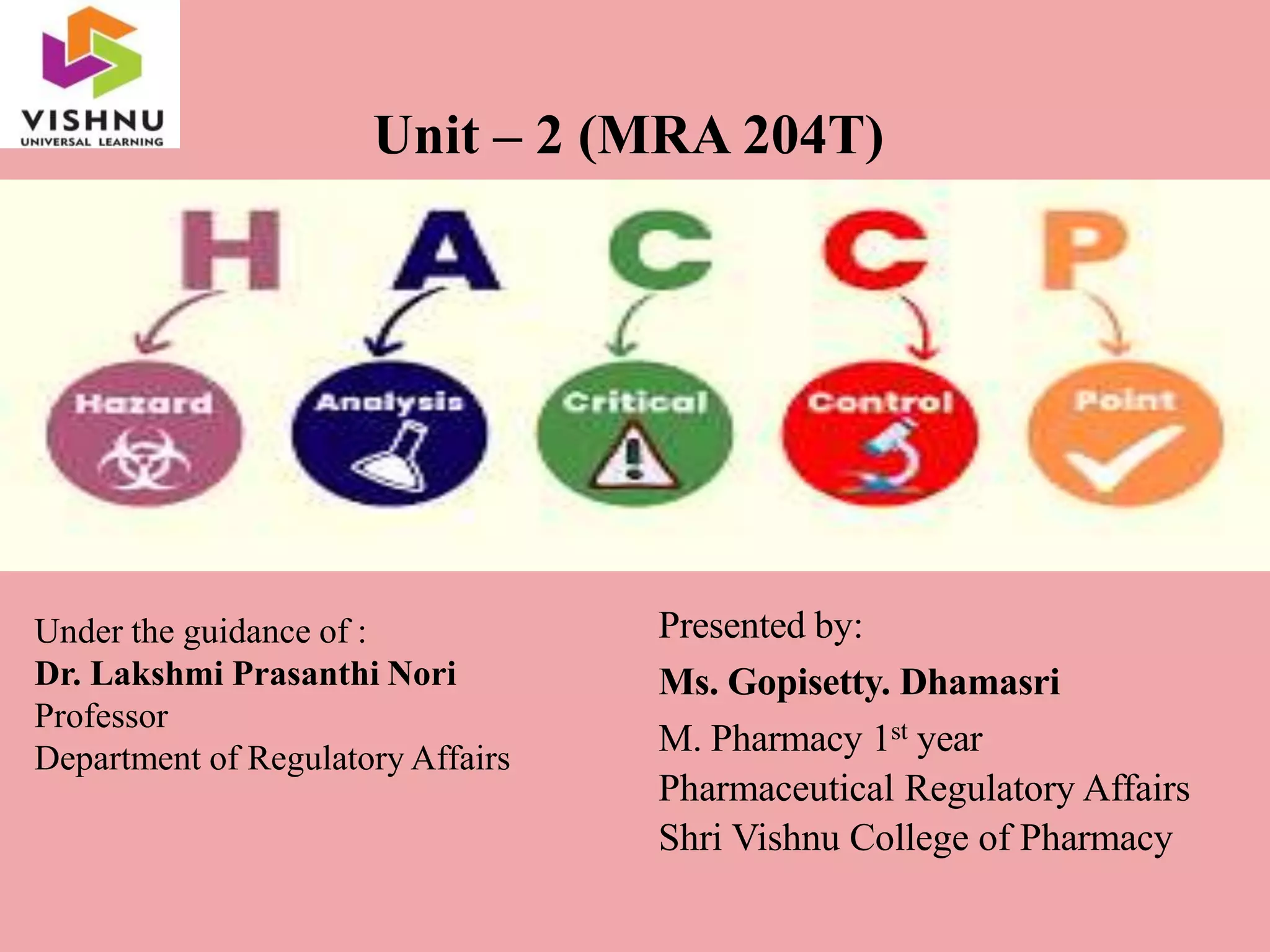
• What is HACCP
• Definitions
• Goal of HACCP
• Guidelines for application of HACCP principles
• Preliminary Tasks
• HACCP Principles
• Example of HACCP
What is HACCP ?
HACCP is defined as a management system in which food
safety is addressed through the analysis and control of
biological, chemical, and physical hazards from raw material
production, procurement and handling, to manufacturing,
distribution and consumption of the finished product.
Definitions:
Hazard Analysis:
The process of collecting and evaluating information on hazard
associated with the food under consideration to decide which
are significant and must be addressed in the HACCP plan.
Critical Control Point:
A step at which control can be applied and is essential to
prevent or eliminate a food safety hazard or reduce it to an
acceptable level.
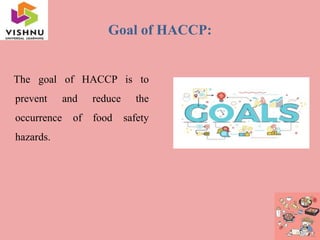
Goal of HACCP:
The goal of HACCP is to
prevent and reduce the
occurrence of food safety
hazards.
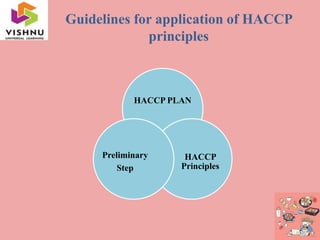
HACCP PLAN
HACCP
Principles
Preliminary
Step
Guidelines for application of HACCP
principles
Developing a HACCP Plan:
• The format of HACCP plans will vary. In many cases the plans
will be product and process specific. HACCP plans can serve
as useful guides in the development of process and product.
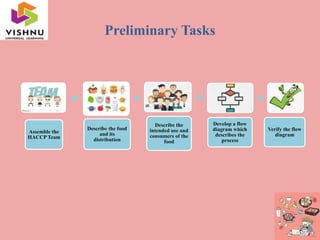
• In the development of a HACCP plan, five preliminary tasks
need to be accomplished before the application of the HACCP
principles to a specific product and process. The five
preliminary tasks are…..
Preliminary Tasks
Assemble the
HACCP Team
Describe the food
and its
distribution
Describe the
intended use and
consumers of the
food
Develop a flow
diagram which
describes the
process
Verify the flow
diagram
Preliminary Tasks
1. Assemble the HACCP
Team
• Specific knowledge and Expertise
appropriate to the product and process.
• Multi disciplinary team
• Individuals from areas such as
engineering, production, sanitation,
quality assurance, and food microbiology
• Local personnel who are involved in the
operation as they are more familiar with
the variability and limitations of the
operation.
2. Describe the food and its
distribution
• The HACCP team first describes
the food. This consists of a general
description of the food,
ingredients, and processing methods.
• The method of distribution should be
described along with information on
whether the food is to be distributed
frozen, refrigerated, or at ambient
temperature.
Preliminary Tasks
3. Describe the intended use and
consumers of the food
Describe the normal expected use of
the food. The intended consumers may
be the general public or a particular
segment of the population (e.g.,
infants, the elderly, etc.).
4. Develop a flow diagram which
describes the process
• The purpose of a flow diagram is to
provide a clear, simple outline of the
steps involved in the process.
• The scope of the flow diagram must
cover all the steps in the process.
• A simple schematic of the facility is
often useful in understanding and
evaluating product and process flow.
5. Verify the flow diagram:
•The HACCP team should perform an on-
site review of the operation to verify the
accuracy and completeness of the flow
diagram.
• Modifications should be made to the flow
diagram as necessary and documented.
HACCP Principles
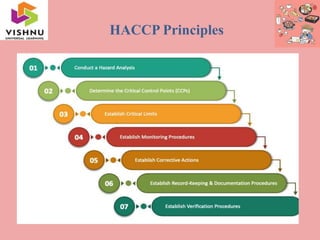
• After these five preliminary tasks have been
completed, the seven principles of HACCP are applied.
• HACCP is a systematic approach to the identification,
evaluation, and control of food safety hazards based on
the following seven principles:
HACCP Principles
Conduct a hazard analysis
(Principle 1)
• The HACCP team conducts a hazard analysis and
identifies appropriate control measures.
• The purpose of the hazard analysis is to develop a list of
hazards which are significant and that they are reasonably
likely to cause injury or illness.
Determine the critical control points
(principle 2)
• The number of CCPs in a process will depend on the
complexity of the process itself and the Scope of the
study.
• CCPs should be determined through experience and
judgment, this may be aided by the use of a decision
tree.
Establish critical limits
(principle 3)
• A critical limit is a maximum and/or minimum value to which
a biological, chemical or physical parameter must be
controlled at a CCP to prevent, eliminate or reduce to an
acceptable level the occurrence of a food safety hazard.
• A critical limit is used to distinguish between safe and unsafe
operating conditions at a CCP.
Establish monitoring procedures
(Principle 4)
Monitoring is a planned sequence of observations or
measurements to assess whether a CCP is under
control and to produce an accurate record for
future use in verification.
Establish corrective actions
(Principle 5)
• The HACCP system for food safety management is designed
to identify health hazards and to establish strategies to prevent,
eliminate, or reduce their occurrence.
• An important purpose of corrective actions is to prevent foods
which may be hazardous from reaching consumers.
• Where there is a deviation from established critical limits,
corrective actions are necessary.
Establish verification procedures
(Principle 6)
• verification is evaluating whether the facility's HACCP system
is functioning according to the HACCP plan.
• verification is the initial validation of the HACCP plan to
determine that the plan is scientifically and technically sound,
that all hazards have been identified and the HACCP plan is
properly implemented according to the hazards and that should
be effectively controlled.
Establish record-keeping and
documentation procedures (Principle 7)
The records maintained for the HACCP System should include the
following:
1. A summary of the hazard analysis, including the rationale for
determining hazards and control measures.
2. The HACCP Plan
• Listing of the HACCP team and assigned responsibilities.
• Description of the food, its distribution, intended use, and
consumer.
3. Support documentation such as validation records.
4. Records that are generated during the operation of the plan.
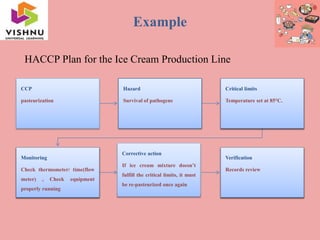
CCP
pasteurization
Hazard
Survival of pathogens
Critical limits
Temperature set at 85°C.
Monitoring
Check thermometer/ time(flow
meter) , Check equipment
properly running
Corrective action
If ice cream mixture doesn’t
fulfill the critical limits, it must
be re-pasteurized once again
Verification
Records review
Example
HACCP Plan for the Ice Cream Production Line
1. Write in detail about HACCP?
2. Discuss about the preliminary steps?
3. Explain about principles involved in HACCP?
With example.
REFERENCE
https://www.fda.gov/food/hazard-analysis-
critical-control-point-haccp/haccp-principles-
application-guidelines
Hazard Analysis and Critical Control Point

Hazard Analysis and Critical Control Point

  • 1.
    Presented by: Ms. Gopisetty.Dhamasri M. Pharmacy 1st year Pharmaceutical Regulatory Affairs Shri Vishnu College of Pharmacy Under the guidance of : Dr. Lakshmi Prasanthi Nori Professor Department of Regulatory Affairs Unit – 2 (MRA 204T)
  • 2.
    contents • What isHACCP • Definitions • Goal of HACCP • Guidelines for application of HACCP principles • Preliminary Tasks • HACCP Principles • Example of HACCP
  • 3.
    What is HACCP? HACCP is defined as a management system in which food safety is addressed through the analysis and control of biological, chemical, and physical hazards from raw material production, procurement and handling, to manufacturing, distribution and consumption of the finished product.
  • 4.
    Definitions: Hazard Analysis: The processof collecting and evaluating information on hazard associated with the food under consideration to decide which are significant and must be addressed in the HACCP plan. Critical Control Point: A step at which control can be applied and is essential to prevent or eliminate a food safety hazard or reduce it to an acceptable level.
  • 5.
    Goal of HACCP: Thegoal of HACCP is to prevent and reduce the occurrence of food safety hazards.
  • 6.
  • 7.
    Developing a HACCPPlan: • The format of HACCP plans will vary. In many cases the plans will be product and process specific. HACCP plans can serve as useful guides in the development of process and product. • In the development of a HACCP plan, five preliminary tasks need to be accomplished before the application of the HACCP principles to a specific product and process. The five preliminary tasks are…..
  • 8.
    Preliminary Tasks Assemble the HACCPTeam Describe the food and its distribution Describe the intended use and consumers of the food Develop a flow diagram which describes the process Verify the flow diagram
  • 9.
    Preliminary Tasks 1. Assemblethe HACCP Team • Specific knowledge and Expertise appropriate to the product and process. • Multi disciplinary team • Individuals from areas such as engineering, production, sanitation, quality assurance, and food microbiology • Local personnel who are involved in the operation as they are more familiar with the variability and limitations of the operation. 2. Describe the food and its distribution • The HACCP team first describes the food. This consists of a general description of the food, ingredients, and processing methods. • The method of distribution should be described along with information on whether the food is to be distributed frozen, refrigerated, or at ambient temperature.
  • 10.
    Preliminary Tasks 3. Describethe intended use and consumers of the food Describe the normal expected use of the food. The intended consumers may be the general public or a particular segment of the population (e.g., infants, the elderly, etc.). 4. Develop a flow diagram which describes the process • The purpose of a flow diagram is to provide a clear, simple outline of the steps involved in the process. • The scope of the flow diagram must cover all the steps in the process. • A simple schematic of the facility is often useful in understanding and evaluating product and process flow. 5. Verify the flow diagram: •The HACCP team should perform an on- site review of the operation to verify the accuracy and completeness of the flow diagram. • Modifications should be made to the flow diagram as necessary and documented.
  • 11.
    HACCP Principles • Afterthese five preliminary tasks have been completed, the seven principles of HACCP are applied. • HACCP is a systematic approach to the identification, evaluation, and control of food safety hazards based on the following seven principles:
  • 12.
  • 13.
    Conduct a hazardanalysis (Principle 1) • The HACCP team conducts a hazard analysis and identifies appropriate control measures. • The purpose of the hazard analysis is to develop a list of hazards which are significant and that they are reasonably likely to cause injury or illness.
  • 14.
    Determine the criticalcontrol points (principle 2) • The number of CCPs in a process will depend on the complexity of the process itself and the Scope of the study. • CCPs should be determined through experience and judgment, this may be aided by the use of a decision tree.
  • 15.
    Establish critical limits (principle3) • A critical limit is a maximum and/or minimum value to which a biological, chemical or physical parameter must be controlled at a CCP to prevent, eliminate or reduce to an acceptable level the occurrence of a food safety hazard. • A critical limit is used to distinguish between safe and unsafe operating conditions at a CCP.
  • 16.
    Establish monitoring procedures (Principle4) Monitoring is a planned sequence of observations or measurements to assess whether a CCP is under control and to produce an accurate record for future use in verification.
  • 17.
    Establish corrective actions (Principle5) • The HACCP system for food safety management is designed to identify health hazards and to establish strategies to prevent, eliminate, or reduce their occurrence. • An important purpose of corrective actions is to prevent foods which may be hazardous from reaching consumers. • Where there is a deviation from established critical limits, corrective actions are necessary.
  • 18.
    Establish verification procedures (Principle6) • verification is evaluating whether the facility's HACCP system is functioning according to the HACCP plan. • verification is the initial validation of the HACCP plan to determine that the plan is scientifically and technically sound, that all hazards have been identified and the HACCP plan is properly implemented according to the hazards and that should be effectively controlled.
  • 19.
    Establish record-keeping and documentationprocedures (Principle 7) The records maintained for the HACCP System should include the following: 1. A summary of the hazard analysis, including the rationale for determining hazards and control measures. 2. The HACCP Plan • Listing of the HACCP team and assigned responsibilities. • Description of the food, its distribution, intended use, and consumer.
  • 20.
    3. Support documentationsuch as validation records. 4. Records that are generated during the operation of the plan.
  • 21.
    CCP pasteurization Hazard Survival of pathogens Criticallimits Temperature set at 85°C. Monitoring Check thermometer/ time(flow meter) , Check equipment properly running Corrective action If ice cream mixture doesn’t fulfill the critical limits, it must be re-pasteurized once again Verification Records review Example HACCP Plan for the Ice Cream Production Line
  • 22.
    1. Write indetail about HACCP? 2. Discuss about the preliminary steps? 3. Explain about principles involved in HACCP? With example.
  • 23.