.
Group members
Tayyab Ismat L1SS15MBAM002
0
HABIT 6
SYNERGIZE
From the book:
“The Seven Habits Of
Highly Effective People”
Written by:
STEPHYEN R. COVEY
Contents of presentation
1 Introduction & Synergistic Communication
2 Synergy in classroom & business
3 Synergy communication & Fishing third
alternative
4 Negative Synergy & Valuing the difference
5 Negative Synergy & Valuing the difference
Tayyab’s part
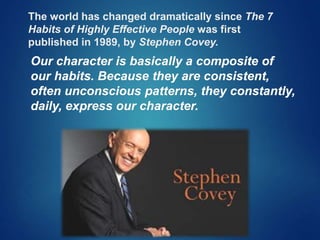
The world has changed dramatically since The 7
Habits of Highly Effective People was first
published in 1989, by Stephen Covey.
Our character is basically a composite of
our habits. Because they are consistent,
often unconscious patterns, they constantly,
daily, express our character.
A reporter asked Covey: “Are the 7
Habits still relevant today? ”And, for
that matter, “Will they be relevant 10, 20,
50, 100 years from now?”
Stephen R. Covey’s answer:
“The greater the change and more
difficult our challenges, the more
relevant the habits become.”
HABIT
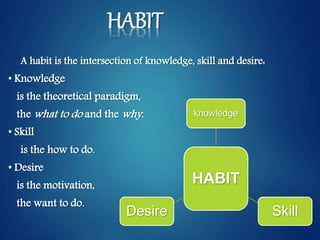
A habit is the intersection of knowledge, skill and desire:
• Knowledge
is the theoretical paradigm,
the what to do and the why.
• Skill
is the how to do.
• Desire
is the motivation,
the want to do.
HABIT
knowledge
SkillDesire
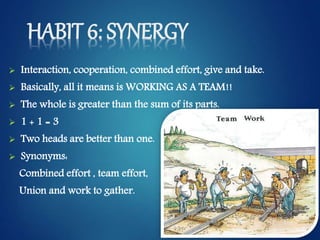
HABIT 6: SYNERGY
 Interaction, cooperation, combined effort, give and take.
 Basically, all it means is WORKING AS A TEAM!!
 The whole is greater than the sum of its parts.
 1 + 1 = 3
 Two heads are better than one.
 Synonyms:
Combined effort , team effort,
Union and work to gather.
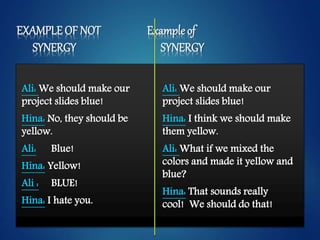
EXAMPLE OF NOT Example of
SYNERGY SYNERGY
Ali: We should make our
project slides blue!
Hina: No, they should be
yellow.
Ali: Blue!
Hina: Yellow!
Ali : BLUE!
Hina: I hate you.
Ali: We should make our
project slides blue!
Hina: I think we should make
them yellow.
Ali: What if we mixed the
colors and made it yellow and
blue?
Hina: That sounds really
cool! We should do that!
SYNERGESTIC EFFECT
Two politicians being able to get a million voters
each, but 2.5 million together.
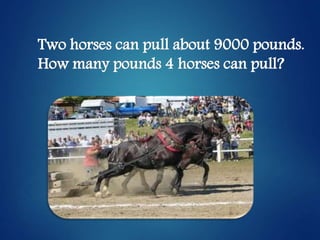
Two horses can pull about 9000 pounds.
How many pounds 4 horses can pull?
Arithmetic response is 18000.
Sound reasonable.
But it’s wrong.
Four horses can actually pull over
30000 pounds.
IT’S SYNERGY THAT MAKES THE
DIFFERENCE.
SYNERGISTIC
COMMUNICATION
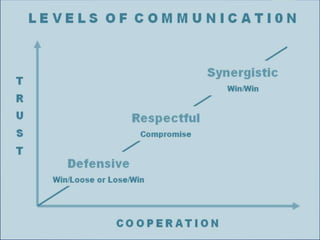
Synergistic communication is opening your
mind and heart to new possibilities. It may
seem like you are casting aside "beginning
with the end in mind," but you are actually
fulfilling it by clarifying your goals and
discovering better ones.
Advantages Of Synergistic
Communication
Co-operation among individuals begins
to flow easily.
Inspiration level of individuals goes up.
It helps to broaden and improve
communication,
It increase individual’s efficiency.
Break the idols of colour and blood and become lost in
the community.
Let neither Turanians, Iranians nor Afghan remain.
By Dr. Iqbal (THE RISE OF ISLAM)
Synergy in Classroom
 Synergy is almost as if a group
collectively agree to subordinate old
scripts and write a new one.
 Synergy is the power of the whole versus
the part of a system working
Independently.
Sumaira’s part
Synergy tests in classroom
Synergy tests weather teachers and students
are really open to principle of the whole
being greater than the sum of its parts.
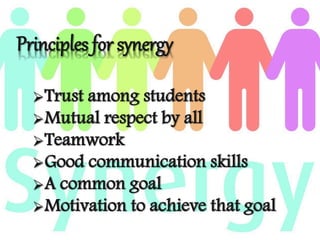
Principles for synergy
Trust among students
Mutual respect by all
Teamwork
Good communication skills
A common goal
Motivation to achieve that goal
Synergize can employ the following
TACTICS
Create a community that celebrates the
unique nature of learning.
Encourage out of class study groups.
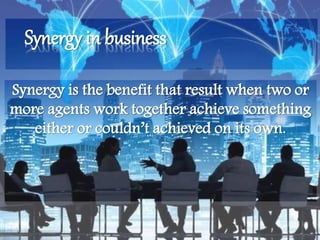
Synergy in business
Synergy is the benefit that result when two or
more agents work together achieve something
either or couldn’t achieved on its own.
How it works/example
A company may require a similar firm
allowing it to exposal its product
offering and as a result, increased its
sale and Revenues.
Synergistic
COMMUNICATION
Hira’s part
Synergy is:
Exciting
Creativity
phenomenal
HISTORICAL PERSPECTIVE
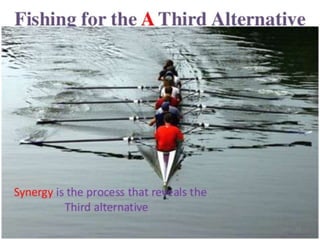
Fishing for third
Alternative
Third Alternative
 The third alternative thinking offers a way to
resolve conflict an d disagreement without any
party feeling as if they as compromised or
given up ground.
 This is a very creative process, requiring fresh,
creative and spontaneous thinking.
SCENARIO:
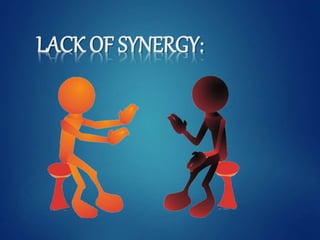
LACK OF SYNERGY:
SOLOUTION:
Negative synergy
 The usual win/lose approach result in
expending negative synergy
 The heart of intrapersonal synergy is the
first three habits, which give the
internal security sufficient to handle the
risk of being open and therefore
vulnerable.
Aqeel’s part
Problem of highly dependent people
The problem is that highly dependent
people are trying to succeed in an
interdependent reality. They may talk
win/win technique , but they want to
manipulate others. These insecure people
need to mold others to their way of
thinking.
Result of Negative synergy
 Negative synergy refers to “2+2=3”effect
 The result of negative synergy is waste
time & time is money
Valuing Difference
 People who grow in environment
having high diversity are most
able to take advantage of the
increased productivity that can
result from collaboration.
 It is logical that two people can
disagree & that both can be right?
It’s not logical : it’s psychological.
Three approaches to diversity
 Diversity can be positive thing or a negative thing
depending on your perspective and background.
1. Level 1: Shun diversity - People who shun
others are afraid of differences.
-it disturbs them that someone may have different
skin color or wear a different brand of jeans.
-They are convinced by their way of life is the “best”
or “right”, or “only way”.
2. Level 2: Tolerate diversity – Tolerates believe
that everyone has the right to be different.
-They don’t shun diversity but they don’t embrace it
either.
-It’s the “Don’t bother me I won’t bother you”
attitude.
3. Level 3: Celebrate diversity – Celebrators
value differences.
-We should celebrate differences.
-To celebrate diversity on every issue is actually
hard for most people.
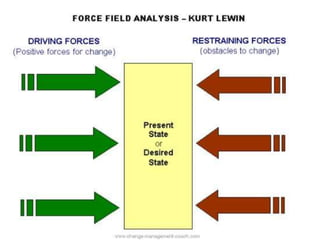
Force Field Analysis
Sociologist Kurt Lewin developed a "Force Field
Analysis" model in which he described any
current level of performance or being as a
state of equilibrium between the driving forces
that encourage upward movement and the
restraining forces that discourage it.
Ather’s Part
Force Field Analysis
“Driving forces” generally are positive, reasonable,
logical, conscious and economic. Whereas,
“Restraining forces” are often negative, emotional,
illogical, unconscious and social/psychological. Both
sets of forces are very real and must be taken into
account in dealing with change.
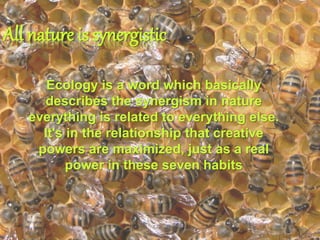
All nature is synergistic
Ecology is a word which basically
describes the synergism in nature
everything is related to everything else.
It's in the relationship that creative
powers are maximized, just as a real
power in these seven habits
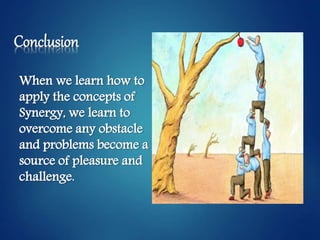
Conclusion
When we learn how to
apply the concepts of
Synergy, we learn to
overcome any obstacle
and problems become a
source of pleasure and
challenge.
.
Thank you

Habit 6 Synergize

  • 1.
  • 2.
  • 3.
    HABIT 6 SYNERGIZE From thebook: “The Seven Habits Of Highly Effective People” Written by: STEPHYEN R. COVEY
  • 4.
    Contents of presentation 1Introduction & Synergistic Communication 2 Synergy in classroom & business 3 Synergy communication & Fishing third alternative 4 Negative Synergy & Valuing the difference 5 Negative Synergy & Valuing the difference Tayyab’s part
  • 5.
    The world haschanged dramatically since The 7 Habits of Highly Effective People was first published in 1989, by Stephen Covey. Our character is basically a composite of our habits. Because they are consistent, often unconscious patterns, they constantly, daily, express our character.
  • 6.
    A reporter askedCovey: “Are the 7 Habits still relevant today? ”And, for that matter, “Will they be relevant 10, 20, 50, 100 years from now?” Stephen R. Covey’s answer: “The greater the change and more difficult our challenges, the more relevant the habits become.”
  • 7.
    HABIT A habit isthe intersection of knowledge, skill and desire: • Knowledge is the theoretical paradigm, the what to do and the why. • Skill is the how to do. • Desire is the motivation, the want to do. HABIT knowledge SkillDesire
  • 8.
    HABIT 6: SYNERGY Interaction, cooperation, combined effort, give and take.  Basically, all it means is WORKING AS A TEAM!!  The whole is greater than the sum of its parts.  1 + 1 = 3  Two heads are better than one.  Synonyms: Combined effort , team effort, Union and work to gather.
  • 9.
    EXAMPLE OF NOTExample of SYNERGY SYNERGY Ali: We should make our project slides blue! Hina: No, they should be yellow. Ali: Blue! Hina: Yellow! Ali : BLUE! Hina: I hate you. Ali: We should make our project slides blue! Hina: I think we should make them yellow. Ali: What if we mixed the colors and made it yellow and blue? Hina: That sounds really cool! We should do that!
  • 10.
    SYNERGESTIC EFFECT Two politiciansbeing able to get a million voters each, but 2.5 million together.
  • 11.
    Two horses canpull about 9000 pounds. How many pounds 4 horses can pull?
  • 12.
    Arithmetic response is18000. Sound reasonable. But it’s wrong. Four horses can actually pull over 30000 pounds. IT’S SYNERGY THAT MAKES THE DIFFERENCE.
  • 13.
    SYNERGISTIC COMMUNICATION Synergistic communication isopening your mind and heart to new possibilities. It may seem like you are casting aside "beginning with the end in mind," but you are actually fulfilling it by clarifying your goals and discovering better ones.
  • 14.
    Advantages Of Synergistic Communication Co-operationamong individuals begins to flow easily. Inspiration level of individuals goes up. It helps to broaden and improve communication, It increase individual’s efficiency.
  • 15.
    Break the idolsof colour and blood and become lost in the community. Let neither Turanians, Iranians nor Afghan remain. By Dr. Iqbal (THE RISE OF ISLAM)
  • 16.
    Synergy in Classroom Synergy is almost as if a group collectively agree to subordinate old scripts and write a new one.  Synergy is the power of the whole versus the part of a system working Independently. Sumaira’s part
  • 17.
    Synergy tests inclassroom Synergy tests weather teachers and students are really open to principle of the whole being greater than the sum of its parts.
  • 18.
    Principles for synergy Trustamong students Mutual respect by all Teamwork Good communication skills A common goal Motivation to achieve that goal
  • 19.
    Synergize can employthe following TACTICS Create a community that celebrates the unique nature of learning. Encourage out of class study groups.
  • 20.
    Synergy in business Synergyis the benefit that result when two or more agents work together achieve something either or couldn’t achieved on its own.
  • 21.
    How it works/example Acompany may require a similar firm allowing it to exposal its product offering and as a result, increased its sale and Revenues.
  • 22.
  • 23.
  • 24.
  • 26.
  • 27.
    Third Alternative  Thethird alternative thinking offers a way to resolve conflict an d disagreement without any party feeling as if they as compromised or given up ground.  This is a very creative process, requiring fresh, creative and spontaneous thinking.
  • 28.
  • 29.
  • 30.
  • 31.
    Negative synergy  Theusual win/lose approach result in expending negative synergy  The heart of intrapersonal synergy is the first three habits, which give the internal security sufficient to handle the risk of being open and therefore vulnerable. Aqeel’s part
  • 32.
    Problem of highlydependent people The problem is that highly dependent people are trying to succeed in an interdependent reality. They may talk win/win technique , but they want to manipulate others. These insecure people need to mold others to their way of thinking.
  • 33.
    Result of Negativesynergy  Negative synergy refers to “2+2=3”effect  The result of negative synergy is waste time & time is money
  • 34.
    Valuing Difference  Peoplewho grow in environment having high diversity are most able to take advantage of the increased productivity that can result from collaboration.  It is logical that two people can disagree & that both can be right? It’s not logical : it’s psychological.
  • 35.
    Three approaches todiversity  Diversity can be positive thing or a negative thing depending on your perspective and background. 1. Level 1: Shun diversity - People who shun others are afraid of differences. -it disturbs them that someone may have different skin color or wear a different brand of jeans. -They are convinced by their way of life is the “best” or “right”, or “only way”.
  • 36.
    2. Level 2:Tolerate diversity – Tolerates believe that everyone has the right to be different. -They don’t shun diversity but they don’t embrace it either. -It’s the “Don’t bother me I won’t bother you” attitude. 3. Level 3: Celebrate diversity – Celebrators value differences. -We should celebrate differences. -To celebrate diversity on every issue is actually hard for most people.
  • 37.
    Force Field Analysis SociologistKurt Lewin developed a "Force Field Analysis" model in which he described any current level of performance or being as a state of equilibrium between the driving forces that encourage upward movement and the restraining forces that discourage it. Ather’s Part
  • 39.
    Force Field Analysis “Drivingforces” generally are positive, reasonable, logical, conscious and economic. Whereas, “Restraining forces” are often negative, emotional, illogical, unconscious and social/psychological. Both sets of forces are very real and must be taken into account in dealing with change.
  • 40.
    All nature issynergistic Ecology is a word which basically describes the synergism in nature everything is related to everything else. It's in the relationship that creative powers are maximized, just as a real power in these seven habits
  • 41.
    Conclusion When we learnhow to apply the concepts of Synergy, we learn to overcome any obstacle and problems become a source of pleasure and challenge.
  • 42.