Deep Learning 

Through Examples
Silicon Valley Big Data Science Meetup
Mountain View, 2/12/2015
Arno Candel, H2O.ai
Who am I?
PhD in Computational Physics, 2005

from ETH Zurich Switzerland
6 years at SLAC - Accelerator Physics Modeling
2 years at Skytree - Machine Learning
13 months at H2O.ai - Machine Learning
15 years in Supercomputing & Modeling
Named “2014 Big Data All-Star” by Fortune Magazine
@ArnoCandel
H2O Deep Learning, @ArnoCandel
Outline
Introduction (10 mins)
Methods & Implementation (20 mins)
Results and Live Demos (20 mins)
Higgs boson classification
MNIST handwritten digits
Ebay text classification
h2o-dev Outlook: Flow, Python
Part 2: Hands-On Session (40 mins)
Web GUI: Higgs dataset
R Studio: Adult, Higgs, MNIST datasets
4
H2O Deep Learning, @ArnoCandel
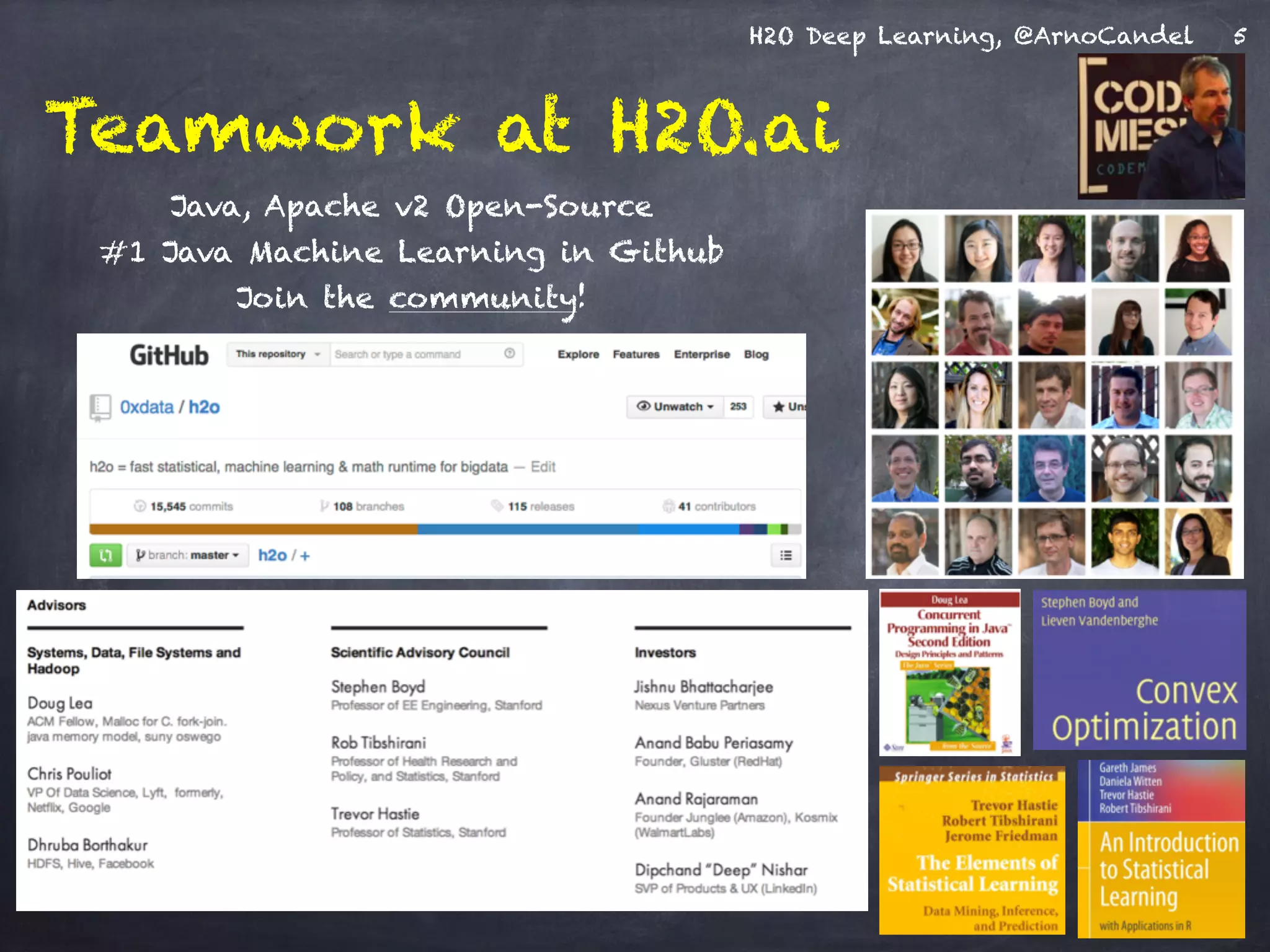
Teamwork at H2O.ai
Java, Apache v2 Open-Source
#1 Java Machine Learning in Github
Join the community!
5
H2O Deep Learning, @ArnoCandel
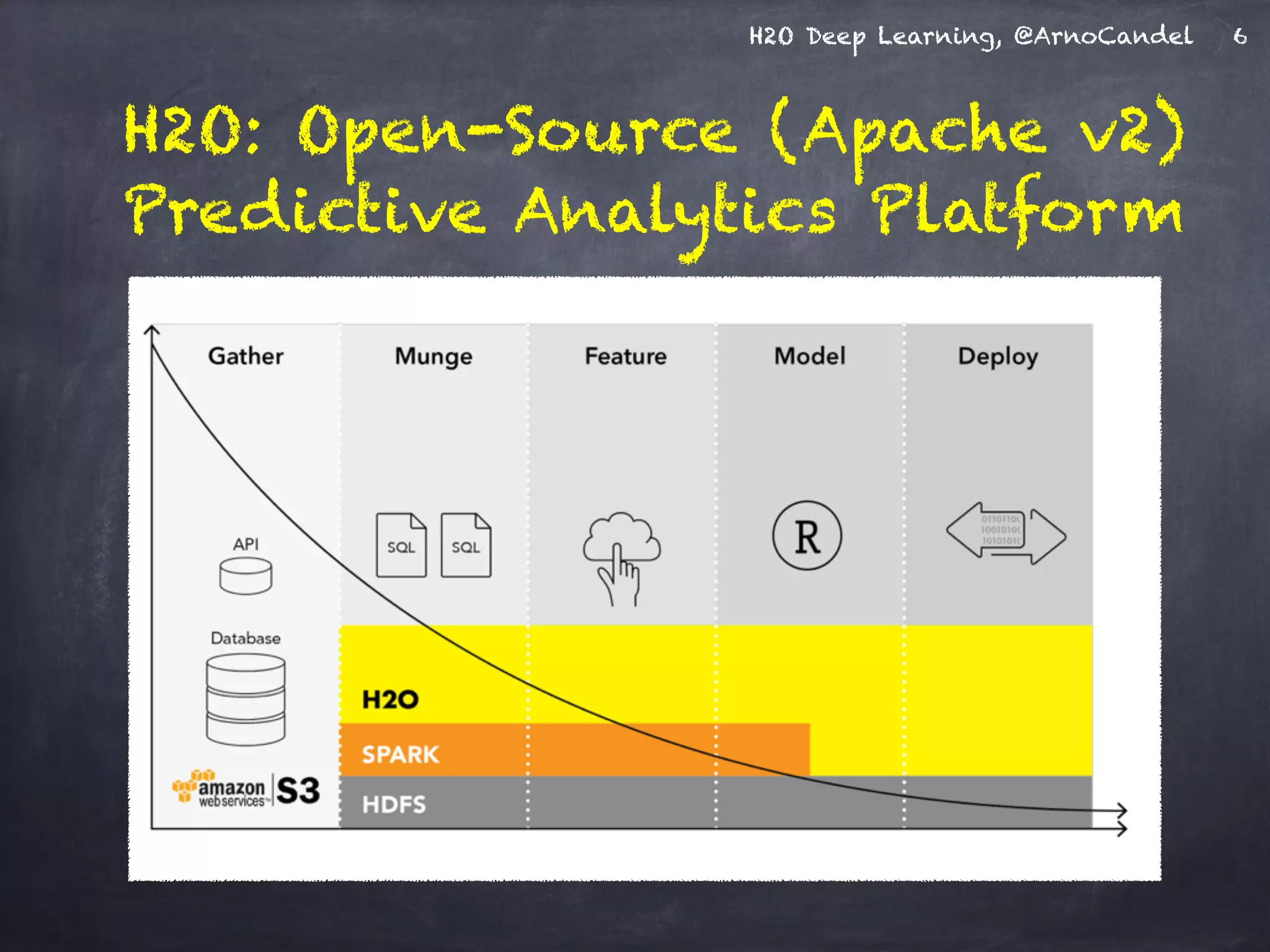
H2O: Open-Source (Apache v2)
Predictive Analytics Platform
6
H2O Deep Learning, @ArnoCandel 7
H2O Architecture - Designed for speed,
scale, accuracy & ease of use
Key technical points:
• distributed JVMs + REST API
• no Java GC issues 

(data in byte[], Double)
• loss-less number compression
• Hadoop integration (v1,YARN)
• R package (CRAN)
Pre-built fully featured algos:

K-Means, NB, PCA, CoxPH,

GLM, RF, GBM, DeepLearning
H2O Deep Learning, @ArnoCandel
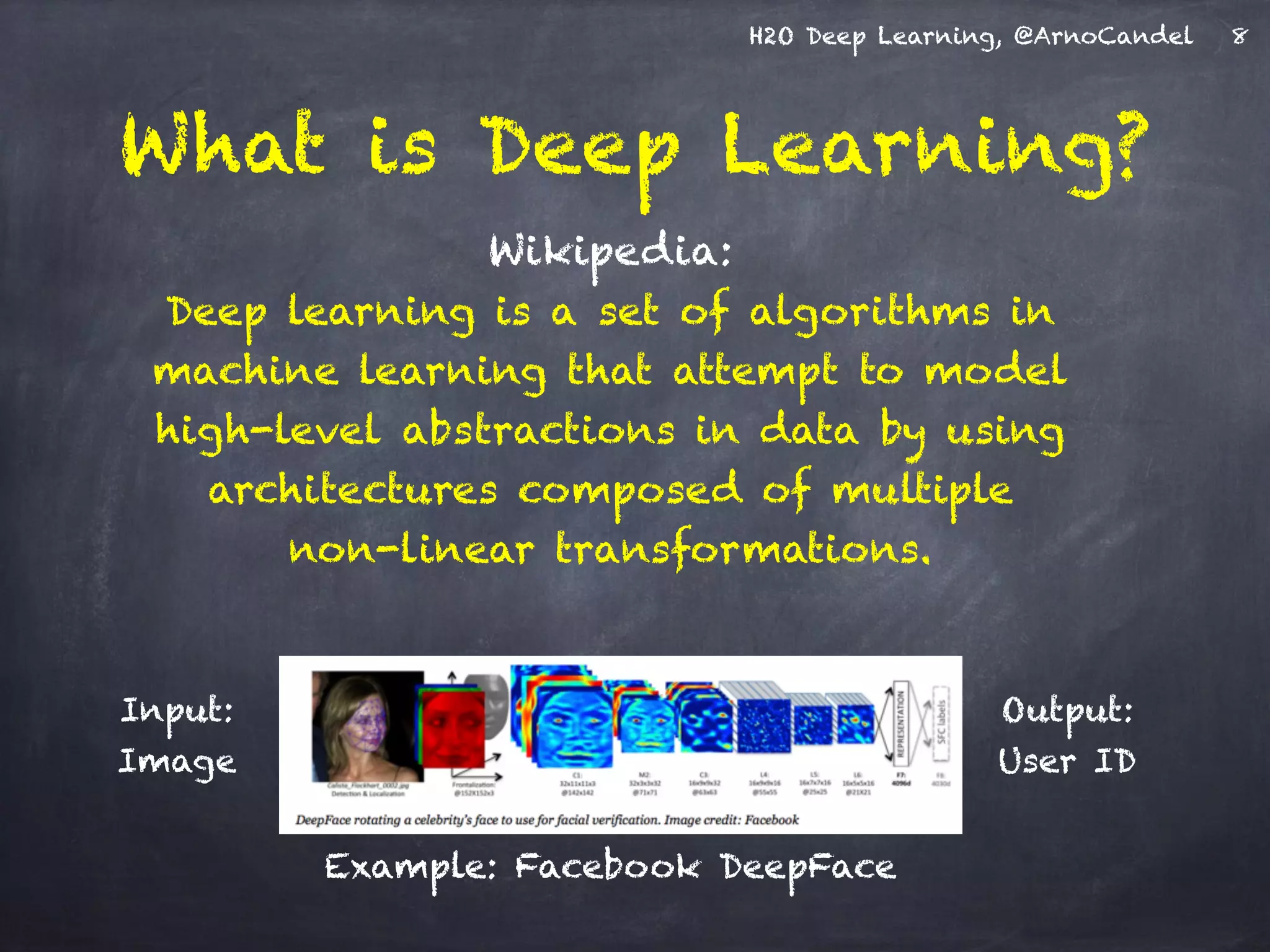
Wikipedia:

Deep learning is a set of algorithms in
machine learning that attempt to model
high-level abstractions in data by using
architectures composed of multiple 

non-linear transformations.
What is Deep Learning?
Input:

Image
Output:

User ID
8
Example: Facebook DeepFace
H2O Deep Learning, @ArnoCandel
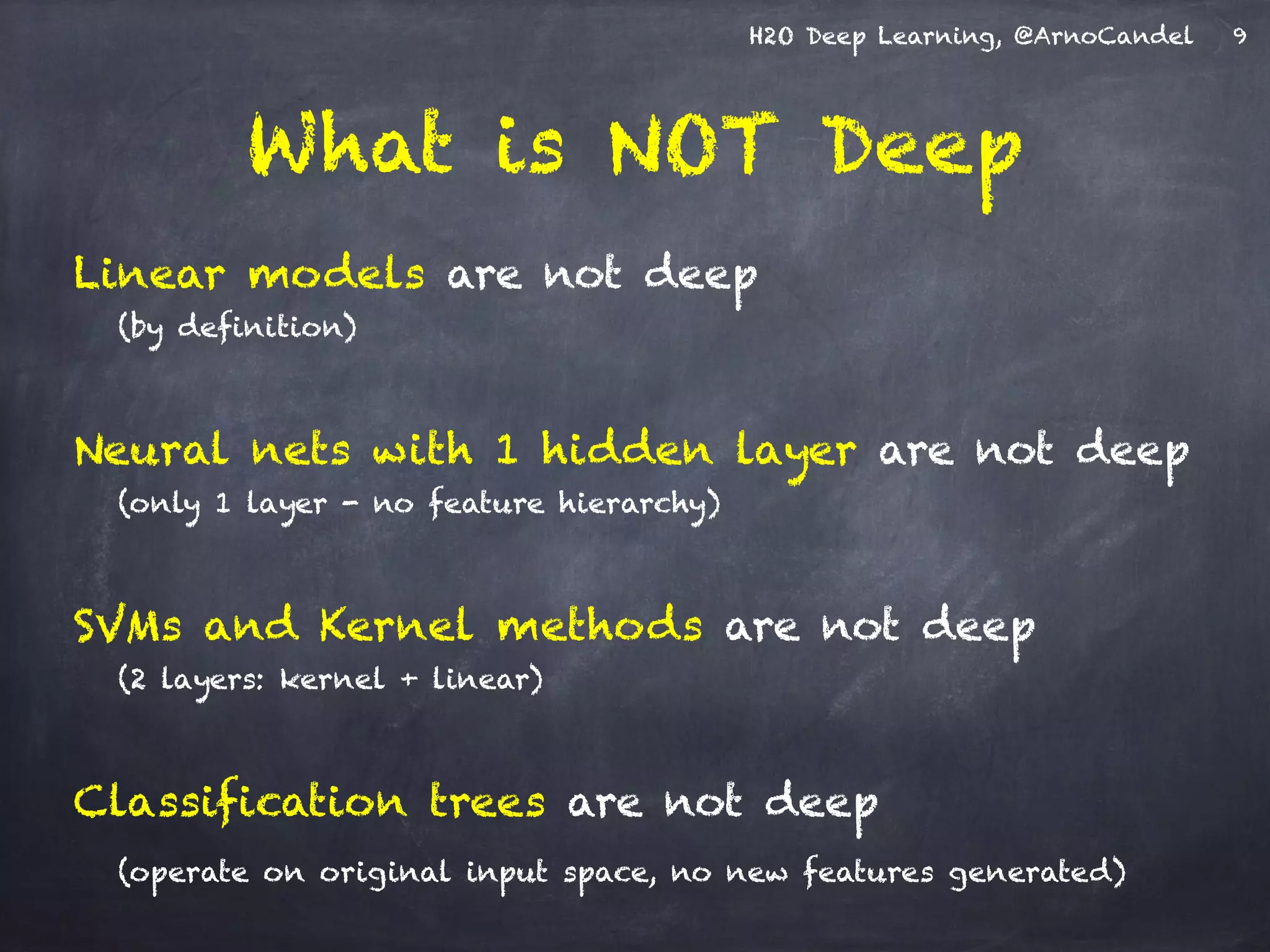
What is NOT Deep
Linear models are not deep
(by definition)
Neural nets with 1 hidden layer are not deep
(only 1 layer - no feature hierarchy)
SVMs and Kernel methods are not deep
(2 layers: kernel + linear)
Classification trees are not deep
(operate on original input space, no new features generated)
9
H2O Deep Learning, @ArnoCandel
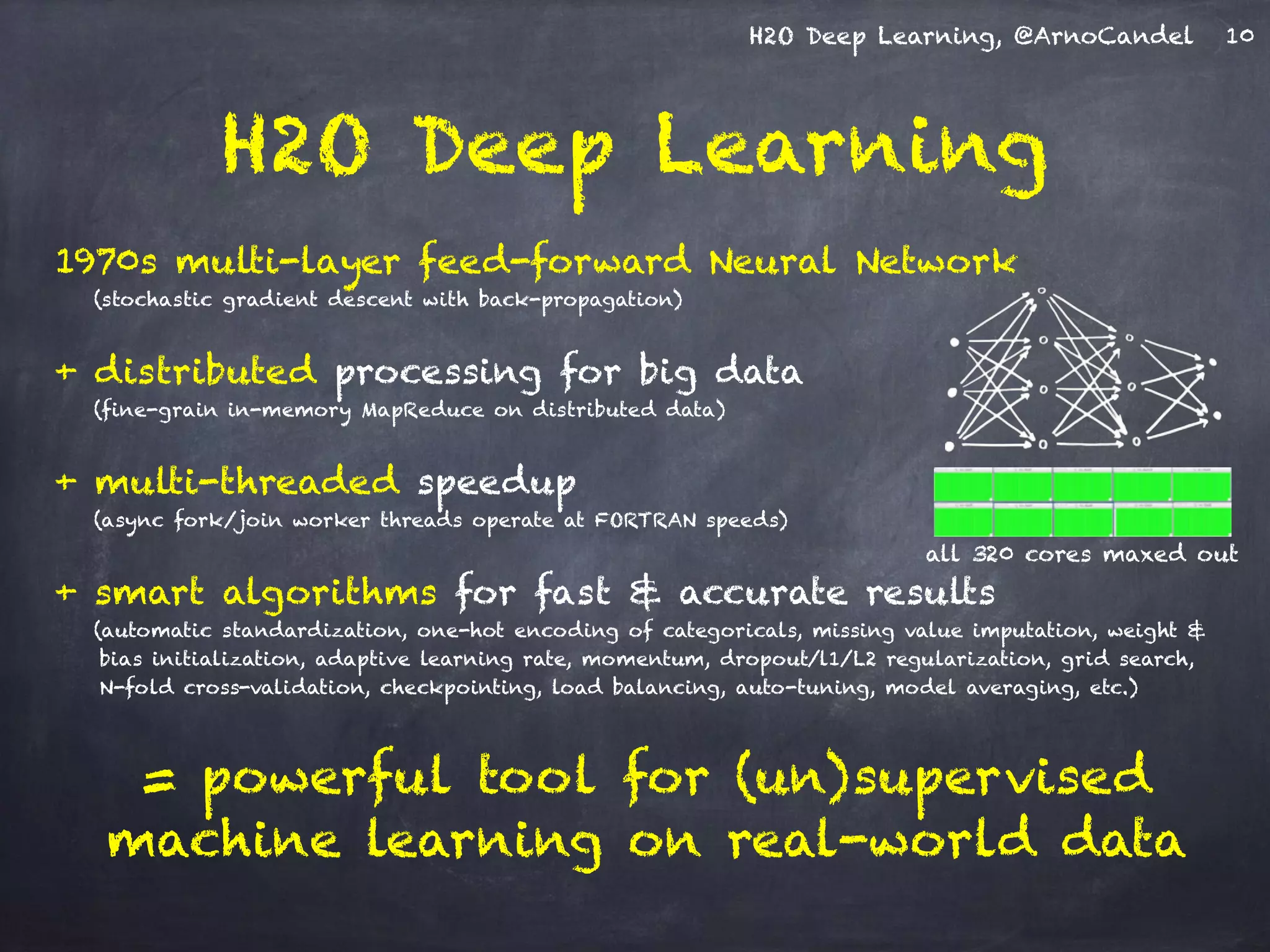
1970s multi-layer feed-forward Neural Network
(stochastic gradient descent with back-propagation)
+ distributed processing for big data
(fine-grain in-memory MapReduce on distributed data)
+ multi-threaded speedup
(async fork/join worker threads operate at FORTRAN speeds)
+ smart algorithms for fast & accurate results
(automatic standardization, one-hot encoding of categoricals, missing value imputation, weight &
bias initialization, adaptive learning rate, momentum, dropout/l1/L2 regularization, grid search, 

N-fold cross-validation, checkpointing, load balancing, auto-tuning, model averaging, etc.)
= powerful tool for (un)supervised
machine learning on real-world data
H2O Deep Learning
10
all 320 cores maxed out
H2O Deep Learning, @ArnoCandel
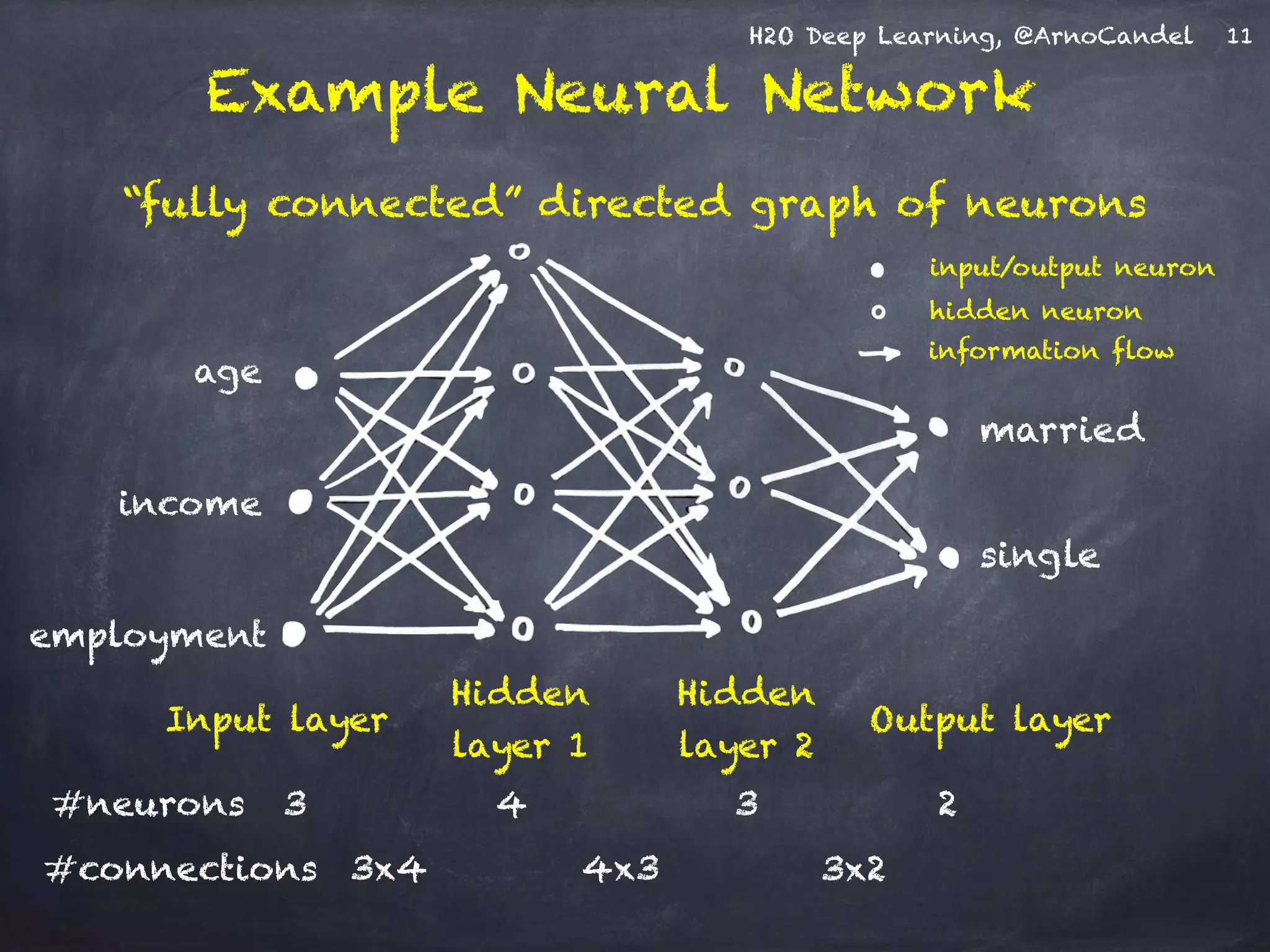
“fully connected” directed graph of neurons
age
income
employment
married
single
Input layer
Hidden
layer 1
Hidden
layer 2
Output layer
3x4 4x3 3x2#connections
information flow
input/output neuron
hidden neuron
4 3 2#neurons 3
Example Neural Network
11
H2O Deep Learning, @ArnoCandel
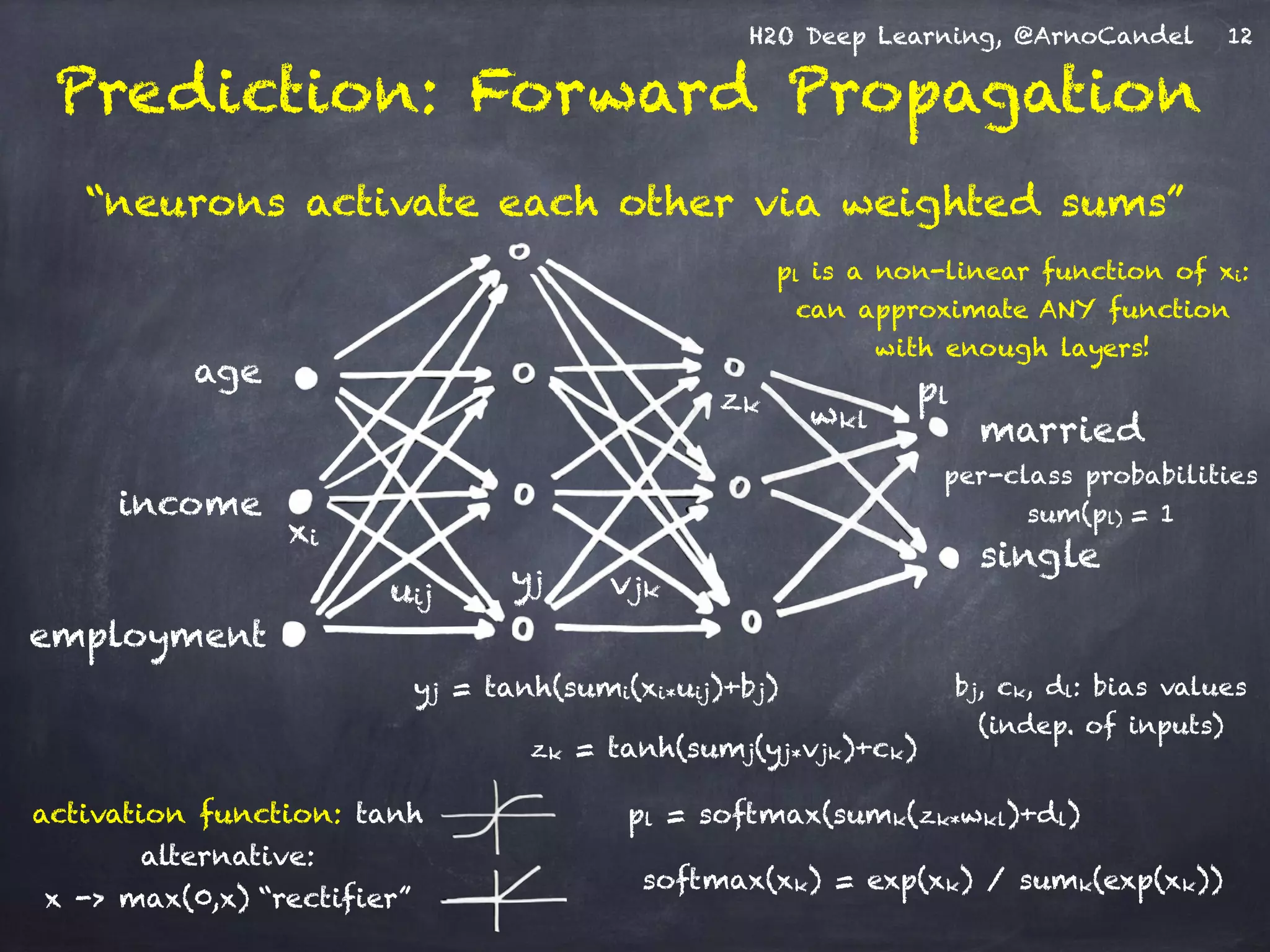
age
income
employment
yj = tanh(sumi(xi*uij)+bj)
uij
xi
yj
per-class probabilities

sum(pl) = 1
zk = tanh(sumj(yj*vjk)+ck)
vjk
zk
pl
pl = softmax(sumk(zk*wkl)+dl)
wkl
softmax(xk) = exp(xk) / sumk(exp(xk))
“neurons activate each other via weighted sums”
Prediction: Forward Propagation
activation function: tanh
alternative:

x -> max(0,x) “rectifier”
pl is a non-linear function of xi:
can approximate ANY function
with enough layers!
bj, ck, dl: bias values

(indep. of inputs)
12
married
single
H2O Deep Learning, @ArnoCandel
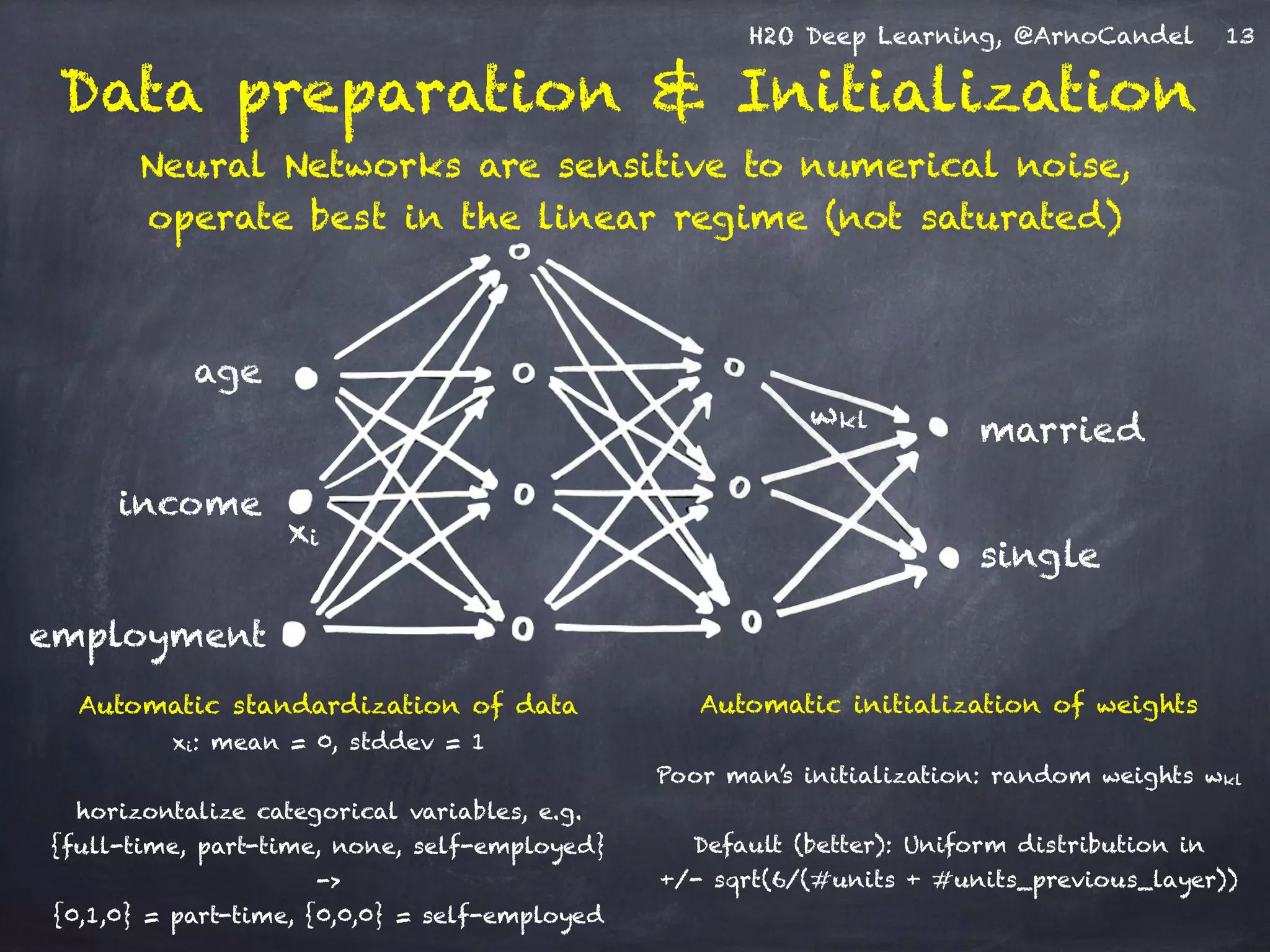
age
income
employment
xi
Automatic standardization of data

xi: mean = 0, stddev = 1
horizontalize categorical variables, e.g.
{full-time, part-time, none, self-employed} 

->

{0,1,0} = part-time, {0,0,0} = self-employed
Automatic initialization of weights
Poor man’s initialization: random weights wkl
Default (better): Uniform distribution in

+/- sqrt(6/(#units + #units_previous_layer))
Data preparation & Initialization
Neural Networks are sensitive to numerical noise,

operate best in the linear regime (not saturated)
13
married
single
wkl
H2O Deep Learning, @ArnoCandel
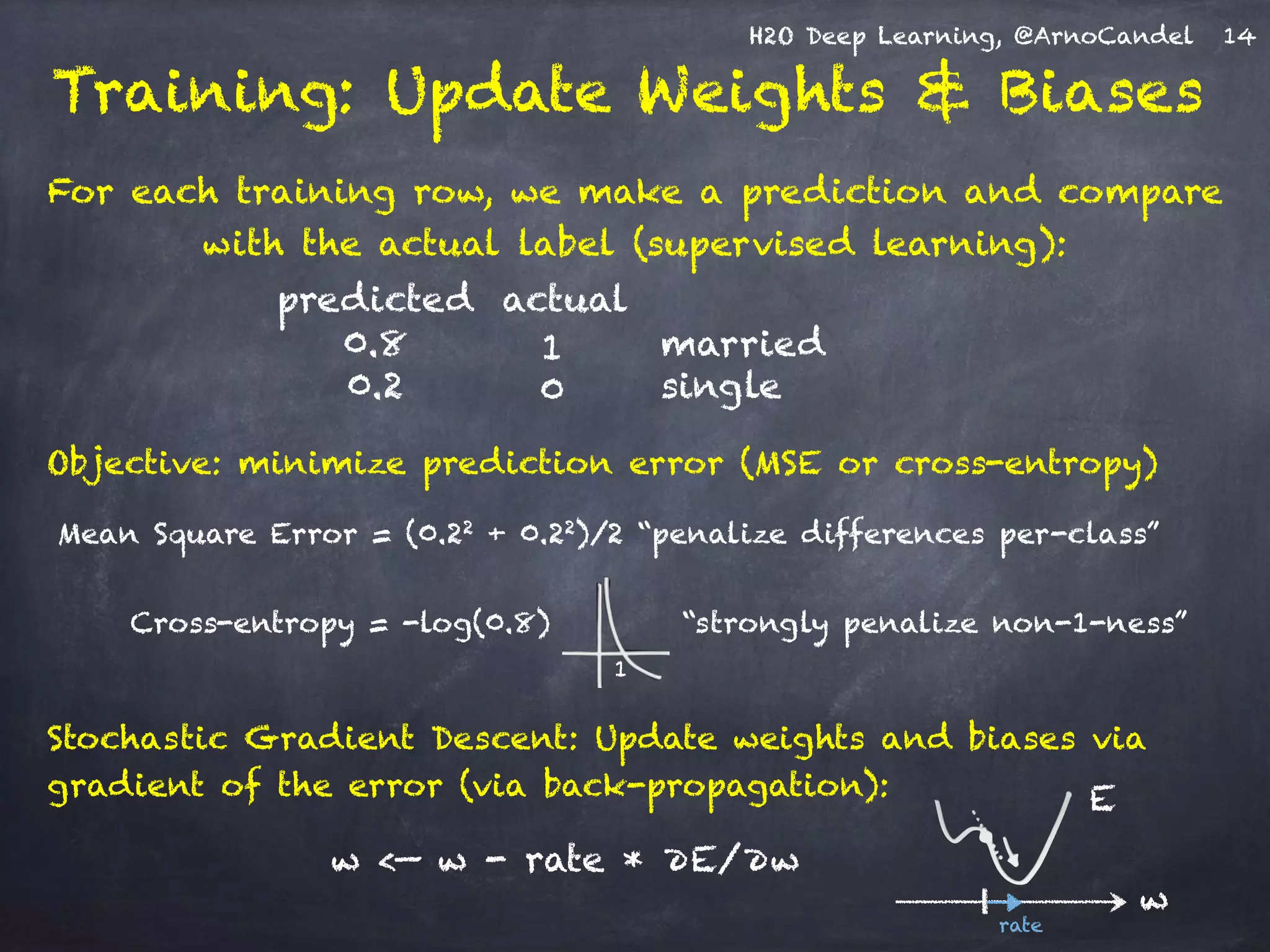
Mean Square Error = (0.22 + 0.22)/2 “penalize differences per-class”
Cross-entropy = -log(0.8) “strongly penalize non-1-ness”
Training: Update Weights & Biases
Stochastic Gradient Descent: Update weights and biases via
gradient of the error (via back-propagation):
For each training row, we make a prediction and compare
with the actual label (supervised learning):
married10.8
predicted actual
Objective: minimize prediction error (MSE or cross-entropy)
w <— w - rate * ∂E/∂w
1
14
single00.2
E
w
rate
H2O Deep Learning, @ArnoCandel
Backward Propagation


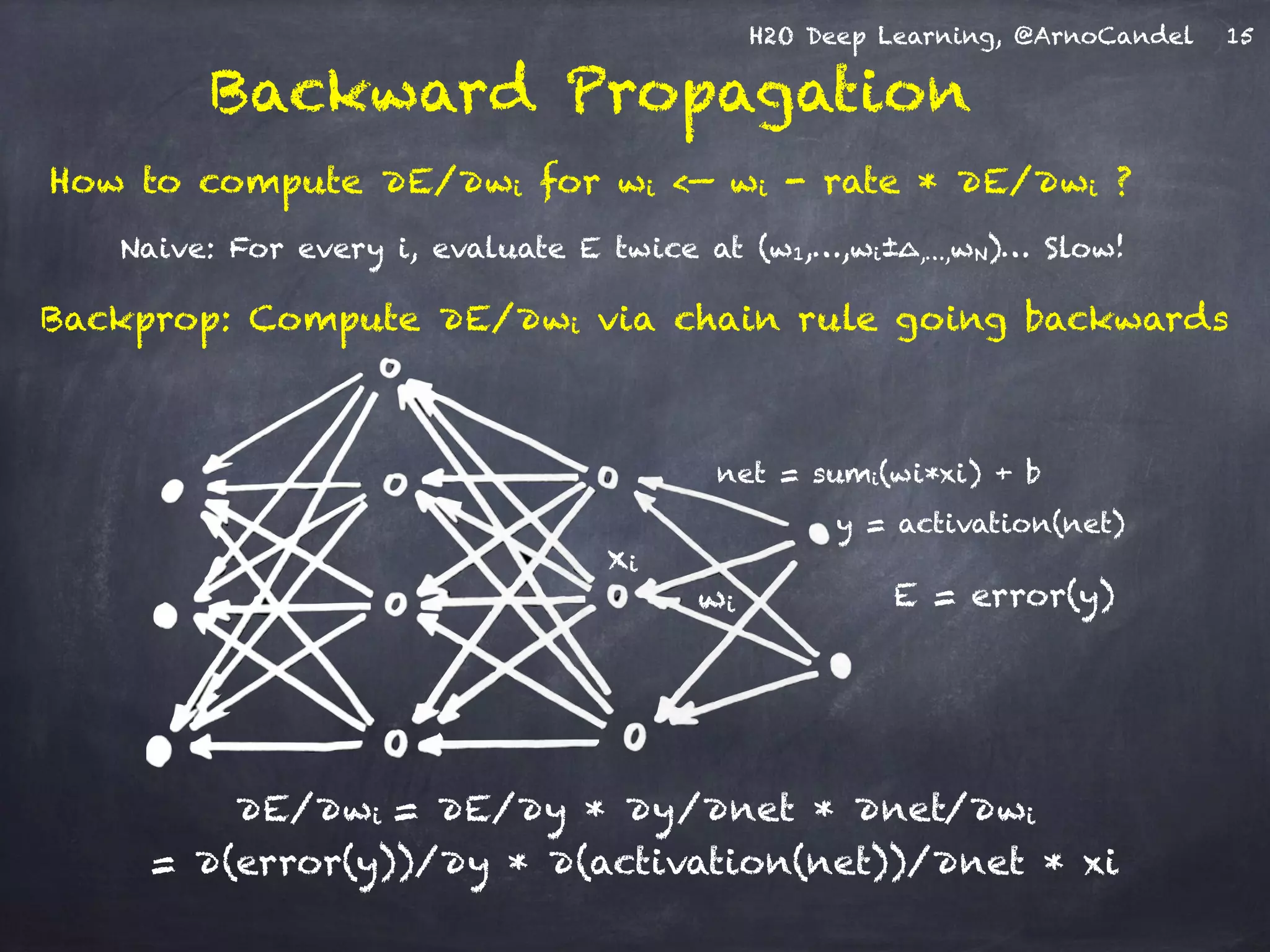
∂E/∂wi = ∂E/∂y * ∂y/∂net * ∂net/∂wi
= ∂(error(y))/∂y * ∂(activation(net))/∂net * xi
Backprop: Compute ∂E/∂wi via chain rule going backwards
wi
net = sumi(wi*xi) + b
xi
E = error(y)
y = activation(net)
How to compute ∂E/∂wi for wi <— wi - rate * ∂E/∂wi ?
Naive: For every i, evaluate E twice at (w1,…,wi±∆,…,wN)… Slow!
15
H2O Deep Learning, @ArnoCandel
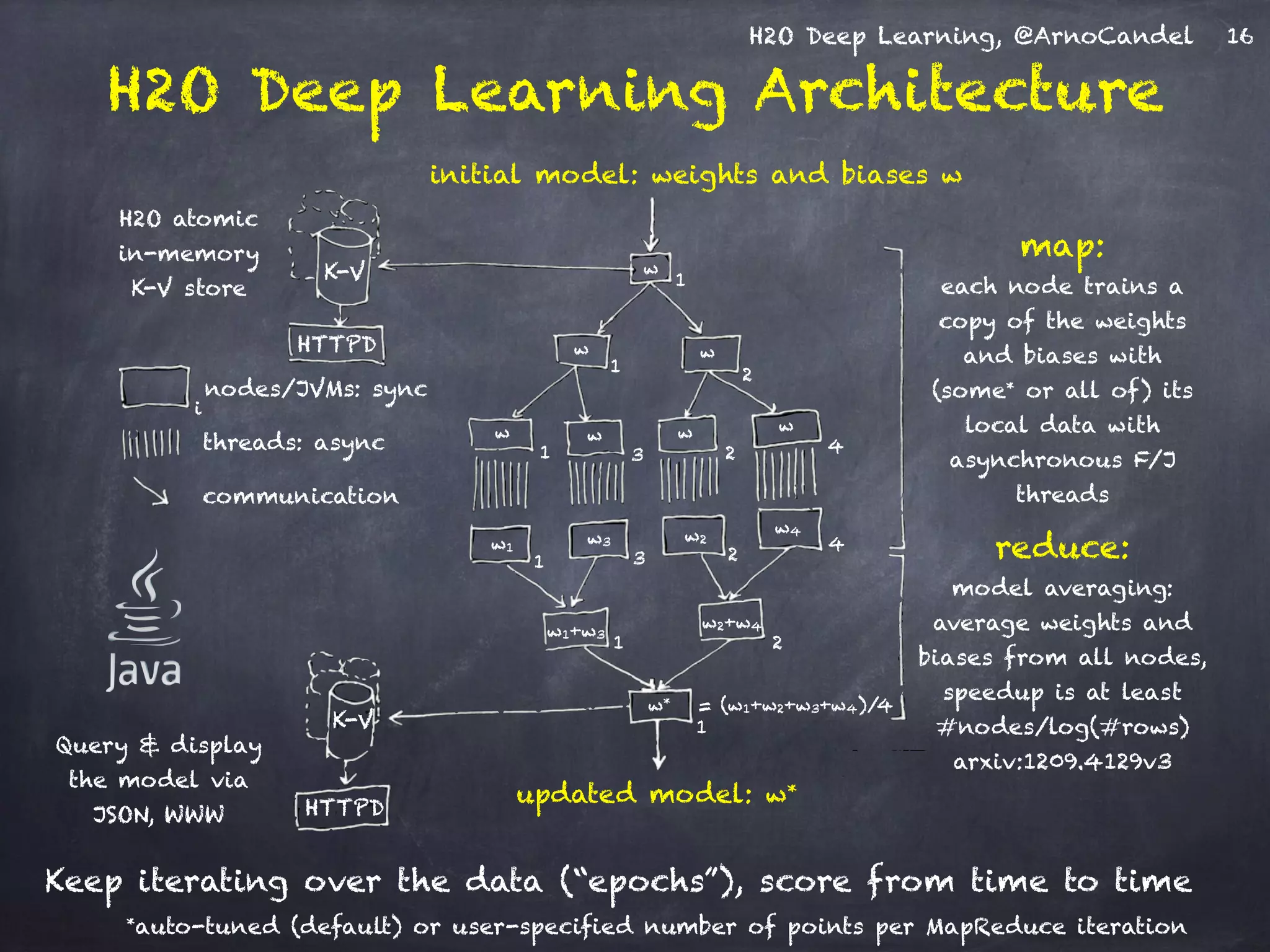
H2O Deep Learning Architecture
K-V
K-V
HTTPD
HTTPD
nodes/JVMs: sync
threads: async
communication
w
w w
w w w w
w1
w3 w2
w4
w2+w4
w1+w3
w* = (w1+w2+w3+w4)/4
map:

each node trains a
copy of the weights
and biases with
(some* or all of) its
local data with
asynchronous F/J
threads
initial model: weights and biases w
updated model: w*
H2O atomic
in-memory

K-V store
reduce:

model averaging:
average weights and
biases from all nodes,
speedup is at least
#nodes/log(#rows)
arxiv:1209.4129v3
Keep iterating over the data (“epochs”), score from time to time
Query & display
the model via
JSON, WWW
2
2 431
1
1
1
4
3 2
1 2
1
i
*auto-tuned (default) or user-specified number of points per MapReduce iteration
16
H2O Deep Learning, @ArnoCandel
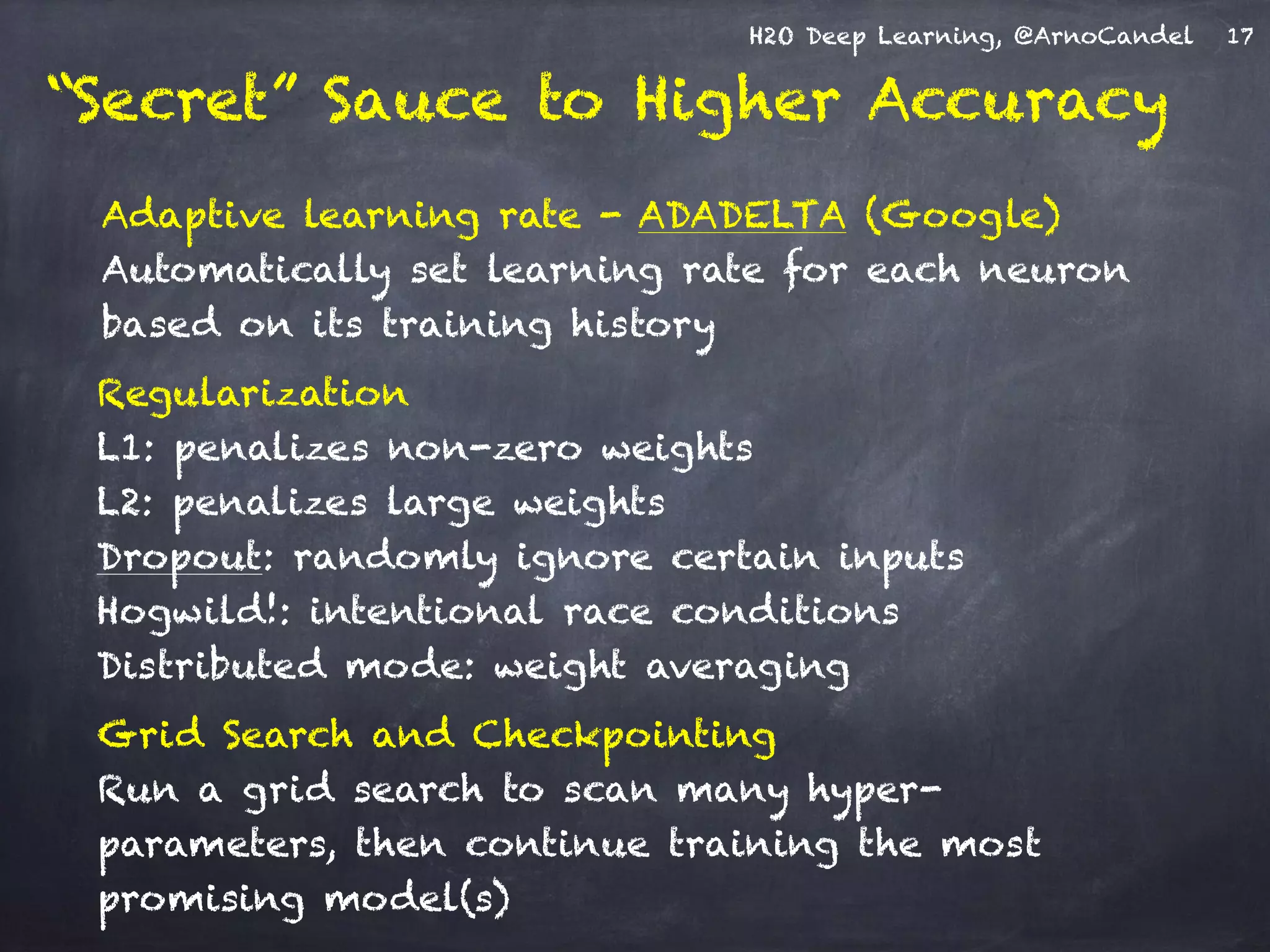
Adaptive learning rate - ADADELTA (Google)

Automatically set learning rate for each neuron
based on its training history
Grid Search and Checkpointing

Run a grid search to scan many hyper-
parameters, then continue training the most
promising model(s)
Regularization

L1: penalizes non-zero weights

L2: penalizes large weights

Dropout: randomly ignore certain inputs
Hogwild!: intentional race conditions
Distributed mode: weight averaging
17
“Secret” Sauce to Higher Accuracy
H2O Deep Learning, @ArnoCandel
Detail: Adaptive Learning Rate
Compute moving average of ∆wi
2 at time t for window length rho:
E[∆wi
2]t = rho * E[∆wi
2]t-1 + (1-rho) * ∆wi
2
Compute RMS of ∆wi at time t with smoothing epsilon:
RMS[∆wi]t = sqrt( E[∆wi
2]t + epsilon )
Adaptive annealing / progress:
Gradient-dependent learning rate,
moving window prevents “freezing”
(unlike ADAGRAD: no window)
Adaptive acceleration / momentum:
accumulate previous weight updates,
but over a window of time
RMS[∆wi]t-1
RMS[∂E/∂wi]t
rate(wi, t) =
Do the same for ∂E/∂wi, then
obtain per-weight learning rate:
cf. ADADELTA paper
18
H2O Deep Learning, @ArnoCandel
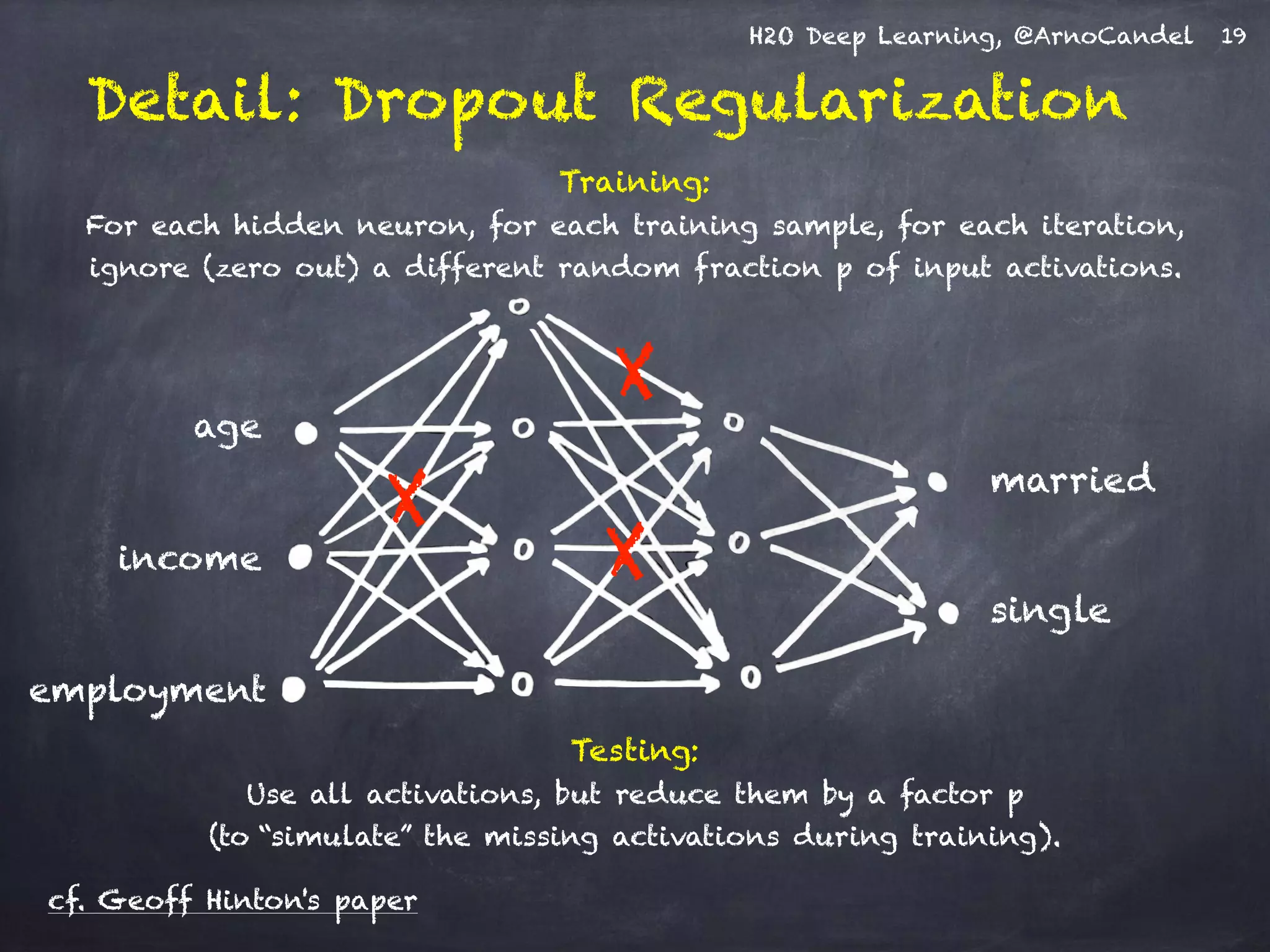
Detail: Dropout Regularization
19
Training:
For each hidden neuron, for each training sample, for each iteration,
ignore (zero out) a different random fraction p of input activations.
age
income
employment
married
single
X
X
X
Testing:
Use all activations, but reduce them by a factor p
(to “simulate” the missing activations during training).
cf. Geoff Hinton's paper
H2O Deep Learning, @ArnoCandel 20
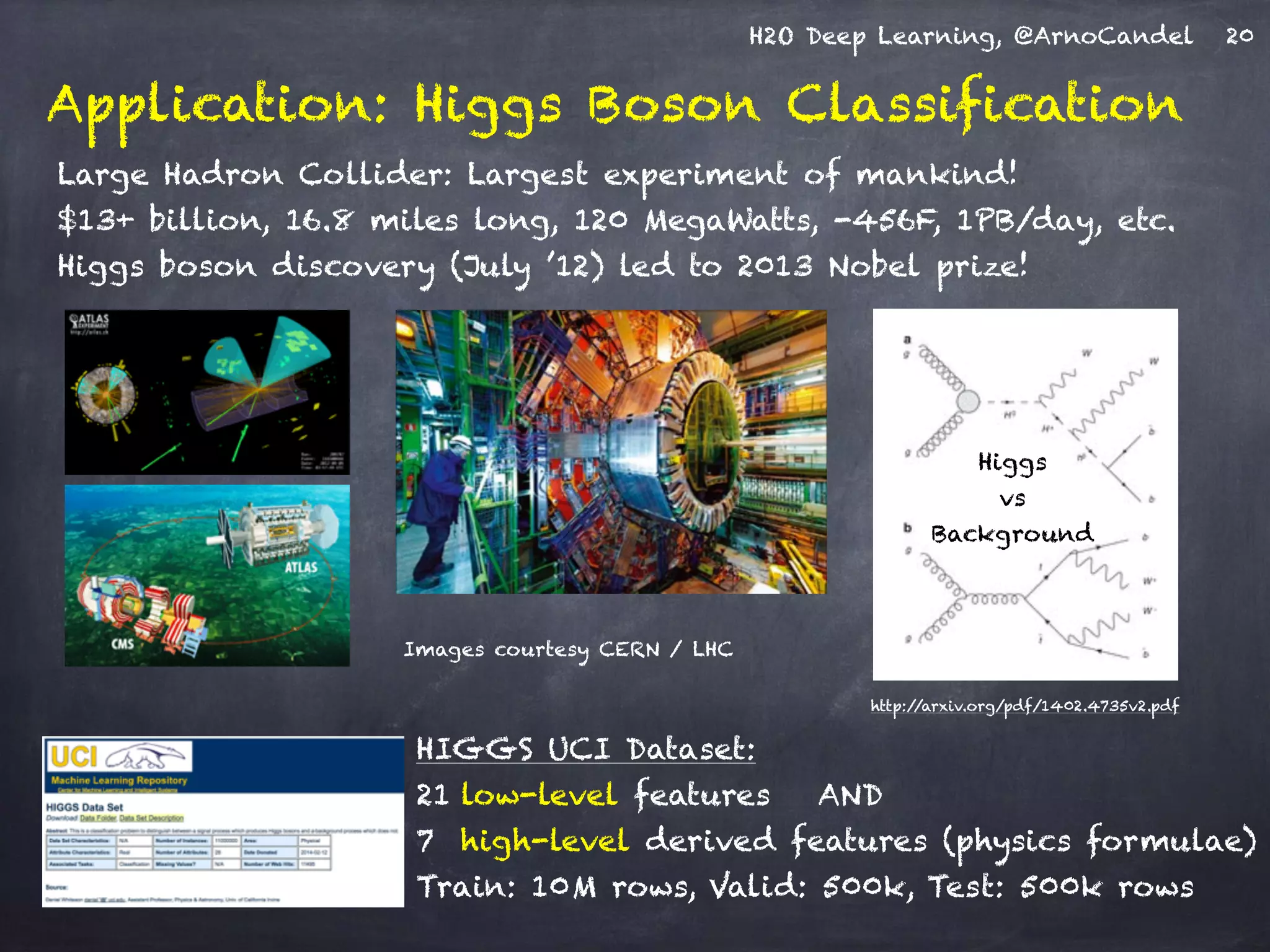
Application: Higgs Boson Classification
Higgs

vs

Background
Large Hadron Collider: Largest experiment of mankind!
$13+ billion, 16.8 miles long, 120 MegaWatts, -456F, 1PB/day, etc.
Higgs boson discovery (July ’12) led to 2013 Nobel prize!
http://arxiv.org/pdf/1402.4735v2.pdf
Images courtesy CERN / LHC
HIGGS UCI Dataset:
21 low-level features AND
7 high-level derived features (physics formulae)
Train: 10M rows, Valid: 500k, Test: 500k rows
H2O Deep Learning, @ArnoCandel 21
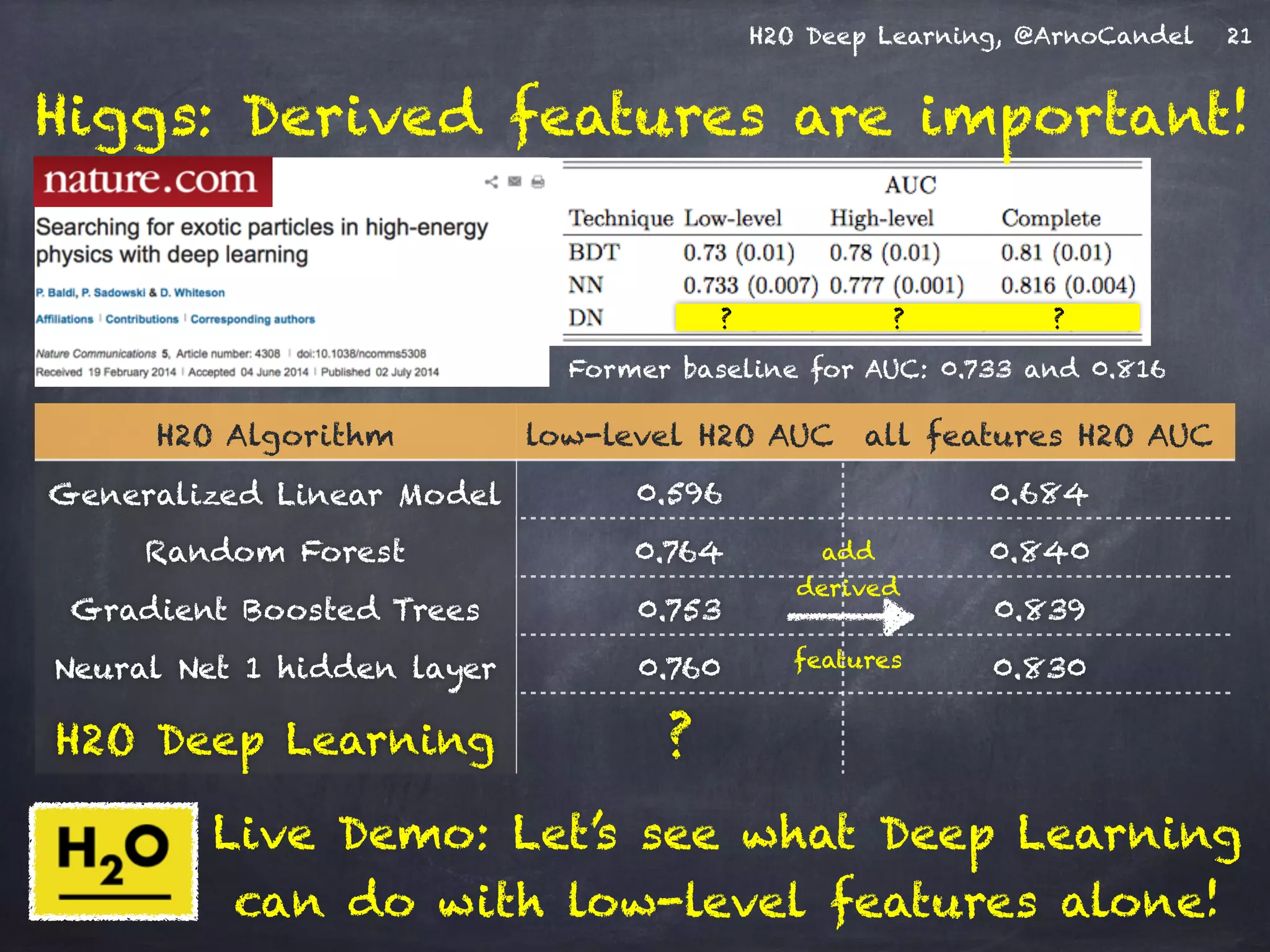
Live Demo: Let’s see what Deep Learning
can do with low-level features alone!
? ? ?
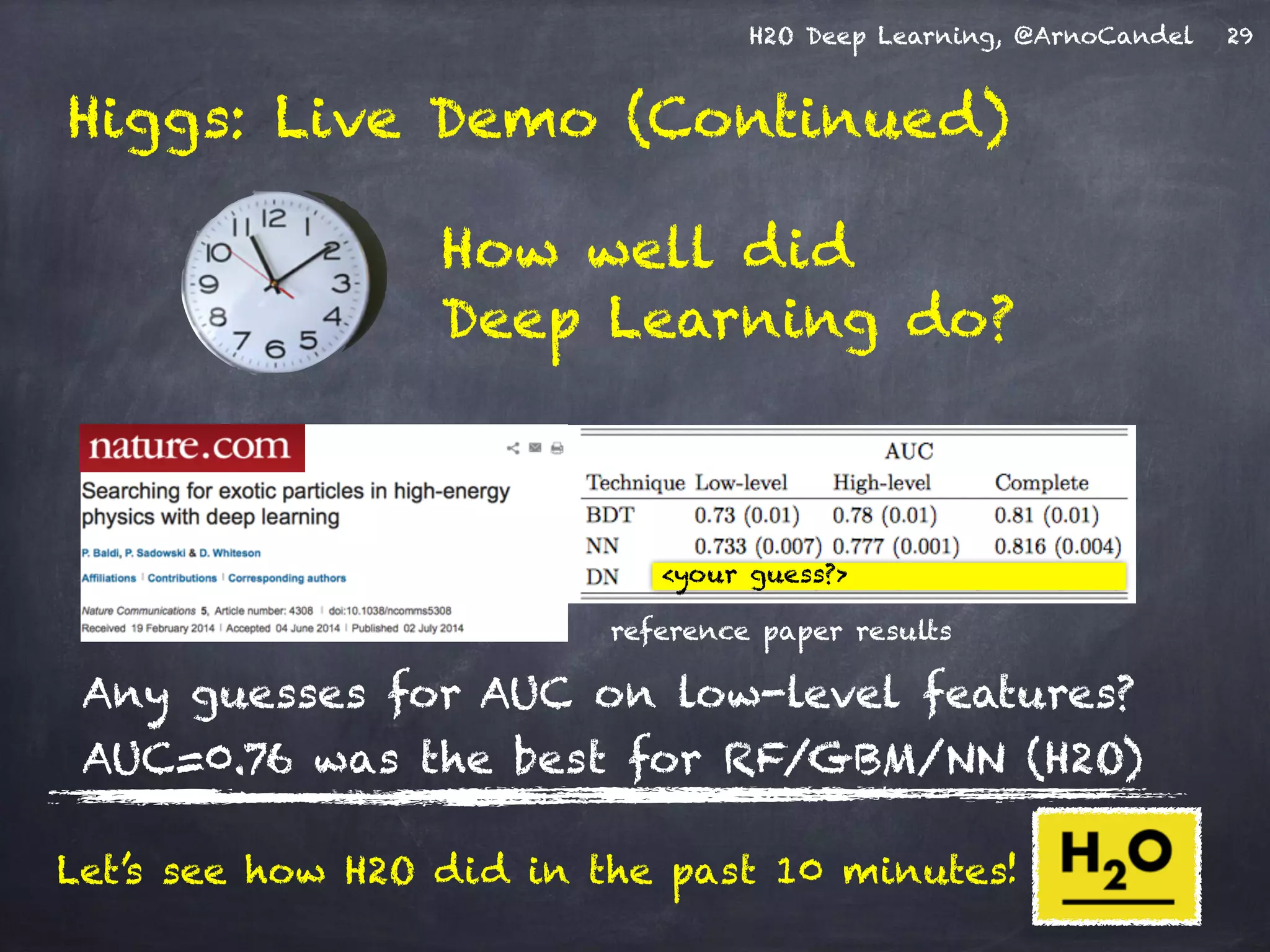
Former baseline for AUC: 0.733 and 0.816
H2O Algorithm low-level H2O AUC all features H2O AUC
Generalized Linear Model 0.596 0.684
Random Forest 0.764 0.840
Gradient Boosted Trees 0.753 0.839
Neural Net 1 hidden layer 0.760 0.830
H2O Deep Learning ?
add

derived

features
Higgs: Derived features are important!
H2O Deep Learning, @ArnoCandel
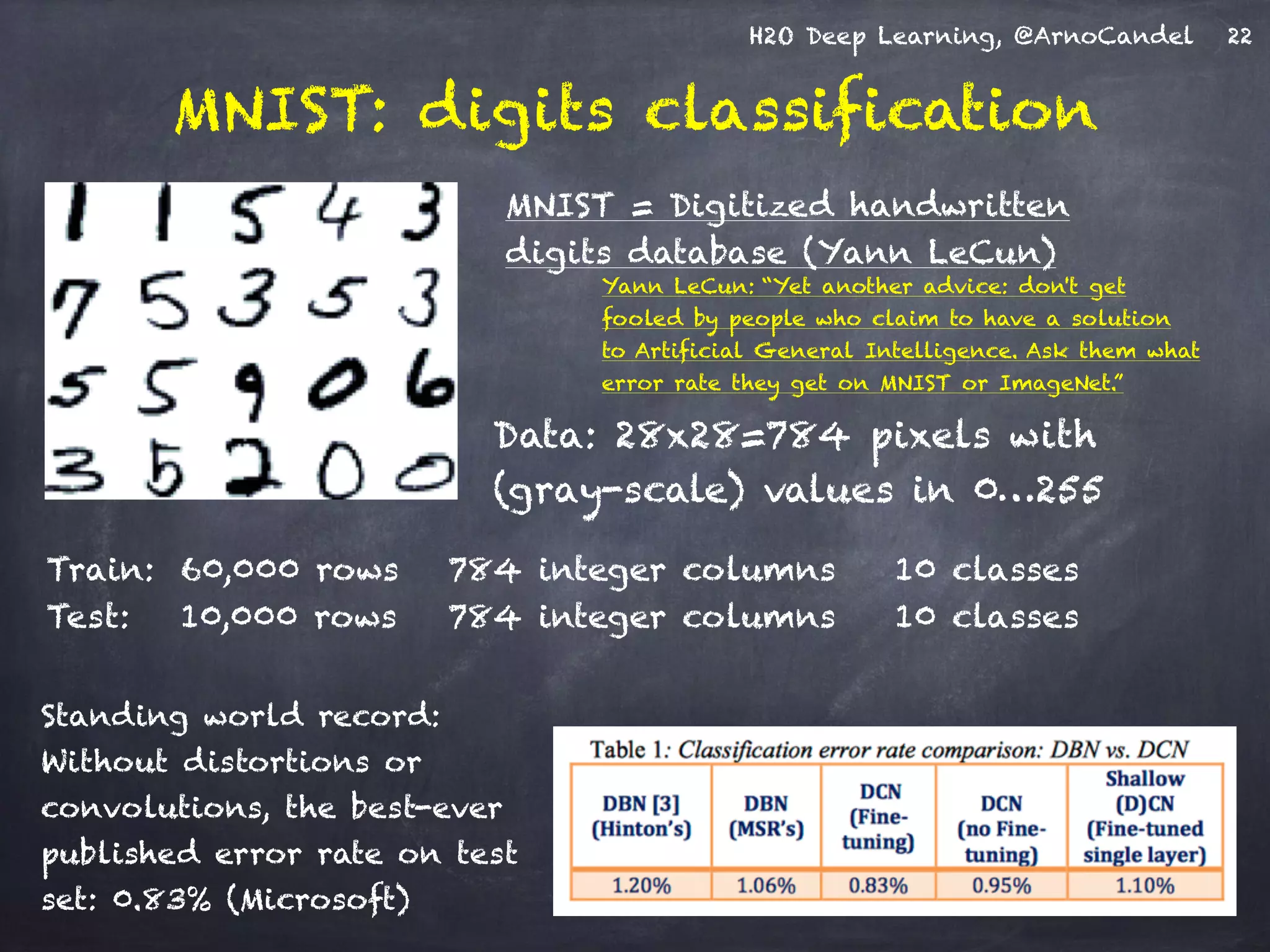
MNIST: digits classification
Standing world record:

Without distortions or
convolutions, the best-ever
published error rate on test
set: 0.83% (Microsoft)
22
Train: 60,000 rows 784 integer columns 10 classes
Test: 10,000 rows 784 integer columns 10 classes
MNIST = Digitized handwritten
digits database (Yann LeCun)
Data: 28x28=784 pixels with
(gray-scale) values in 0…255
Yann LeCun: “Yet another advice: don't get
fooled by people who claim to have a solution
to Artificial General Intelligence. Ask them what
error rate they get on MNIST or ImageNet.”
H2O Deep Learning, @ArnoCandel 23
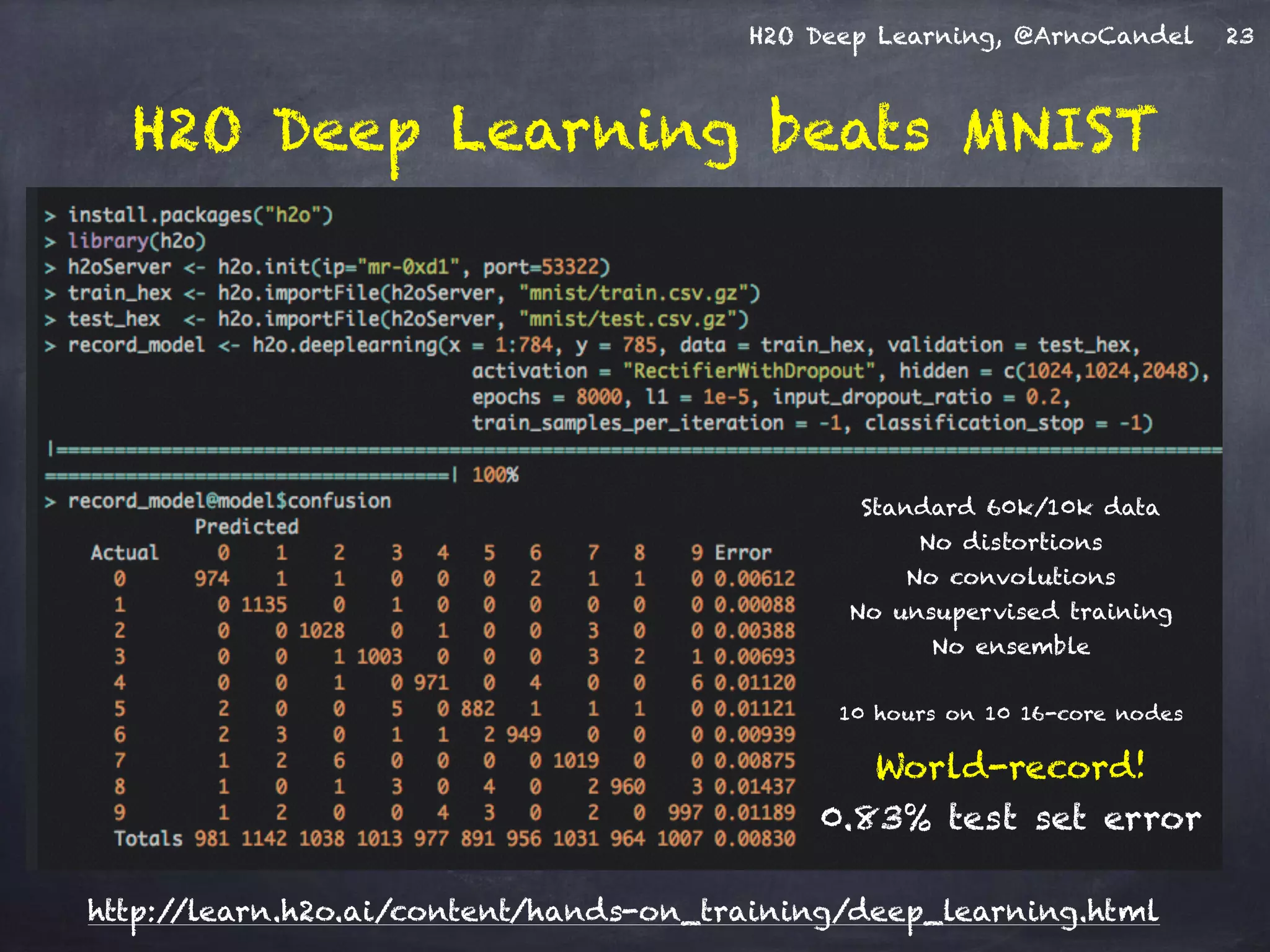
H2O Deep Learning beats MNIST
Standard 60k/10k data
No distortions
No convolutions
No unsupervised training
No ensemble
10 hours on 10 16-core nodes
World-record!
0.83% test set error
http://learn.h2o.ai/content/hands-on_training/deep_learning.html
H2O Deep Learning, @ArnoCandel
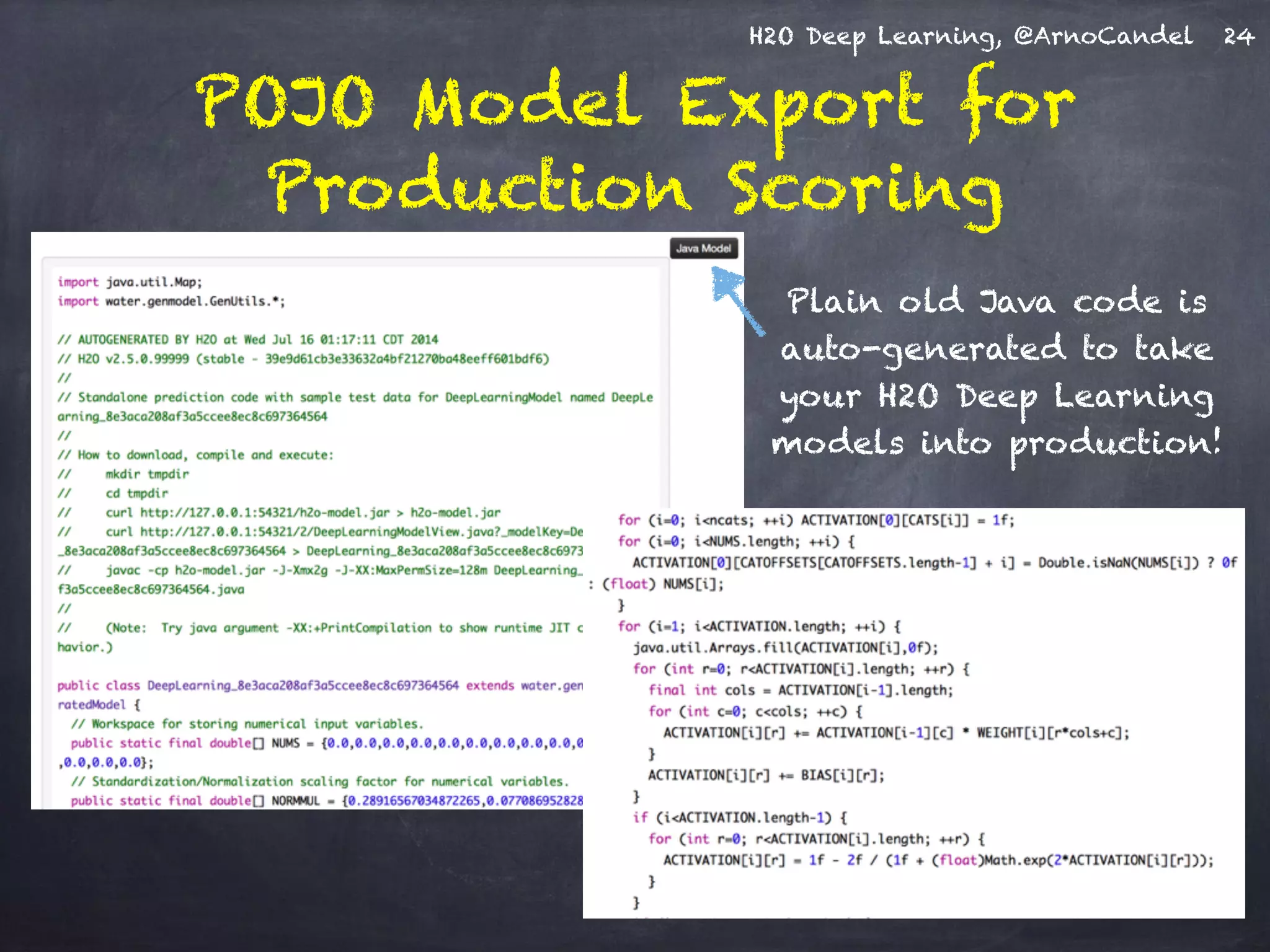
POJO Model Export for
Production Scoring
24
Plain old Java code is
auto-generated to take
your H2O Deep Learning
models into production!
H2O Deep Learning, @ArnoCandel
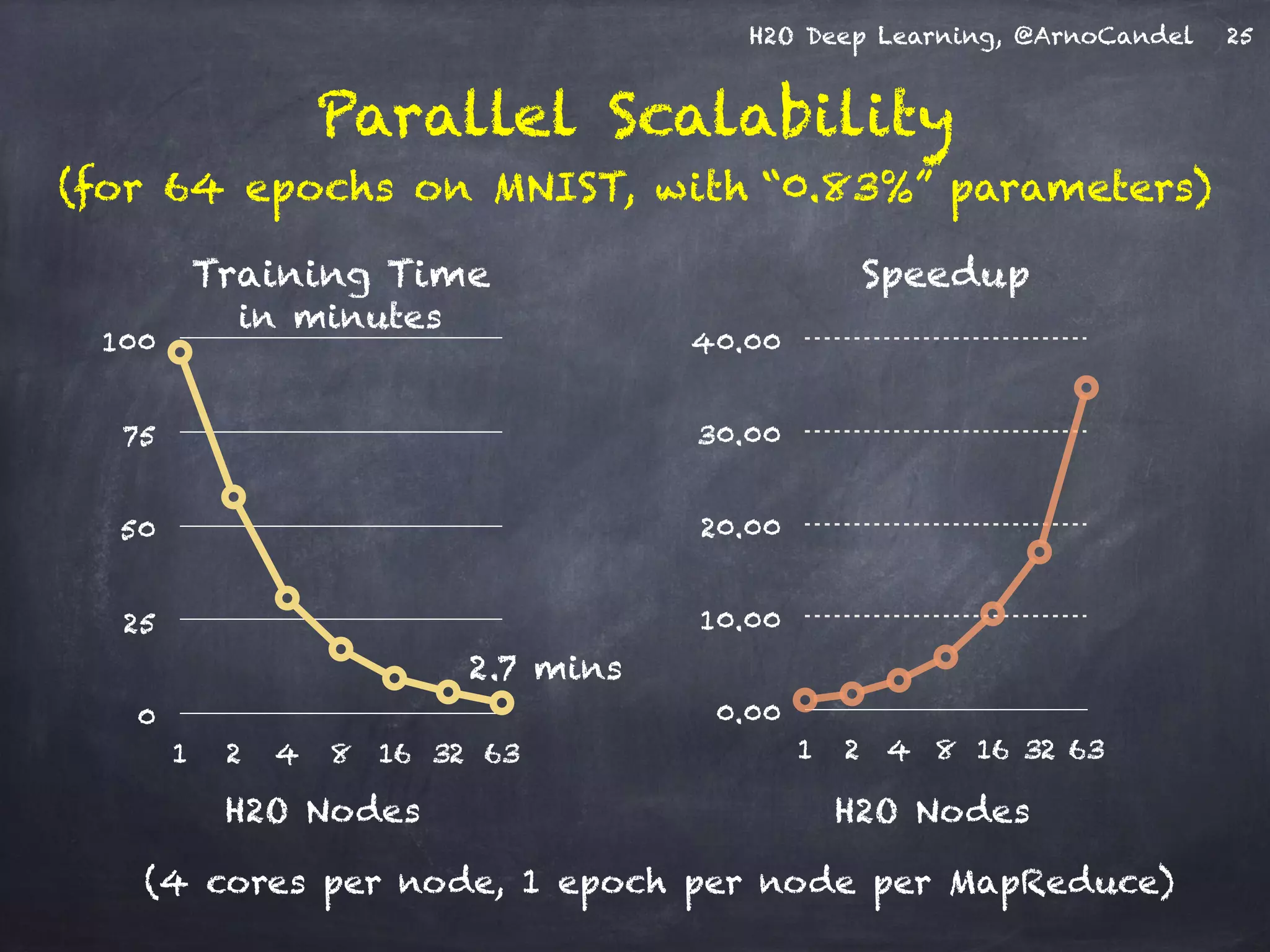
Parallel Scalability
(for 64 epochs on MNIST, with “0.83%” parameters)
25
Speedup
0.00
10.00
20.00
30.00
40.00
1 2 4 8 16 32 63
H2O Nodes
(4 cores per node, 1 epoch per node per MapReduce)
2.7 mins
Training Time
0
25
50
75
100
1 2 4 8 16 32 63
H2O Nodes
in minutes
H2O Deep Learning, @ArnoCandel
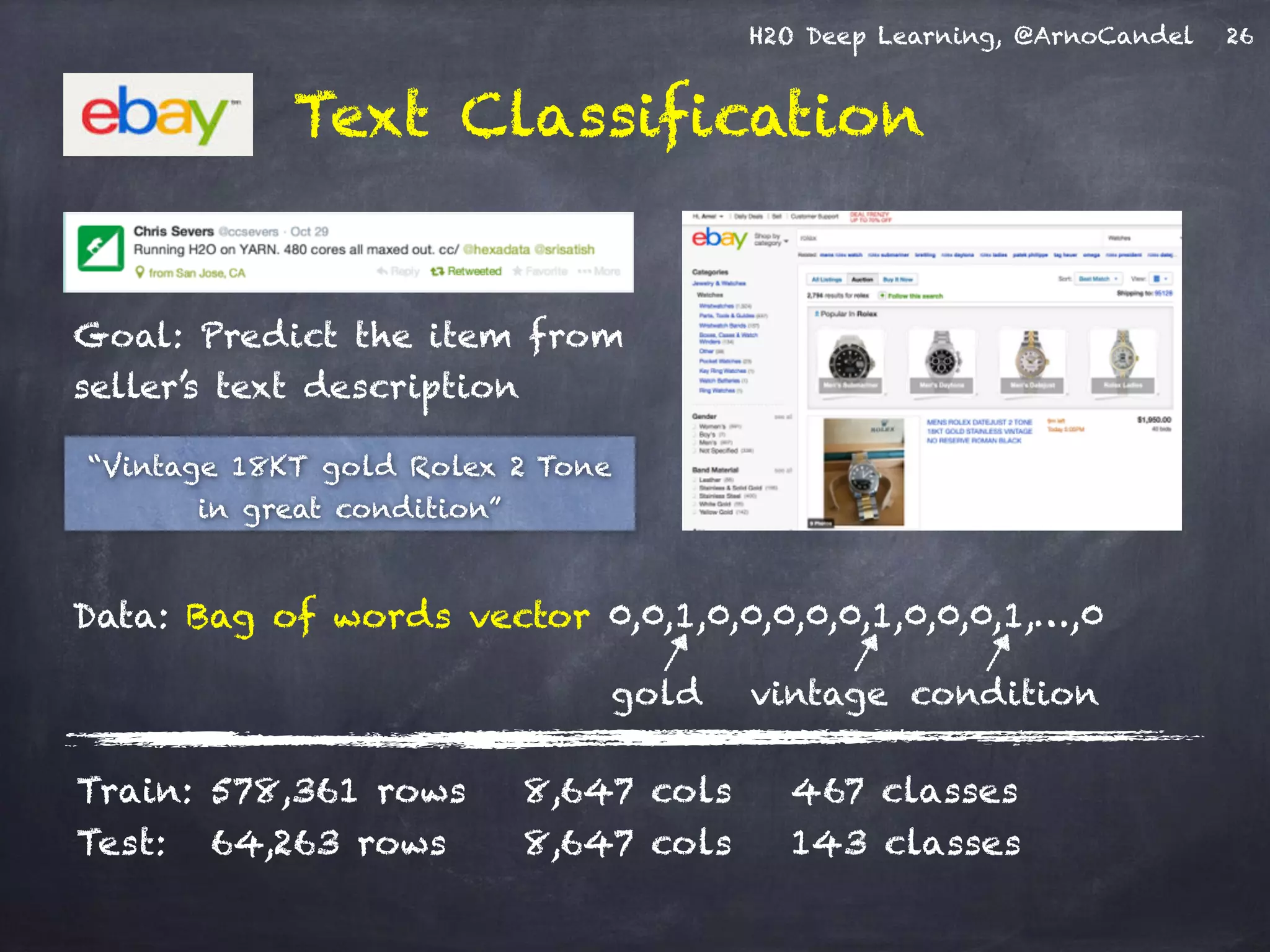
Goal: Predict the item from
seller’s text description
26
Train: 578,361 rows 8,647 cols 467 classes
Test: 64,263 rows 8,647 cols 143 classes
“Vintage 18KT gold Rolex 2 Tone
in great condition”
Data: Bag of words vector 0,0,1,0,0,0,0,0,1,0,0,0,1,…,0
vintagegold condition
Text Classification
H2O Deep Learning, @ArnoCandel
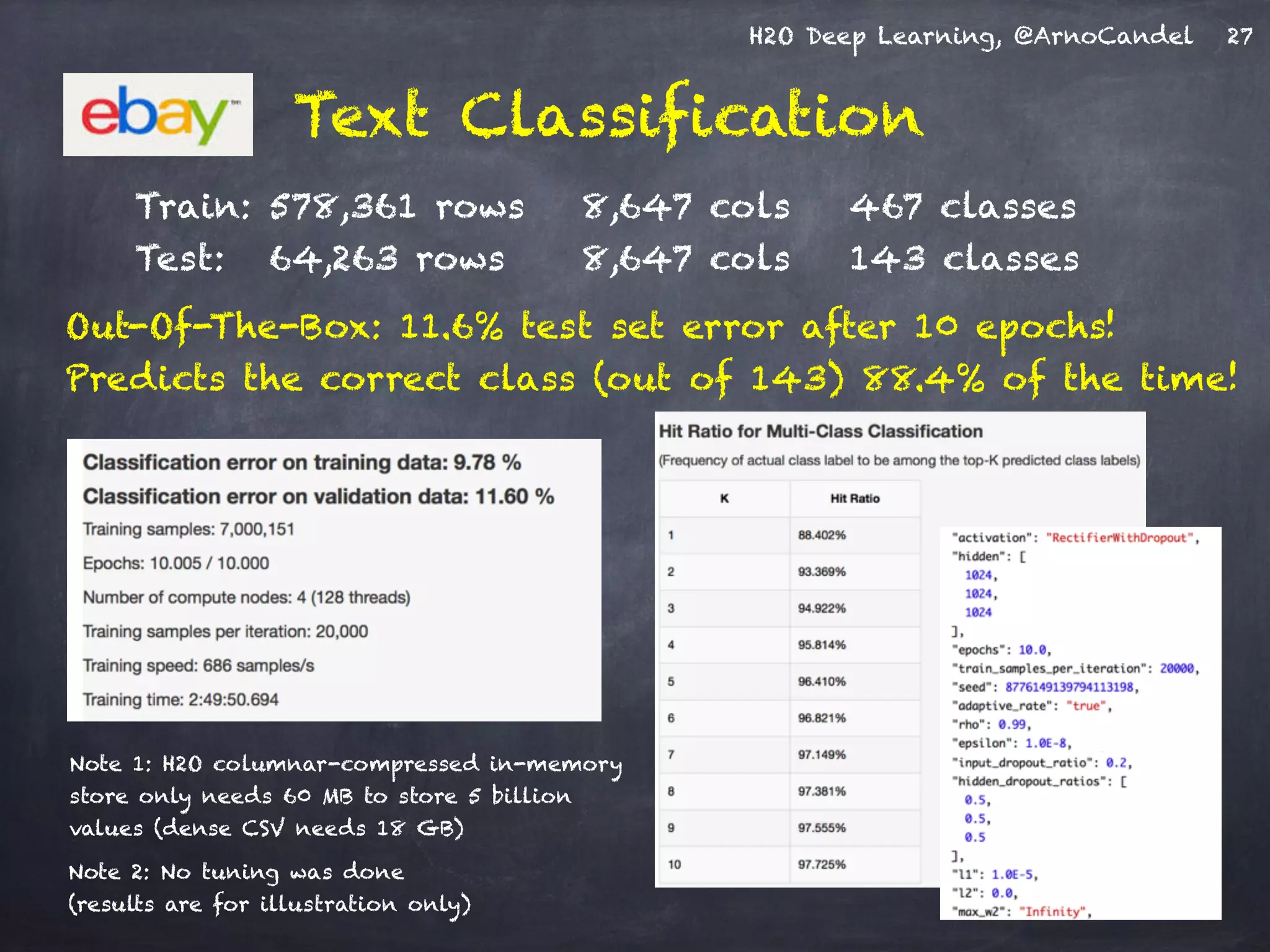
Out-Of-The-Box: 11.6% test set error after 10 epochs!
Predicts the correct class (out of 143) 88.4% of the time!
27
Note 2: No tuning was done

(results are for illustration only)
Train: 578,361 rows 8,647 cols 467 classes
Test: 64,263 rows 8,647 cols 143 classes
Note 1: H2O columnar-compressed in-memory
store only needs 60 MB to store 5 billion
values (dense CSV needs 18 GB)
Text Classification
H2O Deep Learning, @ArnoCandel
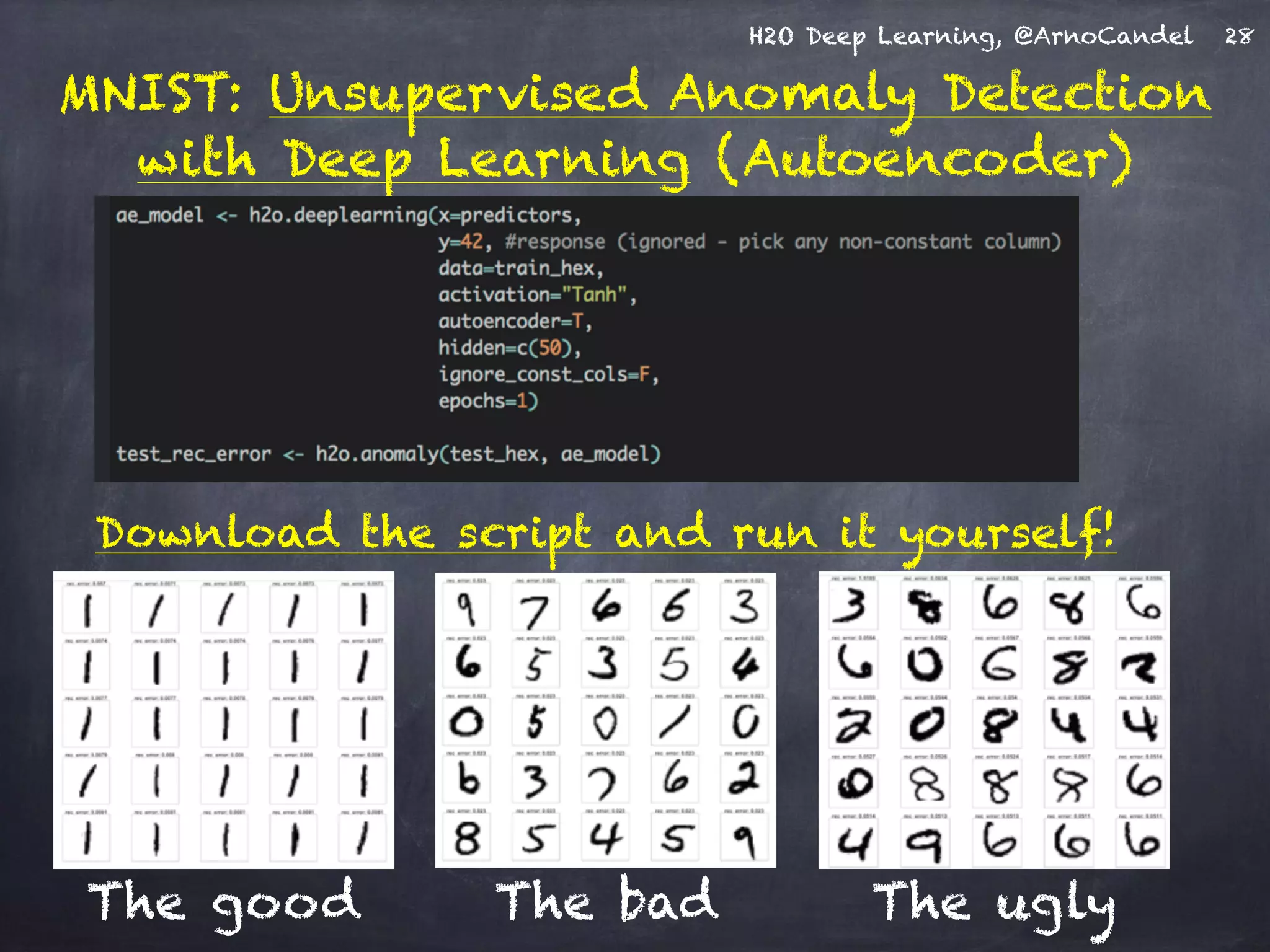
MNIST: Unsupervised Anomaly Detection
with Deep Learning (Autoencoder)
28
The good The bad The ugly
Download the script and run it yourself!
H2O Deep Learning, @ArnoCandel 29
How well did
Deep Learning do?
Let’s see how H2O did in the past 10 minutes!
Higgs: Live Demo (Continued)
<your guess?>
reference paper results
Any guesses for AUC on low-level features?
AUC=0.76 was the best for RF/GBM/NN (H2O)
H2O Deep Learning, @ArnoCandel
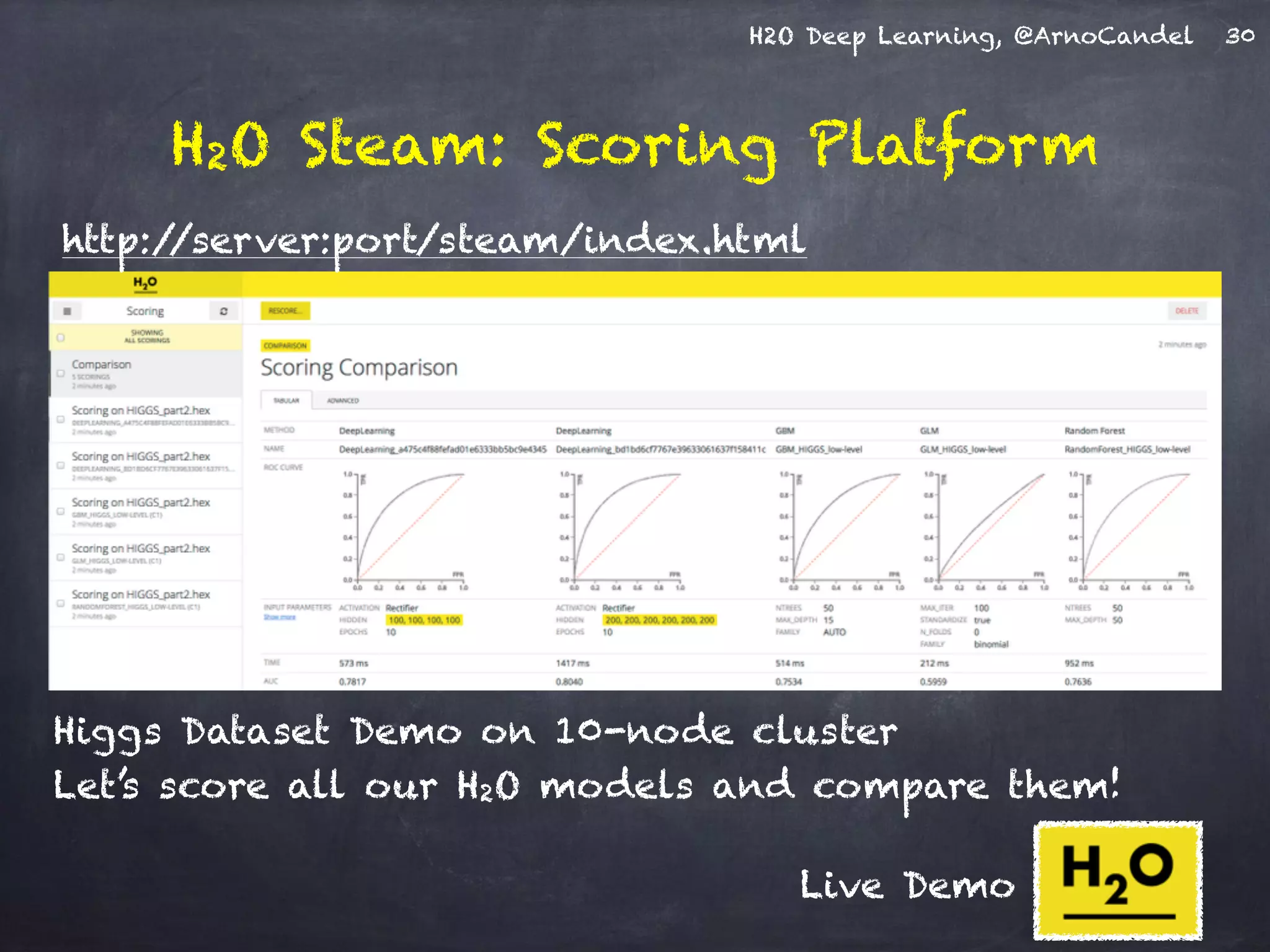
H2O Steam: Scoring Platform
30
Higgs Dataset Demo on 10-node cluster
Let’s score all our H2O models and compare them!
http://server:port/steam/index.html
Live Demo
H2O Deep Learning, @ArnoCandel 31
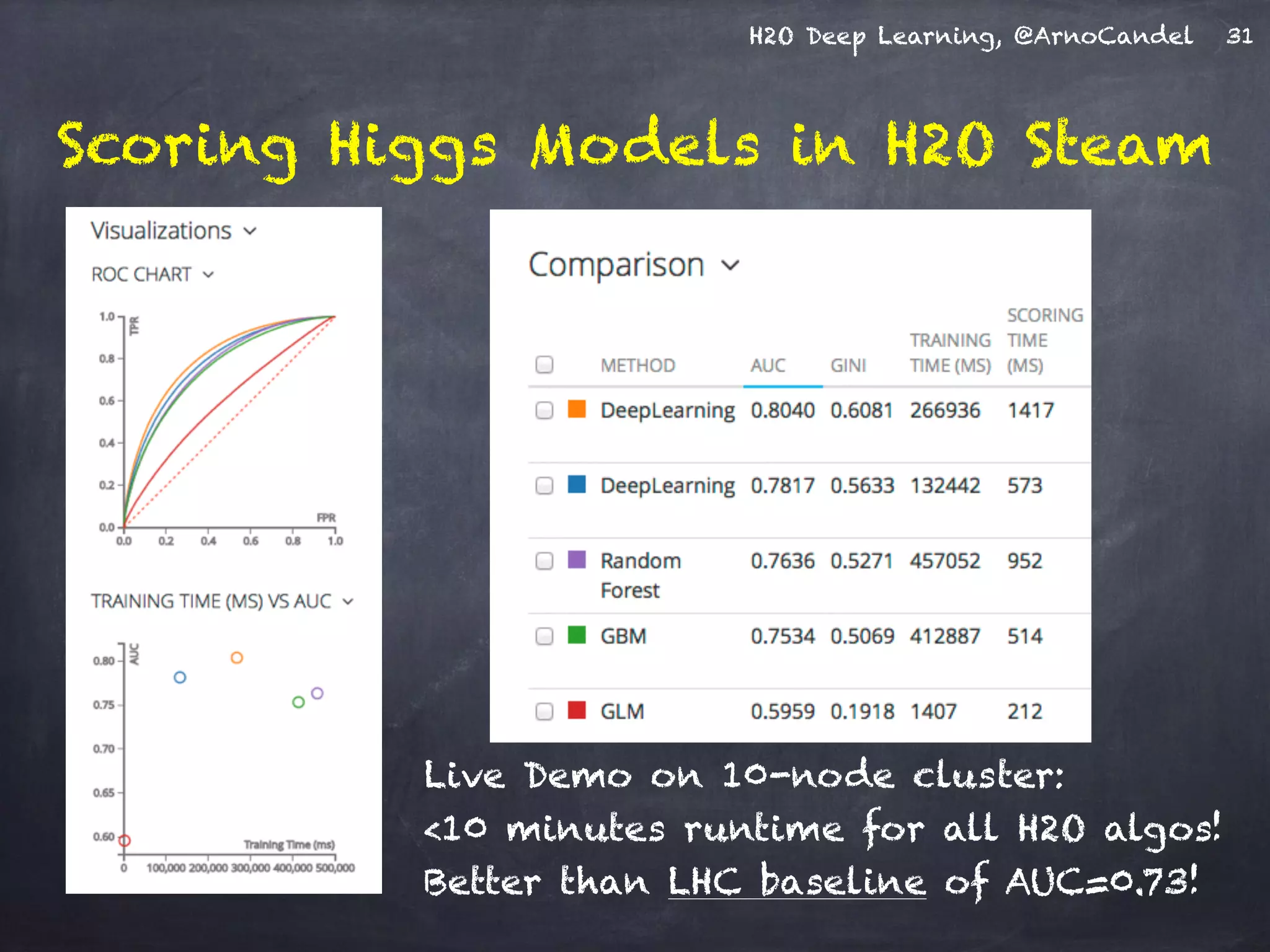
Live Demo on 10-node cluster:
<10 minutes runtime for all H2O algos!
Better than LHC baseline of AUC=0.73!
Scoring Higgs Models in H2O Steam
H2O Deep Learning, @ArnoCandel 32
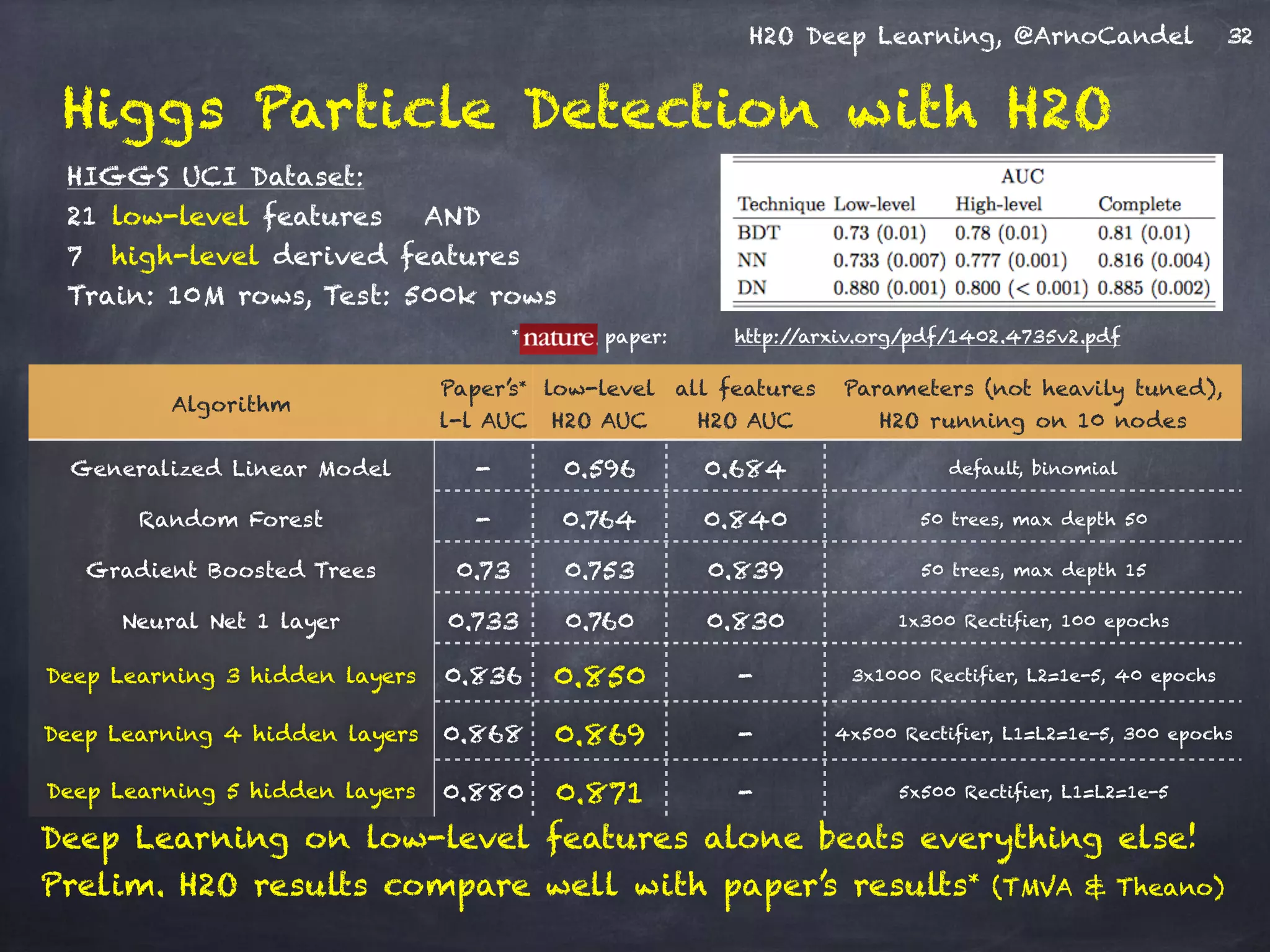
Algorithm
Paper’s*
l-l AUC
low-level
H2O AUC
all features

H2O AUC
Parameters (not heavily tuned), 

H2O running on 10 nodes
Generalized Linear Model - 0.596 0.684 default, binomial
Random Forest - 0.764 0.840 50 trees, max depth 50
Gradient Boosted Trees 0.73 0.753 0.839 50 trees, max depth 15
Neural Net 1 layer 0.733 0.760 0.830 1x300 Rectifier, 100 epochs
Deep Learning 3 hidden layers 0.836 0.850 - 3x1000 Rectifier, L2=1e-5, 40 epochs
Deep Learning 4 hidden layers 0.868 0.869 - 4x500 Rectifier, L1=L2=1e-5, 300 epochs
Deep Learning 5 hidden layers 0.880 0.871 - 5x500 Rectifier, L1=L2=1e-5
Deep Learning on low-level features alone beats everything else!
Prelim. H2O results compare well with paper’s results* (TMVA & Theano)
Higgs Particle Detection with H2O
*Nature paper: http://arxiv.org/pdf/1402.4735v2.pdf
HIGGS UCI Dataset:
21 low-level features AND
7 high-level derived features
Train: 10M rows, Test: 500k rows
H2O Deep Learning, @ArnoCandel
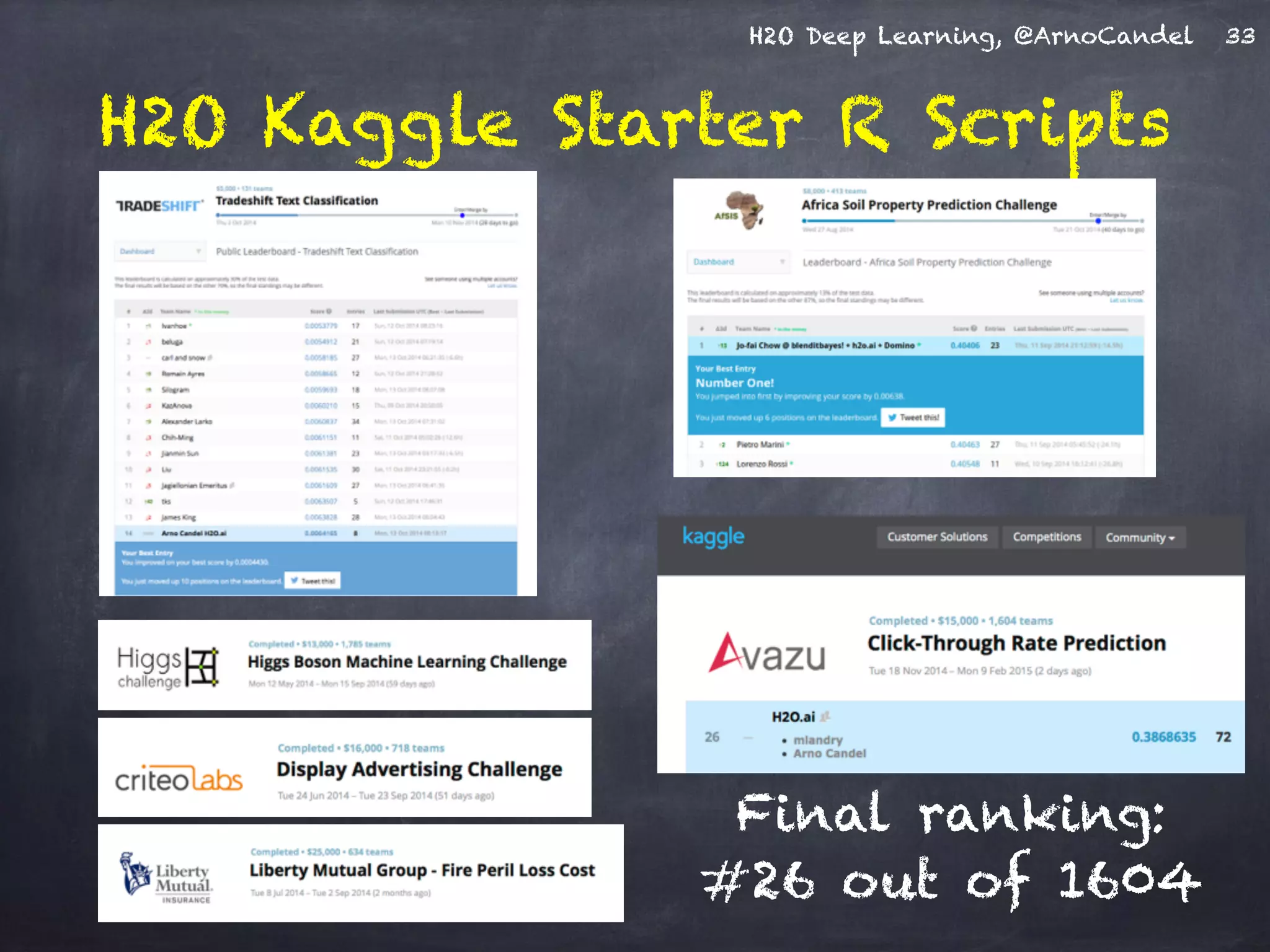
H2O Kaggle Starter R Scripts
33
Final ranking:

#26 out of 1604
H2O Deep Learning, @ArnoCandel
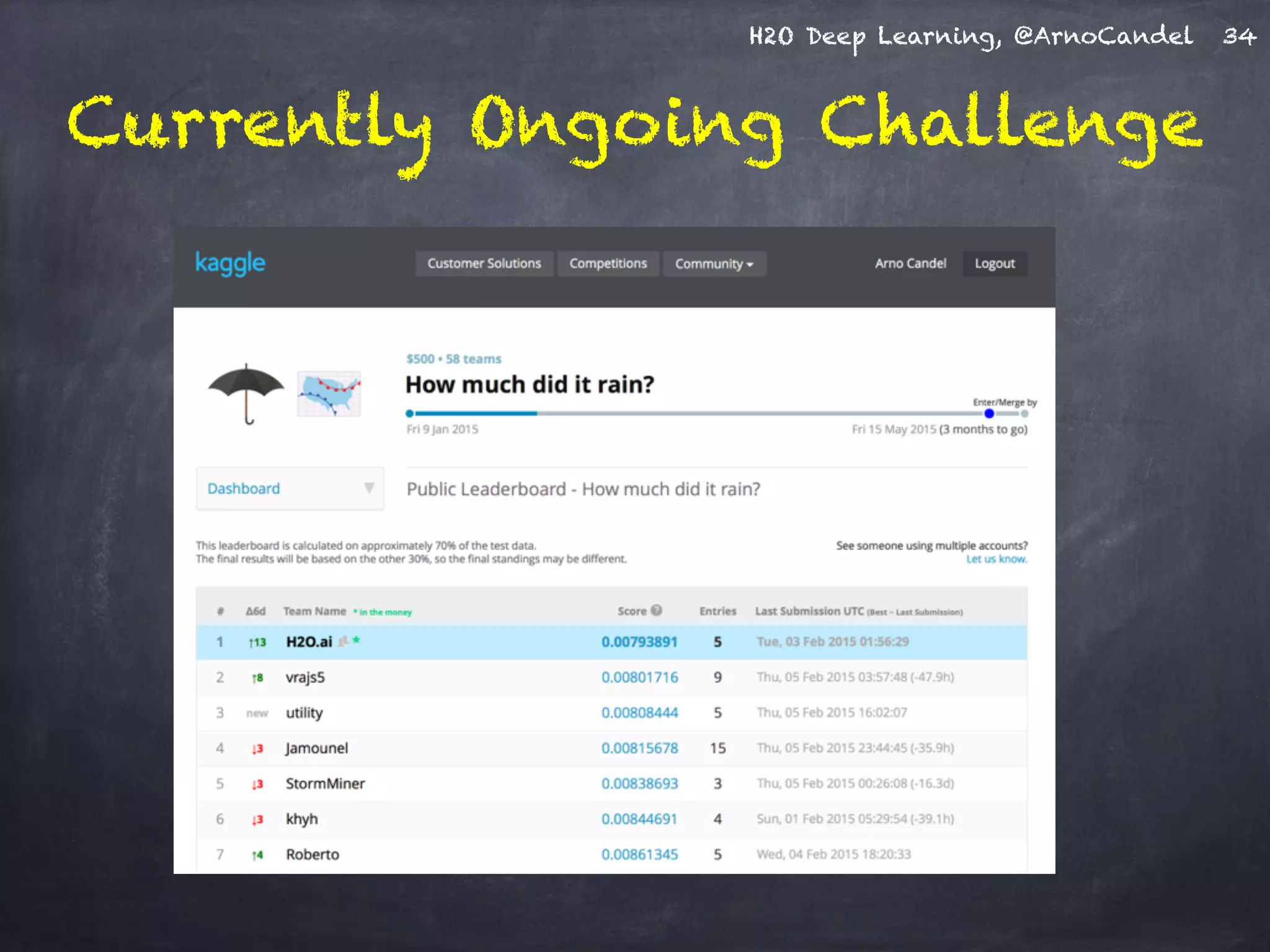
Currently Ongoing Challenge
34
H2O Deep Learning, @ArnoCandel
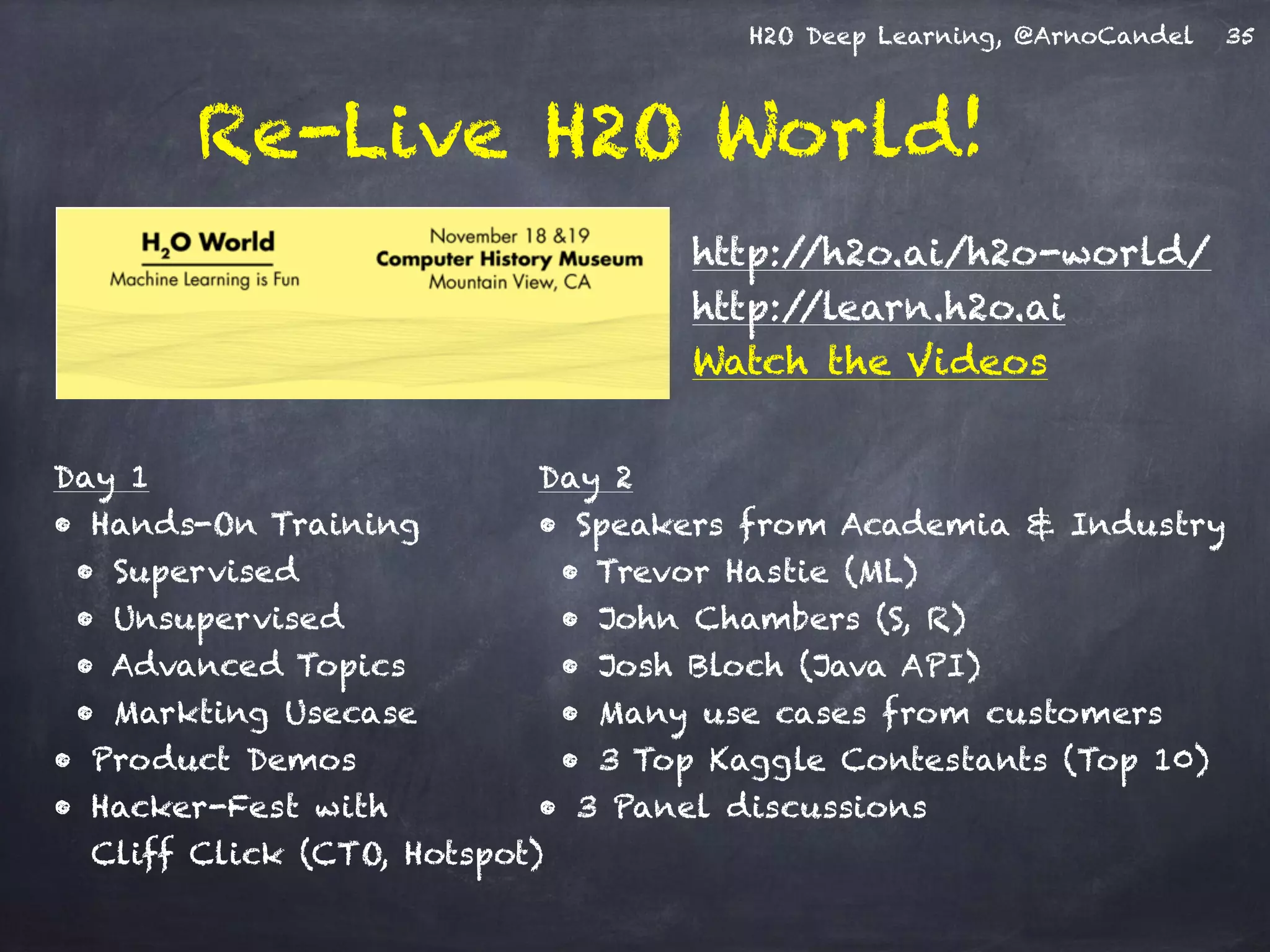
Re-Live H2O World!
35
http://h2o.ai/h2o-world/
http://learn.h2o.ai
Watch the Videos
Day 2
• Speakers from Academia & Industry
• Trevor Hastie (ML)
• John Chambers (S, R)
• Josh Bloch (Java API)
• Many use cases from customers
• 3 Top Kaggle Contestants (Top 10)
• 3 Panel discussions
Day 1
• Hands-On Training
• Supervised
• Unsupervised
• Advanced Topics
• Markting Usecase
• Product Demos
• Hacker-Fest with 

Cliff Click (CTO, Hotspot)
H2O Deep Learning, @ArnoCandel 36
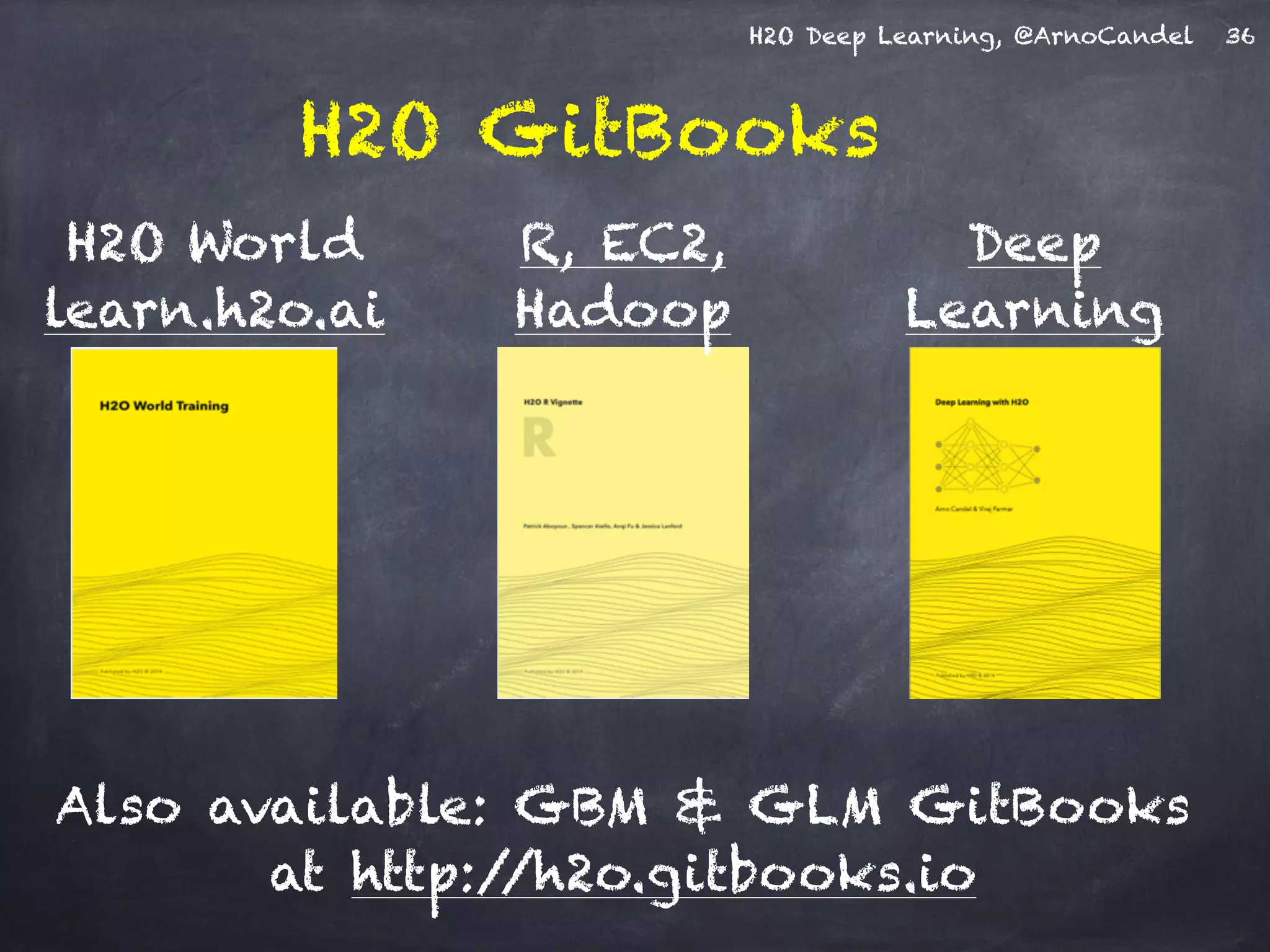
H2O GitBooks
Also available: GBM & GLM GitBooks
at http://h2o.gitbooks.io
H2O World
learn.h2o.ai
R, EC2,
Hadoop
Deep
Learning
H2O Deep Learning, @ArnoCandel
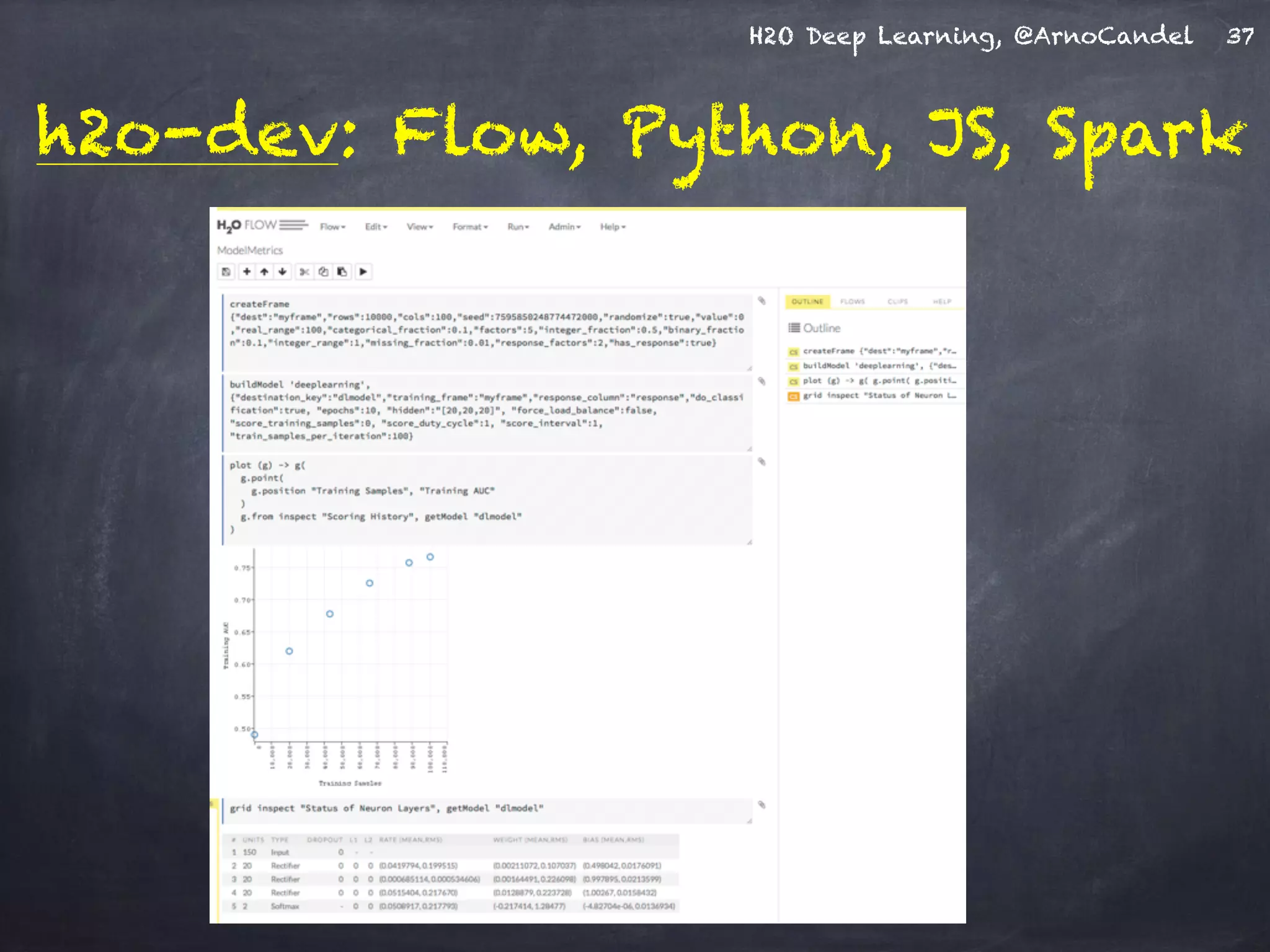
h2o-dev: Flow, Python, JS, Spark
37
H2O Deep Learning, @ArnoCandel
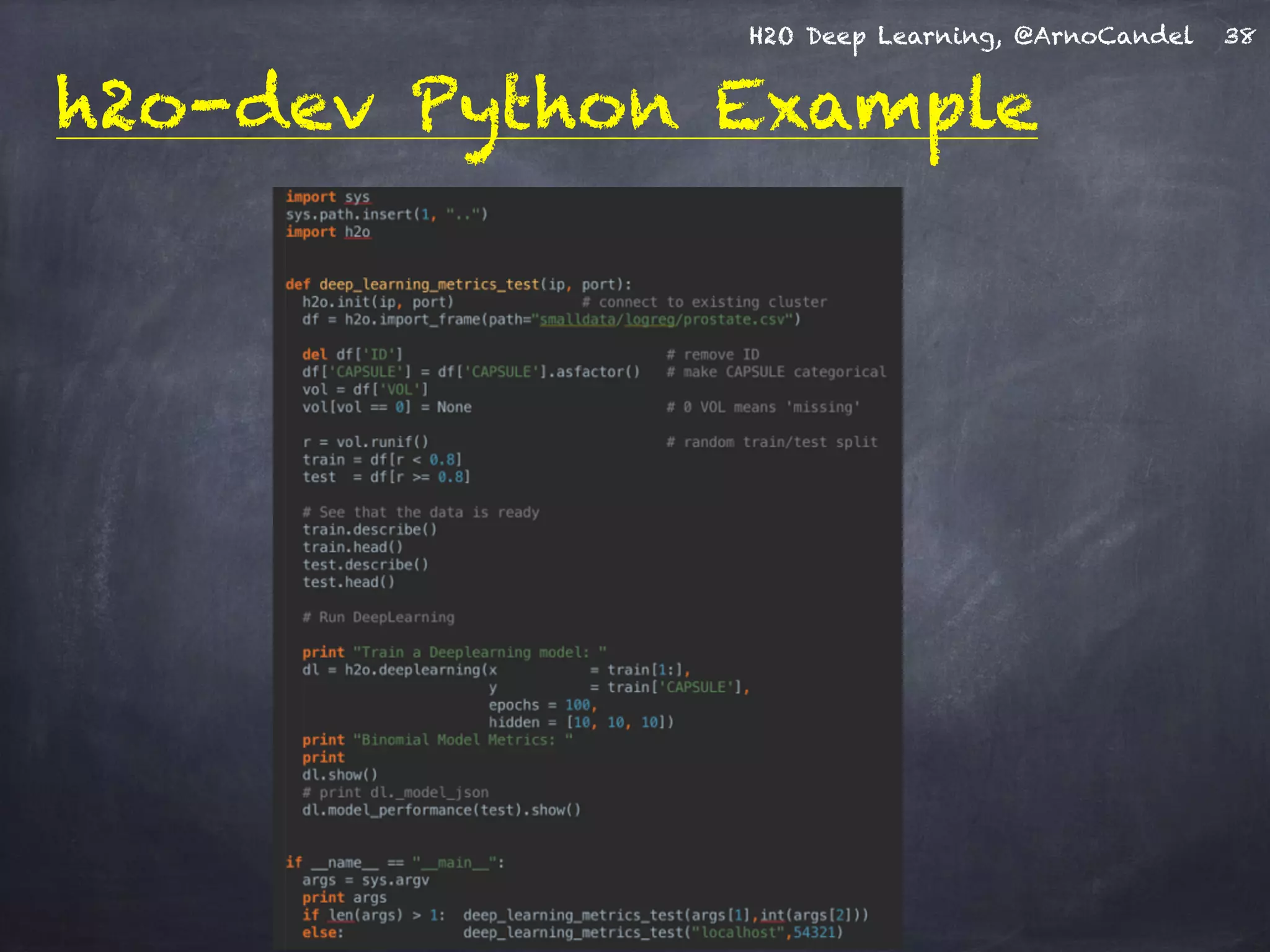
h2o-dev Python Example
38
H2O Deep Learning, @ArnoCandel
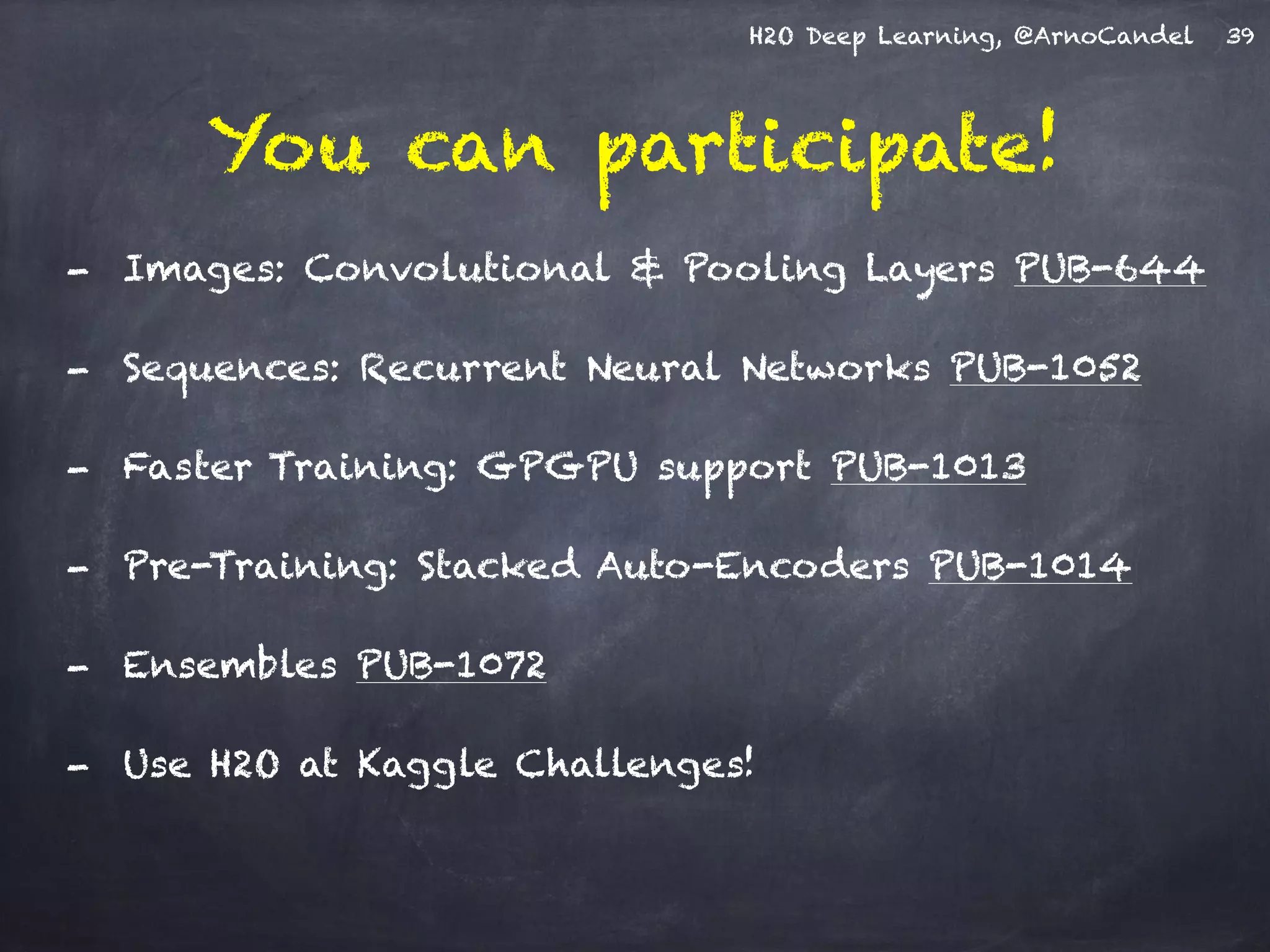
You can participate!
39
- Images: Convolutional & Pooling Layers PUB-644
- Sequences: Recurrent Neural Networks PUB-1052
- Faster Training: GPGPU support PUB-1013
- Pre-Training: Stacked Auto-Encoders PUB-1014
- Ensembles PUB-1072
- Use H2O at Kaggle Challenges!
H2O Deep Learning, @ArnoCandel
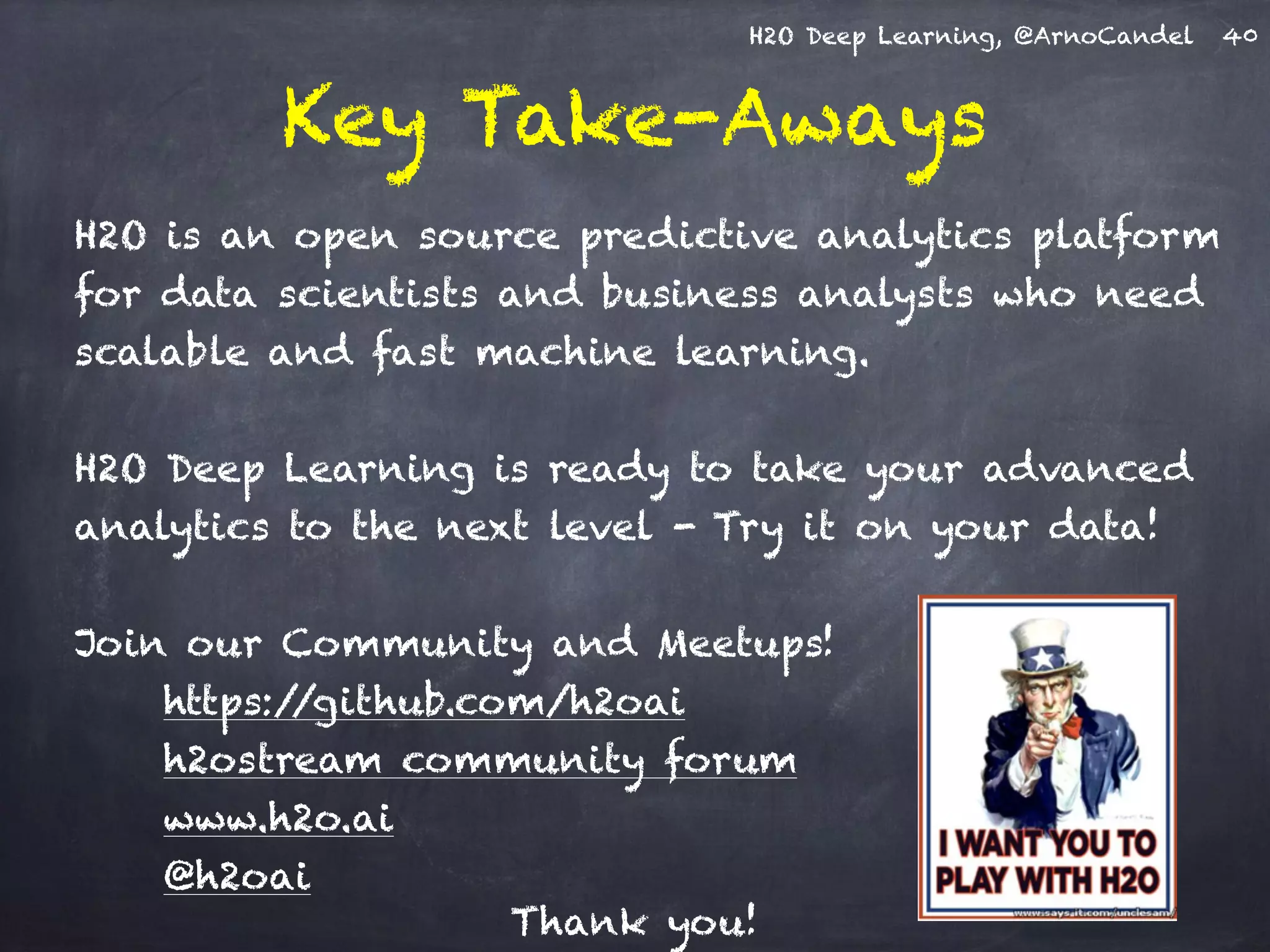
Key Take-Aways
H2O is an open source predictive analytics platform
for data scientists and business analysts who need
scalable and fast machine learning.
H2O Deep Learning is ready to take your advanced
analytics to the next level - Try it on your data!
Join our Community and Meetups!
https://github.com/h2oai
h2ostream community forum
www.h2o.ai
@h2oai
40
Thank you!

H2ODeepLearningThroughExamples021215

  • 1.
    Deep Learning 
 ThroughExamples Silicon Valley Big Data Science Meetup Mountain View, 2/12/2015 Arno Candel, H2O.ai
  • 2.
    Who am I? PhDin Computational Physics, 2005
 from ETH Zurich Switzerland 6 years at SLAC - Accelerator Physics Modeling 2 years at Skytree - Machine Learning 13 months at H2O.ai - Machine Learning 15 years in Supercomputing & Modeling Named “2014 Big Data All-Star” by Fortune Magazine @ArnoCandel
  • 4.
    H2O Deep Learning,@ArnoCandel Outline Introduction (10 mins) Methods & Implementation (20 mins) Results and Live Demos (20 mins) Higgs boson classification MNIST handwritten digits Ebay text classification h2o-dev Outlook: Flow, Python Part 2: Hands-On Session (40 mins) Web GUI: Higgs dataset R Studio: Adult, Higgs, MNIST datasets 4
  • 5.
    H2O Deep Learning,@ArnoCandel Teamwork at H2O.ai Java, Apache v2 Open-Source #1 Java Machine Learning in Github Join the community! 5
  • 6.
    H2O Deep Learning,@ArnoCandel H2O: Open-Source (Apache v2) Predictive Analytics Platform 6
  • 7.
    H2O Deep Learning,@ArnoCandel 7 H2O Architecture - Designed for speed, scale, accuracy & ease of use Key technical points: • distributed JVMs + REST API • no Java GC issues 
 (data in byte[], Double) • loss-less number compression • Hadoop integration (v1,YARN) • R package (CRAN) Pre-built fully featured algos:
 K-Means, NB, PCA, CoxPH,
 GLM, RF, GBM, DeepLearning
  • 8.
    H2O Deep Learning,@ArnoCandel Wikipedia:
 Deep learning is a set of algorithms in machine learning that attempt to model high-level abstractions in data by using architectures composed of multiple 
 non-linear transformations. What is Deep Learning? Input:
 Image Output:
 User ID 8 Example: Facebook DeepFace
  • 9.
    H2O Deep Learning,@ArnoCandel What is NOT Deep Linear models are not deep (by definition) Neural nets with 1 hidden layer are not deep (only 1 layer - no feature hierarchy) SVMs and Kernel methods are not deep (2 layers: kernel + linear) Classification trees are not deep (operate on original input space, no new features generated) 9
  • 10.
    H2O Deep Learning,@ArnoCandel 1970s multi-layer feed-forward Neural Network (stochastic gradient descent with back-propagation) + distributed processing for big data (fine-grain in-memory MapReduce on distributed data) + multi-threaded speedup (async fork/join worker threads operate at FORTRAN speeds) + smart algorithms for fast & accurate results (automatic standardization, one-hot encoding of categoricals, missing value imputation, weight & bias initialization, adaptive learning rate, momentum, dropout/l1/L2 regularization, grid search, 
 N-fold cross-validation, checkpointing, load balancing, auto-tuning, model averaging, etc.) = powerful tool for (un)supervised machine learning on real-world data H2O Deep Learning 10 all 320 cores maxed out
  • 11.
    H2O Deep Learning,@ArnoCandel “fully connected” directed graph of neurons age income employment married single Input layer Hidden layer 1 Hidden layer 2 Output layer 3x4 4x3 3x2#connections information flow input/output neuron hidden neuron 4 3 2#neurons 3 Example Neural Network 11
  • 12.
    H2O Deep Learning,@ArnoCandel age income employment yj = tanh(sumi(xi*uij)+bj) uij xi yj per-class probabilities
 sum(pl) = 1 zk = tanh(sumj(yj*vjk)+ck) vjk zk pl pl = softmax(sumk(zk*wkl)+dl) wkl softmax(xk) = exp(xk) / sumk(exp(xk)) “neurons activate each other via weighted sums” Prediction: Forward Propagation activation function: tanh alternative:
 x -> max(0,x) “rectifier” pl is a non-linear function of xi: can approximate ANY function with enough layers! bj, ck, dl: bias values
 (indep. of inputs) 12 married single
  • 13.
    H2O Deep Learning,@ArnoCandel age income employment xi Automatic standardization of data
 xi: mean = 0, stddev = 1 horizontalize categorical variables, e.g. {full-time, part-time, none, self-employed} 
 ->
 {0,1,0} = part-time, {0,0,0} = self-employed Automatic initialization of weights Poor man’s initialization: random weights wkl Default (better): Uniform distribution in
 +/- sqrt(6/(#units + #units_previous_layer)) Data preparation & Initialization Neural Networks are sensitive to numerical noise,
 operate best in the linear regime (not saturated) 13 married single wkl
  • 14.
    H2O Deep Learning,@ArnoCandel Mean Square Error = (0.22 + 0.22)/2 “penalize differences per-class” Cross-entropy = -log(0.8) “strongly penalize non-1-ness” Training: Update Weights & Biases Stochastic Gradient Descent: Update weights and biases via gradient of the error (via back-propagation): For each training row, we make a prediction and compare with the actual label (supervised learning): married10.8 predicted actual Objective: minimize prediction error (MSE or cross-entropy) w <— w - rate * ∂E/∂w 1 14 single00.2 E w rate
  • 15.
    H2O Deep Learning,@ArnoCandel Backward Propagation 
 ∂E/∂wi = ∂E/∂y * ∂y/∂net * ∂net/∂wi = ∂(error(y))/∂y * ∂(activation(net))/∂net * xi Backprop: Compute ∂E/∂wi via chain rule going backwards wi net = sumi(wi*xi) + b xi E = error(y) y = activation(net) How to compute ∂E/∂wi for wi <— wi - rate * ∂E/∂wi ? Naive: For every i, evaluate E twice at (w1,…,wi±∆,…,wN)… Slow! 15
  • 16.
    H2O Deep Learning,@ArnoCandel H2O Deep Learning Architecture K-V K-V HTTPD HTTPD nodes/JVMs: sync threads: async communication w w w w w w w w1 w3 w2 w4 w2+w4 w1+w3 w* = (w1+w2+w3+w4)/4 map:
 each node trains a copy of the weights and biases with (some* or all of) its local data with asynchronous F/J threads initial model: weights and biases w updated model: w* H2O atomic in-memory
 K-V store reduce:
 model averaging: average weights and biases from all nodes, speedup is at least #nodes/log(#rows) arxiv:1209.4129v3 Keep iterating over the data (“epochs”), score from time to time Query & display the model via JSON, WWW 2 2 431 1 1 1 4 3 2 1 2 1 i *auto-tuned (default) or user-specified number of points per MapReduce iteration 16
  • 17.
    H2O Deep Learning,@ArnoCandel Adaptive learning rate - ADADELTA (Google)
 Automatically set learning rate for each neuron based on its training history Grid Search and Checkpointing
 Run a grid search to scan many hyper- parameters, then continue training the most promising model(s) Regularization
 L1: penalizes non-zero weights
 L2: penalizes large weights
 Dropout: randomly ignore certain inputs Hogwild!: intentional race conditions Distributed mode: weight averaging 17 “Secret” Sauce to Higher Accuracy
  • 18.
    H2O Deep Learning,@ArnoCandel Detail: Adaptive Learning Rate Compute moving average of ∆wi 2 at time t for window length rho: E[∆wi 2]t = rho * E[∆wi 2]t-1 + (1-rho) * ∆wi 2 Compute RMS of ∆wi at time t with smoothing epsilon: RMS[∆wi]t = sqrt( E[∆wi 2]t + epsilon ) Adaptive annealing / progress: Gradient-dependent learning rate, moving window prevents “freezing” (unlike ADAGRAD: no window) Adaptive acceleration / momentum: accumulate previous weight updates, but over a window of time RMS[∆wi]t-1 RMS[∂E/∂wi]t rate(wi, t) = Do the same for ∂E/∂wi, then obtain per-weight learning rate: cf. ADADELTA paper 18
  • 19.
    H2O Deep Learning,@ArnoCandel Detail: Dropout Regularization 19 Training: For each hidden neuron, for each training sample, for each iteration, ignore (zero out) a different random fraction p of input activations. age income employment married single X X X Testing: Use all activations, but reduce them by a factor p (to “simulate” the missing activations during training). cf. Geoff Hinton's paper
  • 20.
    H2O Deep Learning,@ArnoCandel 20 Application: Higgs Boson Classification Higgs
 vs
 Background Large Hadron Collider: Largest experiment of mankind! $13+ billion, 16.8 miles long, 120 MegaWatts, -456F, 1PB/day, etc. Higgs boson discovery (July ’12) led to 2013 Nobel prize! http://arxiv.org/pdf/1402.4735v2.pdf Images courtesy CERN / LHC HIGGS UCI Dataset: 21 low-level features AND 7 high-level derived features (physics formulae) Train: 10M rows, Valid: 500k, Test: 500k rows
  • 21.
    H2O Deep Learning,@ArnoCandel 21 Live Demo: Let’s see what Deep Learning can do with low-level features alone! ? ? ? Former baseline for AUC: 0.733 and 0.816 H2O Algorithm low-level H2O AUC all features H2O AUC Generalized Linear Model 0.596 0.684 Random Forest 0.764 0.840 Gradient Boosted Trees 0.753 0.839 Neural Net 1 hidden layer 0.760 0.830 H2O Deep Learning ? add
 derived
 features Higgs: Derived features are important!
  • 22.
    H2O Deep Learning,@ArnoCandel MNIST: digits classification Standing world record:
 Without distortions or convolutions, the best-ever published error rate on test set: 0.83% (Microsoft) 22 Train: 60,000 rows 784 integer columns 10 classes Test: 10,000 rows 784 integer columns 10 classes MNIST = Digitized handwritten digits database (Yann LeCun) Data: 28x28=784 pixels with (gray-scale) values in 0…255 Yann LeCun: “Yet another advice: don't get fooled by people who claim to have a solution to Artificial General Intelligence. Ask them what error rate they get on MNIST or ImageNet.”
  • 23.
    H2O Deep Learning,@ArnoCandel 23 H2O Deep Learning beats MNIST Standard 60k/10k data No distortions No convolutions No unsupervised training No ensemble 10 hours on 10 16-core nodes World-record! 0.83% test set error http://learn.h2o.ai/content/hands-on_training/deep_learning.html
  • 24.
    H2O Deep Learning,@ArnoCandel POJO Model Export for Production Scoring 24 Plain old Java code is auto-generated to take your H2O Deep Learning models into production!
  • 25.
    H2O Deep Learning,@ArnoCandel Parallel Scalability (for 64 epochs on MNIST, with “0.83%” parameters) 25 Speedup 0.00 10.00 20.00 30.00 40.00 1 2 4 8 16 32 63 H2O Nodes (4 cores per node, 1 epoch per node per MapReduce) 2.7 mins Training Time 0 25 50 75 100 1 2 4 8 16 32 63 H2O Nodes in minutes
  • 26.
    H2O Deep Learning,@ArnoCandel Goal: Predict the item from seller’s text description 26 Train: 578,361 rows 8,647 cols 467 classes Test: 64,263 rows 8,647 cols 143 classes “Vintage 18KT gold Rolex 2 Tone in great condition” Data: Bag of words vector 0,0,1,0,0,0,0,0,1,0,0,0,1,…,0 vintagegold condition Text Classification
  • 27.
    H2O Deep Learning,@ArnoCandel Out-Of-The-Box: 11.6% test set error after 10 epochs! Predicts the correct class (out of 143) 88.4% of the time! 27 Note 2: No tuning was done
 (results are for illustration only) Train: 578,361 rows 8,647 cols 467 classes Test: 64,263 rows 8,647 cols 143 classes Note 1: H2O columnar-compressed in-memory store only needs 60 MB to store 5 billion values (dense CSV needs 18 GB) Text Classification
  • 28.
    H2O Deep Learning,@ArnoCandel MNIST: Unsupervised Anomaly Detection with Deep Learning (Autoencoder) 28 The good The bad The ugly Download the script and run it yourself!
  • 29.
    H2O Deep Learning,@ArnoCandel 29 How well did Deep Learning do? Let’s see how H2O did in the past 10 minutes! Higgs: Live Demo (Continued) <your guess?> reference paper results Any guesses for AUC on low-level features? AUC=0.76 was the best for RF/GBM/NN (H2O)
  • 30.
    H2O Deep Learning,@ArnoCandel H2O Steam: Scoring Platform 30 Higgs Dataset Demo on 10-node cluster Let’s score all our H2O models and compare them! http://server:port/steam/index.html Live Demo
  • 31.
    H2O Deep Learning,@ArnoCandel 31 Live Demo on 10-node cluster: <10 minutes runtime for all H2O algos! Better than LHC baseline of AUC=0.73! Scoring Higgs Models in H2O Steam
  • 32.
    H2O Deep Learning,@ArnoCandel 32 Algorithm Paper’s* l-l AUC low-level H2O AUC all features
 H2O AUC Parameters (not heavily tuned), 
 H2O running on 10 nodes Generalized Linear Model - 0.596 0.684 default, binomial Random Forest - 0.764 0.840 50 trees, max depth 50 Gradient Boosted Trees 0.73 0.753 0.839 50 trees, max depth 15 Neural Net 1 layer 0.733 0.760 0.830 1x300 Rectifier, 100 epochs Deep Learning 3 hidden layers 0.836 0.850 - 3x1000 Rectifier, L2=1e-5, 40 epochs Deep Learning 4 hidden layers 0.868 0.869 - 4x500 Rectifier, L1=L2=1e-5, 300 epochs Deep Learning 5 hidden layers 0.880 0.871 - 5x500 Rectifier, L1=L2=1e-5 Deep Learning on low-level features alone beats everything else! Prelim. H2O results compare well with paper’s results* (TMVA & Theano) Higgs Particle Detection with H2O *Nature paper: http://arxiv.org/pdf/1402.4735v2.pdf HIGGS UCI Dataset: 21 low-level features AND 7 high-level derived features Train: 10M rows, Test: 500k rows
  • 33.
    H2O Deep Learning,@ArnoCandel H2O Kaggle Starter R Scripts 33 Final ranking:
 #26 out of 1604
  • 34.
    H2O Deep Learning,@ArnoCandel Currently Ongoing Challenge 34
  • 35.
    H2O Deep Learning,@ArnoCandel Re-Live H2O World! 35 http://h2o.ai/h2o-world/ http://learn.h2o.ai Watch the Videos Day 2 • Speakers from Academia & Industry • Trevor Hastie (ML) • John Chambers (S, R) • Josh Bloch (Java API) • Many use cases from customers • 3 Top Kaggle Contestants (Top 10) • 3 Panel discussions Day 1 • Hands-On Training • Supervised • Unsupervised • Advanced Topics • Markting Usecase • Product Demos • Hacker-Fest with 
 Cliff Click (CTO, Hotspot)
  • 36.
    H2O Deep Learning,@ArnoCandel 36 H2O GitBooks Also available: GBM & GLM GitBooks at http://h2o.gitbooks.io H2O World learn.h2o.ai R, EC2, Hadoop Deep Learning
  • 37.
    H2O Deep Learning,@ArnoCandel h2o-dev: Flow, Python, JS, Spark 37
  • 38.
    H2O Deep Learning,@ArnoCandel h2o-dev Python Example 38
  • 39.
    H2O Deep Learning,@ArnoCandel You can participate! 39 - Images: Convolutional & Pooling Layers PUB-644 - Sequences: Recurrent Neural Networks PUB-1052 - Faster Training: GPGPU support PUB-1013 - Pre-Training: Stacked Auto-Encoders PUB-1014 - Ensembles PUB-1072 - Use H2O at Kaggle Challenges!
  • 40.
    H2O Deep Learning,@ArnoCandel Key Take-Aways H2O is an open source predictive analytics platform for data scientists and business analysts who need scalable and fast machine learning. H2O Deep Learning is ready to take your advanced analytics to the next level - Try it on your data! Join our Community and Meetups! https://github.com/h2oai h2ostream community forum www.h2o.ai @h2oai 40 Thank you!