Solving Large-Scale Machine Learning Problems
in a Distributed Way
Martin Tak´aˇc
Cognitive Systems Institute Group Speaker Series
June 09 2016
1 / 28
Outline
1 Machine Learning - Examples and Algorithm
2 Distributed Computing
3 Learning Large-Scale Deep Neural Network (DNN)
2 / 28
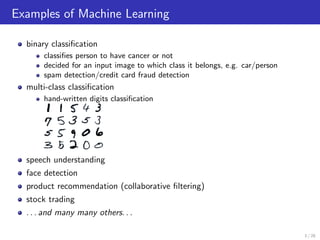
Examples of Machine Learning
binary classification
classifies person to have cancer or not
decided for an input image to which class it belongs, e.g. car/person
spam detection/credit card fraud detection
multi-class classification
hand-written digits classification
speech understanding
face detection
product recommendation (collaborative filtering)
stock trading
. . . and many many others. . .
3 / 28
Support Vector Machines (SVM)
blue: healthy person
green: e.g. patient with lung cancer
Exhaled breath analysis for lung cancer: predict if patient has cancer or not
4 / 28
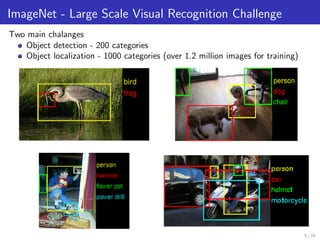
ImageNet - Large Scale Visual Recognition Challenge
Two main chalanges
Object detection - 200 categories
Object localization - 1000 categories (over 1.2 million images for training)
5 / 28
ImageNet - Large Scale Visual Recognition Challenge
Two main chalanges
Object detection - 200 categories
Object localization - 1000 categories (over 1.2 million images for training)
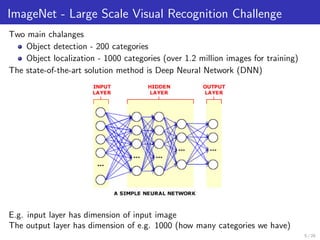
The state-of-the-art solution method is Deep Neural Network (DNN)
E.g. input layer has dimension of input image
The output layer has dimension of e.g. 1000 (how many categories we have)
5 / 28
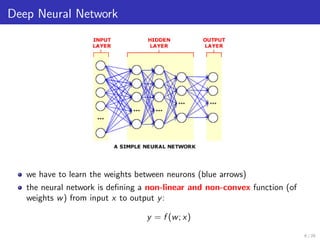
Deep Neural Network
we have to learn the weights between neurons (blue arrows)
the neural network is defining a non-linear and non-convex function (of
weights w) from input x to output y:
y = f (w; x)
6 / 28
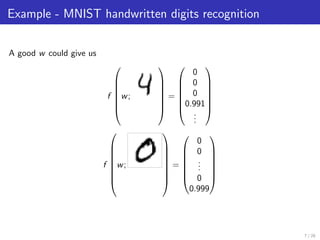
Example - MNIST handwritten digits recognition
A good w could give us
f







w;







=







0
0
0
0.991
...







f








w;








=







0
0
...
0
0.999







7 / 28
Mathematical Formulation
Expected Loss Minimization
let (X, Y ) be the distribution of input samples and its labels
we would like to find w such that
w∗
= arg min
w
E(x,y)∼(X,Y )[ (f (w; x), y)]
is a loss function, i.e. (f (w; x), y) = f (w; x) − y 2
8 / 28
Mathematical Formulation
Expected Loss Minimization
let (X, Y ) be the distribution of input samples and its labels
we would like to find w such that
w∗
= arg min
w
E(x,y)∼(X,Y )[ (f (w; x), y)]
is a loss function, i.e. (f (w; x), y) = f (w; x) − y 2
Impossible, as we do not know the distribution (X, Y )
8 / 28
Mathematical Formulation
Expected Loss Minimization
let (X, Y ) be the distribution of input samples and its labels
we would like to find w such that
w∗
= arg min
w
E(x,y)∼(X,Y )[ (f (w; x), y)]
is a loss function, i.e. (f (w; x), y) = f (w; x) − y 2
Impossible, as we do not know the distribution (X, Y )
Common approach: Empirical loss minimization:
we sample n points from (X, Y ): {(xi , yi )}n
i=1
we minimize regularized empirical loss
w∗
= arg min
w
1
n
n
i=1
(f (w; xi ), yi ) +
λ
2
w 2
8 / 28
Stochastic Gradient Descent (SGD) Algorithm
How can we solve
min
w
F(w) :=
1
n
n
i=1
(f (w; xi ); yi ) +
λ
2
w 2
9 / 28
Stochastic Gradient Descent (SGD) Algorithm
How can we solve
min
w
F(w) :=
1
n
n
i=1
(f (w; xi ); yi ) +
λ
2
w 2
1 we can use an iterative algorithm
2 we start with some initial w
3 we compute g = F(w)
4 we get a new iterate w ← w − αg
5 if w is still not good enough go to step 3
if n is very large, computing g can take a while.... even few hours/days
9 / 28
Stochastic Gradient Descent (SGD) Algorithm
How can we solve
min
w
F(w) :=
1
n
n
i=1
(f (w; xi ); yi ) +
λ
2
w 2
1 we can use an iterative algorithm
2 we start with some initial w
3 we compute g = F(w)
4 we get a new iterate w ← w − αg
5 if w is still not good enough go to step 3
if n is very large, computing g can take a while.... even few hours/days
Trick:
choose i ∈ {1, . . . , n} randomly
define gi = (f (w; wi ); yi ) + λ
2 w 2
use gi instead of g in the algorithm (step 4)
9 / 28
Stochastic Gradient Descent (SGD) Algorithm
How can we solve
min
w
F(w) :=
1
n
n
i=1
(f (w; xi ); yi ) +
λ
2
w 2
1 we can use an iterative algorithm
2 we start with some initial w
3 we compute g = F(w)
4 we get a new iterate w ← w − αg
5 if w is still not good enough go to step 3
if n is very large, computing g can take a while.... even few hours/days
Trick:
choose i ∈ {1, . . . , n} randomly
define gi = (f (w; wi ); yi ) + λ
2 w 2
use gi instead of g in the algorithm (step 4)
Note: E[gi ] = g, so in expectation, the ”direction” the algorithm is going is the
same as if we use the true gradient, but we can compute it n times faster!
9 / 28
Outline
1 Machine Learning - Examples and Algorithm
2 Distributed Computing
3 Learning Large-Scale Deep Neural Network (DNN)
10 / 28
The Architecture
What if the size of data {(xi , yi )} exceeds the memory of a single
computing node?
11 / 28
The Architecture
What if the size of data {(xi , yi )} exceeds the memory of a single
computing node?
each node can store portion of the data {(xi , yi )}
each node is connected to the computer network
they can communicate with any other node (over maybe 1 or more switches)
Fact: every communication is much more expensive then accessing local data
(can be even 100,000 times slower).
11 / 28
Outline
1 Machine Learning - Examples and Algorithm
2 Distributed Computing
3 Learning Large-Scale Deep Neural Network (DNN)
12 / 28
Using SGD for DNN in Distributed Way
assume that the size of data or the size weights (or both) is so big, that we
cannot store them on one machine
. . . or we can store them but it takes too long to compute something . . .
SGD: we need to compute w (f (w; xi ); yi )
The DNN has a nice structure
w (f (w; xi ); yi ) can we computed by backpropagation procedure (this is
nothing else just automated differentiation)
13 / 28
Why is SGD a Bad Distributed Algorithm
it samples only 1 sample and computes gi (this is very fast)
then w is updated
each update of w requires a communication (cost c seconds)
hence one iteration is suddenly much slower then if we would run SGD on
one computer
14 / 28
Why is SGD a Bad Distributed Algorithm
it samples only 1 sample and computes gi (this is very fast)
then w is updated
each update of w requires a communication (cost c seconds)
hence one iteration is suddenly much slower then if we would run SGD on
one computer
The trick: Mini-batch SGD
In each iteration
1 Choose randomly S ⊂ {1, 2, . . . , n} with |S| = b
2 Use gb = 1
b i∈S gi instead of just gi
14 / 28
Why is SGD a Bad Distributed Algorithm
it samples only 1 sample and computes gi (this is very fast)
then w is updated
each update of w requires a communication (cost c seconds)
hence one iteration is suddenly much slower then if we would run SGD on
one computer
The trick: Mini-batch SGD
In each iteration
1 Choose randomly S ⊂ {1, 2, . . . , n} with |S| = b
2 Use gb = 1
b i∈S gi instead of just gi
Cost of one epoch
number of MPI calls / epoch n/b
amount of data send over network n
b × log(N) × sizeof (w)
if we increase b → n we would minimize amount of data and number of
number of communications per epoch!
14 / 28
Why is SGD a Bad Distributed Algorithm
it samples only 1 sample and computes gi (this is very fast)
then w is updated
each update of w requires a communication (cost c seconds)
hence one iteration is suddenly much slower then if we would run SGD on
one computer
The trick: Mini-batch SGD
In each iteration
1 Choose randomly S ⊂ {1, 2, . . . , n} with |S| = b
2 Use gb = 1
b i∈S gi instead of just gi
Cost of one epoch
number of MPI calls / epoch n/b
amount of data send over network n
b × log(N) × sizeof (w)
if we increase b → n we would minimize amount of data and number of
number of communications per epoch! Caveat: there is no free lunch!
Very large b means slower convergence!
14 / 28
Model Parallelism
Model parallelism: we partition weights w across many nodes; every node
has all data points (but maybe just few features of them)
Hidden Layer 1
Hidden Layer 2
Output
Input
ForwardPropagation
Hidden Layer 1
Hidden Layer 2
Output
BackwardPropagation
Node1
Node1
Node2
Node2
AllSamples
AllSamples
AllSamples
AllSamples
Exchange Activation
Exchange Activation
Exchange Deltas
Exchange Deltas
15 / 28
Data Parallelism
Data parallelism: we partition data-samples across many nodes, each node
has a fresh copy of w
Hidden Layer 1
Hidden Layer 2
Output
Input
ForwardPropagation
Hidden Layer 1
Hidden Layer 2
Output
BackwardPropagation
Node1
Node1
Node2
Node2
PartialSamples
PartialSamples
PartialSamples
PartialSamples
Hidden Layer 1
Hidden Layer 2
Hidden Layer 1
Hidden Layer 2
Exchange Gradient
16 / 28
Large-Scale Deep Neural Network1
1Dipankar Das, Sasikanth Avancha, Dheevatsa Mudigere, Karthikeyan Vaidynathan, Srinivas
Sridharan, Dhiraj Kalamkar, Bharat Kaul, Pradeep Dubey: Distributed Deep Learning Using
Synchronous Stochastic Gradient Descent, arXiv:1602.06709
17 / 28
There is almost no speedup for large b
18 / 28
The Dilemma
large b allows algorithm to be efficiently run on large computer cluster (more
nodes)
very large b doesn’t reduce number of iterations, but each iteration is more
expensive!
The Trick: Do not use just gradient, but use also Hessian (Martens 2010)
19 / 28
The Dilemma
large b allows algorithm to be efficiently run on large computer cluster (more
nodes)
very large b doesn’t reduce number of iterations, but each iteration is more
expensive!
The Trick: Do not use just gradient, but use also Hessian (Martens 2010)
Caveat: Hessian matrix can be very large, e.g. the dimension of weights for
TIMIT datasets is almost 1.5M, hence to store Hessian we would need almost
10TB.
19 / 28
The Dilemma
large b allows algorithm to be efficiently run on large computer cluster (more
nodes)
very large b doesn’t reduce number of iterations, but each iteration is more
expensive!
The Trick: Do not use just gradient, but use also Hessian (Martens 2010)
Caveat: Hessian matrix can be very large, e.g. the dimension of weights for
TIMIT datasets is almost 1.5M, hence to store Hessian we would need almost
10TB.
The Trick:
We can use Hessian Free approach (we need to be able to compute just
Hessian-vector products)
19 / 28
The Dilemma
large b allows algorithm to be efficiently run on large computer cluster (more
nodes)
very large b doesn’t reduce number of iterations, but each iteration is more
expensive!
The Trick: Do not use just gradient, but use also Hessian (Martens 2010)
Caveat: Hessian matrix can be very large, e.g. the dimension of weights for
TIMIT datasets is almost 1.5M, hence to store Hessian we would need almost
10TB.
The Trick:
We can use Hessian Free approach (we need to be able to compute just
Hessian-vector products)
Algorithm:
w ← w − α[ 2
F(w)]−1
F(w)
19 / 28
Non-convexity
We want to minimize
min
w
F(w)
2
F(w) is NOT positive semi-definite at any w!
20 / 28
Computing Step
recall the algorithm
w ← w − α[ 2
F(w)]−1
F(w)
we need to compute p = [ 2
F(w)]−1
F(w), i.e. to solve
2
F(w)p = F(w) (1)
we can use few iterations of CG method to solve it
(CG assumes that 2
F(w) 0)
In our case it may not be true, hence, it is suggested to stop CG sooner, if it
is detected during CG that 2
F(w) is indefinite
We can use a Bi-CG algorithm to solve (1) and modify the algorithm2
as
follows
w ← w − α
p, if pT
F(x) > 0,
−p, otherwise
PS: we use just b samples to estimate 2
F(w)
2Xi He, Dheevatsa Mudigere, Mikhail Smelyanskiy and Martin Tak´aˇc: Large Scale Distributed
Hessian-Free Optimization for Deep Neural Network, arXiv:1606.00511, 2016.
21 / 28
Saddle Point
Gradient descent slows down around saddle point. Second order methods can help
a lot to prevent that.
22 / 28
50 100 150 200 250 300 350 400
10
−3
10
−2
10
−1
10
0
MNIST, 4 layers
Number of iteration
TrainError
SGD, b=64
SGD, b=128
ggn−cg, b=512
hess−bicgstab, b=512
hess−cg, b=512
hybrid−cg, b=512
50 100 150 200 250 300 350 400
10
−3
10
−2
10
−1
10
0
MNIST, 4 layers
Number of iteration
TrainError
SGD, b=64
SGD, b=128
ggn−cg, b=1024
hess−bicgstab, b=1024
hess−cg, b=1024
hybrid−cg, b=1024
50 100 150 200 250 300 350 400
10
−3
10
−2
10
−1
10
0
MNIST, 4 layers
Number of iteration
TrainError
SGD, b=64
SGD, b=128
ggn−cg, b=2048
hess−bicgstab, b=2048
hess−cg, b=2048
hybrid−cg, b=2048
10
1
10
2
10
3
10
2
10
3
MNIST, 4 layers
Size of Mini−batch
NumberofIterations
ggn−cg
hess−bicgstab
hess−cg
hybrid−cg
23 / 28
1 1.5 2 2.5 3 3.5 4 4.5 5
10
0
10
1
10
2
10
3
TIMIT, T=18, b=512
log2
(Number of Nodes)
RunTimeperIteration
Gradient
CG
Linesearch
1 1.5 2 2.5 3 3.5 4 4.5 5
10
0
10
1
10
2
10
3
TIMIT, T=18, b=1024
log2
(Number of Nodes)
RunTimeperIteration
Gradient
CG
Linesearch
1 1.5 2 2.5 3 3.5 4 4.5 5
10
0
10
1
10
2
10
3
TIMIT, T=18, b=4096
log2
(Number of Nodes)
RunTimeperIteration
Gradient
CG
Linesearch
1 1.5 2 2.5 3 3.5 4 4.5 5
10
1
10
2
10
3
TIMIT, T=18, b=8192
log2
(Number of Nodes)
RunTimeperIteration
Gradient
CG
Linesearch
24 / 28
1 1.5 2 2.5 3 3.5 4 4.5 5
10
0
10
1
TIMIT, T=18
log2
(Number of Nodes)
RunTimeperOneLineSearch
b=512
b=1024
b=4096
b=8192
25 / 28
Learning Artistic Style by Deep Neural Network3
3Joint work with Jiawei Zhang, based on Leon A. Gatys, Alexander S. Ecker, Matthias Bethge, A Neural Algorithm of Artistic Style, arxiv 1508.06576
26 / 28
Learning Artistic Style by Deep Neural Network3
3Joint work with Jiawei Zhang, based on Leon A. Gatys, Alexander S. Ecker, Matthias Bethge, A Neural Algorithm of Artistic Style, arxiv 1508.06576
26 / 28
Learning Artistic Style by Deep Neural Network4
4Joint work with Jiawei Zhang, based on Leon A. Gatys, Alexander S. Ecker, Matthias Bethge, A Neural Algorithm of Artistic Style, arxiv 1508.0657627 / 28
Learning Artistic Style by Deep Neural Network4
4Joint work with Jiawei Zhang, based on Leon A. Gatys, Alexander S. Ecker, Matthias Bethge, A Neural Algorithm of Artistic Style, arxiv 1508.0657627 / 28
References
1 Albert Berahas, Jorge Nocedal and Martin Tak´aˇc: A Multi-Batch L-BFGS Method for Machine
Learning, arXiv:1605.06049, 2016.
2 Xi He, Dheevatsa Mudigere, Mikhail Smelyanskiy and Martin Tak´aˇc:
Large Scale Distributed Hessian-Free Optimization for Deep Neural Network, arXiv:1606.00511, 2016.
3 Chenxin Ma and Martin Tak´aˇc: Partitioning Data on Features or Samples in Communication-Efficient
Distributed Optimization?, OptML@NIPS 2015.
4 Chenxin Ma, Virginia Smith, Martin Jaggi, Michael I. Jordan, Peter Richt´arik and Martin Tak´aˇc: Adding
vs. Averaging in Distributed Primal-Dual Optimization, ICML 2015.
5 Martin Jaggi, Virginia Smith, Martin Tak´aˇc, Jonathan Terhorst, Thomas Hofmann and Michael I.
Jordan: Communication-Efficient Distributed Dual Coordinate Ascent, NIPS 2014.
6 Richt´arik, P. and Tak´aˇc, M.: Distributed coordinate descent method for learning with big data, Journal
Paper Journal of Machine Learning Research (to appear), 2016
7 Richt´arik, P. and Tak´aˇc, M.: On optimal probabilities in stochastic coordinate descent methods,
Optimization Letters, 2015.
8 Richt´arik, P. and Tak´aˇc, M.: Parallel coordinate descent methods for big data optimization,
Mathematical Programming, 2015.
9 Richt´arik, P. and Tak´aˇc, M.: Iteration complexity of randomized block-coordinate descent methods for
minimizing a composite function, Mathematical Programming, 2012.
10 Tak´aˇc, M., Bijral, A., Richt´arik, P. and Srebro, N.: Mini-batch primal and dual methods for SVMs, In
ICML, 2013.
11 Qu, Z., Richt´arik, P. and Zhang, T.: Randomized dual coordinate ascent with arbitrary sampling,
arXiv:1411.5873, 2014.
12 Qu, Z., Richt´arik, P., Tak´aˇc, M. and Fercoq, O.: SDNA: Stochastic Dual Newton Ascent for Empirical
Risk Minimization, arXiv:1502.02268, 2015.
13 Tappenden, R., Tak´aˇc, M. and Richt´arik, P., On the Complexity of Parallel Coordinate Descent, arXiv:
1503.03033, 2015.
28 / 28

Martin Takac - “Solving Large-Scale Machine Learning Problems in a Distributed Way”

  • 1.
    Solving Large-Scale MachineLearning Problems in a Distributed Way Martin Tak´aˇc Cognitive Systems Institute Group Speaker Series June 09 2016 1 / 28
  • 2.
    Outline 1 Machine Learning- Examples and Algorithm 2 Distributed Computing 3 Learning Large-Scale Deep Neural Network (DNN) 2 / 28
  • 3.
    Examples of MachineLearning binary classification classifies person to have cancer or not decided for an input image to which class it belongs, e.g. car/person spam detection/credit card fraud detection multi-class classification hand-written digits classification speech understanding face detection product recommendation (collaborative filtering) stock trading . . . and many many others. . . 3 / 28
  • 4.
    Support Vector Machines(SVM) blue: healthy person green: e.g. patient with lung cancer Exhaled breath analysis for lung cancer: predict if patient has cancer or not 4 / 28
  • 5.
    ImageNet - LargeScale Visual Recognition Challenge Two main chalanges Object detection - 200 categories Object localization - 1000 categories (over 1.2 million images for training) 5 / 28
  • 6.
    ImageNet - LargeScale Visual Recognition Challenge Two main chalanges Object detection - 200 categories Object localization - 1000 categories (over 1.2 million images for training) The state-of-the-art solution method is Deep Neural Network (DNN) E.g. input layer has dimension of input image The output layer has dimension of e.g. 1000 (how many categories we have) 5 / 28
  • 7.
    Deep Neural Network wehave to learn the weights between neurons (blue arrows) the neural network is defining a non-linear and non-convex function (of weights w) from input x to output y: y = f (w; x) 6 / 28
  • 8.
    Example - MNISThandwritten digits recognition A good w could give us f        w;        =        0 0 0 0.991 ...        f         w;         =        0 0 ... 0 0.999        7 / 28
  • 9.
    Mathematical Formulation Expected LossMinimization let (X, Y ) be the distribution of input samples and its labels we would like to find w such that w∗ = arg min w E(x,y)∼(X,Y )[ (f (w; x), y)] is a loss function, i.e. (f (w; x), y) = f (w; x) − y 2 8 / 28
  • 10.
    Mathematical Formulation Expected LossMinimization let (X, Y ) be the distribution of input samples and its labels we would like to find w such that w∗ = arg min w E(x,y)∼(X,Y )[ (f (w; x), y)] is a loss function, i.e. (f (w; x), y) = f (w; x) − y 2 Impossible, as we do not know the distribution (X, Y ) 8 / 28
  • 11.
    Mathematical Formulation Expected LossMinimization let (X, Y ) be the distribution of input samples and its labels we would like to find w such that w∗ = arg min w E(x,y)∼(X,Y )[ (f (w; x), y)] is a loss function, i.e. (f (w; x), y) = f (w; x) − y 2 Impossible, as we do not know the distribution (X, Y ) Common approach: Empirical loss minimization: we sample n points from (X, Y ): {(xi , yi )}n i=1 we minimize regularized empirical loss w∗ = arg min w 1 n n i=1 (f (w; xi ), yi ) + λ 2 w 2 8 / 28
  • 12.
    Stochastic Gradient Descent(SGD) Algorithm How can we solve min w F(w) := 1 n n i=1 (f (w; xi ); yi ) + λ 2 w 2 9 / 28
  • 13.
    Stochastic Gradient Descent(SGD) Algorithm How can we solve min w F(w) := 1 n n i=1 (f (w; xi ); yi ) + λ 2 w 2 1 we can use an iterative algorithm 2 we start with some initial w 3 we compute g = F(w) 4 we get a new iterate w ← w − αg 5 if w is still not good enough go to step 3 if n is very large, computing g can take a while.... even few hours/days 9 / 28
  • 14.
    Stochastic Gradient Descent(SGD) Algorithm How can we solve min w F(w) := 1 n n i=1 (f (w; xi ); yi ) + λ 2 w 2 1 we can use an iterative algorithm 2 we start with some initial w 3 we compute g = F(w) 4 we get a new iterate w ← w − αg 5 if w is still not good enough go to step 3 if n is very large, computing g can take a while.... even few hours/days Trick: choose i ∈ {1, . . . , n} randomly define gi = (f (w; wi ); yi ) + λ 2 w 2 use gi instead of g in the algorithm (step 4) 9 / 28
  • 15.
    Stochastic Gradient Descent(SGD) Algorithm How can we solve min w F(w) := 1 n n i=1 (f (w; xi ); yi ) + λ 2 w 2 1 we can use an iterative algorithm 2 we start with some initial w 3 we compute g = F(w) 4 we get a new iterate w ← w − αg 5 if w is still not good enough go to step 3 if n is very large, computing g can take a while.... even few hours/days Trick: choose i ∈ {1, . . . , n} randomly define gi = (f (w; wi ); yi ) + λ 2 w 2 use gi instead of g in the algorithm (step 4) Note: E[gi ] = g, so in expectation, the ”direction” the algorithm is going is the same as if we use the true gradient, but we can compute it n times faster! 9 / 28
  • 16.
    Outline 1 Machine Learning- Examples and Algorithm 2 Distributed Computing 3 Learning Large-Scale Deep Neural Network (DNN) 10 / 28
  • 17.
    The Architecture What ifthe size of data {(xi , yi )} exceeds the memory of a single computing node? 11 / 28
  • 18.
    The Architecture What ifthe size of data {(xi , yi )} exceeds the memory of a single computing node? each node can store portion of the data {(xi , yi )} each node is connected to the computer network they can communicate with any other node (over maybe 1 or more switches) Fact: every communication is much more expensive then accessing local data (can be even 100,000 times slower). 11 / 28
  • 19.
    Outline 1 Machine Learning- Examples and Algorithm 2 Distributed Computing 3 Learning Large-Scale Deep Neural Network (DNN) 12 / 28
  • 20.
    Using SGD forDNN in Distributed Way assume that the size of data or the size weights (or both) is so big, that we cannot store them on one machine . . . or we can store them but it takes too long to compute something . . . SGD: we need to compute w (f (w; xi ); yi ) The DNN has a nice structure w (f (w; xi ); yi ) can we computed by backpropagation procedure (this is nothing else just automated differentiation) 13 / 28
  • 21.
    Why is SGDa Bad Distributed Algorithm it samples only 1 sample and computes gi (this is very fast) then w is updated each update of w requires a communication (cost c seconds) hence one iteration is suddenly much slower then if we would run SGD on one computer 14 / 28
  • 22.
    Why is SGDa Bad Distributed Algorithm it samples only 1 sample and computes gi (this is very fast) then w is updated each update of w requires a communication (cost c seconds) hence one iteration is suddenly much slower then if we would run SGD on one computer The trick: Mini-batch SGD In each iteration 1 Choose randomly S ⊂ {1, 2, . . . , n} with |S| = b 2 Use gb = 1 b i∈S gi instead of just gi 14 / 28
  • 23.
    Why is SGDa Bad Distributed Algorithm it samples only 1 sample and computes gi (this is very fast) then w is updated each update of w requires a communication (cost c seconds) hence one iteration is suddenly much slower then if we would run SGD on one computer The trick: Mini-batch SGD In each iteration 1 Choose randomly S ⊂ {1, 2, . . . , n} with |S| = b 2 Use gb = 1 b i∈S gi instead of just gi Cost of one epoch number of MPI calls / epoch n/b amount of data send over network n b × log(N) × sizeof (w) if we increase b → n we would minimize amount of data and number of number of communications per epoch! 14 / 28
  • 24.
    Why is SGDa Bad Distributed Algorithm it samples only 1 sample and computes gi (this is very fast) then w is updated each update of w requires a communication (cost c seconds) hence one iteration is suddenly much slower then if we would run SGD on one computer The trick: Mini-batch SGD In each iteration 1 Choose randomly S ⊂ {1, 2, . . . , n} with |S| = b 2 Use gb = 1 b i∈S gi instead of just gi Cost of one epoch number of MPI calls / epoch n/b amount of data send over network n b × log(N) × sizeof (w) if we increase b → n we would minimize amount of data and number of number of communications per epoch! Caveat: there is no free lunch! Very large b means slower convergence! 14 / 28
  • 25.
    Model Parallelism Model parallelism:we partition weights w across many nodes; every node has all data points (but maybe just few features of them) Hidden Layer 1 Hidden Layer 2 Output Input ForwardPropagation Hidden Layer 1 Hidden Layer 2 Output BackwardPropagation Node1 Node1 Node2 Node2 AllSamples AllSamples AllSamples AllSamples Exchange Activation Exchange Activation Exchange Deltas Exchange Deltas 15 / 28
  • 26.
    Data Parallelism Data parallelism:we partition data-samples across many nodes, each node has a fresh copy of w Hidden Layer 1 Hidden Layer 2 Output Input ForwardPropagation Hidden Layer 1 Hidden Layer 2 Output BackwardPropagation Node1 Node1 Node2 Node2 PartialSamples PartialSamples PartialSamples PartialSamples Hidden Layer 1 Hidden Layer 2 Hidden Layer 1 Hidden Layer 2 Exchange Gradient 16 / 28
  • 27.
    Large-Scale Deep NeuralNetwork1 1Dipankar Das, Sasikanth Avancha, Dheevatsa Mudigere, Karthikeyan Vaidynathan, Srinivas Sridharan, Dhiraj Kalamkar, Bharat Kaul, Pradeep Dubey: Distributed Deep Learning Using Synchronous Stochastic Gradient Descent, arXiv:1602.06709 17 / 28
  • 28.
    There is almostno speedup for large b 18 / 28
  • 29.
    The Dilemma large ballows algorithm to be efficiently run on large computer cluster (more nodes) very large b doesn’t reduce number of iterations, but each iteration is more expensive! The Trick: Do not use just gradient, but use also Hessian (Martens 2010) 19 / 28
  • 30.
    The Dilemma large ballows algorithm to be efficiently run on large computer cluster (more nodes) very large b doesn’t reduce number of iterations, but each iteration is more expensive! The Trick: Do not use just gradient, but use also Hessian (Martens 2010) Caveat: Hessian matrix can be very large, e.g. the dimension of weights for TIMIT datasets is almost 1.5M, hence to store Hessian we would need almost 10TB. 19 / 28
  • 31.
    The Dilemma large ballows algorithm to be efficiently run on large computer cluster (more nodes) very large b doesn’t reduce number of iterations, but each iteration is more expensive! The Trick: Do not use just gradient, but use also Hessian (Martens 2010) Caveat: Hessian matrix can be very large, e.g. the dimension of weights for TIMIT datasets is almost 1.5M, hence to store Hessian we would need almost 10TB. The Trick: We can use Hessian Free approach (we need to be able to compute just Hessian-vector products) 19 / 28
  • 32.
    The Dilemma large ballows algorithm to be efficiently run on large computer cluster (more nodes) very large b doesn’t reduce number of iterations, but each iteration is more expensive! The Trick: Do not use just gradient, but use also Hessian (Martens 2010) Caveat: Hessian matrix can be very large, e.g. the dimension of weights for TIMIT datasets is almost 1.5M, hence to store Hessian we would need almost 10TB. The Trick: We can use Hessian Free approach (we need to be able to compute just Hessian-vector products) Algorithm: w ← w − α[ 2 F(w)]−1 F(w) 19 / 28
  • 33.
    Non-convexity We want tominimize min w F(w) 2 F(w) is NOT positive semi-definite at any w! 20 / 28
  • 34.
    Computing Step recall thealgorithm w ← w − α[ 2 F(w)]−1 F(w) we need to compute p = [ 2 F(w)]−1 F(w), i.e. to solve 2 F(w)p = F(w) (1) we can use few iterations of CG method to solve it (CG assumes that 2 F(w) 0) In our case it may not be true, hence, it is suggested to stop CG sooner, if it is detected during CG that 2 F(w) is indefinite We can use a Bi-CG algorithm to solve (1) and modify the algorithm2 as follows w ← w − α p, if pT F(x) > 0, −p, otherwise PS: we use just b samples to estimate 2 F(w) 2Xi He, Dheevatsa Mudigere, Mikhail Smelyanskiy and Martin Tak´aˇc: Large Scale Distributed Hessian-Free Optimization for Deep Neural Network, arXiv:1606.00511, 2016. 21 / 28
  • 35.
    Saddle Point Gradient descentslows down around saddle point. Second order methods can help a lot to prevent that. 22 / 28
  • 36.
    50 100 150200 250 300 350 400 10 −3 10 −2 10 −1 10 0 MNIST, 4 layers Number of iteration TrainError SGD, b=64 SGD, b=128 ggn−cg, b=512 hess−bicgstab, b=512 hess−cg, b=512 hybrid−cg, b=512 50 100 150 200 250 300 350 400 10 −3 10 −2 10 −1 10 0 MNIST, 4 layers Number of iteration TrainError SGD, b=64 SGD, b=128 ggn−cg, b=1024 hess−bicgstab, b=1024 hess−cg, b=1024 hybrid−cg, b=1024 50 100 150 200 250 300 350 400 10 −3 10 −2 10 −1 10 0 MNIST, 4 layers Number of iteration TrainError SGD, b=64 SGD, b=128 ggn−cg, b=2048 hess−bicgstab, b=2048 hess−cg, b=2048 hybrid−cg, b=2048 10 1 10 2 10 3 10 2 10 3 MNIST, 4 layers Size of Mini−batch NumberofIterations ggn−cg hess−bicgstab hess−cg hybrid−cg 23 / 28
  • 37.
    1 1.5 22.5 3 3.5 4 4.5 5 10 0 10 1 10 2 10 3 TIMIT, T=18, b=512 log2 (Number of Nodes) RunTimeperIteration Gradient CG Linesearch 1 1.5 2 2.5 3 3.5 4 4.5 5 10 0 10 1 10 2 10 3 TIMIT, T=18, b=1024 log2 (Number of Nodes) RunTimeperIteration Gradient CG Linesearch 1 1.5 2 2.5 3 3.5 4 4.5 5 10 0 10 1 10 2 10 3 TIMIT, T=18, b=4096 log2 (Number of Nodes) RunTimeperIteration Gradient CG Linesearch 1 1.5 2 2.5 3 3.5 4 4.5 5 10 1 10 2 10 3 TIMIT, T=18, b=8192 log2 (Number of Nodes) RunTimeperIteration Gradient CG Linesearch 24 / 28
  • 38.
    1 1.5 22.5 3 3.5 4 4.5 5 10 0 10 1 TIMIT, T=18 log2 (Number of Nodes) RunTimeperOneLineSearch b=512 b=1024 b=4096 b=8192 25 / 28
  • 39.
    Learning Artistic Styleby Deep Neural Network3 3Joint work with Jiawei Zhang, based on Leon A. Gatys, Alexander S. Ecker, Matthias Bethge, A Neural Algorithm of Artistic Style, arxiv 1508.06576 26 / 28
  • 40.
    Learning Artistic Styleby Deep Neural Network3 3Joint work with Jiawei Zhang, based on Leon A. Gatys, Alexander S. Ecker, Matthias Bethge, A Neural Algorithm of Artistic Style, arxiv 1508.06576 26 / 28
  • 41.
    Learning Artistic Styleby Deep Neural Network4 4Joint work with Jiawei Zhang, based on Leon A. Gatys, Alexander S. Ecker, Matthias Bethge, A Neural Algorithm of Artistic Style, arxiv 1508.0657627 / 28
  • 42.
    Learning Artistic Styleby Deep Neural Network4 4Joint work with Jiawei Zhang, based on Leon A. Gatys, Alexander S. Ecker, Matthias Bethge, A Neural Algorithm of Artistic Style, arxiv 1508.0657627 / 28
  • 43.
    References 1 Albert Berahas,Jorge Nocedal and Martin Tak´aˇc: A Multi-Batch L-BFGS Method for Machine Learning, arXiv:1605.06049, 2016. 2 Xi He, Dheevatsa Mudigere, Mikhail Smelyanskiy and Martin Tak´aˇc: Large Scale Distributed Hessian-Free Optimization for Deep Neural Network, arXiv:1606.00511, 2016. 3 Chenxin Ma and Martin Tak´aˇc: Partitioning Data on Features or Samples in Communication-Efficient Distributed Optimization?, OptML@NIPS 2015. 4 Chenxin Ma, Virginia Smith, Martin Jaggi, Michael I. Jordan, Peter Richt´arik and Martin Tak´aˇc: Adding vs. Averaging in Distributed Primal-Dual Optimization, ICML 2015. 5 Martin Jaggi, Virginia Smith, Martin Tak´aˇc, Jonathan Terhorst, Thomas Hofmann and Michael I. Jordan: Communication-Efficient Distributed Dual Coordinate Ascent, NIPS 2014. 6 Richt´arik, P. and Tak´aˇc, M.: Distributed coordinate descent method for learning with big data, Journal Paper Journal of Machine Learning Research (to appear), 2016 7 Richt´arik, P. and Tak´aˇc, M.: On optimal probabilities in stochastic coordinate descent methods, Optimization Letters, 2015. 8 Richt´arik, P. and Tak´aˇc, M.: Parallel coordinate descent methods for big data optimization, Mathematical Programming, 2015. 9 Richt´arik, P. and Tak´aˇc, M.: Iteration complexity of randomized block-coordinate descent methods for minimizing a composite function, Mathematical Programming, 2012. 10 Tak´aˇc, M., Bijral, A., Richt´arik, P. and Srebro, N.: Mini-batch primal and dual methods for SVMs, In ICML, 2013. 11 Qu, Z., Richt´arik, P. and Zhang, T.: Randomized dual coordinate ascent with arbitrary sampling, arXiv:1411.5873, 2014. 12 Qu, Z., Richt´arik, P., Tak´aˇc, M. and Fercoq, O.: SDNA: Stochastic Dual Newton Ascent for Empirical Risk Minimization, arXiv:1502.02268, 2015. 13 Tappenden, R., Tak´aˇc, M. and Richt´arik, P., On the Complexity of Parallel Coordinate Descent, arXiv: 1503.03033, 2015. 28 / 28