Deep Learning
with H2O
!
H2O.ai

Scalable In-Memory Machine Learning
!
H20 Meetup, TypeSafe, San Francisco, 4/3/14
Arno Candel
Who am I?
PhD in Computational Physics, 2005

from ETH Zurich Switzerland
!
6 years at SLAC - Accelerator Physics Modeling
2 years at Skytree, Inc - Machine Learning
3 months at 0xdata/H2O - Machine Learning
!
10+ years in HPC, C++, MPI, Supercomputing
Arno Candel
H2O Deep Learning, A. Candel
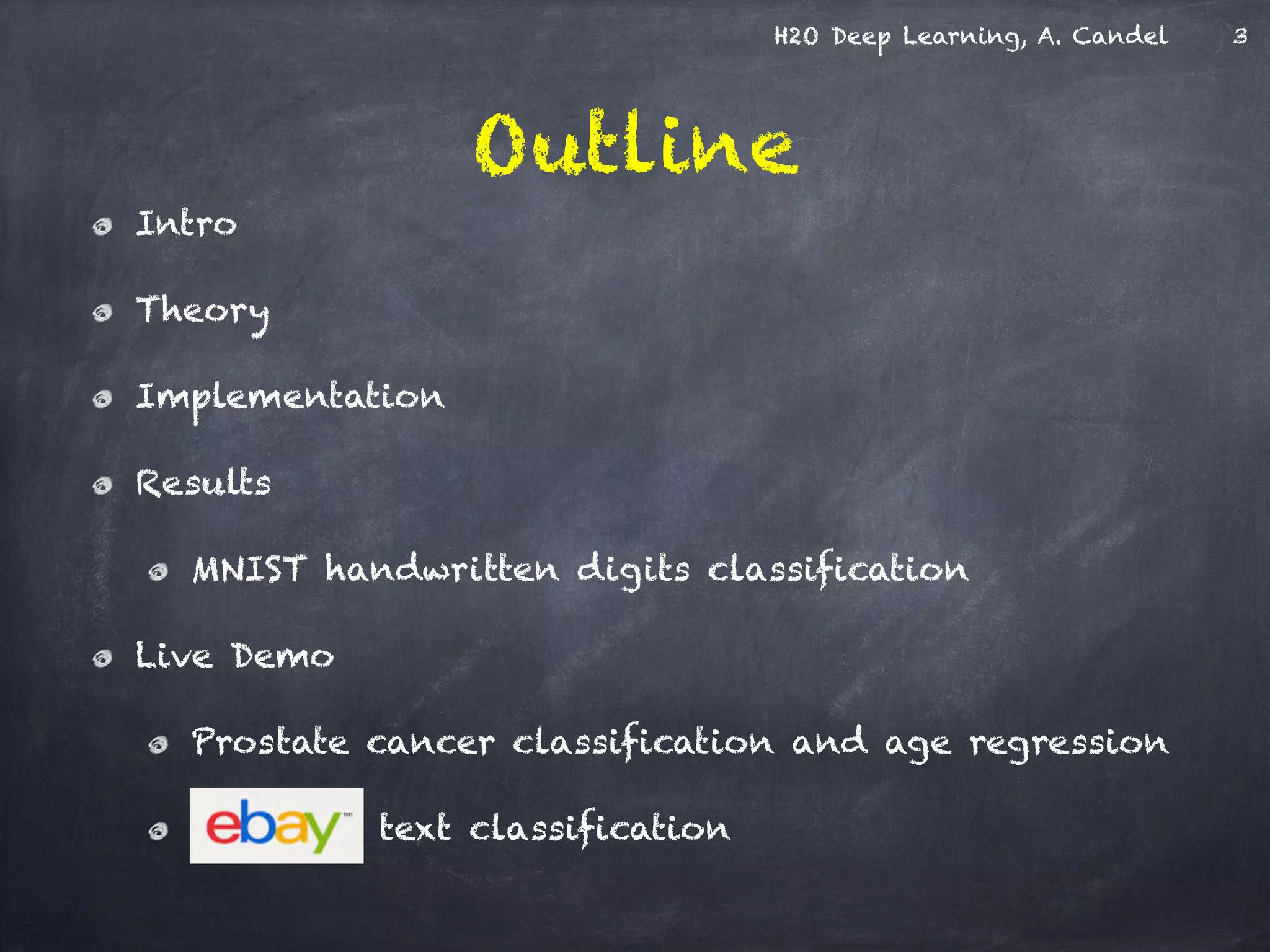
Outline
Intro
Theory
Implementation
Results
MNIST handwritten digits classification
Live Demo
Prostate cancer classification and age regression
text classification
3
H2O Deep Learning, A. Candel
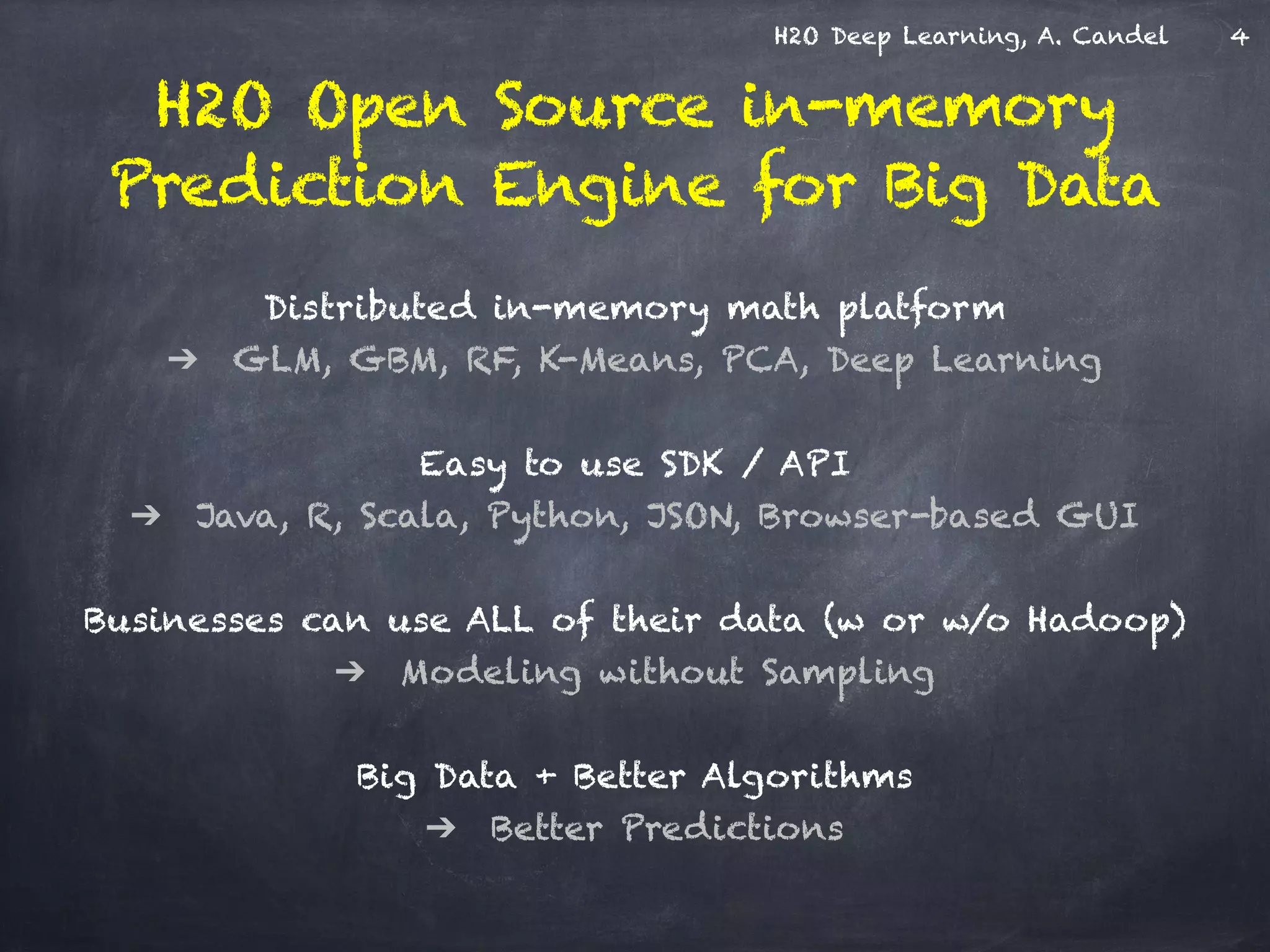
Distributed in-memory math platform 

➔ GLM, GBM, RF, K-Means, PCA, Deep Learning

Easy to use SDK / API

➔ Java, R, Scala, Python, JSON, Browser-based GUI
!
Businesses can use ALL of their data (w or w/o Hadoop)

➔ Modeling without Sampling


Big Data + Better Algorithms 

➔ Better Predictions
H2O Open Source in-memory

Prediction Engine for Big Data
4
H2O Deep Learning, A. Candel
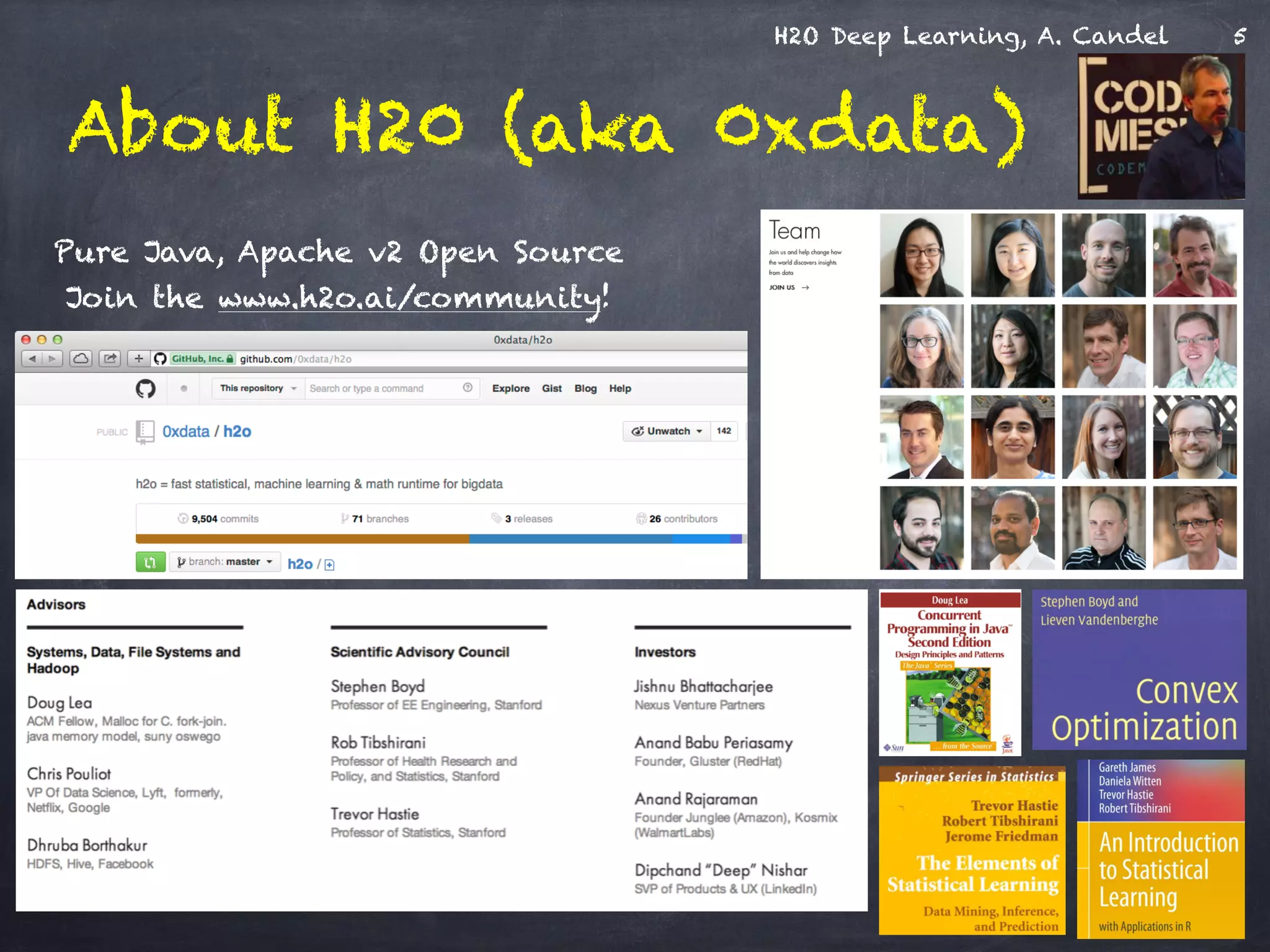
About H20 (aka 0xdata)
Pure Java, Apache v2 Open Source
Join the www.h2o.ai/community!
5
H2O Deep Learning, A. Candel
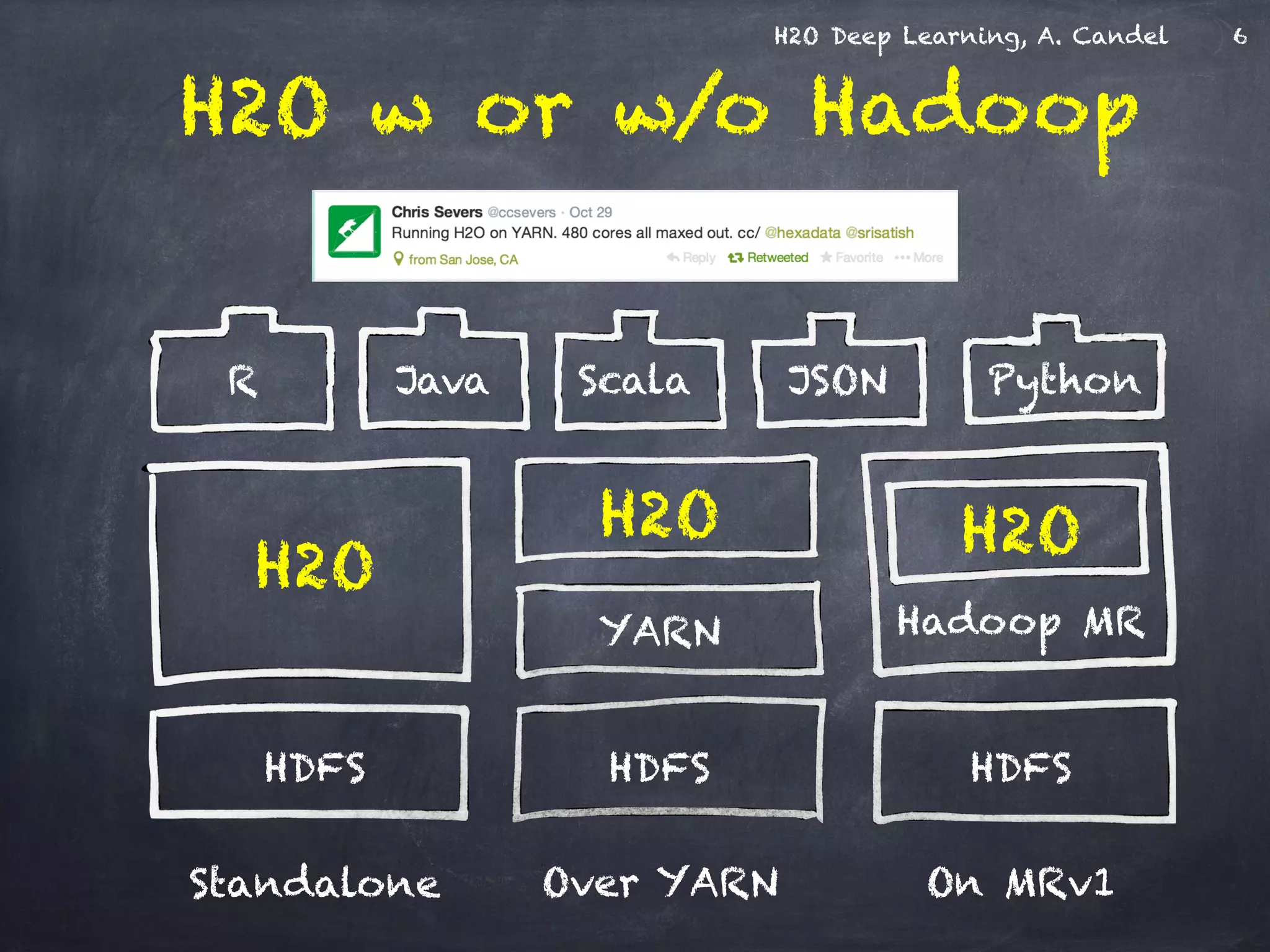
H2O w or w/o Hadoop
H2O
H2O H2O
HDFS HDFS HDFS
YARN Hadoop MR
R Java Scala JSON Python
Standalone Over YARN On MRv1
6
H2O Deep Learning, A. Candel
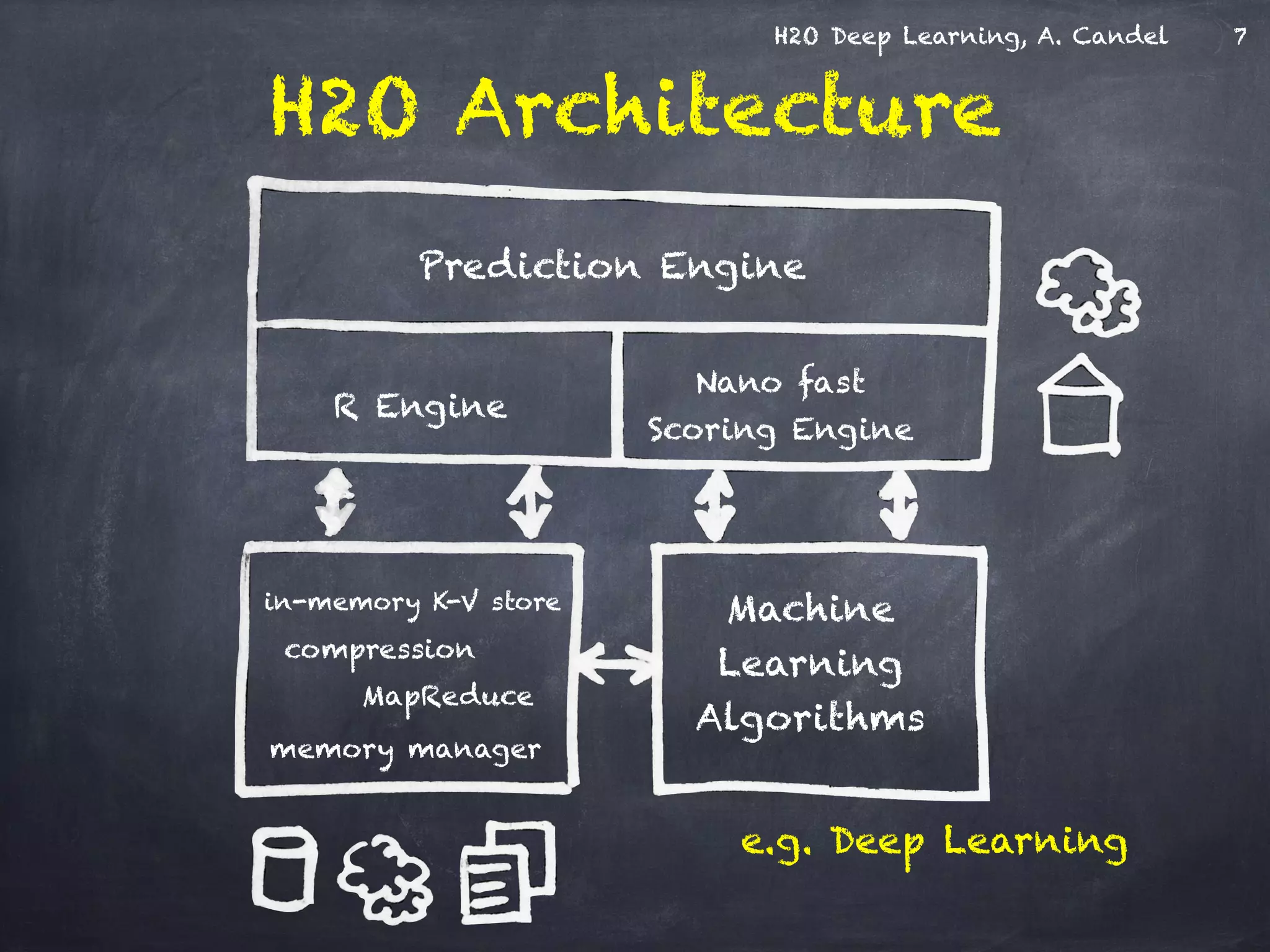
H2O Architecture
in-memory K-V store
compression
Machine
Learning
Algorithms
R Engine
Nano fast
Scoring Engine
Prediction Engine
memory manager
e.g. Deep Learning
7
MapReduce
H2O Deep Learning, A. Candel
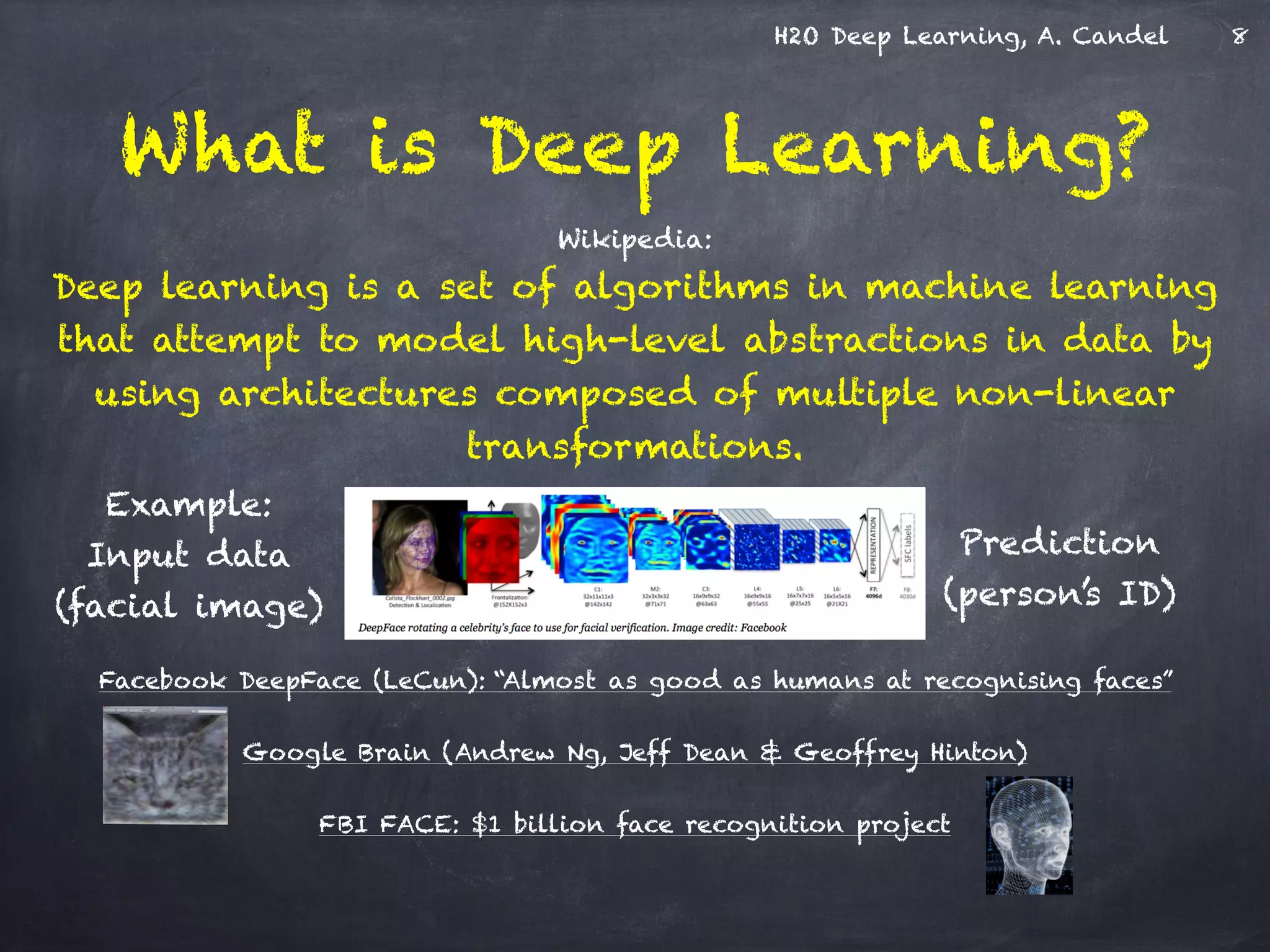
Wikipedia:

Deep learning is a set of algorithms in machine learning
that attempt to model high-level abstractions in data by
using architectures composed of multiple non-linear
transformations.
!
!
!
!
!
Facebook DeepFace (LeCun): “Almost as good as humans at recognising faces”
!
Google Brain (Andrew Ng, Jeff Dean & Geoffrey Hinton)
!
FBI FACE: $1 billion face recognition project
What is Deep Learning?
Example:
Input data

(facial image)
Prediction
(person’s ID)
8
H2O Deep Learning, A. Candel
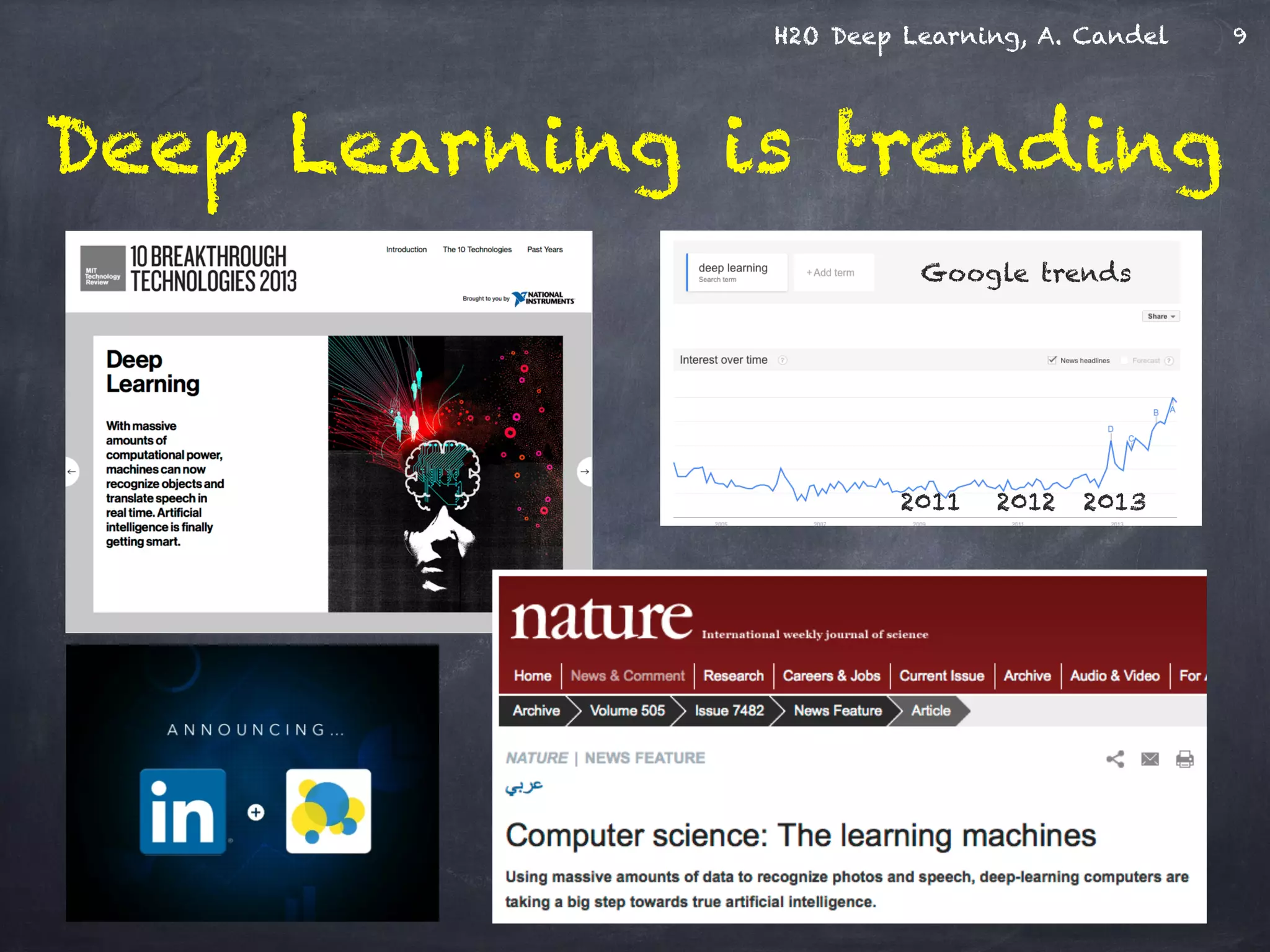
Deep Learning is trending
20132012
Google trends
2011
9
H2O Deep Learning, A. Candel
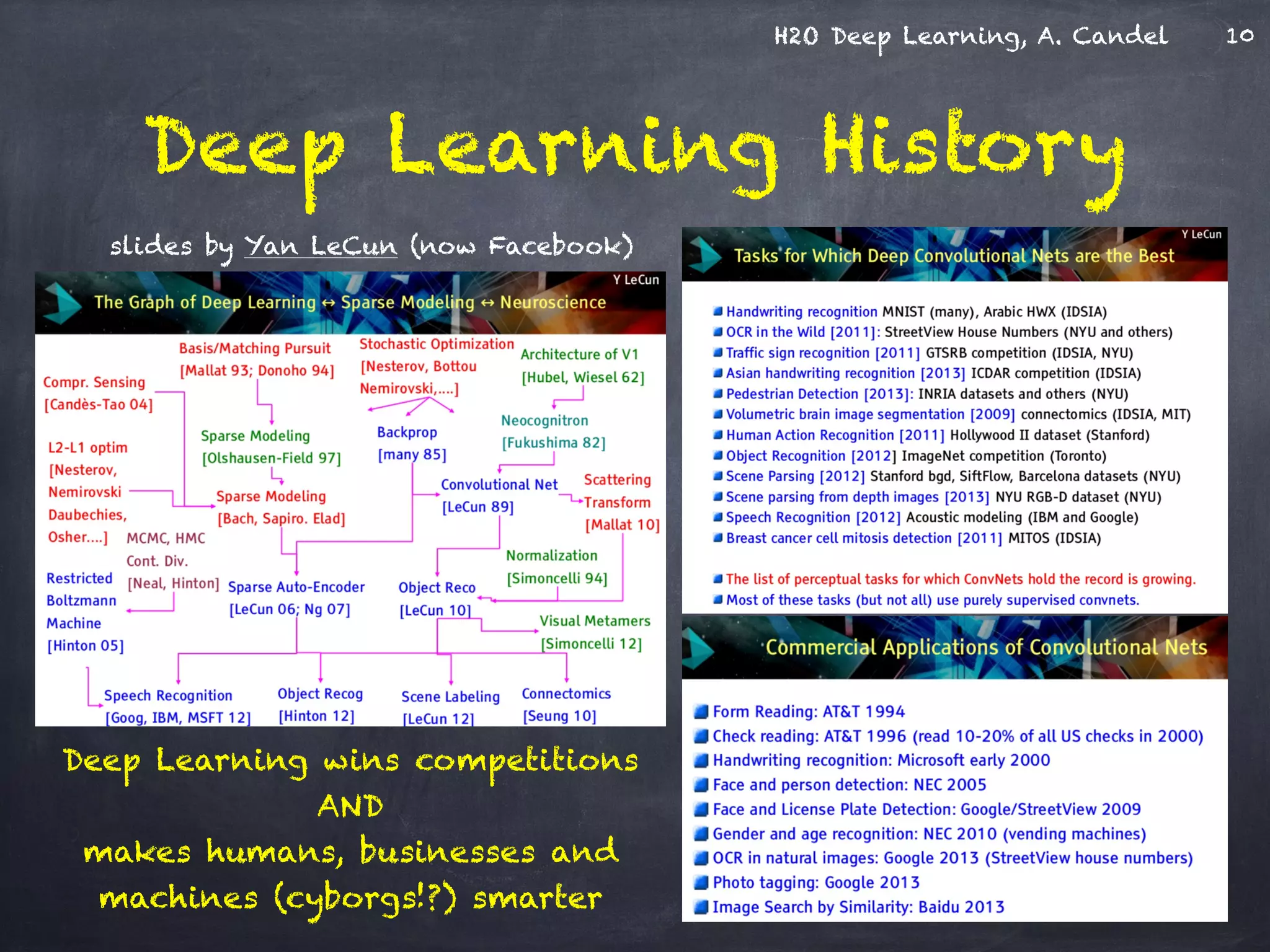
Deep Learning History
slides by Yan LeCun (now Facebook)
10
Deep Learning wins competitions
AND

makes humans, businesses and
machines (cyborgs!?) smarter
H2O Deep Learning, A. Candel
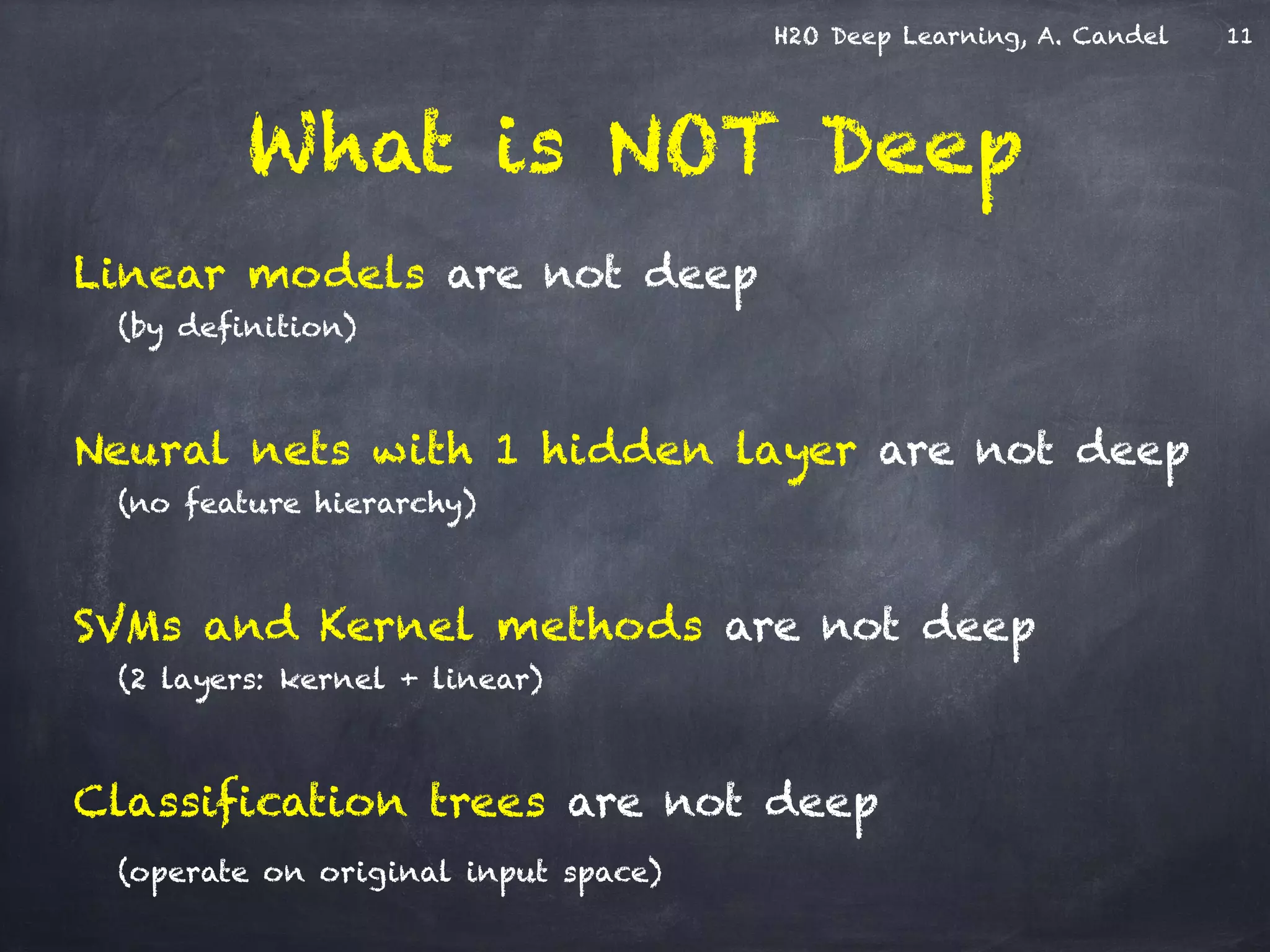
What is NOT Deep
Linear models are not deep
(by definition)
!
Neural nets with 1 hidden layer are not deep
(no feature hierarchy)
!
SVMs and Kernel methods are not deep
(2 layers: kernel + linear)
!
Classification trees are not deep
(operate on original input space)
11
H2O Deep Learning, A. Candel
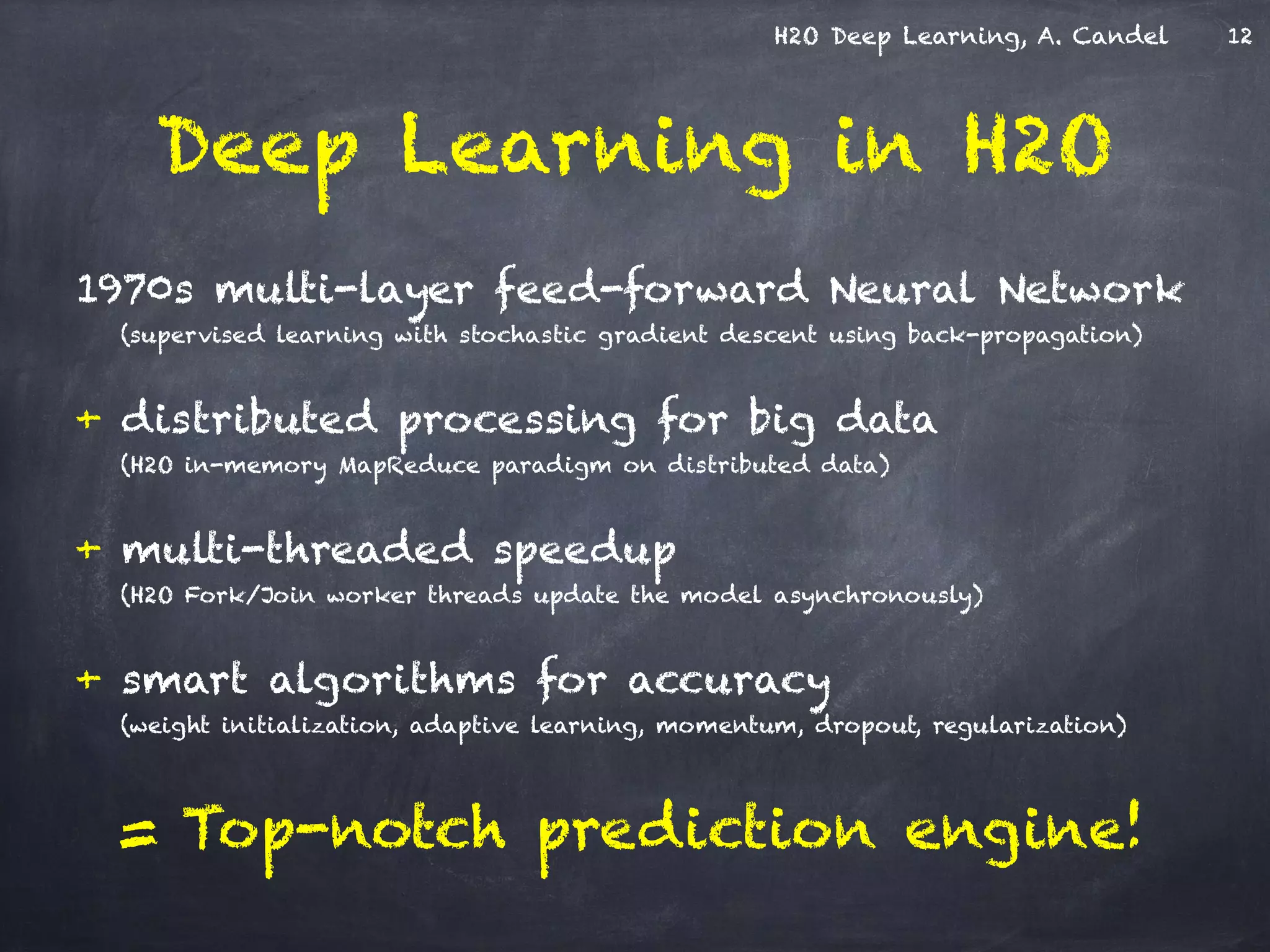
1970s multi-layer feed-forward Neural Network
(supervised learning with stochastic gradient descent using back-propagation)
!
+ distributed processing for big data
(H2O in-memory MapReduce paradigm on distributed data)
!
+ multi-threaded speedup
(H2O Fork/Join worker threads update the model asynchronously)
!
+ smart algorithms for accuracy
(weight initialization, adaptive learning, momentum, dropout, regularization)
!
= Top-notch prediction engine!
Deep Learning in H2O
12
H2O Deep Learning, A. Candel
“fully connected” directed graph of neurons
age
income
employment
married
not married
Input layer
Hidden
layer 1
Hidden
layer 2
Output layer
3x4 4x3 3x2#connections
information flow
input/output neuron
hidden neuron
4 3 2#neurons 3
Example Neural Network
13
H2O Deep Learning, A. Candel
age
income
employment
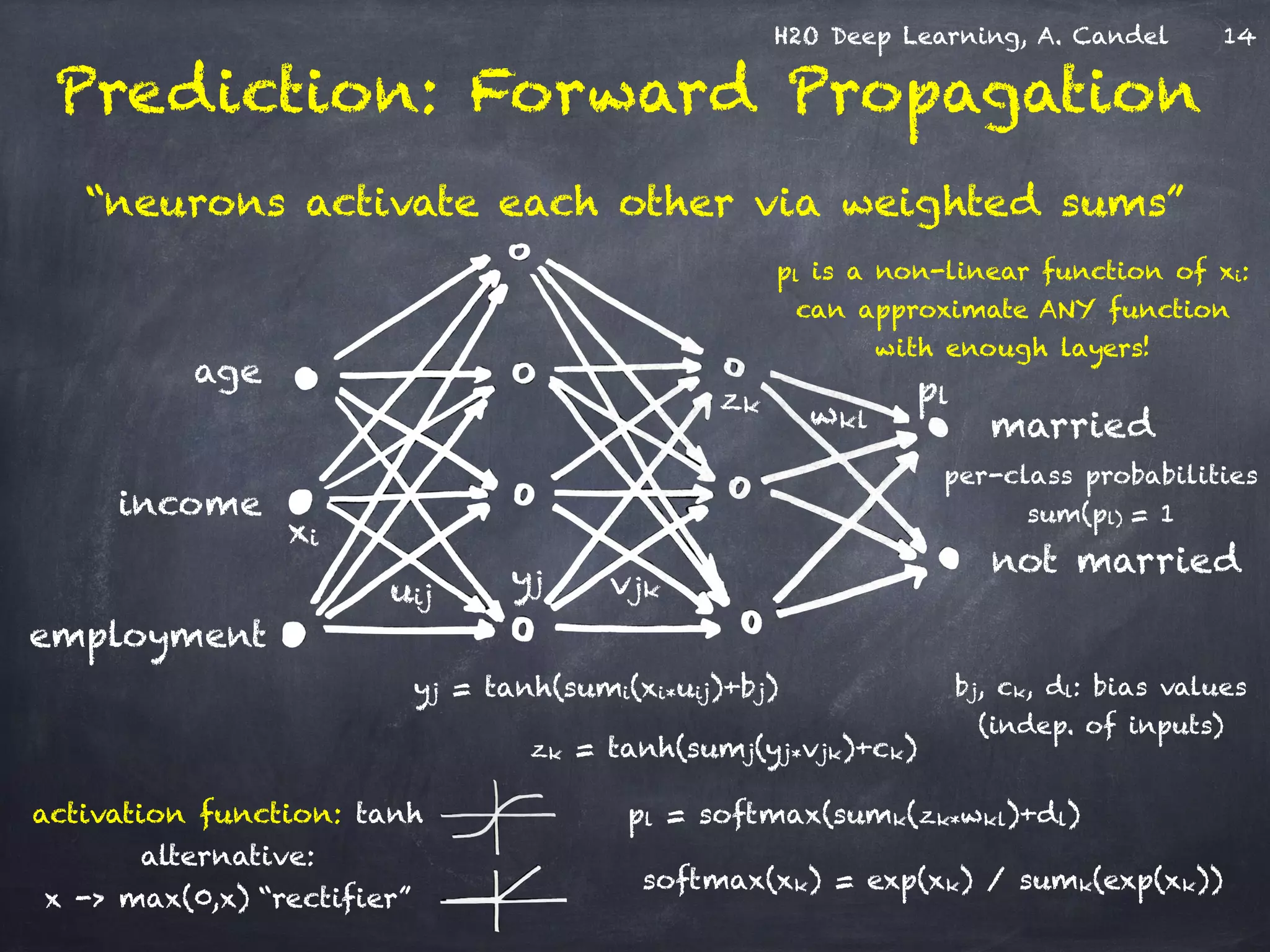
yj = tanh(sumi(xi*uij)+bj)
uij
xi
yj
per-class probabilities

sum(pl) = 1
zk = tanh(sumj(yj*vjk)+ck)
vjk
zk
pl
pl = softmax(sumk(zk*wkl)+dl)
wkl
softmax(xk) = exp(xk) / sumk(exp(xk))
“neurons activate each other via weighted sums”
Prediction: Forward Propagation
married
not married
activation function: tanh
alternative:

x -> max(0,x) “rectifier”
pl is a non-linear function of xi:
can approximate ANY function
with enough layers!
bj, ck, dl: bias values

(indep. of inputs)
14
H2O Deep Learning, A. Candel
age
income
employment
xi
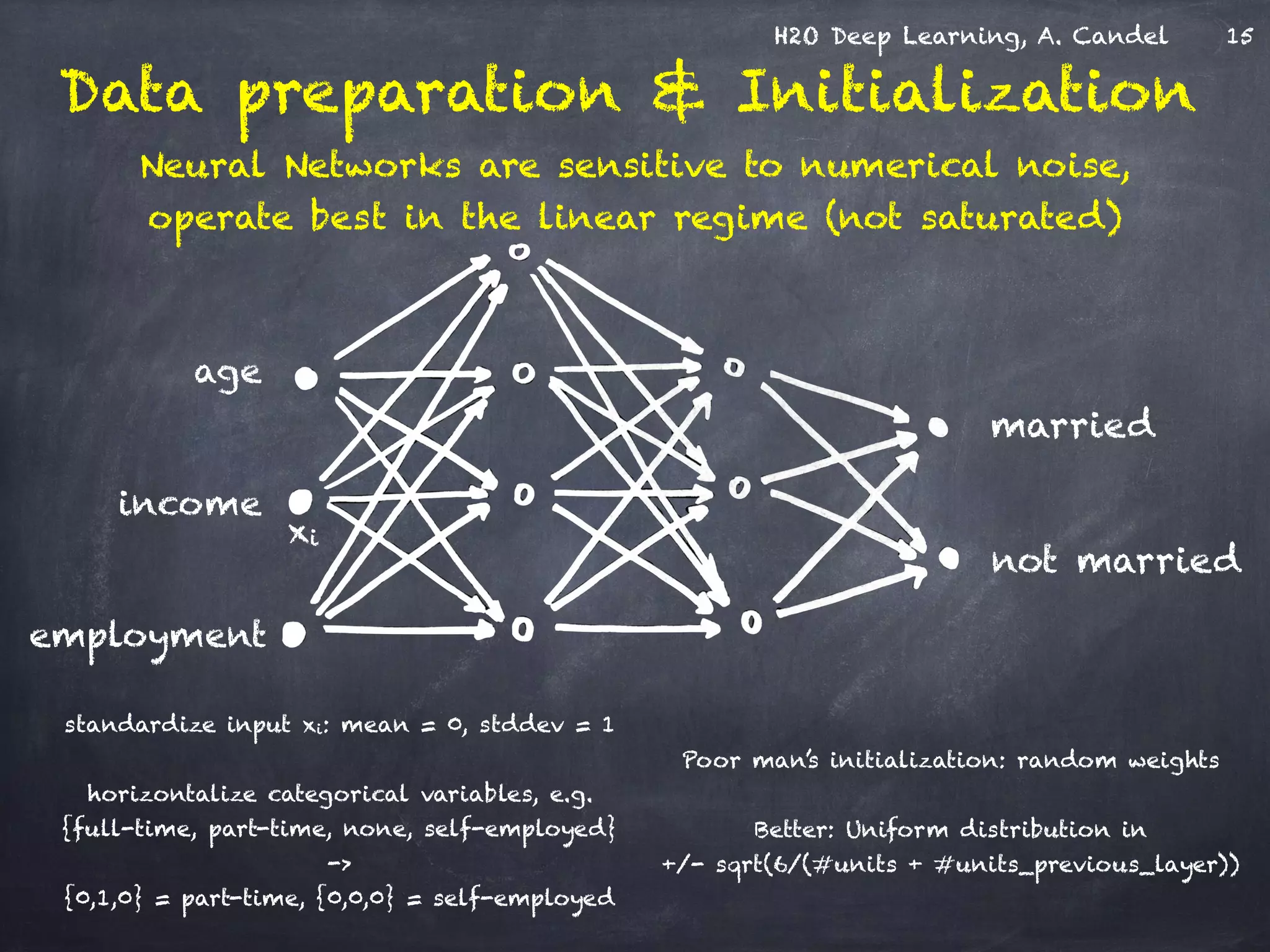
standardize input xi: mean = 0, stddev = 1
!
horizontalize categorical variables, e.g.
{full-time, part-time, none, self-employed} 

->

{0,1,0} = part-time, {0,0,0} = self-employed
Poor man’s initialization: random weights
!
Better: Uniform distribution in

+/- sqrt(6/(#units + #units_previous_layer))
Data preparation & Initialization
Neural Networks are sensitive to numerical noise,

operate best in the linear regime (not saturated)
married
not married
15
H2O Deep Learning, A. Candel
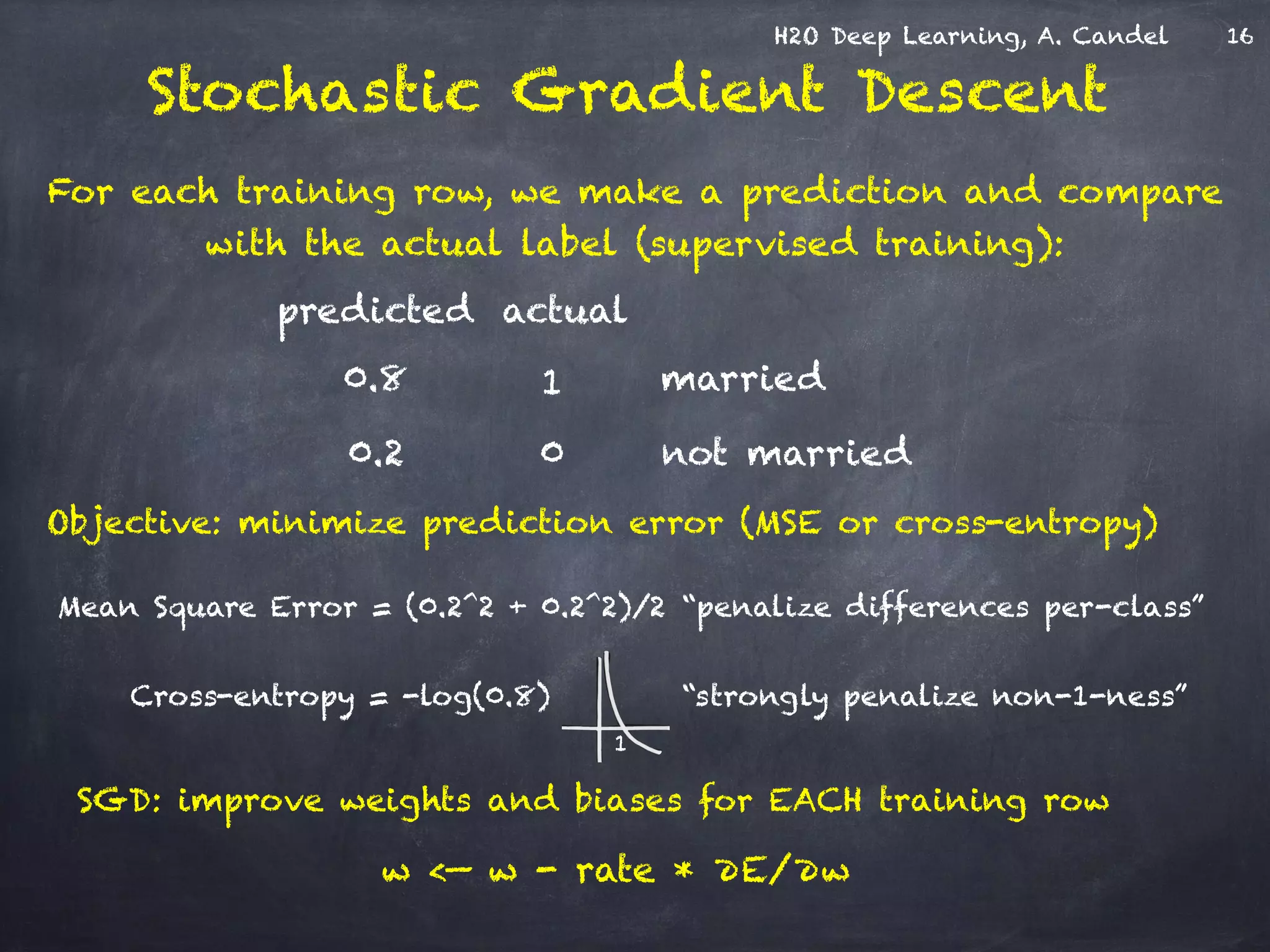
Mean Square Error = (0.2^2 + 0.2^2)/2 “penalize differences per-class”
!
Cross-entropy = -log(0.8) “strongly penalize non-1-ness”
Stochastic Gradient Descent
SGD: improve weights and biases for EACH training row
married
not married
For each training row, we make a prediction and compare
with the actual label (supervised training):
1
0
0.8
0.2
predicted actual
Objective: minimize prediction error (MSE or cross-entropy)
w <— w - rate * ∂E/∂w
1
16
H2O Deep Learning, A. Candel
Backward Propagation


!
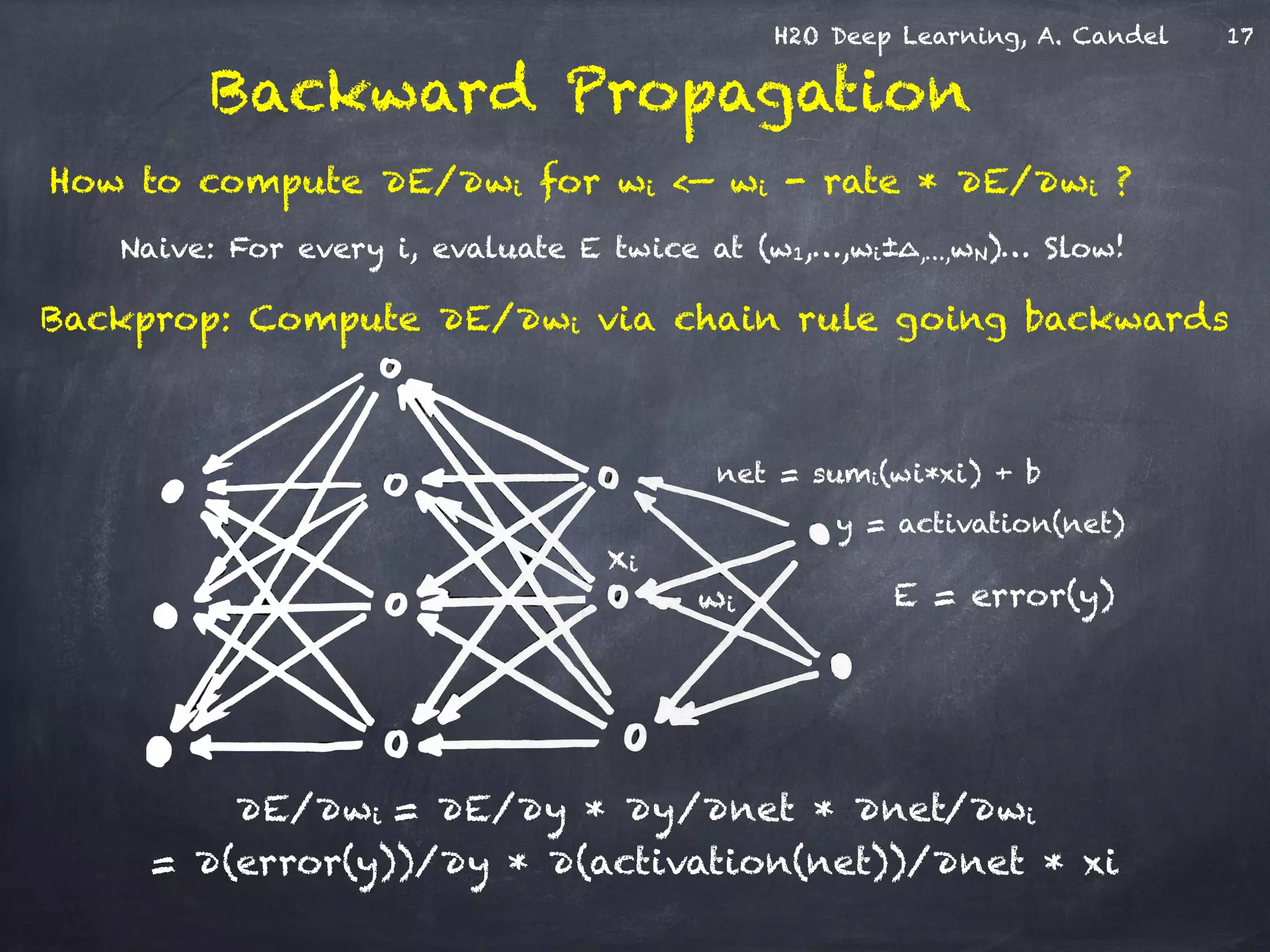
∂E/∂wi = ∂E/∂y * ∂y/∂net * ∂net/∂wi
= ∂(error(y))/∂y * ∂(activation(net))/∂net * xi
Backprop: Compute ∂E/∂wi via chain rule going backwards
wi
net = sumi(wi*xi) + b
xi
E = error(y)
y = activation(net)
How to compute ∂E/∂wi for wi <— wi - rate * ∂E/∂wi ?
Naive: For every i, evaluate E twice at (w1,…,wi±∆,…,wN)… Slow!
17
H2O Deep Learning, A. Candel
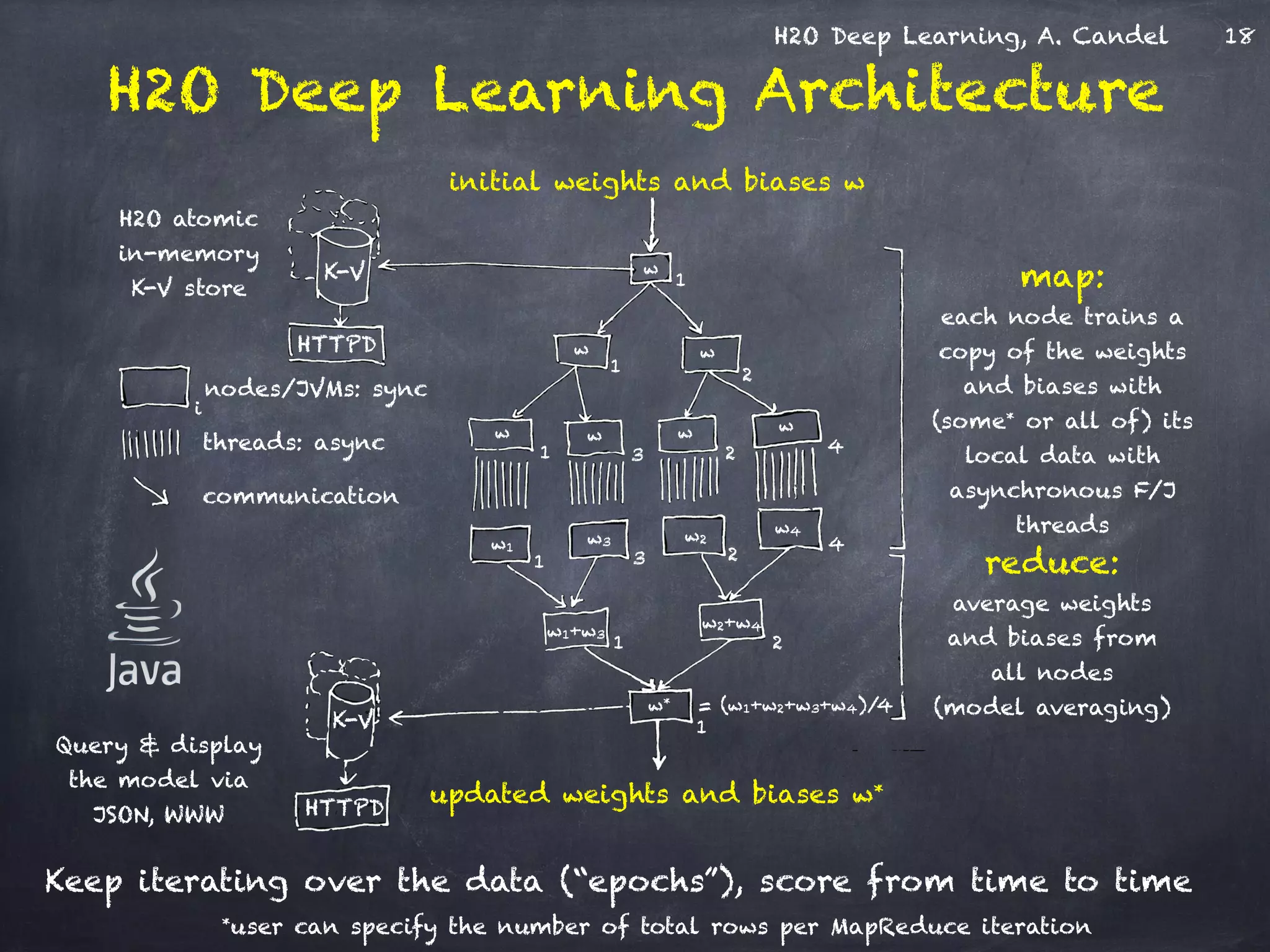
H2O Deep Learning Architecture
K-V
K-V
HTTPD
HTTPD
nodes/JVMs: sync
threads: async
communication
w
w w
w w w w
w1
w3 w2
w4
w2+w4
w1+w3
w* = (w1+w2+w3+w4)/4
map:

each node trains a
copy of the weights
and biases with
(some* or all of) its
local data with
asynchronous F/J
threads
initial weights and biases w
updated weights and biases w*
H2O atomic
in-memory

K-V store
reduce:

average weights
and biases from
all nodes

(model averaging)
Keep iterating over the data (“epochs”), score from time to time
Query & display
the model via
JSON, WWW
2
2 431
1
1
1
4
3 2
1 2
1
i
*user can specify the number of total rows per MapReduce iteration
18
H2O Deep Learning, A. Candel
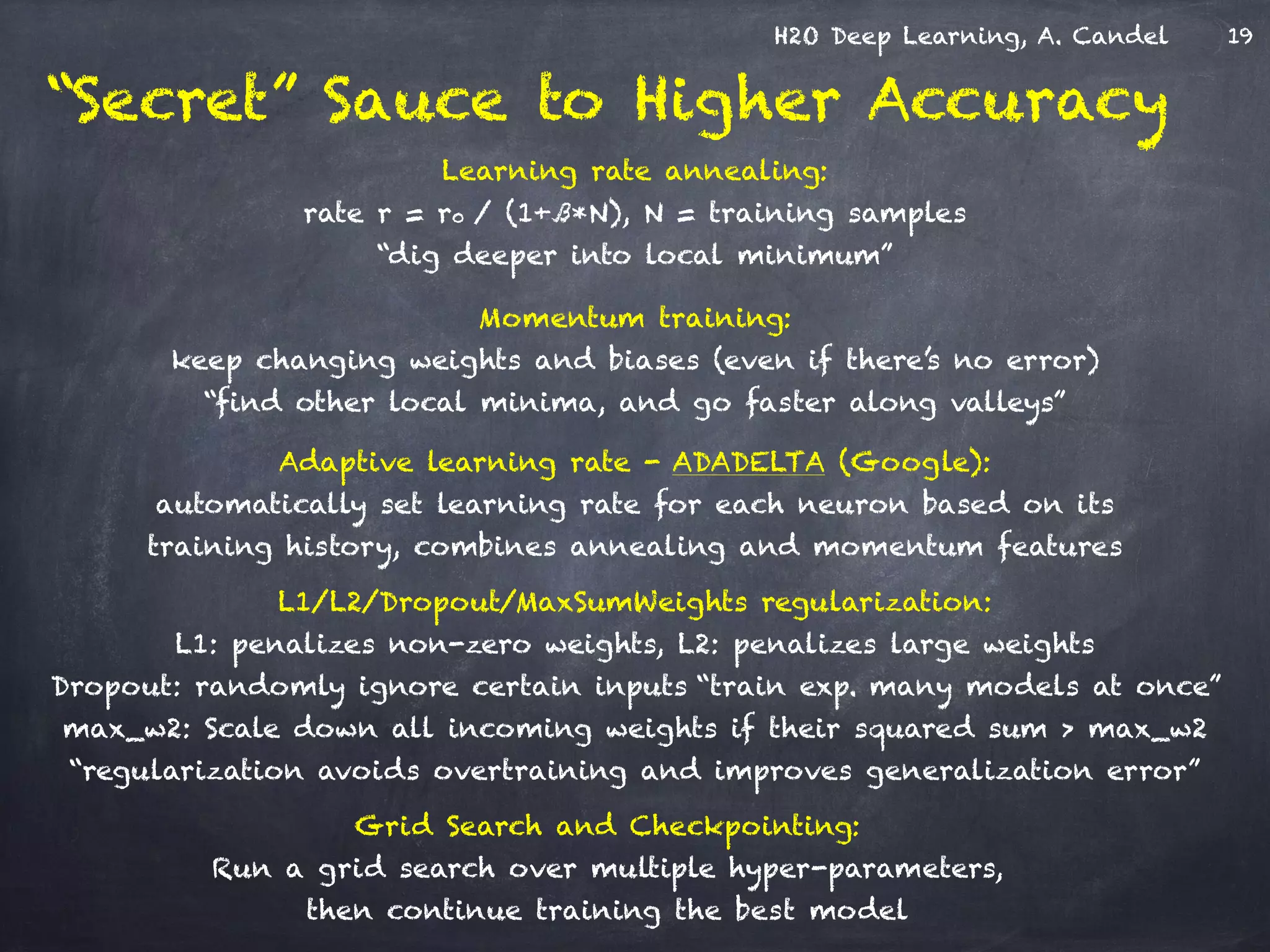
“Secret” Sauce to Higher Accuracy
Momentum training:

keep changing weights and biases (even if there’s no error) 

“find other local minima, and go faster along valleys”
Adaptive learning rate - ADADELTA (Google):

automatically set learning rate for each neuron based on its
training history, combines annealing and momentum features
Learning rate annealing:

rate r = r0 / (1+ß*N), N = training samples
“dig deeper into local minimum”
Grid Search and Checkpointing:

Run a grid search over multiple hyper-parameters,
then continue training the best model
L1/L2/Dropout/MaxSumWeights regularization:

L1: penalizes non-zero weights, L2: penalizes large weights

Dropout: randomly ignore certain inputs “train exp. many models at once”
max_w2: Scale down all incoming weights if their squared sum > max_w2
“regularization avoids overtraining and improves generalization error”
19
H2O Deep Learning, A. Candel
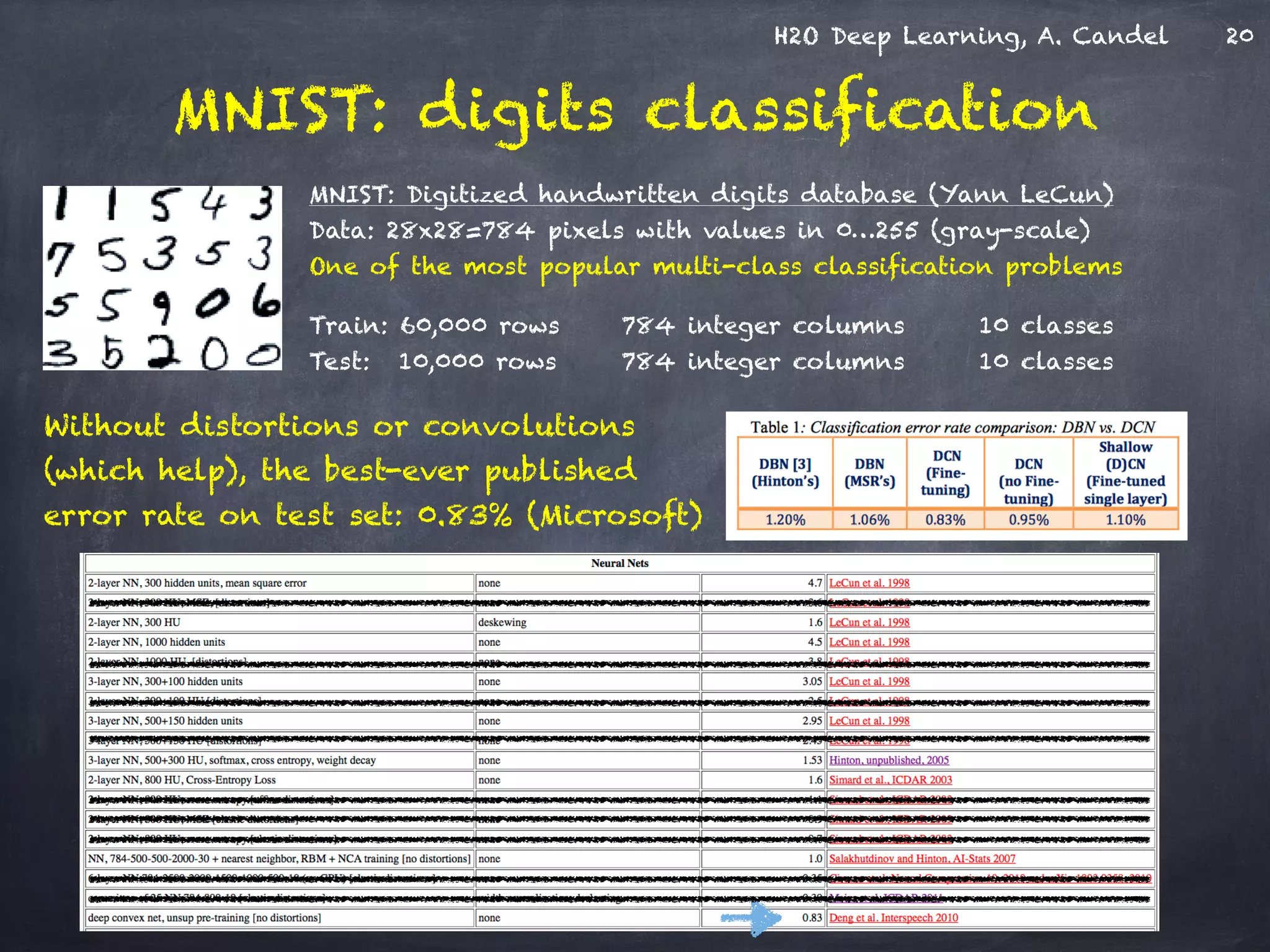
MNIST: digits classification
Train: 60,000 rows 784 integer columns 10 classes
Test: 10,000 rows 784 integer columns 10 classes
MNIST: Digitized handwritten digits database (Yann LeCun)
Data: 28x28=784 pixels with values in 0…255 (gray-scale)
One of the most popular multi-class classification problems
Without distortions or convolutions
(which help), the best-ever published
error rate on test set: 0.83% (Microsoft)
20
H2O Deep Learning, A. Candel
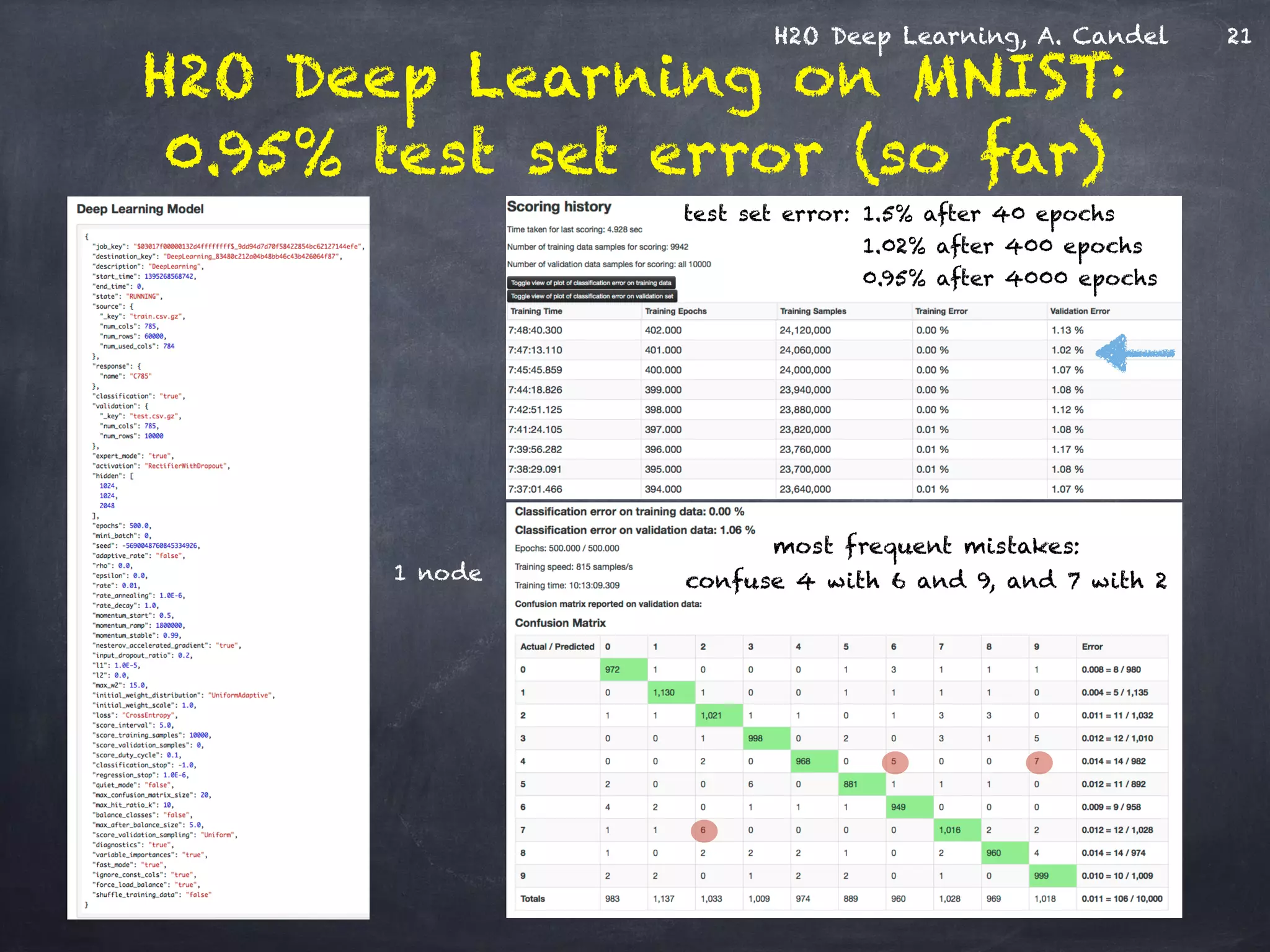
most frequent mistakes:

confuse 4 with 6 and 9, and 7 with 2
test set error: 1.5% after 40 epochs
1.02% after 400 epochs

0.95% after 4000 epochs
H2O Deep Learning on MNIST:
0.95% test set error (so far)
1 node
21
H2O Deep Learning, A. Candel
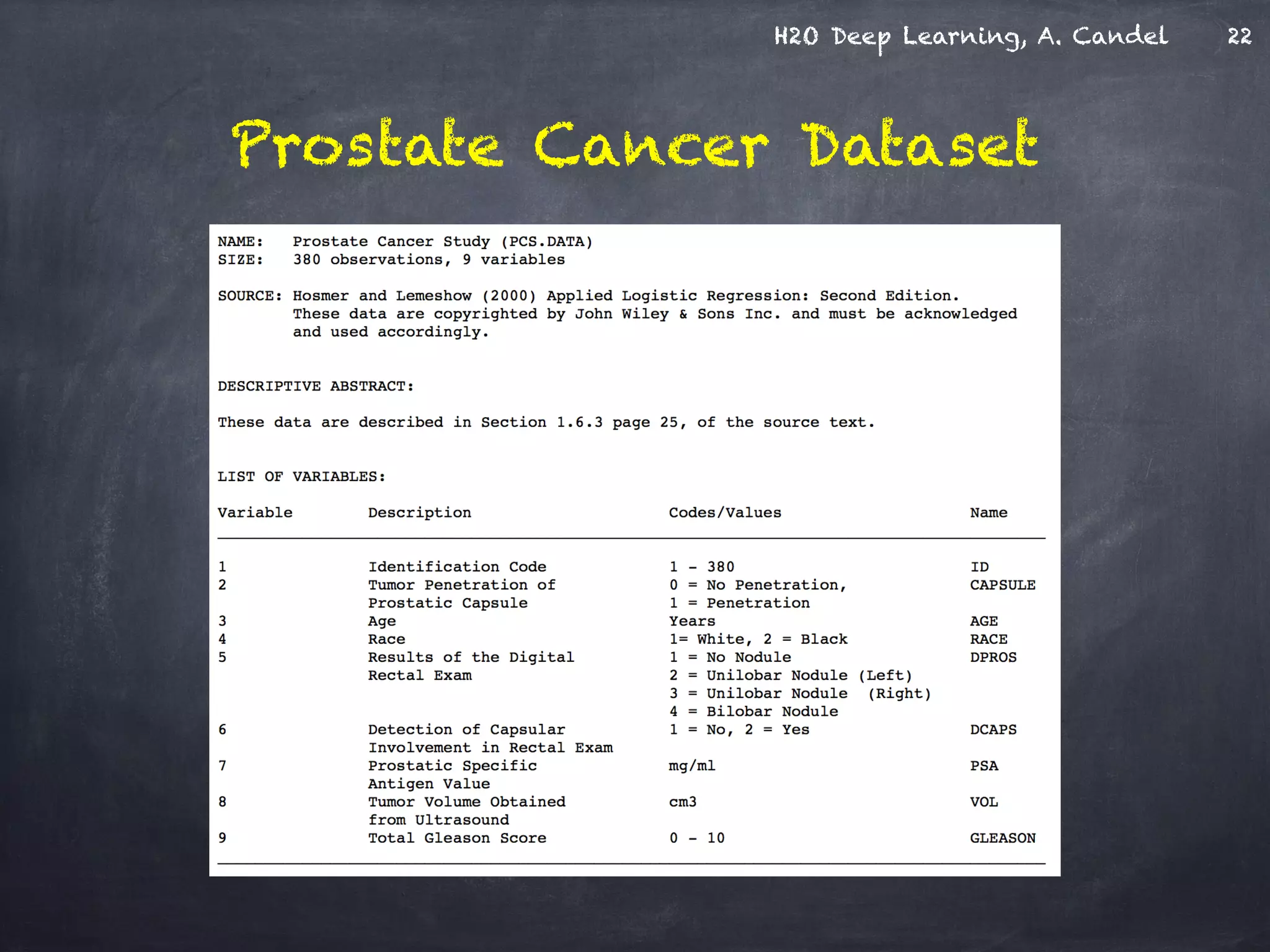
Prostate Cancer Dataset
22
H2O Deep Learning, A. Candel
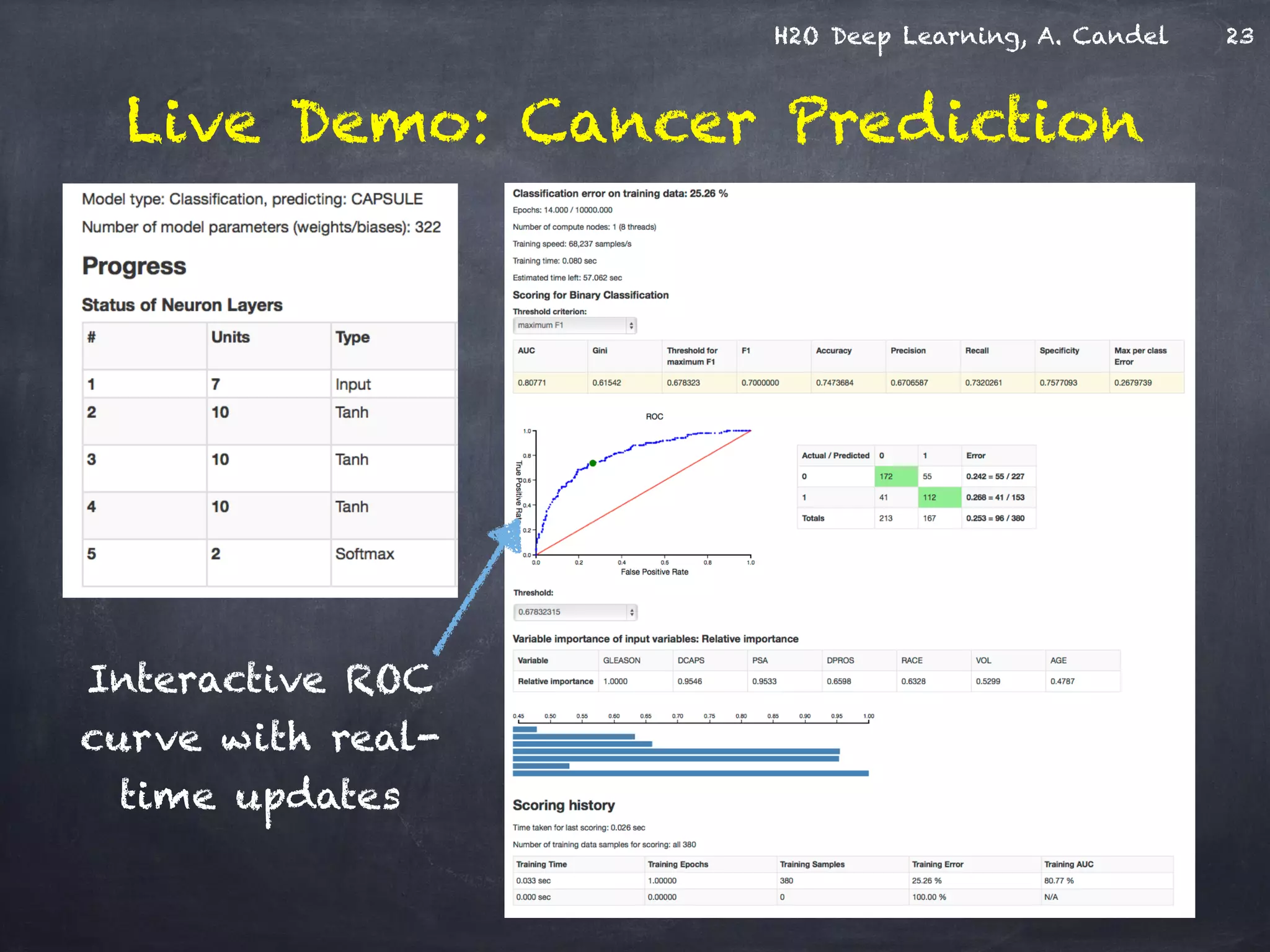
Live Demo: Cancer Prediction
Interactive ROC
curve with real-
time updates
23
H2O Deep Learning, A. Candel
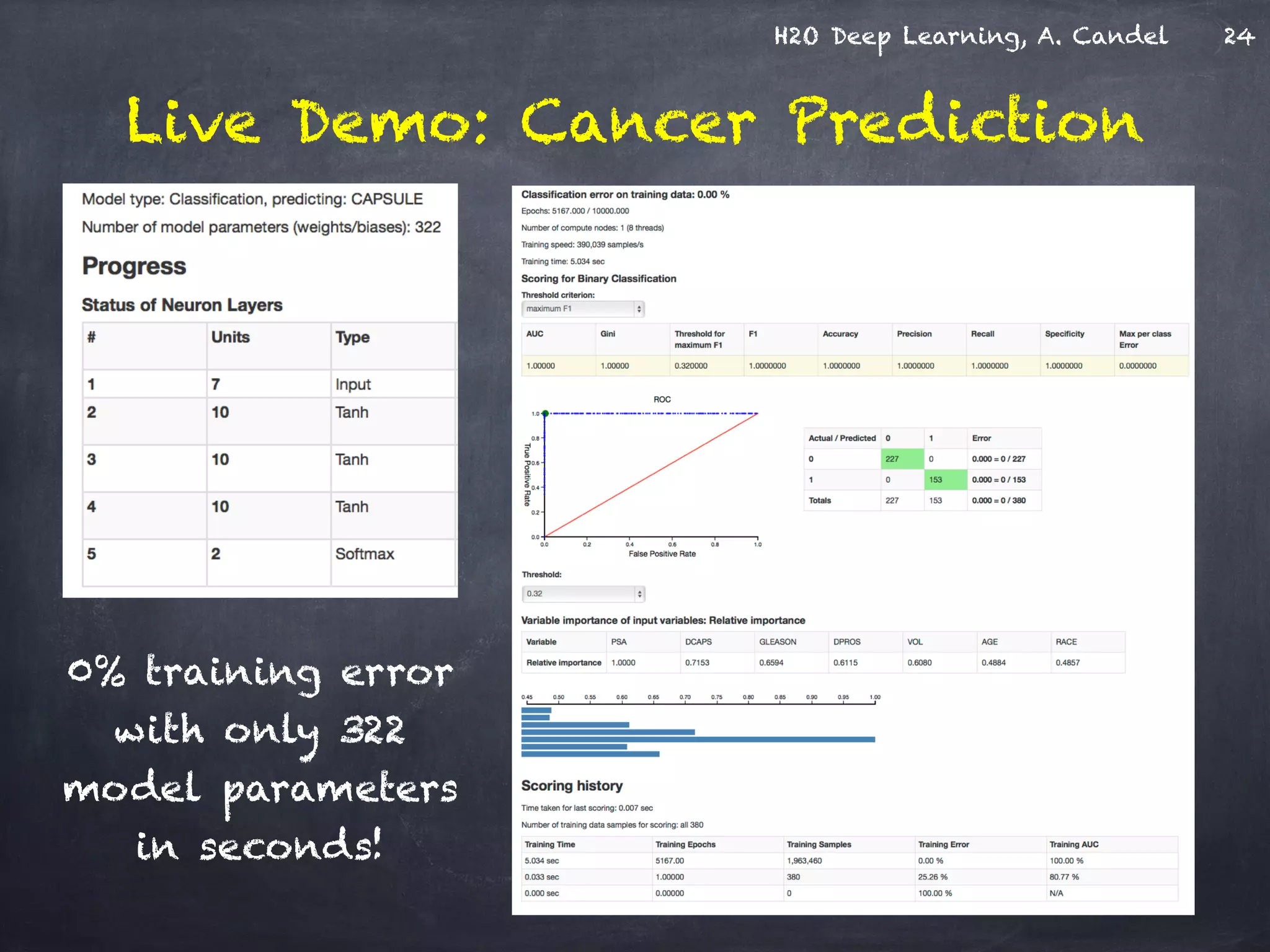
Live Demo: Cancer Prediction
0% training error
with only 322
model parameters
in seconds!
24
H2O Deep Learning, A. Candel
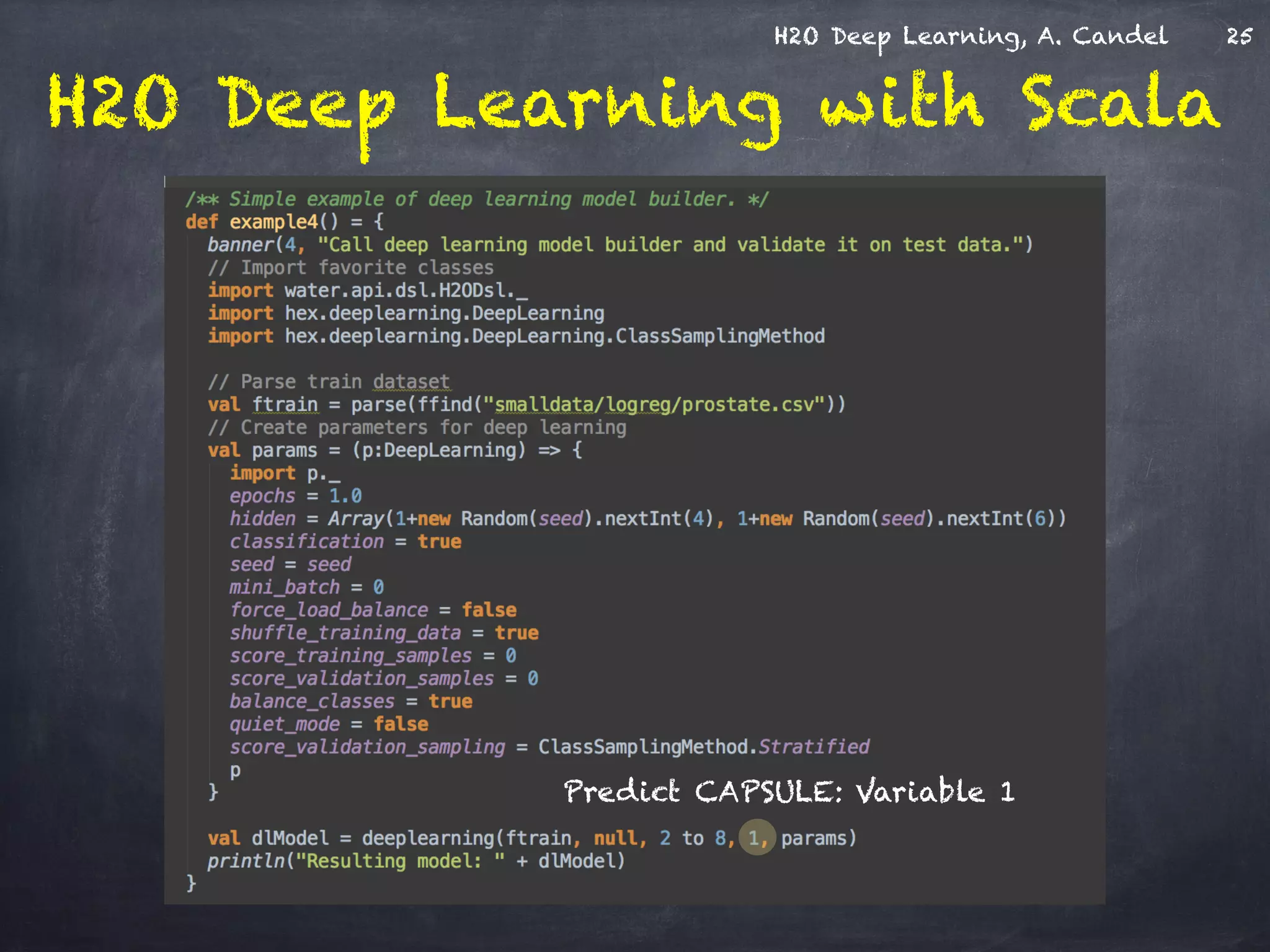
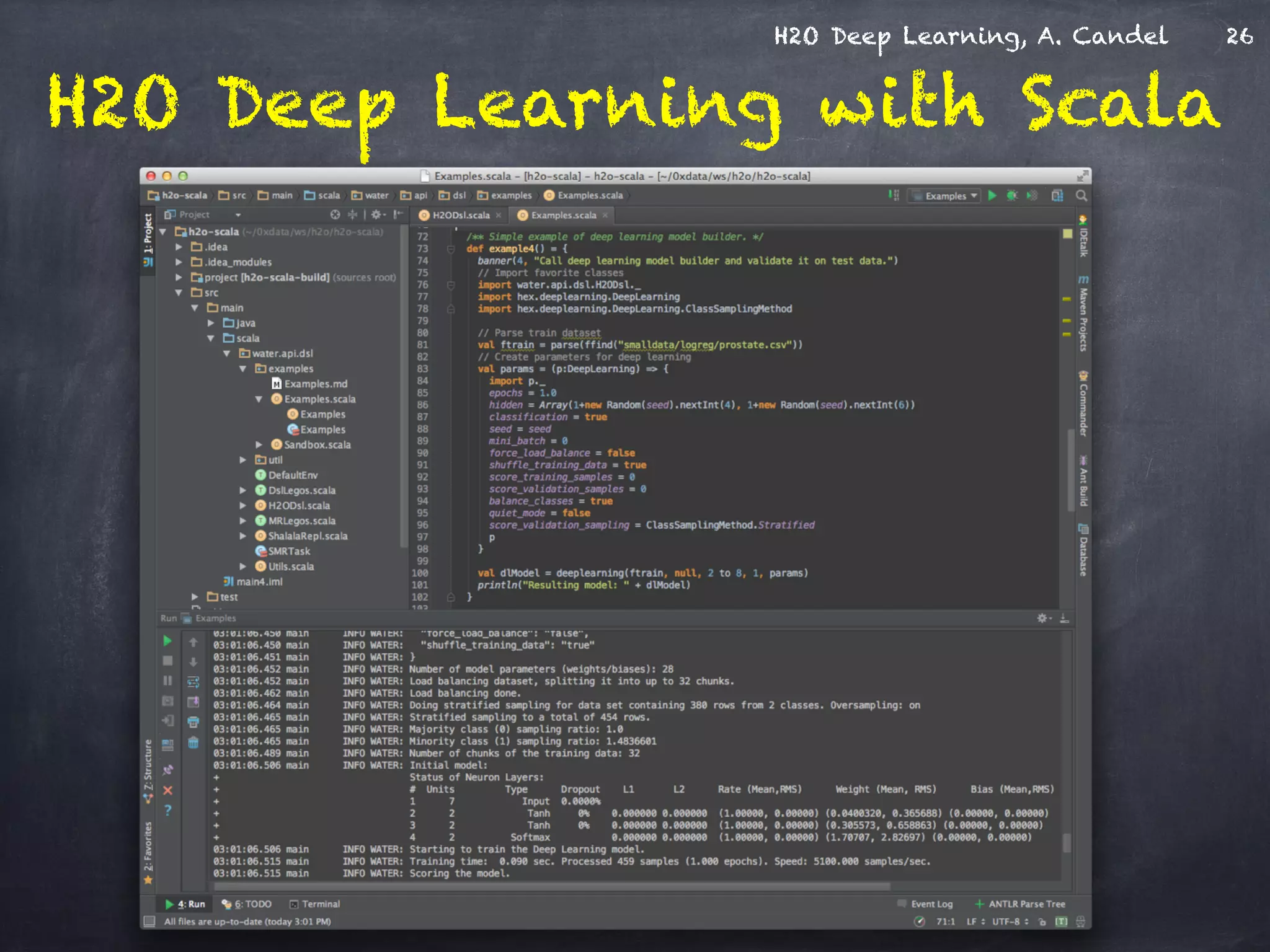
H2O Deep Learning with Scala
25
Predict CAPSULE: Variable 1
H2O Deep Learning, A. Candel
H2O Deep Learning with Scala
26
H2O Deep Learning, A. Candel
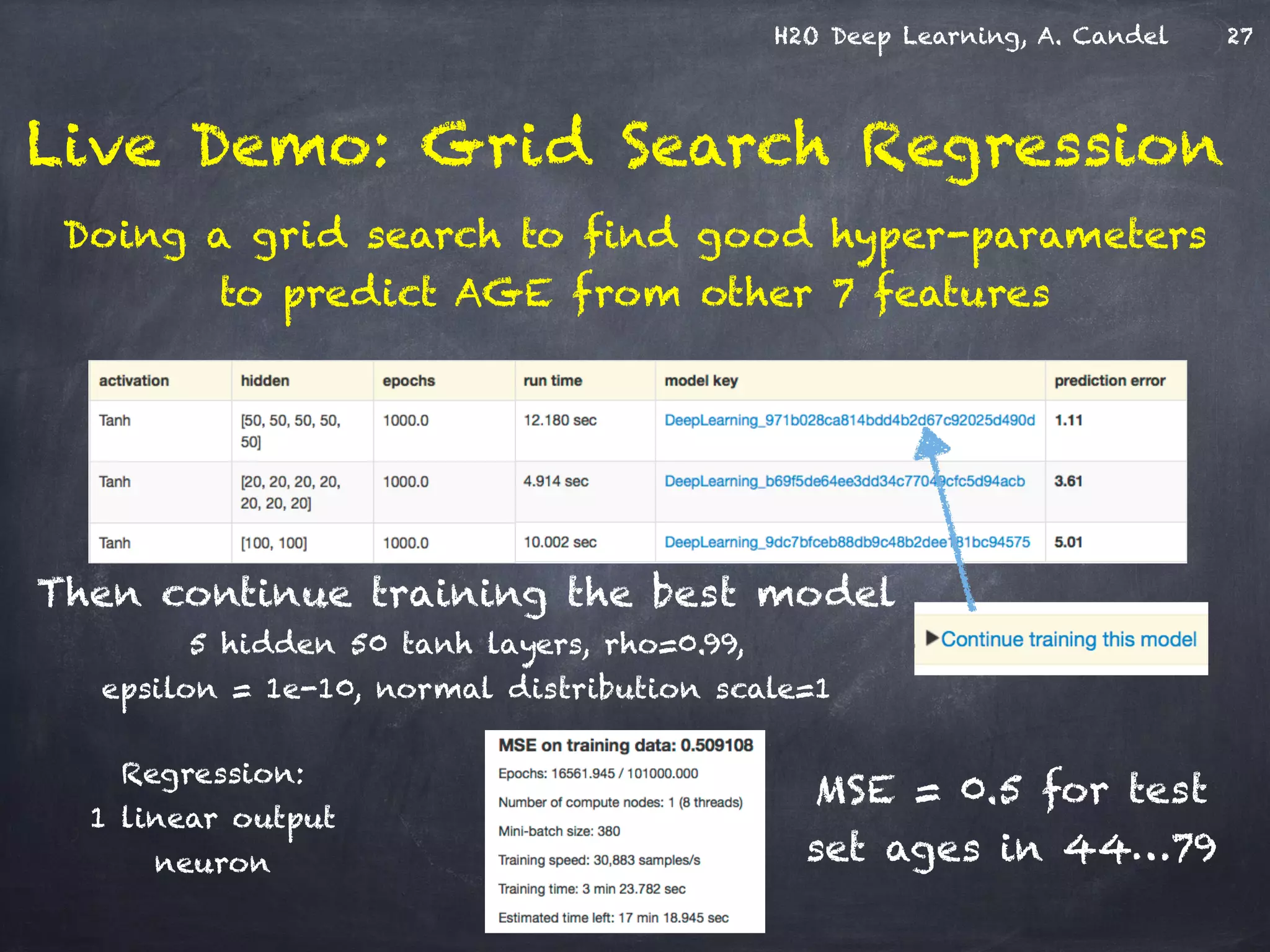
Live Demo: Grid Search Regression
Doing a grid search to find good hyper-parameters
to predict AGE from other 7 features
Then continue training the best model
5 hidden 50 tanh layers, rho=0.99,

epsilon = 1e-10, normal distribution scale=1
MSE = 0.5 for test
set ages in 44…79
Regression:
1 linear output
neuron
27
H2O Deep Learning, A. Candel
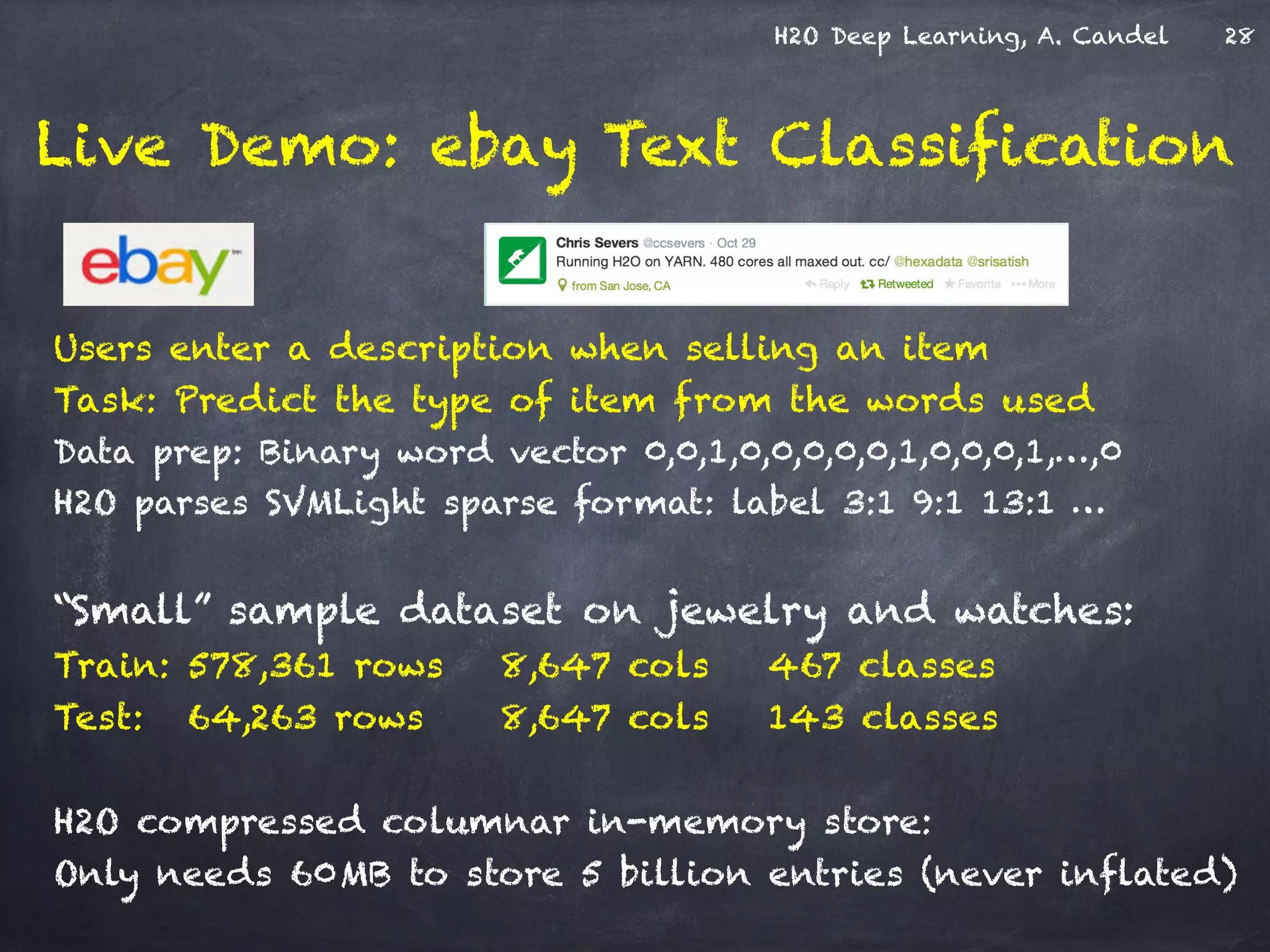
Live Demo: ebay Text Classification
Users enter a description when selling an item
Task: Predict the type of item from the words used
Data prep: Binary word vector 0,0,1,0,0,0,0,0,1,0,0,0,1,…,0
H2O parses SVMLight sparse format: label 3:1 9:1 13:1 …
!
“Small” sample dataset on jewelry and watches:
Train: 578,361 rows 8,647 cols 467 classes
Test: 64,263 rows 8,647 cols 143 classes
!
H2O compressed columnar in-memory store:
Only needs 60MB to store 5 billion entries (never inflated)
28
H2O Deep Learning, A. Candel
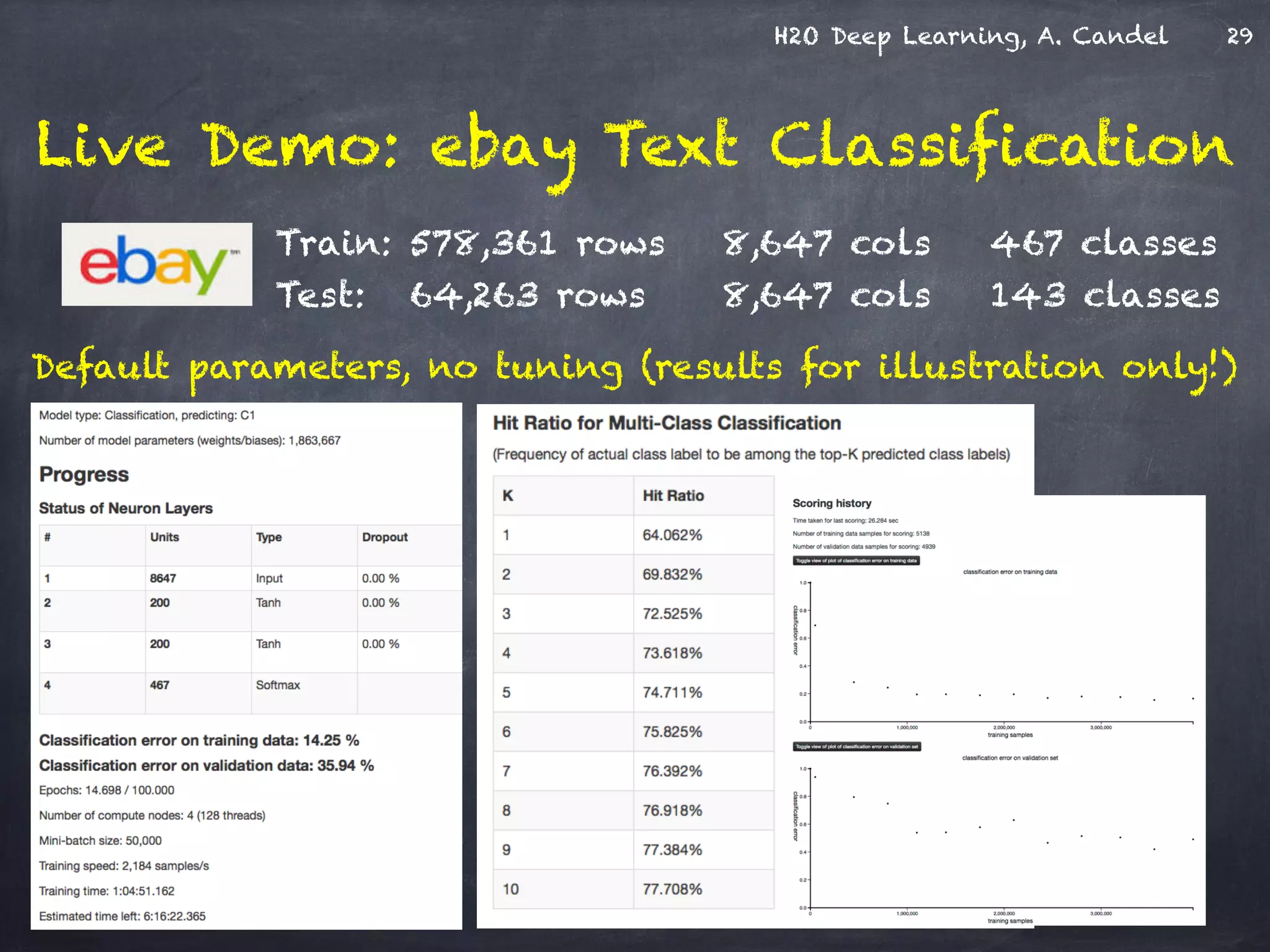
Live Demo: ebay Text Classification
Default parameters, no tuning (results for illustration only!)
Train: 578,361 rows 8,647 cols 467 classes
Test: 64,263 rows 8,647 cols 143 classes
29
H2O Deep Learning, A. Candel
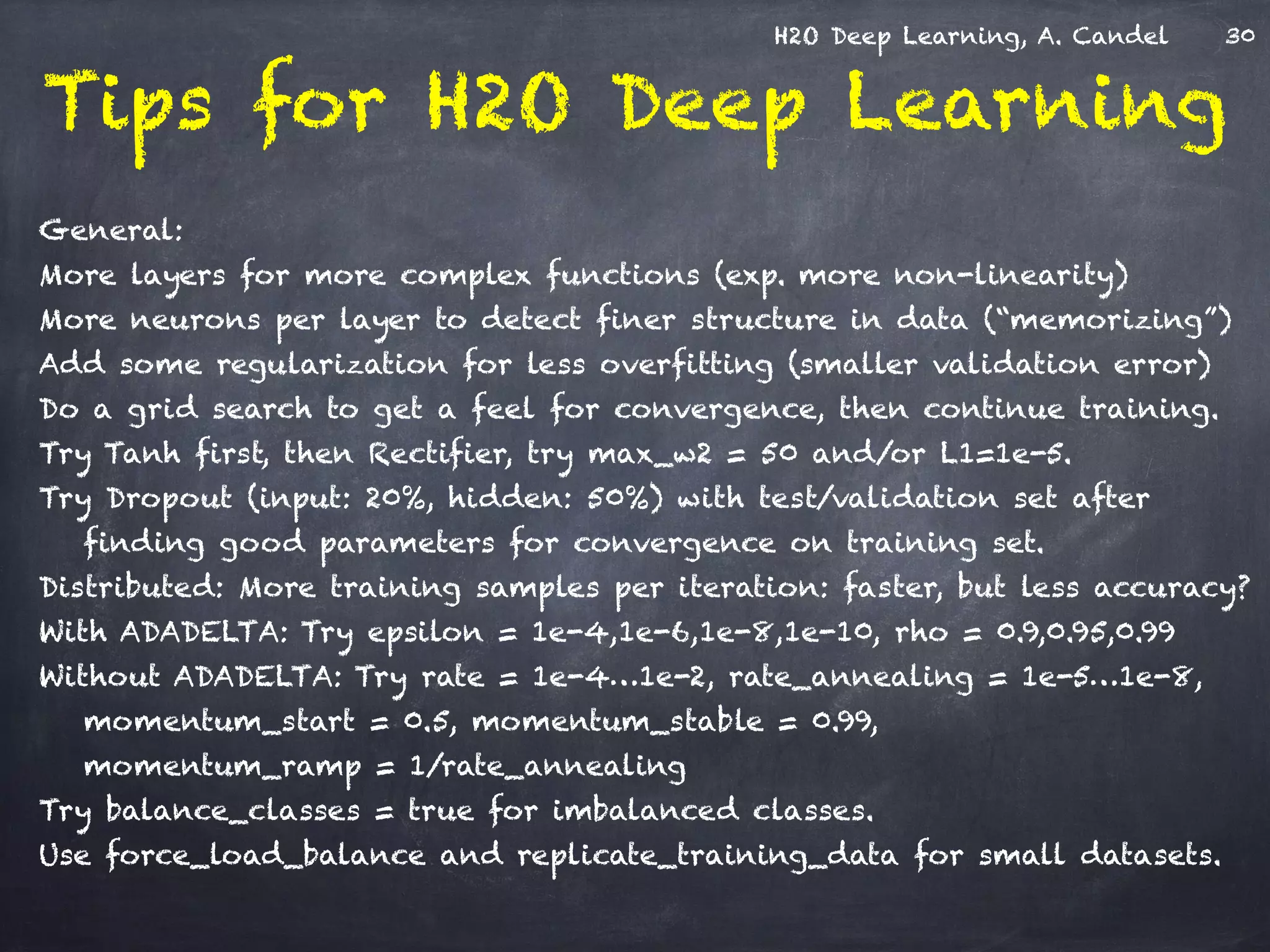
Tips for H2O Deep Learning
!
General:
More layers for more complex functions (exp. more non-linearity)
More neurons per layer to detect finer structure in data (“memorizing”)
Add some regularization for less overfitting (smaller validation error)
Do a grid search to get a feel for convergence, then continue training.
Try Tanh first, then Rectifier, try max_w2 = 50 and/or L1=1e-5.
Try Dropout (input: 20%, hidden: 50%) with test/validation set after
finding good parameters for convergence on training set.
Distributed: More training samples per iteration: faster, but less accuracy?
With ADADELTA: Try epsilon = 1e-4,1e-6,1e-8,1e-10, rho = 0.9,0.95,0.99
Without ADADELTA: Try rate = 1e-4…1e-2, rate_annealing = 1e-5…1e-8,
momentum_start = 0.5, momentum_stable = 0.99,

momentum_ramp = 1/rate_annealing
Try balance_classes = true for imbalanced classes.
Use force_load_balance and replicate_training_data for small datasets.
30
H2O Deep Learning, A. Candel
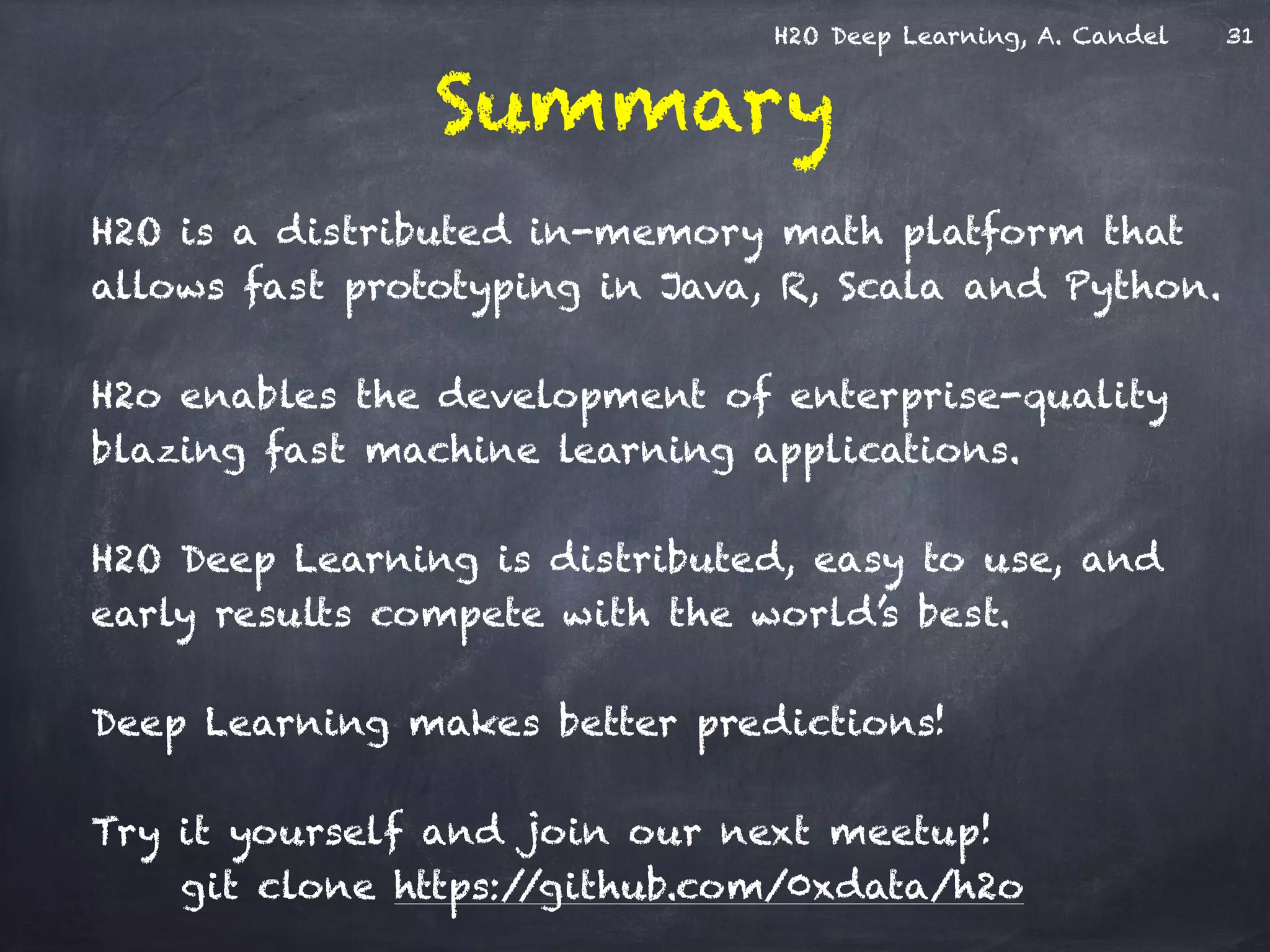
Summary
H2O is a distributed in-memory math platform that
allows fast prototyping in Java, R, Scala and Python.
!
H2o enables the development of enterprise-quality
blazing fast machine learning applications.
!
H2O Deep Learning is distributed, easy to use, and
early results compete with the world’s best.
!
Deep Learning makes better predictions!
!
Try it yourself and join our next meetup!

git clone https://github.com/0xdata/h2o
31

H2O.ai's Distributed Deep Learning by Arno Candel 04/03/14

  • 1.
    Deep Learning with H2O ! H2O.ai
 ScalableIn-Memory Machine Learning ! H20 Meetup, TypeSafe, San Francisco, 4/3/14 Arno Candel
  • 2.
    Who am I? PhDin Computational Physics, 2005
 from ETH Zurich Switzerland ! 6 years at SLAC - Accelerator Physics Modeling 2 years at Skytree, Inc - Machine Learning 3 months at 0xdata/H2O - Machine Learning ! 10+ years in HPC, C++, MPI, Supercomputing Arno Candel
  • 3.
    H2O Deep Learning,A. Candel Outline Intro Theory Implementation Results MNIST handwritten digits classification Live Demo Prostate cancer classification and age regression text classification 3
  • 4.
    H2O Deep Learning,A. Candel Distributed in-memory math platform 
 ➔ GLM, GBM, RF, K-Means, PCA, Deep Learning
 Easy to use SDK / API
 ➔ Java, R, Scala, Python, JSON, Browser-based GUI ! Businesses can use ALL of their data (w or w/o Hadoop)
 ➔ Modeling without Sampling
 
 Big Data + Better Algorithms 
 ➔ Better Predictions H2O Open Source in-memory
 Prediction Engine for Big Data 4
  • 5.
    H2O Deep Learning,A. Candel About H20 (aka 0xdata) Pure Java, Apache v2 Open Source Join the www.h2o.ai/community! 5
  • 6.
    H2O Deep Learning,A. Candel H2O w or w/o Hadoop H2O H2O H2O HDFS HDFS HDFS YARN Hadoop MR R Java Scala JSON Python Standalone Over YARN On MRv1 6
  • 7.
    H2O Deep Learning,A. Candel H2O Architecture in-memory K-V store compression Machine Learning Algorithms R Engine Nano fast Scoring Engine Prediction Engine memory manager e.g. Deep Learning 7 MapReduce
  • 8.
    H2O Deep Learning,A. Candel Wikipedia:
 Deep learning is a set of algorithms in machine learning that attempt to model high-level abstractions in data by using architectures composed of multiple non-linear transformations. ! ! ! ! ! Facebook DeepFace (LeCun): “Almost as good as humans at recognising faces” ! Google Brain (Andrew Ng, Jeff Dean & Geoffrey Hinton) ! FBI FACE: $1 billion face recognition project What is Deep Learning? Example: Input data
 (facial image) Prediction (person’s ID) 8
  • 9.
    H2O Deep Learning,A. Candel Deep Learning is trending 20132012 Google trends 2011 9
  • 10.
    H2O Deep Learning,A. Candel Deep Learning History slides by Yan LeCun (now Facebook) 10 Deep Learning wins competitions AND
 makes humans, businesses and machines (cyborgs!?) smarter
  • 11.
    H2O Deep Learning,A. Candel What is NOT Deep Linear models are not deep (by definition) ! Neural nets with 1 hidden layer are not deep (no feature hierarchy) ! SVMs and Kernel methods are not deep (2 layers: kernel + linear) ! Classification trees are not deep (operate on original input space) 11
  • 12.
    H2O Deep Learning,A. Candel 1970s multi-layer feed-forward Neural Network (supervised learning with stochastic gradient descent using back-propagation) ! + distributed processing for big data (H2O in-memory MapReduce paradigm on distributed data) ! + multi-threaded speedup (H2O Fork/Join worker threads update the model asynchronously) ! + smart algorithms for accuracy (weight initialization, adaptive learning, momentum, dropout, regularization) ! = Top-notch prediction engine! Deep Learning in H2O 12
  • 13.
    H2O Deep Learning,A. Candel “fully connected” directed graph of neurons age income employment married not married Input layer Hidden layer 1 Hidden layer 2 Output layer 3x4 4x3 3x2#connections information flow input/output neuron hidden neuron 4 3 2#neurons 3 Example Neural Network 13
  • 14.
    H2O Deep Learning,A. Candel age income employment yj = tanh(sumi(xi*uij)+bj) uij xi yj per-class probabilities
 sum(pl) = 1 zk = tanh(sumj(yj*vjk)+ck) vjk zk pl pl = softmax(sumk(zk*wkl)+dl) wkl softmax(xk) = exp(xk) / sumk(exp(xk)) “neurons activate each other via weighted sums” Prediction: Forward Propagation married not married activation function: tanh alternative:
 x -> max(0,x) “rectifier” pl is a non-linear function of xi: can approximate ANY function with enough layers! bj, ck, dl: bias values
 (indep. of inputs) 14
  • 15.
    H2O Deep Learning,A. Candel age income employment xi standardize input xi: mean = 0, stddev = 1 ! horizontalize categorical variables, e.g. {full-time, part-time, none, self-employed} 
 ->
 {0,1,0} = part-time, {0,0,0} = self-employed Poor man’s initialization: random weights ! Better: Uniform distribution in
 +/- sqrt(6/(#units + #units_previous_layer)) Data preparation & Initialization Neural Networks are sensitive to numerical noise,
 operate best in the linear regime (not saturated) married not married 15
  • 16.
    H2O Deep Learning,A. Candel Mean Square Error = (0.2^2 + 0.2^2)/2 “penalize differences per-class” ! Cross-entropy = -log(0.8) “strongly penalize non-1-ness” Stochastic Gradient Descent SGD: improve weights and biases for EACH training row married not married For each training row, we make a prediction and compare with the actual label (supervised training): 1 0 0.8 0.2 predicted actual Objective: minimize prediction error (MSE or cross-entropy) w <— w - rate * ∂E/∂w 1 16
  • 17.
    H2O Deep Learning,A. Candel Backward Propagation 
 ! ∂E/∂wi = ∂E/∂y * ∂y/∂net * ∂net/∂wi = ∂(error(y))/∂y * ∂(activation(net))/∂net * xi Backprop: Compute ∂E/∂wi via chain rule going backwards wi net = sumi(wi*xi) + b xi E = error(y) y = activation(net) How to compute ∂E/∂wi for wi <— wi - rate * ∂E/∂wi ? Naive: For every i, evaluate E twice at (w1,…,wi±∆,…,wN)… Slow! 17
  • 18.
    H2O Deep Learning,A. Candel H2O Deep Learning Architecture K-V K-V HTTPD HTTPD nodes/JVMs: sync threads: async communication w w w w w w w w1 w3 w2 w4 w2+w4 w1+w3 w* = (w1+w2+w3+w4)/4 map:
 each node trains a copy of the weights and biases with (some* or all of) its local data with asynchronous F/J threads initial weights and biases w updated weights and biases w* H2O atomic in-memory
 K-V store reduce:
 average weights and biases from all nodes
 (model averaging) Keep iterating over the data (“epochs”), score from time to time Query & display the model via JSON, WWW 2 2 431 1 1 1 4 3 2 1 2 1 i *user can specify the number of total rows per MapReduce iteration 18
  • 19.
    H2O Deep Learning,A. Candel “Secret” Sauce to Higher Accuracy Momentum training:
 keep changing weights and biases (even if there’s no error) 
 “find other local minima, and go faster along valleys” Adaptive learning rate - ADADELTA (Google):
 automatically set learning rate for each neuron based on its training history, combines annealing and momentum features Learning rate annealing:
 rate r = r0 / (1+ß*N), N = training samples “dig deeper into local minimum” Grid Search and Checkpointing:
 Run a grid search over multiple hyper-parameters, then continue training the best model L1/L2/Dropout/MaxSumWeights regularization:
 L1: penalizes non-zero weights, L2: penalizes large weights
 Dropout: randomly ignore certain inputs “train exp. many models at once” max_w2: Scale down all incoming weights if their squared sum > max_w2 “regularization avoids overtraining and improves generalization error” 19
  • 20.
    H2O Deep Learning,A. Candel MNIST: digits classification Train: 60,000 rows 784 integer columns 10 classes Test: 10,000 rows 784 integer columns 10 classes MNIST: Digitized handwritten digits database (Yann LeCun) Data: 28x28=784 pixels with values in 0…255 (gray-scale) One of the most popular multi-class classification problems Without distortions or convolutions (which help), the best-ever published error rate on test set: 0.83% (Microsoft) 20
  • 21.
    H2O Deep Learning,A. Candel most frequent mistakes:
 confuse 4 with 6 and 9, and 7 with 2 test set error: 1.5% after 40 epochs 1.02% after 400 epochs
 0.95% after 4000 epochs H2O Deep Learning on MNIST: 0.95% test set error (so far) 1 node 21
  • 22.
    H2O Deep Learning,A. Candel Prostate Cancer Dataset 22
  • 23.
    H2O Deep Learning,A. Candel Live Demo: Cancer Prediction Interactive ROC curve with real- time updates 23
  • 24.
    H2O Deep Learning,A. Candel Live Demo: Cancer Prediction 0% training error with only 322 model parameters in seconds! 24
  • 25.
    H2O Deep Learning,A. Candel H2O Deep Learning with Scala 25 Predict CAPSULE: Variable 1
  • 26.
    H2O Deep Learning,A. Candel H2O Deep Learning with Scala 26
  • 27.
    H2O Deep Learning,A. Candel Live Demo: Grid Search Regression Doing a grid search to find good hyper-parameters to predict AGE from other 7 features Then continue training the best model 5 hidden 50 tanh layers, rho=0.99,
 epsilon = 1e-10, normal distribution scale=1 MSE = 0.5 for test set ages in 44…79 Regression: 1 linear output neuron 27
  • 28.
    H2O Deep Learning,A. Candel Live Demo: ebay Text Classification Users enter a description when selling an item Task: Predict the type of item from the words used Data prep: Binary word vector 0,0,1,0,0,0,0,0,1,0,0,0,1,…,0 H2O parses SVMLight sparse format: label 3:1 9:1 13:1 … ! “Small” sample dataset on jewelry and watches: Train: 578,361 rows 8,647 cols 467 classes Test: 64,263 rows 8,647 cols 143 classes ! H2O compressed columnar in-memory store: Only needs 60MB to store 5 billion entries (never inflated) 28
  • 29.
    H2O Deep Learning,A. Candel Live Demo: ebay Text Classification Default parameters, no tuning (results for illustration only!) Train: 578,361 rows 8,647 cols 467 classes Test: 64,263 rows 8,647 cols 143 classes 29
  • 30.
    H2O Deep Learning,A. Candel Tips for H2O Deep Learning ! General: More layers for more complex functions (exp. more non-linearity) More neurons per layer to detect finer structure in data (“memorizing”) Add some regularization for less overfitting (smaller validation error) Do a grid search to get a feel for convergence, then continue training. Try Tanh first, then Rectifier, try max_w2 = 50 and/or L1=1e-5. Try Dropout (input: 20%, hidden: 50%) with test/validation set after finding good parameters for convergence on training set. Distributed: More training samples per iteration: faster, but less accuracy? With ADADELTA: Try epsilon = 1e-4,1e-6,1e-8,1e-10, rho = 0.9,0.95,0.99 Without ADADELTA: Try rate = 1e-4…1e-2, rate_annealing = 1e-5…1e-8, momentum_start = 0.5, momentum_stable = 0.99,
 momentum_ramp = 1/rate_annealing Try balance_classes = true for imbalanced classes. Use force_load_balance and replicate_training_data for small datasets. 30
  • 31.
    H2O Deep Learning,A. Candel Summary H2O is a distributed in-memory math platform that allows fast prototyping in Java, R, Scala and Python. ! H2o enables the development of enterprise-quality blazing fast machine learning applications. ! H2O Deep Learning is distributed, easy to use, and early results compete with the world’s best. ! Deep Learning makes better predictions! ! Try it yourself and join our next meetup!
 git clone https://github.com/0xdata/h2o 31