What Deep Learning Means
for Artificial Intelligence
Jonathan Mugan
Austin Data Geeks
March 11, 2015
@jmugan, www.jonathanmugan.com
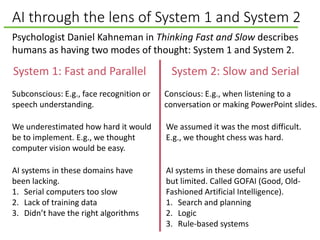
AI through the lens of System 1 and System 2
Psychologist Daniel Kahneman in Thinking Fast and Slow describes
humans as having two modes of thought: System 1 and System 2.
System 1: Fast and Parallel System 2: Slow and Serial
AI systems in these domains are useful
but limited. Called GOFAI (Good, Old-
Fashioned Artificial Intelligence).
1. Search and planning
2. Logic
3. Rule-based systems
AI systems in these domains have
been lacking.
1. Serial computers too slow
2. Lack of training data
3. Didn’t have the right algorithms
Subconscious: E.g., face recognition or
speech understanding.
Conscious: E.g., when listening to a
conversation or making PowerPoint slides.
We underestimated how hard it would
be to implement. E.g., we thought
computer vision would be easy.
We assumed it was the most difficult.
E.g., we thought chess was hard.
AI through the lens of System 1 and System 2
Psychologist Daniel Kahneman in Thinking Fast and Slow describes
humans as having two modes of thought: System 1 and System 2.
System 1: Fast and Parallel System 2: Slow and Serial
AI systems in these domains are useful
but limited. Called GOFAI (Good, Old-
Fashioned Artificial Intelligence).
1. Search and planning
2. Logic
3. Rule-based systems
Subconscious: E.g., face recognition or
speech understanding.
Conscious: E.g., when listening to a
conversation or making PowerPoint slides.
We underestimated how hard it would
be to implement. E.g., we thought
computer vision would be easy.
We assumed it was the most difficult.
E.g., we thought chess was hard.
This has changed
1. We now have GPUs and
distributed computing
2. We have Big Data
3. We have new algorithms [Bengio et
al., 2003; Hinton et al., 2006; Ranzato et
al., 2006]
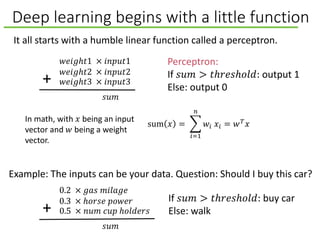
Deep learning begins with a little function
sum 𝑥 =
𝑖=1
𝑛
𝑤𝑖 𝑥𝑖 = 𝑤 𝑇
𝑥
𝑤𝑒𝑖𝑔ℎ𝑡1 × 𝑖𝑛𝑝𝑢𝑡1
𝑤𝑒𝑖𝑔ℎ𝑡2 × 𝑖𝑛𝑝𝑢𝑡2
𝑤𝑒𝑖𝑔ℎ𝑡3 × 𝑖𝑛𝑝𝑢𝑡3+
𝑠𝑢𝑚
It all starts with a humble linear function called a perceptron.
Perceptron:
If 𝑠𝑢𝑚 > 𝑡ℎ𝑟𝑒𝑠ℎ𝑜𝑙𝑑: output 1
Else: output 0
In math, with 𝑥 being an input
vector and 𝑤 being a weight
vector.
Example: The inputs can be your data. Question: Should I buy this car?
0.2 × 𝑔𝑎𝑠 𝑚𝑖𝑙𝑎𝑔𝑒
0.3 × ℎ𝑜𝑟𝑠𝑒 𝑝𝑜𝑤𝑒𝑟
0.5 × 𝑛𝑢𝑚 𝑐𝑢𝑝 ℎ𝑜𝑙𝑑𝑒𝑟𝑠+
𝑠𝑢𝑚
If 𝑠𝑢𝑚 > 𝑡ℎ𝑟𝑒𝑠ℎ𝑜𝑙𝑑: buy car
Else: walk
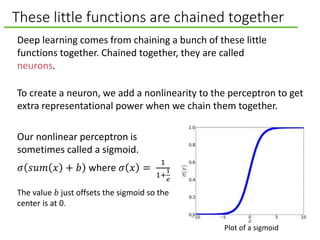
These little functions are chained together
Deep learning comes from chaining a bunch of these little
functions together. Chained together, they are called
neurons.
𝜎 𝑠𝑢𝑚 𝑥 + 𝑏 where 𝜎 𝑥 =
1
1+
1
𝑒
To create a neuron, we add a nonlinearity to the perceptron to get
extra representational power when we chain them together.
Our nonlinear perceptron is
sometimes called a sigmoid.
The value 𝑏 just offsets the sigmoid so the
center is at 0.
Plot of a sigmoid
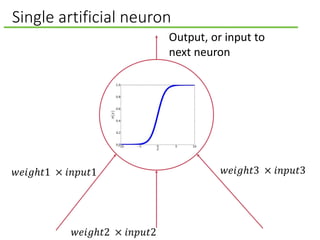
Single artificial neuron
𝑤𝑒𝑖𝑔ℎ𝑡1 × 𝑖𝑛𝑝𝑢𝑡1
𝑤𝑒𝑖𝑔ℎ𝑡2 × 𝑖𝑛𝑝𝑢𝑡2
𝑤𝑒𝑖𝑔ℎ𝑡3 × 𝑖𝑛𝑝𝑢𝑡3
Output, or input to
next neuron
Three-layered neural network
A bunch of neurons chained together is called a neural network.
Layer 2: hidden layer. Called
this because it is neither input
nor output.
[16.2, 17.3, −52.3, 11.1]
Layer 3: output. E.g., cat
or not a cat; buy the car or
walk.
Layer 1: input data. Can
be pixel values or the number
of cup holders.
This network has three layers.
(Some edges lighter
to avoid clutter.)
Training with supervised learning
Supervised Learning: You show the network a bunch of things
with a labels saying what they are, and you want the network to
learn to classify future things without labels.
Example: here are some
pictures of cats. Tell me
which of these other pictures
are of cats.
To train the network, want to
find the weights that
correctly classify all of the
training examples. You hope
it will work on the testing
examples.
Done with an algorithm
called Backpropagation
[Rumelhart et al., 1986].
[16.2, 17.3, −52.3, 11.1]
Deep learning is adding more layers
There is no exact
definition of
what constitutes
“deep learning.”
The number of
weights (parameters)
is generally large.
Some networks have
millions of parameters
that are learned.
[16.2, 17.3, −52.3, 11.1]
(Some edges omitted
to avoid clutter.)
Talk Outline
• Introduction
• Deep learning and natural language processing
• Deep learning and computer vision
• Deep learning and robot actions
• What deep learning still can’t do
• Practical ways you can get started
• Conclusion
• References
Talk Outline
• Introduction
• Deep learning and natural language processing
• Deep learning and computer vision
• Deep learning and robot actions
• What deep learning still can’t do
• Practical ways you can get started
• Conclusion
• References
Recall our standard architecture
Layer 2: hidden layer. Called
this because it is neither input
nor output.
Layer 3: output. E.g., cat
or not a cat; buy the car or
walk.
Layer 1: input data. Can
be pixel values or the number
of cup holders.
[16.2, 17.3, −52.3, 11.1]
Is this a cat?
Neural nets with multiple outputs
Okay, but what kind of cat is it?
𝑃(𝑥)
[16.2, 17.3, −52.3, 11.1]
𝑃 𝑜𝑖 =
𝑒 𝑠𝑢𝑚(𝑥 𝑖)+𝑏 𝑖
𝑗 𝑒 𝑠𝑢𝑚 𝑥 𝑗 +𝑏 𝑗
𝑃(𝑥)𝑃(𝑥) 𝑃(𝑥) 𝑃(𝑥)
Introduce a new node
called a softmax.
Probability a
house cat
Probability a
lion
Probability a
panther
Probability a
bobcat
Where 𝑗 varies over all the
other nodes at that layer.
Just normalize the output 𝑜𝑖
over the sum of the other
outputs.
Learning word vectors
13.2, 5.4, −3.1 [−12.1, 13.1, 0.1] [7.2, 3.2,-1.9]
the man ran
From the sentence, “The man ran fast.”
𝑃(𝑥)𝑃(𝑥) 𝑃(𝑥) 𝑃(𝑥)
Probability
of “fast”
Probability
of “slow”
Probability
of “taco”
Probability
of “bobcat”
Learns a vector for each word based on the “meaning” in the sentence by
trying to predict the next word [Bengio et al., 2003].
Computationally
expensive because you
need a softmax
node for each word in
the vocabulary.
Recent work models the top
layer using a binary tree
[Mikolov et al., 2013].
These numbers updated
along with the weights
and become the vector
representations of the
words.
Comparing vector and symbolic representations
Vector representation
taco = [17.32, 82.9, −4.6, 7.2]
Symbolic representation
taco = 𝑡𝑎𝑐𝑜
• Vectors have a similarity score.
• A taco is not a burrito but similar.
• Symbols can be the same or not.
• A taco is just as different from a
burrito as a Toyota.
• Vectors have internal structure
[Mikolov et al., 2013].
• Italy – Rome = France – Paris
• King – Queen = Man – Woman
• Symbols have no structure.
• Symbols are arbitrarily assigned.
• Meaning relative to other symbols.
• Vectors are grounded in
experience.
• Meaning relative to predictions.
• Ability to learn representations
makes agents less brittle.
Learning vectors of longer text
[33.1, 7.5, 11.2] 13.2, 5.4, −3.1 [−12.1, 13.1, 0.1] [7.2, 3.2,-1.9]
<current paragraph> the man ran
From the sentence, “The man ran fast.”
𝑃(𝑥)𝑃(𝑥) 𝑃(𝑥) 𝑃(𝑥)
Probability
of “fast”
Probability
of “slow”
Probability
of “taco”
Probability
of “bobcat”
The “meaning” of a
paragraph is encoded in
a vector that allows you
to predict the next word
in the paragraph using
already learned word
vectors [Le and Mikolov,
2014].
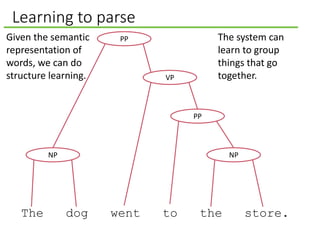
Learning to parse
The dog went to the store.
NP NP
PP
VP
PPGiven the semantic
representation of
words, we can do
structure learning.
The system can
learn to group
things that go
together.
Learning to parse
[1.1,1.3] [8.1, 2.1] [2.6, 8.4] [2.0, 7.1] [8.9, 2.4] [7.1, 2.2]
[1.1, 1.3] [1.1, 1.3]
[7.3, 9.8]
[3.2, 8.8]
[9.1, 0.2]Given the semantic
representation of
words we can do
structure learning.
Socher et al. [2010]
learned word
vectors and then
used the Penn Tree
Bank to train a
parser that
encodes semantic
meaning.
The dog went to the store.
Talk Outline
• Introduction
• Deep learning and natural language processing
• Deep learning and computer vision
• Deep learning and robot actions
• What deep learning still can’t do
• Practical ways you can get started
• Conclusion
• References
Talk Outline
• Introduction
• Deep learning and natural language processing
• Deep learning and computer vision
• Deep learning and robot actions
• What deep learning still can’t do
• Practical ways you can get started
• Conclusion
• References
Vision is hard
• Even harder for 3D
objects.
• You move a bit, and
everything changes.
72 ⋯ 91
⋮ ⋱ ⋮
16 ⋯ 40
How a computer sees an image.
Example from MNIST
handwritten digit dataset
[LeCun and Cortes, 1998].
Vision is hard because images are big matrices of numbers.
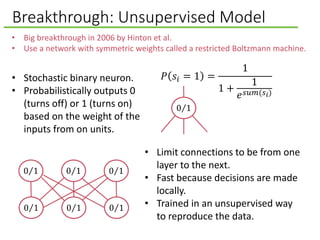
Breakthrough: Unsupervised Model
• Big breakthrough in 2006 by Hinton et al.
• Use a network with symmetric weights called a restricted Boltzmann machine.
• Stochastic binary neuron.
• Probabilistically outputs 0
(turns off) or 1 (turns on)
based on the weight of the
inputs from on units.
0 1
𝑃 𝑠𝑖 = 1 =
1
1 +
1
𝑒 𝑠𝑢𝑚(𝑠 𝑖)
• Limit connections to be from one
layer to the next.
• Fast because decisions are made
locally.
• Trained in an unsupervised way
to reproduce the data.
0 1 0 1 0 1
0 1 0 1 0 1
Stack up the layers to make a deep network
Input data
Hidden
The output of each layer
becomes the input to the
next layer [Hinton et al.,
2006].
See video starting at
second 45
https://www.coursera.org
/course/neuralnets
0 1 0 1 0 1
0 1 0 1 0 1
Input data
Hidden
0 1 0 1 0 1
0 1 0 1 0 1
Hidden layer becomes
input data of next layer.
Computer vision, scaling up
Unsupervised learning was scaled up
by Honglak Lee et al. [2009] to learn
high-level visual features.
[Lee et al., 2009]
Further scaled up by Quoc Le et al.
[2012].
• Used 1,000 machines (16,000
cores) running for 3 days to train 1
billion weights by watching
YouTube videos.
• The network learned to identify
cats.
• The network wasn’t told to look
for cats, it naturally learned that
cats were integral to online
viewing.
• Video on the topic at NYT
http://www.nytimes.com/2012/06/26/tec
hnology/in-a-big-network-of-computers-
evidence-of-machine-learning.html
Why is this significant?
To have a grounded understanding
of its environment, an agent must
be able to acquire representations
through experience [Pierce et al.,
1997; Mugan et al., 2012].
Without a grounded understanding,
the agent is limited to what was
programmed in.
We saw that unsupervised learning
could be used to learn the meanings of words, grounded in the
experience of reading.
Using these deep Boltzmann machines, machines can learn
to see the world through experience.
Limit connections and duplicate parameters
Convolutional neural networks build in
a kind of feature invariance. They take
advantage the layout of the pixels.
[16.2, 17.3, −52.3, 11.1]
With the layers and
topology, our networks are
starting to look a little like
the visual cortex. Although,
we still don’t fully
understand the visual
cortex.
Different areas
of the image go
to different
parts of the
neural network,
and weights are
shared.
Recent deep vision networks
ImageNet http://www.image-net.org/ is a huge collection of images
corresponding to the nouns of the WordNet hierarchy. There are hundreds to
thousands of images per noun.
2012 – Deep Learning begins to dominate image recognition
Krizhevsky et al. [2012] got 16% error on recognizing objects, when
before the best error was 26%. They used a convolutional neural
network.
2015 – Deep Learning surpasses human level performance
He et al. [2015] surpassed human level performance on recognizing
images of objects.* Computers seem to have an advantage when the
classes of objects are fine grained, such as multiple species of dogs.
Closing note on computer vision: Hinton points out that modern networks can just
work with top down (supervised learning) if the network is small enough relative to
the amount of the training data; but the goal of AI is broad-based understanding,
and there will likely never be enough labeled training data for general intelligence.
*But deep learning can be easily fooled [Nguyen et al., 2014]. Enlightening video at https://www.youtube.com/watch?v=M2IebCN9Ht4.
Talk Outline
• Introduction
• Deep learning and natural language processing
• Deep learning and computer vision
• Deep learning and robot actions
• What deep learning still can’t do
• Practical ways you can get started
• Conclusion
• References
Talk Outline
• Introduction
• Deep learning and natural language processing
• Deep learning and computer vision
• Deep learning and robot actions
• What deep learning still can’t do
• Practical ways you can get started
• Conclusion
• References
A stamping in of behavior
When we think of doing things, we think of conscious planning
with System 2.
Imagine trying to get to Seattle.
• Get to the airport. How? Take a taxi. How? Call a taxi. How?
Find my phone.
• Some behaviors arise more from a
a gradual stamping in [Thorndike,
1898].
• Became the study of Behaviorism
[Skinner, 1953] (see Skinner box
on the right).
• Formulated into artificial
intelligence as Reinforcement
Learning [Sutton and Barto, 1998]. By Andreas1 (Adapted from Image:Boite skinner.jpg) [GFDL
(http://www.gnu.org/copyleft/fdl.html) or CC-BY-SA-3.0
(http://creativecommons.org/licenses/by-sa/3.0/)], via
Wikimedia Commons
A “Skinner box”
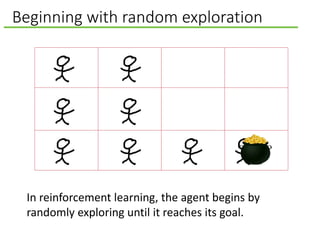
Beginning with random exploration
In reinforcement learning, the agent begins by
randomly exploring until it reaches its goal.
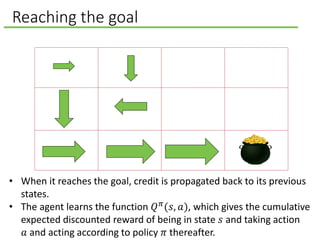
• When it reaches the goal, credit is propagated back to its previous
states.
• The agent learns the function 𝑄 𝜋(𝑠, 𝑎), which gives the cumulative
expected discounted reward of being in state 𝑠 and taking action
𝑎 and acting according to policy 𝜋 thereafter.
Reaching the goal
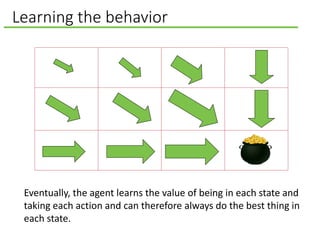
Eventually, the agent learns the value of being in each state and
taking each action and can therefore always do the best thing in
each state.
Learning the behavior
Playing Atari with Deep Learning
Input, last four frames, where each frame
is downsampled to 84 by 84 pixels.
[Mnih et al., 2013]
represent the
state-action value
function 𝑄 𝑠, 𝑎 as
a convolutional
neural network.
𝑃(𝑥)𝑃(𝑥) 𝑃(𝑥) 𝑃(𝑥)
Value of
moving left
Value of
moving right
Value of
shooting
Value of
reloading
In [Mnih et al., 2013],
this is actually three
hidden layers.
See some videos at
http://mashable.com/2015/02
/25/computer-wins-at-atari-
games/
Talk Outline
• Introduction
• Deep learning and natural language processing
• Deep learning and computer vision
• Deep learning and robot actions
• What deep learning still can’t do
• Practical ways you can get started
• Conclusion
• References
Talk Outline
• Introduction
• Deep learning and natural language processing
• Deep learning and computer vision
• Deep learning and robot actions
• What deep learning still can’t do
• Practical ways you can get started
• Conclusion
• References
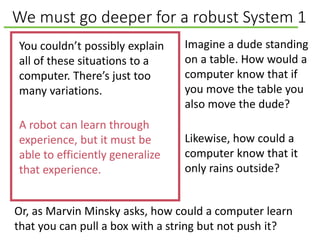
We must go deeper for a robust System 1
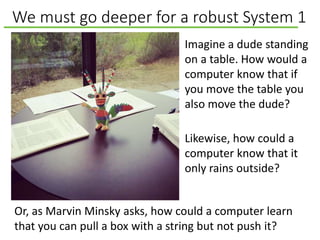
Imagine a dude standing
on a table. How would a
computer know that if
you move the table you
also move the dude?
Likewise, how could a
computer know that it
only rains outside?
Or, as Marvin Minsky asks, how could a computer learn
that you can pull a box with a string but not push it?
We must go deeper for a robust System 1
Imagine a dude standing
on a table. How would a
computer know that if
you move the table you
also move the dude?
Likewise, how could a
computer know that it
only rains outside?
Or, as Marvin Minsky asks, how could a computer learn
that you can pull a box with a string but not push it?
You couldn’t possibly explain
all of these situations to a
computer. There’s just too
many variations.
A robot can learn through
experience, but it must be
able to efficiently generalize
that experience.
Abstract thinking through image schemas
Humans efficiently generalize experience using abstractions called
image schemas [Johnson, 1987]. Image schemas map experience
to conceptual structure.
Developmental psychologist Jean Mandler argues that some
image schemas are formed before children begin to talk, and that
language is eventually built onto this base set of schemas [2004].
• Consider what it means for an object to contain another object,
such as for a box to contain a ball.
• The container constrains the movement of the object inside.
If the container is moved, the contained object moves.
• These constraints are represented by the container image
schema.
• Other image schemas from Mark Johnson’s book, The Body in the Mind:
path, counterforce, restraint, removal, enablement, attraction, link,
cycle, near-far, scale, part-whole, full-empty, matching, surface, object,
and collection.
Abstract thinking through metaphors
Love is a journey. Love is war.
Lakoff and Johnson [1980] argue that we understand abstract
concepts through metaphors to physical experience.
Neural networks will likely require advances in both architecture
and size to reach this level of abstraction.
For example, a container can be more than
a way of understanding physical
constraints, it can be a metaphor used to
understand the abstract concept of what
an argument is. You could say that
someone’s argument doesn’t hold water, or
you could say that it is empty, or you could
say that the argument has holes in it.
Talk Outline
• Introduction
• Deep learning and natural language processing
• Deep learning and computer vision
• Deep learning and robot actions
• What deep learning still can’t do
• Practical ways you can get started
• Conclusion
• References
Talk Outline
• Introduction
• Deep learning and natural language processing
• Deep learning and computer vision
• Deep learning and robot actions
• What deep learning still can’t do
• Practical ways you can get started
• Conclusion
• References
Some code to get you started
Google Word2Vec: they looked at (3 billion documents) and
created 300 long vectors.
https://code.google.com/p/word2vec/
Gensim has an implementation of the learning algorithm in
Python.
http://radimrehurek.com/gensim/models/word2vec.html
Theano is a general-purpose deep learning implementation with
great documentation and tutorials.
http://deeplearning.net/software/theano/
Best learning resources
Best place to start. Hinton’s Coursera Course. Get it right from
the horse’s mouth. He explains things well.
https://www.coursera.org/course/neuralnets
Online textbook in preparation for deep learning from Yoshua
Bengio and friends. Clear and understandable.
http://www.iro.umontreal.ca/~bengioy/dlbook/
Introduction to programming deep learning with Python and
Theano. It's clear, detailed, and entertaining. 1-hour talk.
http://www.rosebt.com/blog/introduction-to-deep-learning-
with-python
Talk Outline
• Introduction
• Deep learning and natural language processing
• Deep learning and computer vision
• Deep learning and robot actions
• What deep learning still can’t do
• Practical ways you can get started
• Conclusion
• References
Talk Outline
• Introduction
• Deep learning and natural language processing
• Deep learning and computer vision
• Deep learning and robot actions
• What deep learning still can’t do
• Practical ways you can get started
• Conclusion
• References
What deep learning means for artificial intelligence
Deep learning can allow a robot to autonomously
learn a representation through experience with the
world.
When its representation is grounded in experience,
a robot can be autonomous without having to rely
on the intentionality of the human designer.
If we can continue to scale up deep learning to
represent ever higher levels of abstraction, our
robots may view the world in an alien way, but
they will be independently intelligent.
References
1. Yoshua Bengio, Réjean Ducharme, Pascal Vincent, and Christian Janvin. A neural probabilistic
language model. The Journal of Machine Learning Research, 3:1137–1155, 2003.
2. Kaiming He, Xiangyu Zhang, Shaoqing Ren, and Jian Sun. Delving deep into rectifiers:
Surpassing human-level performance on imagenet classification. arXiv preprint
arXiv:1502.01852, 2015.
3. Geoffrey Hinton, Simon Osindero, and Yee-Whye Teh. A fast learning algorithm for deep
belief nets. Neural computation, 18(7):1527–1554, 2006.
4. M. Johnson. The Body in the Mind: The Bodily Basis of Meaning, Imagination, and Reason.
University of Chicago Press, Chicago, Illinois, USA, 1987.
5. Alex Krizhevsky, Ilya Sutskever, and Geoffrey E Hinton. ImageNet classification with deep
convolutional neural networks. In Advances in neural information processing systems, pages
1097–1105, 2012.
6. G. Lakoff and M. Johnson. Metaphors We Live By. University of Chicago Press, Chicago, 1980.
7. Quoc Le and Tomas Mikolov. Distributed representations of sentences and documents. In
Proceedings of the 31st International Conference on Machine Learning (ICML-14), pages
1188–1196, 2014.
8. Q.V. Le, M.A. Ranzato, R. Monga, M. Devin, K. Chen, G.S. Corrado, J. Dean, and A. Ng. Building
high-level features using large scale unsupervised learning. In International Conference on
Machine Learning (ICML), 2012.
9. Yann LeCun and Corinna Cortes. The mnist database of handwritten digits, 1998.
References (continued)
10. Honglak Lee, Roger Grosse, Rajesh Ranganath, and Andrew Y Ng. Convolutional deep belief
networks for scalable unsupervised learning of hierarchical representations. In Proceedings
of the 26th Annual International Conference on Machine Learning, pages 609–616. ACM,
2009.
11. J. Mandler. The Foundations of Mind, Origins of Conceptual Thought. Oxford University
Press, New York, New York, USA, 2004.
12. Tomas Mikolov, Ilya Sutskever, Kai Chen, Greg S Corrado, and Jeff Dean. Distributed
representations of words and phrases and their compositionality. In Advances in Neural
Information Processing Systems, pages 3111–3119, 2013.
13. Volodymyr Mnih, Koray Kavukcuoglu, David Silver, Alex Graves, Ioannis Antonoglou, Daan
Wierstra, and Martin Riedmiller. Playing Atari with deep reinforcement learning. arXiv
preprint arXiv:1312.5602, 2013.
14. J. Mugan and B. Kuipers. Autonomous learning of high-level states and actions in
continuous environments. IEEE Trans. Autonomous Mental Development, 4(1):70–86,
2012.
15. Anh Nguyen, Jason Yosinski, and Jeff Clune. Deep neural networks are easily fooled: High
confidence predictions for unrecognizable images. arXiv preprint arXiv:1412.1897, 2014.
16. D. M. Pierce and B. J. Kuipers. Map learning with uninterpreted sensors and effectors.
92:169–227, 1997.
17. Marc’Aurelio Ranzato, Christopher Poultney, Sumit Chopra, and Yann LeCun. Efficient
learning of sparse representations with an energy-based model. In Advances in neural
information processing systems, pages 1137–1144, 2006.
References (continued)
18. David E Rumelhart, Geoffrey E Hinton, and Ronald J Williams. Parallel Distributed
Processing: Explorations in the Microstructure of Cognition, Volume 2, chapter Learning
representations by error propagation, pages 3–18–362. 1986.
19. Burrhus Frederic Skinner. Science and human behavior. Simon and Schuster, 1953.
20. Richard Socher, Christopher D Manning, and Andrew Y Ng. Learning continuous phrase
representations and syntactic parsing with recursive neural networks. In Proceedings of the
NIPS-2010 Deep Learning and Unsupervised Feature Learning Workshop, pages 1–9, 2010.
21. R. S. Sutton and A. G. Barto. Reinforcement Learning. MIT Press, Cambridge MA, 1998.
22. E.L. Thorndike. Animal intelligence: an experimental study of the associative processes in
animals. 1898.
Thanks for listening
Jonathan Mugan
@jmugan
www.jonathanmugan.com

What Deep Learning Means for Artificial Intelligence

  • 1.
    What Deep LearningMeans for Artificial Intelligence Jonathan Mugan Austin Data Geeks March 11, 2015 @jmugan, www.jonathanmugan.com
  • 2.
    AI through thelens of System 1 and System 2 Psychologist Daniel Kahneman in Thinking Fast and Slow describes humans as having two modes of thought: System 1 and System 2. System 1: Fast and Parallel System 2: Slow and Serial AI systems in these domains are useful but limited. Called GOFAI (Good, Old- Fashioned Artificial Intelligence). 1. Search and planning 2. Logic 3. Rule-based systems AI systems in these domains have been lacking. 1. Serial computers too slow 2. Lack of training data 3. Didn’t have the right algorithms Subconscious: E.g., face recognition or speech understanding. Conscious: E.g., when listening to a conversation or making PowerPoint slides. We underestimated how hard it would be to implement. E.g., we thought computer vision would be easy. We assumed it was the most difficult. E.g., we thought chess was hard.
  • 3.
    AI through thelens of System 1 and System 2 Psychologist Daniel Kahneman in Thinking Fast and Slow describes humans as having two modes of thought: System 1 and System 2. System 1: Fast and Parallel System 2: Slow and Serial AI systems in these domains are useful but limited. Called GOFAI (Good, Old- Fashioned Artificial Intelligence). 1. Search and planning 2. Logic 3. Rule-based systems Subconscious: E.g., face recognition or speech understanding. Conscious: E.g., when listening to a conversation or making PowerPoint slides. We underestimated how hard it would be to implement. E.g., we thought computer vision would be easy. We assumed it was the most difficult. E.g., we thought chess was hard. This has changed 1. We now have GPUs and distributed computing 2. We have Big Data 3. We have new algorithms [Bengio et al., 2003; Hinton et al., 2006; Ranzato et al., 2006]
  • 4.
    Deep learning beginswith a little function sum 𝑥 = 𝑖=1 𝑛 𝑤𝑖 𝑥𝑖 = 𝑤 𝑇 𝑥 𝑤𝑒𝑖𝑔ℎ𝑡1 × 𝑖𝑛𝑝𝑢𝑡1 𝑤𝑒𝑖𝑔ℎ𝑡2 × 𝑖𝑛𝑝𝑢𝑡2 𝑤𝑒𝑖𝑔ℎ𝑡3 × 𝑖𝑛𝑝𝑢𝑡3+ 𝑠𝑢𝑚 It all starts with a humble linear function called a perceptron. Perceptron: If 𝑠𝑢𝑚 > 𝑡ℎ𝑟𝑒𝑠ℎ𝑜𝑙𝑑: output 1 Else: output 0 In math, with 𝑥 being an input vector and 𝑤 being a weight vector. Example: The inputs can be your data. Question: Should I buy this car? 0.2 × 𝑔𝑎𝑠 𝑚𝑖𝑙𝑎𝑔𝑒 0.3 × ℎ𝑜𝑟𝑠𝑒 𝑝𝑜𝑤𝑒𝑟 0.5 × 𝑛𝑢𝑚 𝑐𝑢𝑝 ℎ𝑜𝑙𝑑𝑒𝑟𝑠+ 𝑠𝑢𝑚 If 𝑠𝑢𝑚 > 𝑡ℎ𝑟𝑒𝑠ℎ𝑜𝑙𝑑: buy car Else: walk
  • 5.
    These little functionsare chained together Deep learning comes from chaining a bunch of these little functions together. Chained together, they are called neurons. 𝜎 𝑠𝑢𝑚 𝑥 + 𝑏 where 𝜎 𝑥 = 1 1+ 1 𝑒 To create a neuron, we add a nonlinearity to the perceptron to get extra representational power when we chain them together. Our nonlinear perceptron is sometimes called a sigmoid. The value 𝑏 just offsets the sigmoid so the center is at 0. Plot of a sigmoid
  • 6.
    Single artificial neuron 𝑤𝑒𝑖𝑔ℎ𝑡1× 𝑖𝑛𝑝𝑢𝑡1 𝑤𝑒𝑖𝑔ℎ𝑡2 × 𝑖𝑛𝑝𝑢𝑡2 𝑤𝑒𝑖𝑔ℎ𝑡3 × 𝑖𝑛𝑝𝑢𝑡3 Output, or input to next neuron
  • 7.
    Three-layered neural network Abunch of neurons chained together is called a neural network. Layer 2: hidden layer. Called this because it is neither input nor output. [16.2, 17.3, −52.3, 11.1] Layer 3: output. E.g., cat or not a cat; buy the car or walk. Layer 1: input data. Can be pixel values or the number of cup holders. This network has three layers. (Some edges lighter to avoid clutter.)
  • 8.
    Training with supervisedlearning Supervised Learning: You show the network a bunch of things with a labels saying what they are, and you want the network to learn to classify future things without labels. Example: here are some pictures of cats. Tell me which of these other pictures are of cats. To train the network, want to find the weights that correctly classify all of the training examples. You hope it will work on the testing examples. Done with an algorithm called Backpropagation [Rumelhart et al., 1986]. [16.2, 17.3, −52.3, 11.1]
  • 9.
    Deep learning isadding more layers There is no exact definition of what constitutes “deep learning.” The number of weights (parameters) is generally large. Some networks have millions of parameters that are learned. [16.2, 17.3, −52.3, 11.1] (Some edges omitted to avoid clutter.)
  • 10.
    Talk Outline • Introduction •Deep learning and natural language processing • Deep learning and computer vision • Deep learning and robot actions • What deep learning still can’t do • Practical ways you can get started • Conclusion • References
  • 11.
    Talk Outline • Introduction •Deep learning and natural language processing • Deep learning and computer vision • Deep learning and robot actions • What deep learning still can’t do • Practical ways you can get started • Conclusion • References
  • 12.
    Recall our standardarchitecture Layer 2: hidden layer. Called this because it is neither input nor output. Layer 3: output. E.g., cat or not a cat; buy the car or walk. Layer 1: input data. Can be pixel values or the number of cup holders. [16.2, 17.3, −52.3, 11.1] Is this a cat?
  • 13.
    Neural nets withmultiple outputs Okay, but what kind of cat is it? 𝑃(𝑥) [16.2, 17.3, −52.3, 11.1] 𝑃 𝑜𝑖 = 𝑒 𝑠𝑢𝑚(𝑥 𝑖)+𝑏 𝑖 𝑗 𝑒 𝑠𝑢𝑚 𝑥 𝑗 +𝑏 𝑗 𝑃(𝑥)𝑃(𝑥) 𝑃(𝑥) 𝑃(𝑥) Introduce a new node called a softmax. Probability a house cat Probability a lion Probability a panther Probability a bobcat Where 𝑗 varies over all the other nodes at that layer. Just normalize the output 𝑜𝑖 over the sum of the other outputs.
  • 14.
    Learning word vectors 13.2,5.4, −3.1 [−12.1, 13.1, 0.1] [7.2, 3.2,-1.9] the man ran From the sentence, “The man ran fast.” 𝑃(𝑥)𝑃(𝑥) 𝑃(𝑥) 𝑃(𝑥) Probability of “fast” Probability of “slow” Probability of “taco” Probability of “bobcat” Learns a vector for each word based on the “meaning” in the sentence by trying to predict the next word [Bengio et al., 2003]. Computationally expensive because you need a softmax node for each word in the vocabulary. Recent work models the top layer using a binary tree [Mikolov et al., 2013]. These numbers updated along with the weights and become the vector representations of the words.
  • 15.
    Comparing vector andsymbolic representations Vector representation taco = [17.32, 82.9, −4.6, 7.2] Symbolic representation taco = 𝑡𝑎𝑐𝑜 • Vectors have a similarity score. • A taco is not a burrito but similar. • Symbols can be the same or not. • A taco is just as different from a burrito as a Toyota. • Vectors have internal structure [Mikolov et al., 2013]. • Italy – Rome = France – Paris • King – Queen = Man – Woman • Symbols have no structure. • Symbols are arbitrarily assigned. • Meaning relative to other symbols. • Vectors are grounded in experience. • Meaning relative to predictions. • Ability to learn representations makes agents less brittle.
  • 16.
    Learning vectors oflonger text [33.1, 7.5, 11.2] 13.2, 5.4, −3.1 [−12.1, 13.1, 0.1] [7.2, 3.2,-1.9] <current paragraph> the man ran From the sentence, “The man ran fast.” 𝑃(𝑥)𝑃(𝑥) 𝑃(𝑥) 𝑃(𝑥) Probability of “fast” Probability of “slow” Probability of “taco” Probability of “bobcat” The “meaning” of a paragraph is encoded in a vector that allows you to predict the next word in the paragraph using already learned word vectors [Le and Mikolov, 2014].
  • 17.
    Learning to parse Thedog went to the store. NP NP PP VP PPGiven the semantic representation of words, we can do structure learning. The system can learn to group things that go together.
  • 18.
    Learning to parse [1.1,1.3][8.1, 2.1] [2.6, 8.4] [2.0, 7.1] [8.9, 2.4] [7.1, 2.2] [1.1, 1.3] [1.1, 1.3] [7.3, 9.8] [3.2, 8.8] [9.1, 0.2]Given the semantic representation of words we can do structure learning. Socher et al. [2010] learned word vectors and then used the Penn Tree Bank to train a parser that encodes semantic meaning. The dog went to the store.
  • 19.
    Talk Outline • Introduction •Deep learning and natural language processing • Deep learning and computer vision • Deep learning and robot actions • What deep learning still can’t do • Practical ways you can get started • Conclusion • References
  • 20.
    Talk Outline • Introduction •Deep learning and natural language processing • Deep learning and computer vision • Deep learning and robot actions • What deep learning still can’t do • Practical ways you can get started • Conclusion • References
  • 21.
    Vision is hard •Even harder for 3D objects. • You move a bit, and everything changes. 72 ⋯ 91 ⋮ ⋱ ⋮ 16 ⋯ 40 How a computer sees an image. Example from MNIST handwritten digit dataset [LeCun and Cortes, 1998]. Vision is hard because images are big matrices of numbers.
  • 22.
    Breakthrough: Unsupervised Model •Big breakthrough in 2006 by Hinton et al. • Use a network with symmetric weights called a restricted Boltzmann machine. • Stochastic binary neuron. • Probabilistically outputs 0 (turns off) or 1 (turns on) based on the weight of the inputs from on units. 0 1 𝑃 𝑠𝑖 = 1 = 1 1 + 1 𝑒 𝑠𝑢𝑚(𝑠 𝑖) • Limit connections to be from one layer to the next. • Fast because decisions are made locally. • Trained in an unsupervised way to reproduce the data. 0 1 0 1 0 1 0 1 0 1 0 1
  • 23.
    Stack up thelayers to make a deep network Input data Hidden The output of each layer becomes the input to the next layer [Hinton et al., 2006]. See video starting at second 45 https://www.coursera.org /course/neuralnets 0 1 0 1 0 1 0 1 0 1 0 1 Input data Hidden 0 1 0 1 0 1 0 1 0 1 0 1 Hidden layer becomes input data of next layer.
  • 24.
    Computer vision, scalingup Unsupervised learning was scaled up by Honglak Lee et al. [2009] to learn high-level visual features. [Lee et al., 2009] Further scaled up by Quoc Le et al. [2012]. • Used 1,000 machines (16,000 cores) running for 3 days to train 1 billion weights by watching YouTube videos. • The network learned to identify cats. • The network wasn’t told to look for cats, it naturally learned that cats were integral to online viewing. • Video on the topic at NYT http://www.nytimes.com/2012/06/26/tec hnology/in-a-big-network-of-computers- evidence-of-machine-learning.html
  • 25.
    Why is thissignificant? To have a grounded understanding of its environment, an agent must be able to acquire representations through experience [Pierce et al., 1997; Mugan et al., 2012]. Without a grounded understanding, the agent is limited to what was programmed in. We saw that unsupervised learning could be used to learn the meanings of words, grounded in the experience of reading. Using these deep Boltzmann machines, machines can learn to see the world through experience.
  • 26.
    Limit connections andduplicate parameters Convolutional neural networks build in a kind of feature invariance. They take advantage the layout of the pixels. [16.2, 17.3, −52.3, 11.1] With the layers and topology, our networks are starting to look a little like the visual cortex. Although, we still don’t fully understand the visual cortex. Different areas of the image go to different parts of the neural network, and weights are shared.
  • 27.
    Recent deep visionnetworks ImageNet http://www.image-net.org/ is a huge collection of images corresponding to the nouns of the WordNet hierarchy. There are hundreds to thousands of images per noun. 2012 – Deep Learning begins to dominate image recognition Krizhevsky et al. [2012] got 16% error on recognizing objects, when before the best error was 26%. They used a convolutional neural network. 2015 – Deep Learning surpasses human level performance He et al. [2015] surpassed human level performance on recognizing images of objects.* Computers seem to have an advantage when the classes of objects are fine grained, such as multiple species of dogs. Closing note on computer vision: Hinton points out that modern networks can just work with top down (supervised learning) if the network is small enough relative to the amount of the training data; but the goal of AI is broad-based understanding, and there will likely never be enough labeled training data for general intelligence. *But deep learning can be easily fooled [Nguyen et al., 2014]. Enlightening video at https://www.youtube.com/watch?v=M2IebCN9Ht4.
  • 28.
    Talk Outline • Introduction •Deep learning and natural language processing • Deep learning and computer vision • Deep learning and robot actions • What deep learning still can’t do • Practical ways you can get started • Conclusion • References
  • 29.
    Talk Outline • Introduction •Deep learning and natural language processing • Deep learning and computer vision • Deep learning and robot actions • What deep learning still can’t do • Practical ways you can get started • Conclusion • References
  • 30.
    A stamping inof behavior When we think of doing things, we think of conscious planning with System 2. Imagine trying to get to Seattle. • Get to the airport. How? Take a taxi. How? Call a taxi. How? Find my phone. • Some behaviors arise more from a a gradual stamping in [Thorndike, 1898]. • Became the study of Behaviorism [Skinner, 1953] (see Skinner box on the right). • Formulated into artificial intelligence as Reinforcement Learning [Sutton and Barto, 1998]. By Andreas1 (Adapted from Image:Boite skinner.jpg) [GFDL (http://www.gnu.org/copyleft/fdl.html) or CC-BY-SA-3.0 (http://creativecommons.org/licenses/by-sa/3.0/)], via Wikimedia Commons A “Skinner box”
  • 31.
    Beginning with randomexploration In reinforcement learning, the agent begins by randomly exploring until it reaches its goal.
  • 32.
    • When itreaches the goal, credit is propagated back to its previous states. • The agent learns the function 𝑄 𝜋(𝑠, 𝑎), which gives the cumulative expected discounted reward of being in state 𝑠 and taking action 𝑎 and acting according to policy 𝜋 thereafter. Reaching the goal
  • 33.
    Eventually, the agentlearns the value of being in each state and taking each action and can therefore always do the best thing in each state. Learning the behavior
  • 34.
    Playing Atari withDeep Learning Input, last four frames, where each frame is downsampled to 84 by 84 pixels. [Mnih et al., 2013] represent the state-action value function 𝑄 𝑠, 𝑎 as a convolutional neural network. 𝑃(𝑥)𝑃(𝑥) 𝑃(𝑥) 𝑃(𝑥) Value of moving left Value of moving right Value of shooting Value of reloading In [Mnih et al., 2013], this is actually three hidden layers. See some videos at http://mashable.com/2015/02 /25/computer-wins-at-atari- games/
  • 35.
    Talk Outline • Introduction •Deep learning and natural language processing • Deep learning and computer vision • Deep learning and robot actions • What deep learning still can’t do • Practical ways you can get started • Conclusion • References
  • 36.
    Talk Outline • Introduction •Deep learning and natural language processing • Deep learning and computer vision • Deep learning and robot actions • What deep learning still can’t do • Practical ways you can get started • Conclusion • References
  • 37.
    We must godeeper for a robust System 1 Imagine a dude standing on a table. How would a computer know that if you move the table you also move the dude? Likewise, how could a computer know that it only rains outside? Or, as Marvin Minsky asks, how could a computer learn that you can pull a box with a string but not push it?
  • 38.
    We must godeeper for a robust System 1 Imagine a dude standing on a table. How would a computer know that if you move the table you also move the dude? Likewise, how could a computer know that it only rains outside? Or, as Marvin Minsky asks, how could a computer learn that you can pull a box with a string but not push it? You couldn’t possibly explain all of these situations to a computer. There’s just too many variations. A robot can learn through experience, but it must be able to efficiently generalize that experience.
  • 39.
    Abstract thinking throughimage schemas Humans efficiently generalize experience using abstractions called image schemas [Johnson, 1987]. Image schemas map experience to conceptual structure. Developmental psychologist Jean Mandler argues that some image schemas are formed before children begin to talk, and that language is eventually built onto this base set of schemas [2004]. • Consider what it means for an object to contain another object, such as for a box to contain a ball. • The container constrains the movement of the object inside. If the container is moved, the contained object moves. • These constraints are represented by the container image schema. • Other image schemas from Mark Johnson’s book, The Body in the Mind: path, counterforce, restraint, removal, enablement, attraction, link, cycle, near-far, scale, part-whole, full-empty, matching, surface, object, and collection.
  • 40.
    Abstract thinking throughmetaphors Love is a journey. Love is war. Lakoff and Johnson [1980] argue that we understand abstract concepts through metaphors to physical experience. Neural networks will likely require advances in both architecture and size to reach this level of abstraction. For example, a container can be more than a way of understanding physical constraints, it can be a metaphor used to understand the abstract concept of what an argument is. You could say that someone’s argument doesn’t hold water, or you could say that it is empty, or you could say that the argument has holes in it.
  • 41.
    Talk Outline • Introduction •Deep learning and natural language processing • Deep learning and computer vision • Deep learning and robot actions • What deep learning still can’t do • Practical ways you can get started • Conclusion • References
  • 42.
    Talk Outline • Introduction •Deep learning and natural language processing • Deep learning and computer vision • Deep learning and robot actions • What deep learning still can’t do • Practical ways you can get started • Conclusion • References
  • 43.
    Some code toget you started Google Word2Vec: they looked at (3 billion documents) and created 300 long vectors. https://code.google.com/p/word2vec/ Gensim has an implementation of the learning algorithm in Python. http://radimrehurek.com/gensim/models/word2vec.html Theano is a general-purpose deep learning implementation with great documentation and tutorials. http://deeplearning.net/software/theano/
  • 44.
    Best learning resources Bestplace to start. Hinton’s Coursera Course. Get it right from the horse’s mouth. He explains things well. https://www.coursera.org/course/neuralnets Online textbook in preparation for deep learning from Yoshua Bengio and friends. Clear and understandable. http://www.iro.umontreal.ca/~bengioy/dlbook/ Introduction to programming deep learning with Python and Theano. It's clear, detailed, and entertaining. 1-hour talk. http://www.rosebt.com/blog/introduction-to-deep-learning- with-python
  • 45.
    Talk Outline • Introduction •Deep learning and natural language processing • Deep learning and computer vision • Deep learning and robot actions • What deep learning still can’t do • Practical ways you can get started • Conclusion • References
  • 46.
    Talk Outline • Introduction •Deep learning and natural language processing • Deep learning and computer vision • Deep learning and robot actions • What deep learning still can’t do • Practical ways you can get started • Conclusion • References
  • 47.
    What deep learningmeans for artificial intelligence Deep learning can allow a robot to autonomously learn a representation through experience with the world. When its representation is grounded in experience, a robot can be autonomous without having to rely on the intentionality of the human designer. If we can continue to scale up deep learning to represent ever higher levels of abstraction, our robots may view the world in an alien way, but they will be independently intelligent.
  • 48.
    References 1. Yoshua Bengio,Réjean Ducharme, Pascal Vincent, and Christian Janvin. A neural probabilistic language model. The Journal of Machine Learning Research, 3:1137–1155, 2003. 2. Kaiming He, Xiangyu Zhang, Shaoqing Ren, and Jian Sun. Delving deep into rectifiers: Surpassing human-level performance on imagenet classification. arXiv preprint arXiv:1502.01852, 2015. 3. Geoffrey Hinton, Simon Osindero, and Yee-Whye Teh. A fast learning algorithm for deep belief nets. Neural computation, 18(7):1527–1554, 2006. 4. M. Johnson. The Body in the Mind: The Bodily Basis of Meaning, Imagination, and Reason. University of Chicago Press, Chicago, Illinois, USA, 1987. 5. Alex Krizhevsky, Ilya Sutskever, and Geoffrey E Hinton. ImageNet classification with deep convolutional neural networks. In Advances in neural information processing systems, pages 1097–1105, 2012. 6. G. Lakoff and M. Johnson. Metaphors We Live By. University of Chicago Press, Chicago, 1980. 7. Quoc Le and Tomas Mikolov. Distributed representations of sentences and documents. In Proceedings of the 31st International Conference on Machine Learning (ICML-14), pages 1188–1196, 2014. 8. Q.V. Le, M.A. Ranzato, R. Monga, M. Devin, K. Chen, G.S. Corrado, J. Dean, and A. Ng. Building high-level features using large scale unsupervised learning. In International Conference on Machine Learning (ICML), 2012. 9. Yann LeCun and Corinna Cortes. The mnist database of handwritten digits, 1998.
  • 49.
    References (continued) 10. HonglakLee, Roger Grosse, Rajesh Ranganath, and Andrew Y Ng. Convolutional deep belief networks for scalable unsupervised learning of hierarchical representations. In Proceedings of the 26th Annual International Conference on Machine Learning, pages 609–616. ACM, 2009. 11. J. Mandler. The Foundations of Mind, Origins of Conceptual Thought. Oxford University Press, New York, New York, USA, 2004. 12. Tomas Mikolov, Ilya Sutskever, Kai Chen, Greg S Corrado, and Jeff Dean. Distributed representations of words and phrases and their compositionality. In Advances in Neural Information Processing Systems, pages 3111–3119, 2013. 13. Volodymyr Mnih, Koray Kavukcuoglu, David Silver, Alex Graves, Ioannis Antonoglou, Daan Wierstra, and Martin Riedmiller. Playing Atari with deep reinforcement learning. arXiv preprint arXiv:1312.5602, 2013. 14. J. Mugan and B. Kuipers. Autonomous learning of high-level states and actions in continuous environments. IEEE Trans. Autonomous Mental Development, 4(1):70–86, 2012. 15. Anh Nguyen, Jason Yosinski, and Jeff Clune. Deep neural networks are easily fooled: High confidence predictions for unrecognizable images. arXiv preprint arXiv:1412.1897, 2014. 16. D. M. Pierce and B. J. Kuipers. Map learning with uninterpreted sensors and effectors. 92:169–227, 1997. 17. Marc’Aurelio Ranzato, Christopher Poultney, Sumit Chopra, and Yann LeCun. Efficient learning of sparse representations with an energy-based model. In Advances in neural information processing systems, pages 1137–1144, 2006.
  • 50.
    References (continued) 18. DavidE Rumelhart, Geoffrey E Hinton, and Ronald J Williams. Parallel Distributed Processing: Explorations in the Microstructure of Cognition, Volume 2, chapter Learning representations by error propagation, pages 3–18–362. 1986. 19. Burrhus Frederic Skinner. Science and human behavior. Simon and Schuster, 1953. 20. Richard Socher, Christopher D Manning, and Andrew Y Ng. Learning continuous phrase representations and syntactic parsing with recursive neural networks. In Proceedings of the NIPS-2010 Deep Learning and Unsupervised Feature Learning Workshop, pages 1–9, 2010. 21. R. S. Sutton and A. G. Barto. Reinforcement Learning. MIT Press, Cambridge MA, 1998. 22. E.L. Thorndike. Animal intelligence: an experimental study of the associative processes in animals. 1898.
  • 51.
    Thanks for listening JonathanMugan @jmugan www.jonathanmugan.com