Domina Petric, MD
Gustation
• Gustation (sense of taste) begins in the oropharynx.
• Taste buds on the tongue allow for the presentation of
ingested molecules: their function is sensory transduction.
• At the base of the sensory cells there is a synaptic
connection with an afferent axon.
• Axon comes from one of these cranial nerves: VII., IX. and
X. nerve.
• There are also taste buds on the epiglottis and posterior
parts of the pharynx.
Gustation
• Axons from the VII., IX. and X. cranial nerve synapse in
the Nucleus of the solitary tract (gustatory nucleus).
• Next station is in ventral and posterior part of the
thalamus: third order neurons of the gustatory
pathway.
• Third order neurons provide inputs for Insular cortex:
primary gustatory cortex.
• Another part of the insular cortex is Frontal taste cortex
in the frontal operculum.
Gustation
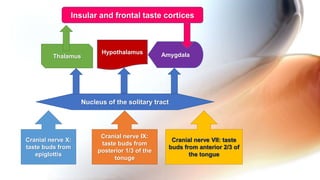
Cranial nerve X:
taste buds from
epiglottis
Cranial nerve IX:
taste buds from
posterior 1/3 of the
tonuge
Cranial nerve VII: taste
buds from anterior 2/3 of
the tongue
Nucleus of the solitary tract
Thalamus
Hypothalamus Amygdala
Insular and frontal taste cortices
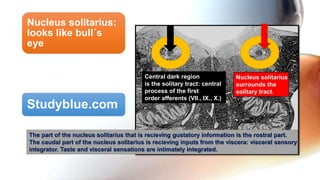
Nucleus solitarius:
looks like bull´s
eye
Studyblue.com
Central dark region
is the solitary tract: central
process of the first
order afferents (VII., IX., X.)
Nucleus solitarius
surrounds the
solitary tract.
The part of the nucleus solitarius that is recieving gustatory information is the rostral part.
The caudal part of the nucleus solitarius is recieving inputs from the viscera: visceral sensory
integrator. Taste and visceral sensations are intimately integrated.
Taste and visceral signals are processed
and integrated in the insular cortex.
From the insular cortex informations go to
the orbitofrontal cortex (hedonic value of
food).
Central processing
At the back of the tongue there is a row of circumvallate
papillae: nerve IX (glossopharyngeal nerve).
At both sides of the tongue (laterally) there are foliate
papillae.
At the anterior part of the tongue there are fungiform
papillae: nerve VII (facialis).
Sensory transduction
Taste cells have at the appical surface
the taste pore where ingested
molecules interact with taste cells.
When the taste cell is depolarised, it
releases the neurotransmitter in the
synapse between the base of the taste
cell and afferent gustatory axon.
Sensory transduction
Taste categories are:
• SALT
• ACID (SOUR)
• SWEET
• BITTER
• UMAMI (taste of monosodium glutamate)
Sensory transduction
• Salty and acidic tastants interact with ion channels that
have binding place on the extracellular part of the
channels.
• When salty and acidic tastants bind to the channels,
positive cations influx the taste cell and depolarise it.
• Depolarisation causes opening of the voltage gated
channels at the base of the taste cell that allow calcium to
influx into the taste cell.
• Then happens the calcium dependent exocytosis of the
vesicles and neurotransmitter SEROTONIN is released.
Sensory transduction
• With sufficient release of the serotonin there will be action
potential in the afferent gustatory axon.
• Sweet, bitter and umami tastants interact with G-protein
coupled receptors.
• G-protein activation causes interaction with several second
messenger systems: some of those systems cause
depolarisation of the taste cell, other systems cause
release of the calcium from intracellular stores.
• Increase of the calcium levels (wheter from voltage gated
channels or intracellular stores) causes the release of
neurotransmitter.
Sensory transduction
• There are taste cells that have different types of receptors
and taste cells with only one type of receptor.
• The most of taste cells sensitive to the salty tastants are in
the anterior and lateral parts of the tongue.
• Majority of taste cells sensitive to umami and sweet
tastants are also in the anterior and lateral parts of the
tongue.
• Salty and sweet is going to be represented primarily via the
facial nerve (VII. nerve).
Topography of taste receptors
• Majority of taste cells sensitive to bitter tastants are in the
posterior part of the tongue.
• Bitter is going to be represented primarily via the
glossopharyngeal nerve (IX. nerve).
• Bitter taste cells are the most sensitive of all taste cells and
can detect harmfull molecules in food even in nanomolar
concentrations.
• Majority of taste cells sensitive to sour are distributed in
the lateral flanks of the tongue.
Topography of taste receptors
Sweet and salty taste
cells are sensitive to
milimolar
concentrations.
Topography of taste receptors
Coding of the gustatory
system is labeled-line
coding.
Labeled-line coding
II.
Trigeminal chemoreception
• At the endings of three divisions of trigeminal nerve
(ophtalmic, maxillary and mandibular nerve) there are
receptors that belong to transient receptor potential family
of receptors: TRP channels.
• TRP channels are sensitive to heat or cold or acids or
protons or to organic molecules (for example capsaicin).
• Capsaicin is found in spicy food.
• Capsaicin binds to the cytoplasmic binding spot on the
TRP channel and causes opening of the TRP channel:
influx of calcium and sodium ions, depolarisation.
Trigeminal nerve
• This activates nociceptive division of trigeminal nerve and
its branches.
• Pain and temperature information from face is processed
via the spinal trigeminal tract.
• Second order neurons are in the spinal trigeminal nucleus.
• Second order axons cross the midline and ascend through
the tegmentum of the midbrain.
• Third order neurons are in the ventral posterior medial
nucleus of the thalamus.
Trigeminal nerve
Trigeminal chemoreception allows humans to
recognise potentially harmfull substances in,
for example, food in our mouth, irritating
particles in our eyes...
This will cause coordinated visceral and motor
response like spitting the bad food or crying to
wash the irritating particles from our eyes.
Trigeminal nerve
https://www.coursera.org/learn/medical-
neuroscience/lecture: Leonard E. White, PhD
Studyblue.com
Literature

Gustation

  • 1.
  • 2.
    • Gustation (senseof taste) begins in the oropharynx. • Taste buds on the tongue allow for the presentation of ingested molecules: their function is sensory transduction. • At the base of the sensory cells there is a synaptic connection with an afferent axon. • Axon comes from one of these cranial nerves: VII., IX. and X. nerve. • There are also taste buds on the epiglottis and posterior parts of the pharynx. Gustation
  • 3.
    • Axons fromthe VII., IX. and X. cranial nerve synapse in the Nucleus of the solitary tract (gustatory nucleus). • Next station is in ventral and posterior part of the thalamus: third order neurons of the gustatory pathway. • Third order neurons provide inputs for Insular cortex: primary gustatory cortex. • Another part of the insular cortex is Frontal taste cortex in the frontal operculum. Gustation
  • 4.
    Cranial nerve X: tastebuds from epiglottis Cranial nerve IX: taste buds from posterior 1/3 of the tonuge Cranial nerve VII: taste buds from anterior 2/3 of the tongue Nucleus of the solitary tract Thalamus Hypothalamus Amygdala Insular and frontal taste cortices
  • 5.
    Nucleus solitarius: looks likebull´s eye Studyblue.com Central dark region is the solitary tract: central process of the first order afferents (VII., IX., X.) Nucleus solitarius surrounds the solitary tract. The part of the nucleus solitarius that is recieving gustatory information is the rostral part. The caudal part of the nucleus solitarius is recieving inputs from the viscera: visceral sensory integrator. Taste and visceral sensations are intimately integrated.
  • 6.
    Taste and visceralsignals are processed and integrated in the insular cortex. From the insular cortex informations go to the orbitofrontal cortex (hedonic value of food). Central processing
  • 7.
    At the backof the tongue there is a row of circumvallate papillae: nerve IX (glossopharyngeal nerve). At both sides of the tongue (laterally) there are foliate papillae. At the anterior part of the tongue there are fungiform papillae: nerve VII (facialis). Sensory transduction
  • 8.
    Taste cells haveat the appical surface the taste pore where ingested molecules interact with taste cells. When the taste cell is depolarised, it releases the neurotransmitter in the synapse between the base of the taste cell and afferent gustatory axon. Sensory transduction
  • 9.
    Taste categories are: •SALT • ACID (SOUR) • SWEET • BITTER • UMAMI (taste of monosodium glutamate) Sensory transduction
  • 10.
    • Salty andacidic tastants interact with ion channels that have binding place on the extracellular part of the channels. • When salty and acidic tastants bind to the channels, positive cations influx the taste cell and depolarise it. • Depolarisation causes opening of the voltage gated channels at the base of the taste cell that allow calcium to influx into the taste cell. • Then happens the calcium dependent exocytosis of the vesicles and neurotransmitter SEROTONIN is released. Sensory transduction
  • 11.
    • With sufficientrelease of the serotonin there will be action potential in the afferent gustatory axon. • Sweet, bitter and umami tastants interact with G-protein coupled receptors. • G-protein activation causes interaction with several second messenger systems: some of those systems cause depolarisation of the taste cell, other systems cause release of the calcium from intracellular stores. • Increase of the calcium levels (wheter from voltage gated channels or intracellular stores) causes the release of neurotransmitter. Sensory transduction
  • 12.
    • There aretaste cells that have different types of receptors and taste cells with only one type of receptor. • The most of taste cells sensitive to the salty tastants are in the anterior and lateral parts of the tongue. • Majority of taste cells sensitive to umami and sweet tastants are also in the anterior and lateral parts of the tongue. • Salty and sweet is going to be represented primarily via the facial nerve (VII. nerve). Topography of taste receptors
  • 13.
    • Majority oftaste cells sensitive to bitter tastants are in the posterior part of the tongue. • Bitter is going to be represented primarily via the glossopharyngeal nerve (IX. nerve). • Bitter taste cells are the most sensitive of all taste cells and can detect harmfull molecules in food even in nanomolar concentrations. • Majority of taste cells sensitive to sour are distributed in the lateral flanks of the tongue. Topography of taste receptors
  • 14.
    Sweet and saltytaste cells are sensitive to milimolar concentrations. Topography of taste receptors
  • 15.
    Coding of thegustatory system is labeled-line coding. Labeled-line coding
  • 16.
  • 17.
    • At theendings of three divisions of trigeminal nerve (ophtalmic, maxillary and mandibular nerve) there are receptors that belong to transient receptor potential family of receptors: TRP channels. • TRP channels are sensitive to heat or cold or acids or protons or to organic molecules (for example capsaicin). • Capsaicin is found in spicy food. • Capsaicin binds to the cytoplasmic binding spot on the TRP channel and causes opening of the TRP channel: influx of calcium and sodium ions, depolarisation. Trigeminal nerve
  • 18.
    • This activatesnociceptive division of trigeminal nerve and its branches. • Pain and temperature information from face is processed via the spinal trigeminal tract. • Second order neurons are in the spinal trigeminal nucleus. • Second order axons cross the midline and ascend through the tegmentum of the midbrain. • Third order neurons are in the ventral posterior medial nucleus of the thalamus. Trigeminal nerve
  • 19.
    Trigeminal chemoreception allowshumans to recognise potentially harmfull substances in, for example, food in our mouth, irritating particles in our eyes... This will cause coordinated visceral and motor response like spitting the bad food or crying to wash the irritating particles from our eyes. Trigeminal nerve
  • 20.