Taste
Dr. Berjin
Jr Resident
Department of Physiology
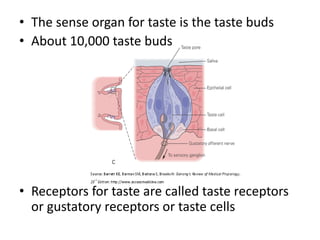
• The sense organ for taste is the taste buds
• About 10,000 taste buds
• Receptors for taste are called taste receptors
or gustatory receptors or taste cells
Structure of taste bud
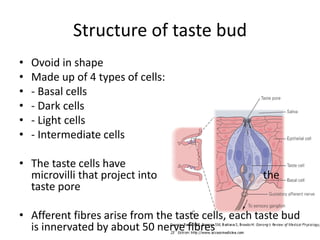
• Ovoid in shape
• Made up of 4 types of cells:
• - Basal cells
• - Dark cells
• - Light cells
• - Intermediate cells
• The taste cells have
microvilli that project into the
taste pore
• Afferent fibres arise from the taste cells, each taste bud
is innervated by about 50 nerve fibres
Location of taste buds
• Taste buds are located in the mucosa of the
• Epiglottis
• Palate
• Pharynx
• Walls of papillae of tongue
Types of papillae in the tongue
1.The Fungiform papilla
2.The Circumvallate papilla
3.Foliate papilla
Types of papillae in the tongue
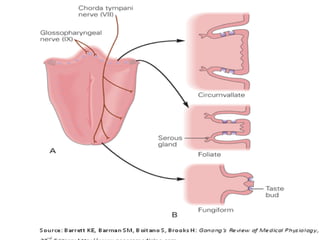
• Fungiform papillae – rounded structures near
the tip of the tongue (about 5 taste buds
each)
• Circumvallate papillae – arranged in a V in the
back of the tongue (about 100 taste buds
each)
• Foliate papillae : posterior edge of the tongue
(about 100 taste buds each)
Taste Pathway
Taste pathway
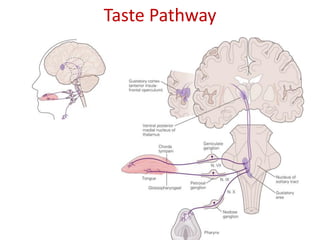
• The sensory nerve fibers from the taste buds on the anterior two-
thirds of the tongue travel in the chorda tympani branch of the facial
nerve
• Taste sensations from the posterior third of the tongue reach the
brain stem via the glossopharyngeal nerve
• The fibers from other areas other than the tongue (eg, pharynx)
reach the brain stem via the vagus nerve
• The taste fibres in the three nerves unite in the gustatory portion of
the nucleus of the solitary tract (NTS) in the medulla oblongata
Taste pathway
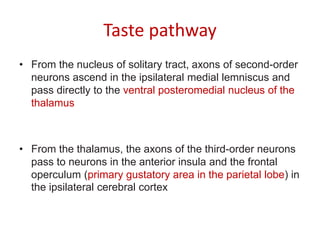
• From the nucleus of solitary tract, axons of second-order
neurons ascend in the ipsilateral medial lemniscus and
pass directly to the ventral posteromedial nucleus of the
thalamus
• From the thalamus, the axons of the third-order neurons
pass to neurons in the anterior insula and the frontal
operculum (primary gustatory area in the parietal lobe) in
the ipsilateral cerebral cortex
Basic taste Modalities
• Sweet
• Sour
• Salty
• Bitter
• Umami - taste sensation triggered by monosodium
glutamate, pleasant & sweetish
Any special areas on the tongue for
each taste sensation?
• All taste sensations are sensed from all parts
of the tongue
Taste thresholds and intensity
discrimination
• Most sensitive to taste receptors – Bitter
• Least sensitive to taste receptors – sweet
• A 30% change in the concentration of the
substance being tasted is necessary before an
intensity difference can be detected
Abnormalities of taste
• Ageusia : absence of sense of taste
• Hypogeusia : diminished taste sensitivity
– Causes : Damage to the lingual or glossopharyngeal
nerves, Bell’s palsy
• Dysgeusia or parageusia : Unpleasant perception
of taste : can be caused by the above factors
• Ganong ‘s review of Medical Physiology

2. Taste.pdf

  • 1.
  • 2.
    • The senseorgan for taste is the taste buds • About 10,000 taste buds • Receptors for taste are called taste receptors or gustatory receptors or taste cells
  • 3.
    Structure of tastebud • Ovoid in shape • Made up of 4 types of cells: • - Basal cells • - Dark cells • - Light cells • - Intermediate cells • The taste cells have microvilli that project into the taste pore • Afferent fibres arise from the taste cells, each taste bud is innervated by about 50 nerve fibres
  • 4.
    Location of tastebuds • Taste buds are located in the mucosa of the • Epiglottis • Palate • Pharynx • Walls of papillae of tongue
  • 5.
    Types of papillaein the tongue 1.The Fungiform papilla 2.The Circumvallate papilla 3.Foliate papilla
  • 6.
    Types of papillaein the tongue • Fungiform papillae – rounded structures near the tip of the tongue (about 5 taste buds each) • Circumvallate papillae – arranged in a V in the back of the tongue (about 100 taste buds each) • Foliate papillae : posterior edge of the tongue (about 100 taste buds each)
  • 8.
  • 9.
    Taste pathway • Thesensory nerve fibers from the taste buds on the anterior two- thirds of the tongue travel in the chorda tympani branch of the facial nerve • Taste sensations from the posterior third of the tongue reach the brain stem via the glossopharyngeal nerve • The fibers from other areas other than the tongue (eg, pharynx) reach the brain stem via the vagus nerve • The taste fibres in the three nerves unite in the gustatory portion of the nucleus of the solitary tract (NTS) in the medulla oblongata
  • 10.
    Taste pathway • Fromthe nucleus of solitary tract, axons of second-order neurons ascend in the ipsilateral medial lemniscus and pass directly to the ventral posteromedial nucleus of the thalamus • From the thalamus, the axons of the third-order neurons pass to neurons in the anterior insula and the frontal operculum (primary gustatory area in the parietal lobe) in the ipsilateral cerebral cortex
  • 11.
    Basic taste Modalities •Sweet • Sour • Salty • Bitter • Umami - taste sensation triggered by monosodium glutamate, pleasant & sweetish
  • 12.
    Any special areason the tongue for each taste sensation? • All taste sensations are sensed from all parts of the tongue
  • 13.
    Taste thresholds andintensity discrimination • Most sensitive to taste receptors – Bitter • Least sensitive to taste receptors – sweet • A 30% change in the concentration of the substance being tasted is necessary before an intensity difference can be detected
  • 14.
    Abnormalities of taste •Ageusia : absence of sense of taste • Hypogeusia : diminished taste sensitivity – Causes : Damage to the lingual or glossopharyngeal nerves, Bell’s palsy • Dysgeusia or parageusia : Unpleasant perception of taste : can be caused by the above factors
  • 15.
    • Ganong ‘sreview of Medical Physiology