Presented By:
Mohsin Shad
Registration Number:
2013-BC-005
Presentation :
Cell Signaling
Date:
21-03-2016
Presented To:
Dr.Muhammad Tayyab
1
Taste Receptor 2
Taste Receptor
• Receptor that facilitates the sensation of taste.
• When food or other substances enter the mouth
• Molecules interact with saliva and are bound to taste
receptors
• Present in Oral cavity and throat.
• It is type of chemoreceptors that is present on taste buds
• Taste buds- epithelial cells that act like neurotransmitters
• Innervated by cranial nerves
3
Taste
• Taste (‘gustation’) is often referred to as the chemical senses
• They are mediated in the first instance by receptors that are
stimulated by chemical substances.
• Receptors are called ‘ chemoreceptors
• Taste: Chemicals dissolve in our mouth (must be water soluble)
and stimulate the taste buds in the oral cavity (tongue, soft
palate, cheek, etc.).
4
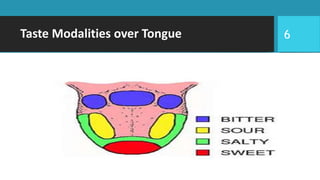
Types of Tastes
Taste = ‘Gustation
Basic tastes:
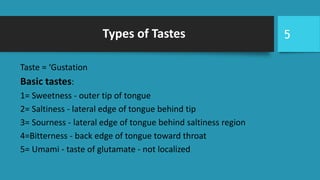
1= Sweetness - outer tip of tongue
2= Saltiness - lateral edge of tongue behind tip
3= Sourness - lateral edge of tongue behind saltiness region
4=Bitterness - back edge of tongue toward throat
5= Umami - taste of glutamate - not localized
5
Taste Modalities over Tongue 6
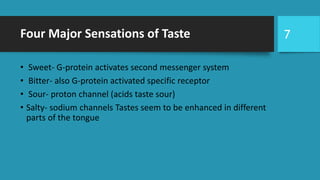
Four Major Sensations of Taste
• Sweet- G-protein activates second messenger system
• Bitter- also G-protein activated specific receptor
• Sour- proton channel (acids taste sour)
• Salty- sodium channels Tastes seem to be enhanced in different
parts of the tongue
7
Different ions or Receptors for Different Tastes
8
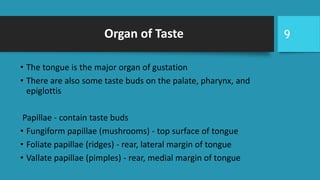
Organ of Taste
• The tongue is the major organ of gustation
• There are also some taste buds on the palate, pharynx, and
epiglottis
Papillae - contain taste buds
• Fungiform papillae (mushrooms) - top surface of tongue
• Foliate papillae (ridges) - rear, lateral margin of tongue
• Vallate papillae (pimples) - rear, medial margin of tongue
9
10
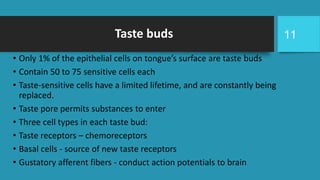
Taste buds
• Only 1% of the epithelial cells on tongue’s surface are taste buds
• Contain 50 to 75 sensitive cells each
• Taste-sensitive cells have a limited lifetime, and are constantly being
replaced.
• Taste pore permits substances to enter
• Three cell types in each taste bud:
• Taste receptors – chemoreceptors
• Basal cells - source of new taste receptors
• Gustatory afferent fibers - conduct action potentials to brain
11
Taste cells – Taste Receptors
• Come from the division and differentiation of the basal cells
• Not neurons in the strict sense, but have synapses with gustatory afferent
fibers
• Arrival of chemical molecules on surface leads to change in membrane
potential - receptor potential
• Most taste receptors respond to at least two of the basic tastes
• Sometimes taste receptors generate action potential
• Transduction differs for each type of taste receptor
12
Neural Pathways for Taste
• Afferents
• Anterior 2/3 of tongue - VII (facial nerve)
• Posterior 1/3 of tongue - IX (glossopharyngeal nerve)
• glottis, epiglottis, pharynx, palate - X (vagus nerve)
• All afferent fibers end in gustatory nucleus in the medulla
13
Pathways to the Brain
• Taste fibers proceed along several pathways to the medulla oblongata or
brain stem, then to the thalamus, and finally to the taste area on the
anterior cortex.
• For taste sensation, gustatory nucleus neurons send fibers to the ventral
posterior medial nucleus (VPM) of thalamus
14
Pathways to the Brain
• VPM sends fibers to the primary gustatory cortex ( Brodmann's area 43
in ventral parietal lobe
• For autonomic functions, gustatory nucleus sends fibers to the many
brainstem regions involved in swallowing, salivation, gagging, vomiting,
digestion, respiration and to the hypothalamus and amygdala
• appetite and food preferences
15
Clinical Considerations
• Ageusia:
Absence of sense of taste
• Dysgeusia:
Disturbed sense of taste
• Hypogeusia:
Diminished sense of taste
• Hypergeusia:
Increased sense of taste
16
17Any Question ?
For Listening My Presentation

Taste Receptor

  • 1.
    Presented By: Mohsin Shad RegistrationNumber: 2013-BC-005 Presentation : Cell Signaling Date: 21-03-2016 Presented To: Dr.Muhammad Tayyab 1
  • 2.
  • 3.
    Taste Receptor • Receptorthat facilitates the sensation of taste. • When food or other substances enter the mouth • Molecules interact with saliva and are bound to taste receptors • Present in Oral cavity and throat. • It is type of chemoreceptors that is present on taste buds • Taste buds- epithelial cells that act like neurotransmitters • Innervated by cranial nerves 3
  • 4.
    Taste • Taste (‘gustation’)is often referred to as the chemical senses • They are mediated in the first instance by receptors that are stimulated by chemical substances. • Receptors are called ‘ chemoreceptors • Taste: Chemicals dissolve in our mouth (must be water soluble) and stimulate the taste buds in the oral cavity (tongue, soft palate, cheek, etc.). 4
  • 5.
    Types of Tastes Taste= ‘Gustation Basic tastes: 1= Sweetness - outer tip of tongue 2= Saltiness - lateral edge of tongue behind tip 3= Sourness - lateral edge of tongue behind saltiness region 4=Bitterness - back edge of tongue toward throat 5= Umami - taste of glutamate - not localized 5
  • 6.
  • 7.
    Four Major Sensationsof Taste • Sweet- G-protein activates second messenger system • Bitter- also G-protein activated specific receptor • Sour- proton channel (acids taste sour) • Salty- sodium channels Tastes seem to be enhanced in different parts of the tongue 7
  • 8.
    Different ions orReceptors for Different Tastes 8
  • 9.
    Organ of Taste •The tongue is the major organ of gustation • There are also some taste buds on the palate, pharynx, and epiglottis Papillae - contain taste buds • Fungiform papillae (mushrooms) - top surface of tongue • Foliate papillae (ridges) - rear, lateral margin of tongue • Vallate papillae (pimples) - rear, medial margin of tongue 9
  • 10.
  • 11.
    Taste buds • Only1% of the epithelial cells on tongue’s surface are taste buds • Contain 50 to 75 sensitive cells each • Taste-sensitive cells have a limited lifetime, and are constantly being replaced. • Taste pore permits substances to enter • Three cell types in each taste bud: • Taste receptors – chemoreceptors • Basal cells - source of new taste receptors • Gustatory afferent fibers - conduct action potentials to brain 11
  • 12.
    Taste cells –Taste Receptors • Come from the division and differentiation of the basal cells • Not neurons in the strict sense, but have synapses with gustatory afferent fibers • Arrival of chemical molecules on surface leads to change in membrane potential - receptor potential • Most taste receptors respond to at least two of the basic tastes • Sometimes taste receptors generate action potential • Transduction differs for each type of taste receptor 12
  • 13.
    Neural Pathways forTaste • Afferents • Anterior 2/3 of tongue - VII (facial nerve) • Posterior 1/3 of tongue - IX (glossopharyngeal nerve) • glottis, epiglottis, pharynx, palate - X (vagus nerve) • All afferent fibers end in gustatory nucleus in the medulla 13
  • 14.
    Pathways to theBrain • Taste fibers proceed along several pathways to the medulla oblongata or brain stem, then to the thalamus, and finally to the taste area on the anterior cortex. • For taste sensation, gustatory nucleus neurons send fibers to the ventral posterior medial nucleus (VPM) of thalamus 14
  • 15.
    Pathways to theBrain • VPM sends fibers to the primary gustatory cortex ( Brodmann's area 43 in ventral parietal lobe • For autonomic functions, gustatory nucleus sends fibers to the many brainstem regions involved in swallowing, salivation, gagging, vomiting, digestion, respiration and to the hypothalamus and amygdala • appetite and food preferences 15
  • 16.
    Clinical Considerations • Ageusia: Absenceof sense of taste • Dysgeusia: Disturbed sense of taste • Hypogeusia: Diminished sense of taste • Hypergeusia: Increased sense of taste 16
  • 17.
    17Any Question ? ForListening My Presentation