COSMETICS-
REGULATORY
Presented by:
Mahewash Sana A.
Pathan
COSMETICS
• Cosmetics are regulated under the Drug and Cosmetic
Act (D & C Act) 1940 & The Rule in 1945 & the labeling
Declarations by Beauro of Indian Standards (BIS), BIS sets
the standards for cosmetics for the products listed under
Schedule S of the D & C Rules 1945.
• According to D & C Act, Cosmetic is defined as the “any
article intended to be rubbed, poured, sprinkled or
sprayed on, or introduced into, or otherwise applied to,
the human body or any part thereof for cleansing,
beautifying, promoting attractiveness, or altering the
appearance, & includes any article intended for use as a
component of cosmetic.”
Regulatory provision relating to manufacture of cosmetics
1. HOW TO OBTAIN LICENSE
• The procedure should be followed in order to manufacture
cosmetics in India has been laid down under the D & C Rules, 1945.
• Schedule M-II classifies cosmetics into 11 broad product categories:
1. Powders
2. Creams, lotions, emulsions, pastes, cleansing milks, shampoos,
pomade, brilliantine, shaving creams, hair oils, etc.
3. Nail polishes & nail lacquers
4. Lipsticks & lip gloss
5. Depilatories
6. Preparations used for eyes
7. Aerosol
8. Alcoholic fragrance solutions
9. Hair dyes
10. Tooth powders & tooth pastes
11. Toilet soaps.
• The application has to be submitted in form (form-31) along
with a license fee of Rs. 2500 & an inspection fee of Rs. 1000.
• The manufacturer has to ensure that the production is done
in presence of a competent & qualified technical staff & at
least one of the staff persons should possess the following
educational requirements:
1. Holds a Diploma in Pharmacy approved by the PCI under the
Pharmacy Act 1948; or
2. Is registered under the Pharmacy Act, 1948; or
3. Has passed the intermediate examination with chemistry as
one of the subjects or any other examination as recognized
by the licensing authority as equivalent to it.
• Before granting or refusing the license, the licensing Authority
is required to order inspection of the whole premises where
the operations are to be carried out. The inspectors are
appointed under the act, they are then required to submit a
detailed report to the Licensing Authority which can then
decide whether to grant the license or not.
Schedule M (II) of D & C rule 1945 deals with
requirements for the factory premises for the
manufacture of cosmetics:
• GENERAL REQUIREMENTS:
1. Location & surroundings
2. Buildings
3. Water supply
4. Disposal of water
5. Health clothing & sanitary requirements of the staff
6. Medical devices
7. Working benches for the operation of cosmetics.
• REQUIREMENT OF PLANT & EQUIPMENT:
Depending on the manufacture of different formulation
equipment, area & other requirements are been taken into
consideration.
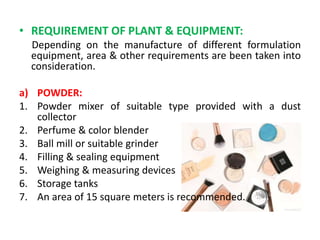
a) POWDER:
1. Powder mixer of suitable type provided with a dust
collector
2. Perfume & color blender
3. Ball mill or suitable grinder
4. Filling & sealing equipment
5. Weighing & measuring devices
6. Storage tanks
7. An area of 15 square meters is recommended.
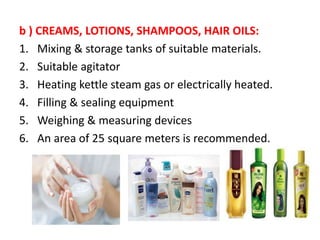
b ) CREAMS, LOTIONS, SHAMPOOS, HAIR OILS:
1. Mixing & storage tanks of suitable materials.
2. Suitable agitator
3. Heating kettle steam gas or electrically heated.
4. Filling & sealing equipment
5. Weighing & measuring devices
6. An area of 25 square meters is recommended.
c) NAIL POLISHES & NAIL LACQUERS:
1. Equipment: A suitable mixer, storage tanks, filling &
sealing machine, weighing & measuring devices.
2. Premises: should be suitable in an industrial area,
shall be separate from other cosmetic
manufacturing areas, floors, walls & doors shall be
proof,.
3. Storage: all explosive solvent & ingredients shall be
stored in metal cupboards.
4. Manufacture: workers shall be asked to wear shoes
in the section.
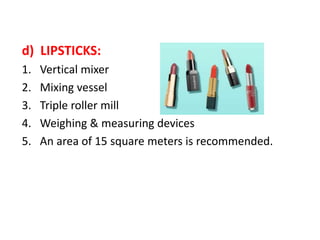
d) LIPSTICKS:
1. Vertical mixer
2. Mixing vessel
3. Triple roller mill
4. Weighing & measuring devices
5. An area of 15 square meters is recommended.
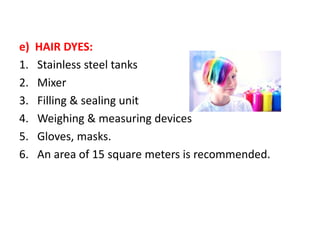
e) HAIR DYES:
1. Stainless steel tanks
2. Mixer
3. Filling & sealing unit
4. Weighing & measuring devices
5. Gloves, masks.
6. An area of 15 square meters is recommended.
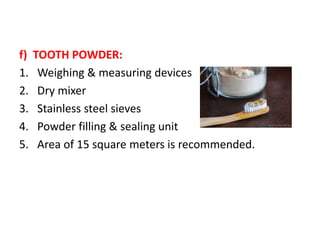
f) TOOTH POWDER:
1. Weighing & measuring devices
2. Dry mixer
3. Stainless steel sieves
4. Powder filling & sealing unit
5. Area of 15 square meters is recommended.
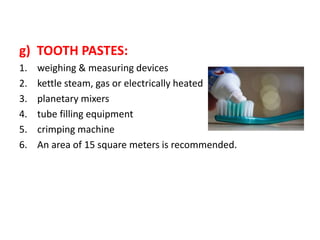
g) TOOTH PASTES:
1. weighing & measuring devices
2. kettle steam, gas or electrically heated
3. planetary mixers
4. tube filling equipment
5. crimping machine
6. An area of 15 square meters is recommended.
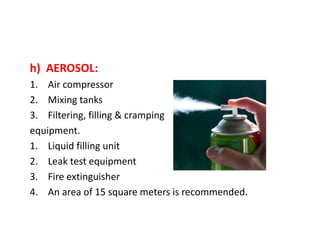
h) AEROSOL:
1. Air compressor
2. Mixing tanks
3. Filtering, filling & cramping
equipment.
1. Liquid filling unit
2. Leak test equipment
3. Fire extinguisher
4. An area of 15 square meters is recommended.
i) EYE BROWS, EYE LASHES, EYE LINERS:
1. Mixing tanks
2. Filtering, filling & sealing equipment.
3. Weighing & measuring devices
4. An area of 15 square meters is recommended.
j) ALCOHOLIC FRAGRANCE SOLUTIONS:
1. Mixing tanks
2. Filtering, filling & sealing equipment
3. Weighing & measuring equipment
4. An area of 15 square meters
2. CONDITIONS OF LICENSE:
• Manufacturer shall have to continue to provide &
maintain the premises, equipment & staff as at
the time of grant of license.
• Manufacturer should test each batch of raw
material before its use in the manufacture of
cosmetics.
• Manufacturer should have to test each batch of
finished cosmetics.
• Should have to maintain records of raw materials,
manufacturer of each batch of cosmetic & their
testing.
• Particulars to be shown in the manufacturing
records:
1. Serial no.
2. Name of the product
3. Batch size
4. Batch no.
5. Name of all ingredients used
6. Actual production & packaging particulars indicating
the size & qt of finished packing.
7. Signature of the expert staff responsible for the
manufacture.
• The requirements pertaining to labeling of products:
• Following are some of the labeling requirements as laid down
under the D & C Rules, 1945:
1. Name of the product along with the manufacturing address
must be mentioned on both the inner & the outer labels. If the
container is small in size, then the principal place of mfg & the
pin code are enough.
2. The outer label should clearly specify the net contents of the
ingredients used in the manufacture of the product.
3. The inner label should contain the directions for use along with
any warning or caution that may be necessary. It should also
contain names & quantities of ingredients which are hazardous
in nature.
4. A distinctive batch no. preceded by letter ‘B’ along with mfg
license no. preceded by letter ‘M’ must be mentioned on the
label.
5. Quality standards in case of the aforementioned categories of
products must conform to the Indian standards laid down &
revised by the BIS.
3. REGULATORY PROVISIONS ON SALE OF
COSMETICS:
• Sale of cosmetics is prohibited under the Act these are:
1. Any cosmetic this is not of std quality.
2. Any cosmetic that is misbranded or spurious.
3. A cosmetic containing ingredient which render it
injurious or harmful or unsafe to use.
4. A cosmetic whose import is prohibited by rule.
5. Any cosmetic except toilet soap containing
hexachlorophene.
6. Any cosmetic in which lead or arsenic compound used
for coloring purpose.
7. Any cosmetic which contain mercury compounds.
4. LOAN LICENSE:
• A person not having his own mfg facilities can get
cosmetics manufactured from licensed cosmetic
manufacturer under license system. Application for loan
license in prescribed form (form 31-A) along with a fee Rs
3500 together with other requisite documents should be
submitted to the state regulatory authorities.
• The licensing authority of the state, after examining that
the licensed manufacturer has spare capacity & agrees to
manufacture cosmetics for applicant, will grant loan
license.
Regulatory provision relating to import of
cosmetics:-
• Import of certain cosmetics is prohibited under D & C Act &
Rules 134A, 135, 135A.
o Any cosmetic this is not of std quality.
o Any cosmetic that is misbranded or spurious.
o A cosmetic containing ingredient which render it injurious
or harmful or unsafe to use.
o A cosmetic whose import is prohibited by rule.
o Any cosmetic except toilet soap containing
hexachlorophene.
o Any cosmetic in which lead or arsenic compound used for
coloring purpose.
o Any cosmetic which contain mercury compounds.
• In eighties, stds formed by Indian std institution were adopted for
certain cosmetics. 28 cosmetics have been placed under Schedule ‘S’
to the rules & are required to comply with Indian stds. & these are:
• Skin powder
• Tooth powder
• Skin creams
• Shampoos, soap based
• Hair creams
• Cologne
• Aftershave lotions
• Depilatories, chemical
• Cosmetic pencils
• Toilet soap
• Baby toilet soap
• Shaving soap
• Skin powder for infants
• Powder hair dye
•Tooth paste
•Bindi
•Hair oils
•Kumkum powder
•Shampoos, synthetic detergent
based
•Oxidation hair dyes, liquid
•Nail polish
•Pomades & brilliantine
•Shaving creams
•Lipsticks
•Henna powder
•Liquid toilet soaps
•Transparent toilet saps
•Lipsalve
• Misbranded & spurious cosmetics have been defined in
section 17-C & 17-D as under:
• Misbranded cosmetics: Any cosmetic
1. If it contain a color which is not prescribed
2. If it not labeled in the prescribed manner
3. If the label or container bears any statement which is false or
misleading in any particular.
• Spurious cosmetic: Any cosmetic
1. If it imported under a name which belongs to another
cosmetic.
2. If the label or container bears the name of an individual or a
company purporting to be the manufacturer of the cosmetic
which individual or company is fictitious or does not exist,
or
3. If it purports to be the product of a manufacturer of whom it
is not truly a product.
OFFENCES AND PENALTIES
Contravention Penalty
Import of spurious cosmetic or
cosmetic containing any ingredient
which harmful for use.
Imprisonment for term of 3 years
which may extends to 5 years with
fine of 5000 Rs.
Import of cosmetics whose import is
prohibited under section 10-A
Imprisonment for term of 3 years
which may extends to 5 years with
fine of 5000 Rs.
Repeated offence of above two. Imprisonment for term of 5 years &
fine which may extends to 10000 Rs.
Sale/ manufacture of cosmetic which
is not of std or misbranded cosmetic
Imprisonment for term of 3 years
which may extends to 5 years with
fine of 5000 Rs.
List of amending Act and adaptation orders:
• The Drug Amendment Act 11 of 1995.
• The Drug Amendment Act 35 of 1960
• The drug amendment Act 21 of 1962
• The D & C Amendment Act 13 of 1964
• The D & C Amendment Act 19 of 1972
• The D & C Amendment Act 68 of 1982
• The D & C Amendment Act 71 of 1995
• The D & C Amendment Act 26 of 2008
• The D & C Rules 1945 as amended from time to time.
Cosmetics  regulatory

Cosmetics regulatory

  • 1.
  • 2.
    COSMETICS • Cosmetics areregulated under the Drug and Cosmetic Act (D & C Act) 1940 & The Rule in 1945 & the labeling Declarations by Beauro of Indian Standards (BIS), BIS sets the standards for cosmetics for the products listed under Schedule S of the D & C Rules 1945. • According to D & C Act, Cosmetic is defined as the “any article intended to be rubbed, poured, sprinkled or sprayed on, or introduced into, or otherwise applied to, the human body or any part thereof for cleansing, beautifying, promoting attractiveness, or altering the appearance, & includes any article intended for use as a component of cosmetic.”
  • 3.
    Regulatory provision relatingto manufacture of cosmetics 1. HOW TO OBTAIN LICENSE • The procedure should be followed in order to manufacture cosmetics in India has been laid down under the D & C Rules, 1945. • Schedule M-II classifies cosmetics into 11 broad product categories: 1. Powders 2. Creams, lotions, emulsions, pastes, cleansing milks, shampoos, pomade, brilliantine, shaving creams, hair oils, etc. 3. Nail polishes & nail lacquers 4. Lipsticks & lip gloss 5. Depilatories 6. Preparations used for eyes 7. Aerosol 8. Alcoholic fragrance solutions 9. Hair dyes 10. Tooth powders & tooth pastes 11. Toilet soaps.
  • 4.
    • The applicationhas to be submitted in form (form-31) along with a license fee of Rs. 2500 & an inspection fee of Rs. 1000. • The manufacturer has to ensure that the production is done in presence of a competent & qualified technical staff & at least one of the staff persons should possess the following educational requirements: 1. Holds a Diploma in Pharmacy approved by the PCI under the Pharmacy Act 1948; or 2. Is registered under the Pharmacy Act, 1948; or 3. Has passed the intermediate examination with chemistry as one of the subjects or any other examination as recognized by the licensing authority as equivalent to it.
  • 5.
    • Before grantingor refusing the license, the licensing Authority is required to order inspection of the whole premises where the operations are to be carried out. The inspectors are appointed under the act, they are then required to submit a detailed report to the Licensing Authority which can then decide whether to grant the license or not.
  • 6.
    Schedule M (II)of D & C rule 1945 deals with requirements for the factory premises for the manufacture of cosmetics: • GENERAL REQUIREMENTS: 1. Location & surroundings 2. Buildings 3. Water supply 4. Disposal of water 5. Health clothing & sanitary requirements of the staff 6. Medical devices 7. Working benches for the operation of cosmetics.
  • 7.
    • REQUIREMENT OFPLANT & EQUIPMENT: Depending on the manufacture of different formulation equipment, area & other requirements are been taken into consideration. a) POWDER: 1. Powder mixer of suitable type provided with a dust collector 2. Perfume & color blender 3. Ball mill or suitable grinder 4. Filling & sealing equipment 5. Weighing & measuring devices 6. Storage tanks 7. An area of 15 square meters is recommended.
  • 8.
    b ) CREAMS,LOTIONS, SHAMPOOS, HAIR OILS: 1. Mixing & storage tanks of suitable materials. 2. Suitable agitator 3. Heating kettle steam gas or electrically heated. 4. Filling & sealing equipment 5. Weighing & measuring devices 6. An area of 25 square meters is recommended.
  • 9.
    c) NAIL POLISHES& NAIL LACQUERS: 1. Equipment: A suitable mixer, storage tanks, filling & sealing machine, weighing & measuring devices. 2. Premises: should be suitable in an industrial area, shall be separate from other cosmetic manufacturing areas, floors, walls & doors shall be proof,. 3. Storage: all explosive solvent & ingredients shall be stored in metal cupboards. 4. Manufacture: workers shall be asked to wear shoes in the section.
  • 10.
    d) LIPSTICKS: 1. Verticalmixer 2. Mixing vessel 3. Triple roller mill 4. Weighing & measuring devices 5. An area of 15 square meters is recommended.
  • 11.
    e) HAIR DYES: 1.Stainless steel tanks 2. Mixer 3. Filling & sealing unit 4. Weighing & measuring devices 5. Gloves, masks. 6. An area of 15 square meters is recommended.
  • 12.
    f) TOOTH POWDER: 1.Weighing & measuring devices 2. Dry mixer 3. Stainless steel sieves 4. Powder filling & sealing unit 5. Area of 15 square meters is recommended.
  • 13.
    g) TOOTH PASTES: 1.weighing & measuring devices 2. kettle steam, gas or electrically heated 3. planetary mixers 4. tube filling equipment 5. crimping machine 6. An area of 15 square meters is recommended.
  • 14.
    h) AEROSOL: 1. Aircompressor 2. Mixing tanks 3. Filtering, filling & cramping equipment. 1. Liquid filling unit 2. Leak test equipment 3. Fire extinguisher 4. An area of 15 square meters is recommended.
  • 15.
    i) EYE BROWS,EYE LASHES, EYE LINERS: 1. Mixing tanks 2. Filtering, filling & sealing equipment. 3. Weighing & measuring devices 4. An area of 15 square meters is recommended. j) ALCOHOLIC FRAGRANCE SOLUTIONS: 1. Mixing tanks 2. Filtering, filling & sealing equipment 3. Weighing & measuring equipment 4. An area of 15 square meters
  • 16.
    2. CONDITIONS OFLICENSE: • Manufacturer shall have to continue to provide & maintain the premises, equipment & staff as at the time of grant of license. • Manufacturer should test each batch of raw material before its use in the manufacture of cosmetics. • Manufacturer should have to test each batch of finished cosmetics. • Should have to maintain records of raw materials, manufacturer of each batch of cosmetic & their testing.
  • 17.
    • Particulars tobe shown in the manufacturing records: 1. Serial no. 2. Name of the product 3. Batch size 4. Batch no. 5. Name of all ingredients used 6. Actual production & packaging particulars indicating the size & qt of finished packing. 7. Signature of the expert staff responsible for the manufacture.
  • 18.
    • The requirementspertaining to labeling of products: • Following are some of the labeling requirements as laid down under the D & C Rules, 1945: 1. Name of the product along with the manufacturing address must be mentioned on both the inner & the outer labels. If the container is small in size, then the principal place of mfg & the pin code are enough. 2. The outer label should clearly specify the net contents of the ingredients used in the manufacture of the product. 3. The inner label should contain the directions for use along with any warning or caution that may be necessary. It should also contain names & quantities of ingredients which are hazardous in nature. 4. A distinctive batch no. preceded by letter ‘B’ along with mfg license no. preceded by letter ‘M’ must be mentioned on the label. 5. Quality standards in case of the aforementioned categories of products must conform to the Indian standards laid down & revised by the BIS.
  • 19.
    3. REGULATORY PROVISIONSON SALE OF COSMETICS: • Sale of cosmetics is prohibited under the Act these are: 1. Any cosmetic this is not of std quality. 2. Any cosmetic that is misbranded or spurious. 3. A cosmetic containing ingredient which render it injurious or harmful or unsafe to use. 4. A cosmetic whose import is prohibited by rule. 5. Any cosmetic except toilet soap containing hexachlorophene. 6. Any cosmetic in which lead or arsenic compound used for coloring purpose. 7. Any cosmetic which contain mercury compounds.
  • 20.
    4. LOAN LICENSE: •A person not having his own mfg facilities can get cosmetics manufactured from licensed cosmetic manufacturer under license system. Application for loan license in prescribed form (form 31-A) along with a fee Rs 3500 together with other requisite documents should be submitted to the state regulatory authorities. • The licensing authority of the state, after examining that the licensed manufacturer has spare capacity & agrees to manufacture cosmetics for applicant, will grant loan license.
  • 21.
    Regulatory provision relatingto import of cosmetics:- • Import of certain cosmetics is prohibited under D & C Act & Rules 134A, 135, 135A. o Any cosmetic this is not of std quality. o Any cosmetic that is misbranded or spurious. o A cosmetic containing ingredient which render it injurious or harmful or unsafe to use. o A cosmetic whose import is prohibited by rule. o Any cosmetic except toilet soap containing hexachlorophene. o Any cosmetic in which lead or arsenic compound used for coloring purpose. o Any cosmetic which contain mercury compounds.
  • 22.
    • In eighties,stds formed by Indian std institution were adopted for certain cosmetics. 28 cosmetics have been placed under Schedule ‘S’ to the rules & are required to comply with Indian stds. & these are: • Skin powder • Tooth powder • Skin creams • Shampoos, soap based • Hair creams • Cologne • Aftershave lotions • Depilatories, chemical • Cosmetic pencils • Toilet soap • Baby toilet soap • Shaving soap • Skin powder for infants • Powder hair dye •Tooth paste •Bindi •Hair oils •Kumkum powder •Shampoos, synthetic detergent based •Oxidation hair dyes, liquid •Nail polish •Pomades & brilliantine •Shaving creams •Lipsticks •Henna powder •Liquid toilet soaps •Transparent toilet saps •Lipsalve
  • 23.
    • Misbranded &spurious cosmetics have been defined in section 17-C & 17-D as under: • Misbranded cosmetics: Any cosmetic 1. If it contain a color which is not prescribed 2. If it not labeled in the prescribed manner 3. If the label or container bears any statement which is false or misleading in any particular. • Spurious cosmetic: Any cosmetic 1. If it imported under a name which belongs to another cosmetic. 2. If the label or container bears the name of an individual or a company purporting to be the manufacturer of the cosmetic which individual or company is fictitious or does not exist, or 3. If it purports to be the product of a manufacturer of whom it is not truly a product.
  • 24.
    OFFENCES AND PENALTIES ContraventionPenalty Import of spurious cosmetic or cosmetic containing any ingredient which harmful for use. Imprisonment for term of 3 years which may extends to 5 years with fine of 5000 Rs. Import of cosmetics whose import is prohibited under section 10-A Imprisonment for term of 3 years which may extends to 5 years with fine of 5000 Rs. Repeated offence of above two. Imprisonment for term of 5 years & fine which may extends to 10000 Rs. Sale/ manufacture of cosmetic which is not of std or misbranded cosmetic Imprisonment for term of 3 years which may extends to 5 years with fine of 5000 Rs.
  • 25.
    List of amendingAct and adaptation orders: • The Drug Amendment Act 11 of 1995. • The Drug Amendment Act 35 of 1960 • The drug amendment Act 21 of 1962 • The D & C Amendment Act 13 of 1964 • The D & C Amendment Act 19 of 1972 • The D & C Amendment Act 68 of 1982 • The D & C Amendment Act 71 of 1995 • The D & C Amendment Act 26 of 2008 • The D & C Rules 1945 as amended from time to time.