PRESENTED BY
:-
MR. Dinesh kumar
2ND Yr. M. Sc.
NURSING
 According to Jones,
Everyone needs assistance at some times in
his life; some will need it constantly and
throughout their lives, while others need it
only at rare intervals at times of great crisis.
Counseling Indian Facts
 Counseling has not yet achieved
professional status in India. Very few
professionally trained personnel are
available.
The world's most famous disabled people
 The world's most famous
disabled people....let me
know if I have missed any
out!
 Albert Einstein
The Mathematician/Physicist
who had a learning
disability and did not speak
until age 3.
 Alexander Graham Bell
Had a learning disability
 George Washington
Had a learning disability.
He could barely write and
had very poor grammar
skills.
The world's most famous disabled people
 Sudha Chandran
(Indian actress and
classical dancer) This
brave lady dances with a
Jaipur foot.
 Woodrow Wilson
U.S. President from
1913-1921. Had a
learning disability - he
was severely dyslexic
The world's most famous disabled people
 Sarah Bernhardt
French actress (1844-
1923) Disabled by a
knee injury, her leg
amputated in 1914, she
continued starring on
stage until just before
her death. She is
regarded as France's
greatest actress -- "The
Divine Sarah".
The world's most famous disabled people
 ALI Mohammad,
 1942-present,
(neuromuscular)
American
heavyweight boxing
champion. As an adult
was diagnosed with
Parkinson’s disease.
 DA VINCI Leonardo,
 1452-1519, (dyslexia)
(epilepsy),
One of the greatest
painters and most
versatile geniuses in
history.
The world's most famous disabled people
Tom Cruise
 (Hollywood Star):
is severely
dyslexic
Meaning of the term Guide:-
 To Indicate.
 To Point out.
 To Show the way.
 To Lead.
 To direct.
DEFINITION :-
1. "Guidance is a process of dynamic and
interpersonal relationship designed to
influences the attitudes and subsequent
behavior of a person."
------ BY [GOOD]
DEFINITION :-
2. "Guidance is the help given by one person to
another in making choices and adjustments
and in solving problems". Further it aims at
aiding the recipient to grow in his
independence, the ability "to be responsible
for himself."
------ BY JONE [1971].
 Guidance is both a concept and process.
 As a concept guidance is concerned with the
optimal development of the individual,
educational, vocational, personal, social, moral,
physical both. For his own satisfaction and for
the benefit of the society.
 As a process, it includes the gathering of
substantive knowledge of the development
characterization of an individual.
Definition Counseling
Counseling is the helping relationship, that
include: some one seeking help, someone
wiling to give help who is capable or trained
to help, in a setting that permits help to given
and received.
------ BY CORMIER & HACKNEY [1987].
Counseling is aimed at
 Bringing about desired changes in the
individual for self realization.
 Providing assistance to solve problem
through an intimate personal relationship.
The objectives of Counseling are to enable
client / recipient
 To achieve Positive Mental Health.
 Resolve their problems.
 Improve Personal Effectiveness.
 Maximize individual freedom to choose &
set within the conditions imposed by the
environment.
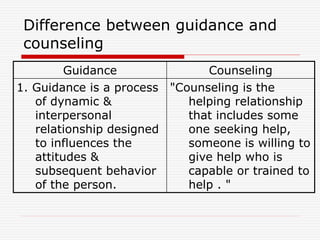
Difference between guidance and
counseling
Guidance Counseling
1. Guidance is a process
of dynamic &
interpersonal
relationship designed
to influences the
attitudes &
subsequent behavior
of the person.
"Counseling is the
helping relationship
that includes some
one seeking help,
someone is willing to
give help who is
capable or trained to
help . "
2. Guidance is an organized service to
identify and develop the potentialities
of pupils comprehensive information
about all the clients is collected in the
help of different test, tools, and
resources, recorded. This information
is communicated to the individual to
help than to understand themselves
and for their all round personality of
development.
In counseling
information is
given to solve
the problem.
Difference between guidance
and counseling
3. Guidance is preventive, and
developmental.
Counseling is curative or
therapeutic, developmental and
remedial.
4. Guidance may be done by
any guidance workers.
Counseling requires a high
level skill as well as
special professional
training.
5. Guidance may be given in
any normal set up.
Counseling requires special
setup a room to conduct.
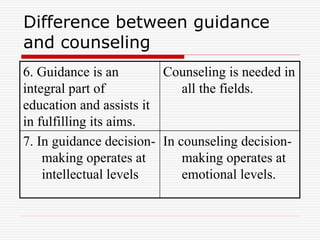
Difference between guidance
and counseling
6. Guidance is an
integral part of
education and assists it
in fulfilling its aims.
Counseling is needed in
all the fields.
7. In guidance decision-
making operates at
intellectual levels
In counseling decision-
making operates at
emotional levels.
Difference between guidance
and counseling
Scope / Purposes of Guidance and Counseling
1. Aimed at assisting the client to draw up their
own plans and find solutions to the problem.
2. Help the individual to realize his potentialities
and to make optimum contribution to the
growth of the society.
3. Help the person to solve his own problems and
make proper choice and adjustment.
4. Aim as providing assistance to the nurse as a
guide or Counsellor in their efforts to
understand their clients.
5. Aim at enabling recipient to acquire abilities
which promote self direction and self-
realization.
6. Development of good qualities such as
perseverance, dedication, sincerity, devotion.
Positive outlook respect for views of others,
temperament which are essential to them for
making significant contributions.
Principles of Guidance and Counseling
Guidance and counseling is a professional activity
based on certain well accepted principles.
1. Guidance and Counseling is unique to an individual.
2. Guidance and Counseling is concerned with total
individual.
3. It is always goal directed and goal oriented.
4. It is a Professional Activity.
5. Guidance and Counseling is based on a thorough
knowledge of characteristics of the stages of human
growth and development.
6. Guidance and counseling is meant for all
those who need to help.
7. Guidance and Counseling is not specific to
any state of development.
8. Guidance and counseling is a continuous
process
9. Guidance and Counseling should be based
on reliable data.
10. Guidance and Counseling should have a
flexible approach
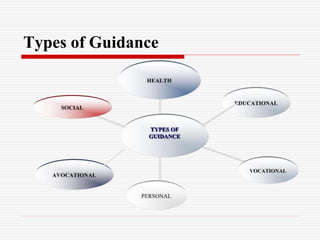
Types of Guidance
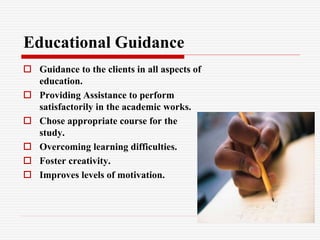
Educational Guidance
 Guidance to the clients in all aspects of
education.
 Providing Assistance to perform
satisfactorily in the academic works.
 Chose appropriate course for the
study.
 Overcoming learning difficulties.
 Foster creativity.
 Improves levels of motivation.
Vocational Guidance
 Assistance provided for selection of a
vocation and preparation for same.
 Concerned with enabling clients to acquire
information about career opportunities,
career growth and training facilities.
Personal Guidance
Guidance to clients to enable them to
adjust themselves to their environment
so that they become efficient citizens.
Social Guidance
 Enable clients to make substantial
contributions to the society, assume
leadership, conform to the social norms,
work as team members, develop healthy and
positive attitudes, appreciate problems of
society
Avocational Guidance
The assistance to be provided to
clients to spend their available leisure
time profitably such as games,
photography drama, fine arts which
have recreational value.
Health Guidance
Implies the assistance rendered to
clients for maintaining sound health.
Why there is need of guidance
(Need / Importance of Guidance.)
1. Complex nature of society- Economic, social and
political systems, consumption, production, distribution
and exchange.
2. Individual differences.
3. Welfare state and the individual.
4. Changed industrial and educational patter of country.
5. Changed economic pattern of the country.
6. Conservation of Human energy.
7. Audience for good citizenship.
8. Intellectual development.
Guidance is useful in
1. Problem solving
2. Telling various fields
3. Great insight
4. Self guidance
5. For counseling
6. Self development
7. Leads to success
8. Plan wisely
9. Telling individuals difficulties with help of
psychological test.
Characteristics of Guidance
It is a process.
It is a continuous process.
Choice and problem points are the distinctive
concerns of guides.
Assistance to develop capacity for self direction,
self guidance and self improvement.
Services meant for all.
Generalized specialized services.
Personal Help.
Approach to problem solving in guidance
Phases of Counseling
 The counseling process will takes place in
accordance with the nature of the person
being helped.
1. Establishing relationship
2. Assessment
3. Setting goals
4. Intervention
5. Termination and Follow-Up.
Who’s Who in counseling
 Counseling is a personal meeting of two
individuals the counselor who assists in
analyzing and understanding the problem
and counselee is one, who has a problem and
needs assistance in arriving at a solution to
the same.
Types of Counseling
Directive counseling [counselor
directed approach]
In-directive counseling
Eclectic Counseling
Group Counseling
Tools for Collecting Information in
counseling
Non-Testing tools [other than psychological Tools]
 - Interview
 - Observation
 - Anecdotal Tools
 - Cumulative record card
 - Problem/Interest Checklist
 - Rating Scales
 - Sociemetry
Attributes / Skills required for the counselor.
 To accomplish the phases of counseling
effectively, the counselor needs to
demonstrate certain attitudes, skills and
knowledge.
Pre-Training Attributes-
 Self-awareness and understanding
 Good psychological health
 Sensitivity
 Open mindedness
 Objectivity
 Trustworthiness
 Approachability
Inter Training Attributes -
 Interview setting and getting started
 Problem focus
 Identifying an important theme
 Focusing on a theme
 Directing a theme towards a goal
 Managing interactions with the individual
Problems which may arise in
Counseling Sessions
 Resistance to counseling.
 Counseling individuals of different cultures.
 Counseling individuals with strong emotions
 Counselor burn out
 Lack of awareness of value of counseling by public
 Inadequate administrative support
 Inadequate physical facilities
 Non availability of tools and tests.
 Lack of counselors knowledge &. skills
 Lack of environment and communication facilities.
What Is the Difference Between
Counseling and Psychotherapy?
 Psychotherapy" and "counseling" are terms that are often used
interchangeably. Although they are very similar, there are some
subtle differences as well.
 Technically speaking, "counselor" means "advisor". It involves
two people working together to solve a problem. It is a term that
is used in conjunction with many types of advice giving. For
example, financial planning and spiritual guidance 'are both
types of counseling. Just about anyone at all may claim to be a
counselor if they are in the role of giving advice. The term
counseling may also properly be used to refer to what occurs in
a relationship with a psychotherapist
 In the context of mental health, "counseling" is generally
used to denote a relatively brief treatment that is focused
most upon behavior. It often targets a particular symptom
or problematic situation and offers suggestions and advice
for dealing with it.
 "Psychotherapy" on the other hand is generally a longer
term treatment which focuses more on gaining insight into
chronic physical and emotional problems. It's focus is on
the patient's thought processes and way of being in the
world rather than specific problems.
 In actual practice there may be quite a bit of
overlap between the two. A therapist may provide
counseling with specific situations and a counselor
may function in a psychotherapeutic manner.
Generally speaking, however, psychotherapy
requires more skill than simple counseling. It is
conducted by professionals trained to practice
psychotherapy such as a psychiatrist, a trained
counselor, social worker or psychologist. While a
psychotherapist is qualified to provide counseling, a
counselor mayor may not possess the necessary
training and skills to provide psychotherapy.
Hotline:-
A telephone line maintained
by a trained personnel
for purpose of providing
crisis intervention and
guidance in time of
emergencies eg. suicide.
There are voluntary
organizations in India
providing such services.
Sahai Helpline
The telephone no. is
+91 80 2549 7777.
guidance & counselling.ppt

guidance & counselling.ppt

  • 1.
    PRESENTED BY :- MR. Dineshkumar 2ND Yr. M. Sc. NURSING
  • 2.
     According toJones, Everyone needs assistance at some times in his life; some will need it constantly and throughout their lives, while others need it only at rare intervals at times of great crisis.
  • 3.
    Counseling Indian Facts Counseling has not yet achieved professional status in India. Very few professionally trained personnel are available.
  • 4.
    The world's mostfamous disabled people  The world's most famous disabled people....let me know if I have missed any out!  Albert Einstein The Mathematician/Physicist who had a learning disability and did not speak until age 3.
  • 5.
     Alexander GrahamBell Had a learning disability  George Washington Had a learning disability. He could barely write and had very poor grammar skills. The world's most famous disabled people
  • 6.
    The world's mostfamous disabled people  Sudha Chandran (Indian actress and classical dancer) This brave lady dances with a Jaipur foot.  Woodrow Wilson U.S. President from 1913-1921. Had a learning disability - he was severely dyslexic
  • 7.
    The world's mostfamous disabled people  Sarah Bernhardt French actress (1844- 1923) Disabled by a knee injury, her leg amputated in 1914, she continued starring on stage until just before her death. She is regarded as France's greatest actress -- "The Divine Sarah".
  • 8.
    The world's mostfamous disabled people  ALI Mohammad,  1942-present, (neuromuscular) American heavyweight boxing champion. As an adult was diagnosed with Parkinson’s disease.
  • 9.
     DA VINCILeonardo,  1452-1519, (dyslexia) (epilepsy), One of the greatest painters and most versatile geniuses in history. The world's most famous disabled people
  • 10.
    The world's mostfamous disabled people Tom Cruise  (Hollywood Star): is severely dyslexic
  • 11.
    Meaning of theterm Guide:-  To Indicate.  To Point out.  To Show the way.  To Lead.  To direct.
  • 12.
    DEFINITION :- 1. "Guidanceis a process of dynamic and interpersonal relationship designed to influences the attitudes and subsequent behavior of a person." ------ BY [GOOD]
  • 13.
    DEFINITION :- 2. "Guidanceis the help given by one person to another in making choices and adjustments and in solving problems". Further it aims at aiding the recipient to grow in his independence, the ability "to be responsible for himself." ------ BY JONE [1971].
  • 14.
     Guidance isboth a concept and process.  As a concept guidance is concerned with the optimal development of the individual, educational, vocational, personal, social, moral, physical both. For his own satisfaction and for the benefit of the society.  As a process, it includes the gathering of substantive knowledge of the development characterization of an individual.
  • 15.
    Definition Counseling Counseling isthe helping relationship, that include: some one seeking help, someone wiling to give help who is capable or trained to help, in a setting that permits help to given and received. ------ BY CORMIER & HACKNEY [1987].
  • 16.
    Counseling is aimedat  Bringing about desired changes in the individual for self realization.  Providing assistance to solve problem through an intimate personal relationship.
  • 17.
    The objectives ofCounseling are to enable client / recipient  To achieve Positive Mental Health.  Resolve their problems.  Improve Personal Effectiveness.  Maximize individual freedom to choose & set within the conditions imposed by the environment.
  • 18.
    Difference between guidanceand counseling Guidance Counseling 1. Guidance is a process of dynamic & interpersonal relationship designed to influences the attitudes & subsequent behavior of the person. "Counseling is the helping relationship that includes some one seeking help, someone is willing to give help who is capable or trained to help . "
  • 19.
    2. Guidance isan organized service to identify and develop the potentialities of pupils comprehensive information about all the clients is collected in the help of different test, tools, and resources, recorded. This information is communicated to the individual to help than to understand themselves and for their all round personality of development. In counseling information is given to solve the problem. Difference between guidance and counseling
  • 20.
    3. Guidance ispreventive, and developmental. Counseling is curative or therapeutic, developmental and remedial. 4. Guidance may be done by any guidance workers. Counseling requires a high level skill as well as special professional training. 5. Guidance may be given in any normal set up. Counseling requires special setup a room to conduct. Difference between guidance and counseling
  • 21.
    6. Guidance isan integral part of education and assists it in fulfilling its aims. Counseling is needed in all the fields. 7. In guidance decision- making operates at intellectual levels In counseling decision- making operates at emotional levels. Difference between guidance and counseling
  • 22.
    Scope / Purposesof Guidance and Counseling 1. Aimed at assisting the client to draw up their own plans and find solutions to the problem. 2. Help the individual to realize his potentialities and to make optimum contribution to the growth of the society. 3. Help the person to solve his own problems and make proper choice and adjustment. 4. Aim as providing assistance to the nurse as a guide or Counsellor in their efforts to understand their clients.
  • 23.
    5. Aim atenabling recipient to acquire abilities which promote self direction and self- realization. 6. Development of good qualities such as perseverance, dedication, sincerity, devotion. Positive outlook respect for views of others, temperament which are essential to them for making significant contributions.
  • 24.
    Principles of Guidanceand Counseling Guidance and counseling is a professional activity based on certain well accepted principles. 1. Guidance and Counseling is unique to an individual. 2. Guidance and Counseling is concerned with total individual. 3. It is always goal directed and goal oriented. 4. It is a Professional Activity. 5. Guidance and Counseling is based on a thorough knowledge of characteristics of the stages of human growth and development.
  • 25.
    6. Guidance andcounseling is meant for all those who need to help. 7. Guidance and Counseling is not specific to any state of development. 8. Guidance and counseling is a continuous process 9. Guidance and Counseling should be based on reliable data. 10. Guidance and Counseling should have a flexible approach
  • 26.
  • 27.
    Educational Guidance  Guidanceto the clients in all aspects of education.  Providing Assistance to perform satisfactorily in the academic works.  Chose appropriate course for the study.  Overcoming learning difficulties.  Foster creativity.  Improves levels of motivation.
  • 28.
    Vocational Guidance  Assistanceprovided for selection of a vocation and preparation for same.  Concerned with enabling clients to acquire information about career opportunities, career growth and training facilities.
  • 29.
    Personal Guidance Guidance toclients to enable them to adjust themselves to their environment so that they become efficient citizens.
  • 30.
    Social Guidance  Enableclients to make substantial contributions to the society, assume leadership, conform to the social norms, work as team members, develop healthy and positive attitudes, appreciate problems of society
  • 31.
    Avocational Guidance The assistanceto be provided to clients to spend their available leisure time profitably such as games, photography drama, fine arts which have recreational value.
  • 32.
    Health Guidance Implies theassistance rendered to clients for maintaining sound health.
  • 33.
    Why there isneed of guidance (Need / Importance of Guidance.) 1. Complex nature of society- Economic, social and political systems, consumption, production, distribution and exchange. 2. Individual differences. 3. Welfare state and the individual. 4. Changed industrial and educational patter of country. 5. Changed economic pattern of the country. 6. Conservation of Human energy. 7. Audience for good citizenship. 8. Intellectual development.
  • 34.
    Guidance is usefulin 1. Problem solving 2. Telling various fields 3. Great insight 4. Self guidance 5. For counseling 6. Self development 7. Leads to success 8. Plan wisely 9. Telling individuals difficulties with help of psychological test.
  • 35.
    Characteristics of Guidance Itis a process. It is a continuous process. Choice and problem points are the distinctive concerns of guides. Assistance to develop capacity for self direction, self guidance and self improvement. Services meant for all. Generalized specialized services. Personal Help.
  • 36.
    Approach to problemsolving in guidance
  • 37.
    Phases of Counseling The counseling process will takes place in accordance with the nature of the person being helped. 1. Establishing relationship 2. Assessment 3. Setting goals 4. Intervention 5. Termination and Follow-Up.
  • 38.
    Who’s Who incounseling  Counseling is a personal meeting of two individuals the counselor who assists in analyzing and understanding the problem and counselee is one, who has a problem and needs assistance in arriving at a solution to the same.
  • 39.
    Types of Counseling Directivecounseling [counselor directed approach] In-directive counseling Eclectic Counseling Group Counseling
  • 40.
    Tools for CollectingInformation in counseling Non-Testing tools [other than psychological Tools]  - Interview  - Observation  - Anecdotal Tools  - Cumulative record card  - Problem/Interest Checklist  - Rating Scales  - Sociemetry
  • 41.
    Attributes / Skillsrequired for the counselor.  To accomplish the phases of counseling effectively, the counselor needs to demonstrate certain attitudes, skills and knowledge.
  • 42.
    Pre-Training Attributes-  Self-awarenessand understanding  Good psychological health  Sensitivity  Open mindedness  Objectivity  Trustworthiness  Approachability
  • 43.
    Inter Training Attributes-  Interview setting and getting started  Problem focus  Identifying an important theme  Focusing on a theme  Directing a theme towards a goal  Managing interactions with the individual
  • 44.
    Problems which mayarise in Counseling Sessions  Resistance to counseling.  Counseling individuals of different cultures.  Counseling individuals with strong emotions  Counselor burn out  Lack of awareness of value of counseling by public  Inadequate administrative support  Inadequate physical facilities  Non availability of tools and tests.  Lack of counselors knowledge &. skills  Lack of environment and communication facilities.
  • 45.
    What Is theDifference Between Counseling and Psychotherapy?  Psychotherapy" and "counseling" are terms that are often used interchangeably. Although they are very similar, there are some subtle differences as well.  Technically speaking, "counselor" means "advisor". It involves two people working together to solve a problem. It is a term that is used in conjunction with many types of advice giving. For example, financial planning and spiritual guidance 'are both types of counseling. Just about anyone at all may claim to be a counselor if they are in the role of giving advice. The term counseling may also properly be used to refer to what occurs in a relationship with a psychotherapist
  • 46.
     In thecontext of mental health, "counseling" is generally used to denote a relatively brief treatment that is focused most upon behavior. It often targets a particular symptom or problematic situation and offers suggestions and advice for dealing with it.  "Psychotherapy" on the other hand is generally a longer term treatment which focuses more on gaining insight into chronic physical and emotional problems. It's focus is on the patient's thought processes and way of being in the world rather than specific problems.
  • 47.
     In actualpractice there may be quite a bit of overlap between the two. A therapist may provide counseling with specific situations and a counselor may function in a psychotherapeutic manner. Generally speaking, however, psychotherapy requires more skill than simple counseling. It is conducted by professionals trained to practice psychotherapy such as a psychiatrist, a trained counselor, social worker or psychologist. While a psychotherapist is qualified to provide counseling, a counselor mayor may not possess the necessary training and skills to provide psychotherapy.
  • 48.
    Hotline:- A telephone linemaintained by a trained personnel for purpose of providing crisis intervention and guidance in time of emergencies eg. suicide. There are voluntary organizations in India providing such services. Sahai Helpline The telephone no. is +91 80 2549 7777.