




QualityAssurance in Nursing Care
Mr.Visanth VS
Asso.Professor
IGSCON, Amethi
QualityAssurance -Meaning
•Quality assurance means the
assurance to consumers that the
products, components, parts and
tools etc. possess specified
characteristics and are fit for the
intended purpose.
Definition
•“Quality assurance is defined as all the
arrangements and activities that are
meant to safeguard, maintain and
promote the quality of care.”
• “Quality Assurance is an on-going,
systematic comprehensive evaluation of
health care services and the impact of
those services on health care services.
Concepts of QA
• Quality assurance originated in manufacturing
industry “to ensure that the product consistently
achieved customer satisfaction”.
• Quality assurance is a dynamic process through
which nurses assume accountability for quality of
care they provide.
• It is a guarantee to the society that services provided
by nurses are being regulated by members of
profession.
• Quality assurance monitor the activities of client 4
Objectives
According to Jonas (2000), the two main
objectives are;
• To ensure the delivery of quality client care
• To demonstrate the efforts of the health care
providers to provide the best possible results
5
Purposes
• Rising expectations of consumer of services.
• Increasing pressure from national,
international, government and other
professional bodies to demonstrate that the
allocation of funds produces satisfactory
results in terms of patient care.
• The increasing complexity of health care
organizations.
• Improvement of job satisfaction.
6
•Highly informed consumer
•To prevent rising medical errors
•Rise in health insurance industry
•Accreditation bodies
•Reducing global boundaries.
7
Principles
• QM operates most effectively within a flat,
democratic and organizational structure
• Managers and workers must be committed to
quality improvement.
• The goal of QM is to improve systems and
processes and not to assign blame.
• Customers define quality.
• Quality improvement focuses on outcome.
• Decisions must be based on data.
Approaches
•General Approach
•Specific Approach
9
GeneralApproach
1. Credentialing- It is the formal recognition of
professional or technical competence and
attainment of minimum standards by a person and
agency. Credentialing process has 4 functional
components
• To produce a quality product
• To confirm a unique identity
• To protect the provider and public
• To control the profession
2. Licensure- It is a contract between the profession and the state
in which the profession is granted control over entry into an exit
from the profession and over quality of professional practice.
3. Accreditation- It is a process in which certification of
competency, authority, or credibility is presented to an
organization with necessary standards.
4. Certification
5. Charter- It is a mechanism by which a state government
agency under state law grants corporate state to institutions with
or without right to award degrees.
6. Recognition- It is defined as a process whereby one agency
accepts the credentialing states of and the credential confined by
another.
7. Academic degree 11
SpecificApproach
1. Peer review
2. Standard as a device for quality assurance :-
Standard is a pre-determined baseline condition or
level of excellence that comprises a model to be
followed and practiced.
3. Audit as a tool for quality assurance :- Nursing
audit may be defined as a detailed review and
evaluation of selected clinical records in order to
evaluate the quality of nursing care and
performance by comparing it with accepted
standards.
Components of QA
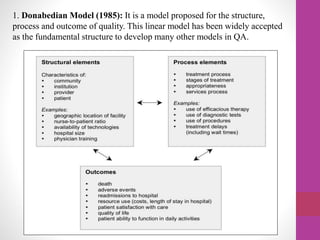
• Structure Element- The physical, financial
and organizational resources provided for
health care.
• Process Element- The activities of a health
system or healthcare personnel in the
provision of care.
• Outcome Element- A change in the patient‘s
current or future health that results from
nursing interventions.
Contd……..
• According to Manwell, Shaw, and Beurri, there are
3A’s and 3E’s;
3A’s
• Access to healthcare
• Acceptability
• Appropriateness and relevance to need
3E’s
• Effectiveness
• Efficiency
• Equity
Areas of QA
• Outpatient department- The points to be
remembered are;
• Courteous behavior must be extended by all, trained or
untrained personnel.
• Reduction of waiting time in the OPD and for lab
investigations by creating more service outlets.
• Provide basic amenities like toilets, telephone, and drinking
water etc.
• Provision of polyclinic concept to give all specialty services
under one roof.
• Providing ambulatory services or running day care centers.
• Emergency medical services :- Services
must be provided by well trained and
dedicated staff, and they should have access
to the most sophisticated life- saving
equipment and materials, and also have the
facility of rendering pre- hospital emergency
medical aid through a quick reaction trauma
care team provided with a trauma care
emergency van.
16
• In- patient services :- Provide a pleasant hospital
stay to the patient through provision of a safe,
homely atmosphere, a listening ear, humane
approach and well behaved, courteous staff.
• Specialty services:- A high tech hospital with all
types of specialty and super- specialty services will
increase the image of the hospital.
• Training:- A continuous training programme
should be present consisting of on the job training,
skill training workshops, seminars, conferences, and
case presentations.
17
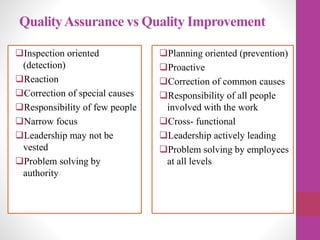
QualityAssurance vs Quality Improvement
Inspection oriented
(detection)
Reaction
Correction of special causes
Responsibility of few people
Narrow focus
Leadership may not be
vested
Problem solving by
authority
Planning oriented (prevention)
Proactive
Correction of common causes
Responsibility of all people
involved with the work
Cross- functional
Leadership actively leading
Problem solving by employees
at all levels
19
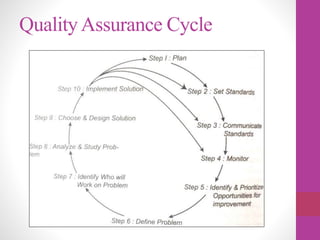
QualityAssurance Cycle
• In practice, QA is a cyclical, iterative process that
must be applied flexibly to meet the needs of a
specific program.
• The process may begin with a comprehensive effort
to define standards and norms as described in Steps
1-3, or it may start with small-scale quality
improvement activities (Steps 5-10). Alternatively,
the process may begin with monitoring (Step 4).
• The ten steps in the QA process are discussed.
QualityAssurance Cycle
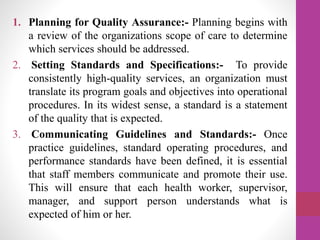
1. Planning for Quality Assurance:- Planning begins with
a review of the organizations scope of care to determine
which services should be addressed.
2. Setting Standards and Specifications:- To provide
consistently high-quality services, an organization must
translate its program goals and objectives into operational
procedures. In its widest sense, a standard is a statement
of the quality that is expected.
3. Communicating Guidelines and Standards:- Once
practice guidelines, standard operating procedures, and
performance standards have been defined, it is essential
that staff members communicate and promote their use.
This will ensure that each health worker, supervisor,
manager, and support person understands what is
expected of him or her.
4. Monitoring Quality:- Monitoring is the routine
collection and review of data that helps to assess whether
program norms are being followed or whether outcomes
are improved.
5. Identifying Problems and Selecting Opportunities for
Improvement:- Program managers can identify quality
improvement opportunities by monitoring and evaluating
activities. Other means include soliciting suggestions from
health workers, performing system process analyses,
reviewing patient feedback or complaints, and generating
ideas through brainstorming or other group techniques.
6. Defining the Problem:- Having selected a problem, the
team must define it operationally-as a gap between actual
performance and performance as prescribed by guidelines
and standards.
7. Choosing a Team:- After defining a problem, a small team
should be assigned; the team will analyze the problem,
develop a QI plan, and implement and evaluate the effort.
8. Analyzing and Studying the Problem:- to Identify the Root
Cause Achieving a meaningful and sustainable quality
improvement effort depends on understanding the problem and
its root causes.
9. Developing Solutions and Actions for QI:- The problem-
solving team should now be ready to develop and evaluate
potential solutions.
10. Implementing and Evaluating QI Efforts:- The team must
determine the necessary resources and time frame and decide
who will be responsible for implementation.
QualityAssurance Model
1. Donabedian Model (1985): It is a model proposed for the structure,
process and outcome of quality. This linear model has been widely accepted
as the fundamental structure to develop many other models in QA.
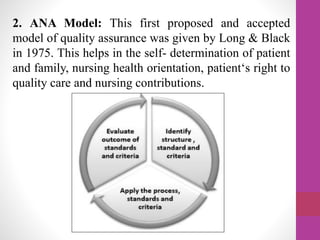
2. ANA Model: This first proposed and accepted
model of quality assurance was given by Long & Black
in 1975. This helps in the self- determination of patient
and family, nursing health orientation, patient‘s right to
quality care and nursing contributions.
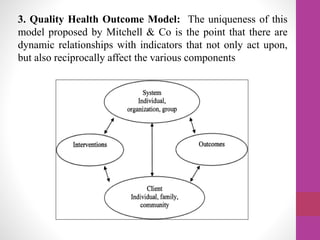
3. Quality Health Outcome Model: The uniqueness of this
model proposed by Mitchell & Co is the point that there are
dynamic relationships with indicators that not only act upon,
but also reciprocally affect the various components
Indicators of QualityAssurance
• Waiting time for different services in the hospital
• Medical errors in judgment, diagnosis, laboratory
reporting, medical treatment or surgical
procedures, etc.
• Hospital infections including hospital- acquired
infections, cross infections.
• Quality of services in key areas like blood bank,
laboratories, X- ray department, central
sterilization services, pharmacy and nursing.
QualityAssurance Resources
The organizations providing quality indexes are;
• AHRQ –Agency for Healthcare Research and Quality
• IHI –Institute for Healthcare Improvement
• JCAHO –Joint Commission on Accreditation of
Healthcare Organizations
• NAHQ –National Association for Healthcare Quality
• IOM –Institute of Medicine
• NCQA –National Committee for Quality Assurance
QI Process Steps
1. Identify needs most important to the consumer of health
care services.
2. Assemble a multidisciplinary team to review the identified
consumer needs and services.
3. Collect data to measure the current status of these services.
4. Establish measurable outcomes and quality indicators.
5. Select and implement a plan to meet the outcomes.
6. Collect data to evaluate the implementation of the plan and
achievement of outcomes.
QualityAssurance in Nursing
• Quality assurance is a dynamic process
through which nurses assume accountability
for quality of care they provide.
• It is a guarantee to the society that services
provided by nurses are being regulated by
members of profession.
JCAHO-Joint Commission onAccreditation of Health
Care Organizations
• • Hospitals are required by the Joint Commission on
Accreditation of Health Care Organizations
(JCAHO) to establish programs to improve the
quality and appropriateness of care. ...
• An effective quality assurance (QA) system should
allow hospitals and individuals to determine the
level of quality of care they administer.
JCAHO Steps
• Assigning responsibility
• Identifying the scope of care. ...
• Identifying important aspects of care. ...
• Developing indicators. ...
• Determining thresholds. ...
• Collecting and organizing data. ...
• Evaluating Data
• Taking action to improve care
• Assessing the effectiveness of actions taken
• Communicating findings
Factors affecting QAin Nursing
• Lack of resources
• Personnel problems
• Improper maintenance
• Unreasonable patients and attendants
• Absence of accreditation laws
• Lack of incident review procedures
• Lack of good and hospital information system
• Absence of patient satisfaction surveys
• Lack of nursing care records
Framework for QA
1. Maxwell (1984)
• Maxwell recognized that, in a society where resources are limited,
self-assessment by health care professionals is not satisfactory in
demonstrating the efficiency or effectiveness of a services.
• The dimensions of quality he proposed are;
• Assess to service
• Relevance to need
• Effectiveness
• Equity
• Social acceptance
• Efficiency and economy
2. WILSON (1987)
• Wilson considers there to be four essential
components to a QA
• Setting objectives
• Quality promotion
• Activity monitoring
• Performance assessment
3. Lang (1976)
• This framework has subsequently been adopted and developed by the
ANA. The stages include;
• Identify and agree values
• Review literature, Known QAP
• Analyze available programmes
• Determine most appropriate QAP
• Establish structure, plans, outcome criteria and standards
• Ratify standards and criteria
• Evaluate current levels of nursing practice against ratified
structures
• Identify and analyze factors contributing to results
• Select appropriate actions to maintain or improve care
• Implement selected actions
• Evaluate QAP
STAGES OFTHE DEVELOPMENTOFINTERNATIONAL
STANDARDS
• An International Standard is the result of an agreement between the
member bodies of ISO. It may be used as such, or may be
implemented through incorporation in national standards of
different countries.
• International Standards are developed by ISO technical committees
(TC) and subcommittees (SC) by a six-step process:
• Stage 1: Proposal stage
• Stage 2: Preparatory stage
• Stage 3: Committee stage
• Stage 4: Enquiry stage
• Stage 5: Approval stage
• Stage 6: Publication stage
IMPACT OF ISO IN LOCALHOSPITAL:
• Nurses are accountable for their actions
• Nurses can deliver a high standard of care
• Guaranteeing standards of care to the
public
• Nurses are actively involved in audit and
consumer reactions
• Improve the overall quality of nursing care
• Improves all type of documentation and
communication
Role of Nurse in QA
• Participate in quality improvement team
• Properly supervise and check whether patient is receiving
proper care or not.
• Contribute innovation and improvement of patient care
• Participating in improvement projects and patient safety
initiatives
• Participates in CNE programs
• Periodic and continuing appraisal
• Participate in research work
• Identify area where needs improvement
• Help in professional growth & maintain international standard.
Quality Assurance in nursing care

Quality Assurance in nursing care

  • 1.
    QualityAssurance in NursingCare Mr.Visanth VS Asso.Professor IGSCON, Amethi
  • 2.
    QualityAssurance -Meaning •Quality assurancemeans the assurance to consumers that the products, components, parts and tools etc. possess specified characteristics and are fit for the intended purpose.
  • 3.
    Definition •“Quality assurance isdefined as all the arrangements and activities that are meant to safeguard, maintain and promote the quality of care.” • “Quality Assurance is an on-going, systematic comprehensive evaluation of health care services and the impact of those services on health care services.
  • 4.
    Concepts of QA •Quality assurance originated in manufacturing industry “to ensure that the product consistently achieved customer satisfaction”. • Quality assurance is a dynamic process through which nurses assume accountability for quality of care they provide. • It is a guarantee to the society that services provided by nurses are being regulated by members of profession. • Quality assurance monitor the activities of client 4
  • 5.
    Objectives According to Jonas(2000), the two main objectives are; • To ensure the delivery of quality client care • To demonstrate the efforts of the health care providers to provide the best possible results 5
  • 6.
    Purposes • Rising expectationsof consumer of services. • Increasing pressure from national, international, government and other professional bodies to demonstrate that the allocation of funds produces satisfactory results in terms of patient care. • The increasing complexity of health care organizations. • Improvement of job satisfaction. 6
  • 7.
    •Highly informed consumer •Toprevent rising medical errors •Rise in health insurance industry •Accreditation bodies •Reducing global boundaries. 7
  • 8.
    Principles • QM operatesmost effectively within a flat, democratic and organizational structure • Managers and workers must be committed to quality improvement. • The goal of QM is to improve systems and processes and not to assign blame. • Customers define quality. • Quality improvement focuses on outcome. • Decisions must be based on data.
  • 9.
  • 10.
    GeneralApproach 1. Credentialing- Itis the formal recognition of professional or technical competence and attainment of minimum standards by a person and agency. Credentialing process has 4 functional components • To produce a quality product • To confirm a unique identity • To protect the provider and public • To control the profession
  • 11.
    2. Licensure- Itis a contract between the profession and the state in which the profession is granted control over entry into an exit from the profession and over quality of professional practice. 3. Accreditation- It is a process in which certification of competency, authority, or credibility is presented to an organization with necessary standards. 4. Certification 5. Charter- It is a mechanism by which a state government agency under state law grants corporate state to institutions with or without right to award degrees. 6. Recognition- It is defined as a process whereby one agency accepts the credentialing states of and the credential confined by another. 7. Academic degree 11
  • 12.
    SpecificApproach 1. Peer review 2.Standard as a device for quality assurance :- Standard is a pre-determined baseline condition or level of excellence that comprises a model to be followed and practiced. 3. Audit as a tool for quality assurance :- Nursing audit may be defined as a detailed review and evaluation of selected clinical records in order to evaluate the quality of nursing care and performance by comparing it with accepted standards.
  • 13.
    Components of QA •Structure Element- The physical, financial and organizational resources provided for health care. • Process Element- The activities of a health system or healthcare personnel in the provision of care. • Outcome Element- A change in the patient‘s current or future health that results from nursing interventions.
  • 14.
    Contd…….. • According toManwell, Shaw, and Beurri, there are 3A’s and 3E’s; 3A’s • Access to healthcare • Acceptability • Appropriateness and relevance to need 3E’s • Effectiveness • Efficiency • Equity
  • 15.
    Areas of QA •Outpatient department- The points to be remembered are; • Courteous behavior must be extended by all, trained or untrained personnel. • Reduction of waiting time in the OPD and for lab investigations by creating more service outlets. • Provide basic amenities like toilets, telephone, and drinking water etc. • Provision of polyclinic concept to give all specialty services under one roof. • Providing ambulatory services or running day care centers.
  • 16.
    • Emergency medicalservices :- Services must be provided by well trained and dedicated staff, and they should have access to the most sophisticated life- saving equipment and materials, and also have the facility of rendering pre- hospital emergency medical aid through a quick reaction trauma care team provided with a trauma care emergency van. 16
  • 17.
    • In- patientservices :- Provide a pleasant hospital stay to the patient through provision of a safe, homely atmosphere, a listening ear, humane approach and well behaved, courteous staff. • Specialty services:- A high tech hospital with all types of specialty and super- specialty services will increase the image of the hospital. • Training:- A continuous training programme should be present consisting of on the job training, skill training workshops, seminars, conferences, and case presentations. 17
  • 18.
    QualityAssurance vs QualityImprovement Inspection oriented (detection) Reaction Correction of special causes Responsibility of few people Narrow focus Leadership may not be vested Problem solving by authority Planning oriented (prevention) Proactive Correction of common causes Responsibility of all people involved with the work Cross- functional Leadership actively leading Problem solving by employees at all levels
  • 19.
  • 20.
    QualityAssurance Cycle • Inpractice, QA is a cyclical, iterative process that must be applied flexibly to meet the needs of a specific program. • The process may begin with a comprehensive effort to define standards and norms as described in Steps 1-3, or it may start with small-scale quality improvement activities (Steps 5-10). Alternatively, the process may begin with monitoring (Step 4). • The ten steps in the QA process are discussed.
  • 21.
  • 22.
    1. Planning forQuality Assurance:- Planning begins with a review of the organizations scope of care to determine which services should be addressed. 2. Setting Standards and Specifications:- To provide consistently high-quality services, an organization must translate its program goals and objectives into operational procedures. In its widest sense, a standard is a statement of the quality that is expected. 3. Communicating Guidelines and Standards:- Once practice guidelines, standard operating procedures, and performance standards have been defined, it is essential that staff members communicate and promote their use. This will ensure that each health worker, supervisor, manager, and support person understands what is expected of him or her.
  • 23.
    4. Monitoring Quality:-Monitoring is the routine collection and review of data that helps to assess whether program norms are being followed or whether outcomes are improved. 5. Identifying Problems and Selecting Opportunities for Improvement:- Program managers can identify quality improvement opportunities by monitoring and evaluating activities. Other means include soliciting suggestions from health workers, performing system process analyses, reviewing patient feedback or complaints, and generating ideas through brainstorming or other group techniques. 6. Defining the Problem:- Having selected a problem, the team must define it operationally-as a gap between actual performance and performance as prescribed by guidelines and standards.
  • 24.
    7. Choosing aTeam:- After defining a problem, a small team should be assigned; the team will analyze the problem, develop a QI plan, and implement and evaluate the effort. 8. Analyzing and Studying the Problem:- to Identify the Root Cause Achieving a meaningful and sustainable quality improvement effort depends on understanding the problem and its root causes. 9. Developing Solutions and Actions for QI:- The problem- solving team should now be ready to develop and evaluate potential solutions. 10. Implementing and Evaluating QI Efforts:- The team must determine the necessary resources and time frame and decide who will be responsible for implementation.
  • 25.
  • 26.
    1. Donabedian Model(1985): It is a model proposed for the structure, process and outcome of quality. This linear model has been widely accepted as the fundamental structure to develop many other models in QA.
  • 27.
    2. ANA Model:This first proposed and accepted model of quality assurance was given by Long & Black in 1975. This helps in the self- determination of patient and family, nursing health orientation, patient‘s right to quality care and nursing contributions.
  • 28.
    3. Quality HealthOutcome Model: The uniqueness of this model proposed by Mitchell & Co is the point that there are dynamic relationships with indicators that not only act upon, but also reciprocally affect the various components
  • 29.
    Indicators of QualityAssurance •Waiting time for different services in the hospital • Medical errors in judgment, diagnosis, laboratory reporting, medical treatment or surgical procedures, etc. • Hospital infections including hospital- acquired infections, cross infections. • Quality of services in key areas like blood bank, laboratories, X- ray department, central sterilization services, pharmacy and nursing.
  • 30.
    QualityAssurance Resources The organizationsproviding quality indexes are; • AHRQ –Agency for Healthcare Research and Quality • IHI –Institute for Healthcare Improvement • JCAHO –Joint Commission on Accreditation of Healthcare Organizations • NAHQ –National Association for Healthcare Quality • IOM –Institute of Medicine • NCQA –National Committee for Quality Assurance
  • 31.
    QI Process Steps 1.Identify needs most important to the consumer of health care services. 2. Assemble a multidisciplinary team to review the identified consumer needs and services. 3. Collect data to measure the current status of these services. 4. Establish measurable outcomes and quality indicators. 5. Select and implement a plan to meet the outcomes. 6. Collect data to evaluate the implementation of the plan and achievement of outcomes.
  • 32.
    QualityAssurance in Nursing •Quality assurance is a dynamic process through which nurses assume accountability for quality of care they provide. • It is a guarantee to the society that services provided by nurses are being regulated by members of profession.
  • 33.
    JCAHO-Joint Commission onAccreditationof Health Care Organizations • • Hospitals are required by the Joint Commission on Accreditation of Health Care Organizations (JCAHO) to establish programs to improve the quality and appropriateness of care. ... • An effective quality assurance (QA) system should allow hospitals and individuals to determine the level of quality of care they administer.
  • 34.
    JCAHO Steps • Assigningresponsibility • Identifying the scope of care. ... • Identifying important aspects of care. ... • Developing indicators. ... • Determining thresholds. ... • Collecting and organizing data. ... • Evaluating Data • Taking action to improve care • Assessing the effectiveness of actions taken • Communicating findings
  • 35.
    Factors affecting QAinNursing • Lack of resources • Personnel problems • Improper maintenance • Unreasonable patients and attendants • Absence of accreditation laws • Lack of incident review procedures • Lack of good and hospital information system • Absence of patient satisfaction surveys • Lack of nursing care records
  • 36.
    Framework for QA 1.Maxwell (1984) • Maxwell recognized that, in a society where resources are limited, self-assessment by health care professionals is not satisfactory in demonstrating the efficiency or effectiveness of a services. • The dimensions of quality he proposed are; • Assess to service • Relevance to need • Effectiveness • Equity • Social acceptance • Efficiency and economy
  • 37.
    2. WILSON (1987) •Wilson considers there to be four essential components to a QA • Setting objectives • Quality promotion • Activity monitoring • Performance assessment
  • 38.
    3. Lang (1976) •This framework has subsequently been adopted and developed by the ANA. The stages include; • Identify and agree values • Review literature, Known QAP • Analyze available programmes • Determine most appropriate QAP • Establish structure, plans, outcome criteria and standards • Ratify standards and criteria • Evaluate current levels of nursing practice against ratified structures • Identify and analyze factors contributing to results • Select appropriate actions to maintain or improve care • Implement selected actions • Evaluate QAP
  • 39.
    STAGES OFTHE DEVELOPMENTOFINTERNATIONAL STANDARDS •An International Standard is the result of an agreement between the member bodies of ISO. It may be used as such, or may be implemented through incorporation in national standards of different countries. • International Standards are developed by ISO technical committees (TC) and subcommittees (SC) by a six-step process: • Stage 1: Proposal stage • Stage 2: Preparatory stage • Stage 3: Committee stage • Stage 4: Enquiry stage • Stage 5: Approval stage • Stage 6: Publication stage
  • 40.
    IMPACT OF ISOIN LOCALHOSPITAL: • Nurses are accountable for their actions • Nurses can deliver a high standard of care • Guaranteeing standards of care to the public • Nurses are actively involved in audit and consumer reactions • Improve the overall quality of nursing care • Improves all type of documentation and communication
  • 41.
    Role of Nursein QA • Participate in quality improvement team • Properly supervise and check whether patient is receiving proper care or not. • Contribute innovation and improvement of patient care • Participating in improvement projects and patient safety initiatives • Participates in CNE programs • Periodic and continuing appraisal • Participate in research work • Identify area where needs improvement • Help in professional growth & maintain international standard.