Budget
Presented By :
Mr. Uttam Vaishnav
M.Sc. Nursing
(Psychiatric)
Meaning
• A forecast of the resources required to deliver the
services offered by the organization
• A plan for coordinating the financial goals of an
organization
• A formal , quantitative expression of management’s
plans, intentions, expectations & actions to control
results
In summary
• A budget is a financial plan that includes estimated
expenses as well as income for a period of time.
• Fixed or variable/ either controllable or non-
controllable .
• Fixed expenses do not vary with volume, whereas
variable expenses do
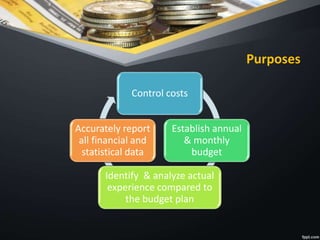
Purposes
Control costs
Establish annual
& monthly
budget
Identify & analyze actual
experience compared to
the budget plan
Accurately report
all financial and
statistical data
Characteristics
• It is a plan or program, framed on the basis of past
experience
• A scheme for action
• It should estimate revenues & expenditures as
accurately as possible
• It is comprehensive plan of action
Features
Flexible
Synthesis of past, present & future
Product of joint venture or participation of
executive at different levels
It should be clearly defined
Form of statistical standard laid down in
specific numerical form
Represent expected revenue as compared
with anticipated expense
Facilitate goal achievement
Principles
• Provide sound financial management
• Focus on objectives & policies of an organization
• Be flexible
• Budget necessitates a review of the performance of
the previous year & an evaluation of its adequacy
Importance of Budget
• An essential management tool
• Budget tells you how much money you need to carry
out your activities
• Budget enables to monitor income & expenditure
• The budget is a basis for financial accountability &
transparency
Types of Budget
Capital Budget
• Fund needed for the capital items for the growth
• New supplies & facilities & the replacement of worn out
equipment, machinery and furniture.
• The decision on capital budgeting is primarily is based
on:
i. Needs of patients and existing alternatives
ii. Effects of additional equipment on income &
expenditure
iii. Availability of funds
Operating Budget
• It provides an overview of an agency’s functions by
projecting the planned operations , usually for the
upcoming year.
• The nurse manager might include: personnel salaries ,
employee benefits, insurance , medical- surgical
supplies, office supplies , rent , light , house-keeping
• Both controllable and non-controlable expenses are
projected
Personal Budget
• Estimates the cost of direct labor
necessary to meet the nursing
needs of the estimated patient
population.
• The current staffing patterns,
number of unfilled positions and
last year’s report can provide a
base
Cash Budget
• Cash budget are planned to
make adequate funds available
as needed and to use any extra
funds profitably
• The ensure that the agency has
enough, but not too much , cash
on hand during the budgetary
period
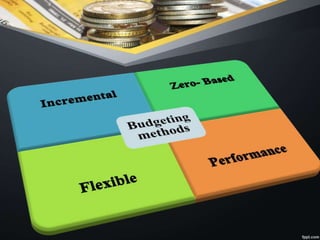
Budgeting methods
• Simplest method
• Budget for the coming year is projected
• Requires little budget expertise from the part of the
manager
Incremental
• Assumes the base for projecting next year’s budget is
zero
• Manager’s are required to justify all activities &
programs as if they are initiated for the first time.
• Every proposed expenditure must be justified with:
• current environment
• fit with organizational objectives
Zero-Based
Continues…
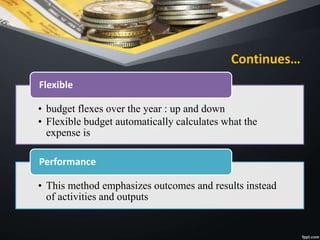
• budget flexes over the year : up and down
• Flexible budget automatically calculates what the
expense is
Flexible
• This method emphasizes outcomes and results instead
of activities and outputs
Performance
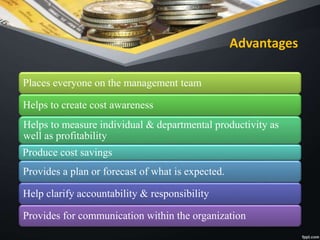
Advantages
Places everyone on the management team
Helps to create cost awareness
Helps to measure individual & departmental productivity as
well as profitability
Produce cost savings
Provides a plan or forecast of what is expected.
Help clarify accountability & responsibility
Provides for communication within the organization
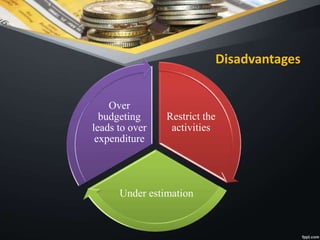
Disadvantages
Restrict the
activities
Under estimation
Over
budgeting
leads to over
expenditure
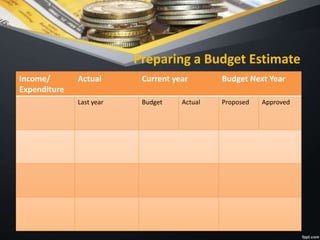
Preparing a Budget Estimate
Income/
Expenditure
Actual Current year Budget Next Year
Last year Budget Actual Proposed Approved
Role of Nurse Manager
• The administrator requires sufficient funds to support
sound program
• The administrator submits a budget request and a
justification for the proposed expenditures.
• Budget is presented to the president
• The budget is reviewed , analyzed and modified on the
basis of discussions of president and budget committee
• Once revisions are made , president presents the budget to
board of trustees for approval
Continues..
• When the budget is approved , it has given
authorization to make expenditure and to collect
income as indicated in the budget
• When the budget is adopted , administrator is
committed to support the budget
• Once the budget is approved , it is the responsibility
of the administrator to see that expenditures do not
exceed the approximates 1 made to the institution
Budget (Nursing Management)

Budget (Nursing Management)

  • 1.
    Budget Presented By : Mr.Uttam Vaishnav M.Sc. Nursing (Psychiatric)
  • 2.
    Meaning • A forecastof the resources required to deliver the services offered by the organization • A plan for coordinating the financial goals of an organization • A formal , quantitative expression of management’s plans, intentions, expectations & actions to control results
  • 3.
    In summary • Abudget is a financial plan that includes estimated expenses as well as income for a period of time. • Fixed or variable/ either controllable or non- controllable . • Fixed expenses do not vary with volume, whereas variable expenses do
  • 4.
    Purposes Control costs Establish annual &monthly budget Identify & analyze actual experience compared to the budget plan Accurately report all financial and statistical data
  • 5.
    Characteristics • It isa plan or program, framed on the basis of past experience • A scheme for action • It should estimate revenues & expenditures as accurately as possible • It is comprehensive plan of action
  • 6.
    Features Flexible Synthesis of past,present & future Product of joint venture or participation of executive at different levels It should be clearly defined Form of statistical standard laid down in specific numerical form Represent expected revenue as compared with anticipated expense Facilitate goal achievement
  • 7.
    Principles • Provide soundfinancial management • Focus on objectives & policies of an organization • Be flexible • Budget necessitates a review of the performance of the previous year & an evaluation of its adequacy
  • 8.
    Importance of Budget •An essential management tool • Budget tells you how much money you need to carry out your activities • Budget enables to monitor income & expenditure • The budget is a basis for financial accountability & transparency
  • 9.
  • 10.
    Capital Budget • Fundneeded for the capital items for the growth • New supplies & facilities & the replacement of worn out equipment, machinery and furniture. • The decision on capital budgeting is primarily is based on: i. Needs of patients and existing alternatives ii. Effects of additional equipment on income & expenditure iii. Availability of funds
  • 11.
    Operating Budget • Itprovides an overview of an agency’s functions by projecting the planned operations , usually for the upcoming year. • The nurse manager might include: personnel salaries , employee benefits, insurance , medical- surgical supplies, office supplies , rent , light , house-keeping • Both controllable and non-controlable expenses are projected
  • 12.
    Personal Budget • Estimatesthe cost of direct labor necessary to meet the nursing needs of the estimated patient population. • The current staffing patterns, number of unfilled positions and last year’s report can provide a base
  • 13.
    Cash Budget • Cashbudget are planned to make adequate funds available as needed and to use any extra funds profitably • The ensure that the agency has enough, but not too much , cash on hand during the budgetary period
  • 15.
    Budgeting methods • Simplestmethod • Budget for the coming year is projected • Requires little budget expertise from the part of the manager Incremental • Assumes the base for projecting next year’s budget is zero • Manager’s are required to justify all activities & programs as if they are initiated for the first time. • Every proposed expenditure must be justified with: • current environment • fit with organizational objectives Zero-Based
  • 16.
    Continues… • budget flexesover the year : up and down • Flexible budget automatically calculates what the expense is Flexible • This method emphasizes outcomes and results instead of activities and outputs Performance
  • 17.
    Advantages Places everyone onthe management team Helps to create cost awareness Helps to measure individual & departmental productivity as well as profitability Produce cost savings Provides a plan or forecast of what is expected. Help clarify accountability & responsibility Provides for communication within the organization
  • 18.
  • 19.
    Preparing a BudgetEstimate Income/ Expenditure Actual Current year Budget Next Year Last year Budget Actual Proposed Approved
  • 20.
    Role of NurseManager • The administrator requires sufficient funds to support sound program • The administrator submits a budget request and a justification for the proposed expenditures. • Budget is presented to the president • The budget is reviewed , analyzed and modified on the basis of discussions of president and budget committee • Once revisions are made , president presents the budget to board of trustees for approval
  • 21.
    Continues.. • When thebudget is approved , it has given authorization to make expenditure and to collect income as indicated in the budget • When the budget is adopted , administrator is committed to support the budget • Once the budget is approved , it is the responsibility of the administrator to see that expenditures do not exceed the approximates 1 made to the institution