Immunity
“State or quality of being immune”
or
“Resistance exhibited by the host against any
foreign antigen and towards injury caused by
microorganisms and their products.”
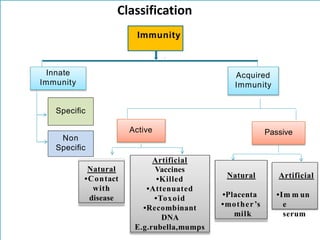
Innate
Immunity
Acquired
Immunity
Non
Specific
Specific
Active Passive
Natural
•Contact
with
disease
Artificial
Vaccines
•Killed
•Attenuated
•Toxoid
•Recombinant
DNA
E.g.rubella,mumps
Natural
•Placenta
•mother’s
milk
Artificial
•Im m un
e
serum
Immunity
Classification
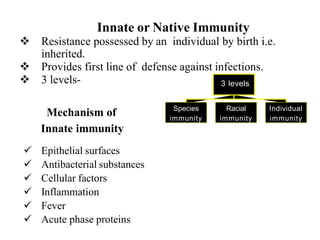
Innate or Native Immunity
 Resistance possessed by an individual by birth i.e.
inherited.
 Provides first line of defense against infections.
 3 levels-
Mechanism of
Innate immunity
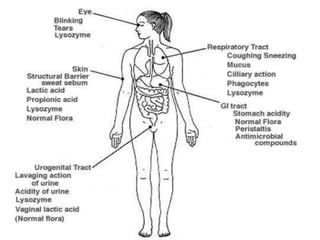
 Epithelial surfaces
 Antibacterial substances
 Cellular factors
 Inflammation
 Fever
 Acute phase proteins
3 levels
Species
immunity
Racial
immunity
Individual
immunity
Epithelial Surfaces
Skin
 Provides mechanical barrier to microorganisms
 High concentration of salts in sweat, sebaceous
secretions provides bactericidal secretions
 The resident bacterial flora of skin and mucous
surfaces prevent colonization by pathogen
 Alteration of normal flora may lead to invasion by
extraneous microbes and cause serious diseases.
Respiratory tract
• Respiratory tract is lined by moist mucous
surfaces which act as trapping mechanism.
• Inhaled particles are arrested in nasal passage on
moist mucous membrane surfaces.
• The hair like cilia propels the particles towards
pharynx and are swallowed or coughed out.
• Some particles which manage to reach alveoli are
ingested by phagocytes
Intestinal tract
• Saliva present in mouth inhibits many
microorganisms.
• Acidic ph of gastric juices destroys the swallowed
bacteria if any.
• Normal flora of intestine prevent colonization of
pathogens.
Conjunctiva
•Tears flush away bacteria and other dust particles
• Lysozyme present in tears has bactericidal action.
Genitourinary tract
• Urine eliminate bacteria from urethra by its
flushing action.
• Acidic ph of vaginal secretion of female due to
fermentation of glycogen by lactobacillus
(normal flora) makes vagina free from
microorganisms.
• In males, semen is believed to have some
antibacterial substance.
Antibacterial substances in blood
and tissues
There are no. of antibacterial substances present
in blood and tissues
 Beta lysin: relatively thermo stable substance
active against anthrax and related bacilli.
 Basic Polypeptide : e.g- leukins and plakins
 Acidic substances : lactic acid present in tissue
and infected area
 Interferon : protects against certain acute and
viral infections.
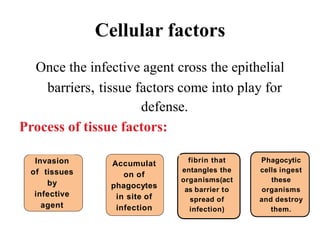
Cellular factors
Once the infective agent cross the epithelial
barriers, tissue factors come into play for
defense.
Process of tissue factors:
Invasion
of tissues
by
infective
agent
Accumulat
on of
phagocytes
in site of
infection
fibrin that
entangles the
organisms(act
as barrier to
spread of
infection)
Phagocytic
cells ingest
these
organisms
and destroy
them.
Inflammations
 An important non-specific defense mechanism
 Occurs as a result of tissue injury, initiated by
entry of pathogens.
 Leads to vasodilation, increased vascular
permeability and cellular infiltration
 Due to increased vascular permeability, plasma
pours out and dilutes the toxic products present.
 Fibrin barrier is laid to wall off the site of
infection
Fever
• Rise in temperature destroys the infecting
organism
• Stimulates the production of interferon, which
help in recovery from viral infections
Acute phase proteins
• Acute phase proteins: After injury, there is
sudden increase or decrease in plasma
concentration of certain proteins, collectively
called Acute phase proteins
• They activate the alternative pathway of
complement
• Prevent tissue injury and promote repair of
inflammatory lesions
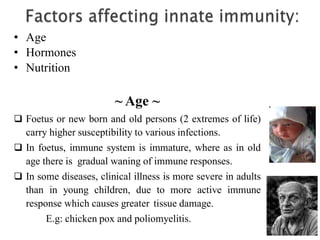
• Age
• Hormones
• Nutrition
~ Age ~
 Foetus or new born and old persons (2 extremes of life)
carry higher susceptibility to various infections.
 In foetus, immune system is immature, where as in old
age there is gradual waning of immune responses.
 In some diseases, clinical illness is more severe in adults
than in young children, due to more active immune
response which causes greater tissue damage.
E.g: chicken pox and poliomyelitis.
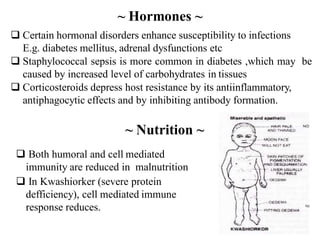
 Certain hormonal disorders enhance susceptibility to infections
E.g. diabetes mellitus, adrenal dysfunctions etc
 Staphylococcal sepsis is more common in diabetes ,which may be
caused by increased level of carbohydrates in tissues
 Corticosteroids depress host resistance by its antiinflammatory,
antiphagocytic effects and by inhibiting antibody formation.
~ Hormones ~
 Both humoral and cell mediated
immunity are reduced in malnutrition
 In Kwashiorker (severe protein
defficiency), cell mediated immune
response reduces.
~ Nutrition ~
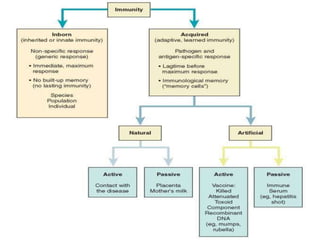
Acquired/ Adoptive Immunity
 The resistance acquired by an individual during life by
recognizing and selectively eliminating specific foreign
molecules.
 Provides second line of defense against infection.
Two types:-
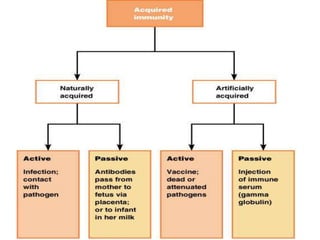
• Active acquired immunity
• Passive acquired immunity
Active acquired immunity
• also known as adaptive immunity
• Resistance developed by an individual as a result of an
antigenic stimulus
• Used for prophylaxis to increase body resistance
• 2 types:
 Natural active immunity
 Artificial active immunity
Natural active immunity
• Results from either a clinical or an inapparent infection bya
microbe.
• Usually long lasting
E.g. Person recovering from chicken pox and measles develop
natural active immunity.
Artificial active Immunity
• Resistance induced by vaccination.
Vaccines: preparations of live or killed microorganisms and their
products (antigens or toxoids)
• Bacterial vaccines: live or attenuated- BCG for tuberculosis
killed- Cholera vaccine
• Bacterial products- Tetanus toxoids
• Viral Vaccines: live or attenuated-oral polio vaccine
killed-Injectable polio vaccine, Hepatitis B Vaccine
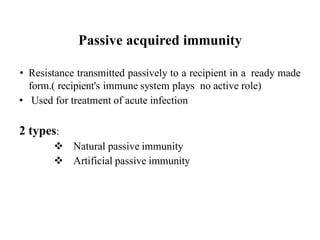
Passive acquired immunity
• Resistance transmitted passively to a recipient in a ready made
form.( recipient's immune system plays no active role)
• Used for treatment of acute infection
2 types:
 Natural passive immunity
 Artificial passive immunity
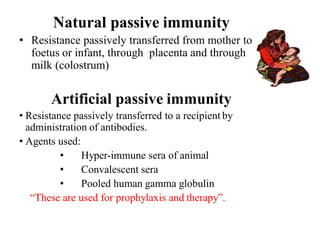
Natural passive immunity
• Resistance passively transferred from mother to
foetus or infant, through placenta and through
milk (colostrum)
Artificial passive immunity
• Resistance passively transferred to a recipient by
administration of antibodies.
• Agents used:
• Hyper-immune sera of animal
• Convalescent sera
• Pooled human gamma globulin
“These are used for prophylaxis and therapy”.
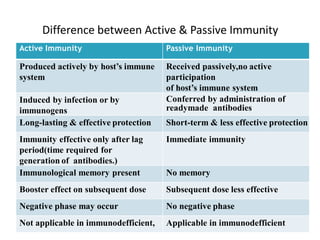
Difference between Active & Passive Immunity
Active Immunity Passive Immunity
Produced actively by host’s immune
system
Received passively,no active
participation
of host’s immune system
Induced by infection or by
immunogens
Conferred by administration of
readymade antibodies
Long-lasting & effective protection Short-term & less effective protection
Immunity effective only after lag
period(time required for
generation of antibodies.)
Immediate immunity
Immunological memory present No memory
Booster effect on subsequent dose Subsequent dose less effective
Negative phase may occur No negative phase
Not applicable in immunodefficient, Applicable in immunodefficient
Immunity- Microbiology-Jayesh Sir.pdf

Immunity- Microbiology-Jayesh Sir.pdf

  • 2.
    Immunity “State or qualityof being immune” or “Resistance exhibited by the host against any foreign antigen and towards injury caused by microorganisms and their products.”
  • 4.
  • 5.
    Innate or NativeImmunity  Resistance possessed by an individual by birth i.e. inherited.  Provides first line of defense against infections.  3 levels- Mechanism of Innate immunity  Epithelial surfaces  Antibacterial substances  Cellular factors  Inflammation  Fever  Acute phase proteins 3 levels Species immunity Racial immunity Individual immunity
  • 6.
    Epithelial Surfaces Skin  Providesmechanical barrier to microorganisms  High concentration of salts in sweat, sebaceous secretions provides bactericidal secretions  The resident bacterial flora of skin and mucous surfaces prevent colonization by pathogen  Alteration of normal flora may lead to invasion by extraneous microbes and cause serious diseases.
  • 7.
    Respiratory tract • Respiratorytract is lined by moist mucous surfaces which act as trapping mechanism. • Inhaled particles are arrested in nasal passage on moist mucous membrane surfaces. • The hair like cilia propels the particles towards pharynx and are swallowed or coughed out. • Some particles which manage to reach alveoli are ingested by phagocytes
  • 8.
    Intestinal tract • Salivapresent in mouth inhibits many microorganisms. • Acidic ph of gastric juices destroys the swallowed bacteria if any. • Normal flora of intestine prevent colonization of pathogens. Conjunctiva •Tears flush away bacteria and other dust particles • Lysozyme present in tears has bactericidal action.
  • 9.
    Genitourinary tract • Urineeliminate bacteria from urethra by its flushing action. • Acidic ph of vaginal secretion of female due to fermentation of glycogen by lactobacillus (normal flora) makes vagina free from microorganisms. • In males, semen is believed to have some antibacterial substance.
  • 11.
    Antibacterial substances inblood and tissues There are no. of antibacterial substances present in blood and tissues  Beta lysin: relatively thermo stable substance active against anthrax and related bacilli.  Basic Polypeptide : e.g- leukins and plakins  Acidic substances : lactic acid present in tissue and infected area  Interferon : protects against certain acute and viral infections.
  • 12.
    Cellular factors Once theinfective agent cross the epithelial barriers, tissue factors come into play for defense. Process of tissue factors: Invasion of tissues by infective agent Accumulat on of phagocytes in site of infection fibrin that entangles the organisms(act as barrier to spread of infection) Phagocytic cells ingest these organisms and destroy them.
  • 13.
    Inflammations  An importantnon-specific defense mechanism  Occurs as a result of tissue injury, initiated by entry of pathogens.  Leads to vasodilation, increased vascular permeability and cellular infiltration  Due to increased vascular permeability, plasma pours out and dilutes the toxic products present.  Fibrin barrier is laid to wall off the site of infection
  • 14.
    Fever • Rise intemperature destroys the infecting organism • Stimulates the production of interferon, which help in recovery from viral infections
  • 15.
    Acute phase proteins •Acute phase proteins: After injury, there is sudden increase or decrease in plasma concentration of certain proteins, collectively called Acute phase proteins • They activate the alternative pathway of complement • Prevent tissue injury and promote repair of inflammatory lesions
  • 16.
    • Age • Hormones •Nutrition ~ Age ~  Foetus or new born and old persons (2 extremes of life) carry higher susceptibility to various infections.  In foetus, immune system is immature, where as in old age there is gradual waning of immune responses.  In some diseases, clinical illness is more severe in adults than in young children, due to more active immune response which causes greater tissue damage. E.g: chicken pox and poliomyelitis.
  • 17.
     Certain hormonaldisorders enhance susceptibility to infections E.g. diabetes mellitus, adrenal dysfunctions etc  Staphylococcal sepsis is more common in diabetes ,which may be caused by increased level of carbohydrates in tissues  Corticosteroids depress host resistance by its antiinflammatory, antiphagocytic effects and by inhibiting antibody formation. ~ Hormones ~  Both humoral and cell mediated immunity are reduced in malnutrition  In Kwashiorker (severe protein defficiency), cell mediated immune response reduces. ~ Nutrition ~
  • 18.
    Acquired/ Adoptive Immunity The resistance acquired by an individual during life by recognizing and selectively eliminating specific foreign molecules.  Provides second line of defense against infection. Two types:- • Active acquired immunity • Passive acquired immunity
  • 19.
    Active acquired immunity •also known as adaptive immunity • Resistance developed by an individual as a result of an antigenic stimulus • Used for prophylaxis to increase body resistance • 2 types:  Natural active immunity  Artificial active immunity
  • 20.
    Natural active immunity •Results from either a clinical or an inapparent infection bya microbe. • Usually long lasting E.g. Person recovering from chicken pox and measles develop natural active immunity. Artificial active Immunity • Resistance induced by vaccination. Vaccines: preparations of live or killed microorganisms and their products (antigens or toxoids) • Bacterial vaccines: live or attenuated- BCG for tuberculosis killed- Cholera vaccine • Bacterial products- Tetanus toxoids • Viral Vaccines: live or attenuated-oral polio vaccine killed-Injectable polio vaccine, Hepatitis B Vaccine
  • 21.
    Passive acquired immunity •Resistance transmitted passively to a recipient in a ready made form.( recipient's immune system plays no active role) • Used for treatment of acute infection 2 types:  Natural passive immunity  Artificial passive immunity
  • 22.
    Natural passive immunity •Resistance passively transferred from mother to foetus or infant, through placenta and through milk (colostrum) Artificial passive immunity • Resistance passively transferred to a recipient by administration of antibodies. • Agents used: • Hyper-immune sera of animal • Convalescent sera • Pooled human gamma globulin “These are used for prophylaxis and therapy”.
  • 23.
    Difference between Active& Passive Immunity Active Immunity Passive Immunity Produced actively by host’s immune system Received passively,no active participation of host’s immune system Induced by infection or by immunogens Conferred by administration of readymade antibodies Long-lasting & effective protection Short-term & less effective protection Immunity effective only after lag period(time required for generation of antibodies.) Immediate immunity Immunological memory present No memory Booster effect on subsequent dose Subsequent dose less effective Negative phase may occur No negative phase Not applicable in immunodefficient, Applicable in immunodefficient