S U R E S H B A B U . G
A S S I S T A N T P R O F E S S O R
C T E C P A S P A I P P A D
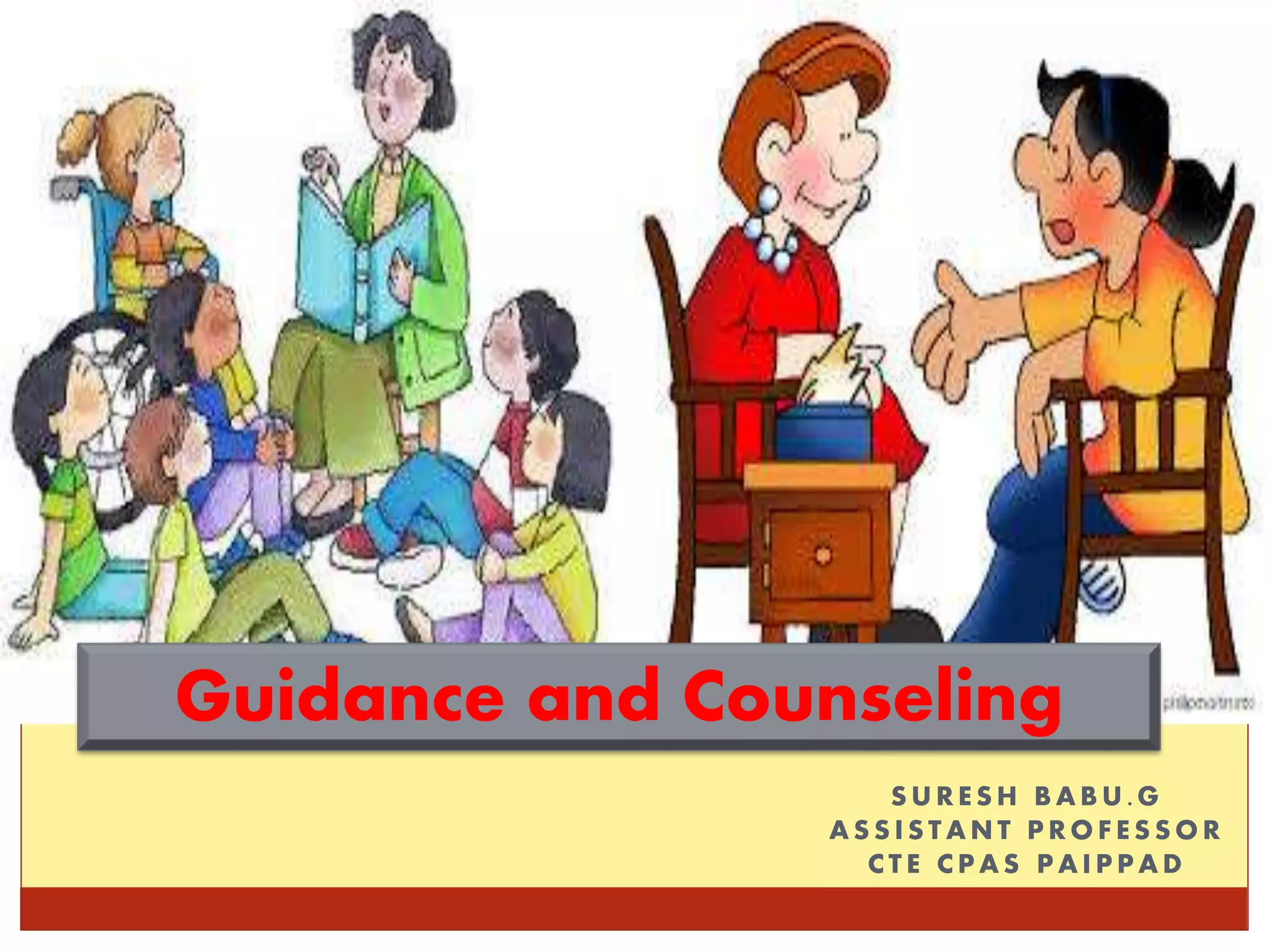
Guidance and Counseling
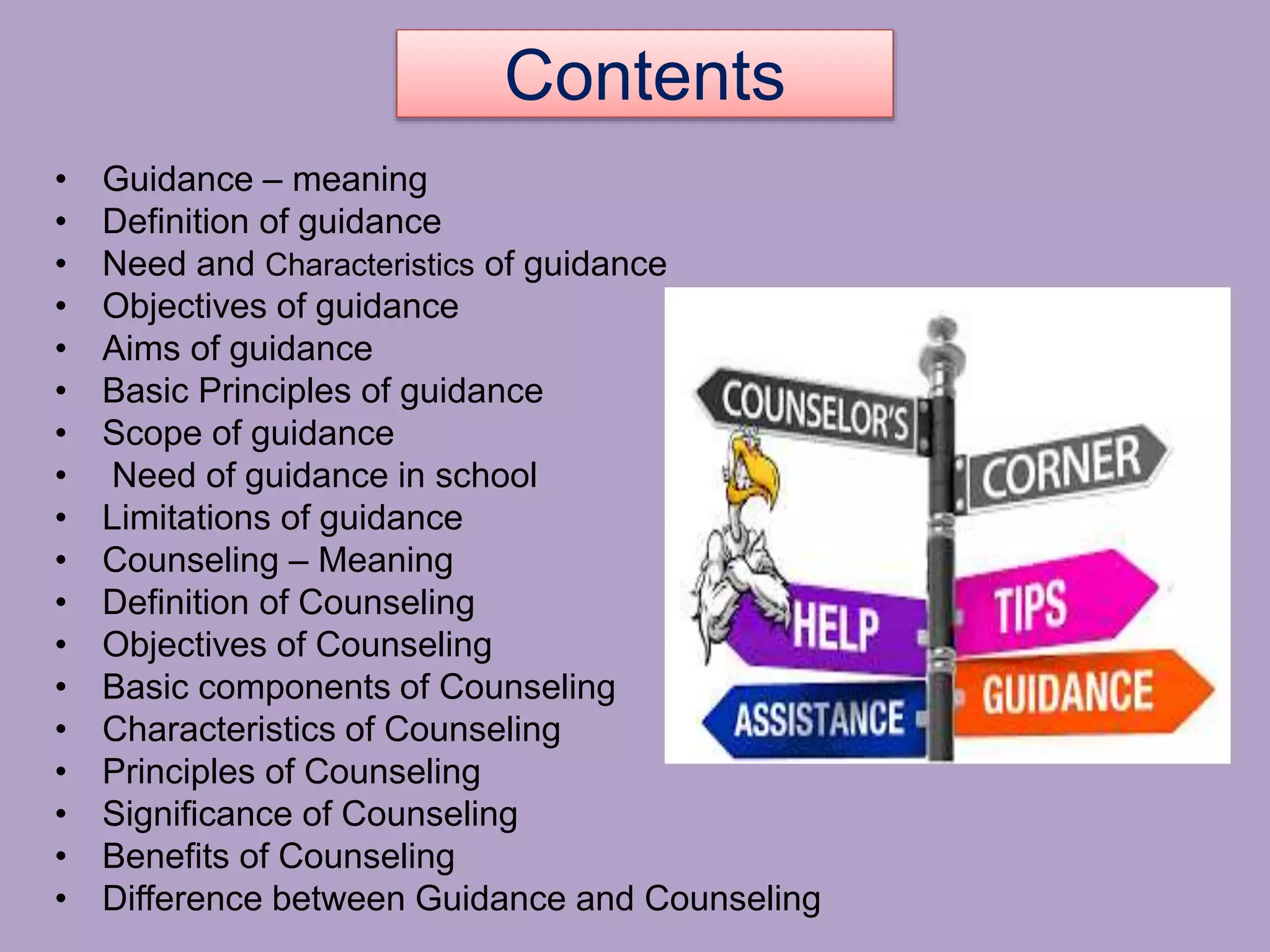
Contents
• Guidance – meaning
• Definition of guidance
• Need and Characteristics of guidance
• Objectives of guidance
• Aims of guidance
• Basic Principles of guidance
• Scope of guidance
• Need of guidance in school
• Limitations of guidance
• Counseling – Meaning
• Definition of Counseling
• Objectives of Counseling
• Basic components of Counseling
• Characteristics of Counseling
• Principles of Counseling
• Significance of Counseling
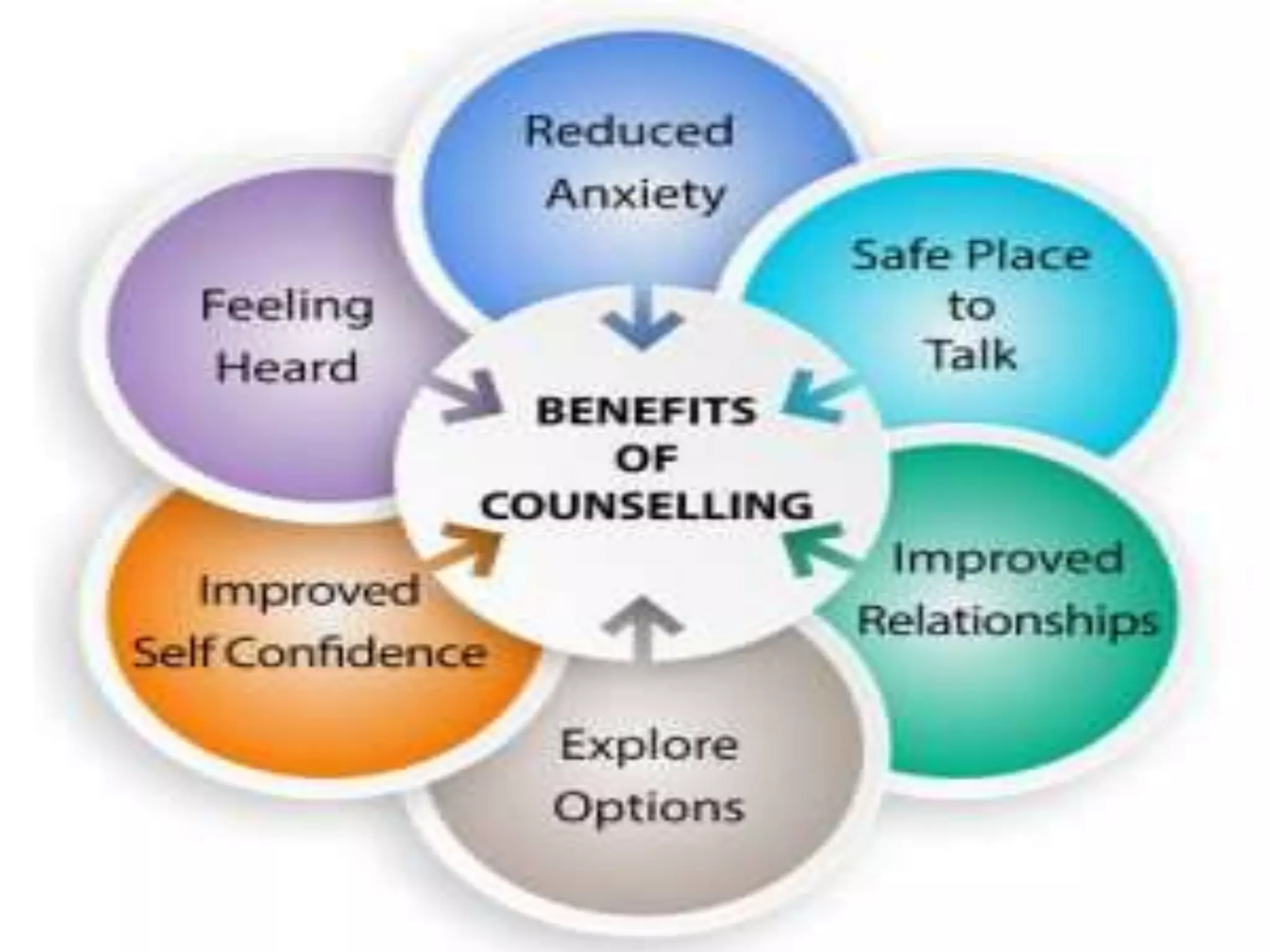
• Benefits of Counseling
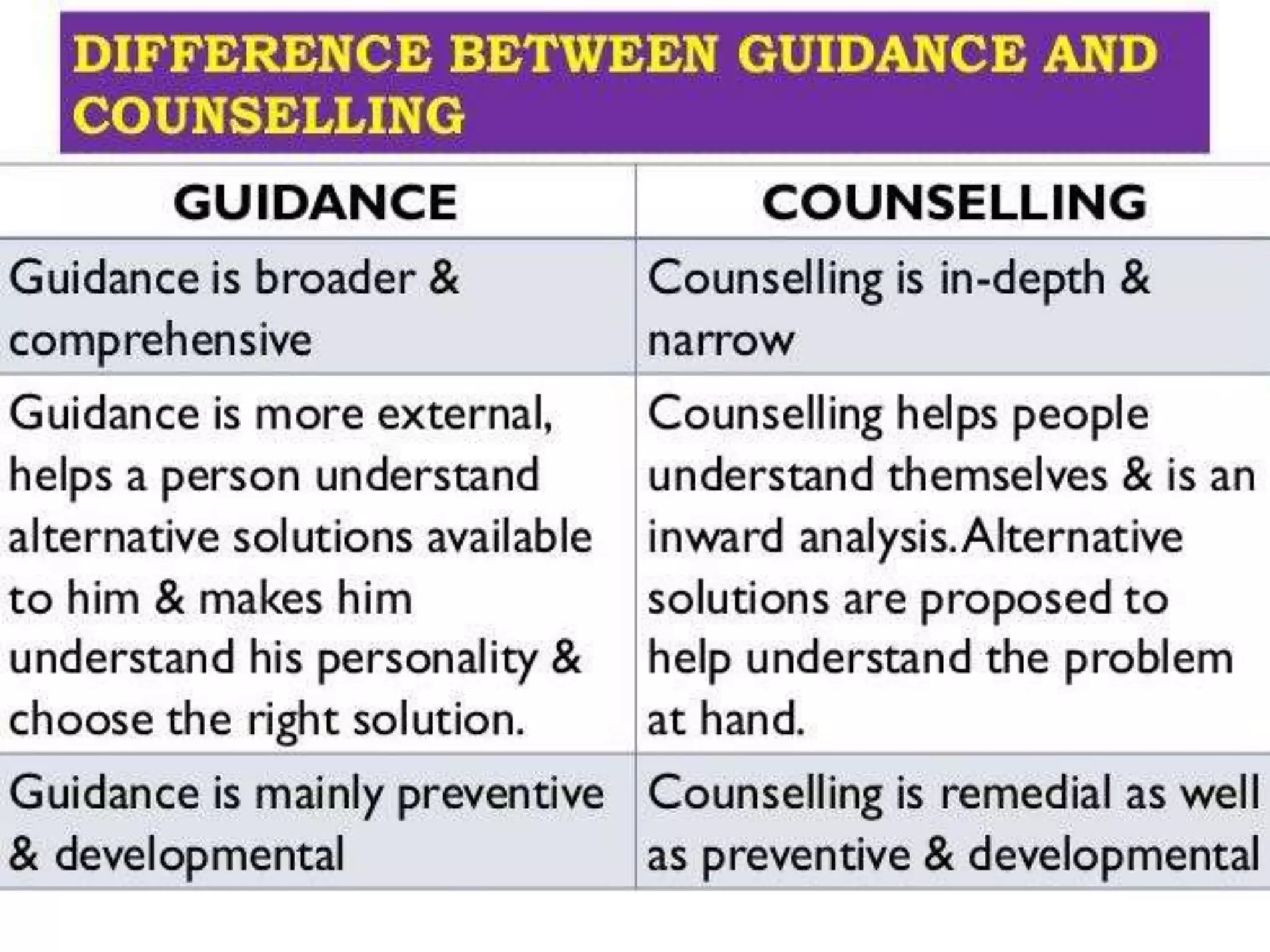
• Difference between Guidance and Counseling
Guidance - Meaning
Guidance is the process of helping an individual to help
himself and to develop his potentialities to the fullest by
utilizing the maximum opportunities provided by the
environment.
Guidance is referred to a process of assisting or helping
the students by properly trained teachers, career
masters or special guidance personnel their own future
wisely and in developing their potentialities to the
maximum for them to solve their immediate or future
problems and to lead a successful personal and social
life.
 Crow and Crow, “Guidance is assistance made
available by personality qualified and adequately
trained men or women to an individual of any age to
help manage his own life activities, develop his
points of view, make his own decisions and carry his
own burdens”.
 Skinner, “Guidance is a process of helping young
persons learns to adjust to self, to others, and to
circumstances”.
 Jones, “Guidance is the help given by one person to
another in making choices and adjustments and in
solving problems”.
Nature and Characteristics of Guidance
 It is a Process.
 It is a Continuous Process.
 It is apart from Instruction.
 Guidance is a process of Development rather
than Direction.
 Guidance fulfils some aims of Education.
 It is an organized service.
 It is always goal oriented.
 It is based on individual difference.
 It is life related.
OBJECTIVES OF GUIDANCE
 To help individual to understand and accept the
positive and negative aspects of his personality,
interests, aptitudes, attitudes etc.
 Provide a wide choice and opportunities.
 Help make adjustment in the new life situation.
 Help in facing the challenges of life and manage
tensions by realizing and accepting the facts.
 Help in solving social and personal problems and
be able to adjust with oneself and the
environment.
 Principle of All-Round Development of the Individual
 Principle of Human Uniqueness
 Principle of Holistic Development
 Principle of Cooperation
 Principle of Continuity
 Principle of Adjustment
 Principle of Individual Needs
 Principle of Expert Opinion
 Principle of Evaluation
 Principle of Responsibility
 Principle of Periodic Appraisal
AIMS OF GUIDANCE
 Exploring Self
 Determining Values
 Setting Goals
 Improving Efficiency
 Building Relationship
 Accepting Responsibility for the Future
Scope of Guidance
 Physical health
 Home problems
 Personality problems
 School or educational problems
 Vocational problems
 Religious and moral problems
 Democratic and political problems
 Marital and sexual problems
 Old age problems
Need for Guidance in schools
 To help in the total development of the student.
 To make proper choices at various stages of their
education career.
 To help the child to recognize and use his inner
resources to set goal.
 To help students choose, prepare, enter upon and
progress in a career.
 To help students make the best possible adjustments
in school and home.
 It is needed to check wastage
and stagnation.
 To help the exceptional children.
 To tackle emotional problems.
Limitations of Guidance
 Its service are not well organized.
 Lack of personnel and other facilities.
 In it there is an overdoing of psychological
tests.
 Conditions of life are too complex for any
person to solve the problems of other through
guidance.
 Unqualified guidance personnel may do more
harm.
Counseling
Counseling
 Counseling is a scientific process of assistance
extended by an expert in an individual situation
to a needy person.
 Counseling involves relationship between two
persons in which one of them (counselor)
attempts to assists the other (counselee or
client) in so organizing himself as to attain a
particular form of happiness, adjusting to a
 life situation, or in short,
self- actualization.
Definition of Counseling
 According to Rogers ,“ Counseling is a series
of direct contacts with the individual which aim
to offer him assistance in changing the
attitudes and behavior”
 Wolberg considers counseling as a form of
interview in which the client is helped to
understand himself more completely in order
to correct an environment or adjustment
difficulty.
Objectives of counseling
 To give students information to his success.
 To get information to student in problem solving.
 To establish mutual understanding between students
and teachers.
 To help student to work out a plan for solving his
difficulties.
 To help the student to know his interest, abilities,
attitudes etc.
 To encourage and develop special abilities and right
attitudes.
 To assist the student in planning
educational and vocational choices.
BASIC COMPONENT OF COUNSELLING
1.Rapport
2.Communication
3.Understanding
4.Change in feeling and expressions
5.Planning of counselling interview
CHARACTERISTICS OF COUNSELLING
 It is a purposeful learning experience for the
counsellee.
 It is the purposeful oriented and private interview
between the counsellor and counsellee
 Based on mutual confidence satisfactory
relationship will be establish
 Counselling process is structured around the felt
needs of the counsellee.
 Main emphasis in the counselling process is on
the counsellee’s self-direction and self
acceptance.
 It is only one aspect of guidance
Principles of counseling
 Self-directed and self- realization of client.
 Its approach is scientific.
 The client must be accepted as a whole person, as a
human being.
 It believes that the client has strength as well as
capacity to solve problems.
 It varies according to the needs of client.
 It is primarily a preventive and remedial process.
 It is voluntary for the student.
 It should be a structured
learning situation.
 Based on democratic value.
Significance of counseling
 Give information on important matters leading
to his success.
 Helps for problem solving.
 Makes mutual understanding
 Helps to understand himself.
 Helps to take steps to solve problems
Guidance and counselling

Guidance and counselling

  • 1.
    S U RE S H B A B U . G A S S I S T A N T P R O F E S S O R C T E C P A S P A I P P A D Guidance and Counseling
  • 2.
    Contents • Guidance –meaning • Definition of guidance • Need and Characteristics of guidance • Objectives of guidance • Aims of guidance • Basic Principles of guidance • Scope of guidance • Need of guidance in school • Limitations of guidance • Counseling – Meaning • Definition of Counseling • Objectives of Counseling • Basic components of Counseling • Characteristics of Counseling • Principles of Counseling • Significance of Counseling • Benefits of Counseling • Difference between Guidance and Counseling
  • 3.
    Guidance - Meaning Guidanceis the process of helping an individual to help himself and to develop his potentialities to the fullest by utilizing the maximum opportunities provided by the environment. Guidance is referred to a process of assisting or helping the students by properly trained teachers, career masters or special guidance personnel their own future wisely and in developing their potentialities to the maximum for them to solve their immediate or future problems and to lead a successful personal and social life.
  • 4.
     Crow andCrow, “Guidance is assistance made available by personality qualified and adequately trained men or women to an individual of any age to help manage his own life activities, develop his points of view, make his own decisions and carry his own burdens”.  Skinner, “Guidance is a process of helping young persons learns to adjust to self, to others, and to circumstances”.  Jones, “Guidance is the help given by one person to another in making choices and adjustments and in solving problems”.
  • 5.
    Nature and Characteristicsof Guidance  It is a Process.  It is a Continuous Process.  It is apart from Instruction.  Guidance is a process of Development rather than Direction.  Guidance fulfils some aims of Education.  It is an organized service.  It is always goal oriented.  It is based on individual difference.  It is life related.
  • 6.
    OBJECTIVES OF GUIDANCE To help individual to understand and accept the positive and negative aspects of his personality, interests, aptitudes, attitudes etc.  Provide a wide choice and opportunities.  Help make adjustment in the new life situation.  Help in facing the challenges of life and manage tensions by realizing and accepting the facts.  Help in solving social and personal problems and be able to adjust with oneself and the environment.
  • 7.
     Principle ofAll-Round Development of the Individual  Principle of Human Uniqueness  Principle of Holistic Development  Principle of Cooperation  Principle of Continuity  Principle of Adjustment  Principle of Individual Needs  Principle of Expert Opinion  Principle of Evaluation  Principle of Responsibility  Principle of Periodic Appraisal
  • 8.
    AIMS OF GUIDANCE Exploring Self  Determining Values  Setting Goals  Improving Efficiency  Building Relationship  Accepting Responsibility for the Future
  • 9.
    Scope of Guidance Physical health  Home problems  Personality problems  School or educational problems  Vocational problems  Religious and moral problems  Democratic and political problems  Marital and sexual problems  Old age problems
  • 10.
    Need for Guidancein schools  To help in the total development of the student.  To make proper choices at various stages of their education career.  To help the child to recognize and use his inner resources to set goal.  To help students choose, prepare, enter upon and progress in a career.  To help students make the best possible adjustments in school and home.  It is needed to check wastage and stagnation.  To help the exceptional children.  To tackle emotional problems.
  • 11.
    Limitations of Guidance Its service are not well organized.  Lack of personnel and other facilities.  In it there is an overdoing of psychological tests.  Conditions of life are too complex for any person to solve the problems of other through guidance.  Unqualified guidance personnel may do more harm.
  • 12.
  • 13.
    Counseling  Counseling isa scientific process of assistance extended by an expert in an individual situation to a needy person.  Counseling involves relationship between two persons in which one of them (counselor) attempts to assists the other (counselee or client) in so organizing himself as to attain a particular form of happiness, adjusting to a  life situation, or in short, self- actualization.
  • 14.
    Definition of Counseling According to Rogers ,“ Counseling is a series of direct contacts with the individual which aim to offer him assistance in changing the attitudes and behavior”  Wolberg considers counseling as a form of interview in which the client is helped to understand himself more completely in order to correct an environment or adjustment difficulty.
  • 15.
    Objectives of counseling To give students information to his success.  To get information to student in problem solving.  To establish mutual understanding between students and teachers.  To help student to work out a plan for solving his difficulties.  To help the student to know his interest, abilities, attitudes etc.  To encourage and develop special abilities and right attitudes.  To assist the student in planning educational and vocational choices.
  • 16.
    BASIC COMPONENT OFCOUNSELLING 1.Rapport 2.Communication 3.Understanding 4.Change in feeling and expressions 5.Planning of counselling interview
  • 17.
    CHARACTERISTICS OF COUNSELLING It is a purposeful learning experience for the counsellee.  It is the purposeful oriented and private interview between the counsellor and counsellee  Based on mutual confidence satisfactory relationship will be establish  Counselling process is structured around the felt needs of the counsellee.  Main emphasis in the counselling process is on the counsellee’s self-direction and self acceptance.  It is only one aspect of guidance
  • 18.
    Principles of counseling Self-directed and self- realization of client.  Its approach is scientific.  The client must be accepted as a whole person, as a human being.  It believes that the client has strength as well as capacity to solve problems.  It varies according to the needs of client.  It is primarily a preventive and remedial process.  It is voluntary for the student.  It should be a structured learning situation.  Based on democratic value.
  • 19.
    Significance of counseling Give information on important matters leading to his success.  Helps for problem solving.  Makes mutual understanding  Helps to understand himself.  Helps to take steps to solve problems