MICRO TEACHING ON :TRENDS
AND ISSUES IN GUIDANCE AND
COUNSELLING
PRESENTED BY :
DIMPLE WARRIOR
MSc (N) 1st YEAR
CONTENTS
1.Definitions
2.Need of guidance and counselling in education
3.Nature of guidance
4.Types of guidance
5.Qualities of guide and counsellor
6.Strategies of guidance
7.Levels of counselling
8.Approaches of counselling
9.Issues for counselling in nursing
WHAT IS GUIDANCE ...?
“Guidance is an assistance given to the individual in
making intelligence choices & adjustments.”
A. J. Jones
‘‘Guidance is a means of helping individuals to
understand and use wisely the educational , Vocational
and personal opportunities they have or can develop
and as a form of systematic assistance whereby
students are aided in achieving satisfactory adjustment
to school & to life.”
Dunsmoor & Miller
WHAT IS COUNSELLING …?
DEFINITION
The act of helping the client to see things more
clearly, possibly from a different view-point. This can
enable the client to focus on feelings, experiences or
behavior, with a goal of facilitating positive change.
NEED OF GUIDANCE AND COUNSELLING IN EDUCATION
....?
1.Increasing aspirants in all sectors of education.
2.Expansion and diversification in courses of study.
3.Mounting number of unemployed graduates.
4.Growing unrest and disturbances in educational sectors.
5.Uncertainties in career and higher education.
6.Social , personal , mental developments and adjustments .
TYPES OF GUIDANCE …?
1. EDUCATIONAL GUIDANCE
2. VOCATIONAL GUIDANCE
3. PERSONAL GUIDANCE
4. HEALTH GUIDANCE
5. SOCIAL GUIDANCE
6.ADVOCATIONAL GUIDANCE
1. EDUCATIONAL GUIDANCE
1 . Educational Guidance :
It refers to that guidance that a child or
students need during his school life. Also, it
helps them to resolve the problems that they
face in school. In addition, it gives all the
required details that children need related to
the school they find most suitable.
2. VOCATIONAL GUIDANCE
2. Vocational Guidance :
is assistance in choosing a career or profession
or in making employment or training decisions.
An example of vocational guidance is a meeting
with a consultant who helps people figure out
what a good job would be for them based on
their skills and qualifications.
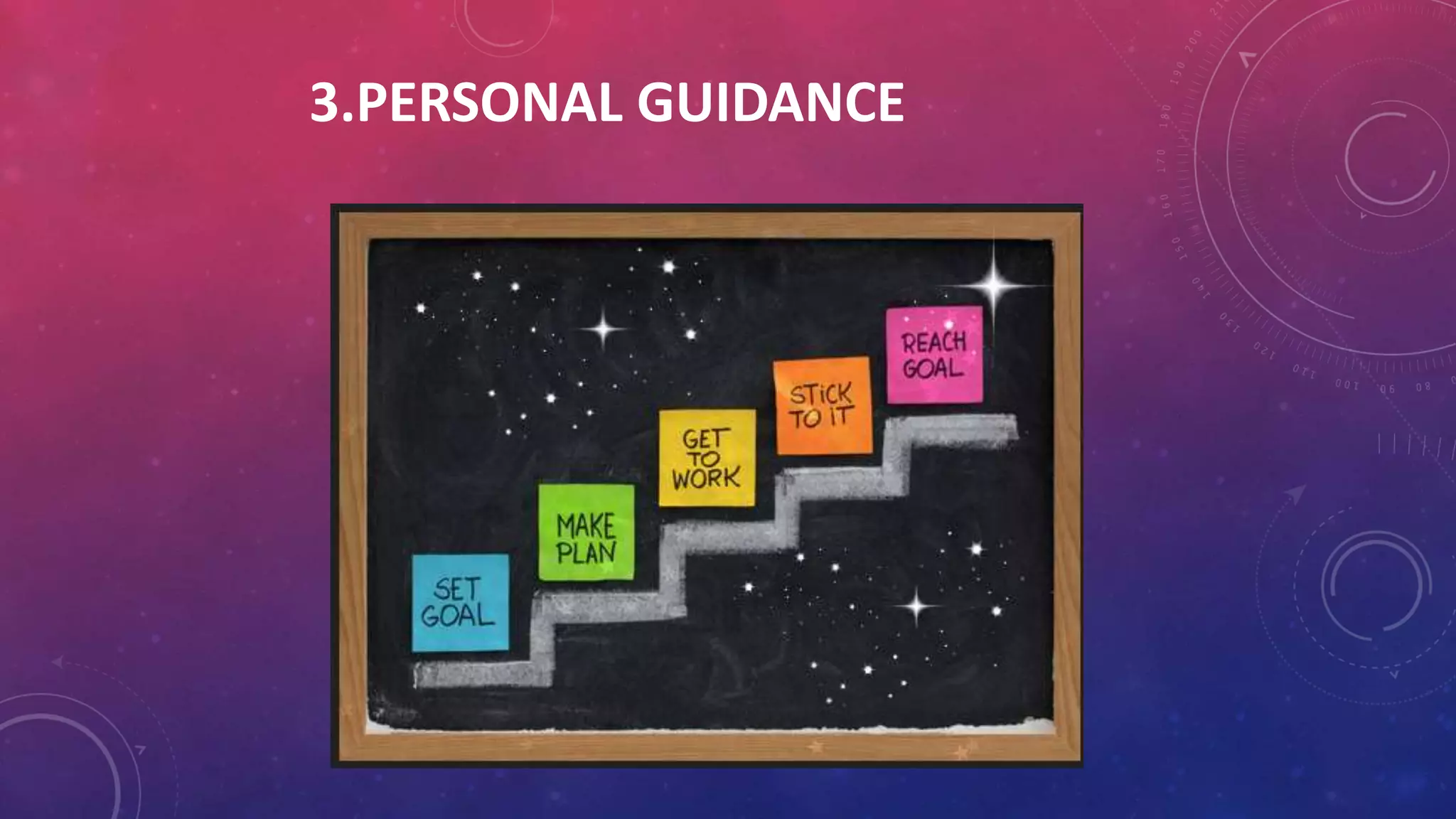
3.PERSONAL GUIDANCE
3. Personal Guidance :
may be defined as the assistance given to the
individual to solve his emotional, social, ethical
and moral as well as health problems. Hence
personal guidance deals with all those problems
of life which are not covered under educational
and vocational guidance.
4 .HEALTH GUIDANCE
4 . Health Guidance :
The guidance which is related to health is also known as health
guidance .
Health guidance can be defined as the principle by which individuals
and groups of people, learn to behave in a manner conducive to the
promotion, maintenance, or restoration of health.
Areas within this profession encompass environmental health,
physical health, social health, emotional health, intellectual health,
and spiritual health, as well as sexual and reproductive health
education and guidance .
5.SOCIAL GUIDANCE
5.Social Guidance :
These counseling services are to help
students develop awareness and
acceptance of self and others, improve
personal skills in survivals, be
responsible for their decisions and
develop intellect .
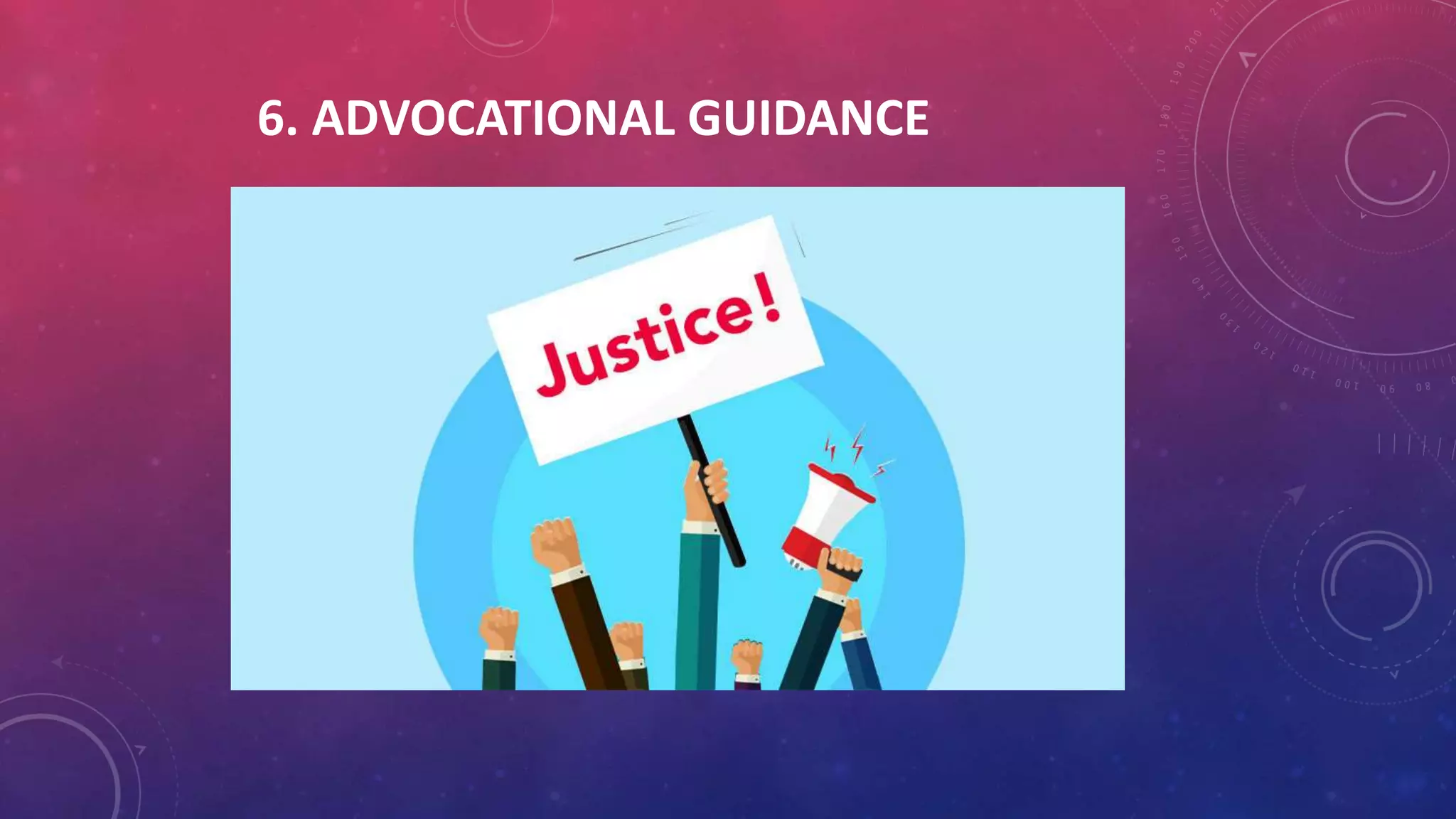
6. ADVOCATIONAL GUIDANCE
• These counseling services are to help students
develop awareness , justice and acceptance of
self and others, improve public support ,
personal skills in survival, recommendations
for particular cause and policy and be
responsible for their decisions legally .
QUALITIES OF A COUNSELLOR
1. Sensitive to human problems
2. Empathetic
3. Respect for individual variations
4. Being non-judgmental
5. Maintain confidentiality
6. Being approachable
7. Being firm yet friendly
8. Pleasant disposition
9. Understanding values and relationships
STRATEGIES OF GUIDANCE
1. INDIVIDUAL APPROACH
2. GROUP APPROACH
INDIVIDUAL APPROACH
1.Targets on single student
2.Special learners require special attention :
 Slow learners
 Gifted
 Creative
 Ones learning with difficulty
GROUP APPROACH
• Organised for general nature
• Students with common problems
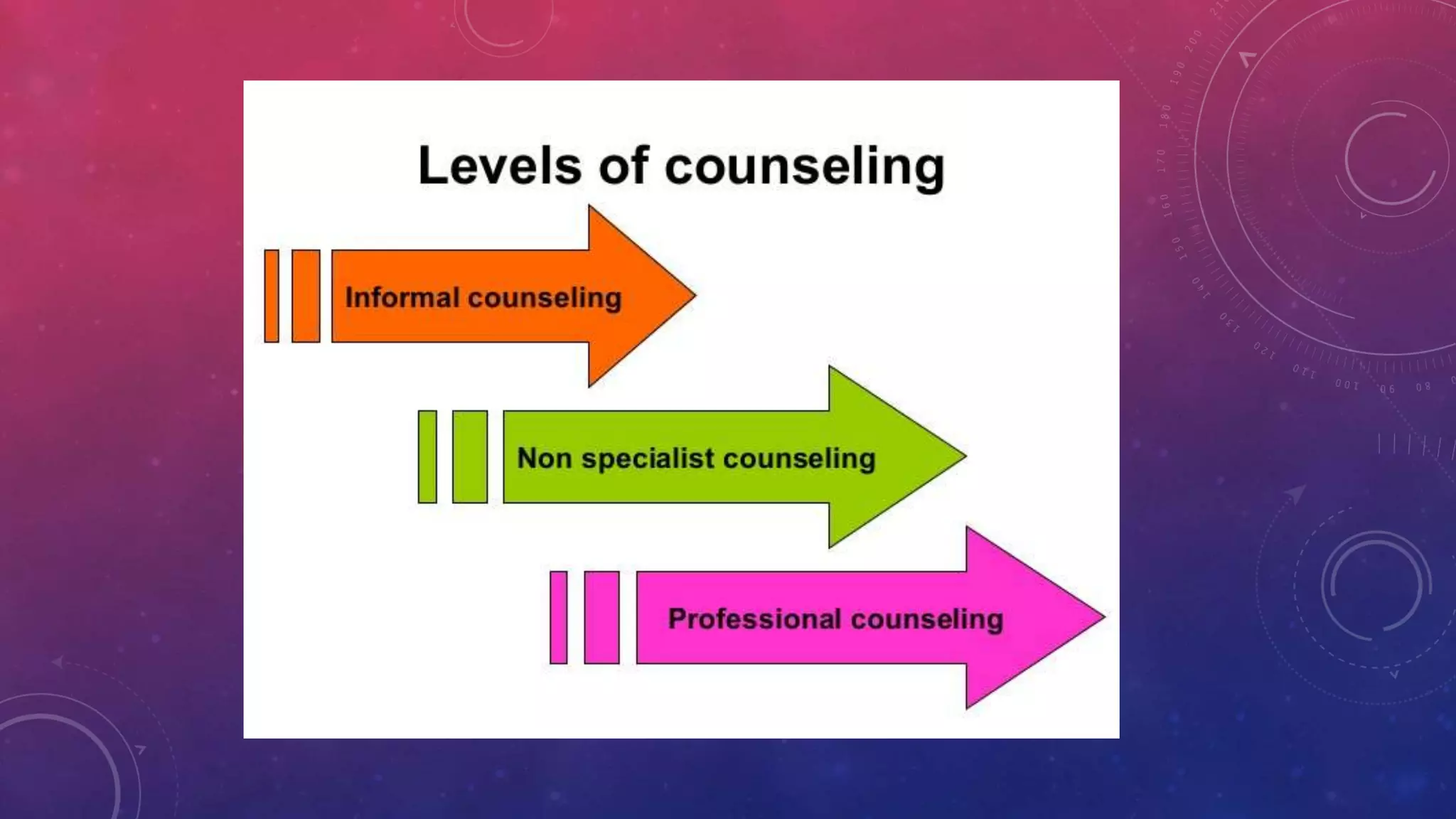
LEVELS OF COUNSELLING
• INFORMAL
• NON – SPECIALIST
• PROFESSIONAL
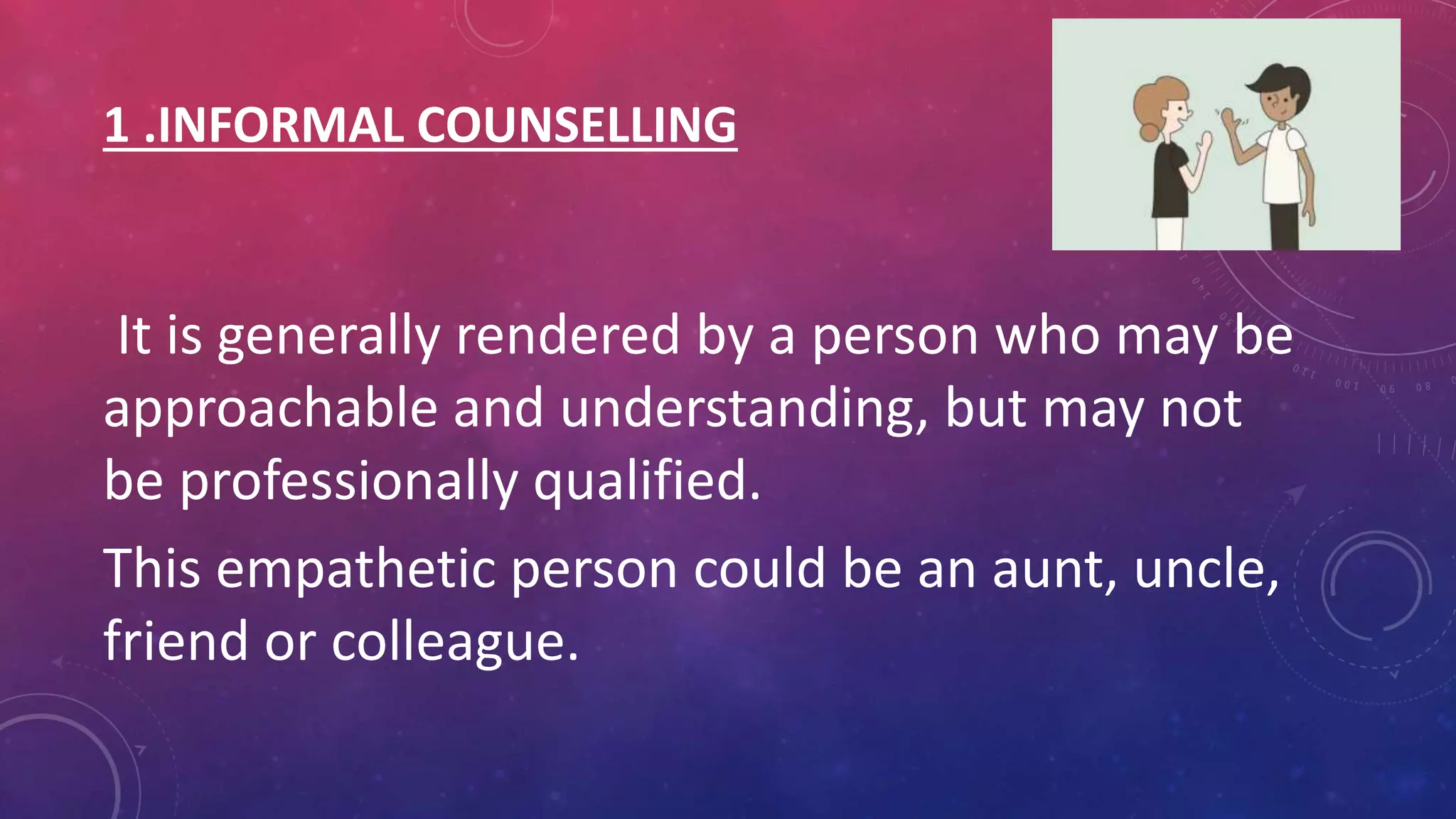
1 .INFORMAL COUNSELLING
It is generally rendered by a person who may be
approachable and understanding, but may not
be professionally qualified.
This empathetic person could be an aunt, uncle,
friend or colleague.
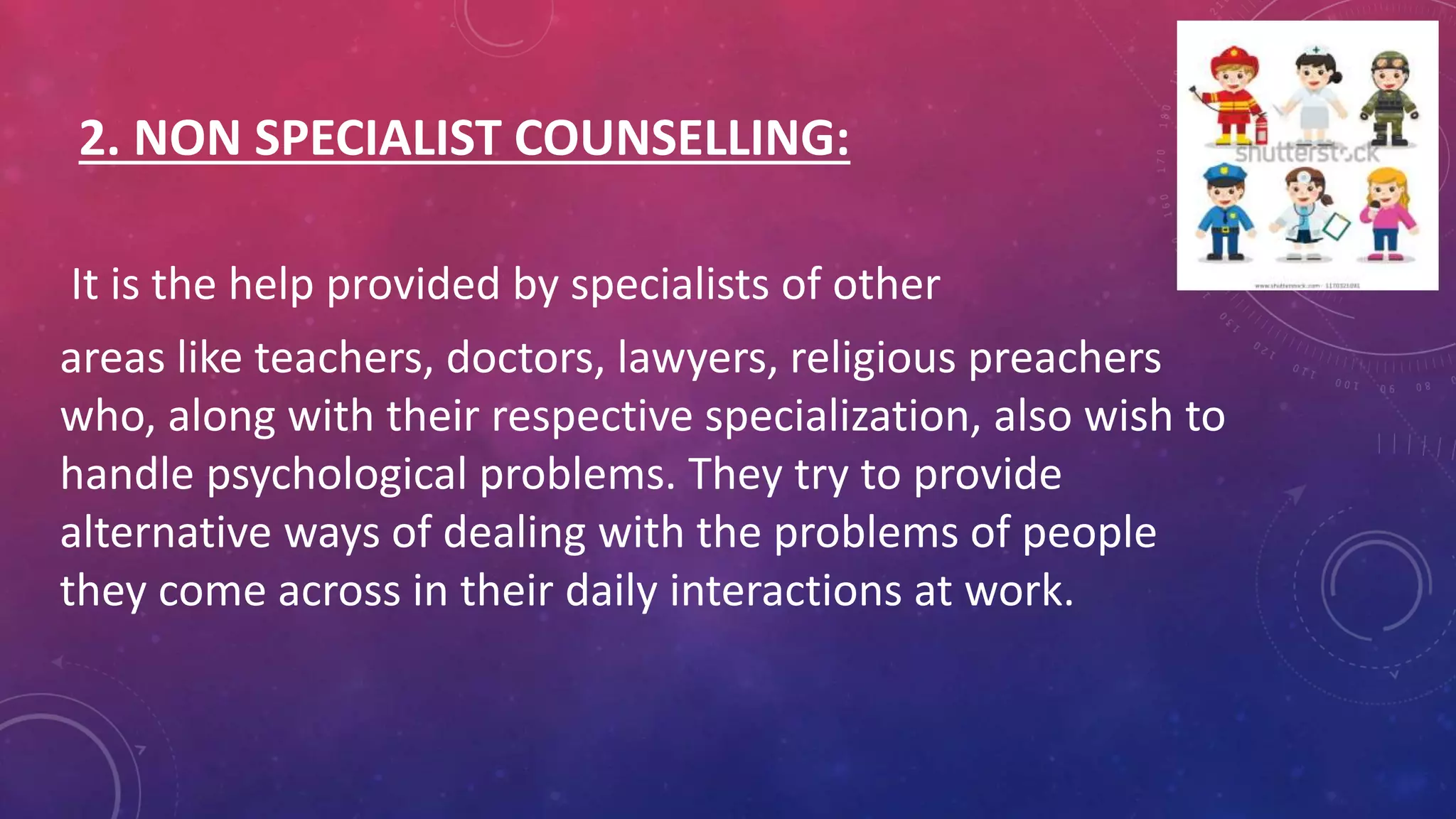
2. NON SPECIALIST COUNSELLING:
It is the help provided by specialists of other
areas like teachers, doctors, lawyers, religious preachers
who, along with their respective specialization, also wish to
handle psychological problems. They try to provide
alternative ways of dealing with the problems of people
they come across in their daily interactions at work.
3. PROFESSIONAL COUNSELLING:
Professional counsellors are the ones who have
received special training in counselling and have the
required qualifications. These counsellors deal with the
person’s social, emotional and personal problems. In
the counselling process, the professional counsellor
may use different techniques.
APPROACHES TO COUNSELLING
1.DIRECTIVE
2.INDIRECTIVE
3.ELECTIC
4.GROUP
5.MISCELLANEOUS
DIRECTIVE COUNSELLING
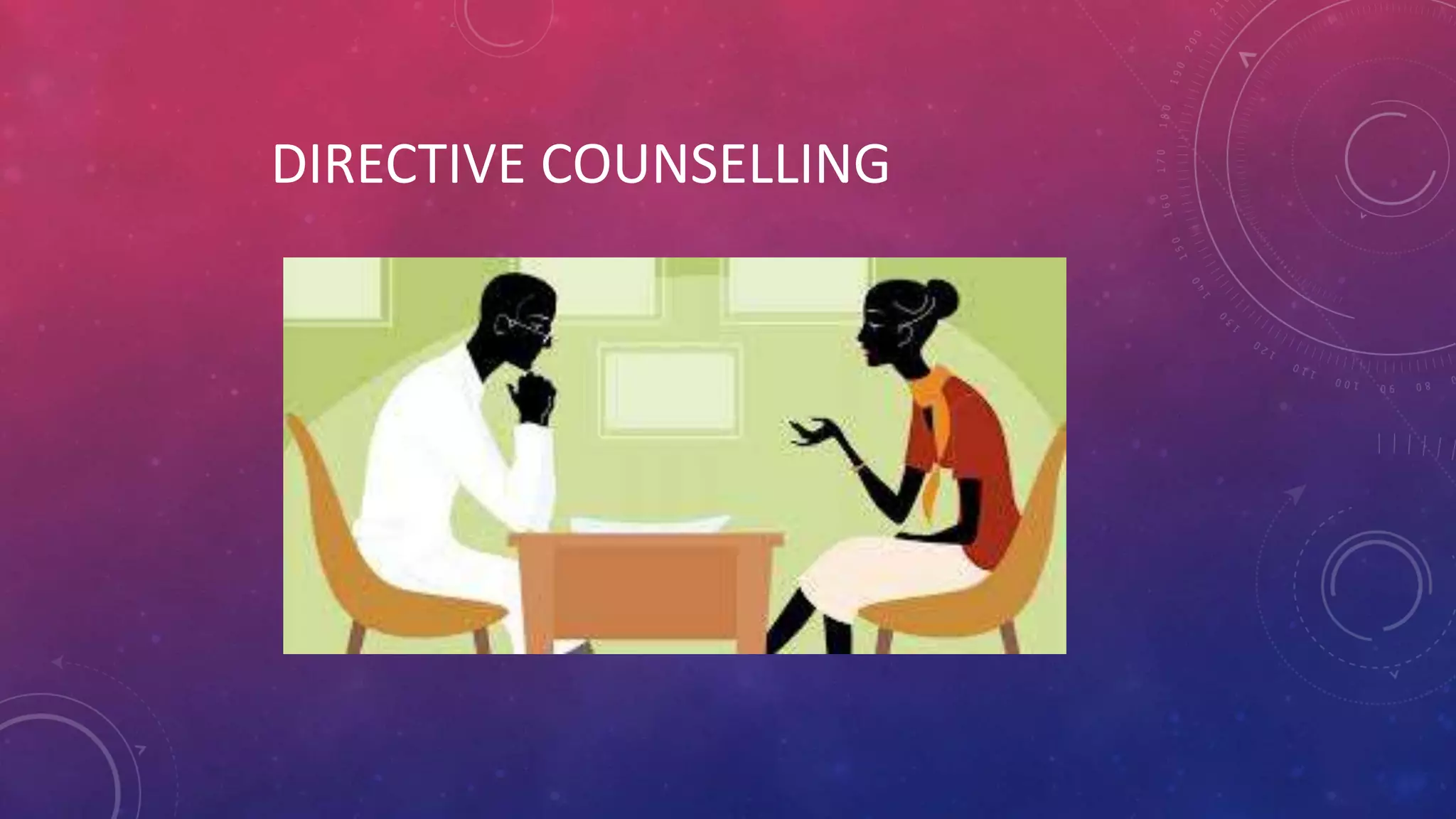
• Directive Counselling is a type of approach
that the counselor plays a significant role. He
replaces the emotional behavior of the client
with deliberately rationale behavior. Although
he avoids mandatory advice, in general, it
focuses on the counselor's viewpoint.
NON DIRECTIVE COUNSELLING
• Non-directive counseling, counselor listen,
support, and encourage the client without
forcing. It has been influenced by humanistic
theories in the tradition of Carl Rogers, but
techniques used in non-directive counseling
are common in many forms of psychological
counseling and treatment today.
ELECTIC COUNSELLING
• It lies in centre point of directive and non directive counselling .
ELECTIC COUNSELLING
• Eclectic counseling is defined as the synthesis and
combination of directive and non-directive
counseling. It represents a middle status between
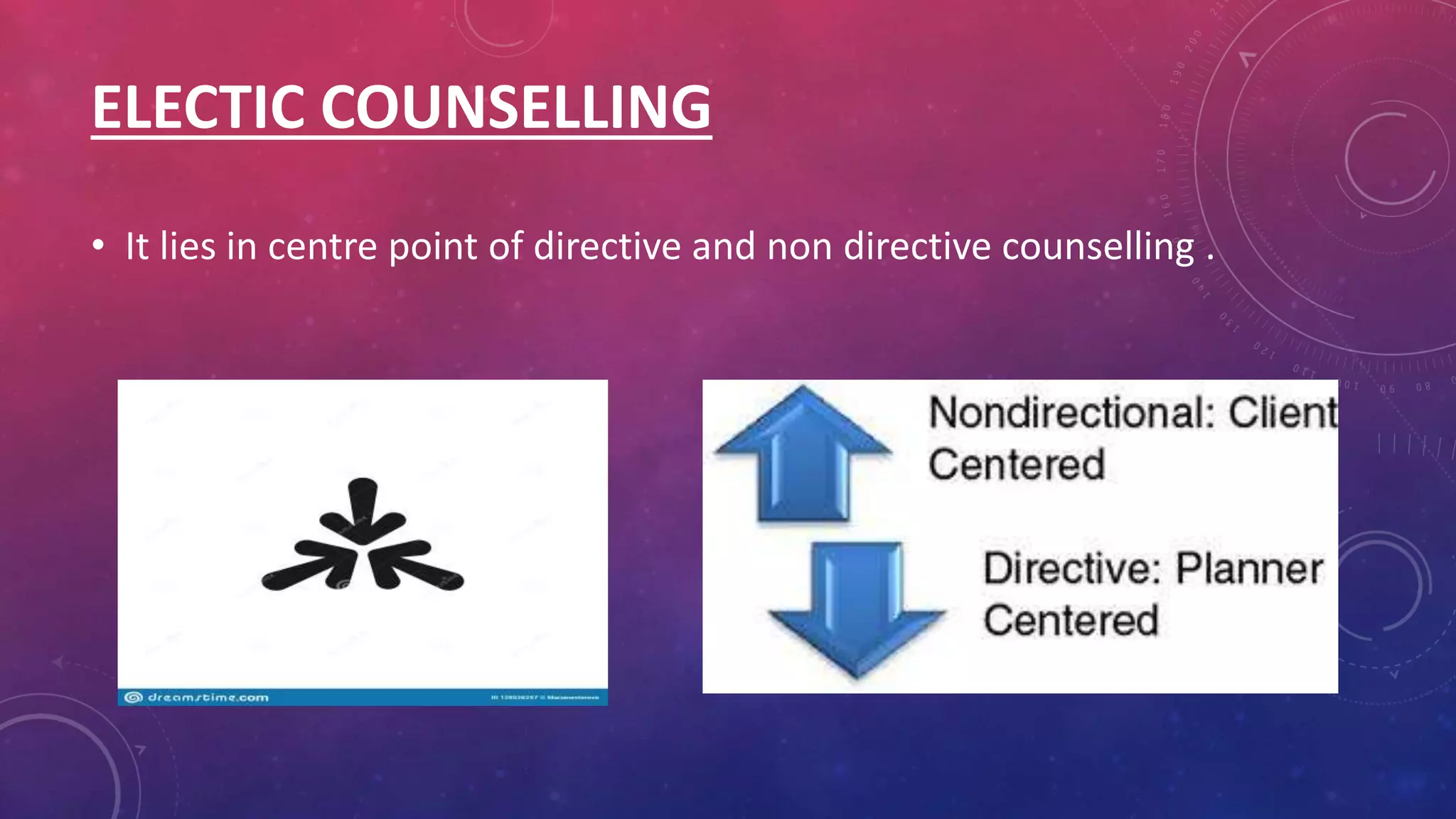
the two extremes represented by the 'non-
directive' technique on one hand and the 'directive'
technique on the other.
GROUP COUNSELLING
GROUP COUNSELLING
• Group counseling is a form of counseling where a
small group of people meet regularly to discuss,
interact, and explore problems with each other and
the group leader. Group counseling seeks to give
students a safe and comfortable place on campus
where they can work out problems and emotional
concerns.
MISCELLANEOUS
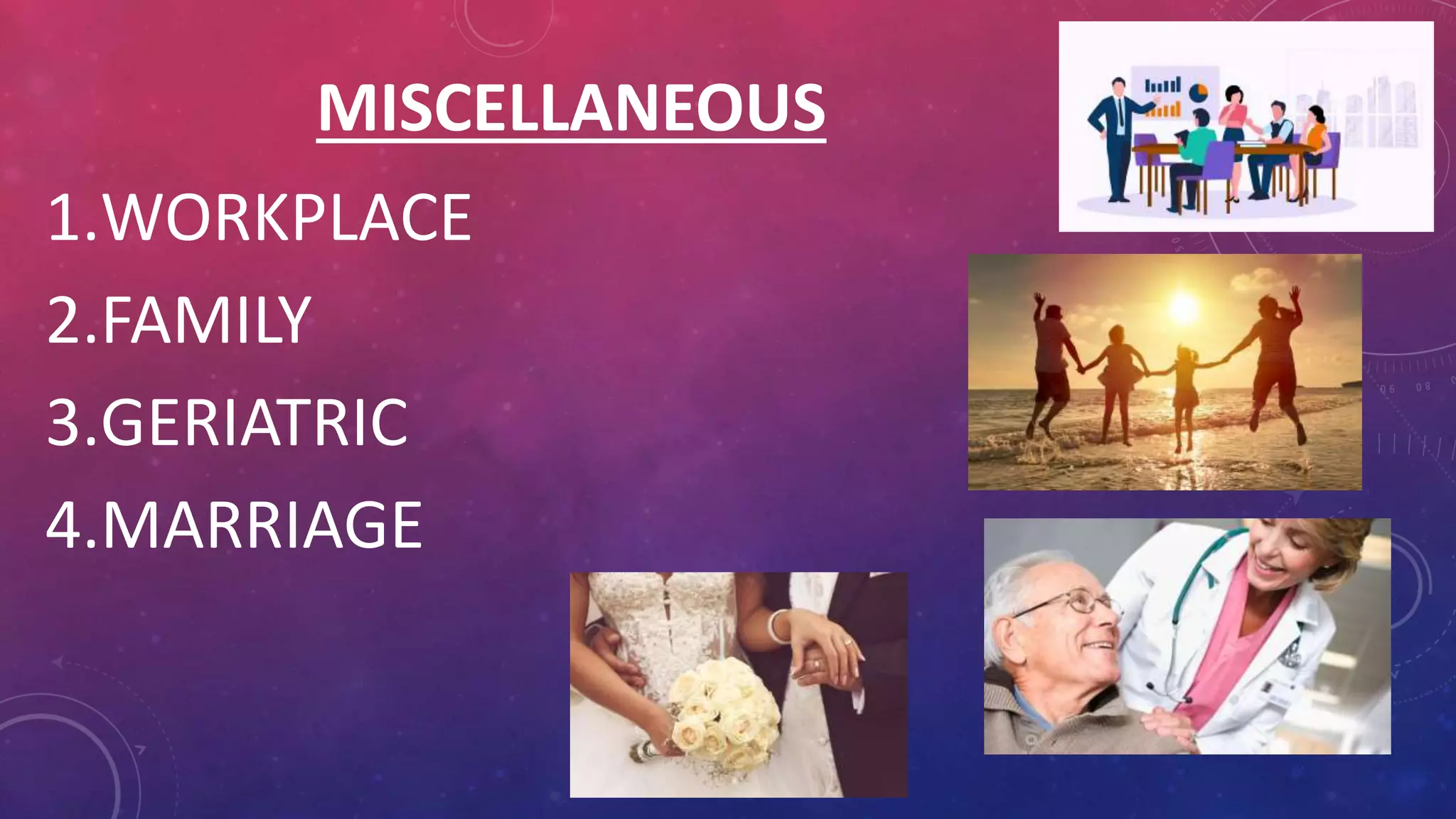
1.WORKPLACE
2.FAMILY
3.GERIATRIC
4.MARRIAGE
ISSUES FOR COUNSELLING IN NURSING
1. Absence of trained counsellors
2. Lack of organized guidance and counselling
3. Minimal pro-counselling environment
4. Poor organizational setups
5. Poor counsellor-counselee ratio
6. Lack of training and skills
7. Non compliance with interventions
8. Inadequate provision of budget and resource
facilities
9. Ethical and moral issues
CONFUSION TO CLARITY..!
Trends and issues in guidance and counseling mt nsg edu

Trends and issues in guidance and counseling mt nsg edu

  • 2.
    MICRO TEACHING ON:TRENDS AND ISSUES IN GUIDANCE AND COUNSELLING PRESENTED BY : DIMPLE WARRIOR MSc (N) 1st YEAR
  • 3.
    CONTENTS 1.Definitions 2.Need of guidanceand counselling in education 3.Nature of guidance 4.Types of guidance 5.Qualities of guide and counsellor 6.Strategies of guidance 7.Levels of counselling 8.Approaches of counselling 9.Issues for counselling in nursing
  • 4.
    WHAT IS GUIDANCE...? “Guidance is an assistance given to the individual in making intelligence choices & adjustments.” A. J. Jones
  • 5.
    ‘‘Guidance is ameans of helping individuals to understand and use wisely the educational , Vocational and personal opportunities they have or can develop and as a form of systematic assistance whereby students are aided in achieving satisfactory adjustment to school & to life.” Dunsmoor & Miller
  • 6.
  • 7.
    DEFINITION The act ofhelping the client to see things more clearly, possibly from a different view-point. This can enable the client to focus on feelings, experiences or behavior, with a goal of facilitating positive change.
  • 8.
    NEED OF GUIDANCEAND COUNSELLING IN EDUCATION ....? 1.Increasing aspirants in all sectors of education. 2.Expansion and diversification in courses of study. 3.Mounting number of unemployed graduates. 4.Growing unrest and disturbances in educational sectors. 5.Uncertainties in career and higher education. 6.Social , personal , mental developments and adjustments .
  • 10.
    TYPES OF GUIDANCE…? 1. EDUCATIONAL GUIDANCE 2. VOCATIONAL GUIDANCE 3. PERSONAL GUIDANCE 4. HEALTH GUIDANCE 5. SOCIAL GUIDANCE 6.ADVOCATIONAL GUIDANCE
  • 11.
  • 12.
    1 . EducationalGuidance : It refers to that guidance that a child or students need during his school life. Also, it helps them to resolve the problems that they face in school. In addition, it gives all the required details that children need related to the school they find most suitable.
  • 13.
  • 14.
    2. Vocational Guidance: is assistance in choosing a career or profession or in making employment or training decisions. An example of vocational guidance is a meeting with a consultant who helps people figure out what a good job would be for them based on their skills and qualifications.
  • 15.
  • 16.
    3. Personal Guidance: may be defined as the assistance given to the individual to solve his emotional, social, ethical and moral as well as health problems. Hence personal guidance deals with all those problems of life which are not covered under educational and vocational guidance.
  • 17.
  • 18.
    4 . HealthGuidance : The guidance which is related to health is also known as health guidance . Health guidance can be defined as the principle by which individuals and groups of people, learn to behave in a manner conducive to the promotion, maintenance, or restoration of health. Areas within this profession encompass environmental health, physical health, social health, emotional health, intellectual health, and spiritual health, as well as sexual and reproductive health education and guidance .
  • 19.
  • 20.
    5.Social Guidance : Thesecounseling services are to help students develop awareness and acceptance of self and others, improve personal skills in survivals, be responsible for their decisions and develop intellect .
  • 21.
  • 22.
    6. ADVOCATIONAL GUIDANCE •These counseling services are to help students develop awareness , justice and acceptance of self and others, improve public support , personal skills in survival, recommendations for particular cause and policy and be responsible for their decisions legally .
  • 23.
    QUALITIES OF ACOUNSELLOR 1. Sensitive to human problems 2. Empathetic 3. Respect for individual variations 4. Being non-judgmental 5. Maintain confidentiality 6. Being approachable 7. Being firm yet friendly 8. Pleasant disposition 9. Understanding values and relationships
  • 24.
    STRATEGIES OF GUIDANCE 1.INDIVIDUAL APPROACH 2. GROUP APPROACH
  • 25.
    INDIVIDUAL APPROACH 1.Targets onsingle student 2.Special learners require special attention :  Slow learners  Gifted  Creative  Ones learning with difficulty
  • 26.
    GROUP APPROACH • Organisedfor general nature • Students with common problems
  • 27.
    LEVELS OF COUNSELLING •INFORMAL • NON – SPECIALIST • PROFESSIONAL
  • 29.
    1 .INFORMAL COUNSELLING Itis generally rendered by a person who may be approachable and understanding, but may not be professionally qualified. This empathetic person could be an aunt, uncle, friend or colleague.
  • 30.
    2. NON SPECIALISTCOUNSELLING: It is the help provided by specialists of other areas like teachers, doctors, lawyers, religious preachers who, along with their respective specialization, also wish to handle psychological problems. They try to provide alternative ways of dealing with the problems of people they come across in their daily interactions at work.
  • 31.
    3. PROFESSIONAL COUNSELLING: Professionalcounsellors are the ones who have received special training in counselling and have the required qualifications. These counsellors deal with the person’s social, emotional and personal problems. In the counselling process, the professional counsellor may use different techniques.
  • 32.
  • 33.
  • 34.
    • Directive Counsellingis a type of approach that the counselor plays a significant role. He replaces the emotional behavior of the client with deliberately rationale behavior. Although he avoids mandatory advice, in general, it focuses on the counselor's viewpoint.
  • 35.
  • 36.
    • Non-directive counseling,counselor listen, support, and encourage the client without forcing. It has been influenced by humanistic theories in the tradition of Carl Rogers, but techniques used in non-directive counseling are common in many forms of psychological counseling and treatment today.
  • 37.
    ELECTIC COUNSELLING • Itlies in centre point of directive and non directive counselling .
  • 38.
    ELECTIC COUNSELLING • Eclecticcounseling is defined as the synthesis and combination of directive and non-directive counseling. It represents a middle status between the two extremes represented by the 'non- directive' technique on one hand and the 'directive' technique on the other.
  • 39.
  • 40.
    GROUP COUNSELLING • Groupcounseling is a form of counseling where a small group of people meet regularly to discuss, interact, and explore problems with each other and the group leader. Group counseling seeks to give students a safe and comfortable place on campus where they can work out problems and emotional concerns.
  • 41.
  • 42.
    ISSUES FOR COUNSELLINGIN NURSING 1. Absence of trained counsellors 2. Lack of organized guidance and counselling 3. Minimal pro-counselling environment 4. Poor organizational setups 5. Poor counsellor-counselee ratio 6. Lack of training and skills 7. Non compliance with interventions 8. Inadequate provision of budget and resource facilities 9. Ethical and moral issues
  • 43.