GUIDANCE & COUNSELLING
Dr. RENJINI U.
Assistant Professor
PTM College of Education
University of Kerala
Guidance
‘Guidance is the personal help that is
given by one person to another in
developing life goals, in making
adjustment and in solving problems that
conference him in the statement of
goals.’: JONES
 Guidance is the practice of giving people advice,
suggestions and practical help so that they take the
best path in life.
 Guidance is not giving directions.
 It is not the imposition of one person’s point of view
upon another person.
 “Guidance is not giving directions.
 It is not the imposition of one person’s point of view
upon another person.
 It is not making decisions for an individual which he
should make for himself.
 It is not carrying the burden of another’s life.
 Rather, guidance is assistance made available by
personally qualified and adequately trained men or
women to an individual of any age to help him
manage his own life active, development his own
point of view, make this own decisions, and carry out
his own burden”. —Crow and Crow
Need of Guidance
Different stages of development
Differences among persons
 Career Maturity
Educational growth
Need of Guidance
Guidance certainly has an enormous need in every individual’s life. Below are some factors
which highlight the need for guidance:
 Different stages of development- The division of an individual’s life can take place into
various stages. These stages are infant, childhood, pre-adolescent, adolescence and
manhood. So, an individual needs guidance in every stage of life. Maximum guidance is
required during the adolescence stage.
 Differences among persons- Psychology inform us that no individuals are alike.
Furthermore, no two individuals get similar opportunities in life. Therefore, every
individual requires guidance, in order to find out the most suitable profession for him.
 Career Maturity- Guidance is certainly essential for the development of a positive work
attitude. Furthermore, guidance would help build suitable habits and values towards
one’s work or profession. This is because; guidance increases the awareness of one’s
world of work. Also, an individual is able to plan and prepare for his work or profession
efficiently due to guidance.
 Educational growth- Guidance certainly helps in the development of educational skills and
abilities. Above all, these skills would facilitate learning and achievement.
Principles of Guidance
 Principle of all-round development
 Principle of holistic development .
 Principle of cooperation
 Principle of continuity
 Principle of extension
 Principle of adjustment
Principles of Guidance
 The principles of guidance certainly form the basis of the need of guidance. Furthermore, principles of guidance are
important principles without which guidance cannot take place. Below are the principles of guidance:
 Principle of all-round development- Guidance must take into account the all-round development of the person.
Furthermore, guidance must ensure this desirable adjustment in any specific area of the individual’ personality.
Principle of human uniqueness- Certainly no two individuals are alike. Furthermore, individuals differ in mental, social,
physical, and emotional development. Moreover, guidance must recognise these important differences and guide
individuals according to their specific need.
 Principle of holistic development- This principle states that guidance must take place in the context of total personality
development. Moreover, a child grows as a whole. Also, if one aspect of personality is in focus, then the other areas of
development must be kept in mind. Most noteworthy, these other areas of development indirectly influence the
personality.
 Principle of cooperation- This principle states that there cannot be any force on any individual regarding guidance.
Moreover, the cooperation and consent of the individual is a pre-requisite for providing guidance.
 Principle of continuity- The principle says that the guidance must take place as a continuous process to an individual. Also,
this guidance must take place in different stages of the individual’s life.
 Principle of extension- In this principle, there should not be a limitation of guidance to a few individuals. Most noteworthy,
the extension of guidance must be to all individuals of all ages.
 Principle of adjustment- It is certainly true that guidance influences every aspect of an individual’s life. However, guidance
is chiefly concerned with a person’s mental or physical health. Furthermore, this adjustment takes place at school, home,
Type of Guidance
1. Educational Guidance,
2. Vocational Guidance, and
 3. Personal Guidance
Educational Guidance
 1. To enable to pupils for selecting appropriate study subjects according to
their abilities and interests.
 2. To assist the pupils for self-learning self-study.
 3. To provide the necessary awareness about the national and state
competitive tests.
 4. To give the knowledge about the educational opportunities.
 5. To help the pupils to adjust in new situations courses and curriculum.
 6. To prevent the pupils from the problems of wastage and stagnation in
education.
 7. To stimulate the pupils to set up worth-while.
 8. To enable the teacher for organizing effective teaching in the classroom.
Vocational Guidance
 1. To assist the pupils for choosing an occupation according to their potentialities and
interests.
 2. To provide the awareness about the different occupations and institutions where
the facility of training are available.
 3. To utilize the native capacities for greatest satisfaction and success to himself.
 4. To give the information’s about the working conditions and future prospects of
different occupations.
 5. To provide the understanding of job analysis of the physical, social emotional and
intellectual requirements of different occupations.
 6. To conserve the nature capacities of youth for his satisfaction and benefit to society.
 7. To develop an adequate picture of himself and his role in the world of work.
 8. To bring the excellence in the job performance by accepting and occupation as a
vocational for him.
Personal Guidance
 1. To help the individual in analyzing the understanding the
personal problems of an individual.
 2. To make the sensitive above his environment and the possibilities
objectively.
 3. To assist the individual for solving the problems of his own
related to family, school, vocation and adjustment in the society.
 4. To enhance the adjustability of an individual.
 5. To understand the personal complexity and causes for speaking
the solution.
 6. To help in developing good relations with their family members
relatives to have maladjustment and performing his role in better
way.
 7. To develop understanding and insight into the various life
situations so that he may bring excellence and adjustment in new
situations.
Counselling
 Counselling is a process that aims to facilitate personal well
being of the students through support and guidance of trained
counsellors, for a healthy mind and body.
 The Counselling Cell encourages the students to understand
themselves and the issues that trouble them and guides them to
resolve their problems. These problems can be personal,
emotional, social, family, peer, academic, sexual, etc. This is done
through individual or group counselling to help them with
academic goals, social and personality development, career
goals, enhancing listening skills, empathy and interpersonal
skills to have healthy relationships and a healthy lifestyle.
Objectives
 To help the students in solving their personal, educational,
social as well as psychological problems.
 To create awareness about issues and problems related to
mental health of student
 To motivate faculty in counselling activities.
 To facilitate positive behaviour changes,
 To improve the student’s ability to establish and maintain
relationships socially, promoting their decision making
process,
 To help the student to understand their own potential and
cope effectively with the problems they face.
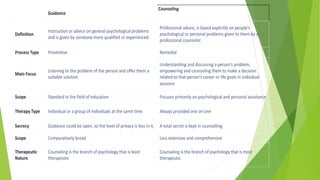
Guidance
Counseling
Definition
Instruction or advice on general psychological problems
and is given by someone more qualified or experienced.
Professional advice, is based explicitly on people’s
psychological or personal problems given to them by a
professional counselor.
Process Type Preventive Remedial
Main Focus
Listening to the problem of the person and offer them a
suitable solution
Understanding and discussing a person’s problem,
empowering and counseling them to make a decision
related to that person’s career or life goals in individual
sessions
Scope Standard in the field of education Focuses primarily on psychological and personal assistance
Therapy Type Individual or a group of individuals at the same time Always provided one on one
Secrecy Guidance could be open, so the level of privacy is less in it, A total secret is kept in counselling
Scope Comparatively broad Less extensive and comprehensive
Therapeutic
Nature
Counseling is the branch of psychology that is least
therapeutic
Counseling is the branch of psychology that is most
therapeutic
COUNSELLING PROCESS
 STAGE 1: (Initial disclosure) Relationship building
 STAGE 2: Identification of the problem
 STAGE 3: Setting of Goal
 STAGE 4: Counseling intervention
 STAGE 5: Evaluation, termination, or referral
SKILLS REQUIRED FOR COUNSELING:
 BY CLIENTS:
 Willingness: The client must be willing to open up about his problems
and attend every counselling appointment.
 Motivation: It helps the client to overcome anxiety and allows new
thought patterns while leaving the comfort zone.
 Commitment: Change cannot be seen without being committed to a
set goal. It requires patience and dedication to reach the desired
destination.
 Faith: The client must have confidence that he is made to do
something better, and he surely can achieve it and succeed in his life.
BY COUNSELLORS:
 Empathy: The counsellor keeps himself in the client's
shoes and tries to feel every emotion on his client's face.
 Effective listening: The counsellors listen patiently to
what the client is speaking about without interrupting
them. They also try to read between the lines by
understanding the unsaid words through gestures and
facial expressions.
 A good communicator: A talk filled with genuine
emotions allows the clients to entrust their problems to
the counsellors, so it is a prime quality that every
counsellor must possess.
 Unconditional positive regard: Through acceptance and non
judgmental behavior, the therapist makes space for the
needs of the client and treats them with dignity.
 Respect for confidentiality: Respect for confidentiality is an
essential trait of an effective counsellor because they
should never share their client's personal information with
anyone without the client's consent.
 Trustworthiness: Unless a client trusts a counsellor, they
are less likely to share their problems and personal
information. So, you should be adept at building and
maintaining trust with your clients.
TYPES OF COUNSELLING
Directive Counselling
Non- Directive Counselling
Eclectic Counselling
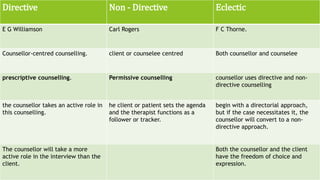
Directive Non - Directive Eclectic
E G Williamson Carl Rogers F C Thorne.
Counsellor-centred counselling. client or counselee centred Both counsellor and counselee
prescriptive counselling. Permissive counselling counsellor uses directive and non-
directive counselling
the counsellor takes an active role in
this counselling.
he client or patient sets the agenda
and the therapist functions as a
follower or tracker.
begin with a directorial approach,
but if the case necessitates it, the
counsellor will convert to a non-
directive approach.
The counsellor will take a more
active role in the interview than the
client.
Both the counsellor and the client
have the freedom of choice and
expression.
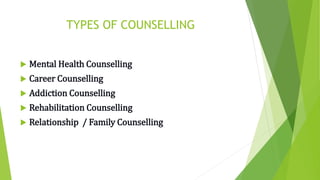
TYPES OF COUNSELLING
 Mental Health Counselling
 Career Counselling
 Addiction Counselling
 Rehabilitation Counselling
 Relationship / Family Counselling
GUIDANCE & COUNSELLING.pptx

GUIDANCE & COUNSELLING.pptx

  • 1.
    GUIDANCE & COUNSELLING Dr.RENJINI U. Assistant Professor PTM College of Education University of Kerala
  • 2.
    Guidance ‘Guidance is thepersonal help that is given by one person to another in developing life goals, in making adjustment and in solving problems that conference him in the statement of goals.’: JONES
  • 3.
     Guidance isthe practice of giving people advice, suggestions and practical help so that they take the best path in life.  Guidance is not giving directions.  It is not the imposition of one person’s point of view upon another person.
  • 4.
     “Guidance isnot giving directions.  It is not the imposition of one person’s point of view upon another person.  It is not making decisions for an individual which he should make for himself.  It is not carrying the burden of another’s life.  Rather, guidance is assistance made available by personally qualified and adequately trained men or women to an individual of any age to help him manage his own life active, development his own point of view, make this own decisions, and carry out his own burden”. —Crow and Crow
  • 5.
    Need of Guidance Differentstages of development Differences among persons  Career Maturity Educational growth
  • 6.
    Need of Guidance Guidancecertainly has an enormous need in every individual’s life. Below are some factors which highlight the need for guidance:  Different stages of development- The division of an individual’s life can take place into various stages. These stages are infant, childhood, pre-adolescent, adolescence and manhood. So, an individual needs guidance in every stage of life. Maximum guidance is required during the adolescence stage.  Differences among persons- Psychology inform us that no individuals are alike. Furthermore, no two individuals get similar opportunities in life. Therefore, every individual requires guidance, in order to find out the most suitable profession for him.  Career Maturity- Guidance is certainly essential for the development of a positive work attitude. Furthermore, guidance would help build suitable habits and values towards one’s work or profession. This is because; guidance increases the awareness of one’s world of work. Also, an individual is able to plan and prepare for his work or profession efficiently due to guidance.  Educational growth- Guidance certainly helps in the development of educational skills and abilities. Above all, these skills would facilitate learning and achievement.
  • 7.
    Principles of Guidance Principle of all-round development  Principle of holistic development .  Principle of cooperation  Principle of continuity  Principle of extension  Principle of adjustment
  • 8.
    Principles of Guidance The principles of guidance certainly form the basis of the need of guidance. Furthermore, principles of guidance are important principles without which guidance cannot take place. Below are the principles of guidance:  Principle of all-round development- Guidance must take into account the all-round development of the person. Furthermore, guidance must ensure this desirable adjustment in any specific area of the individual’ personality. Principle of human uniqueness- Certainly no two individuals are alike. Furthermore, individuals differ in mental, social, physical, and emotional development. Moreover, guidance must recognise these important differences and guide individuals according to their specific need.  Principle of holistic development- This principle states that guidance must take place in the context of total personality development. Moreover, a child grows as a whole. Also, if one aspect of personality is in focus, then the other areas of development must be kept in mind. Most noteworthy, these other areas of development indirectly influence the personality.  Principle of cooperation- This principle states that there cannot be any force on any individual regarding guidance. Moreover, the cooperation and consent of the individual is a pre-requisite for providing guidance.  Principle of continuity- The principle says that the guidance must take place as a continuous process to an individual. Also, this guidance must take place in different stages of the individual’s life.  Principle of extension- In this principle, there should not be a limitation of guidance to a few individuals. Most noteworthy, the extension of guidance must be to all individuals of all ages.  Principle of adjustment- It is certainly true that guidance influences every aspect of an individual’s life. However, guidance is chiefly concerned with a person’s mental or physical health. Furthermore, this adjustment takes place at school, home,
  • 9.
    Type of Guidance 1.Educational Guidance, 2. Vocational Guidance, and  3. Personal Guidance
  • 10.
    Educational Guidance  1.To enable to pupils for selecting appropriate study subjects according to their abilities and interests.  2. To assist the pupils for self-learning self-study.  3. To provide the necessary awareness about the national and state competitive tests.  4. To give the knowledge about the educational opportunities.  5. To help the pupils to adjust in new situations courses and curriculum.  6. To prevent the pupils from the problems of wastage and stagnation in education.  7. To stimulate the pupils to set up worth-while.  8. To enable the teacher for organizing effective teaching in the classroom.
  • 11.
    Vocational Guidance  1.To assist the pupils for choosing an occupation according to their potentialities and interests.  2. To provide the awareness about the different occupations and institutions where the facility of training are available.  3. To utilize the native capacities for greatest satisfaction and success to himself.  4. To give the information’s about the working conditions and future prospects of different occupations.  5. To provide the understanding of job analysis of the physical, social emotional and intellectual requirements of different occupations.  6. To conserve the nature capacities of youth for his satisfaction and benefit to society.  7. To develop an adequate picture of himself and his role in the world of work.  8. To bring the excellence in the job performance by accepting and occupation as a vocational for him.
  • 12.
    Personal Guidance  1.To help the individual in analyzing the understanding the personal problems of an individual.  2. To make the sensitive above his environment and the possibilities objectively.  3. To assist the individual for solving the problems of his own related to family, school, vocation and adjustment in the society.  4. To enhance the adjustability of an individual.  5. To understand the personal complexity and causes for speaking the solution.  6. To help in developing good relations with their family members relatives to have maladjustment and performing his role in better way.  7. To develop understanding and insight into the various life situations so that he may bring excellence and adjustment in new situations.
  • 13.
    Counselling  Counselling isa process that aims to facilitate personal well being of the students through support and guidance of trained counsellors, for a healthy mind and body.  The Counselling Cell encourages the students to understand themselves and the issues that trouble them and guides them to resolve their problems. These problems can be personal, emotional, social, family, peer, academic, sexual, etc. This is done through individual or group counselling to help them with academic goals, social and personality development, career goals, enhancing listening skills, empathy and interpersonal skills to have healthy relationships and a healthy lifestyle.
  • 14.
    Objectives  To helpthe students in solving their personal, educational, social as well as psychological problems.  To create awareness about issues and problems related to mental health of student  To motivate faculty in counselling activities.  To facilitate positive behaviour changes,  To improve the student’s ability to establish and maintain relationships socially, promoting their decision making process,  To help the student to understand their own potential and cope effectively with the problems they face.
  • 15.
    Guidance Counseling Definition Instruction or adviceon general psychological problems and is given by someone more qualified or experienced. Professional advice, is based explicitly on people’s psychological or personal problems given to them by a professional counselor. Process Type Preventive Remedial Main Focus Listening to the problem of the person and offer them a suitable solution Understanding and discussing a person’s problem, empowering and counseling them to make a decision related to that person’s career or life goals in individual sessions Scope Standard in the field of education Focuses primarily on psychological and personal assistance Therapy Type Individual or a group of individuals at the same time Always provided one on one Secrecy Guidance could be open, so the level of privacy is less in it, A total secret is kept in counselling Scope Comparatively broad Less extensive and comprehensive Therapeutic Nature Counseling is the branch of psychology that is least therapeutic Counseling is the branch of psychology that is most therapeutic
  • 16.
    COUNSELLING PROCESS  STAGE1: (Initial disclosure) Relationship building  STAGE 2: Identification of the problem  STAGE 3: Setting of Goal  STAGE 4: Counseling intervention  STAGE 5: Evaluation, termination, or referral
  • 17.
    SKILLS REQUIRED FORCOUNSELING:  BY CLIENTS:  Willingness: The client must be willing to open up about his problems and attend every counselling appointment.  Motivation: It helps the client to overcome anxiety and allows new thought patterns while leaving the comfort zone.  Commitment: Change cannot be seen without being committed to a set goal. It requires patience and dedication to reach the desired destination.  Faith: The client must have confidence that he is made to do something better, and he surely can achieve it and succeed in his life.
  • 18.
    BY COUNSELLORS:  Empathy:The counsellor keeps himself in the client's shoes and tries to feel every emotion on his client's face.  Effective listening: The counsellors listen patiently to what the client is speaking about without interrupting them. They also try to read between the lines by understanding the unsaid words through gestures and facial expressions.  A good communicator: A talk filled with genuine emotions allows the clients to entrust their problems to the counsellors, so it is a prime quality that every counsellor must possess.
  • 19.
     Unconditional positiveregard: Through acceptance and non judgmental behavior, the therapist makes space for the needs of the client and treats them with dignity.  Respect for confidentiality: Respect for confidentiality is an essential trait of an effective counsellor because they should never share their client's personal information with anyone without the client's consent.  Trustworthiness: Unless a client trusts a counsellor, they are less likely to share their problems and personal information. So, you should be adept at building and maintaining trust with your clients.
  • 20.
    TYPES OF COUNSELLING DirectiveCounselling Non- Directive Counselling Eclectic Counselling
  • 21.
    Directive Non -Directive Eclectic E G Williamson Carl Rogers F C Thorne. Counsellor-centred counselling. client or counselee centred Both counsellor and counselee prescriptive counselling. Permissive counselling counsellor uses directive and non- directive counselling the counsellor takes an active role in this counselling. he client or patient sets the agenda and the therapist functions as a follower or tracker. begin with a directorial approach, but if the case necessitates it, the counsellor will convert to a non- directive approach. The counsellor will take a more active role in the interview than the client. Both the counsellor and the client have the freedom of choice and expression.
  • 22.
    TYPES OF COUNSELLING Mental Health Counselling  Career Counselling  Addiction Counselling  Rehabilitation Counselling  Relationship / Family Counselling