




Giovanni Caruso - Angelica Fontana - Silvio Cioni | February 3rd, 2021
Forget Artefacts.
Design Speculative Lifeworlds Instead!
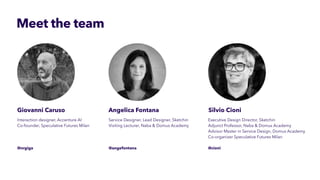
Meet the team
Giovanni Caruso


Angelica Fontana


Silvio Cioni


Interaction designer, Accenture AI


Co-founder, Speculative Futures Milan
@nrgiga
Service Designer, Lead Designer, Sketchin


Visiting Lecturer, Naba & Domus Academy
@angefontana
Executive Design Director, Sketchin


Adjunct Professor, Naba & Domus Academy


Advisor Master in Service Design, Domus Academy


Co-organizer Speculative Futures Milan
@cioni
why we are here today
The idea
aka what we want to get our hands on today
The workshop aims to experiment some design techniques to envision a
speculative world starting from a chosen
fi
ctional artefact.


The imagined must be de
fi
ned enough to allow the speculative artefact itself
(and many others) to exist and function.


The proposed design techniques want to help practitioners and researchers to
go beyond the design of immediate moments of use and consider


the social and technical systems required to keep these artefacts working.
Design Futures
futures-oriented practices and speculative perspectives
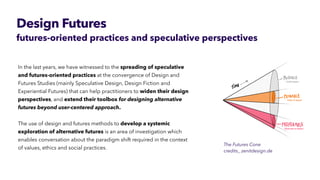
In the last years, we have witnessed to the spreading of speculative
and futures-oriented practices at the convergence of Design and
Futures Studies (mainly Speculative Design, Design Fiction and
Experiential Futures) that can help practitioners to widen their design
perspectives, and extend their toolbox for designing alternative
futures beyond user-centered approach.


The use of design and futures methods to develop a systemic
exploration of alternative futures is an area of investigation which
enables conversation about the paradigm shift required in the context
of values, ethics and social practices.
The Futures Cone


credits_ zenitdesign.de
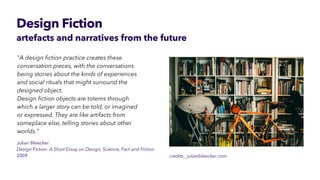
Design Fiction
artefacts and narratives from the future
Julian Bleecker


Design Fiction: A Short Essay on Design, Science, Fact and Fiction


2009
"A design
fi
ction practice creates these
conversation pieces, with the conversations
being stories about the kinds of experiences
and social rituals that might surround the
designed object.


Design
fi
ction objects are totems through
which a larger story can be told, or imagined


or expressed. They are like artifacts from
someplace else, telling stories about other
worlds."
credits_ julianbleecker.com
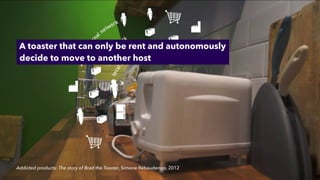
Addicted products: The story of Brad the Toaster, Simone Rebaudengo, 2012
A toaster that can only be rent and autonomously


decide to move to another host
Great! so what? What’s next?
forgetting artefacts… for a while
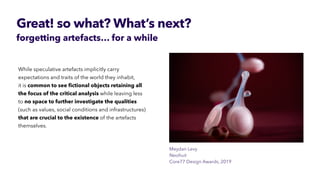
Meydan Levy


it is common to see
fi
ctional objects retaining all
the focus of the critical analysis while leaving less
to no space to further investigate the qualities
(such as values, social conditions and infrastructures)
that are crucial to the existence of the artefacts
themselves.
Wait! life-what?
introducing speculative lifeworlds
More recently a new approach has been introduced to underline how
Speculative Design and Design Fiction can be used to more explicitly


focus on and design the broader social, technical, environmental and
political worlds in which speculative artefacts exist.


This approach uses the concept of lifeworld of speculative artefacts to
go beyond immediate mundane situations of use, to help
practitioners to de
fi
ne the conditions for existence of a
fi
ctional artefact
and identify of the systemic implications that are intrinsic to the
imagined world.


In the work of speculative
design, we consider how the
lifeworlds of the future are
projected through an
imagined design. A projected
lifeworld can be thought of as
the lifeworld one would have
to inhabit in order for the
design to make sense.
Richmond Wong et al.
By exploring speculative Design and Design Fiction practices and moving from
the centricity of the artefact to adopt the lenses of speculative lifeworlds,
participants will learn to stretch their thinking and experiment a new approach
to focus on values, social conditions and technical systems supporting
speculative imaginaries.
experimenting a new approach
what we do today
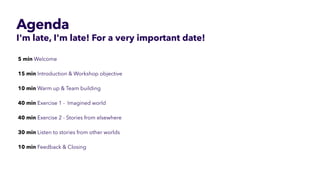
Agenda
I'm late, I'm late! For a very important date!
5 min Welcome


15 min Introduction & Workshop objective


10 min Warm up & Team building 


40 min Exercise 1 -  Imagined world


40 min Exercise 2 - Stories from elsewhere


30 min Listen to stories from other worlds


10 min Feedback & Closing
Discover your speculative artefact
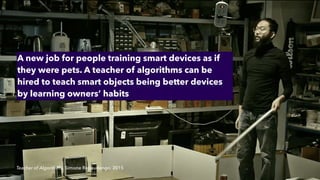
Teacher of Algorithms, Simone Rebaudengo, 2015
A new job for people training smart devices as if
they were pets. A teacher of algorithms can be
hired to teach smart objects being better devices
by learning owners’ habits
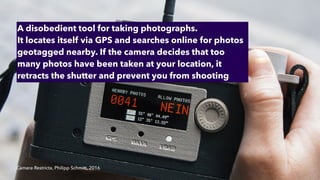
Camera Restricta, Philipp Schmitt, 2016
A disobedient tool for taking photographs.


It locates itself via GPS and searches online for photos
geotagged nearby. If the camera decides that too
many photos have been taken at your location, it
retracts the shutter and prevent you from shooting
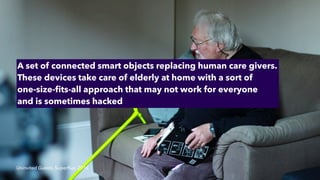
Uninvited Guests, Super
fl
ux, 2016
A set of connected smart objects replacing human care givers.
These devices take care of elderly at home with a sort of


one-size-
fi
ts-all approach that may not work for everyone


and is sometimes hacked
Based on the selected artefact,


2 different design exercises are proposed
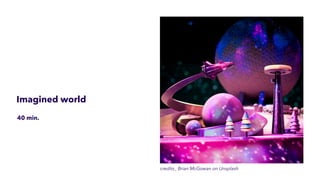
Imagined world
40 min.


credits_ Brian McGowan on Unsplash
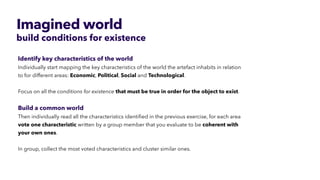
Imagined world
build conditions for existence
Identify key characteristics of the world


Individually start mapping the key characteristics of the world the artefact inhabits in relation
to for different areas: Economic, Political, Social and Technological.


Focus on all the conditions for existence that must be true in order for the object to exist.


Build a common world


Then individually read all the characteristics identi
fi
ed in the previous exercise, for each area
vote one characteristic written by a group member that you evaluate to be coherent with
your own ones.


In group, collect the most voted characteristics and cluster similar ones.
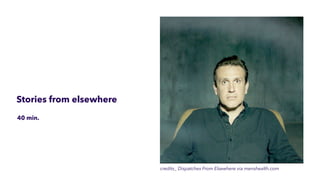
Stories from elsewhere
40 min.


credits_ Dispatches From Elsewhere via menshealth.com
Stories from elsewhere
build everyday narratives
Set up your story elements


Pick 3 characteristics of the world from minimum two different areas mapped in the
previous and 1 activity from the provided list. Based on the elements you picked, build a
narrative to evoke the world your team have imagined.


Build your story


Write a short story, using the
fi
rst person, that describes how your day life might look
like in the imagined world focusing on the actions you carry out in relation to the selected
activity and on the interactions you might have during the day.


Connect stories


Individually read the stories written by your group mates and vote the two stories that are
coherent the most with yours.
Key takeaways
Takeaways
aka three things to bring home
The workshop provides an hands-on experience of a speculative design approach that moves the
focus of design from artefacts to lifeworlds.


The workshop aims at providing you with three principal takeaways:


Design techniques


to envision new values and
meanings for speculative
artefacts and lifeworlds
A systemic approach


to design for imagined
worlds
A novel perspective


on how speculative design and
design
fi
ction can be expanded to
design imagined worlds where
speculative artefacts might exist


and function


3
1 2
Forget Artefacts.
Design Speculative Lifeworlds Instead!
Thank you

Slides_IxD21 workshop_Forget artefact. design speculative lifeworlds instead!

  • 1.
    Giovanni Caruso -Angelica Fontana - Silvio Cioni | February 3rd, 2021 Forget Artefacts. Design Speculative Lifeworlds Instead!
  • 2.
    Meet the team GiovanniCaruso Angelica Fontana Silvio Cioni Interaction designer, Accenture AI 
 Co-founder, Speculative Futures Milan @nrgiga Service Designer, Lead Designer, Sketchin 
 Visiting Lecturer, Naba & Domus Academy @angefontana Executive Design Director, Sketchin 
 Adjunct Professor, Naba & Domus Academy Advisor Master in Service Design, Domus Academy 
 Co-organizer Speculative Futures Milan @cioni
  • 3.
    why we arehere today
  • 4.
    The idea aka whatwe want to get our hands on today The workshop aims to experiment some design techniques to envision a speculative world starting from a chosen fi ctional artefact. 
 The imagined must be de fi ned enough to allow the speculative artefact itself (and many others) to exist and function. The proposed design techniques want to help practitioners and researchers to go beyond the design of immediate moments of use and consider 
 the social and technical systems required to keep these artefacts working.
  • 5.
    Design Futures futures-oriented practicesand speculative perspectives In the last years, we have witnessed to the spreading of speculative and futures-oriented practices at the convergence of Design and Futures Studies (mainly Speculative Design, Design Fiction and Experiential Futures) that can help practitioners to widen their design perspectives, and extend their toolbox for designing alternative futures beyond user-centered approach. The use of design and futures methods to develop a systemic exploration of alternative futures is an area of investigation which enables conversation about the paradigm shift required in the context of values, ethics and social practices. The Futures Cone 
 credits_ zenitdesign.de
  • 6.
    Design Fiction artefacts andnarratives from the future Julian Bleecker Design Fiction: A Short Essay on Design, Science, Fact and Fiction 2009 "A design fi ction practice creates these conversation pieces, with the conversations being stories about the kinds of experiences and social rituals that might surround the designed object. 
 Design fi ction objects are totems through which a larger story can be told, or imagined 
 or expressed. They are like artifacts from someplace else, telling stories about other worlds." credits_ julianbleecker.com
  • 7.
    Addicted products: Thestory of Brad the Toaster, Simone Rebaudengo, 2012 A toaster that can only be rent and autonomously 
 decide to move to another host
  • 8.
    Great! so what?What’s next? forgetting artefacts… for a while Meydan Levy 
 it is common to see fi ctional objects retaining all the focus of the critical analysis while leaving less to no space to further investigate the qualities (such as values, social conditions and infrastructures) that are crucial to the existence of the artefacts themselves.
  • 9.
    Wait! life-what? introducing speculativelifeworlds More recently a new approach has been introduced to underline how Speculative Design and Design Fiction can be used to more explicitly 
 focus on and design the broader social, technical, environmental and political worlds in which speculative artefacts exist. This approach uses the concept of lifeworld of speculative artefacts to go beyond immediate mundane situations of use, to help practitioners to de fi ne the conditions for existence of a fi ctional artefact and identify of the systemic implications that are intrinsic to the imagined world. In the work of speculative design, we consider how the lifeworlds of the future are projected through an imagined design. A projected lifeworld can be thought of as the lifeworld one would have to inhabit in order for the design to make sense. Richmond Wong et al.
  • 10.
    By exploring speculativeDesign and Design Fiction practices and moving from the centricity of the artefact to adopt the lenses of speculative lifeworlds, participants will learn to stretch their thinking and experiment a new approach to focus on values, social conditions and technical systems supporting speculative imaginaries. experimenting a new approach
  • 11.
  • 12.
    Agenda I'm late, I'mlate! For a very important date! 5 min Welcome 15 min Introduction & Workshop objective 10 min Warm up & Team building  40 min Exercise 1 -  Imagined world 40 min Exercise 2 - Stories from elsewhere 30 min Listen to stories from other worlds 10 min Feedback & Closing
  • 13.
  • 14.
    Teacher of Algorithms,Simone Rebaudengo, 2015 A new job for people training smart devices as if they were pets. A teacher of algorithms can be hired to teach smart objects being better devices by learning owners’ habits
  • 15.
    Camera Restricta, PhilippSchmitt, 2016 A disobedient tool for taking photographs. It locates itself via GPS and searches online for photos geotagged nearby. If the camera decides that too many photos have been taken at your location, it retracts the shutter and prevent you from shooting
  • 16.
    Uninvited Guests, Super fl ux,2016 A set of connected smart objects replacing human care givers. These devices take care of elderly at home with a sort of 
 one-size- fi ts-all approach that may not work for everyone 
 and is sometimes hacked
  • 17.
    Based on theselected artefact, 2 different design exercises are proposed
  • 18.
    Imagined world 40 min. credits_Brian McGowan on Unsplash
  • 19.
    Imagined world build conditionsfor existence Identify key characteristics of the world Individually start mapping the key characteristics of the world the artefact inhabits in relation to for different areas: Economic, Political, Social and Technological. 
 
 Focus on all the conditions for existence that must be true in order for the object to exist. Build a common world Then individually read all the characteristics identi fi ed in the previous exercise, for each area vote one characteristic written by a group member that you evaluate to be coherent with your own ones. In group, collect the most voted characteristics and cluster similar ones.
  • 20.
    Stories from elsewhere 40min. credits_ Dispatches From Elsewhere via menshealth.com
  • 21.
    Stories from elsewhere buildeveryday narratives Set up your story elements Pick 3 characteristics of the world from minimum two different areas mapped in the previous and 1 activity from the provided list. Based on the elements you picked, build a narrative to evoke the world your team have imagined. Build your story Write a short story, using the fi rst person, that describes how your day life might look like in the imagined world focusing on the actions you carry out in relation to the selected activity and on the interactions you might have during the day. Connect stories Individually read the stories written by your group mates and vote the two stories that are coherent the most with yours.
  • 22.
  • 23.
    Takeaways aka three thingsto bring home The workshop provides an hands-on experience of a speculative design approach that moves the focus of design from artefacts to lifeworlds. The workshop aims at providing you with three principal takeaways: 
 Design techniques 
 to envision new values and meanings for speculative artefacts and lifeworlds A systemic approach to design for imagined worlds A novel perspective 
 on how speculative design and design fi ction can be expanded to design imagined worlds where speculative artefacts might exist 
 and function 
 3 1 2
  • 24.
    Forget Artefacts. Design SpeculativeLifeworlds Instead! Thank you