Speakers

Hasan Mahmood   061-19-324
Shamim Jahan    061-19-346
Nafiur Rahman   061-19-347
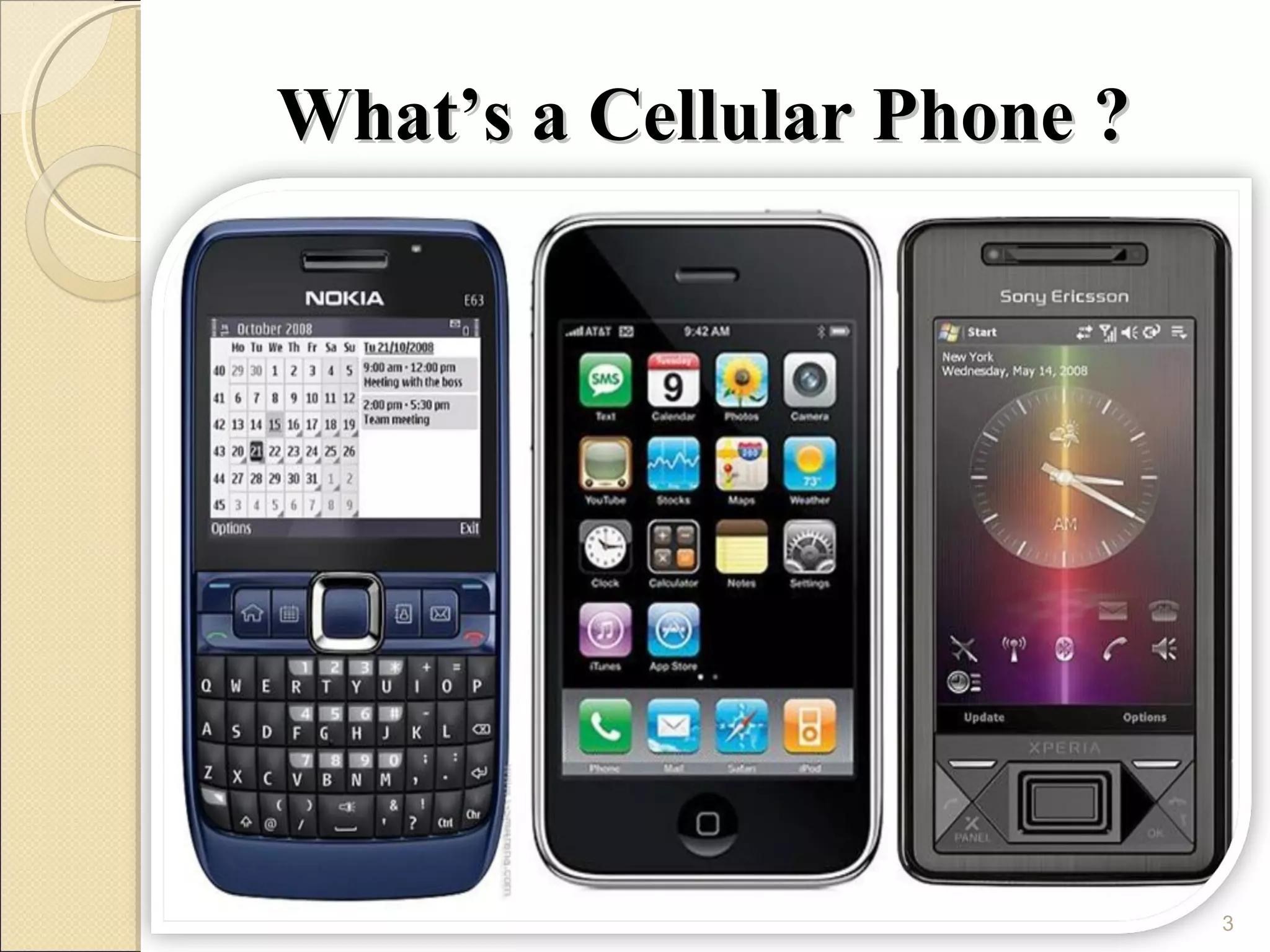
What’s a Cellular Phone ?


                            3
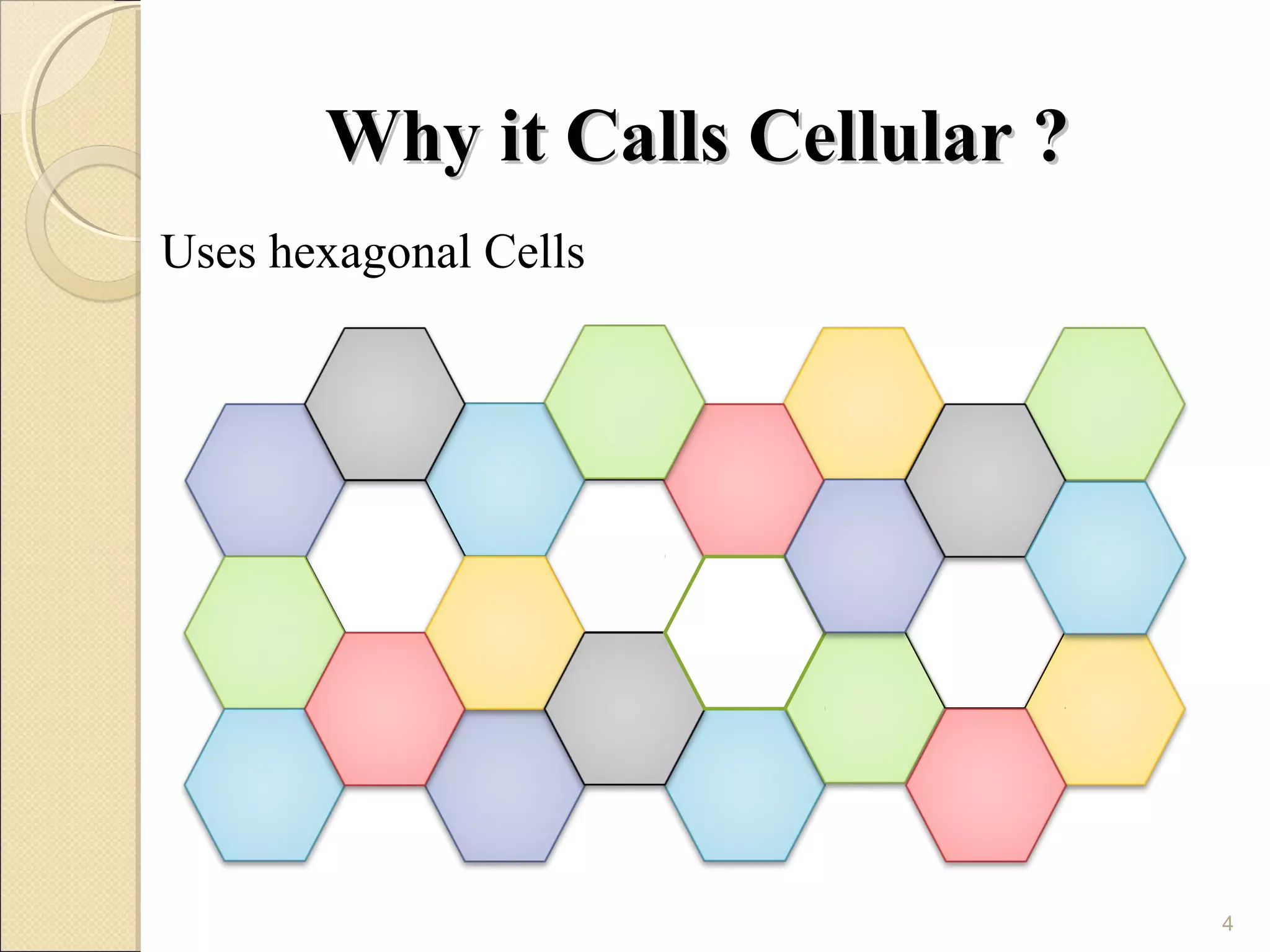
Why it Calls Cellular ?
Uses hexagonal Cells


                                 4
Why Use Cells ?
 If there was no cell

 Limited
      frequency spectrum for available Mobile
 Communication.
 Frequency   utilization is inefficient.
 Single high power antenna causes to be the
 limited number of users.


                                                5
Why Use Cells ?
 Advantages of cell structures:

   More capacity due to frequency reuse.
   Less transmission power needed.
   Deals interference, transmission area locally.

 Problems:

   Fixed network needed for the base stations.
   Handover necessary.
   Interference with other cells.

                                                     6
Frequency Reuse
 Adjacent cells are assigned different frequencies
 to avoid interference or crosstalk.
 The same frequency is reused in different areas
 for after a certain distance.
 InGSM networks a frequency reuse pattern with
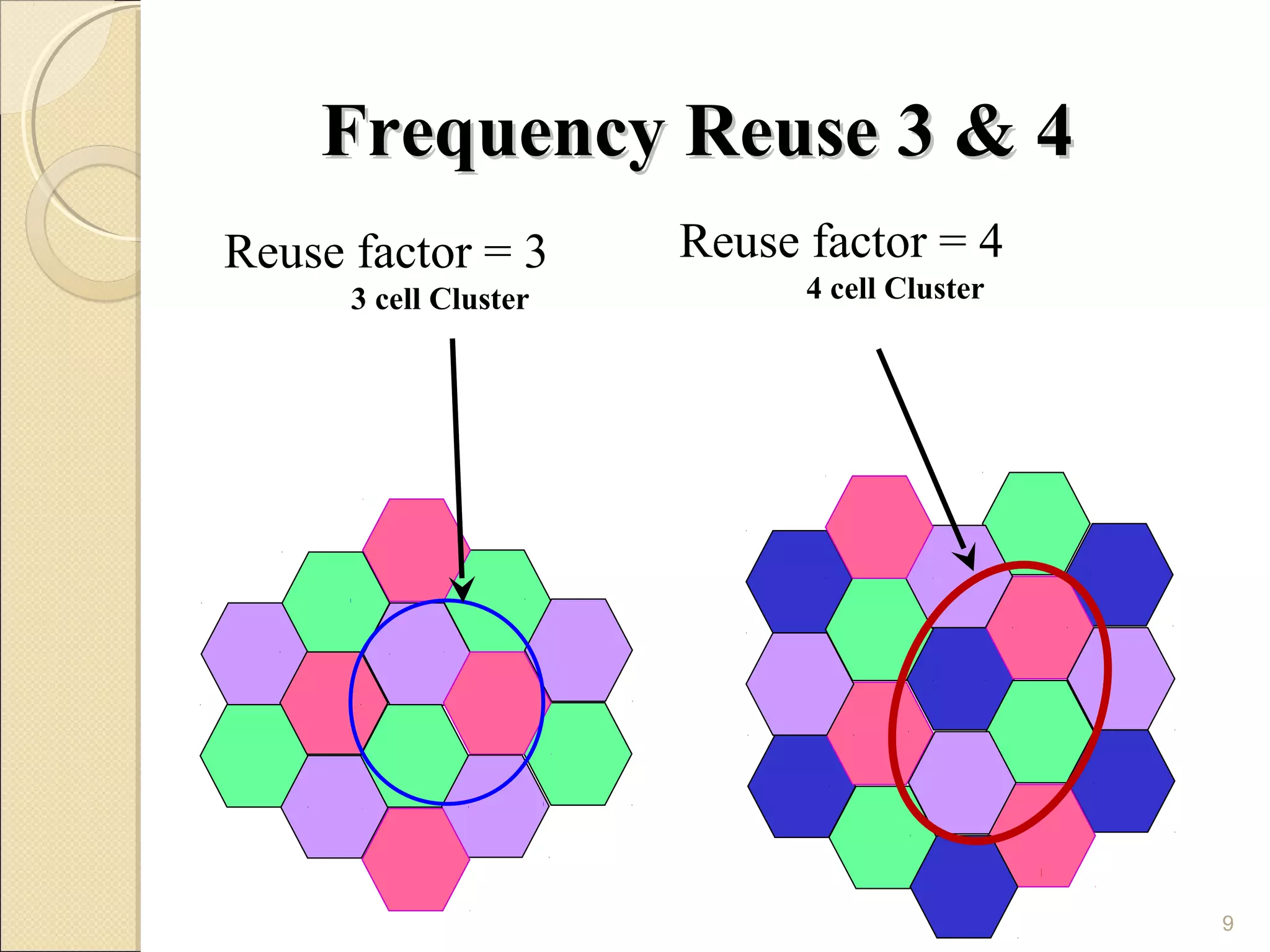
 k = 3, 4, 7, 12 or 21. (k= Frequency reuse factor)
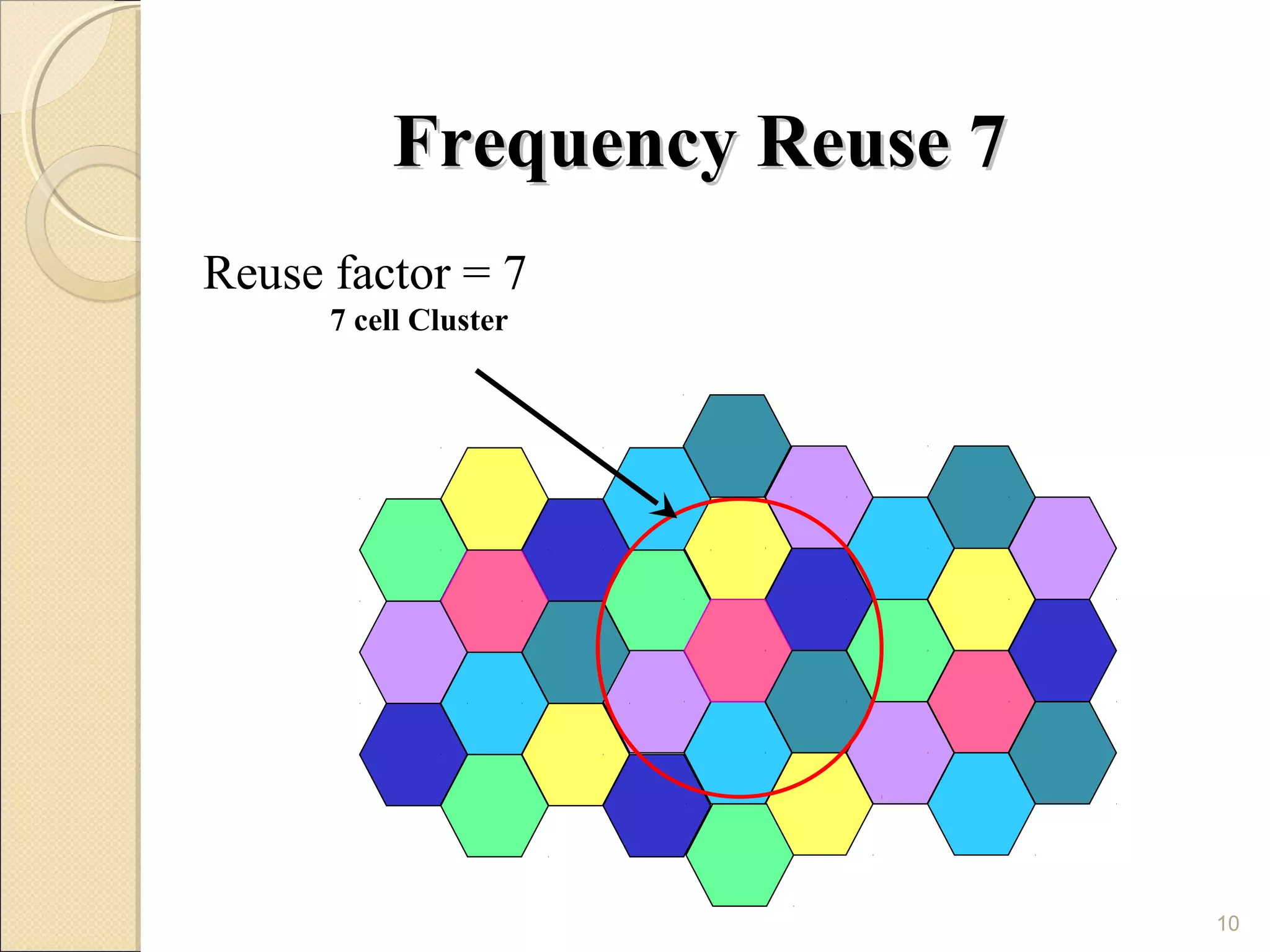
 Each   ‘k’ number of cells make a cluster.


                                                      7
Different Frequency Reuse
 Fixed   frequency assignment:
   certain frequencies are assigned to a certain cell.
   problem: different traffic load in different cells.
 Dynamic    frequency assignment:
   base station chooses frequencies depending on
    the frequencies already used in neighbor cells.
   more capacity in cells with more traffic.


                                                      8
Frequency Reuse 3 & 4
Reuse factor = 3       Reuse factor = 4
      3 cell Cluster         4 cell Cluster


                                              9
Frequency Reuse 7
Reuse factor = 7
      7 cell Cluster


                              10
Adjacent Channel Interference
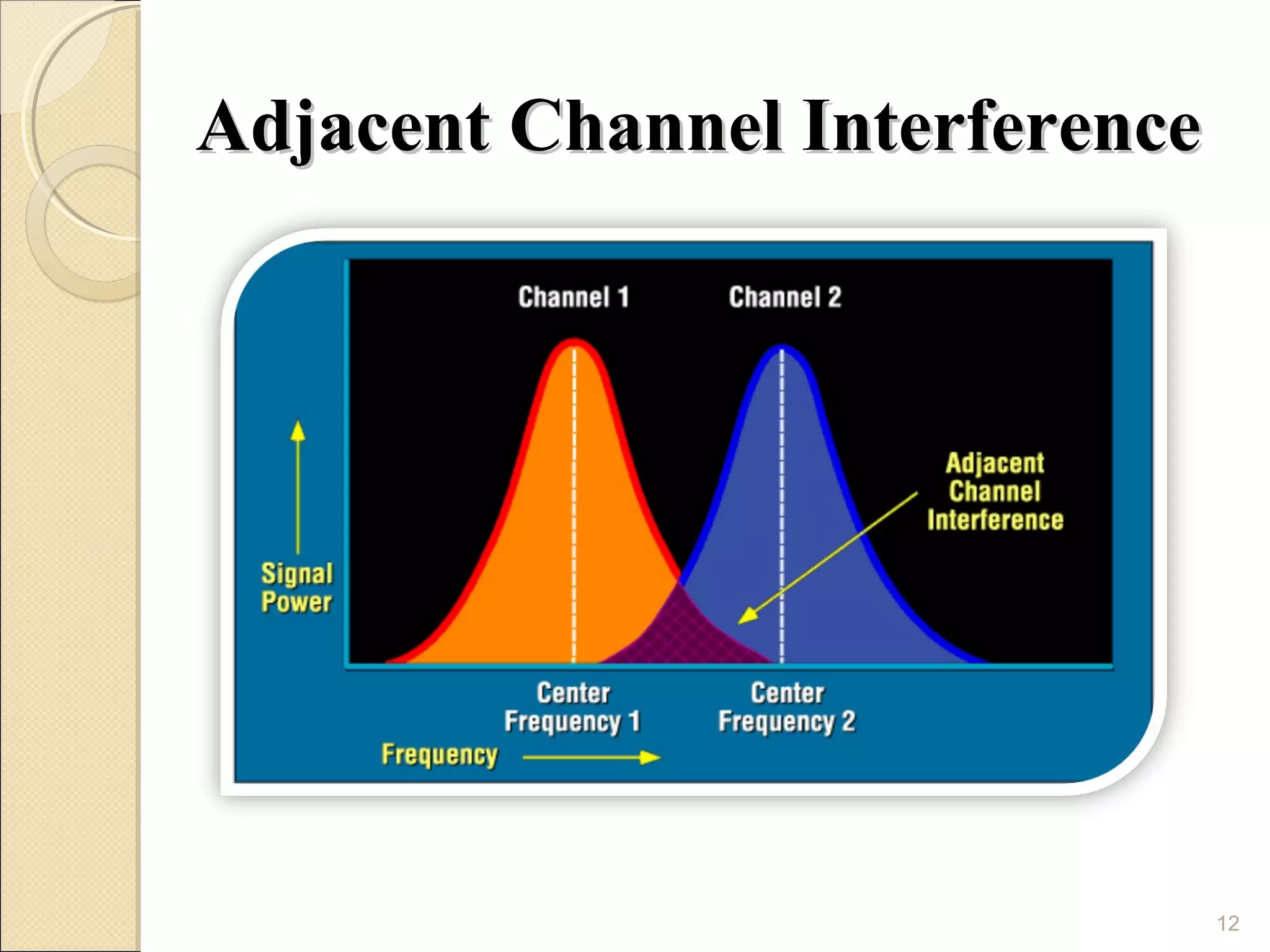
 Comes from imperfect filters that allow frequency
  leakage into the band
 Serious problem if interferer is nearby, near-far
  effect
   Nearby mobile transmits on a frequency near to
    that of a weak mobile
 Base station receivers need high-Q filters to reject
  adjacent channel interference.

                                                         11
Adjacent Channel Interference


                                12
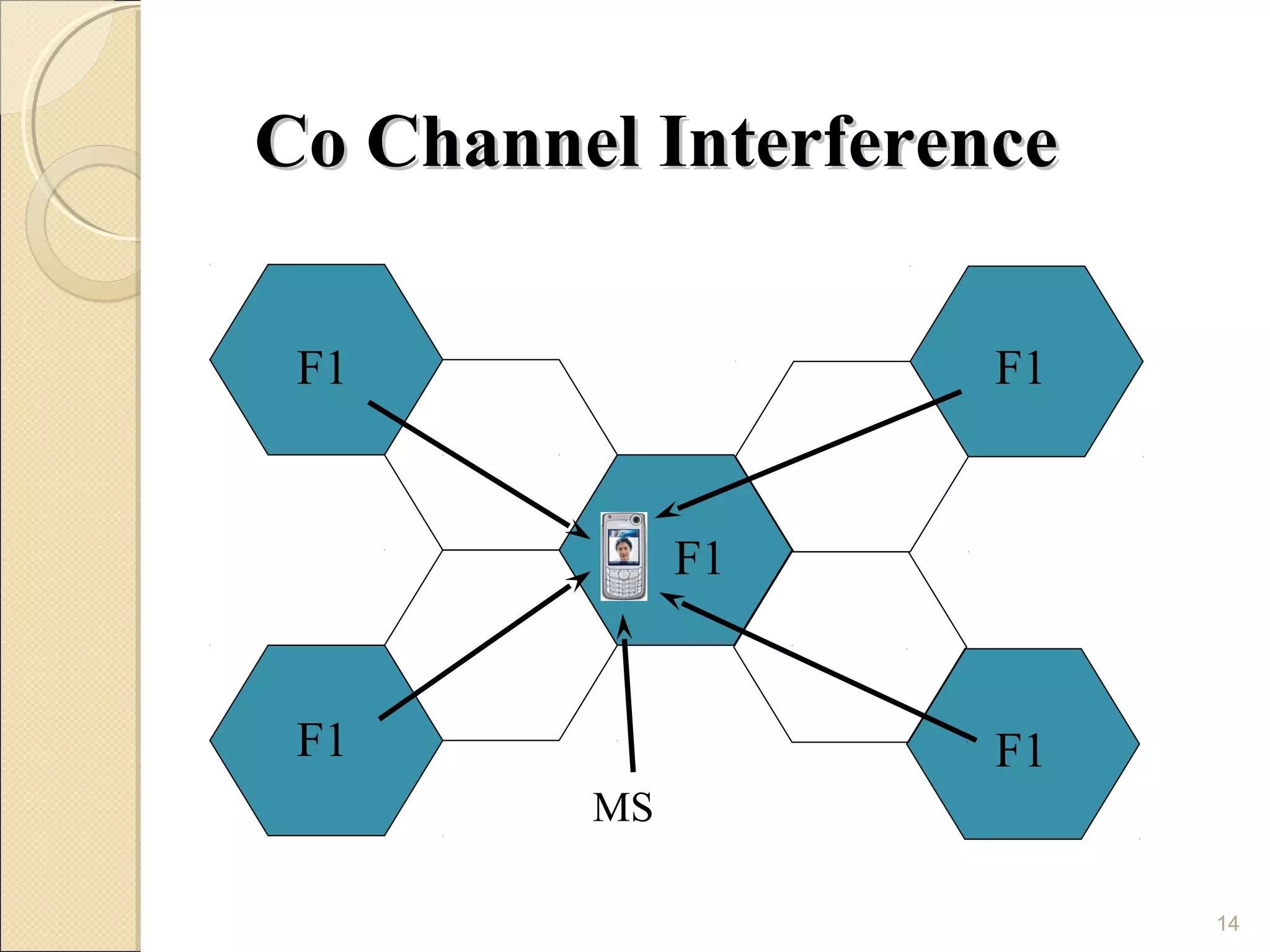
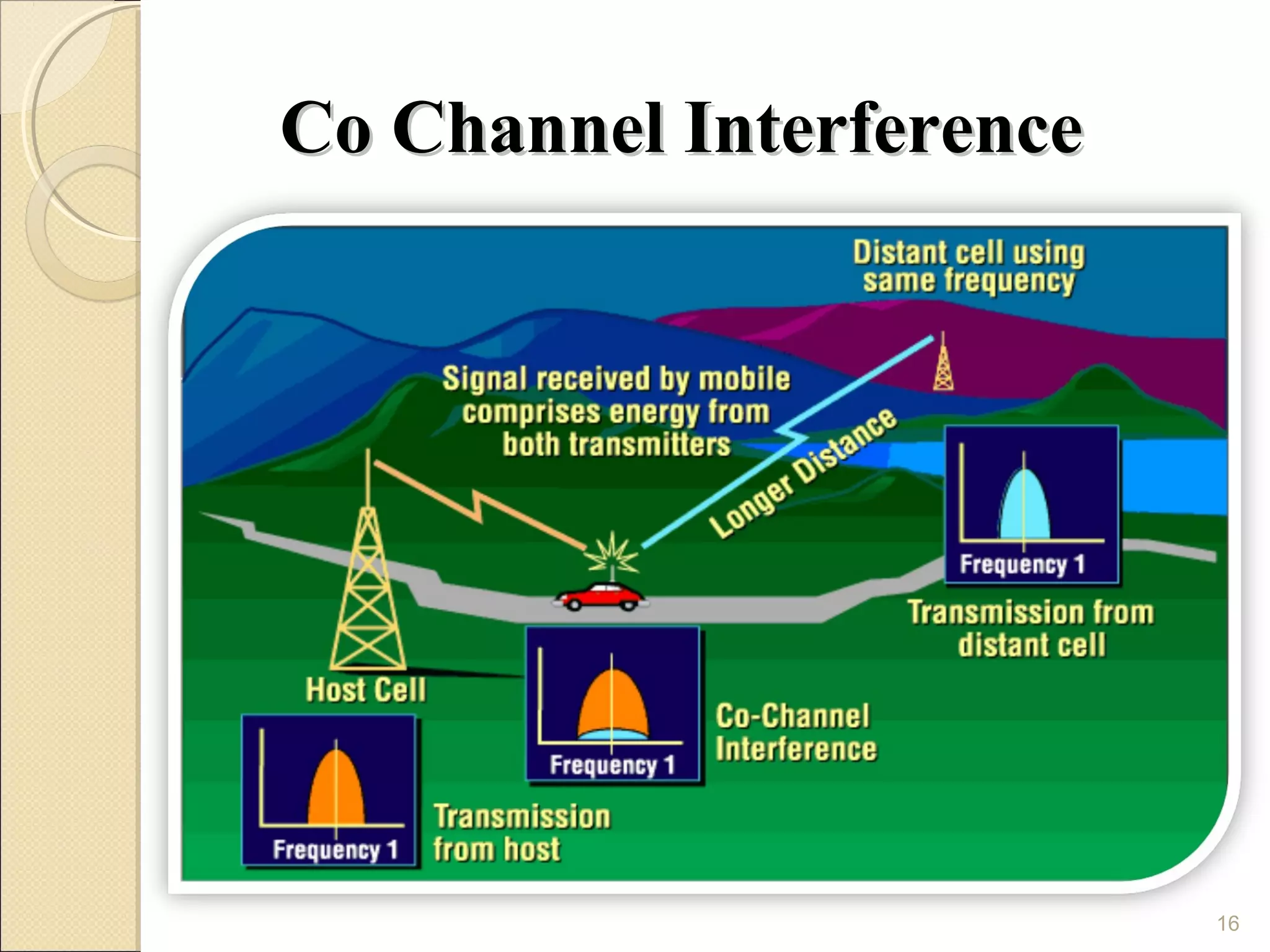
Co Channel Interference
One of the primary forms of man-made signal
degradation associated with digital radio, co-channel
interference occurs when the same carrier frequency
reaches the same receiver from two separate
transmitters.

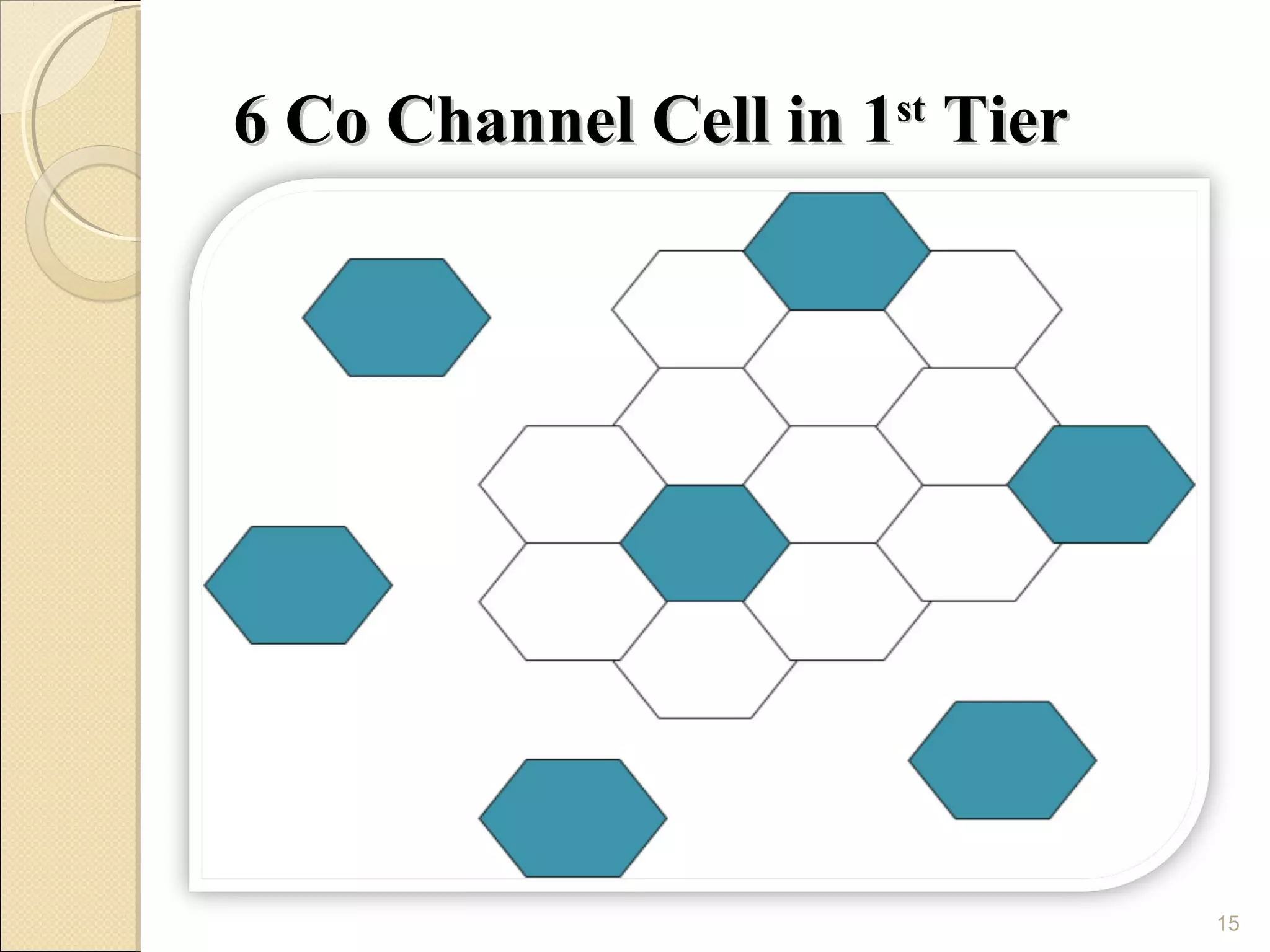
In a fully equipped hexagonal-shaped cell system,
there is always 6 co channel cell.


                                                        13
Co Channel Interference

 F1                  F1


              F1


 F1                  F1
         MS

                          14
6 Co Channel Cell in 1st Tier


                                15
Co Channel Interference


                          16
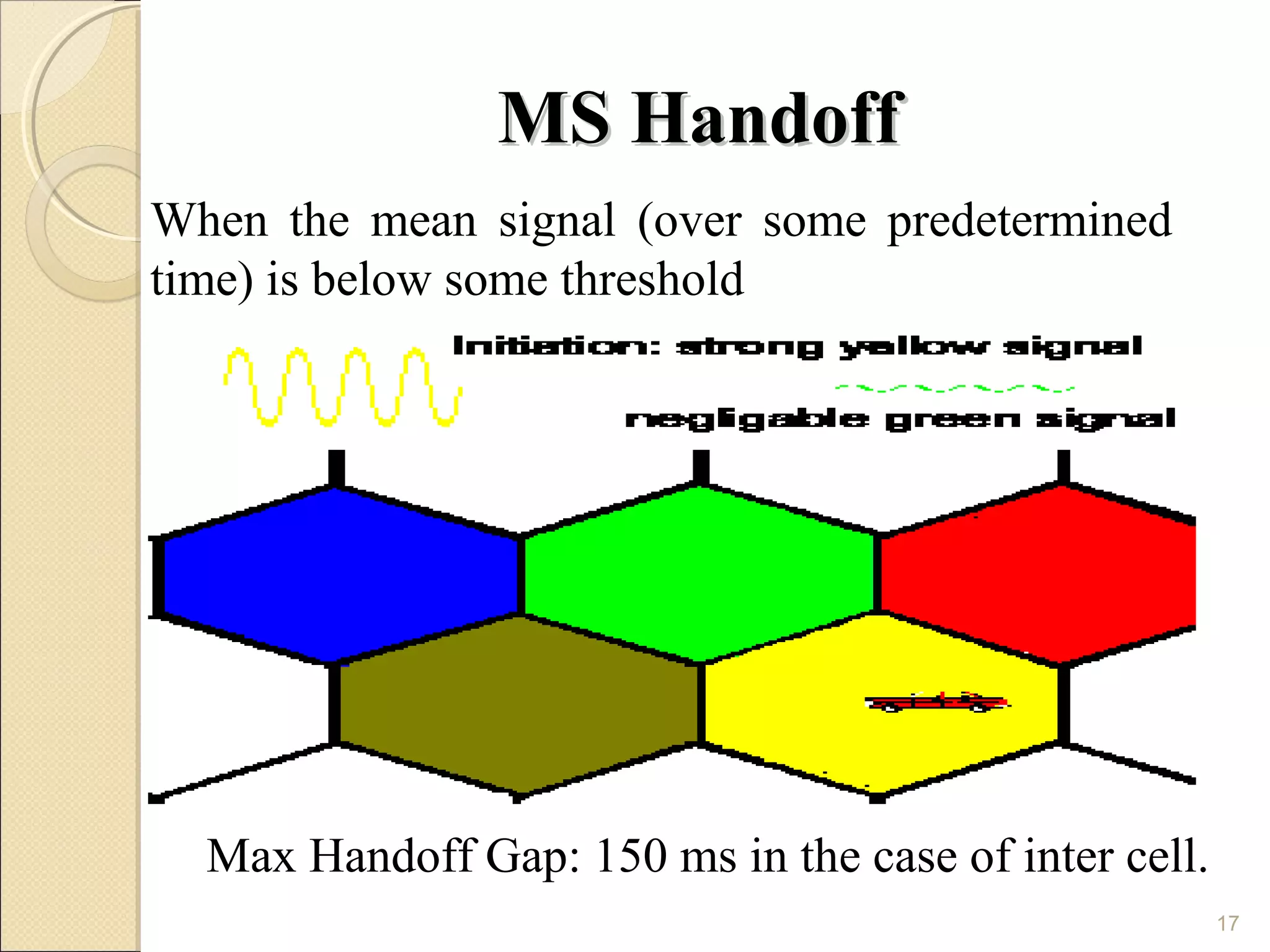
MS Handoff
When the mean signal (over some predetermined
time) is below some threshold


  Max Handoff Gap: 150 ms in the case of inter cell.
                                                       17
Handoff Procedure
 BTS provides list to MS of available channels in
  neighboring cells via BCCH (Broadcast Control
  Channel)
 MS monitors RSS from the BCCHs of the neighboring
  cells and reports it to MSC using SACCH
 BTS also monitors RSS of MS.
 Proprietary algorithms are used to decide when to
  handoff.
 MSC negotiates new channel with the new BSS and
  indicates to the MS to initiate a handoff .
 Upon completion of handoff MS informs the MSC.
 Old BSS is informed to release the resources.

                                                  18
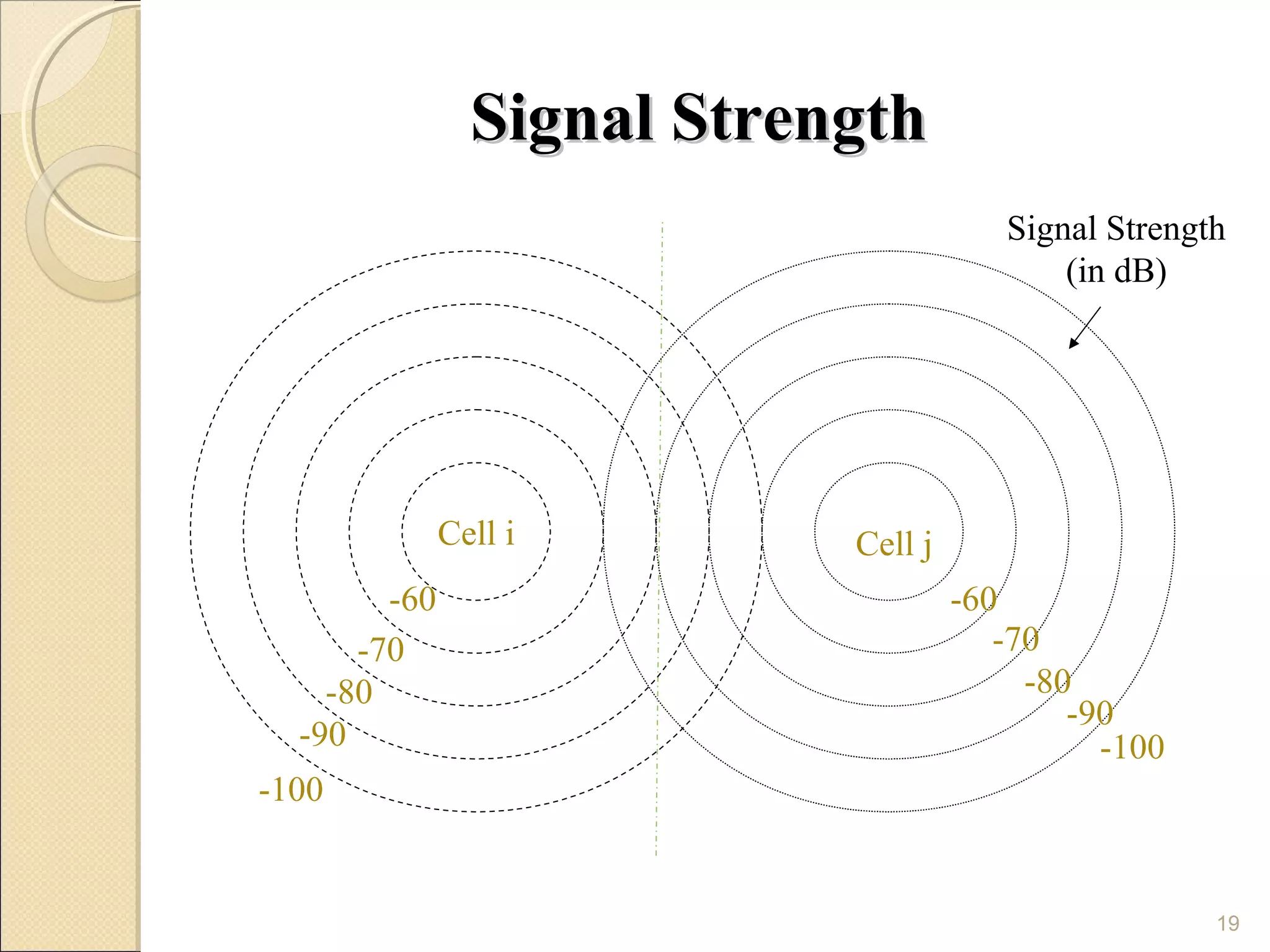
Signal Strength
                                        Signal Strength
                                            (in dB)


              Cell i        Cell j
        -60                          -60
      -70                               -70
    -80                                   -80
                                             -90
  -90                                          -100
-100


                                                      19
Problems of Handoff
 High  speed vehicles can cross many “small” cells
 in a short time.

 Umbrella cell. Large cell with a powerful tower
  to handle high speed vehicles
 Another   problem is called cell dragging.

 Happens when the user moves slowly away from
  the cell and the tower didn’t recognize it due to
  strong average signal.

                                                  20
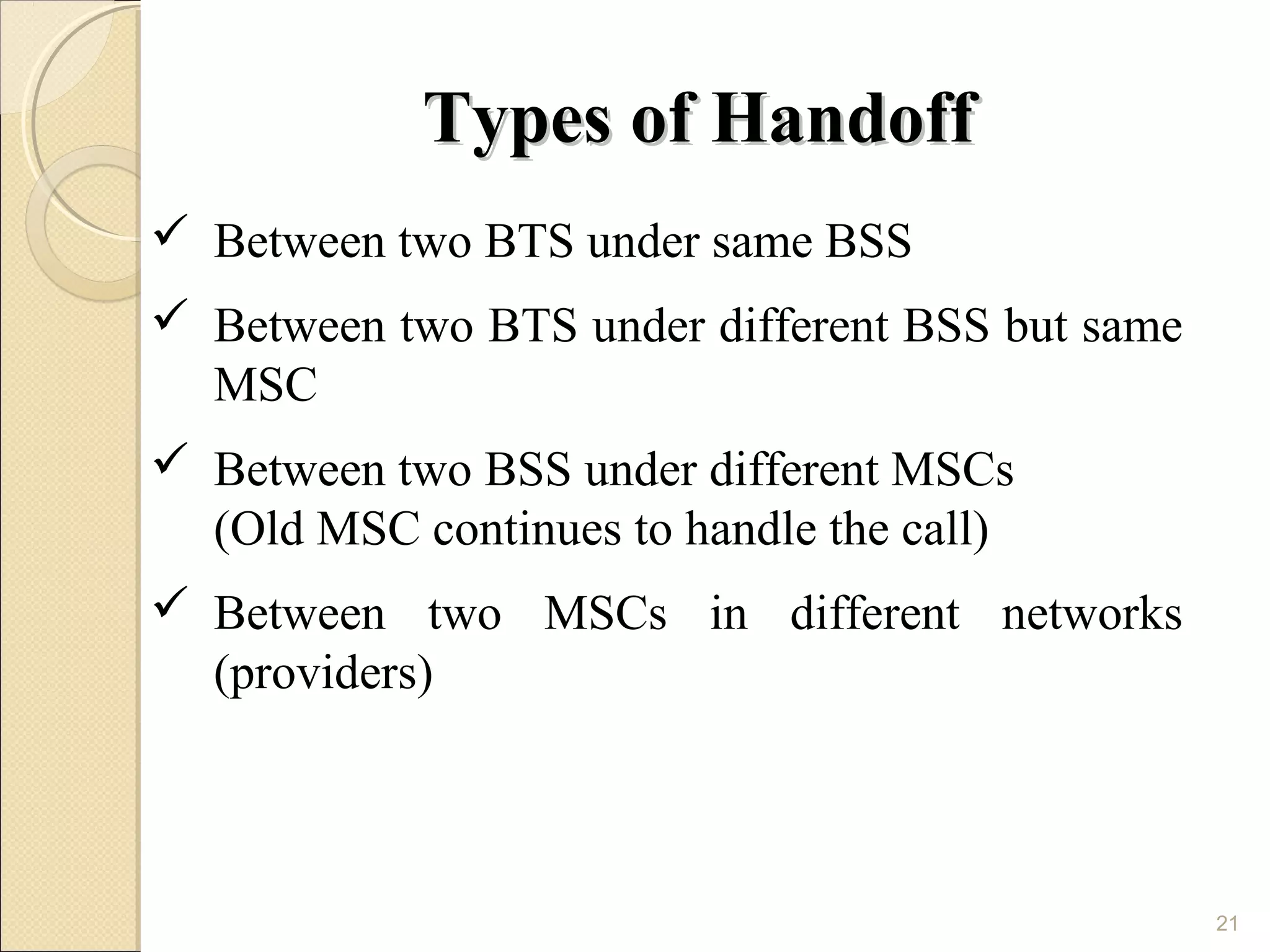
Types of Handoff
 Between two BTS under same BSS
 Between two BTS under different BSS but same
  MSC
 Between two BSS under different MSCs
  (Old MSC continues to handle the call)
 Between two MSCs in different networks
  (providers)


                                                 21
Next Speaker
Shamim Jahan


               22
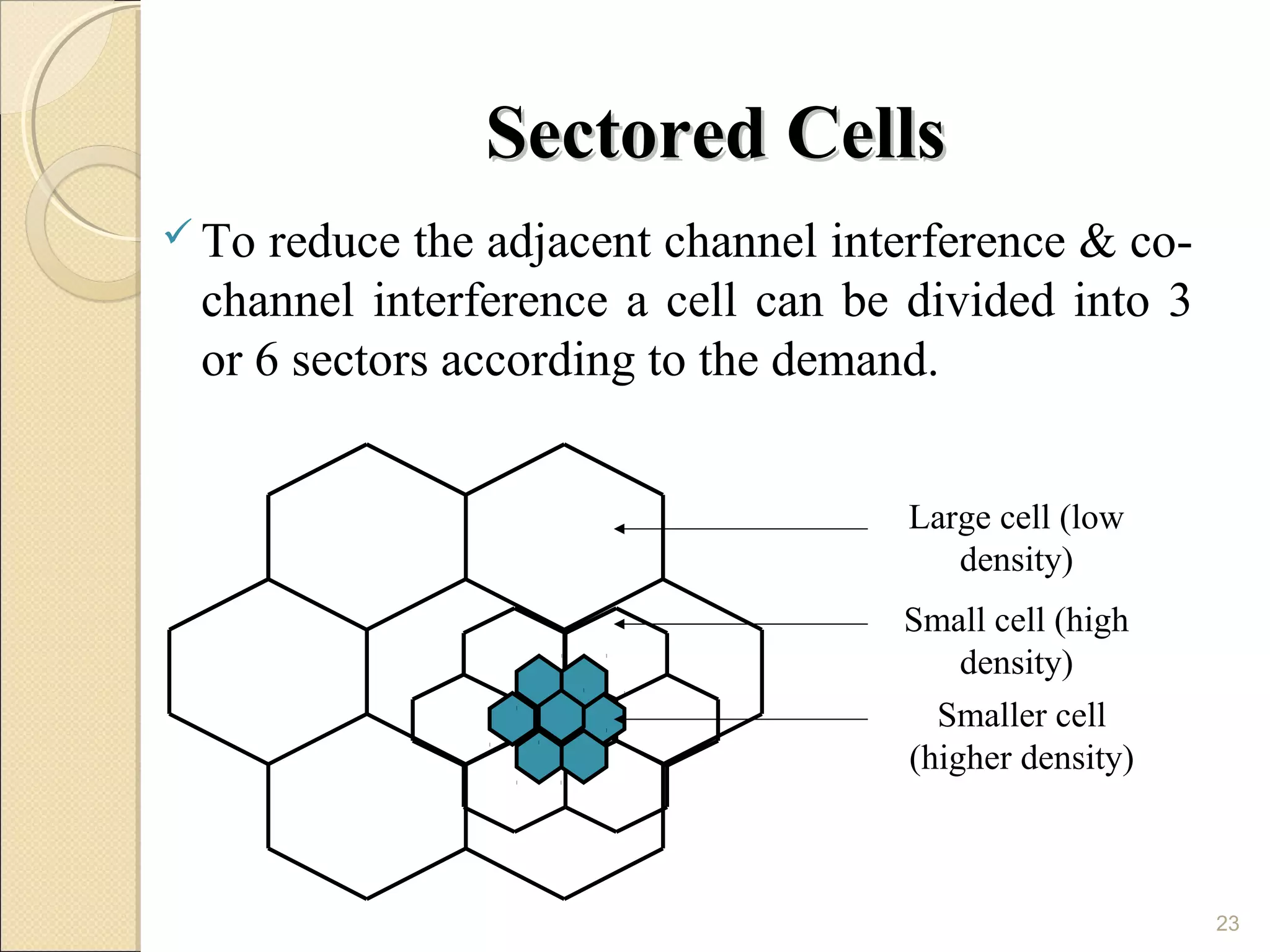
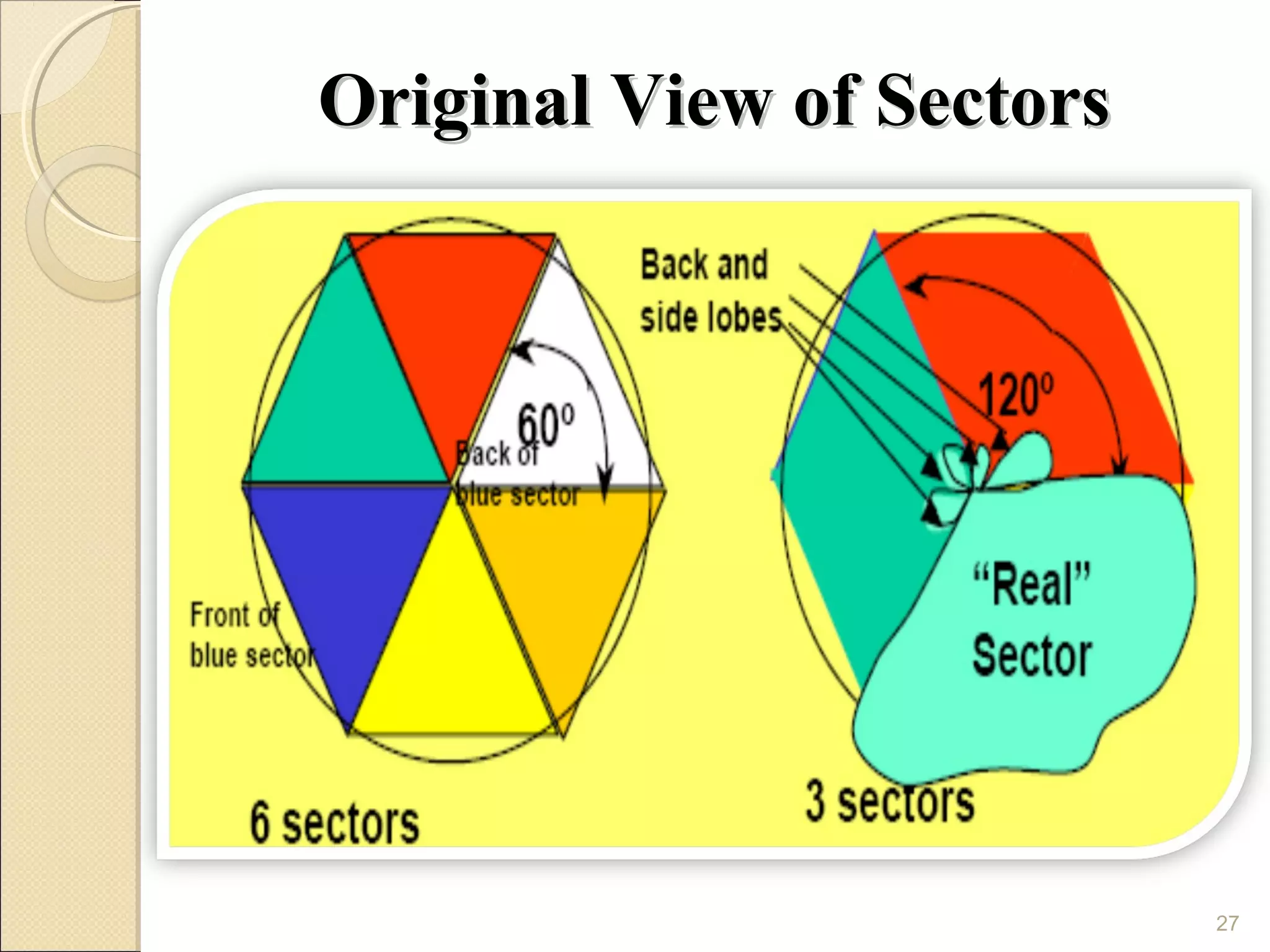
Sectored Cells
 To reduce the adjacent channel interference & co-
 channel interference a cell can be divided into 3
 or 6 sectors according to the demand.


                                    Large cell (low
                                       density)
                                    Small cell (high
                                        density)
                                      Smaller cell
                                    (higher density)


                                                       23
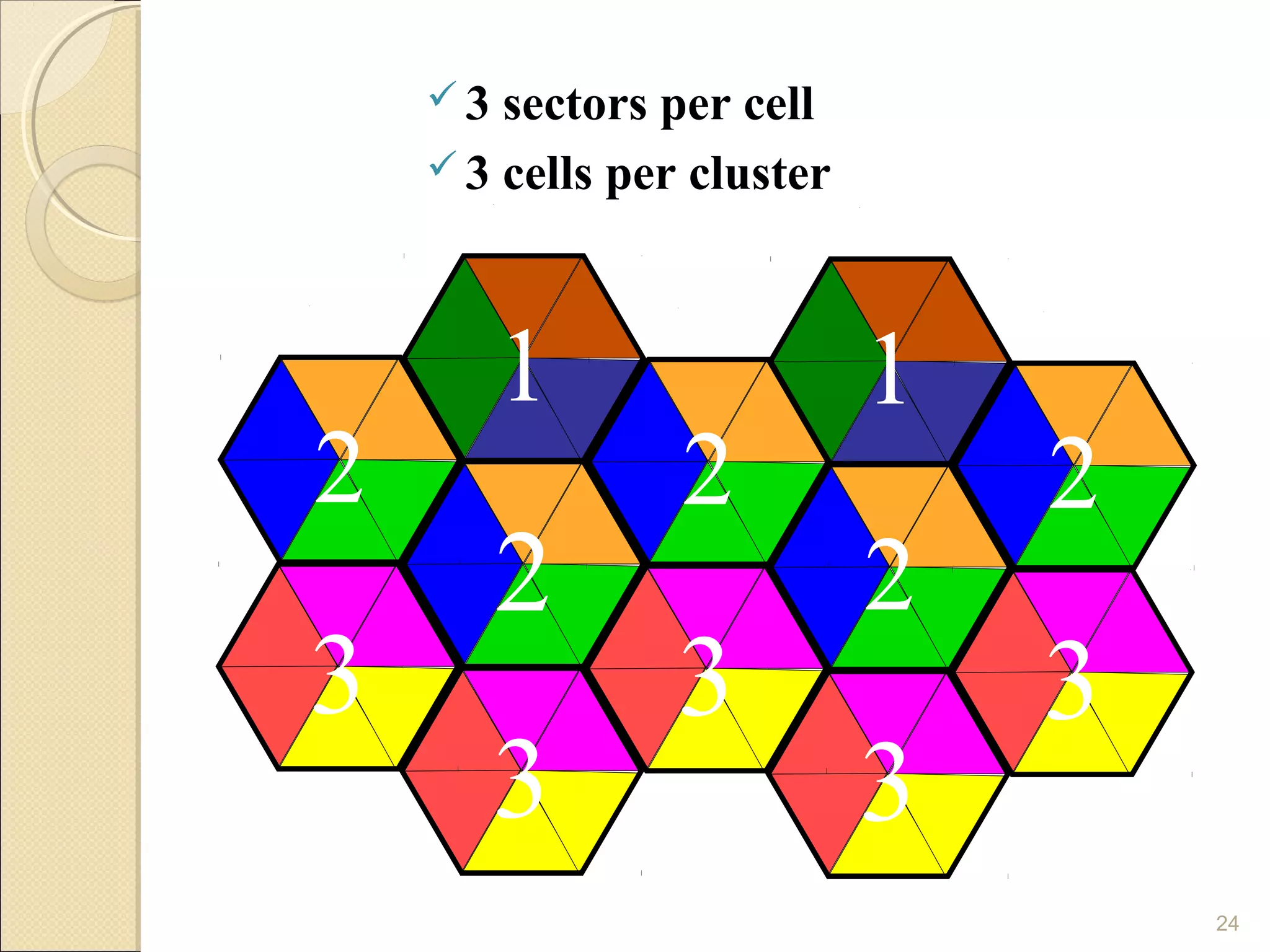
3  sectors per cell
     3 cells per cluster


         1                  1
2                2              2
         2                  2
3                3              3
         3                  3
                                    24
 3 sectors per cell
     4 cells per cluster


1            3              1
    4                 2         4
3            1              3
     2               4          2
1            3              1
    4                2          4
                                    25
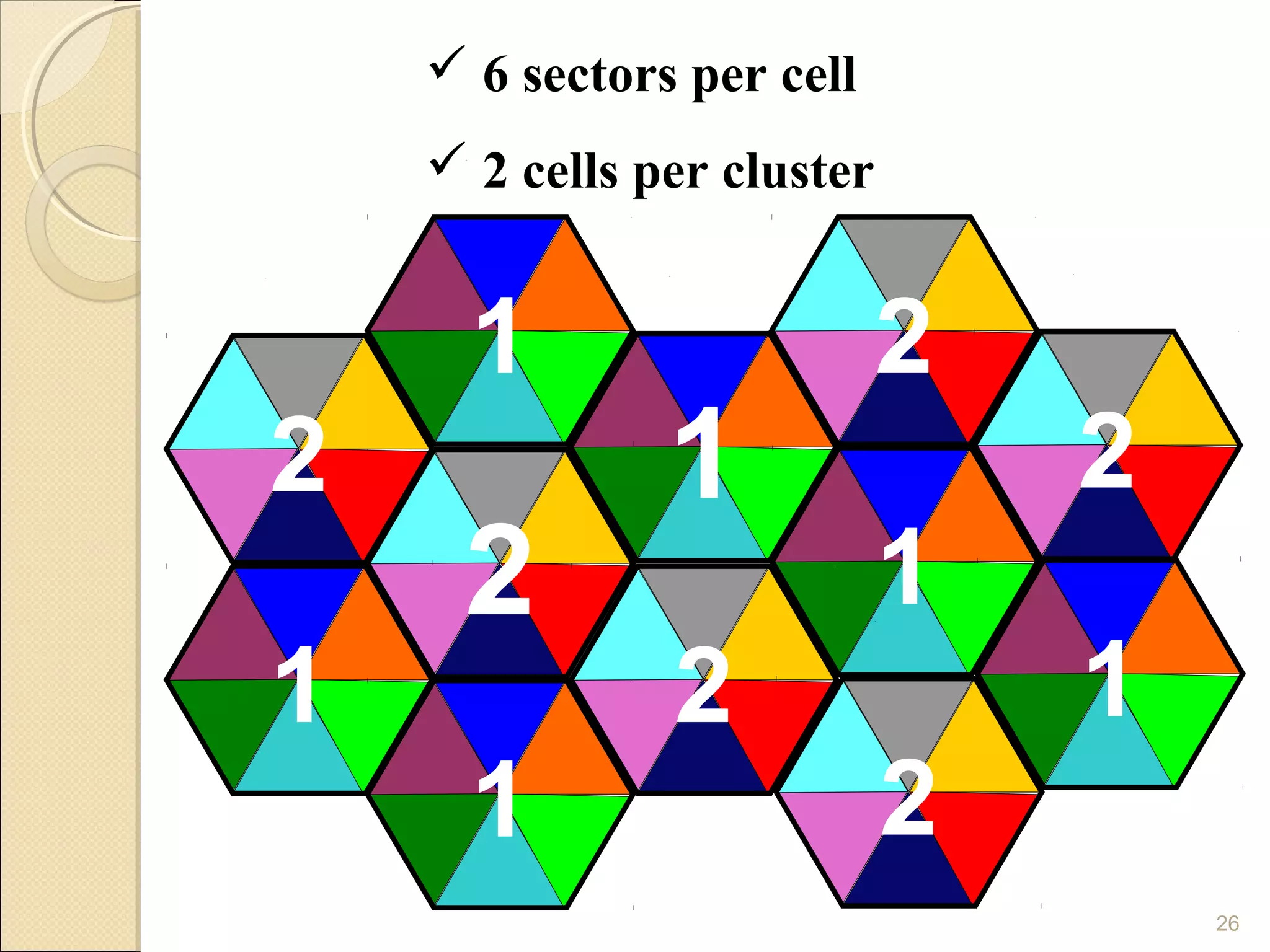
 6 sectors per cell
     2 cells per cluster


      1                     2
2              1                2
     2                      1
1              2                1
      1                     2
                                    26
Original View of Sectors


                           27
FDM & FDMA


                  F3
                  F2
                  F1
yc ne uqer F


                   Time

                            28
TDM & TDMA


                         T1          T2   T3
                     y
                   nc
                   ue
                 eq
               Fr
e du il p mA


                              Time
    t


                                               29
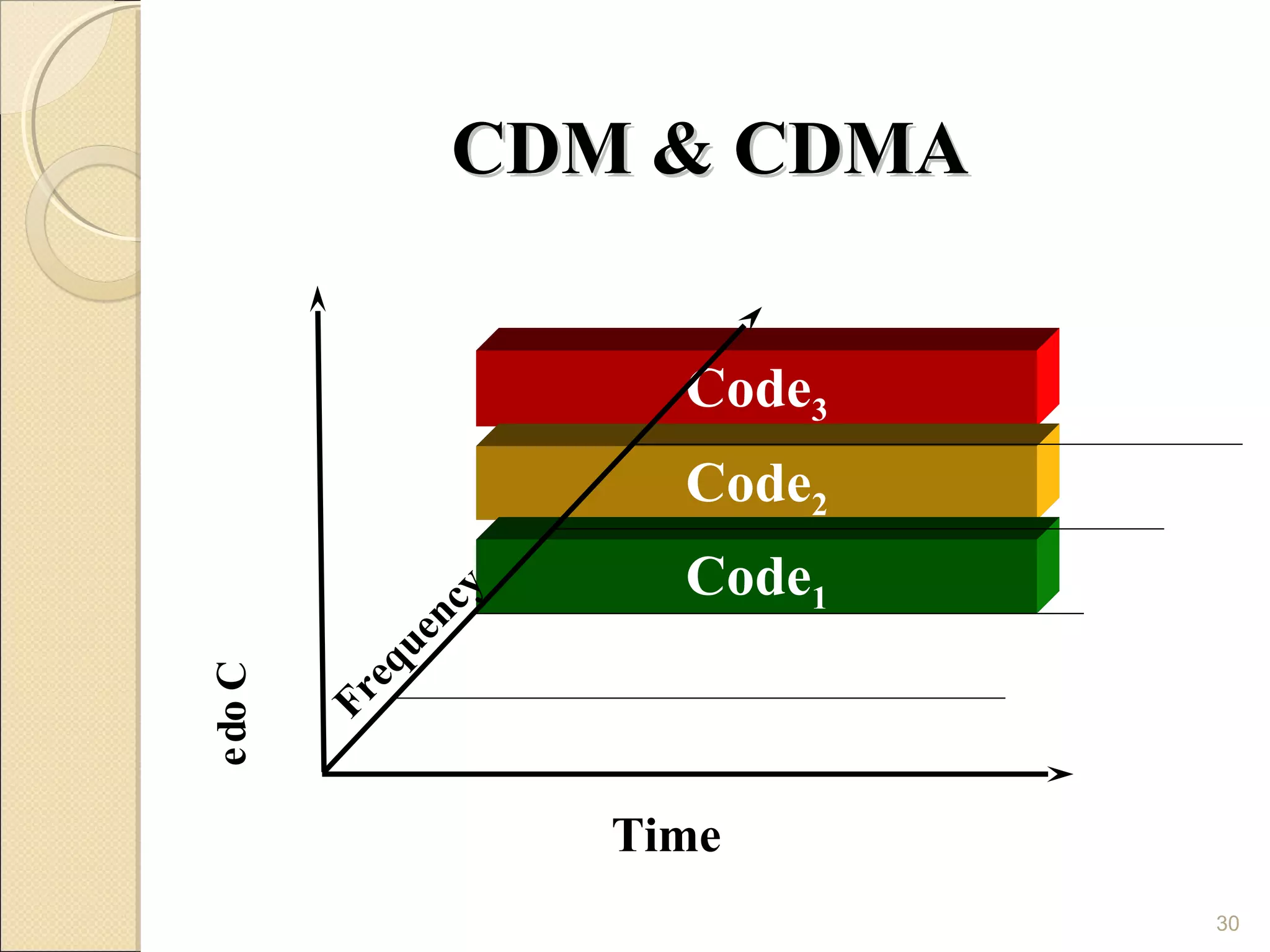
CDM & CDMA


                         Code3
                         Code2
                         Code1
                   y
              e nc
           qu
e do C


            e
         Fr


                       Time
                                 30
Frequency Spectrum

                                  z
                          ~96 0MH
                      5
              lin k 93
          n
       Dow
                                    H   z
                         0   ~9 15M
                 lin k 89
          Up
                                      BTS

MS
                                            31
Channels
 GSM 900 uses 25 MHz frequency spectrum
with 124 channels for uplink & downlink.
 Each channels have 200 KHz bandwidth.
 Each two channels are separated by 1.6 KHz
guard band.
 Each channel have 8 time slots which allows 8
subscribers to use same frequency by TDMA.


                                                  32
Channels
Channels with 200 KHz bandwidth

 1       2       3       4       5       6       123 124


     1       2       3       4       5       6   7   8
             Time slots

                     4.615 ms


                                                           33
Cell Types
Cells can be classified into three types
according to cell size

 Macro  cell
 Micro cell
 Pico cell


                                           34
Cell Types based on Range


                            35
Cell Types based on Range


                            36
Next Speaker
Nafiur Rahman


                37
Types of Antenna
There are three Types of antennas:

 Omni-directional

 Semi-directional

 Highly-directional


                                     38
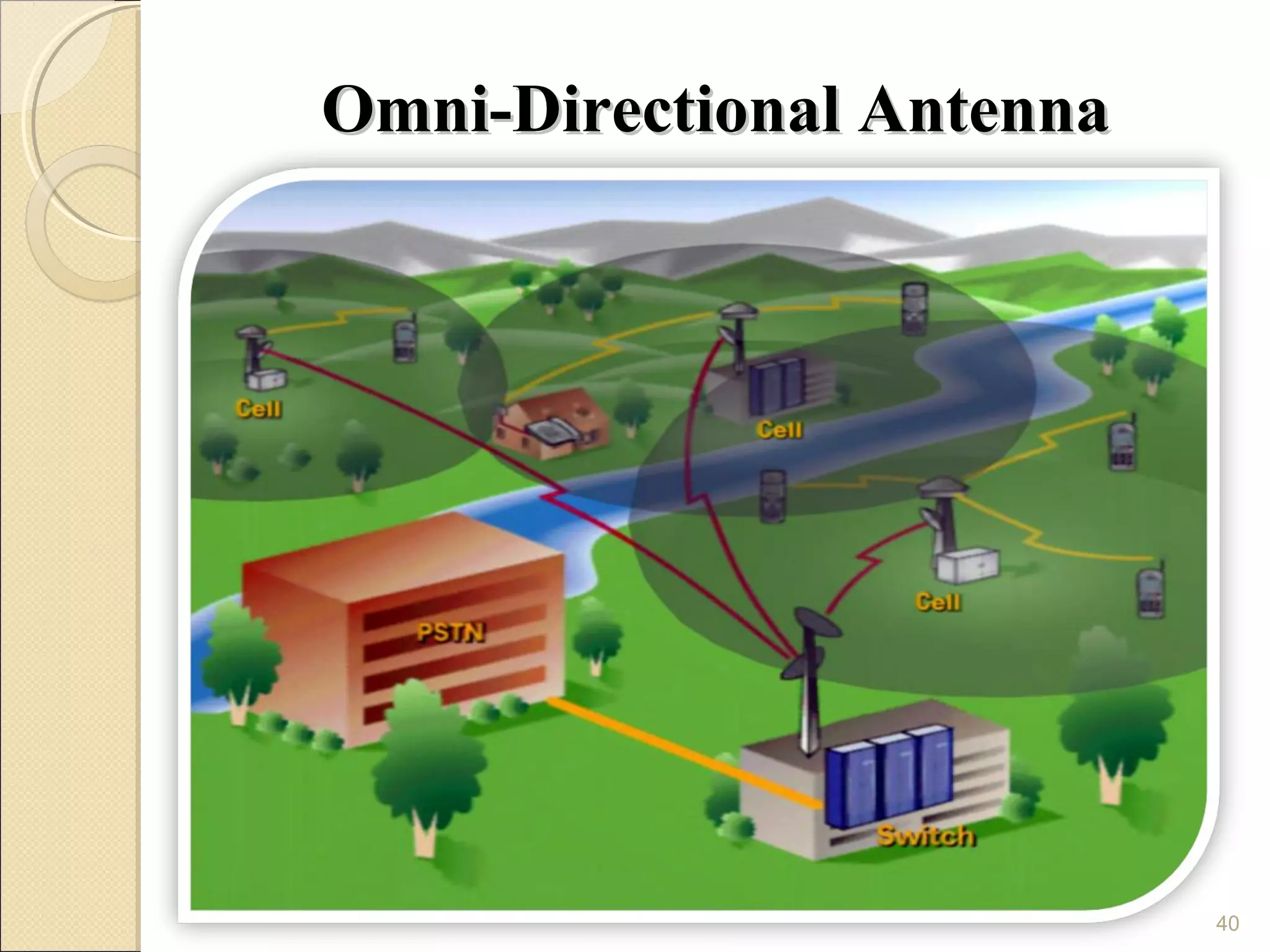
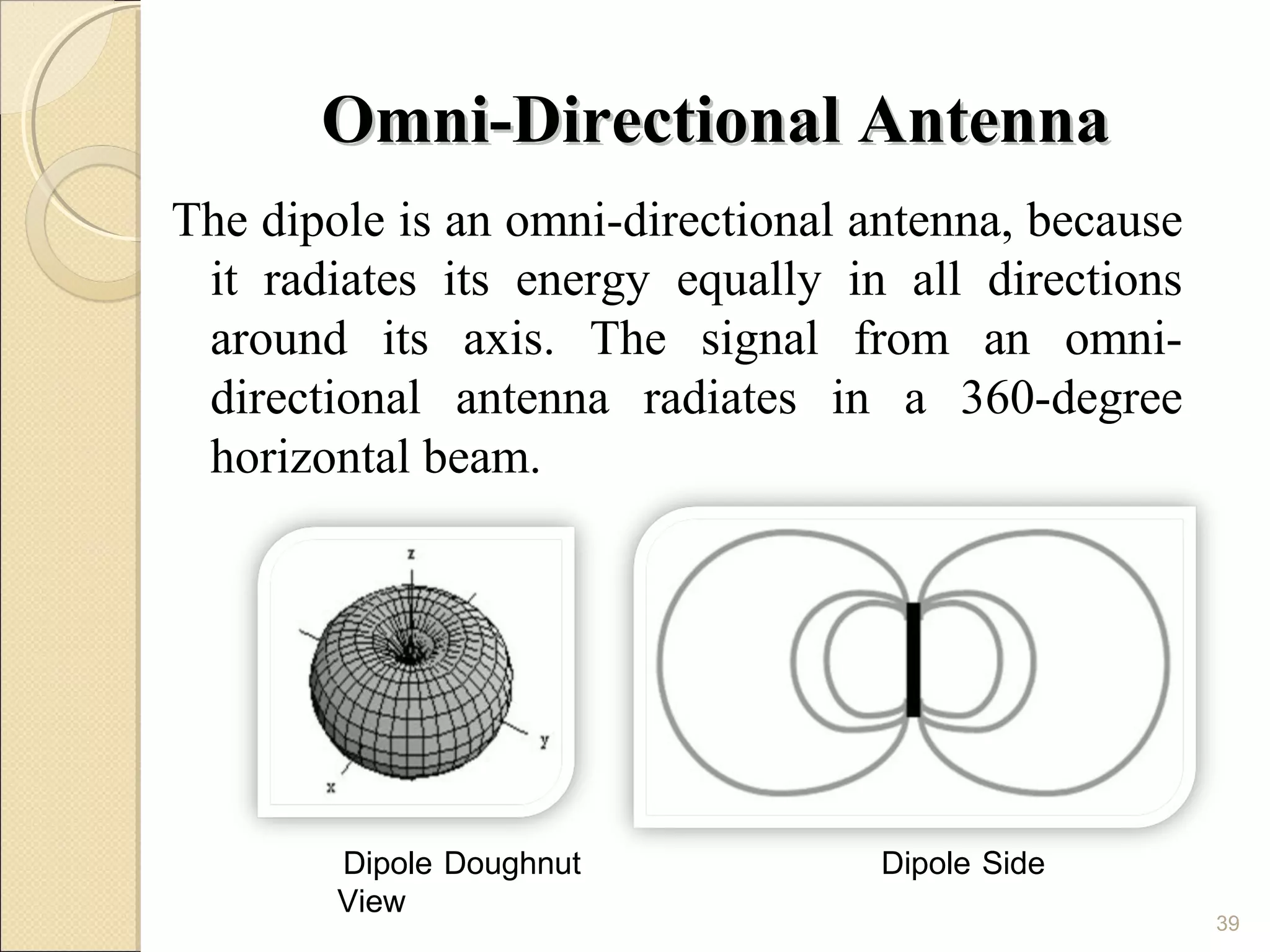
Omni-Directional Antenna
The dipole is an omni-directional antenna, because
 it radiates its energy equally in all directions
 around its axis. The signal from an omni-
 directional antenna radiates in a 360-degree
 horizontal beam.


        Dipole Doughnut            Dipole Side
        View
                                                     39
Omni-Directional Antenna


                           40
Semi-Directional Antenna
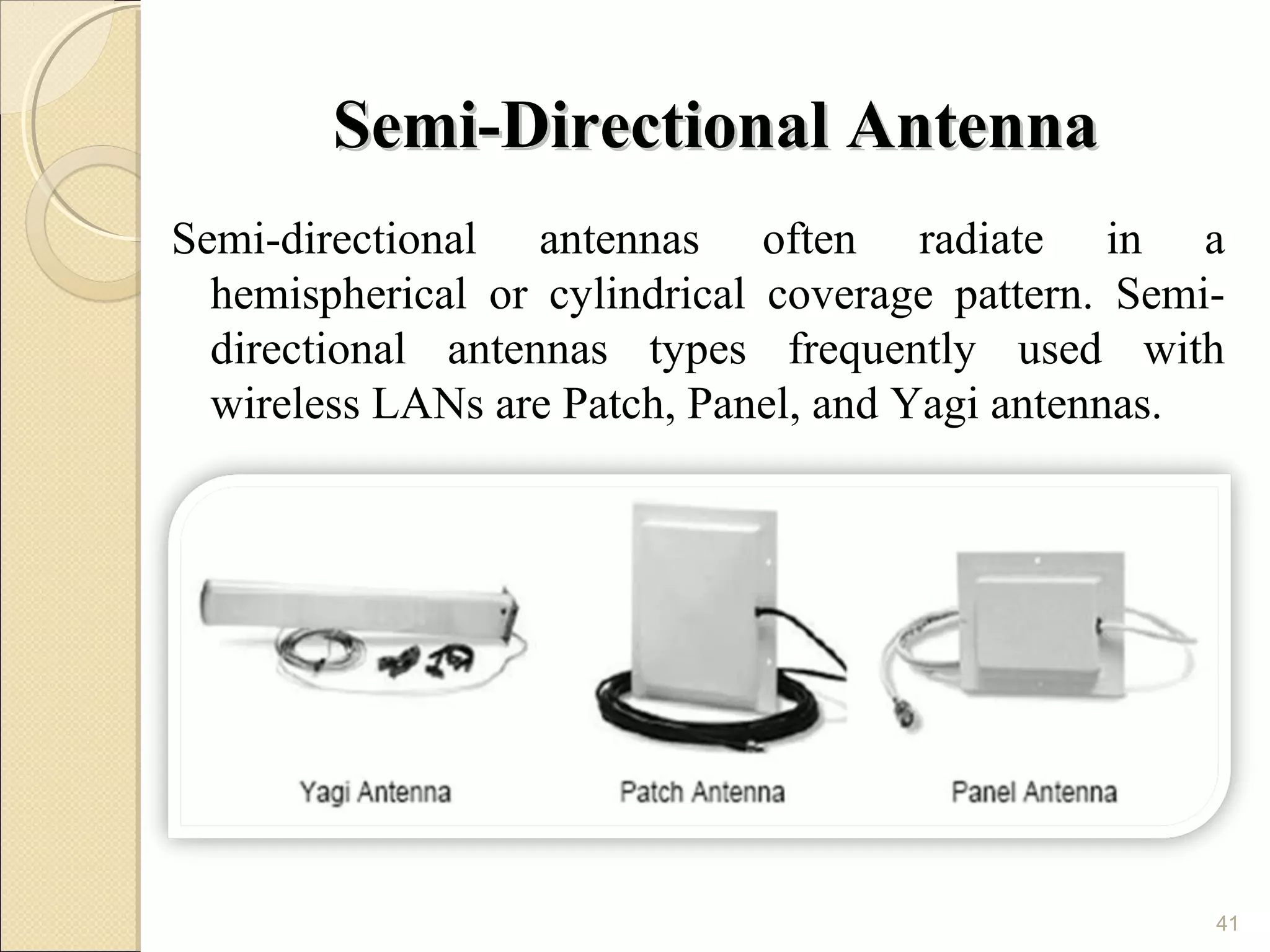
Semi-directional antennas often radiate in a
  hemispherical or cylindrical coverage pattern. Semi-
  directional antennas types frequently used with
  wireless LANs are Patch, Panel, and Yagi antennas.


                                                     41
Usage of Semi-Directional Antenna
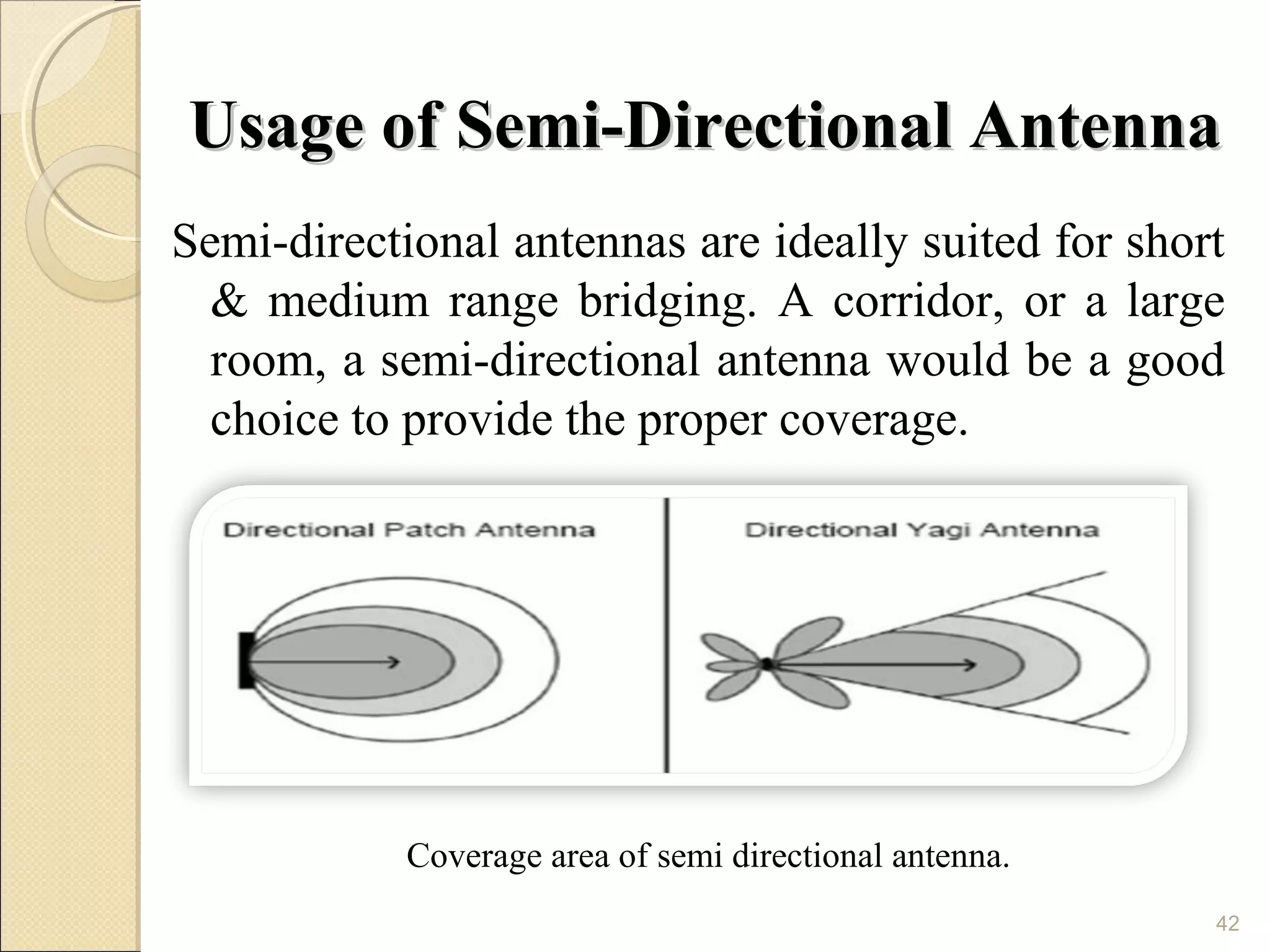
Semi-directional antennas are ideally suited for short
  & medium range bridging. A corridor, or a large
  room, a semi-directional antenna would be a good
  choice to provide the proper coverage.


            Coverage area of semi directional antenna.
                                                         42
Semi Directional Antenna


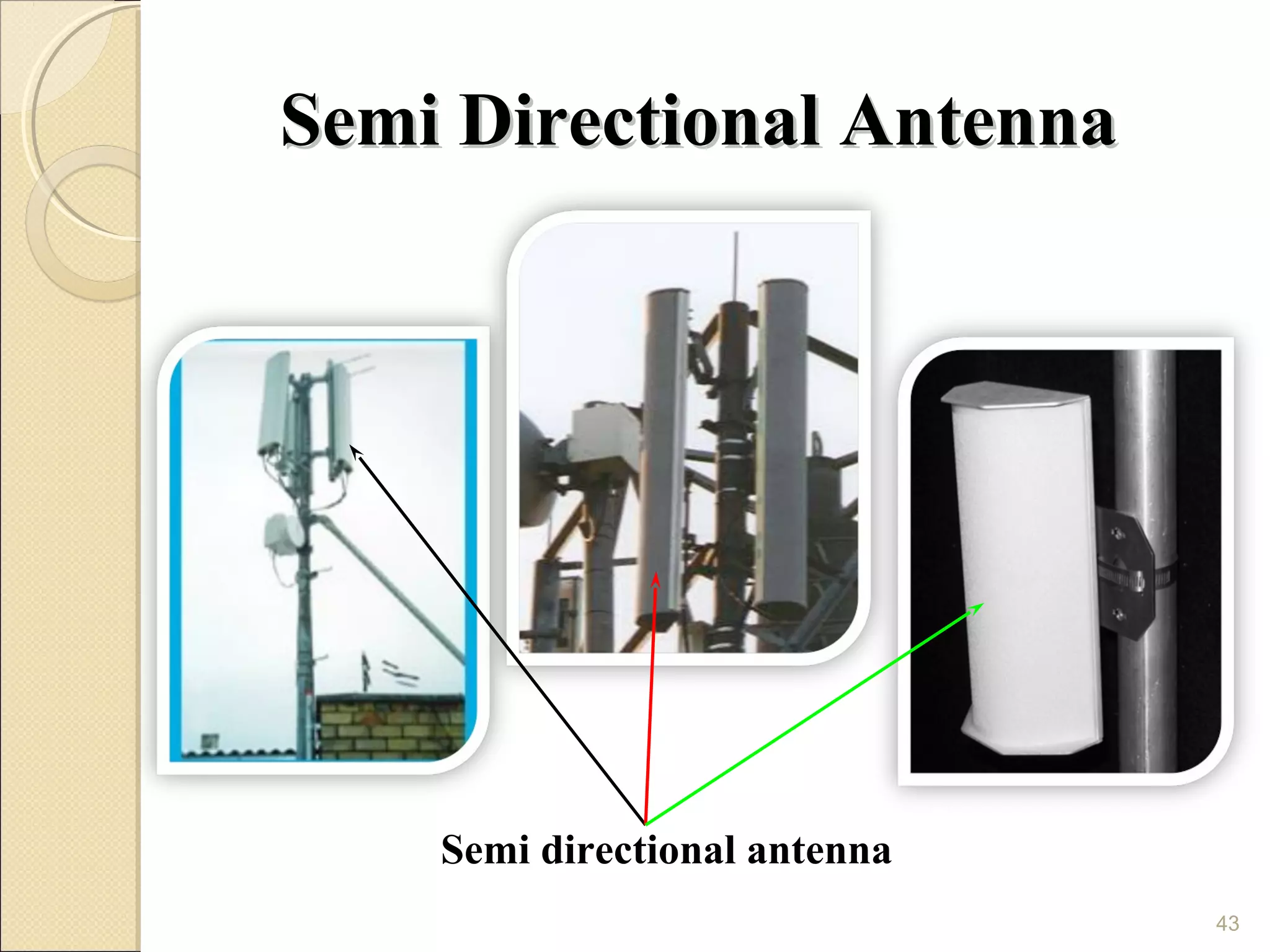
    Semi directional antenna
                               43
Directional Antenna


                      44
Highly-Directional Antenna
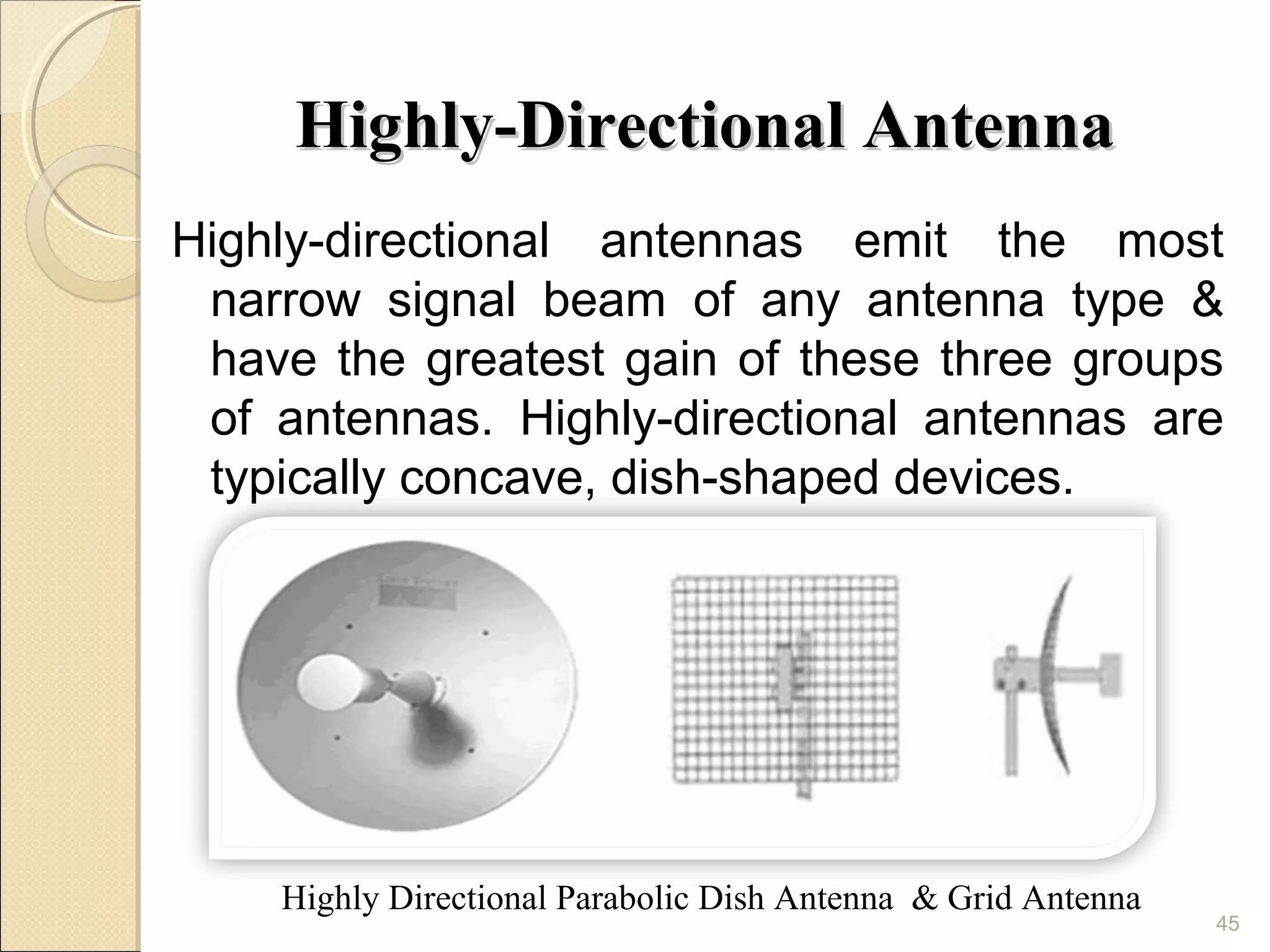
Highly-directional antennas emit the most
 narrow signal beam of any antenna type &
 have the greatest gain of these three groups
 of antennas. Highly-directional antennas are
 typically concave, dish-shaped devices.


    Highly Directional Parabolic Dish Antenna & Grid Antenna
                                                               45
Usage of Highly-Directional Antenna
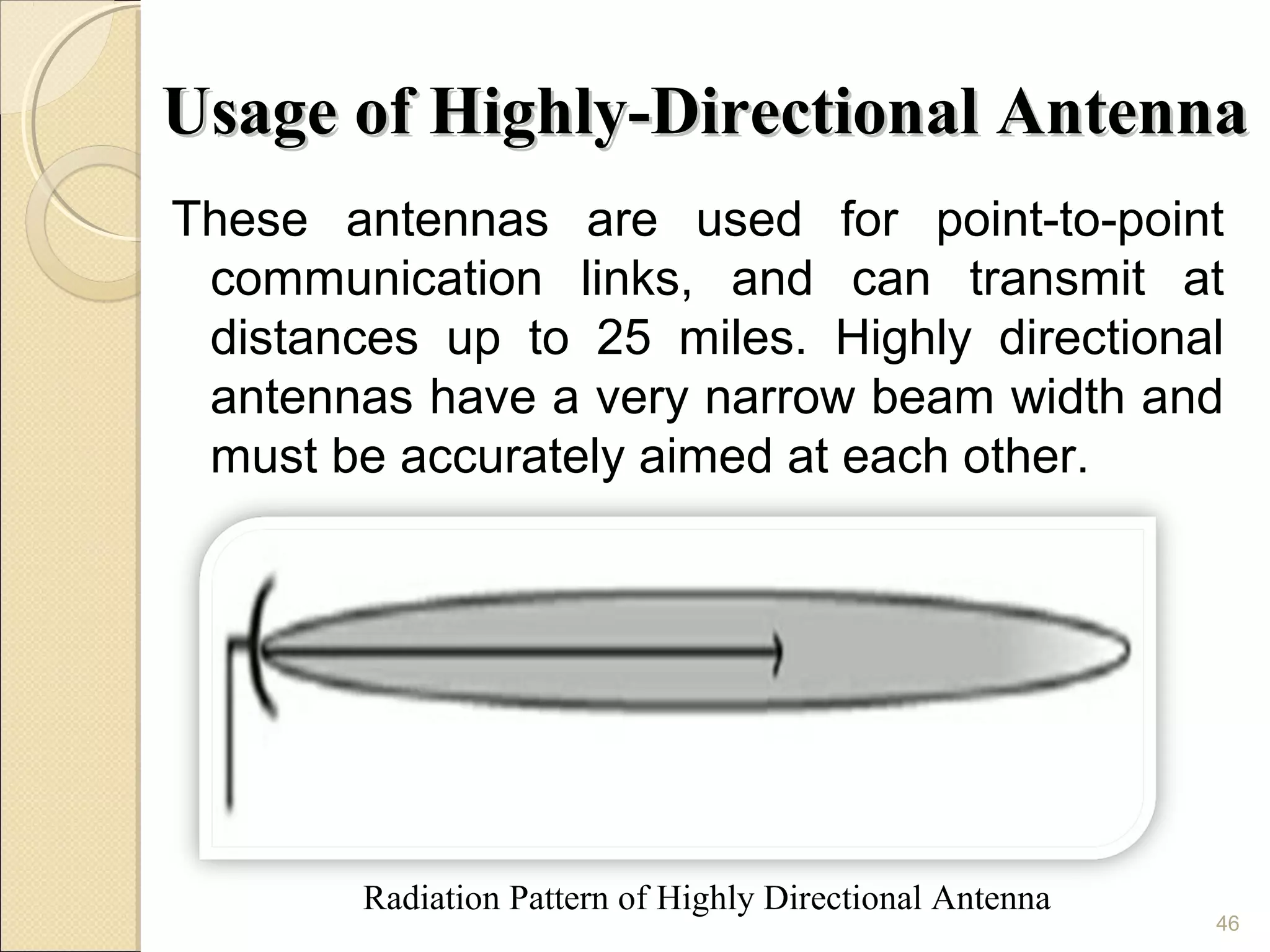
These antennas are used for point-to-point
 communication links, and can transmit at
 distances up to 25 miles. Highly directional
 antennas have a very narrow beam width and
 must be accurately aimed at each other.


        Radiation Pattern of Highly Directional Antenna
                                                          46
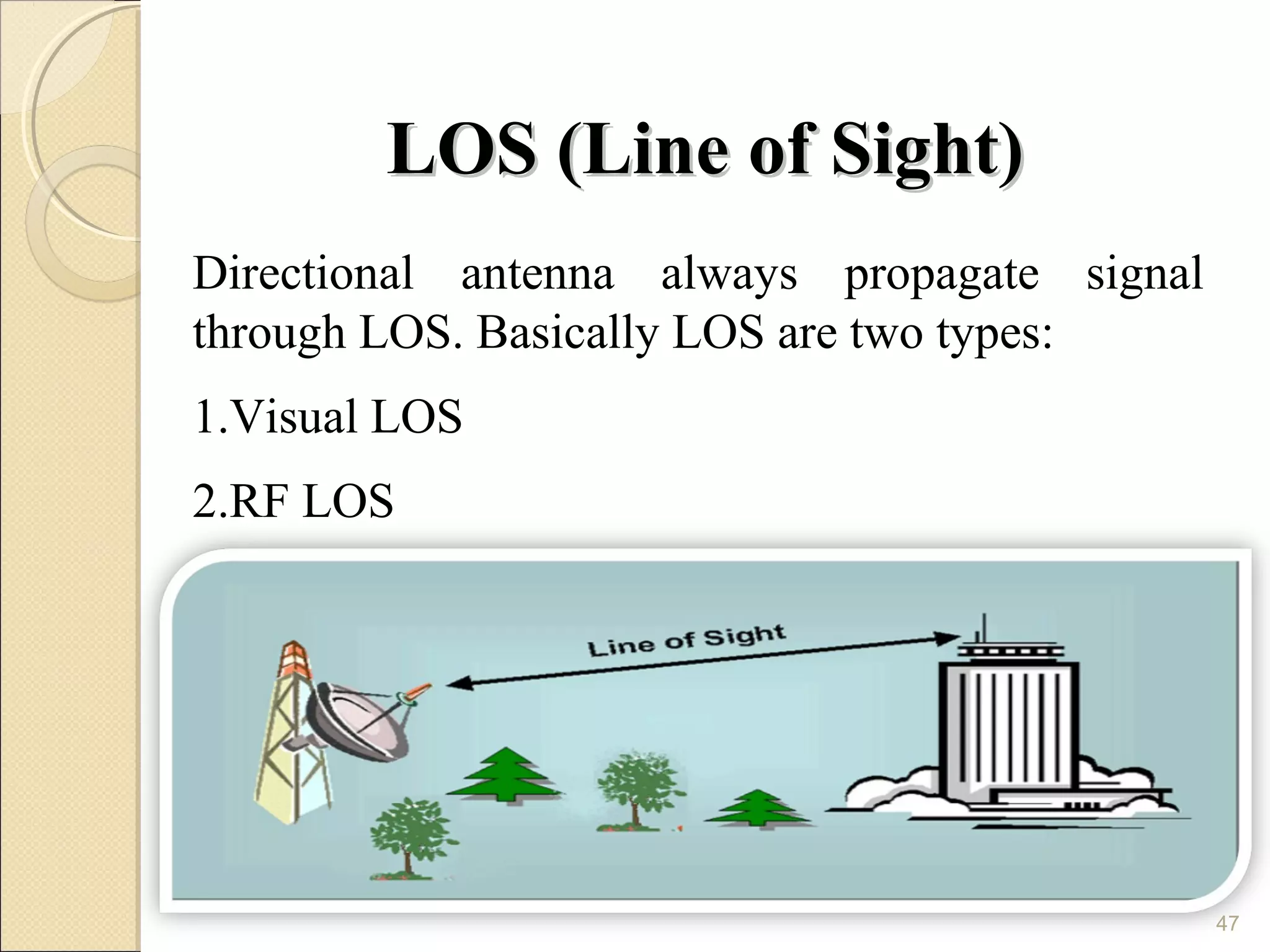
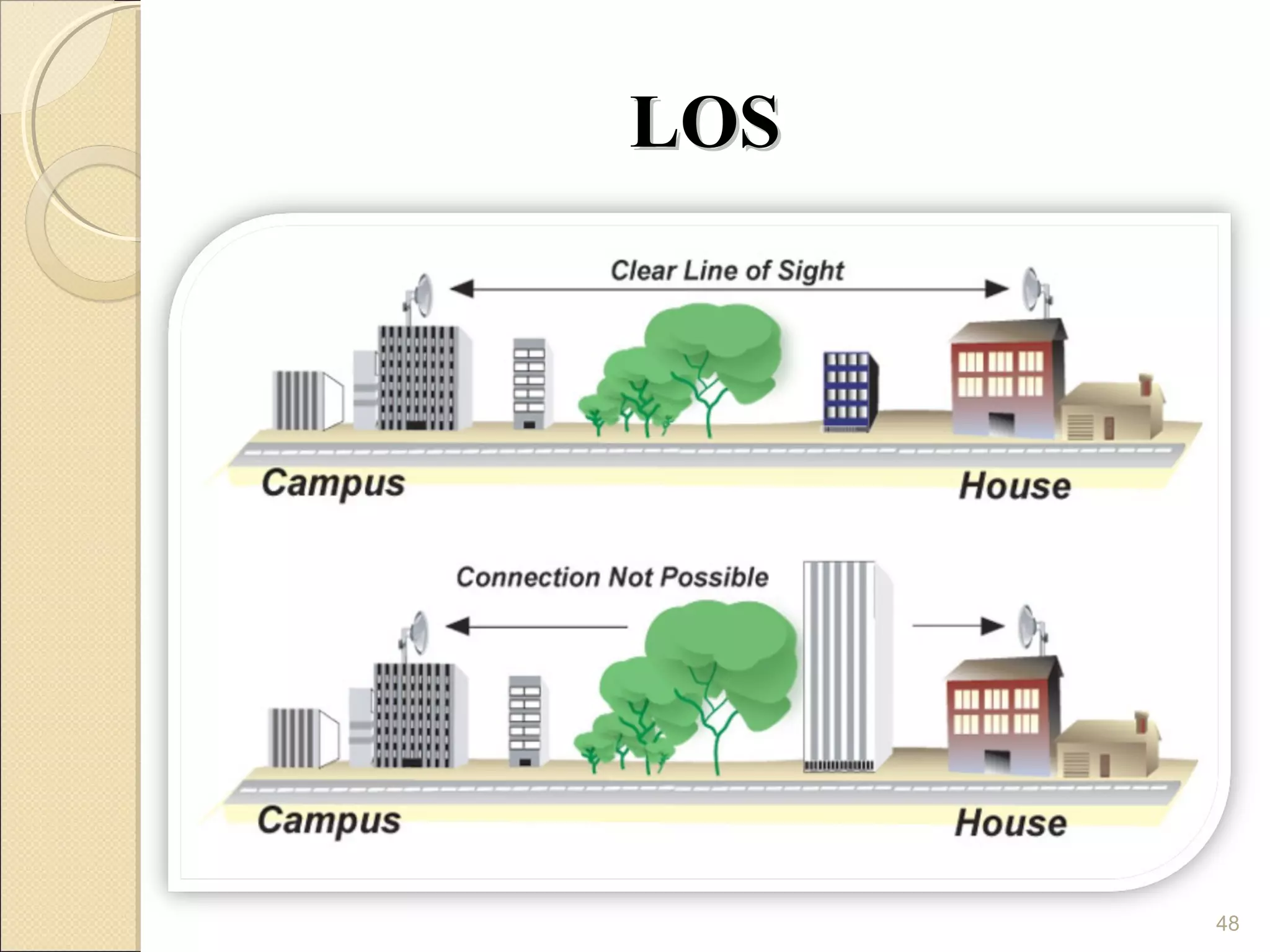
LOS (Line of Sight)
Directional antenna always propagate signal
through LOS. Basically LOS are two types:
1.Visual LOS
2.RF LOS


                                              47
LOS


      48
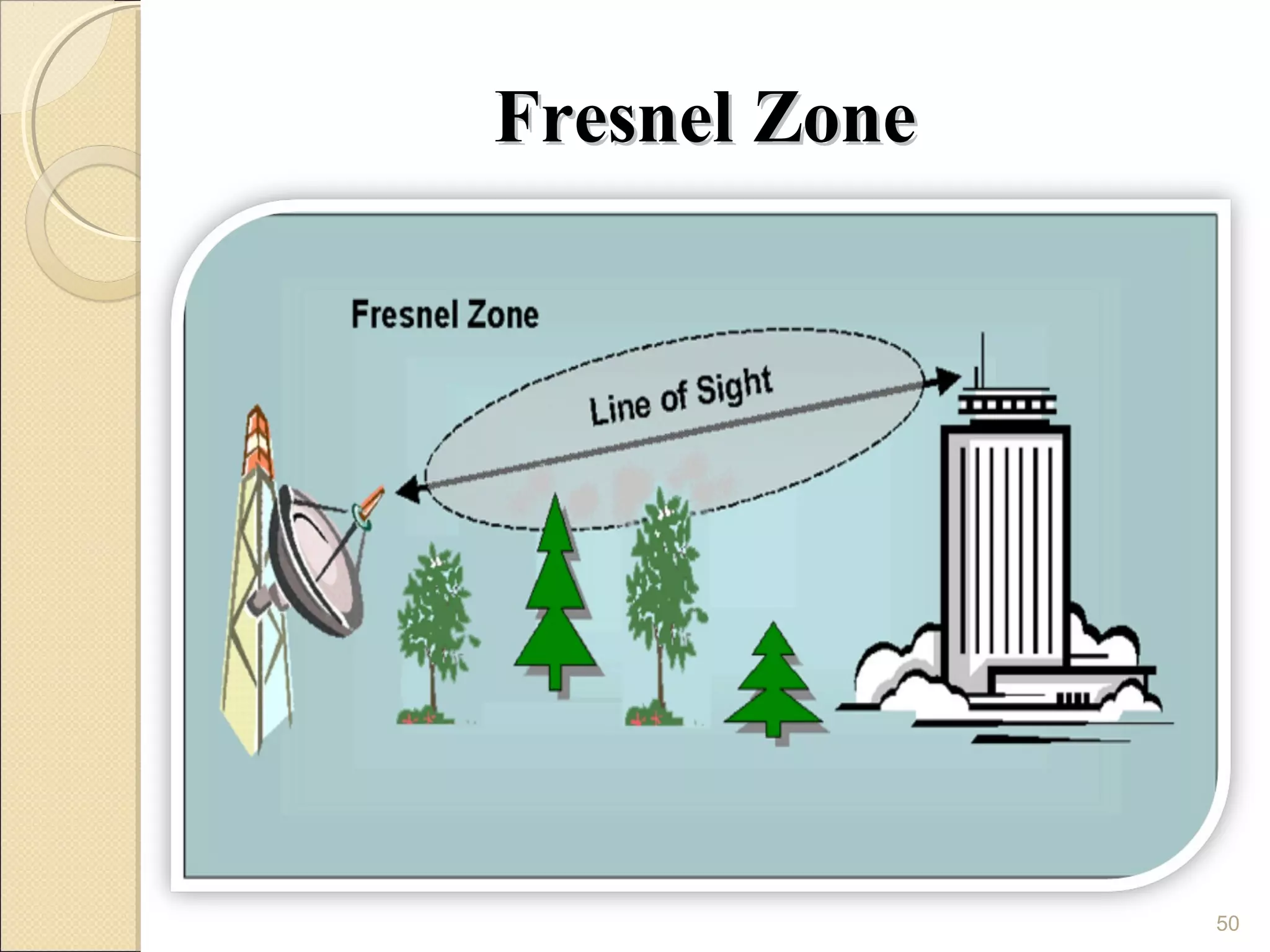
Fresnel Zone
Typically 40% fresnel zone blockage introduce a
manageable amount of interference into the link.

But more then 40% is means the link will be
unreliable.

Allowing no more then 20% blockage of fresnel
zone. When system is design that time we have to
keep it 0%.


                                               49
Fresnel Zone


               50
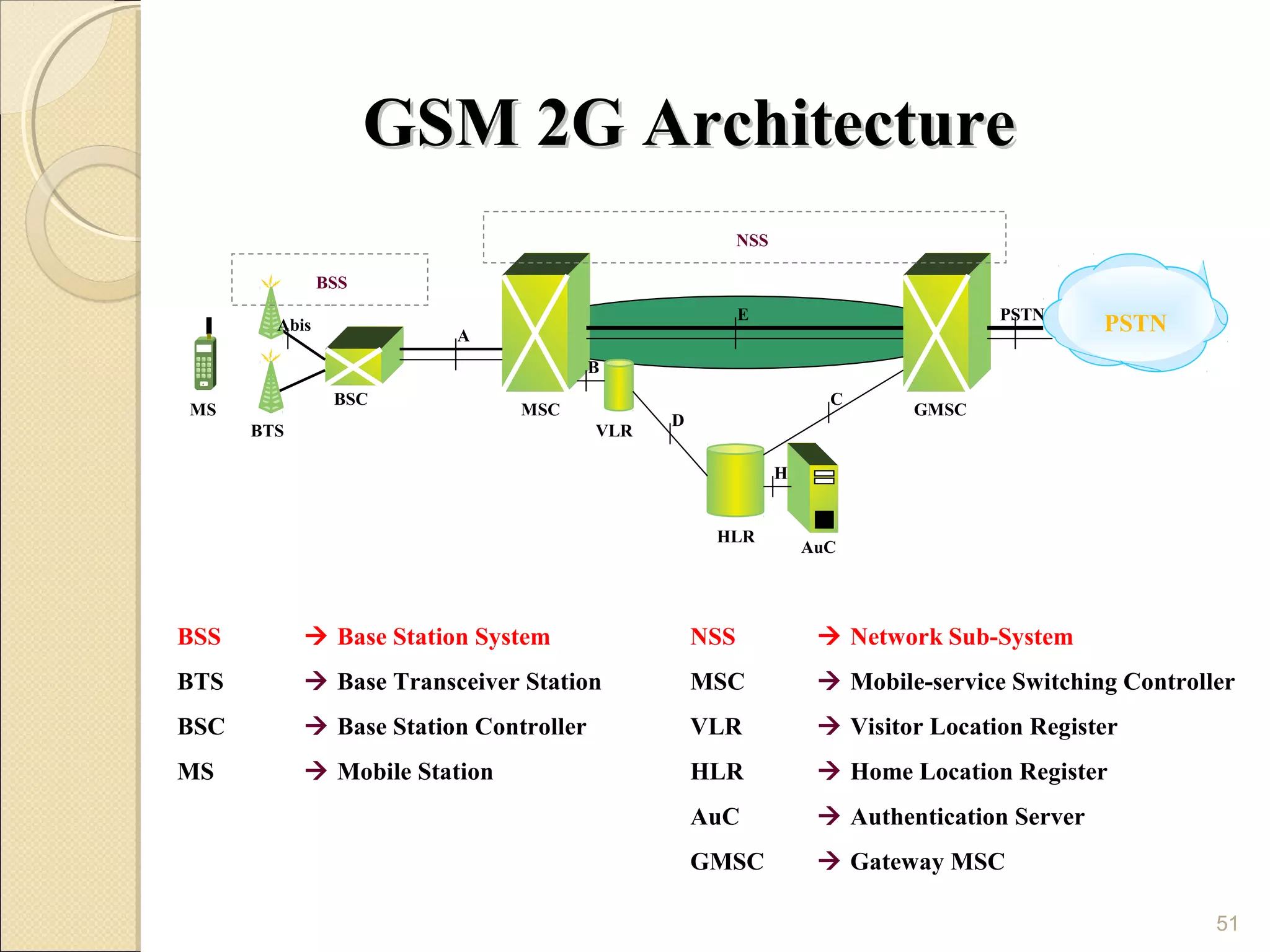
GSM 2G Architecture
                                                        NSS

               BSS
                                                        E                          PSTN
        Abis
                         A
                                                                                             PSTN
                                        B
                BSC                                                 C
MS                             MSC                                         GMSC
                                              D
      BTS                               VLR

                                                              H


                                                   HLR
                                                                  AuC


BSS          Base Station System                 NSS               Network Sub-System
BTS          Base Transceiver Station            MSC               Mobile-service Switching Controller
BSC          Base Station Controller             VLR               Visitor Location Register
MS           Mobile Station                      HLR               Home Location Register
                                                  AuC               Authentication Server
                                                  GMSC              Gateway MSC

                                                                                                      51
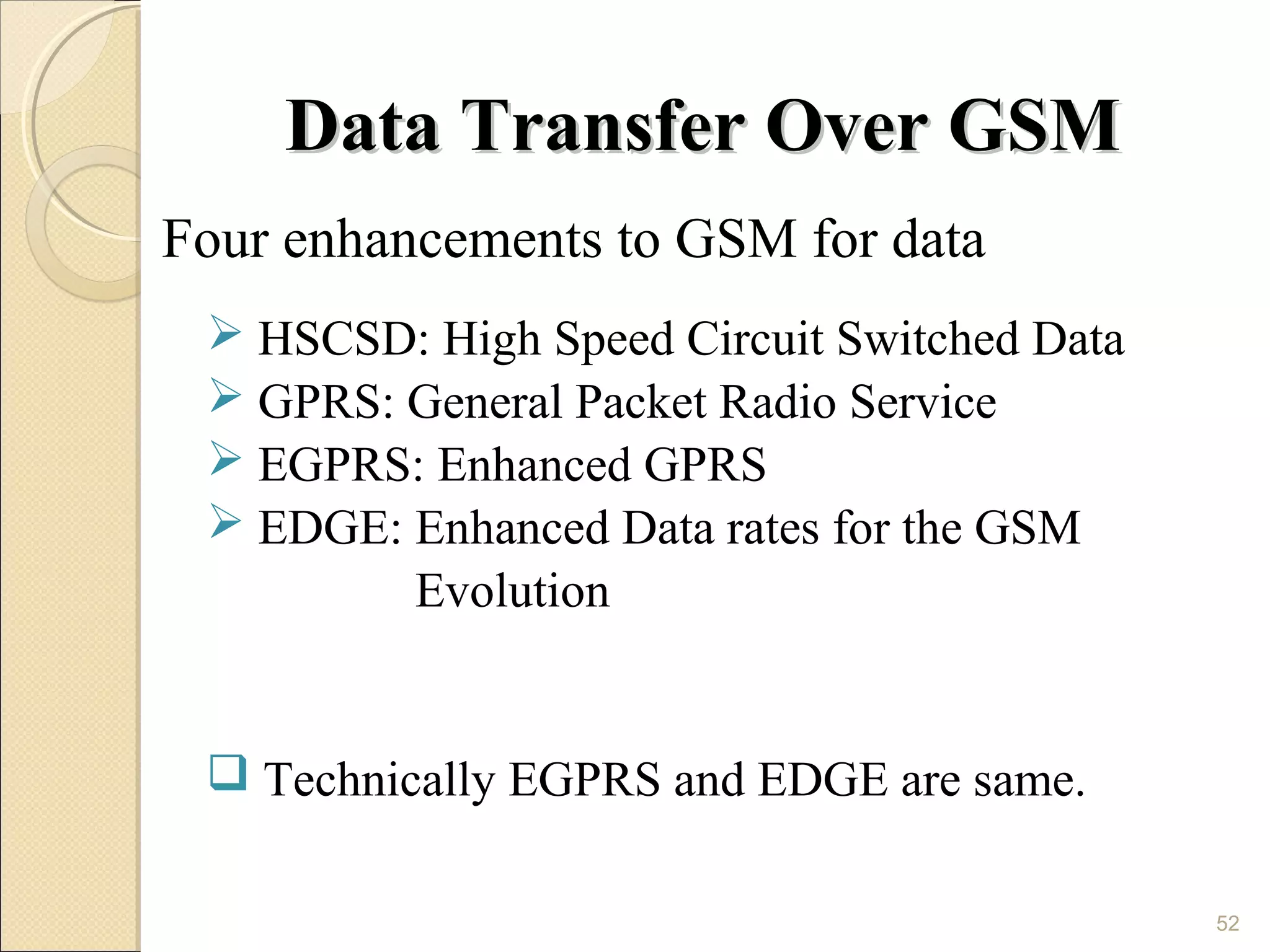
Data Transfer Over GSM
Four enhancements to GSM for data
  HSCSD: High Speed Circuit Switched Data
  GPRS: General Packet Radio Service
  EGPRS: Enhanced GPRS
  EDGE: Enhanced Data rates for the GSM
         Evolution


  Technically EGPRS and EDGE are same.

                                             52
Gsm Technology

Gsm Technology

  • 2.
    Speakers Hasan Mahmood 061-19-324 Shamim Jahan 061-19-346 Nafiur Rahman 061-19-347
  • 3.
  • 4.
    Why it CallsCellular ? Uses hexagonal Cells 4
  • 5.
    Why Use Cells? If there was no cell  Limited frequency spectrum for available Mobile Communication.  Frequency utilization is inefficient.  Single high power antenna causes to be the limited number of users. 5
  • 6.
    Why Use Cells?  Advantages of cell structures: More capacity due to frequency reuse. Less transmission power needed. Deals interference, transmission area locally.  Problems: Fixed network needed for the base stations. Handover necessary. Interference with other cells. 6
  • 7.
    Frequency Reuse  Adjacentcells are assigned different frequencies to avoid interference or crosstalk.  The same frequency is reused in different areas for after a certain distance.  InGSM networks a frequency reuse pattern with k = 3, 4, 7, 12 or 21. (k= Frequency reuse factor)  Each ‘k’ number of cells make a cluster. 7
  • 8.
    Different Frequency Reuse Fixed frequency assignment: certain frequencies are assigned to a certain cell. problem: different traffic load in different cells.  Dynamic frequency assignment: base station chooses frequencies depending on the frequencies already used in neighbor cells. more capacity in cells with more traffic. 8
  • 9.
    Frequency Reuse 3& 4 Reuse factor = 3 Reuse factor = 4 3 cell Cluster 4 cell Cluster 9
  • 10.
    Frequency Reuse 7 Reusefactor = 7 7 cell Cluster 10
  • 11.
    Adjacent Channel Interference Comes from imperfect filters that allow frequency leakage into the band  Serious problem if interferer is nearby, near-far effect Nearby mobile transmits on a frequency near to that of a weak mobile  Base station receivers need high-Q filters to reject adjacent channel interference. 11
  • 12.
  • 13.
    Co Channel Interference Oneof the primary forms of man-made signal degradation associated with digital radio, co-channel interference occurs when the same carrier frequency reaches the same receiver from two separate transmitters. In a fully equipped hexagonal-shaped cell system, there is always 6 co channel cell. 13
  • 14.
    Co Channel Interference F1 F1 F1 F1 F1 MS 14
  • 15.
    6 Co ChannelCell in 1st Tier 15
  • 16.
  • 17.
    MS Handoff When themean signal (over some predetermined time) is below some threshold Max Handoff Gap: 150 ms in the case of inter cell. 17
  • 18.
    Handoff Procedure  BTSprovides list to MS of available channels in neighboring cells via BCCH (Broadcast Control Channel)  MS monitors RSS from the BCCHs of the neighboring cells and reports it to MSC using SACCH  BTS also monitors RSS of MS.  Proprietary algorithms are used to decide when to handoff.  MSC negotiates new channel with the new BSS and indicates to the MS to initiate a handoff .  Upon completion of handoff MS informs the MSC.  Old BSS is informed to release the resources. 18
  • 19.
    Signal Strength Signal Strength (in dB) Cell i Cell j -60 -60 -70 -70 -80 -80 -90 -90 -100 -100 19
  • 20.
    Problems of Handoff High speed vehicles can cross many “small” cells in a short time. Umbrella cell. Large cell with a powerful tower to handle high speed vehicles  Another problem is called cell dragging. Happens when the user moves slowly away from the cell and the tower didn’t recognize it due to strong average signal. 20
  • 21.
    Types of Handoff Between two BTS under same BSS  Between two BTS under different BSS but same MSC  Between two BSS under different MSCs (Old MSC continues to handle the call)  Between two MSCs in different networks (providers) 21
  • 22.
  • 23.
    Sectored Cells  Toreduce the adjacent channel interference & co- channel interference a cell can be divided into 3 or 6 sectors according to the demand. Large cell (low density) Small cell (high density) Smaller cell (higher density) 23
  • 24.
    3 sectorsper cell  3 cells per cluster 1 1 2 2 2 2 2 3 3 3 3 3 24
  • 25.
     3 sectorsper cell  4 cells per cluster 1 3 1 4 2 4 3 1 3 2 4 2 1 3 1 4 2 4 25
  • 26.
     6 sectorsper cell  2 cells per cluster 1 2 2 1 2 2 1 1 2 1 1 2 26
  • 27.
    Original View ofSectors 27
  • 28.
    FDM & FDMA F3 F2 F1 yc ne uqer F Time 28
  • 29.
    TDM & TDMA T1 T2 T3 y nc ue eq Fr e du il p mA Time t 29
  • 30.
    CDM & CDMA Code3 Code2 Code1 y e nc qu e do C e Fr Time 30
  • 31.
    Frequency Spectrum z ~96 0MH 5 lin k 93 n Dow H z 0 ~9 15M lin k 89 Up BTS MS 31
  • 32.
    Channels  GSM 900uses 25 MHz frequency spectrum with 124 channels for uplink & downlink.  Each channels have 200 KHz bandwidth.  Each two channels are separated by 1.6 KHz guard band.  Each channel have 8 time slots which allows 8 subscribers to use same frequency by TDMA. 32
  • 33.
    Channels Channels with 200KHz bandwidth 1 2 3 4 5 6 123 124 1 2 3 4 5 6 7 8 Time slots 4.615 ms 33
  • 34.
    Cell Types Cells canbe classified into three types according to cell size  Macro cell  Micro cell  Pico cell 34
  • 35.
    Cell Types basedon Range 35
  • 36.
    Cell Types basedon Range 36
  • 37.
  • 38.
    Types of Antenna Thereare three Types of antennas:  Omni-directional  Semi-directional  Highly-directional 38
  • 39.
    Omni-Directional Antenna The dipoleis an omni-directional antenna, because it radiates its energy equally in all directions around its axis. The signal from an omni- directional antenna radiates in a 360-degree horizontal beam. Dipole Doughnut Dipole Side View 39
  • 40.
  • 41.
    Semi-Directional Antenna Semi-directional antennasoften radiate in a hemispherical or cylindrical coverage pattern. Semi- directional antennas types frequently used with wireless LANs are Patch, Panel, and Yagi antennas. 41
  • 42.
    Usage of Semi-DirectionalAntenna Semi-directional antennas are ideally suited for short & medium range bridging. A corridor, or a large room, a semi-directional antenna would be a good choice to provide the proper coverage. Coverage area of semi directional antenna. 42
  • 43.
    Semi Directional Antenna Semi directional antenna 43
  • 44.
  • 45.
    Highly-Directional Antenna Highly-directional antennasemit the most narrow signal beam of any antenna type & have the greatest gain of these three groups of antennas. Highly-directional antennas are typically concave, dish-shaped devices. Highly Directional Parabolic Dish Antenna & Grid Antenna 45
  • 46.
    Usage of Highly-DirectionalAntenna These antennas are used for point-to-point communication links, and can transmit at distances up to 25 miles. Highly directional antennas have a very narrow beam width and must be accurately aimed at each other. Radiation Pattern of Highly Directional Antenna 46
  • 47.
    LOS (Line ofSight) Directional antenna always propagate signal through LOS. Basically LOS are two types: 1.Visual LOS 2.RF LOS 47
  • 48.
    LOS 48
  • 49.
    Fresnel Zone Typically 40%fresnel zone blockage introduce a manageable amount of interference into the link. But more then 40% is means the link will be unreliable. Allowing no more then 20% blockage of fresnel zone. When system is design that time we have to keep it 0%. 49
  • 50.
  • 51.
    GSM 2G Architecture NSS BSS E PSTN Abis A PSTN B BSC C MS MSC GMSC D BTS VLR H HLR AuC BSS  Base Station System NSS  Network Sub-System BTS  Base Transceiver Station MSC  Mobile-service Switching Controller BSC  Base Station Controller VLR  Visitor Location Register MS  Mobile Station HLR  Home Location Register AuC  Authentication Server GMSC  Gateway MSC 51
  • 52.
    Data Transfer OverGSM Four enhancements to GSM for data  HSCSD: High Speed Circuit Switched Data  GPRS: General Packet Radio Service  EGPRS: Enhanced GPRS  EDGE: Enhanced Data rates for the GSM Evolution  Technically EGPRS and EDGE are same. 52

Editor's Notes

  • #4 Now all of these cell phones are shining in your hands. Now the question is, why these are called cellular phone ?
  • #5 Those are called cellular cause of the hexagonal shape cell which is considered for convenience.